Category Archives: war in Afghanistan

The limits of American power are like the borders of Israel

For much of the last decade, Rory Stewart has provided one of the wisest voices on Afghanistan. A theme he pounds away at relentlessly is the necessity to differentiate between what is desirable and what is possible.

Stewart, now a newly minted member of Britain’s parliament, writes in Der Spiegel:

The only way in which we could move beyond the counter-insurgency theory, or the hundred other theories which buttress and justify the Afghan war, is by rejecting their most basic underlying premises and objectives. Instead of trying to produce an alternative theory (on how to defeat the Taliban, create an effective, legitimate and stable Afghan state, stabilize Pakistan and ensure that al-Qaida could never again threaten the United States) we need to understand that however desirable such things might be, they are not things that we — as foreigners — can do.

We can do other things for Afghanistan but the West — in particular its armies, development agencies and diplomats — are not as powerful, knowledgeable or popular as we pretend. Our officials cannot hope to predict and control the intricate allegiances and loyalties of Afghan communities or the Afghan approach to government. But to acknowledge these limits and their implications would require not so much an anthropology of Afghanistan, but an anthropology of ourselves.

The cures for our predicament do not lie in increasingly detailed adjustments to our current strategy. The solution is to remind ourselves that politics cannot be reduced to a general scientific theory, that we must recognize the will of other peoples and acknowledge our own limits. Most importantly, we must remind our leaders that they always have a choice.

As simple as this message is, it is one that is virtually impossible for American leaders to hear, and even among those who grasp its truth it remains hard to bluntly acknowledge the fact.

The limits of American power are like the borders of Israel — reaching into terrain impossible to control yet just as difficult to relinquish.

And the struggle to adjust to reality is for Americans just as hard as it is for Israelis, since it depends on a resource severely depleted in both nations: humility.

Facebooktwittermail

The grim, relentless task of crushing of the Taliban and al Qaeda

John Bolton writes: “America’s Afghanistan policy is in chaos. Fear of another Vietnam is palpable, and our friends and adversaries worldwide sense it.”

Another Vietnam? If only the US might be so lucky! Vietnam was an exercise in nation building, interrupted by an American occupation, and then fairly swiftly brought to a peaceful conclusion after the US pulled out. The prospects for Afghanistan look much bleaker.

The fear of another Vietnam is more Bolton’s own — “I confess I had no desire to die in a Southeast Asian rice paddy,” he wrote in 1995 when explaining why he supported that war but declined to enter combat duty.

But at 61, Bolton still seems eager to prove his manhood and what better way than in another full-throated appeal for “a sustained military presence in Afghanistan devoted to the grim, relentless crushing of the Taliban and Al Qaeda.”

Americans “need to understand and agree to a ‘long war’.”

In the short war of World War II, Germany and Japan merely needed to be defeated (though more than 60 million people died in the process) — but the Taliban and al Qaeda must be crushed. Not because they pose a greater threat to the world than fascism but rather because they pose a greater affront to power.

This need to destroy an enemy thus aggrandized is inherently flawed in its design because it mirrors American vanity. Those who supposedly need to be crushed cannot be seen for what they are because their significance is seen utterly in terms of what their existence says about us.

Facebooktwittermail

Jean MacKenzie: war by other means

It is a famous axiom of military strategy that “war is the continuation of politics by other means.” This GlobalPost special report looks at how economic aid in Afghanistan has become “war by other means.” It reveals how the “civilian surge” is struggling to succeed and in some places actually creating instability and inadvertently benefiting the Taliban.

Part one: aid as a weapon.

To recast the 19th-century military strategist Carl von Clausewitz’s enduring axiom of war, economic aid has become “the continuation of war by other means.”

Nowhere is this more obvious than in “The Commander’s Guide to Money as a Weapons System,” released by the U.S. Army in early 2009.

It is a handbook for using assistance as a tool of war.

“Warfighters at brigade, battalion, and company level in a counterinsurgency (COIN) environment employ money as a weapons system to win the hearts and minds of the indigenous population to facilitate defeating the insurgents,” says the handbook.

It continues, “Money is one of the primary weapons used by war fighters to achieve successful mission results in COIN and humanitarian operations.”

With the U.S. military escalating troops in Kandahar this summer, a development offensive is part of the strategy. In fact, the “civilian surge,” as it is being called, is already well under way.

A Channel Four News report on the role of Nato-backed militias in Khandahar:

Part two: arming the militias.

There is a whole new crowd of “security actors” on the Afghan scene.
Known, variously, as “militias,” “arbakai,” “defenders” and even the chillingly euphemistic “guardians,” these groups are springing up with U.S. funding and assistance in some of Afghanistan’s most unstable areas.

But, according to international experts on policing, the new quasi-military actors are more window dressing than actual additions to the security environment. They are intended to create the perception of improvement more than a real solution to a deteriorating security situation. These entities artificially boost numbers on the ground and allow local leaders to boast that they have matters well in hand.

But, in fact, some of the latest initiatives may actually make things worse, by bringing active insurgents into the government, by giving weapons and authority to barely trained local residents who may have personal scores to settle, and by further degrading the already fragile trust the population has in its government.

Part three: guardians of Wardak.

With his grey silk turban and bushy black beard, Ghulam Mohammad looks just like the Taliban commander that he was for many years.

To many critics what is less convincing is his current title: head of the Afghan Public Protection Program, known as “AP3,” a joint Afghan-American effort to bring security to his home province of Wardak.

Ghulam Mohammad himself seems a bit conflicted about his new role. When questioned about his former allegiance to the Taliban and how that squares with his work on behalf of an American-backed program, Ghulam Mohammad just smiled and shrugged.

“That’s my business,” he said.

With his Taliban past and his U.S.-affiliated present, Ghulam Mohammad seems to embody classically Afghan shades of gray — a mixture of both hope and peril — that make up a controversial component of the U.S. counterinsurgency strategy in Afghanistan.

Part four: the law of unintended consequences.

When a 13-year-old boy asked for admittance to Abdullah’s wedding feast, the groom thought it only hospitable to let him in.

He did, however, think it strange for this young, uninvited guest to be swathed in a blanket-like shawl, or “patu,” given the sweltering summer heat.

Rather than extending felicitations, the young boy darted into the center of a courtyard where the male guests were eating dinner, according to eyewitnesses of the attack.

Seconds later, a massive explosion rocked the night. Dead bodies lay on the carpets spread under the pomegranate trees. Cries and moans could be heard from the injured. Blood soaked into the ground in this remote village in the Arghandab Valley in Kandahar Province.

At least 50 people died in the June 9 attack, according to official estimates; local residents say the total was over 80, with more than 90 injured, including the groom. The June 9 attack in Nagahan was, by any measure, one of the worst of Afghanistan’s brutal suicide attacks, and certainly among the cruelest.

The groom, Abdullah, who like many Afghans goes only by his first name, and at least 12 of the men who were killed in the attack were members of a local tribal militia that sought to protect the village against the Taliban. The militia was also part of a little-known U.S. initiative known as the Local Defense Initiative (LDI) to arm local tribes in the fight against the Taliban in exchange for generous reconstruction projects.

Afghan leaders, U.S. military officials and tribal elders believe the boy was a suicide bomber sent to target the members of this U.S.-backed militia and the families who benefit from development projects attached to the militia’s service.

The attack seems to underscore what many aid and development experts believe is the peril of imposing military strategy into the realm of aid and development. The approach can often serve to create divisions and increase hostilities, these critics say, as it appears to have done in the horrific incident Nagahan.

Formerly program director for the Institute for War & Peace Reporting in Kabul, Jean MacKenzie now works as a journalist trainer and consultant and covers Afghanistan for GlobalPost. She has created a network of Afghan reporters who can gather news and information from all over the country, lending an all-important local perspective to coverage of the conflict there.

Facebooktwittermail

The price of perpetual war

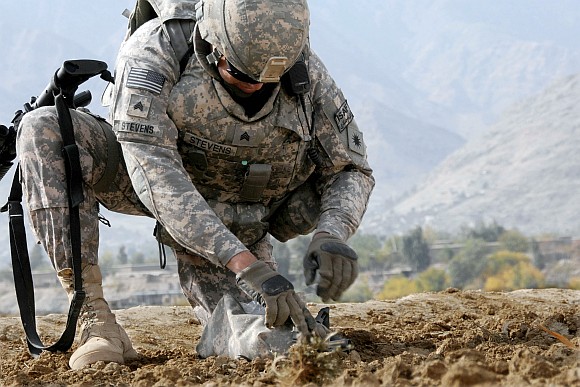
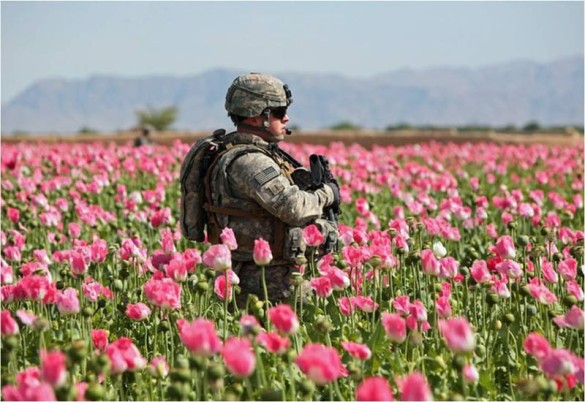
Sgt. Jason Stevens, a horticulturist with the California Army National Guard's 40th Infantry Division Agribusiness Development Team, gathers a soil sample from a field alongside the main road in Marawara, Afghanistan, Nov. 23, 2009. The ADT stopped in Marawara to meet with local farmers about their crop output and farming in the area, as well as to gather soil samples to learn how crop production might be increased in the area.

If wars could be won through slick advertising, no one would be better qualified to become the US commander in Afghanistan than General David Petraeus.

This is how he recently encapsulated his wisdom on counterinsurgency:

We have learned above all that, in campaigns such as those in Iraq or Afghanistan, the human terrain is the decisive terrain. We have to understand the people, their culture, their social structures and how systems to support them are supposed to work — and how they do work. And our most important tasks have to be to secure and to serve the people, as well as to respect them and to facilitate the provision of basic services, the establishment of local governance and the revival of local economies.

That’s a fine wish list — and to be fair, Petraeus makes no claims about the success of the US military in accomplishing these aims. Indeed, he concedes that success in the war is likely to go to whichever side is swifter to learn and adapt.

It might not quite rise to the level of being a law of physics, but the capacity for massive organizations to swiftly learn and adapt is about as great as the ability of oil tankers to make sudden U-turns. It doesn’t matter who’s in charge or how gifted he might be in charming the US Congress.

But Petraeus’ problems run deeper than the structural limitations of the military. As Andrew Bacevich makes clear, the US military is now suffering the corrupting effect of endless war. Far from seeing Gen Stanley McChrystal’s recently revealed contempt for civilian command as exceptional, Bacevich sees strong indications that the problem is systemic.

In the seemingly endless wars of the post-Sept. 11 era, a military that has demonstrated remarkable durability now shows signs of coming undone at the top. The officer corps is losing its bearings.

Americans might do well to contemplate a famous warning issued by another frustrated commander from a much earlier age.

“We had been told, on leaving our native soil,” wrote the centurion Marcus Flavius to a cousin back in Rome, “that we were going to defend the sacred rights conferred on us by so many of our citizens [and to aid] populations in need of our assistance and our civilization.” For such a cause, he and his comrades had willingly offered to “shed our quota of blood, to sacrifice our youth and our hopes.” Yet the news from the homeland was disconcerting: The capital was seemingly rife with factions, treachery and petty politics. “Make haste,” Marcus Flavius continued, “and tell me that our fellow citizens understand us, support us and protect us as we ourselves are protecting the glory of the empire.”

“If it should be otherwise, if we should have to leave our bleached bones on these desert sands in vain, then beware of the anger of the legions!”

Stanley McChrystal is no Marcus Flavius, lacking the Roman’s eloquence, among other things. Yet in ending his military career on such an ignominious note, he has, however clumsily, issued a warning that deserves our attention.

The responsibility facing the American people is clear. They need to reclaim ownership of their army. They need to give their soldiers respite, by insisting that Washington abandon its de facto policy of perpetual war. Or, alternatively, the United States should become a nation truly “at” war, with all that implies in terms of civic obligation, fiscal policies and domestic priorities. Should the people choose neither course — and thereby subject their troops to continuing abuse — the damage to the army and to American democracy will be severe.

Whether for an individual or an nation, change often hinges on reaching a point where the status quo is intolerable.

Over the last decade, perpetual war, far from becoming less tolerable has on the contrary become easier to ignore. It is the backdrop to normalcy — just like climate change — in a culture that barely has any sense of gravity.

Facebooktwittermail

Risk-free killing and the fear of death

There was an age when those afraid of dying knew they should, if they could, stay away from war. They could instead, if so inclined, read about war and fantasize about battlefield heroics from the comfort of an armchair. Nowadays, America’s newest class of warriors enjoy the same comfort with as little risk.

Tom Engelhardt writes:

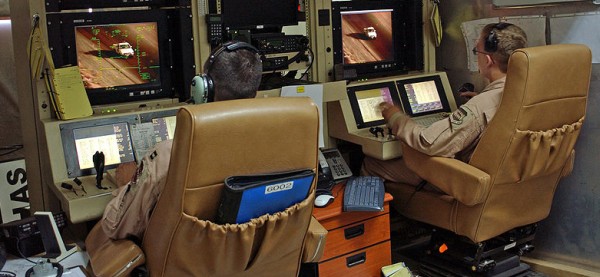
The drone is our latest wonder weapon and a bragging point in a set of wars where there has been little enough to brag about.

CIA director Leon Panetta has, for instance, called the Agency’s drones flying over Pakistan “the only game in town” when it comes to destroying al-Qaeda; a typically anonymous U.S. official in a Washington Post report claims of drone missile attacks, “We’re talking about precision unsurpassed in the history of warfare”; or as Gordon Johnson of the Pentagon’s Joint Forces Command told author Peter Singer, speaking of the glories of drones: “They don’t get hungry. They are not afraid. They don’t forget their orders. They don’t care if the guy next to them has been shot. Will they do a better job than humans? Yes.”

Seven thousand of them, the vast majority surveillance varieties, are reportedly already being operated by the military, and that’s before swarms of “mini-drones” come on line. Our American world is being redefined accordingly.

In February, Greg Jaffe of the Washington Post caught something of this process when he spent time with Colonel Eric Mathewson, perhaps the most experienced Air Force officer in drone operations and on the verge of retirement. Mathewson, reported Jaffe, was trying to come up with an appropriately new definition of battlefield “valor” — a necessity for most combat award citations — to fit our latest corps of pilots at their video consoles. “Valor to me is not risking your life,” the colonel told the reporter. “Valor is doing what is right. Valor is about your motivations and the ends that you seek. It is doing what is right for the right reasons. That to me is valor.”

There is a simple calculus upon which American warfare depends: the fewer Americans get killed, the longer the war can continue.

Maimed Americans don’t count. As for dead or maimed non-Americans, they are a variable part of the calculus, problematic or not depending on the circumstances.

The Pentagon’s love of the drone is Washington’s dread of the dead — let’s not pretend that valor has any place in this equation.

When through the press of a button a soldier in an air-conditioned office rains down death and destruction thousands of miles away, whatever military virtues he might possess, there’s no reason to assume they include bravery. Indeed, the risk-free killing of remote warfare is really the most cowardly form of combat, far removed as it is from battlefields that demand courage because the killers risk being killed.

In Shakespeare’s Henry V, as the Battle of Agincourt is about to commence, the king addresses his men — “We few, we happy few, we band of brothers” — heavily outnumbered by the French and facing the risk of imminent slaughter.

Henry — a king who fights with his men and doesn’t simply issue commands — declares:

… he which hath no stomach to this fight,
Let him depart; his passport shall be made,
And crowns for convoy put into his purse;
We would not die in that man’s company
That fears his fellowship to die with us.

To the extent that there is a noble dimension to warfare it is this: that those willing to kill are also willing to die. Those taking the lives of others do so knowing that just as easily they could lose their own.

The technological advance of war has broken this equation and broken it so thoroughly that not only does the new class of drone-armed killers face no risk of being killed; they may not even lose any sleep.

Facebooktwittermail

Was McChrystal ready to get pushed out?

The problem with owning a military strategy the way Gen Stanley McChrystal owned the counterinsurgency strategy at the center of the war in Afghanistan, is that it’s hard to admit it’s not working. It might be easier just to get fired.

Are we really supposed to believe that McChrystal knew so little about journalism or the magazine that he couldn’t have anticipated what kind of material would end up in his Rolling Stone profile? And more to the point, is it conceivable that another story from just two years ago somehow escaped his attention: the Esquire profile of Admiral William Fallon that led to his swift resignation?

On some level, most indiscretions can be seen as a loss of faith.

Meanwhile, in a short follow up to profile that toppled McChrystal, Michael Hastings writes at Rolling Stone:

President Obama, in announcing the replacement of Gen. Stanley McChrystal moments ago, sought to reassure the American people about the war in Afghanistan. “This is a change in personnel,” he declared, “but not a change in policy.”

That’s precisely the problem.

Changing generals isn’t likely to resolve the real trouble in Afghanistan: the fundamental flaws in the U.S. strategy of counterinsurgency.

So why did the president pick David Petraeus, the most political — and media-savvy — general of his generation, to replace McChrystal? Petraeus makes sense. He’s considered the hero of Iraq, and he has the public’s trust. He won’t be caught dead calling the offensive in Marja a “bleeding ulcer,” as McChrystal did. His appointment neutralizes him as a potential (though highly unlikely) political rival for 2012. He literally wrote the book on counterinsurgency, drafting the Army field manual on the U.S. strategy that is being pursued in Afghanistan. Above all, he is a master at crafting a narrative that Americans are eager to hear. He has almost single-handedly convinced many Washington insiders that his “surge” in Iraq resulted in some kind of major victory in Mesopotamia — a notion that is right up there with thinking that Pizza Hut has good pizza.

Here is the narrative we’re about to be sold: Things will be tough in Afghanistan. It’s going to get worse before it gets better. But eventually, with good old American perseverance, violence will drop (fingers crossed). When that happens, U.S. soldiers will stop dying in large numbers — and Americans will stop paying attention in large numbers.

Thomas Barnett, whose Esquire profile led to Admiral Fallon’s undoing, suggests that Petraeus will now have a bigger say in the conduct of the war than does his own commander in chief:

If Petraeus says the strategy needs more time, then Obama’s running for re-election as a wartime president. Period. There’s just no way that Obama can overrule Petraeus on this one without wounding himself politically. McChrystal had been signaling that Obama’s summer 2011 deadline to begin withdrawing combat troops was too optimistic. Expect Petraeus to press that case — however subtly — from day one.

Facebooktwittermail

McChrystal gets the boot

I guess they just couldn’t figure out the seating chart for this morning’s meeting of the national security team in the Situation Room.

Have McChrystal sit between Gen “Clown” Jones and Richard “Wounded Animal” Holbrooke?

Instead, after meeting President Obama for 30 minutes, McChrystal returned to his home in Ft. McNair, Washington, D.C. He is being replaced by Gen David Petraeus.

The Wall Street Journal reports:

The decision to put Gen. Petraeus in command sends a signal that the president stands behind the counterinsurgency tactics pushed hard by Gen. McChrystal and championed by Gen. Petraeus.

Mr. Obama said his acceptance of Gen. McChrystal’s recommendation didn’t reflect a disagreement about strategy or personal insult. “We are in full agreement about our strategy,” he said Wednesday, expressing “great admiration” for the general.

“But war is bigger than any one man,” Mr. Obama said. He said the change was necessary to maintain a “unity of effort” in Afghanistan. “I welcome debate among my team, but I won’t tolerate division.”

As for sentiment among US troops on the ground, that might have been best summed up by a US Marine at Combat Outpost Hanson in Marjah:

A lance corporal from Denver explains that political news tends to trickle down slowly among Marines with limited access to the Internet, newspapers and other creature comforts readily available at rear bases. “Half of these guys don’t even know why we’re here in the first place,” he said with a laugh.

Facebooktwittermail

America’s war and its illusive heroes

The Russian mystic, Gurdjieff, is said to have advised that if a spiritual seeker wants to guard his faith, he should avoid getting too close to a saint. Perfection can rarely withstand close scrutiny.

The same can be said of war heroes.

The legend of General Stanley McChrystal has been years in the making, but even now, at a moment when he has in his own words “compromised the mission,” there are aspects of his character that for the very same reasons that they cause him trouble also burnish his image as an American hero — the kind captured in the US Army’s ridiculous (and short-lived) slogan “Army of One.”

In a passage of his Rolling Stone profile, Michael Hastings recounts a scene where McChrystal and his badboy comrades let it all hang out during a fraternity-style rebellion. They are up against the stiff cultural challenges presented by Paris nightlife with its “Gucci” restaurants — “Gucci” in McChrystal’s mind is apparently an all-purpose metaphor for what to his eye are Europe’s aristocratic affectations.

The night after his speech in Paris, McChrystal and his staff head to Kitty O’Shea’s, an Irish pub catering to tourists, around the corner from the hotel. His wife, Annie, has joined him for a rare visit: Since the Iraq War began in 2003, she has seen her husband less than 30 days a year. Though it is his and Annie’s 33rd wedding anniversary, McChrystal has invited his inner circle along for dinner and drinks at the “least Gucci” place his staff could find. His wife isn’t surprised. “He once took me to a Jack in the Box when I was dressed in formalwear,” she says with a laugh.

The general’s staff is a handpicked collection of killers, spies, geniuses, patriots, political operators and outright maniacs. There’s a former head of British Special Forces, two Navy Seals, an Afghan Special Forces commando, a lawyer, two fighter pilots and at least two dozen combat veterans and counterinsurgency experts. They jokingly refer to themselves as Team America, taking the name from the South Park-esque sendup of military cluelessness, and they pride themselves on their can-do attitude and their disdain for authority. After arriving in Kabul last summer, Team America set about changing the culture of the International Security Assistance Force, as the NATO-led mission is known. (U.S. soldiers had taken to deriding ISAF as short for “I Suck at Fighting” or “In Sandals and Flip-Flops.”) McChrystal banned alcohol on base, kicked out Burger King and other symbols of American excess, expanded the morning briefing to include thousands of officers and refashioned the command center into a Situational Awareness Room, a free-flowing information hub modeled after Mayor Mike Bloomberg’s offices in New York. He also set a manic pace for his staff, becoming legendary for sleeping four hours a night, running seven miles each morning, and eating one meal a day. (In the month I spend around the general, I witness him eating only once.) It’s a kind of superhuman narrative that has built up around him, a staple in almost every media profile, as if the ability to go without sleep and food translates into the possibility of a man single-handedly winning the war.

By midnight at Kitty O’Shea’s, much of Team America is completely shitfaced. Two officers do an Irish jig mixed with steps from a traditional Afghan wedding dance, while McChrystal’s top advisers lock arms and sing a slurred song of their own invention. “Afghanistan!” they bellow. “Afghanistan!” They call it their Afghanistan song.

McChrystal steps away from the circle, observing his team. “All these men,” he tells me. “I’d die for them. And they’d die for me.”

Bands of brothers always impress each other with their willingness to engage in seemingly heroic acts of self-sacrifice. They also often allow the power of solidarity to dissolve the strength of individual judgement.

McChrystal may well suffer the affliction of every cult leader: that the mutual psychological reinforcement provided by a closed social system inside which one individual becomes idealized, is that the guru becomes blind to his own failings. In turn these failings become amplified because they engender no social penalty among a circle of uncritical admirers.

President Obama now has a problem. Interestingly, the most useful lifeline he’s been presented comes from the Afghan government which sees McChrystal as an ally. President Karzai’s spokesman Waheed Omer says that at this critical juncture “we hope that there is not a change of leadership in the international forces here in Afghanistan.”

If Obama wants to creatively change the subject then he could turn it into an opportunity to implement not merely a structural or strategic adjustment to a war that’s going nowhere. He could initiate a paradigm shift.

Just suppose the war in Afghanistan was approached from a radically new perspective: as though Afghanistan and its people matter.

It’s Afghanistan, stupid — not the war.

Change the subject from the war to Afghanistan and McChrystal is no longer this gigantic figure.

The central issue should be: what will best serve the interests of Afghanistan?

Any American who asks that question should in the very asking, have the humility and intelligence to recognize that, by definition, this is not a question an American can answer. What we can reasonably hope is that if we are ultimately seen as having served this troubled nation’s greater interests, this will also serve our own interests. The key, though, is to abandon the missionary’s conceit: that we know better.

The lesson of a decade of war should be that when it comes to Afghanistan we have learned next to nothing.

As Winston Churchill said: “Americans can always be counted on to do the right thing… after they have exhausted all other possibilities.”

Facebooktwittermail

Maverick McChrystal out of line again

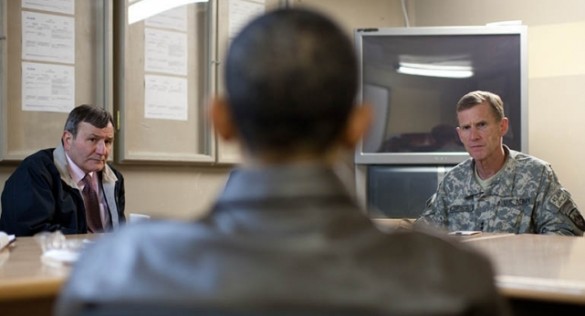
Gen Stanley McChrystal looks bemused at the sight of President Obama in a bomber jacket during a surprise visit to Afghanistan in March, 2010.

A Rolling Stone profile of Gen Stanley McChrystal due out on Friday “was a mistake reflecting poor judgment and it should have never happened,” the commander of US forces in Afghanistan now says.

It was a mistake to say what he and his staff said, or it was a mistake to make these remarks in the presence of a journalist?

The incident reveals the ambivalence Americans feel when it comes to the institutional power at the center of American democracy. Whatever keeps the wheels of Washington working smoothly, it isn’t candor.

Coming as I do from a country that has a real and ancient monarchy (for which I have little respect), during twenty-some years in the United States I’ve always viewed this country’s republican credentials with a certain measure of skepticism.

If at its conception America cast aside regal authority because of an unambiguous faith in the power of the people, why is it that so many Americans have such a gooey-eyed fascination with British royalty? Why the obsession with another form of royalty: celebrity? Why, in a supposedly egalitarian society, is such a high value attached to very visible displays of social status?

Americans seem to have had less interest in completely abandoning rule by a monarch than in modifying regal power and repackaging it in the quasi-regal institution of the presidency.

Having been crowned, a president always remains a president — even once out of office. He lives in a little palace, can never move around without being surrounded by a huge entourage of somewhat venal and sycophantic characters. And as in all forms of palace politics, those individuals who have wormed their way close to the center of power will do whatever they can to protect the status of the institution as they make frequent expressions of obeisance to the king-president.

But the concentration of power always involves the consolidation of power and so a president, just like any king, always needs to be on his guard, aware that one of his dukes or generals might pose a challenge.

Enter, Gen Stanley McChrystal.

McChrystal isn’t trying to stage a coup but he’s a repeat offender when it comes to upholding the most important principle in regal politics: never undermine the authority of the monarch or his highest officers.

National Security Adviser, Gen James Jones is a “clown.” Senior envoy Richard Holbrooke is a “wounded animal.” Joe Biden is “Bite me.” This is not language that can be uttered louder than a whisper in any palace.

As McChrystal heads to Washington for yet another dressing down, there’s one thing we can be sure of: President Obama won’t be wearing a bomber jacket when he lectures his top general. He’ll simply relying on the power of his throne — the Oval Office.

In his Rolling Stone profile of McChrystal, Michael Hastings writes:

The general prides himself on being sharper and ballsier than anyone else, but his brashness comes with a price: Although McChrystal has been in charge of the war for only a year, in that short time he has managed to piss off almost everyone with a stake in the conflict. Last fall, during the question-and-answer session following a speech he gave in London, McChrystal dismissed the counterterrorism strategy being advocated by Vice President Joe Biden as “shortsighted,” saying it would lead to a state of “Chaos-istan.” The remarks earned him a smackdown from the president himself, who summoned the general to a terse private meeting aboard Air Force One. The message to McChrystal seemed clear: Shut the fuck up, and keep a lower profile

Now, flipping through printout cards of his speech in Paris [in mid-April], McChrystal wonders aloud what Biden question he might get today, and how he should respond. “I never know what’s going to pop out until I’m up there, that’s the problem,” he says. Then, unable to help themselves, he and his staff imagine the general dismissing the vice president with a good one-liner.

“Are you asking about Vice President Biden?” McChrystal says with a laugh. “Who’s that?”

“Biden?” suggests a top adviser. “Did you say: Bite Me?”

When Barack Obama entered the Oval Office, he immediately set out to deliver on his most important campaign promise on foreign policy: to refocus the war in Afghanistan on what led us to invade in the first place. “I want the American people to understand,” he announced in March 2009. “We have a clear and focused goal: to disrupt, dismantle and defeat Al Qaeda in Pakistan and Afghanistan.” He ordered another 21,000 troops to Kabul, the largest increase since the war began in 2001. Taking the advice of both the Pentagon and the Joint Chiefs of Staff, he also fired Gen. David McKiernan – then the U.S. and NATO commander in Afghanistan – and replaced him with a man he didn’t know and had met only briefly: Gen. Stanley McChrystal. It was the first time a top general had been relieved from duty during wartime in more than 50 years, since Harry Truman fired Gen. Douglas MacArthur at the height of the Korean War.

Even though he had voted for Obama, McChrystal and his new commander in chief failed from the outset to connect. The general first encountered Obama a week after he took office, when the president met with a dozen senior military officials in a room at the Pentagon known as the Tank. According to sources familiar with the meeting, McChrystal thought Obama looked “uncomfortable and intimidated” by the roomful of military brass. Their first one-on-one meeting took place in the Oval Office four months later, after McChrystal got the Afghanistan job, and it didn’t go much better. “It was a 10-minute photo op,” says an adviser to McChrystal. “Obama clearly didn’t know anything about him, who he was. Here’s the guy who’s going to run his fucking war, but he didn’t seem very engaged. The Boss was pretty disappointed.”

Facebooktwittermail

Floundering in Afghanistan

Last fall, President Obama faced criticism in the early months of his presidency during his exhaustive strategic review of the war in Afghanistan. The review had become so drawn out that his detractors claimed it presented an image of indecisiveness. Obama’s defenders responded by saying this was a process of careful and thorough deliberation from a commander in chief who, unlike his predecessor, had the interest and ability to think things through. If Bush was the decider, Obama was the studious deliberator.

The conclusion of those deliberations was less than impressive. Obama took the only idea that for Bush had acquired some brand value, on the assumption it could sell the war in Afghanistan just as it had helped rejuvenate the saleability of the war in Iraq. Obama followed what has become an American presidential tradition, which is to say, when you don’t know where you’re heading, move forward. Escalate the war — but give escalation a palatable name with the Viagra of American war-making: a surge.

This time around, with no counterpart to Iraq’s Sons of the Awakening offering a helping hand, the Pentagon’s latest efforts to prove the war is not being lost have been so unconvincing that the best face the US can now present is to say, “nobody is winning.”

Tom Engelhardt writes:

To all appearances, when it comes to the administration’s two South Asian wars, one open, one more hidden, Obama and his top officials are flailing around. They are evidently trying whatever comes to mind in much the manner of the oil company BP as it repeatedly fails to cap a demolished oil well 5,000 feet under the waves in the Gulf of Mexico. In a sense, when it comes to Washington’s ability to control the situation, Pakistan and Afghanistan might as well be 5,000 feet underwater. Like BP, Obama’s officials, military and civilian, seem to be operating in the dark, using unmanned robotic vehicles. And as in the Gulf, after each new failure, the destruction only spreads.

For all the policy reviews and shuttling officials, the surging troops, extra private contractors, and new bases, Obama’s wars are worsening. Lacking is any coherent regional policy or semblance of real strategy — counterinsurgency being only a method of fighting and a set of tactics for doing so. In place of strategic coherence there is just one knee-jerk response: escalation. As unexpected events grip the Obama administration by the throat, its officials increasingly act as if further escalation were their only choice, their fated choice.

This response is eerily familiar. It permeated Washington’s mentality in the Vietnam War years. In fact, one of the strangest aspects of that war was the way America’s leaders — including President Lyndon Johnson — felt increasingly helpless and hopeless even as they committed themselves to further steps up the ladder of escalation.

The hallmark of a floundering wartime leader is the extent to which whatever he says begins to ring hollow. Jeremy Scahill picked up on one such declaration last week.

During his White House press conference Wednesday with Afghan President Hamid Karzai, President Obama addressed the issue of civilian deaths caused by US operations in Afghanistan. “I take no pleasure in hearing a report that a civilian has been killed,” said Obama. “That’s not why I ran for president, that’s not why I’m Commander in Chief.”

“Let me be very clear about what I told President Karazi: When there is a civilian casualty, that is not just a political problem for me. I am ultimately accountable, just as Gen. McChrystal is accountable, for somebody who is not on the battlefield who got killed,” said Obama.

That statement is quite remarkable for a number of reasons, not the least of which is that it is not true. How are President Obama or Gen. McChrystal accountable? Afghans have little, if any, recourse for civilian deaths. They cannot press their case in international courts because the US doesn’t recognize an International Criminal Court with jurisdiction over US forces, Afghan courts have not and will not be given jurisdiction and Attorney General Eric Holder has made clear that the Justice Department will not permit cases against US military officials brought by foreign victims to proceed in US courts. So, what does it mean to be accountable for civilian deaths? Public apology? Press conferences? A handful of courts martial?

Meanwhile, David Ignatius remains convinced that the administration has some kind of strategic process in operation, but with his eyes set on the endgame, he suggests:

As the White House prepares its reconciliation strategy, it should ponder the Pashtun culture that spawned the Taliban insurgency. The United States has often lacked this sense of cultural nuance, which is why we have made so many mistakes in places such as Iraq and Afghanistan.

One thing that should be obvious by now is that you don’t make much progress with Pashtun leaders by slapping them around in public. This is a culture that prizes dignity and detests humiliation. Attempts to shame people into capitulation usually backfire.

And in which culture is dignity not prized and humiliation tolerated?

Ignatius is correct in suggesting that Washington needs to understand Pashtun culture — though that recommendation might have been more timely if delivered with some force nine years ago. But America’s problem consists equally in a lack of cultural self-awareness.

In a culture so deeply molded by what I will call the advertising gestalt, America’s most crippling deficit is a pervasive lack of interest in distinguishing between appearance and reality. Military campaigns have been turned into marketing campaigns viewed with the uncritical attention that attends most commercial communication.

We’ve got a government in a box, ready to roll in,” General Stanley McChrystal said on the eve of the Marja offensive. Billed as a “clear and hold” operation, the combat phase was declared a success at the end of February.

As has so often proved to be the case, the American declaration of victory turned out to be premature, McChrystal’s government in a box never got delivered and most of the clearing now taking place is by families clearing out of the battlefield.

Carlotta Gall, reporting from Lashkar Gah, says:

Marja residents arriving here last week, many looking bleak and shell-shocked, said civilians had been trapped by the fighting, running a gantlet of mines laid by insurgents and firefights around government and coalition positions. The pervasive Taliban presence forbids them from having any contact with or taking assistance from the government or coalition forces.

“People are leaving; you see 10 to 20 families each day on the road who are leaving Marja due to insecurity,” said a farmer, Abdul Rahman, 52, who was traveling on his own. “It is now hard to live there in this situation.”

One farmer who was loading his family and belongings onto a tractor-trailer on the edge of Lashkar Gah last week said he had abandoned his whole livelihood in Sistan, Marja, as soon as the harvest, a poor one this year, was done.

“Every day they were fighting and shelling,” said the farmer, Abdul Malook Aka, 55. “We do not feel secure in the village and we decided to leave. Security is getting worse day by day.”

“We thought security would be improving,” he said.

Those who remain in Marja voiced similar complaints in dozens of interviews and repeated visits to Marja over the last month.

“I am sure if I stay in Marja I will be killed one day either by Taliban or the Americans,” said Mir Hamza, 40, a farmer from Loye Charah.

Victory over the Taliban in Marja was supposed to be a prelude to forcing the insurgency out of its largest stronghold, Kandahar. But in light of the indecisive outcome of the earlier operation, US officials are back-pedaling hard in an effort to diminish expectations about what the much larger operation is meant to accomplish. And as they do so, the Taliban have mounted an assassination campaign which guarantees that this time around neither McChrystal nor anyone else will be making any idle promises about early success.

The Los Angeles Times reports:

In recent weeks, Western military officials in Afghanistan have stopped referring to the Kandahar campaign as an offensive.

“What we plan on is mainly an Afghan, politically led process … where you have slowly incremental changes of security, which enables governance and development,” said Army Col. Wayne Shanks, the chief public affairs officer for NATO’s International Security Assistance Force. “So this is not going to be anything that is immediate or quick.”

Such talk leaves many Kandaharis baffled. Rangina Hamidi, who runs a handicraft business that employs Afghan village women in Kandahar province, said it was difficult for local people to understand why the North Atlantic Treaty Organization began talking publicly months ago about Kandahar being the next big target for Western forces.

“Most of the women I work with are illiterate and hardly ever leave their homes — they are not involved in public life,” Hamidi said. “But even these women are saying, ‘If you are going to do an offensive, why are you going to announce it in advance?'”

As U.S. officials seek to emphasize the campaign’s political goals rather than its military ones, insurgent assassins are systematically targeting precisely the kind of people on whom Western planners are relying to help woo the populace to the side of the Afghan government: tribal elders, municipal employees, security officials, aid workers and others.

Facebooktwittermail

Biological warfare in Afghanistan?

Agence France Presse reports:

A mystery disease infecting opium poppies in Afghanistan could cut this year’s illicit crop in some areas by up to 70 percent, an official said Sunday.

The disease has led authorities to expect a “significant” reduction in opium production this year, with the UN Office on Drugs and Crime (UNODC) saying this week that the output could fall by up to 25 percent.

Daud Daud, Afghanistan’s deputy interior minister for counter-narcotics, said that “in some areas up to 70 percent of the crops have been destroyed” by the disease.

“We’ll have a significant reduction” in the opium production “this year,” Daud said, refusing to give further details, saying that an overall survey of this year’s output was still under way.

Afghanistan produces more than 90 percent of the world’s opium, the raw material for making heroin, mainly in the provinces of Helmand and Kandahar in the south and Farah in southwest.

“Interestingly there is a natural disease that is infecting opium in five provinces,” said Daud.

He could not confirm what disease had infected the crops but blamed it on an insect infestation. He said the disease was being investigated in government laboratories.

Antonio Maria Costa, the head of UNODC, has said the disease was a fungus, while some farmers have reportedly blamed the US and Britain for spraying their crops with a chemical in an effort to eradicate opium.

It’s hardly surprising that locals suspect they might be victims of some kind of foreign intrigue as they watch their lucrative crop wither but in this instance one doesn’t have to believe in conspiracy theories to have some doubts.

In October 2000, BBC television reported that a former biological warfare factory was being used in a British-funded project aimed at stemming heroin production.

Scientists in the plant in Uzbekistan are trying to perfect the Pleospora fungus that kills the opium poppy – source of the world’s illegal heroin supply.

But the research work may already be running out of control. Mike Greaves, the British scientist who is the secret project’s expert consultant, admits in a rare interview that he cannot be certain the fungus is 100% safe.

Despite this Greaves, a micro-biologist from Bristol, is convinced the fungus is a ‘sensational’ answer to the world’s heroin problem. He says: “I love the project, it’s one of the most exciting projects that I’ve been involved in.”

Professor Paul Rogers, a leading British plant pathologist warns: “The fungus sounds like a silver bullet but it could easily become a poisoned chalice. Once you develop a technology to spread plant diseases intentionally you are developing a technology which could easily be misused by bad people against legitimate food crops.”

Facebooktwittermail

U.S. is still using private spy ring, despite doubts

The New York Times reports on a secret network of private spies who have produced hundreds of reports from deep inside Afghanistan and Pakistan, despite concerns among some in the military about the legality of the operation.

Since the Sept. 11, 2001, attacks, the Pentagon has used broad interpretations of its authorities to expand military intelligence operations, including sending Special Operations troops on clandestine missions far from declared war zones. These missions have raised concerns in Washington that the Pentagon is running de facto covert actions without proper White House authority and with little oversight from the elaborate system of Congressional committees and internal controls intended to prevent abuses in intelligence gathering.

The officials say the contractors’ reports are delivered via an encrypted e-mail service to a “fusion cell,” located at the military base at Kabul International Airport. There, they are fed into classified military computer networks, then used for future military operations or intelligence reports.

To skirt military restrictions on intelligence gathering, information the contractors gather in eastern Afghanistan and Pakistan’s tribal areas is specifically labeled “atmospheric collection”: information about the workings of militant groups in Afghanistan and Pakistan or about Afghan tribal structures. The boundaries separating “atmospherics” from what spies gather is murky. It is generally considered illegal for the military to run organized operations aimed at penetrating enemy organizations with covert agents.

But defense officials with knowledge of the program said that contractors themselves regarded the contract as permission to spy. Several weeks ago, one of the contractors reported on Taliban militants massing near American military bases east of Kandahar. Not long afterward, Apache gunships arrived at the scene to disperse and kill the militants.

The web of private businesses working under the Lockheed contract include Strategic Influence Alternatives, American International Security Corporation and International Media Ventures, a communications company based in St. Petersburg, Fla., with Czech ownership.

One of the companies employs a network of Americans, Afghans and Pakistanis run by Duane Clarridge, a C.I.A. veteran who became famous for his role in the Iran-Contra scandal.

Facebooktwittermail

Obama’s torture loophole

What’s the difference between a US-military-run detention facility and an intelligence gathering facility? For one thing, Red Cross officials are being prevented from seeing how prisoners are treated when held at Bagram’s intelligence gathering facility. Is that so that they can be tortured in secret?

Two days after taking office, Barack Obama signed an executive order banning torture. The era of secret detention facilities and CIA-administered waterboarding were over. Or so we thought.

Earlier this week, the BBC reported:

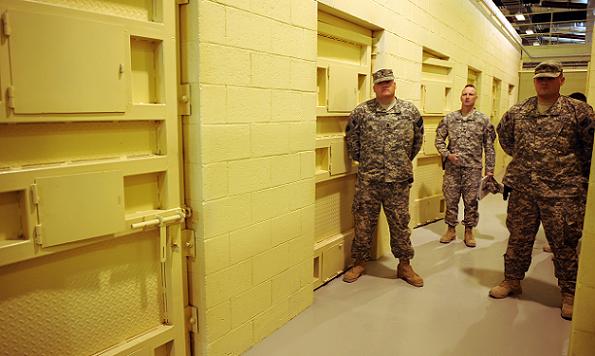
The US airbase at Bagram in Afghanistan contains a facility for detainees that is distinct from its main prison, the Red Cross has confirmed to the BBC.

Nine former prisoners have told the BBC that they were held in a separate building, and subjected to abuse.

The US military says the main prison, now called the Detention Facility in Parwan, is the only detention facility on the base.

However, it has said it will look into the abuse allegations made to the BBC.

The International Committee of the Red Cross (ICRC) said that since August 2009 US authorities have been notifying it of names of detained people in a separate structure at Bagram.

“The ICRC is being notified by the US authorities of detained people within 14 days of their arrest,” a Red Cross spokesman said.

“This has been routine practice since August 2009 and is a development welcomed by the ICRC.”

The spokesman was responding to a question from the BBC about the existence of the facility, referred to by many former prisoners as the Tor Jail, which translates as “black jail”.

Prisoners say they have been kept in isolation in cold cells and subjected to sleep deprivation, but it turns out the CIA’s hands are clean — this time it’s the Defense Intelligence Agency at work. And as for the fact that the Red Cross has been barred from entering this facility, that’s because it isn’t being called a detention facility.

Marc Ambinder reports:

Defense officials said that the White House is kept appraised of the methods used by interrogators at the site. The reason why the Red Cross hasn’t been invited to tour it, officials said, was because the U.S. does not believe it to be a detention facility, classifying it instead as an intelligence gathering facility.

A Defense official said that the agency’s inspector general had launched an internal investigation into reports in the Washington Post that several teenagers were beaten by the interrogators, but [Pentagon spokesman, Bryan] Whitman disputes this.

When the Obama Administration took over, it forbade the DIA from keeping prisoners in the facility longer than 30 days, although it is not clear how that dictum is enforced. It is also not clear how much Congress knows about the DIA’s interrogation procedures, which have largely escaped public scrutiny.

Facebooktwittermail

Is Obama moving to escalate the war in Pakistan?

The United States is at war in Pakistan. It will be up to historians to decide when this war began.

“Drone Strikes Pound West Pakistan” says the headline above a brief report in the New York Times. After the CIA fired 18 missiles resulting in at least 14 deaths on Tuesday, the operation was described merely as “a continuation of the air campaign to degrade the capabilities of Al Qaeda, the Pakistani Taliban and the Afghan Taliban fighters now working together in North Waziristan” (my emphasis).

“Continuation” is another name for escalation when developments that should prompt alarm have already been inoculated with the name “necessity.”

A course of action that if it initiated by George Bush might have been seen as an expression of his intemperate nature, when pursued by no-drama Obama is instead billed as a judicious expansion in the use of force.

But the danger of escalation — now as always — is that the seemingly carefully calibrated expansion of a war has unintended and far-reaching consequences. Only after it’s too late do we learn that the calibration rested on nothing more than wishful thinking.

The logic behind the apparent necessity of expanding the war into Pakistan has been evident ever since the war in Afghanistan began. For Bush, the dangers implicit in crossing the Durand Line seemed to provoke fear, but his successor seems intent on showing he lacks such trepidation. North Waziristan is where Obama gets to prove that he has the steel that Bush lacked — or so the script says.

In this context the Times Square attempted bombing has acquired particular significance. If the lack of a credible endgame in Afghanistan would make it even more difficult to justify expanding the war, then a scare in New York could be useful in prompting a renewed sense of urgency.

In Pakistan’s Dawn newspaper today, Rafia Zakaria writes:

Security experts in Washington have since begun to call Shahzad’s bombing attempt a “game changer” in the war against terror and have been signalling the possibility of an incursion of US forces into Pakistani territory. Several factors point to the fact that such an option is indeed being considered by the Obama administration and Pentagon officials. First, conservative lawmakers on Capitol Hill have long been sounding alarm bells asking for a wider presence in Pakistan to accomplish the goals of the war on terror. Recent hearings held on Capitol Hill have focused on groups such as Jaish-i-Muhammad and Lashkar-i-Taiba that do not operate in the areas currently being targeted by aerial drone attacks.

In a hearing held in March, several US congressmen noted that the Lashkar “had put the world on notice that they intend to escalate the carnage and take it worldwide”. Other analysts have repeatedly pointed to the necessity of expanding drone strikes into Quetta to target the Quetta shura which supposedly runs the Taliban operations. While Shahzad’s connections are not currently traced to groups other than the Taliban, the fact that he spent time in Pakistan bolsters the position of those who insist that a wider military presence in Pakistan is crucial to eliminating the threat to the American homeland.

Second, the problems faced by the highly publicised US/Nato initiatives in Marja and Kandahar in Afghanistan have created a political demand for a more decisive endgame in the region. In the footsteps of the Marja offensive in early April, The New York Times reported that many of the gains made in the area by the US Marines’ costly offensive had largely been reversed and many Taliban had moved back into the area. The Kandahar offensive due to start soon has also been the subject of lowered expectations, with experts saying that the easy absorption of Taliban fighters into the local population and the lack of visible centres of Taliban control make it difficult to win a decisive victory in the area.

The reason why the failure of both offensives — one yet to begin — is relevant to the Pakistan equation is simple: with the beginning of a US withdrawal already announced for 2011, there is immense political pressure on the Obama administration to produce some semblance of victory. The expansion of the Afghanistan war into Pakistani territory would not only be a culmination of the Obama campaign’s slogans of Pakistan being the real problem, it would also provide a visible endgame to the vexing and increasingly intractable issue of whether the war in Afghanistan has really eliminated global terrorism.

If Obama is now a victim of his own campaign logic — the repetition of half-baked slogans must surely be as harmful to those who utter them as it is to those who hear them — this logic is nevertheless looking less persuasive outside the administration.

Noah Shachtman notes that the skepticism once only voiced by counter-insurgency wonks like David Kilcullen and Andrew Exum has now percolated right into the mainstream media.

“If you go into Pakistan and talk to college kids, which is what we did, these drone attacks are feeding this narrative: this is what we [Americans] are aiming to do. We’re aiming to kill Muslims,” Leslie Stahl said today on MSNBC’s Morning Joe.

“Let’s say China was launching drone attacks on Idaho, we would be pretty angry too. We are launching attacking against a people were not at war with, officially,” Joe Scarborough responded. “I would rather us go after the terrorists — individual terrorists — drag ‘em out, interrogate ‘em, get information — instead of dropping bombs that kill four year-old little girls. That dismember grandmoms that happen to be in the family compound. That seems immoral.”

The decision to dramatically escalate the drone war was done behind closed doors, with no public debate about whether the strikes were the best way to smash the jihadist networks based in Pakistan’s tribal wildlands. Perhaps now, we’ll have that discussion.

Visit msnbc.com for breaking news, world news, and news about the economy

Facebooktwittermail

Afghanistan: is it time to talk to the Taliban?

In The Guardian, Jonathan Steele writes:

Eight years after they were overthrown by US air power, a drumbeat is starting to sound across Afghanistan in favour of talking to the Taliban, the country’s once-hated former rulers. An idea that used to seem absurd, if not defeatist, is coming to be seen as the only credible way to end an ever-widening war. Moreover, the proposed agenda of negotiations is not a Taliban surrender, but an offer to share power in Kabul.

President Hamid Karzai and other senior Afghan politicians support the idea. So too do a growing number of foreign governments, including Britain’s – at least tentatively – now that British troops are being killed at twice the rate they were in early 2009.

Perhaps most surprisingly, even among Afghanistan’s small but determined group of woman professionals, the notion of making a deal with the ultra-conservative men who forced them into burkas and denied them the right to work outside the home is no longer anathema. A desperate desire for peace is trumping concern over human rights.

Facebooktwittermail

Pakistani intelligence officials say Taliban chief Hakimullah Mehsud is alive

The Washington Post reports:

Even by the standards of a bullet- and bomb-dodging Taliban commander, Hakimullah Mehsud has displayed notable survival skills.

The Pakistani Taliban chief was thought to have died in a leadership duel last summer, only to stage a news conference a few days later. A U.S. drone strike in January was followed by intense speculation about his fate, then statements by Pakistani intelligence officials that he was “100 percent” dead.

On Thursday, those intelligence officials circulated another message: Mehsud is alive.

Earlier reports that Mehsud was dead — repeated by U.S. officials — were hailed as a potentially fatal blow to the Pakistani Taliban, a loose network of border-based militants that has carried out a cascade of suicide attacks in recent years. News of his survival again underscored the staying power of a group that Pakistan’s military has targeted with unprecedented force in the past year. It also has exposed blind spots within the Pakistani and U.S. intelligence services, which struggle to develop reliable information in Taliban strongholds.

Meanwhile, the Los Angeles Times reports:

A Pentagon report presented a sobering new assessment Wednesday of the Taliban-led insurgency in Afghanistan, saying that its abilities are expanding and its operations are increasing in sophistication, despite recent major offensives by U.S. forces in the militants’ heartland.

The report, requested by Congress, portrays an insurgency with deep roots and broad reach, able to withstand repeated U.S. onslaughts and to reestablish its influence, while discrediting and undermining the country’s Western-backed government.

But the Pentagon said it remained optimistic that its counter-insurgency strategy, formed after an Obama administration review last year, and its effort to peel foot soldiers away from the Taliban will show success in months to come.

Facebooktwittermail

Why the Taliban might win

Christian Science Monitor reports:

While current US counterinsurgency doctrine in Afghanistan broadly conforms with historical best practices, the Taliban enjoy a slew of advantages that historically correlate with insurgent success, according to a new study of 89 past and ongoing insurgencies worldwide.

Factors that favor the Taliban include receiving sanctuary and support in another country, learning to be more discriminating in targeting their attacks, and fighting a government that’s both weak and reliant on direct external support.

The historical trends suggest that the Achilles heel for the Taliban would be the loss of their Pakistani sanctuary, while the principal American vulnerability lies in Hamid Karzai’s anocracy, or weak, pseudodemocracy. The study, says the author, cannot be predictive, but can help the US address or exploit these vulnerabilities.

“A lot of the things being done in the current [US military] plan are along the lines of successful things we’ve seen in the study,” says Ben Connable, lead author “How Insurgencies End,” published by RAND Corp. in Washington. “The key is if the US recognizes it is working with an anocracy and recognizes the limits of that kind of government, you can work on solutions to that problem.”

Meanwhile, The Times reports:

Almost a quarter of the low-ranking Taleban commanders lured out of the insurgency in southern Afghanistan have rejoined the fight because of broken government promises and paltry rewards, a scathing report on reintegration claims.

Nato plans to spend more than $1 billion (£648 million) over the next five years tempting Taleban foot soldiers to lay down their arms.

But research by a Kabul-based thinktank warns that those efforts could make matters worse by swelling the ranks of the insurgency, exacerbating village level feuds and fuelling government corruption.

The report, titled Golden Surrender, by the independent Afghanistan Analysts Network, is highly critical of the British-backed Peace and Reconciliation Scheme (PTS), established in 2005, which it says has been left to flounder under bad leadership with neither the political nor the financial capital it required.

Facebooktwittermail

Dread surrounds Operation Hope

Jean MacKenzie writes:

It is being called Operation Omid.

The word omid means “hope” in Afghanistan’s Dari language. But, judging by the reaction of local residents, the coming U.S.-led military offensive against the Taliban in Kandahar could not be more inappropriately named.
In Kandahar, residents like Abdul Salaam, a farmer, feel more a sense of dread than hope about a military operation that is being billed as one of the largest in the war to date.

“Operation Omid will bring more insecurity, instead of peace,” said Salaam, who lives in the Maiwand district of Kandahar Province. “We have just seen that the opposition has accelerated its attacks. There are more and more explosions in the province. You cannot bring peace through war.”

Meanwhile, a report in The Sunday Times said:

The supreme leader of the Taliban, Mullah Mohammed Omar, has indicated that he and his followers may be willing to hold peace talks with western politicians.

In an interview with The Sunday Times, two of the movement’s senior Islamic scholars have relayed a message from the Quetta shura, the Taliban’s ruling council, that Mullah Omar no longer aims to rule Afghanistan. They said he was prepared to engage in “sincere and honest” talks.

A senior US military source said the remarks reflected a growing belief that a “breakthrough” was possible. “There is evidence from many intelligence sources [that] the Taliban are ready for some kind of peace process,” the source said.

Facebooktwittermail