Category Archives: war in Afghanistan

US Army researchers: Why the Kandahar offensive could backfire

At Wired, Nathan Hodge reports:

The southern Afghan province of Kandahar trusts the Taliban more than the government. And that’s according to a survey commissioned by the U.S. Army.

Kandahar is expected to be the focal point of operations for U.S. and NATO troops this summer, but a poll recently conducted by the Army’s controversial social science program, the Human Terrain System (HTS), is warning that rampant local corruption, and a lack of security, could undermine coalition efforts to win the support of the local population.

Among other things, the survey’s authors warned that a lack of confidence in the Afghan government “sets conditions for a disenfranchised population to respond either by not supporting the government due to its inability to deliver improvements in the quality of life or, worse yet, by supporting the Taliban.”

Facebooktwittermail

Fighting American wars from on high

Tom Engelhardt reflects on the detachment with which the US military, operating from a position akin to that of Olympian gods, has turned people into targets:

[I]n the cities, towns, and villages of the distant lands where Americans tend to make war, civilians die regularly and repeatedly at our hands. Each death may contain its own uniquely nightmarish details, but the overall story remains remarkably repetitious. Such “incidents” are completely predictable. Even General McChrystal, determined to “protect the population” in Afghanistan as part of his counterinsurgency war, has proven remarkably incapable of changing the nature of our style of warfare. Curtail air strikes, rein in Special Operations night attacks — none of it will, in the long run, matter. Put in a nutshell: If you arrive from the heavens, they will die.

Having watched the video of the death of the 22-year-old Reuters photographer Namir Noor-Eldeen in that July 2007 video, his father said: “At last the truth has been revealed, and I’m satisfied God revealed the truth… If such an incident took place in America, even if an animal were killed like this, what would they do?”

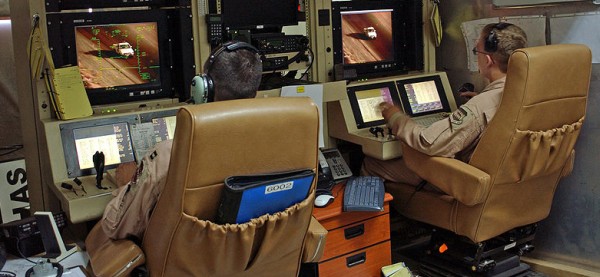
Putting aside the controversy during the 2008 presidential campaign over the hunting of wolves from helicopters in Alaska, Noor-Eldeen may not have gone far enough. For that helicopter crew, his son was indeed the wartime equivalent of a hunted animal. An article on the front page of the New York Times recently captured this perspective, however inadvertently, when, speaking of the CIA’s aerial war over Pakistan’s tribal borderlands, it described the Agency’s unmanned drones as “observing and tracking targets, then unleashing missiles on their quarry.”

“Quarry” has quite a straightforward definition: “a hunted animal; prey.” Indeed, the al-Qaeda leaders, Taliban militants, and local civilians in the region are all “prey” which, of course, makes us the predators. That the majority of drones cruising those skies 24/7 and repeatedly launching their Hellfire missiles are named “Predators” should, then, come as no surprise.

Americans are unused to being the prey in war and so essentially incapable of imagining what that actually means, day in, day out, year after year. We prefer to think of their deaths as so many accidents or mistakes — “collateral damage” — when they are the norm, not the exception, not what’s collateral in such wars. We prefer to imagine ourselves bringing the best (of values and intentions) to a backward, ignorant world and so invariably make ourselves sound far kindlier than we are. Like the gods of Olympus, we have a tendency to flatter ourselves, even as we continually remake the “rules of engagement,” those ROEs, to suit our changing tastes and needs, while creating a language of war that suits our tender sensibilities about ourselves.

In this way, for instance, assassination-by-drone has become an ever more central part of the Obama administration’s foreign and war policy, and yet the word “assassination” — with all its negative implications, legal and otherwise — has been displaced by the far more anodyne, more bureaucratic “targeted killing.” In a sense, in fact, what “enhanced interrogation techniques” (aka torture) were to the Bush administration, “targeted killing” is to the Obama administration.

Facebooktwittermail

Respect — the currency of infinite value

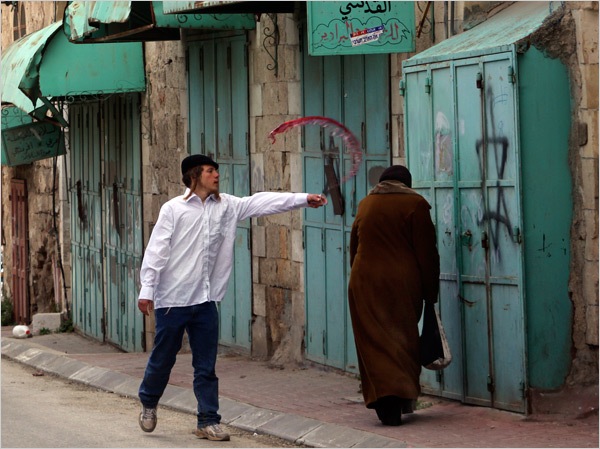
A Jewish settler tosses wine at a Palestinian woman on Shuhada Street in Hebron, the West Bank.

Four years ago, Rory Stewart wrote:

A great many of the failures in Afghanistan and Iraq arise from a single problem: the American-led coalitions’ lack of trust in local politicians. Repeatedly the Western powers, irritated by a lack of progress, have overruled local leaders, rejected compromises and tried to force through their own strategies. But the Westerners’ capacity is limited: they have little understanding of Afghan or Iraqi politics and rely too heavily on troops and money to solve what are fundamentally political and religious problems.

The coalitions cannot achieve political change in the absence of strong local support. And when they try to do so, they undermine their local allies. Iraqi and Afghan national and regional leaders have a far better understanding of the limits and possibilities of the local political scenes; they are more flexible and creative in finding compromises; and unlike the coalition officials, they are elected. They must be given real power and authority. This may seem an obvious prescription — but in fact the coalitions are not allowing it to happen.

Underneath the lack of trust that Stewart correctly identified, is a more fundamental issue: the hubris of power.

We have the guns, the cash, and represent the most powerful nation on Earth. You need to respect us but we really don’t need to respect you. Respect is something we expect but will also on occasions dish out if or when it seems expedient.

Americans, shaped by a culture that tends to place a higher value on power than anything else, are inclined to view respect as simply an element in a power equation. In one situation respect might seem essential, in another merely useful, and in yet another it can be dispensed with. Rarely is it held up as the most vital component in all human relationships.

After President Obama showed up in Kabul just over a week ago, President Karzai showed his uninvited guest and paymaster the courtesy of inviting him to dinner. Obama, the New York Times tells us, returned the courtesy with a thank-you note. “It was a respectful letter,” General James Jones, Obama’s national security adviser told reporters.

The significance of this incident, supposedly, is that it signals an overdue change in tone as the administration registers that its repeated admonitions of the Afghan president have proved counterproductive.

Ironically, an American president whose arrival in office was supposed to herald an historic shift in America’s approach to the world — one which would reinstate the value of soft power — has been a surprisingly clumsy diplomat.

So, if the White House now understands that it must not underestimate the value of respectfulness, that’s a good thing — but let’s not pretend a thank-you note is all it takes.

* * *

Respect is one of those words we use so often we rarely pause to consider its meaning. It describes an attitude, yet its latin root, specere, to look, indicates that this is really a form of attention.

To be respectful is to attentively incline oneself towards the other in recognition of their autonomy and integrity.

There is no one we can respect and simultaneously try to change. When we coerce or manipulate someone, we cannot respect them because our attention is focused not on them but on what we want.

If one views respect as a resource, nowhere is it generally more scarce than among the powerful.

The conceit of power is that power elicits respect, when in truth the tokens of respect bestowed on the powerful are rarely more than expressions of fear, envy or duty. (Hence an underlying paranoia haunts the powerful: they know they are the beneficiaries of a social investment that could, if things turn sour, be swiftly withdrawn.)

Respect is not the fruit of power, but on the contrary, it is a self-propagating virtue that becomes mirrored through its own expression.

Meanwhile, behind what might sound like an overly abstract reflection on respect, another topic floating in the background is Israel, since if one drills to the core of the Middle East conflict, it cannot be reduced to land or religion. It’s about respect.

Can Jews who claimed their “birthright” by dispossessing hundreds of thousands of Palestinians, somehow make peace with those people and their descendants without also acknowledging the Palestinians’ rights to dignity and respect? Yet can such respect be conferred without also calling into question the legitimacy of the Jewish state?

Where is the actual ground for mutual respect when the affirmation of one people’s rights has for six decades depended on the denial of another’s?

Facebooktwittermail

Wars of excess

Tom Engelhardt writes:

Whether it’s 3.1 million items of equipment, or 3 million, 2.8 million, or 1.5 million, whether 341 “facilities” (not including perhaps ten mega-bases which will still be operating in 2011 with tens of thousands of American soldiers, civilians, and private contractors working and living on them), or more than 350 forward operating facilities, or 290 bases are to be shut down, the numbers from Iraq are simply out of this world.

Those sorts of figures define the U.S. military in the Bush era — and now Obama’s — as the most materiel-profligate war-making machine ever. Where armies once had baggage trains and camp followers, our camp followers now help plant our military in foreign soil, build its housing and defenses, and then supply it with vast quantities of food, water, fuel, and god knows what else. In this way, our troops carry not just packs on their backs, but a total, transplantable society right down to the PXs, massage parlors, food courts, and miniature golf courses. At Kandahar Air Base in Afghanistan, there was until recently a “boardwalk” that typically included a “Burger King, a Subway sandwich shop, three cafes, several general stores, a Cold Mountain Creamery, [and an] Oakley sunglasses outlet.” Atypically enough, however, a TGI Friday’s, which had just joined the line-up, was recently ordered shut down along with some of the other stores by Afghan war commander General Stanley McChrystal as inimical to the war effort.

The extraordinary statistics stacked up in this article are of course a testament to the massive imperial footprint imposed by the United States when it goes to war. But they are also a reflection of something else: the extraordinary impunity with which America engages in war.

The fact that the US military can be so extravagant in situating itself in its theaters of engagement is only possible because the enemy it faces has, relatively speaking, such minuscule resources with which it can strike back. There are no enemy air forces that bombard these vast American bases. There is no artillery fire.

So-called asymmetric threats may pose the enduring challenge in this environment yet they also provide a license for every imaginable excess.

Facebooktwittermail

Karzai’s troublesome independence

After Benjamin Netanyahu was recently insulted by President Obama during his March visit to Washington (Obama declined to offer him dinner), Israeli commentators struggled to make an appropriate comparison and for some reason thought this was treatment that the head of a small African state might expect — the rather transparent implication being that Netanyahu should get the kind of deferential treatment that Israelis apparently believe is reserved for white Western leaders.

Israelis could but won’t console themselves with the observation that Netanyahu has yet to be treated like Hamid Karzai.

Last month, Karzai got uninvited by the White House and then, adding insult to injury, an uninvited visit and reprimand from Obama. Karzai is now pissed off. I wonder why?

President Hamid Karzai lashed out at his Western backers for the second time in three days, accusing the U.S. of interfering in Afghan affairs and saying the Taliban insurgency would become a legitimate resistance movement if the meddling doesn’t stop.

Mr. Karzai, whose government is propped up by billions of dollars in Western aid and nearly 100,000 American troops fighting a deadly war against the Taliban, made the comments during a private meeting with about 60 or 70 Afghan lawmakers Saturday.

At one point, Mr. Karzai suggested that he himself would be compelled to join the other side —that is, the Taliban—if the parliament didn’t back his controversial attempt to take control of the country’s electoral watchdog from the United Nations, according to three people who attended the meeting, including an ally of the president.

The prospects of Karzai joining the Taliban are minimal but his threat highlights Washington’s dilemma: they want an Afghan leader who is compliant but doesn’t look like a puppet. They want someone who looks independent but does what he’s told.

The hypocrisy inherent in the American approach is no more evident than in the run-up to the highly-publicized offensive against the Taliban stronghold, Kandahar. Will President Karzai publicly approve the offensive, or merely accede to it, Doyle McManus asks. “He’s got to be seen as the guy who’s leading this fight,” a military officer says.

Much to the frustration of American planners, it turns out that Afghans, including Karzai, have minds of their own. How inconvenient.

Facebooktwittermail

Keeping up the war effort

What’s the key to making sure the US “prevails” in Afghanistan? Making sure that American taxpayers remain sufficiently ignorant and indifferent about what’s happening over there.

The news that US soldiers apparently gouged bullets out of the bodies of pregnant women will likely be yet another story that does little to interrupt the torpor of America’s war consciousness.

The Times reports:

US special forces soldiers dug bullets out of their victims’ bodies in the bloody aftermath of a botched night raid, then washed the wounds with alcohol before lying to their superiors about what happened, Afghan investigators have told The Times.

Two pregnant women, a teenage girl, a police officer and his brother were shot on February 12 when US and Afghan special forces stormed their home in Khataba village, outside Gardez in eastern Afghanistan. The precise composition of the force has never been made public.

The claims were made as Nato admitted responsibility for all the deaths for the first time last night. It had initially claimed that the women had been dead for several hours when the assault force discovered their bodies.

In an excellent analysis of US media coverage of the February killings, Glenn Greenwald notes:

What is clear — yet again — is how completely misinformed and propagandized Americans continue to be by the American media, which constantly “reports” on crucial events in Afghanistan by doing nothing more than mindlessly and unquestioningly passing along U.S. government claims as though they are fact.

Jerome Starkey — who managed to penetrate the propaganda veil by doing what reporters of a bygone era understood to be their job: independently gathering information as opposed to transcribing official statements — writes at Nieman Watchdog:

The only way I found out NATO had lied — deliberately or otherwise — was because I went to the scene of the raid, in Paktia province, and spent three days interviewing the survivors. In Afghanistan that is quite unusual.

NATO is rarely called to account. Their version of events, usually originating from the soldiers involved, is rarely seriously challenged.

This particular raid, in the early hours of Feb 12, piqued my interest. I contacted some of the relatives by phone, established it was probably safe enough to visit, and I finally made it to the scene almost a month after unidentified gunmen stormed the remnants of an all-night family party.

It’s not the first time I’ve found NATO lying, but this is perhaps the most harrowing instance, and every time I go through the same gamut of emotions. I am shocked and appalled that brave men in uniform misrepresent events. Then I feel naïve.

There are a handful of truly fearless reporters in Afghanistan constantly trying to break the military’s monopoly on access to the front. But far too many of our colleagues accept the spin-laden press releases churned out of the Kabul headquarters. Suicide bombers are “cowards,” NATO attacks on civilians are “tragic accidents,” intelligence is foolproof and only militants get arrested.

Some journalists in Kabul are hamstrung by security rules set in Europe or America, which often reflect the least permissive times in Baghdad rather than any realistic threats in Afghanistan. These reporters can’t leave their compounds without convoys of armed guards. They couldn’t dream of driving around rural Paktia, dressed up in local clothes and squashed into the back of an old Toyota Corolla, to interview the survivors of a night raid.

Ultra risk-averse organizations go even further and rely almost entirely on video footage and still images gifted by the entirely partial combat-camera teams or the coalition’s dedicated NATO TV unit, staffed by civilian ex-journalists who churn out good news b-roll. Others lap up this material because it’s cheaper and easier than having their own correspondents in a war zone.

This self-censorship is compounded by the “embed culture,” which encourages journalists to visit the frontlines with NATO soldiers, who provide them food, shelter, security and ultimately with stories.

Facebooktwittermail

US funds help arm the Taliban

The New York Times reports:

Since their offensive here in February, the Marines have flooded Marja with hundreds of thousands of dollars a week. The tactic aims to win over wary residents by paying them compensation for property damage or putting to work men who would otherwise look to the Taliban for support.

The approach helped turn the tide of insurgency in Iraq. But in Marja, where the Taliban seem to know everything — and most of the time it is impossible to even tell who they are — they have already found ways to thwart the strategy in many places, including killing or beating some who take the Marines’ money, or pocketing it themselves.

Just a few weeks since the start of the operation here, the Taliban have “reseized control and the momentum in a lot of ways” in northern Marja, Maj. James Coffman, civil affairs leader for the Third Battalion, Sixth Marines, said in an interview in late March. “We have to change tactics to get the locals back on our side.”

Col. Ghulam Sakhi, an Afghan National Police commander here, says his informants have told him that at least 30 Taliban have come to one Marine outpost here to take money from the Marines as compensation for property damage or family members killed during the operation in February.

“You shake hands with them, but you don’t know they are Taliban,” Colonel Sakhi said. “They have the same clothes, and the same style. And they are using the money against the Marines. They are buying I.E.D.’s and buying ammunition, everything.”

The Los Angeles Times reports:

By any standard, it was a disastrous day for an important U.S. ally in Afghanistan. First, three German soldiers died in an unusually fierce battle with insurgents, then German troops accidentally killed six Afghan soldiers apparently coming to their aid.

The chaotic chain of events in the northern province of Kunduz, detailed by Afghan and NATO officials Saturday, a day after the fact, could further undermine German public backing for the conflict.

Slipping support by North Atlantic Treaty Organization allies could jeopardize the Obama administration’s plan to hit the Taliban hard this year, with the aim of weakening the insurgents to the point that they might be receptive to a negotiated settlement. That in turn is aimed at laying the groundwork for a gradual Western withdrawal beginning in mid-2011.

While the United States rushes troops to Afghanistan’s restive south, where a major offensive is planned this spring and summer in Kandahar province, Taliban fighters and their allies are making their presence felt in areas of the country that had been relatively peaceful.

Facebooktwittermail

Gen. McChrystal: We’ve shot ‘an amazing number of people’ who were not threats

Justin Elliot reports:

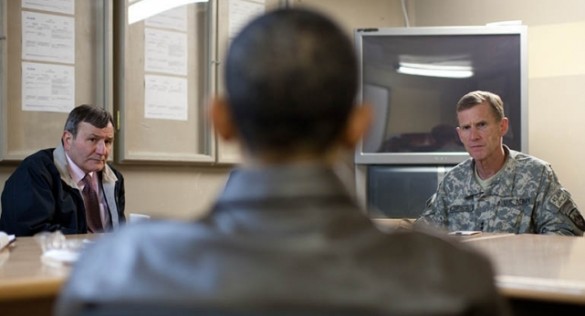
In a stark assessment of shootings of locals by US troops at checkpoints in Afghanistan, Gen. Stanley McChrystal said in little-noticed comments last month that during his time as commander there, “We’ve shot an amazing number of people and killed a number and, to my knowledge, none has proven to have been a real threat to the force.”

The comments came during a virtual town hall with troops in Afghanistan after one asked McChrystal to comment on the “escalation of force” problem. The general responded that, in the nine months he had been in charge, none of the cases in which “we have engaged in an escalation of force incident and hurt someone has it turned out that the vehicle had a suicide bomb or weapons in it.”

In many cases, he added, families were in the vehicles that were fired on.

Facebooktwittermail

The opium wars in Afghanistan

At TomDispatch, Alfred W. McCoy writes:

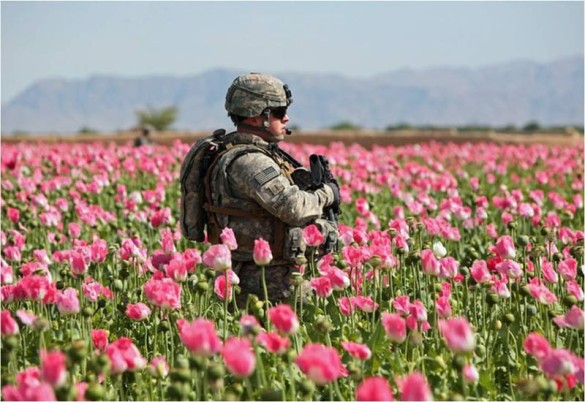
To understand the Afghan War, one basic point must be grasped: in poor nations with weak state services, agriculture is the foundation for all politics, binding villagers to the government or warlords or rebels. The ultimate aim of counterinsurgency strategy is always to establish the state’s authority. When the economy is illicit and by definition beyond government control, this task becomes monumental. If the insurgents capture that illicit economy, as the Taliban have done, then the task becomes little short of insurmountable.

Opium is an illegal drug, but Afghanistan’s poppy crop is still grounded in networks of social trust that tie people together at each step in the chain of production. Crop loans are necessary for planting, labor exchange for harvesting, stability for marketing, and security for shipment. So dominant and problematic is the opium economy in Afghanistan today that a question Washington has avoided for the past nine years must be asked: Can anyone pacify a full-blown narco-state?

The answer to this critical question lies in the history of the three Afghan wars in which Washington has been involved over the past 30 years — the CIA covert warfare of the 1980s, the civil war of the 1990s (fueled at its start by $900 million in CIA funding), and since 2001, the U.S. invasion, occupation, and counterinsurgency campaigns. In each of these conflicts, Washington has tolerated drug trafficking by its Afghan allies as the price of military success — a policy of benign neglect that has helped make Afghanistan today the world’s number one narco-state.

Facebooktwittermail

Effortless, carefree war

What was the most significant thing about President Obama’s surprise trip to Afghanistan on Sunday? He wore a leather bomber jacket.

Or, to be more precise, the most significant thing about Obama’s six-hour visit was nothing that he said, nor the fact that he went, but that in the utterly trivialized view of war that American civilians are fed, the fact that Obama’s attire would merit comment.

A recently leaked CIA document said that the foundation of support for the war from America’s European allies might be weakening. “Why Counting on Apathy Might Not Be Enough” a CIA “Red Cell” special memorandum warned.

While the apathy of Europeans might be in jeopardy, American apathy appears to be as reliable as ever.

Contrary to Obama’s claim that the war in Afghanistan is a war of necessity, it is really a war of indifference — a war that continues because the people paying for it don’t care strongly enough to object to its continuation. Most importantly, Americans have by and large acquiesced to the notion that perpetual war is a condition of this era rather than a product of political policy. War has become an inobtrusive background noise in the American way of life.

Postscript: The “effortless” in the headline is an allusion to that forgotten expression: the war effort.

The fact that America’s wars of this last decade have required no war effort is one of the most telling ways in which these have not been wars of necessity. In a war of necessity, a civilian war effort is not merely required; it is unavoidable.

Whereas the civilian role in a war effort is an adjunct to the military effort, in a war that requires no war effort, there is no civilian role. There is instead a necessity that civilians be cocooned by an infantilism engendered by consumerism, which is to say, that they be easily pacified and rendered politically apathetic by having their trivial desires easily fulfilled.

Facebooktwittermail

Kandahar, a battlefield even before U.S. offensive

Carlotta Gall reports from Kandahar:

American forces have begun operations to push back Taliban insurgents in this most important southern province, the birthplace and spiritual home of the Taliban, and a full-scale offensive is expected in coming weeks.

But the Taliban have already turned this city into a battlefield as they prepare for the operation, which American officials hope will be decisive in breaking the insurgency’s grip on southern Afghanistan.

When American forces all arrive, they will encounter challenges larger than any other in Afghanistan. Taliban suicide bombings and assassinations have left this city virtually paralyzed by fear. The insurgents boldly walk the streets, visit shops and even press people into keeping guns and other supplies in their houses for them in preparation for urban warfare, residents say.

The government, corrupt and ineffective, lacks almost any popular support. Anyone connected to the government lives in fear of assassination. Its few officials sit barricaded behind high blast walls. Services are scant. Security, people say, is at its worst since the fall of the Taliban government in 2001.

Facebooktwittermail

Karzai refuses to be an American puppet

The New York Times reports:

This month, with President Hamid Karzai looking ahead to a visit to the White House, he received a terse note from aides to President Obama: Your invitation has been revoked.

The reason, according to American officials, was Mr. Karzai’s announcement that he was emasculating an independent panel that had discovered widespread fraud in Mr. Karzai’s re-election last year.

Incensed, Mr. Karzai extended an invitation of his own — to Mahmoud Ahmadinejad, the Iranian president, who flew to Kabul and delivered a fiery anti-American speech inside Afghanistan’s presidential palace.

“Karzai was enraged,” said an Afghan with knowledge of the events, who spoke on the condition of anonymity because of the delicacy of the issue. “He invited Ahmadinejad to spite the Americans.”

The dispute was smoothed over only this week, when Mr. Obama flew to Kabul for a surprise dinner with Mr. Karzai. White House officials emphasized that the most important purpose of Mr. Obama’s trip to Afghanistan was to visit American troops there.

But the red carpet treatment of Mr. Ahmadinejad is just one example of how Mr. Karzai is putting distance between himself and his American sponsors, prominent Afghans and American officials here said. Even as Mr. Obama pours tens of thousands of additional American troops into the country to help defend Mr. Karzai’s government, Mr. Karzai now often voices the view that his interests and the United States’ no longer coincide.

Facebooktwittermail

War tourists

The McClatchy blog, Nukes and Spooks reports:

Amongst the swirl of soldiers, diplomats and contractors at America’s largest military bases in Afghanistan are congressional delegations, CODELs as they are often called. Members of Congress and their staffs come through, take a lot of photos with various commanders and ask questions that frankly could have been answered in Washington, all over a matter of no more than a couple days. Then they head back home. The trips are as much about theater as substance. The photos make their way onto campaign materials and the visits serve as the foundation for the questions they pose to commanders when they eventually testify on Capitol Hill. As in, “Gen. McChrystal, during my visit to Afghanistan, I learned….”

The latest VIP visitor was President Obama who spent six hours in Afghanistan over the weekend. The stated purpose was to meet with Afghanistan President Hamid Karzai. But somehow the photo op with the troops made the front page of today’s New York Times.

A couple weeks ago, the State Department Inspector General released a report that found that department personnel spend so much time greeting the scores of congress members who come to visit, they don’t have enough time to do their jobs.

Facebooktwittermail

Insurgent faction presents Afghan peace plan

The New York Times reports:

Representatives of a major insurgent faction have presented a formal 15-point peace plan to the Afghan government, the first concrete proposal to end hostilities since President Hamid Karzai said he would make reconciliation a priority after his re-election last year.

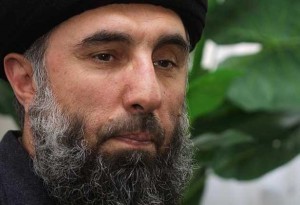
The delegation represents fighters loyal to Gulbuddin Hekmatyar, 60, one of the most brutal of Afghanistan’s former resistance fighters who leads a part of the insurgency against American, NATO and Afghan forces in the north and northeast of the country.
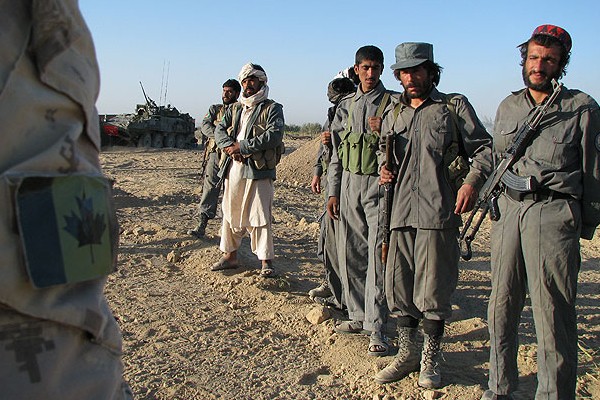
His representatives met Monday with President Karzai and other Afghan officials in the first formal contact between a major insurgent group and the Afghan government after almost two years of backchannel communications, which diplomats say the United States has supported.

Though the insurgent group, Hezb-i-Islami, or Islamic Party, operates under a separate command from the Taliban, it has links to the Taliban leadership and Al Qaeda and has fought on a common front against foreign forces in Afghanistan.

A spokesman for the delegation, Mohammad Daoud Abedi, said the Taliban, which makes up the bulk of the insurgency, would be willing to go along with the plan if a date was set for the withdrawal of foreign forces from the country. Publicly, a Taliban spokesman denied that.

The plan, titled the National Rescue Agreement, a copy of which was given to The New York Times, sets that date as July 2010, with the withdrawal to be completed within six months.

Earlier, Tim McGirk reported:

Pakistan’s arrest of a dozen top Taliban leaders — military commanders, strategic planners and a financier — over the past six weeks is viewed by Afghan and NATO officials with a mixture of relief and suspicion. On one hand, the arrests have disrupted the insurgents’ chain of command, making it tougher for the Taliban’s war council to relay funds and battle plans to their commanders fighting NATO troops. But according to Afghan officials and diplomats in Kabul, the roll-up of Taliban leaders has dealt a blow to secret, preliminary talks under way during the past six months between President Hamid Karzai and the Taliban, as well as those conducted through a separate channel between the Taliban and U.N. envoys.

Sources consulted by TIME in Peshawar, Kabul and Kandahar all characterize those Taliban commanders picked up by Pakistani intelligence agencies as being more malleable to peace talks with Karzai than a core of hard-liners within the Taliban’s ruling shura, or council, who are thought to be hiding in the Pakistani cities of Quetta or Karachi. One foreign diplomat in Kabul says he looked at the list of 14 Taliban arrested by the Pakistanis and thought, “I knew eight of them personally, and they were all in favor of a peace process.” This was confirmed by Kai Eide, the U.N.’s former Special Representative in Afghanistan, who told the BBC on March 18 that Pakistan’s arrests had cut short “talks about talks” between the U.N. and the Taliban in Dubai.

Facebooktwittermail

Policing Afghanistan

At TomDispatch, Pratap Chatterjee writes:

The Pentagon faces a tough choice: Should it award a new contract to Xe (formerly Blackwater), a company made infamous when its employees killed 17 Iraqis in Baghdad in 2007, or to DynCorp, a company made infamous in Bosnia in 1999 when some of its employees were caught trafficking young girls for sex?

This billion-dollar contract will be the linchpin of a training program for the Afghan National Police, who are theoretically to be drilled in counterinsurgency tactics that will help defeat the Taliban and bring security to impoverished, war-torn Afghanistan. The program is also considered a crucial component of the Obama administration’s plan for turning the war around. Ironically, Xe was poised to win the contract until a successful appeal by DynCorp last week threw the field wide open.

Some people in the U.S. government (and many outside it) believe that this task should not be assigned to private contractors in the first place. Meanwhile, many police experts are certain that it hardly matters which company gets the contract. Like so many before it, the latest training program is doomed from the outset, they believe, because its focus will be on defeating the Taliban rather than fostering community-oriented policing.

The Obama administration is in a fix: it believes that, if it can’t put at least 100,000 trained police officers on Afghan streets and into the scattered hamlets that make up the bulk of the country, it won’t be able to begin a drawdown of U.S. troop levels in Afghanistan by the middle of next year.

Meanwhile, the Washington Post reports that US forces are facing soaring IED attacks, the Taliban is making a dramatic comeback in the northern province of Kunduz.

The New York Times says that soon after what had been described as a successful offensive in Marja, the Taliban have begun waging a campaign of intimidation “that some local Afghan leaders worry has jeopardized the success of an American-led offensive there meant as an early test of a revised military approach in Afghanistan.”

Facebooktwittermail

Israel is putting American lives at risk

In Foreign Policy, Mark Perry describes an extraordinary Pentagon briefing on Israel’s impact on conflicts across the Middle East. Here is an excerpt and following some comments of my own, the author has provided me with additional background on his reporting.
[Important update: A senior military officer told Foreign Policy by email that one rather minor detail in Perry’s report was incorrect. A request from Gen Petraeus for the Palestinian occupied territories to be brought within CENTCOM’s region of operations was sent to the Chairman of the Joint Chiefs of Staff, Admiral Mullen, and not directly to the White House (who may or may not have subsequently been consulted). It is significant that the Pentagon made this correction, not because it was an important detail but on the contrary, because it was inconsequential to the overall narrative. In effect, the Pentagon clearly but discreetly said that there was virtually nothing in this report that could be denied.]

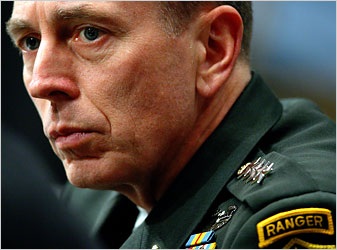
On January 16, two days after a killer earthquake hit Haiti, a team of senior military officers from the U.S. Central Command (responsible for overseeing American security interests in the Middle East), arrived at the Pentagon to brief JCS Chairman Michael Mullen on the Israeli-Palestinian conflict. The team had been dispatched by CENTCOM commander David Petraeus to underline his growing worries at the lack of progress in resolving the issue. The 33-slide 45-minute PowerPoint briefing stunned Mullen. The briefers reported that there was a growing perception among Arab leaders that the U.S. was incapable of standing up to Israel, that CENTCOM’s mostly Arab constituency was losing faith in American promises, that Israeli intransigence on the Israeli-Palestinian conflict was jeopardizing U.S. standing in the region, and that Mitchell himself was (as a senior Pentagon officer later bluntly described it) “too old, too slow…and too late.”

The January Mullen briefing was unprecedented. No previous CENTCOM commander had ever expressed himself on what is essentially a political issue; which is why the briefers were careful to tell Mullen that their conclusions followed from a December 2009 tour of the region where, on Petraeus’s instructions, they spoke to senior Arab leaders. “Everywhere they went, the message was pretty humbling,” a Pentagon officer familiar with the briefing says. “America was not only viewed as weak, but its military posture in the region was eroding.” But Petraeus wasn’t finished: two days after the Mullen briefing, Petraeus sent a paper to the White House requesting that the West Bank and Gaza (which, with Israel, is a part of the European Command – or EUCOM), be made a part of his area of operations. Petraeus’s reason was straightforward: with U.S. troops deployed in Iraq and Afghanistan, the U.S. military had to be perceived by Arab leaders as engaged in the region’s most troublesome conflict.

The Mullen briefing and Petraeus’s request hit the White House like a bombshell. While Petraeus’s request that CENTCOM be expanded to include the Palestinians was denied (“it was dead on arrival,” a Pentagon officer confirms), the Obama Administration decided it would redouble its efforts – pressing Israel once again on the settlements issue, sending Mitchell on a visit to a number of Arab capitals and dispatching Mullen for a carefully arranged meeting with Chief of the Israeli General Staff, Lt. General Gabi Ashkenazi. While the American press speculated that Mullen’s trip focused on Iran, the JCS Chairman actually carried a blunt, and tough, message on the Israeli-Palestinian conflict: that Israel had to see its conflict with the Palestinians “in a larger, regional, context” – as having a direct impact on America’s status in the region. Certainly, it was thought, Israel would get the message. [Read the rest of the report here.]

In December 2006, the Iraq Study Group Report was explicit in making this linkage: “The United States cannot achieve its goals in the Middle East unless it deals directly with the Arab-Israeli conflict and regional instability.”

What Mark Perry’s report indicates is that for the Obama administration a tipping point has been crossed in its perception of Israel’s effect on the conflicts that span the region.

Until now, the necessity for a resolution of the Arab-Israeli conflict has been framed in quasi-positive terms — such as that it would help defuse some of the hostility that the US now faces, or, that it would strengthen an alliance of nations attempting to curtail Iran’s nuclear program.

The shift, as expressed by Joe Biden last week and by the Petraeus briefing in January is that Israel is now being seen as a liability: the Jewish state is putting American lives at risk. “This is starting to get dangerous for us,” Biden reportedly told Netanyahu.

Such a shift marks a watershed in US-Israeli relations and so Perry’s report naturally raises questions. Indeed, the first line of defense from Israel and its supporters will be to claim that, on the contrary, recent events are nothing more than a bump in the road; that we can expect a quick resumption of business as usual between such close allies.

For this reason, I asked Mark — who I have had the privilege of working with in recent years — to provide some background to his report. This is what he said:

My piece on the briefing of Admiral Mullen by CENTCOM senior officers has occasioned a great deal of comment, as well as some skepticism: how accurate is the account? Was it told to me by direct participants in the briefing? Is there any basis for imagining that Petraeus has any kind of hidden agenda, whether that is a desire to expand CENTCOM – or even hostility towards Israel.

I won’t name my sources, even though it’s clear to people in the Pentagon – and certainly to General Petraeus – who they are. Was I told of the briefing by the briefers themselves? I will only say that there were four people in the briefing – the two briefers, Admiral Mullen, and Admiral Mullen’s primary adviser on the Israeli-Palestinian conflict. I know two of the people involved in the briefing. Whether or not they are my sources is something for the reader to determine. The account is not only accurate, it’s a precis of what actually happened. There is a lot more to it. The White House, State Department and Pentagon have not denied the account, and for good reason: it’s true.

Is there any basis for imagining that Petraeus has any kind of hidden agenda in ordering the briefing?

I have been reporting on the American military for thirty years. My work on the Joint Chiefs of Staff, Four Stars, is the authoritative account on the subject. I have deeply rooted contacts in the military that go back thirty years. I have never met a senior military officer whom I do not admire. There is no greater insult than to believe that General Petraeus or any other senior American military officer would use the lives of American soldiers as a lever to enhance their own political future. My sense is that General Petraeus neither likes nor dislikes Israel: but he loves his country and he wants to protect our soldiers. The current crisis in American relations with Israel is not a litmus test of General Petraeus’s loyalty to Israel, but of his, and our, concern for those Americans in uniform in the Middle East.

It is, perhaps, a sign of the depth of “the Biden crisis” that every controversy of this type seems to get translated into whether or not America and its leaders are committed to Israel’s security. This isn’t about Israel’s security, it’s about our security.

Facebooktwittermail

Washington’s cult of narcissism and Iraq

Tom Engelhardt writes:

Hubris? We’re bigger than that!

We’ve now been at war with, or in, Iraq for almost 20 years, and intermittently at war in Afghanistan for 30 years. Think of it as nearly half a century of experience, all bad. And what is it that Washington seems to have concluded? In Afghanistan, where one disaster after another has occurred, that we Americans can finally do more of the same, somewhat differently calibrated, and so much better. In Iraq, where we had, it seemed, decided that enough was enough and we should simply depart, the calls from a familiar crew for us to stay are growing louder by the week.

The Iraqis, so the argument goes, need us. After all, who would leave them alone, trusting them not to do what they’ve done best in recent years: cut one another’s throats?

Modesty in Washington? Humility? The ability to draw new lessons from long-term experience? None of the above is evidently appropriate for “the indispensable nation,” as former Secretary of State Madeleine Albright once called the United States, and to whose leaders she attributed the ability to “see further into the future.” None of the above is part of the American arsenal, not when Washington’s weapon of choice, repeatedly consigned to the scrapheap of history and repeatedly rescued, remains a deep conviction that nothing is going to go anything but truly, deeply, madly badly without us, even if, as in Iraq, things have for years gone truly, deeply, madly badly with us.

An expanding crew of Washington-based opiners are now calling for the Obama administration to alter its plans, negotiated in the last months of the Bush administration, for the departure of all American troops from Iraq by the end of 2011. They seem to have taken Albright’s belief in American foresight — even prophesy — to heart and so are basing their arguments on their ability to divine the future.

Facebooktwittermail

Afghan tribal rivalries bedevil a U.S. plan

The New York Times reports:

Six weeks ago, elders of the Shinwari tribe, which dominates a large area in southeastern Afghanistan, pledged that they would set aside internal differences to focus on fighting the Taliban.

This week, that commitment seemed less important as two Shinwari subtribes took up arms to fight each other over an ancient land dispute, leaving at least 13 people dead, according to local officials.

The fighting was a setback for American military officials, some of whom had hoped it would be possible to replicate the pledge elsewhere. It raised questions about how effectively the American military could use tribes as part of its counterinsurgency strategy, given the patchwork of rivalries that make up Afghanistan.

Government officials and elders from other tribes were trying to get the two sides to reconcile, but given the intensity of the fighting, some said they doubted that the effort would work. At the very least, the dispute is proving a distraction from the tribe’s commitment to fight the Taliban, not each other.

Meanwhile, the Los Angeles Times reports:

A growing number of Taliban militants in the Pakistani border region are refusing to collaborate with Al Qaeda fighters, declining to provide shelter or assist in attacks in Afghanistan even in return for payment, according to U.S. military and counter-terrorism officials.

The officials, citing evidence from interrogation of detainees, communications intercepts and public statements on extremist websites, say that threats to the militants’ long-term survival from Pakistani, Afghan and foreign military action are driving some Afghan Taliban away from Al Qaeda.

As a result, Al Qaeda fighters are in some cases being excluded from villages and other areas near the Afghanistan-Pakistan border where they once received sanctuary.

Facebooktwittermail