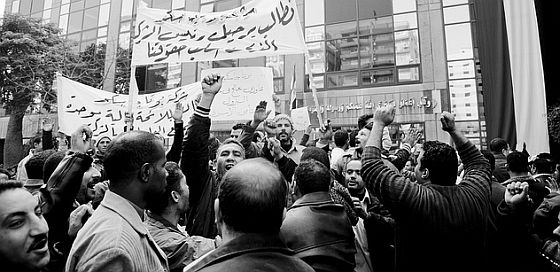
If you live in Washington, DC, the question of what does the Egyptian Revolution mean for Palestine might seem like a strange question. The question du jour here is what does the Egyptian Revolution mean for Israel? The subtext to that second question is what does the Egyptian Revolution mean for Israel’s continued occupation and its denial of equality to non-Jewish citizens and residents. Of course, both questions show an Israel/Palestine-centric view of the world.
Yes, the denial of Palestinian freedom has been an iconic issue of concern not only for Arabs and the larger Muslim world, but also for the Global South and persons of conscience around the world. And once upon a time, the Palestinian struggle for their rights did symbolise the heroism of a people demanding justice for themselves.
But today that mantle lies with the Egyptian and Tunisian peoples. Today, they are the teachers and the rest of us are the pupils. Today, the Arab people of Egypt and Tunisia, and those demonstrating for the same goals throughout the Arab world are providing all of us, including Americans, with hard fought lessons that decades of useless peace-processing and support for authoritarian leaders have let us forget. Here are at least four lessons that have been thrown in our face:
First, the state and the government exist as a consequence of the will of the people, and not vice-versa. It was clear in Hosni Mubarak’s speech yesterday that he has conflated the state of Egypt with himself. His well being is that of Egypt. Attacks on his rule, in his mind, are attacks on Egypt. But Mubarak is not alone in this delusion.
Saddam Hussein saw Iraq in the same way. Listening to the Palestinian rulers in Gaza and Ramallah who administer some of the Palestinian cities under Israeli occupation, you would think that Palestine has become those administrations.
Millions of people marching throughout Egypt today and for the last two weeks have shown us what Egypt actually is – it is the self-determination exercised and demanded by those millions of individuals. Egypt is not an abstract concept tied in to a corrupt rule, it exists because the people today have resurrected themselves and in so doing have resurrected their state.
Palestinians in the first Intifada had tried something very similar but the exercise was ultimately hijacked and ended up in an agreement that actually restricted even further Palestinian space (anyone who lived in the West Bank or Gaza before the Oslo Agreement can tell you it was easier to travel throughout all of historic Palestine before “peace” than after).
Mubarak given up, wants to die in Sharm says Saudi official
Egypt’s ousted president has given up and wants to die in the Red Sea resort of Sharm el-Sheikh where he has been living since a popular uprising ended his rule, a Saudi official said on Wednesday.
Hosni Mubarak, 82, has suffered from health problems in recent years and travelled to Germany for gall bladder surgery in March last year. Reports of a further decline have increased since he stepped down on Friday after three decades in power.
An official in Saudi Arabia said the kingdom had offered to host Mubarak but he was determined to see out his days in Egypt. Official confirmation could not immediately be obtained from the Saudi government. (Reuters)
Ex-judge to head Egypt reform panel
Egypt’s new army rulers have appointed Tareq al-Bishry, a retired judge, to head a committee set up to suggest constitutional changes.
Al-Bishry was a strong supporter of an independent judiciary during Hosni Mubarak’s rule and is respected in legal circles for his independent views.
“I have been chosen by the Higher Military Council to head the committee for constitutional amendments,” al-Bishry said on Tuesday.
The Higher Military Council had earlier vowed to rewrite the constitution within 10 days and put it to a referendum within two months. (Al Jazeera)
Central Auditing Organization employees staged a sit-in Wednesday demanding that the organization be given total independence from the government. Employees also called for amending regulations, promotions and a bonus increase, among other demands.
Meanwhile, about 2000 Manpower Ministry employees protested against corruption within a group of investors who were appointed by Minister Aisha Abdel Hadi. Protesters called for bonus pay and a monthly travel allowance of LE 200. (Al-Masry Al-Youm)
After 25 Bahman’s success, the challenges for Iran’s Green Movement
The Iranian regime’s response to the street protests of Monday was predictable. Rather than realising that a sizeable proportion of its people were maintaining serious and justifiable grievances about the ruling elite, institutions of the Islamic Republic have put up a preposterous show of defiance. A large group of Parliamentary deputies openly agitated for violence and asked for Mir Hossein Mousavi and Mehdi Karroubi to be killed.
The classic line of UK-US-Israel-“terrorist” MKO (Mujahedin-e-Khalq) involvement patterns were put out in full force. The Secretary of the Expediency Council and 2009 Presidential candidate Mohsen Rezaei, a man routinely praised by pundits as a voice of balance and reason on the current Iranian political battleground, called both Mousavi and Karroubi “servants of the Americans” and laid out an ultimatum for the two former Presidential candidates: disown the protests by Tuesday night or face the “fully justifiable” response of the “people”.
The two Green leaders did nothing of that sort. In communiques published on their official website (over which there are some doubts of legitimacy, given that Mousavi has supposedly been cut off from contact since Sunday), both Mousavi and Karroubi praised the behaviour of the people on Monday and stated their determination to persist with their struggle.
Both messages fell short, however, of taking stock of the mood on the streets of Tehran and other cities on 25 Bahman. As relayed by the considerable YouTube footage, the bulk of the slogans shouted by the protestors were directed straight at the Supreme Leader, Ayatollah Ali Khamenei, who is now considered the main “culprit” of the current predicament. But no mention of Khamenei is made by either Mousavi or Karroubi, despite the ringing chant on YouTube associating the Supreme Leader’s fate with that of former Egyptian President Mubarak and Tunisian leader Ben Ali. Both Mousavi and Karroubi have also decided to maintain the controversial theme of “loyalty to the Late Imam’s [Ayatollah Khomeini] Values”. Mousavi’s alleged communique even said that such loyalty is the sole desire of the protestors, a comment which completely discounts the frequent and clear calls for the termination of the velayat-e faqih doctrine — introduced and brought forward by Khomeini — as principal element in the leadership of the Islamic Republic. (Enduring America)
U.S. follows two paths on unrest in Iran and Bahrain
The Obama administration has responded quite differently to two embattled governments that have beaten protesters and blocked the Internet in recent days to fend off the kind of popular revolt that brought down Egypt’s government.
With Iran — a country under sanctions pursuing a nuclear program that has put it at odds with the West — the administration has all but encouraged protesters to take to the streets. With Bahrain, a strategically important ally across the Persian Gulf from Iran, it has urged its king to address the grievances of his people.
Those two approaches were on vivid display at a news conference on Tuesday.
President Obama accused Iran’s leaders of hypocrisy for first encouraging the protests in Egypt, which they described as a continuation of Iran’s own revolution, and then cracking down on Iranians who used the pretext to come out on the streets. He then urged protesters to muster “the courage to be able to express their yearning for greater freedoms and a more representative government.”
But speaking to other restive countries, including Bahrain, Mr. Obama directed his advice to governments, not protesters, illustrating just how tricky diplomacy in the region has become. He said his administration, in talking to Arab allies, was sending the message that “you have a young, vibrant generation within the Middle East that is looking for greater opportunity; and that if you are governing these countries, you’ve got to get out ahead of change. You can’t be behind the curve.”
Mr. Obama’s words on Iran, on the other hand, were among the strongest he has ever voiced in encouraging a street revolt, something his administration initially shied away from doing in June 2009, after a disputed presidential election provoked an uprising that was crushed by the government. Later, the administration embraced the protests, but by then the “Green Movement” in Iran had been crushed. (New York Times)
From Tunis to Cairo to Riyadh?
In any authoritarian regime, instability seems unthinkable up to the moment of upheaval, and that is true now for Saudi Arabia. But even as American influence recedes across the Middle East, the U.S. soon may face the staggering consequences of instability here, in its most important remaining Arab ally. While a radical regime in Egypt would threaten Israel directly but not America, a radical anti-Western regime in Saudi Arabia—which produces one of every four barrels of oil world-wide—clearly would endanger America as leader of the world economy. (Wall Street Journal — subscription required)
Teen killed as Iraq guards fire into demo
A teenager was killed Wednesday when private guards shot at protesters who set fire to several Iraqi government offices, in the country’s most violent demonstrations since uprisings in Egypt and Tunisia.
The protests, which also left 27 people wounded, took place in the southern city of Kut, capital of Wasit province, with more than 2,000 demonstrators calling for the provincial governor to resign over poor basic services.
The demonstration began at 9:00 am (0600 GMT) and saw protesters set fire to three buildings — the offices of Wasit provincial council, the governorate’s main administrative building and the governor’s official residence.
Policemen and soldiers fired their weapons into the air in a bid to dissuade protesters, while private security guards employed by Wasit council opened fire directly into the crowd, for which a senior policeman pledged punishment.
Majid Mohammed Hassan from Kut hospital’s administrative unit put the toll at one dead and 27 wounded. He said the fatality had been a 16-year-old boy who suffered a bullet to the chest. (AFP)
Libya: Protests ‘rock city of Benghazi’
Hundreds of people have clashed with police and pro-government supporters in the Libyan city of Benghazi, reports say.
Eyewitnesses told the BBC the overnight unrest followed the arrest of an outspoken critic of the government.
The lawyer was later said to have been released but the protests continued. (BBC)
What the hell is happening in Yemen?
Tuesday, Feb. 15: Al-Jazeera again reports 3,000 anti-government protesters. I think they’re mainly pulling this from the AFP (I can’t find their article from Tuesday) at this point. That is definitely untrue. About 500 pro and 500 anti-government demonstrators were at the old campus of Sana’a University. Police were keeping them apart as a few of them threw rocks at each other. They filed out around 1 PM, which is lunch/qat time. The giant police force in the central of the city AJE mentions, again, is the group of Saleh supporters that are camping out in Tahrir, enjoying the complimentary vittles.
Wednesday, Feb. 16: A few colleagues went to both old and new campuses of Sana’a University today and all of them said there were nothing but pro-government demos. Somehow, we end up with this gem form the AP. They claim that THOUSANDS of policemen blocked THOUSANDS of student protesters from Sana’a University from joining THOUSANDS of OTHER student protesters somewhere else in Sana’a. That’s rich…and impossible. This AP article firmly establishes the Yemeni alternate universe, somewhere in a galaxy far, far away. Maybe in that Yemen the Russian Club has reasonably priced drinks? No, impossible.
Keep in mind that this is only in Sana’a. I can confidently say that demonstrations in Taiz and Aden are quite large and the government is probably trying to contain them more violently. What is actually going on in Taiz is a mystery, I don’t know of any journalists at all working in that city. From the pictures I’ve seen and the things I’ve read earlier in the week, I can confidently say that if a revolution is going to take place in Yemen (its still probably won’t) its going to start in Taiz. By all (credible) accounts, the protests in Sana’a are winding down. There are plans for more protests next week. Look to those demonstrations to see if the grassroots movement is really going to take hold in Sana’a. (Jeb Boone)
Yemen, UK discuss security cooperation
Yemen and Britain discussed here on Wednesday aspects of security cooperation and means of boosting them, especially areas of training and combating terrorism and enhancing the coastguard abilities.
This came during a meeting brought together Interior Minister Mutahar al-Masri and British ambassador to Yemen Jonathan Wilks, who touched on arrangements for holding the meeting of Friends of Yemen and the possibility of supporting security aspects .
The British ambassador hailed the performance of the Yemeni security services , especially in the counter-terrorism unity and the coastguard authority. (Saba Net)
Jordan revokes restrictions on public gatherings
Protest marches in Jordan will no longer need government permission, Jordan’s interior minister said Tuesday, bowing to growing pressure to allow wider freedoms.
In street protests in the past five weeks, Muslim opposition groups, their leftist allies and independent rights activists demanded that the government remove restrictions on free speech and assembly.
Jordan’s King Abdullah II responded by promising changes to pertinent laws, including a controversial election law which critics say allows the king’s loyalists to dominate the legislature, the only elected national decision-making body.
Srour said Tuesday that protesters would still have to inform authorities of any gathering two days in advance to “ensure public safety” and that they would have to observe public order. However, he stressed that the government would no longer interfere in such matters. (AP)
Oil and gas workers on strike in Cairo, February 14, 2011. Photo: Hossam el-Hamalawy
The tearful TV appearance of Wael Ghonim, the Google executive who had been held in detention blindfolded for 12 days, had an emotional impact that reverberated across Egypt helping bring the revolution to its climax, but as Frederick Bowie notes, no less decisive — even if it garnered much less media attention — was the impact of labor support for the revolution.
Ghonim’s tears certainly played a crucial role in bringing many people, particularly middle-class Egyptians, down into the streets last week. But they cannot directly account for the massive wave of labour unrest which erupted in the days that followed, and which may have played the decisive role in transforming the emotions of the protesters into concrete gains.
Labour activists had proclaimed the creation of an independent trade union federation as early as 30 January, and the city of Suez, one of Egypt’s economic lynchpins, was at the heart of the struggle from day one. (Some believe that when all is finally known, it will be Suez too which has paid the heaviest price for its resistance in terms of dead and injured.) But the initial call for a general strike seemed at first not to find an echo outside one or two areas of the country. And it was not until as late as the middle of last week, when 24,000 workers at the Mahalla Textile Company downed tools, that labour seemed to throw its full weight behind the revolution.
Mahalla has been the epicentre of industrial action in Egypt for much of the last decade, and once the textile workers there had called a strike, it was not long before action spread to encompass armaments factories, public transport networks, universities and hospitals, oil companies, even the actors’ syndicate.
Continuing what has been the hallmark of recent Egyptian labour activism, these actions combined bread-and-butter demands about working conditions and living standards, with attacks on corruption in both management and the official trades unions, and more explicitly political calls for the end of the regime and expressions of solidarity with the protesters in Tahrir Square.
These strikes build on a recent history of labour activism that has grown since the early 2000s to be the most vibrant force for change in Egypt. Driven by the drastic deterioration in the living and working conditions of the majority of the Egyptian people that followed the regime’s compliance with IMF and World Bank demands for the privatization of state-controlled enterprises, the last decade has seen a constantly rising tide of grassroots workplace actions. And as that movement has spread and grown in confidence, its demands have become more and more explicitly political. As Mahalla strike leader Muhammad al-’Attar told a rally in September 2007, “I want the whole government to resign…. I want the Mubarak regime to come to an end. Politics and workers’ rights are inseparable. Work is politics by itself. What we are witnessing here right now, this is as democratic as it gets.”
For Egypt’s workers, the revolution is not just about an image or an emotion. It is about concrete demands, based on their concrete experience of what it is like to go without food, to be unable to pay for their children’s education, and to witness at first hand the corruption that illicitly breeds obscene levels of wealth. And it is rooted in their experience of mounting countless “illegal” actions that have united their communities, built bridges with other forces within Egyptian society, and demonstrated many times over how sheer force of numbers could overwhelm the repressive apparatus of a regime that was looking increasingly neurotic and out-of-touch.
It is too soon to know what exactly tipped the balance at the end of last week, and convinced the Supreme Council of the Armed Forces that the political and institutional superstructure of the Mubarak regime was now a liability, rather than an asset. But it is hard not to subscribe to the implications of one tweet sent by Egyptian microblogger Hossam el-Hamalawy (aka 3arabawy), which seemed to chime immediately with the hopes of many other cyber revolutionaries:
“#EgyWorkers strikes have started. The organized working class is now entering the arena. Mubarak, u r properly fucked.”
Egypt’s revolution is in danger of being hijacked by the army, key political activists have warned, as concrete details of the country’s democratic transition period were revealed for the first time.
Judge Tarek al-Beshry, a moderate Islamic thinker, announced that he had been selected by the military to head a constitutional reform panel. Its proposals will be put to a national referendum in two months’ time. The formation of the panel comes after high-ranking army officers met with selected youth activists on Sunday and promised them that the process of transferring power to a civilian government is now under way.
But the Guardian has learned that despite public pronouncements of faith in the military’s intentions, elements of Egypt’s fractured political opposition are deeply concerned about the army’s unilateral declarations of reform and the apparent unwillingness of senior officers to open up sustained and transparent negotiations with those who helped organise the revolution.
“We need the army to recognise that this is a revolution, and they can’t implement all these changes on their own,” said Alaa Abd El Fattah, a prominent youth activist. “The military are the custodians of this particular stage in the process, and we’re fine with that, but it has to be temporary.
“To work out what comes next there has to be a real civilian cabinet, of our own choosing, one that has some sort of public consensus behind it – not just unilateral communiques from army officers.”
Since Hosni Mubarak fled from Cairo, and even before then, some middle-class activists have been urging Egyptians, in the name of patriotism, to suspend their protests and return to work, singing some of the most ridiculous lullabies: “Let’s build a new Egypt”, “Let’s work harder than ever before”. They clearly do not know that Egyptians are already among the hardest working people in the world.
Those activists want us to trust Mubarak’s generals with the transition to democracy – the same junta that provided the backbone of his dictatorship over the past 30 years. And while I believe the supreme council of the armed forces, which received $1.3bn from the US in 2010, will eventually engineer the transition to a “civilian” government, I have no doubt it will be a government that guarantees the continuation of a system that never touches the army’s privileges, that keeps the armed forces as the institution that has the final say in politics, that guarantees Egypt continues to follow the much hated US foreign policy.
A civilian government should not be made up of cabinet members who have simply removed their military uniforms. A civilian government means one that fully represents the Egyptian people’s demands and desires without any intervention from the top brass. I think it will be very hard to accomplish this, if the junta allows it at all. The military has been the ruling institution in this country since 1952. Its leaders are part of the establishment. And while the young officers and soldiers are our allies, we cannot for one second lend our trust and confidence to the generals.
[A] clear divergence is emerging between the demands of the young men and women who brought down the Mubarak regime and the concessions – if that is what they are – that the army appears willing to grant them. A small rally at the side of Tahrir Square yesterday held up a series of demands which included the suspension of Mubarak’s old emergency law and freedom for political prisoners. The army has promised to drop the emergency legislation “at the right opportunity”, but as long as it remains in force, it gives the military as much power to ban all protests and demonstrations as Mubarak possessed; which is one reason why those little battles broke out between the army and the people in the square yesterday.
As for the freeing of political prisoners, the military has remained suspiciously silent. Is this because there are prisoners who know too much about the army’s involvement in the previous regime? Or because escaped and newly liberated prisoners are returning to Cairo and Alexandria from desert camps with terrible stories of torture and executions by – so they say – military personnel. An Egyptian army officer known to ‘The Independent’ insisted yesterday that the desert prisons were run by military intelligence units who worked for the interior ministry – not for the ministry of defence.
As for the top echelons of the state security police who ordered their men – and their faithful ‘baltagi’ plain-clothes thugs — to attack peaceful demonstrators during the first week of the revolution, they appear to have taken the usual flight to freedom in the Arab Gulf. According to an officer in the Cairo police criminal investigation department whom I spoke to yesterday, all the officers responsible for the violence which left well over 300 Egyptians dead have fled Egypt with their families for the emirate of Abu Dhabi. The criminals who were paid by the cops to beat the protesters have gone to ground – who knows when their services might next be required? – while the middle-ranking police officers wait for justice to take its course against them. If indeed it does.
In mid-December, Sarah A. Topol described the extent to which the military controls Egypt’s economy.
The Egyptian military manufactures everything from bottled water, olive oil, pipes, electric cables, and heaters to roads through different military-controlled enterprises. It runs hotels and construction companies and owns large plots of land.
The Egyptian military has “an enormous vested interest in the way things run in Egypt, and you could, I think, be sure that they’ll try to protect those interests,” a Western diplomat in Cairo told me. “There’s a certain conventional wisdom [that] therefore the next president has to come from the military. I don’t know that that’s true. It’s the interest that they’ll be interested in protecting.”
But reporting on the military is difficult. No one wants to talk about the subject, and people who are willing to talk don’t want their names used. If civilians are worried, Egyptian journalists are petrified. “There is Law 313, [passed in] the year 1956, and it bans you from writing about the army,” Hesham Kassem, an independent publisher, told me. “It’s the taboo of journalism.”
Three days after Hosni Mubarak’s resignation, Egypt’s political opposition was bitterly divided over its next moves as the army expanded its near-total control over the country with no overt signs that it’s included anti-government protesters in its decision-making.
A major meeting of opposition leaders and protesters on Monday quickly devolved into arguments and diatribes, underscoring how difficult it will be for the diverse, leaderless revolutionary movement to coalesce around a political platform before elections that Egypt’s military caretakers have pledged to hold.
While one set of opposition figures battled itself, a group of seven young, middle-class democracy activists said that they’d met with senior members of the Supreme Council of the Armed Forces. The protesters said the generals voiced their “sincere intention to preserve the gains of the revolution.”
But the army, which Friday took power from Mubarak and since has issued only brief statements of its plans for the transition to a democratically elected government, made no mention of the meeting in its only statement of the day — a call for an end to growing labor protests.
The army has met some of the key demands of the protesters who ousted Mubarak. It’s dissolved his rubber-stamp parliament and suspended the flawed constitution. Many Egyptians consider the military the country’s most credible public institution after it remained neutral during the 18-day popular uprising and refused to fire on protesters.
But the military leadership — which includes former members of the Mubarak regime and is headed by his defense minister, Field Marshal Mohamed Hussein Tantawi — so far has emphasized stability over transparency.
Hussein Agha and Robert Malley see in the Egyptian revolution not simply the end of a repressive regime but the rebirth of the Arab world. In the newly emerging Arab world, the new Nasser is Al Jazeera.
Egypt and Saudi Arabia, pillars of the Arab order, are exhausted, bereft of a cause other than preventing their own decline. For Egypt, which stood tallest, the fall has been steepest. But long before Tahrir Square, Egypt forfeited any claim to Arab leadership. It has gone missing in Iraq, and its policy toward Iran remains restricted to protestations, accusations and insults. It has not prevailed in its rivalry with Syria and has lost its battle for influence in Lebanon. It has had no genuine impact on the Arab-Israeli peace process, was unable to reunify the Palestinian movement and was widely seen in the region as complicit in Israel’s siege on Hamas-controlled Gaza.
Riyadh has helplessly witnessed the gradual ascendancy of Iranian influence in Iraq and the wider region. It was humiliated in 2009 when it failed to crush rebels in Yemen despite formidable advantages in resources and military hardware. Its mediation attempts among Palestinians in 2007, and more recently in Lebanon, were brushed aside by local parties over which it once held considerable sway.
The Arab leadership has proved passive and, when active, powerless. Where it once championed a string of lost causes – pan-Arab unity, defiance of the West, resistance to Israel – it now fights for nothing. There was more popular pride in yesterday’s setbacks than in today’s stupor.
Arab states suffer from a curse more debilitating than poverty or autocracy. They have become counterfeit, perceived by their own people as alien, pursuing policies hatched from afar. One cannot fully comprehend the actions of Egyptians, Tunisians, Jordanians and others without considering this deep-seated feeling that they have not been allowed to be themselves, that they have been robbed of their identities.
Taking to the streets is not a mere act of protest. It is an act of self-determination.
Where the United States and Europe have seen moderation and cooperation, the Arab public has sensed a loss of dignity and of the ability to make free decisions. True independence was traded in for Western military, financial and political support. That intimate relationship distorted Arab politics. Reliant on foreign nations’ largesse and accountable to their judgment, the narrow ruling class became more responsive to external demands than to domestic aspirations.
Alienated from their states, the people have in some cases searched elsewhere for guidance. Some have been drawn to groups such as Hamas, Hezbollah and the Muslim Brotherhood, which have resisted and challenged the established order. Others look to non-Arab states, such as Turkey, which under its Islamist government has carved out a dynamic, independent role, or Iran, which flouts Western threats and edicts.
The breakdown of the Arab order has upended natural power relations. Traditional powers punch below their weight, and emerging ones, such as Qatar, punch above theirs. Al-Jazeera has emerged as a full-fledged political actor because it reflects and articulates popular sentiment. It has become the new Nasser. The leader of the Arab world is a television network.
Ilan Pappe writes on why Israelis fear the prospect of becoming surrounded democratic Arab states.
Nonviolent, democratic (be they religious or not) Arabs are bad for Israel. But maybe these Arabs were there all along, not only in Egypt, but also in Palestine. The insistence of Israeli commentators that the most important issue at stake — the Israeli peace treaty with Egypt — is a diversion, and has very little relevance to the powerful impulse that is shaking the Arab world as a whole.
The peace treaties with Israel are the symptoms of moral corruption not the disease itself — this is why Syrian President Bashar Asad, undoubtedly an anti-Israeli leader, is not immune from this wave of change. No, what is at stake here is the pretense that Israel is a stable, civilized, western island in a rough sea of Islamic barbarism and Arab fanaticism. The “danger” for Israel is that the cartography would be the same but the geography would change. It would still be an island but of barbarism and fanaticism in a sea of newly formed egalitarian and democratic states.
In the eyes of large sections of Western civil society the democratic image of Israel has long ago vanished; but it may now be dimmed and tarnished in the eyes of others who are in power and politics. How important is the old, positive image of Israel for maintaining its special relationship with the United States? Only time will tell.
But one way or another the cry rising from Cairo’s Tahrir Square is a warning that fake mythologies of the “only democracy in the Middle East,” hardcore Christian fundamentalism (far more sinister and corrupt than that of the Muslim Brotherhood), cynical military-industrial corporate profiteering, neo-conservatism and brutal lobbying will not guarantee the sustainability of the special relationship between Israel and the United States forever.
The overthrow of Egyptian President Hosni Mubarak and the transitions to new governance systems in Egypt and Tunisia – with others sure to follow – promise the birth of a more democratic, humanistic Arab world, assuming the transitions persist, which I believe is certain. Here are 10 things that may emerge from the current changes and which will determine if real democratization is underway, for these are the attributes that the Arab people have been denied throughout the past century:
First, real self-determination: Egypt and Tunisia may be the first instances of Arab countries that truly define themselves, their national values and their policies, on the basis of their people’s will and sentiments, rather than the decisions of a handful of self-imposed or foreign-installed rulers.
Second, real sovereignty: This may be the first time that modern Arab states implement domestic and foreign policies on the basis of the consent of the governed, rather than according to the desires or dictates of foreign powers.
Third, real politics: This may be the first time that modern Arab states experience the thrill and complexity of genuine politics, by which a variety of legitimate local actors negotiate the exercise of power and the routine transfer of incumbency from one group to another.
Fourth, real nationalism: This may be the first time that Arab societies forge a nationalist spirit that accurately reflects the sentiments, rights and aspiration of their own people, rather than merely the exploitative narrow goals of self-imposed rulers or hysterical crowds those autocrats callously manipulate.
Fifth, real constitutionalism: This may be the first time that modern Arab states see their own citizenry writing the rules of how power is exercised and how public authority is apportioned among the institutions of state, in the form of a constitution that actually represents a constituent population.
After the Egyptian army stressed it was committed to observing all of Egypt’s international treaties, opposition leader Ayman Nour said Sunday, “The role of the Camp David accord has ended.”
In an interview with a Lebanese radio station, Nour, who served a lengthy jail sentence during deposed president Hosni Mubarak’s era, said Egypt “is a great country and must respect its agreements. As for Camp David – this is a unique issue with unique aspects – the people will decide on this matter.
“For all intents and purposes, Camp David is over, because it is an old treaty and its terms must be improved in a way that will correspond with Egypt’s interests,” said Nour, who is considered one of the more liberal opposition figures and has no ties to the Muslim Brotherhood.
“The Egyptian rights must be improved, because these rights – as they appear in the Camp David accord – are very modest,” he said.
Reuters reported today that a police officer tried to stab Ayman Nour while he was on tour in the southern town of Luxor. He was not hurt.
Egypt’s new military rulers will issue a warning on Monday against anyone who creates “chaos and disorder”, an army source said.
The Higher Military Council will also ban meetings by labor unions or professional syndicates, effectively forbidding strikes, and tell all Egyptians to get back to work after the unrest that toppled Hosni Mubarak.
The army will also say it acknowledges and protects the right of people to protest, the source said.
Protesters argued heatedly in Tahrir Square over whether to stay or comply with army orders to leave. “The people want the square cleared,” one group chanted. “We will not leave, we will not leave,” replied another.
Police officers, emboldened by Mubarak’s downfall, gathered outside the Interior Ministry to demand higher pay. Warning shots were fired in the air. No one was hurt.
Workers from the health and culture ministries staged demonstrations as Egyptians began venting pent-up frustrations.
Thousands of workers have staged strikes, sit-ins and protests over pay and conditions at firms and government agencies in fields such as steel, textiles, telecoms, railways, post offices, banks and oil and pharmaceutical companies.
As protesters in Tahrir Square faced off against pro-government forces, they drew a lesson from their counterparts in Tunisia: “Advice to the youth of Egypt: Put vinegar or onion under your scarf for tear gas.”
The exchange on Facebook was part of a remarkable two-year collaboration that has given birth to a new force in the Arab world — a pan-Arab youth movement dedicated to spreading democracy in a region without it. Young Egyptian and Tunisian activists brainstormed on the use of technology to evade surveillance, commiserated about torture and traded practical tips on how to stand up to rubber bullets and organize barricades.
They fused their secular expertise in social networks with a discipline culled from religious movements and combined the energy of soccer fans with the sophistication of surgeons. Breaking free from older veterans of the Arab political opposition, they relied on tactics of nonviolent resistance channeled from an American scholar through a Serbian youth brigade — but also on marketing tactics borrowed from Silicon Valley.
As their swelling protests shook the Egyptian state, they were locked in a virtual tug of war with a leader with a very different vision — Gamal Mubarak, the son of President Hosni Mubarak, a wealthy investment banker and ruling-party power broker. Considered the heir apparent to his father until the youth revolt eliminated any thought of dynastic succession, the younger Mubarak pushed his father to hold on to power even after his top generals and the prime minister were urging an exit, according to American officials who tracked Hosni Mubarak’s final days.
The defiant tone of the president’s speech on Thursday, the officials said, was largely his son’s work.
“He was probably more strident than his father was,” said one American official, who characterized Gamal’s role as “sugarcoating what was for Mubarak a disastrous situation.” But the speech backfired, prompting Egypt’s military to force the president out and assert control of what they promise will be a transition to civilian government.
Now the young leaders are looking beyond Egypt. “Tunis is the force that pushed Egypt, but what Egypt did will be the force that will push the world,” said Walid Rachid, one of the members of the April 6 Youth Movement, which helped organize the Jan. 25 protests that set off the uprising. He spoke at a meeting on Sunday night where the members discussed sharing their experiences with similar youth movements in Libya, Algeria, Morocco and Iran.
As the throngs celebrated in Cairo, I couldn’t help wondering about what is happening to democracy here in the United States. I think it’s on the ropes. We’re in serious danger of becoming a democracy in name only.
While millions of ordinary Americans are struggling with unemployment and declining standards of living, the levers of real power have been all but completely commandeered by the financial and corporate elite. It doesn’t really matter what ordinary people want. The wealthy call the tune, and the politicians dance.
So what we get in this democracy of ours are astounding and increasingly obscene tax breaks and other windfall benefits for the wealthiest, while the bought-and-paid-for politicians hack away at essential public services and the social safety net, saying we can’t afford them. One state after another is reporting that it cannot pay its bills. Public employees across the country are walking the plank by the tens of thousands. Camden, N.J., a stricken city with a serious crime problem, laid off nearly half of its police force. Medicaid, the program that provides health benefits to the poor, is under savage assault from nearly all quarters.
The poor, who are suffering from an all-out depression, are never heard from. In terms of their clout, they might as well not exist. The Obama forces reportedly want to raise a billion dollars or more for the president’s re-election bid. Politicians in search of that kind of cash won’t be talking much about the wants and needs of the poor. They’ll be genuflecting before the very rich.
The events of the last month in Tunisia, Egypt and elsewhere have challenged the way the west thinks of the Arab world (and how the Arab world thinks of itself). What remains to be seen is the extent to which these ongoing events confront the way in which western powers view themselves and their relationship to the Middle East.
Over the last decade in particular, the Arab world has increasingly been depicted in the west as a region in desperate need of being tamed so that it can be civilised. It has been portrayed as an area rooted in religious fervour, where freedom was a foreign concept and democracy a hostile imposition. Violence and terrorism was what they celebrated, and all they would ever understand. Liberty, our leaders insisted, would have to be forced on them through the barrel of a gun for they were not like us. The effect was to infantilise the Arab world in order to justify our active, or at least complicit, role in its brutalisation.
While this view has been intensified by the 9/11 terror attacks, the war on terror and the invasion of Iraq, it was not created by them. “There are westerners and there are Orientals,” explained the late Edward Said, as he laid out the western establishment’s prevailing attitude to the region at the turn of the last century, in his landmark work . “The former dominate, the latter must be dominated, which usually means having their land occupied, their internal affairs rigidly controlled, their blood and treasure put at the disposal of one or another western power.”
So the sight of peaceful, pluralist, secular Arabs mobilising for freedom and democracy in ever greater numbers against a western-backed dictator forces a reckoning with the “clash of civilisations” narrative that has sought to overwhelm the past decade. It turns out there is a means of supporting democracy in this part of the world that does not involve invading, occupying, bombing, torturing and humiliating. Who knew?
The pro-Isreali neocons in the United States and their Zionist counterparts in Israel compare the Egyptian and Iranian revolutions because they are frightened out of their wits by a massive revolutionary uprising in a major Arab country that may no longer allow the abuse of the democratic will of a people for the cozy continuation of a colonial settlement called “Israel”.
Echoing the Israeli Prime Minister Binyamin Netanyahu, the Iranian neocon contingencies like Abbas Milani of the Hoover Institute think tank in California fear that the Muslim Brotherhood will take over the Egyptian revolution and create an Islamic Republic—habitually turning a blind eye to the fact that a fanatical “Jewish Brotherhood” has already created a Jewish Republic for more than sixty years in the same neighborhood.
Soon after Binyamin Netanyahu and Abbas Milani, and from precisely the opposite ideological direction, Ali Khamenei, the leader of the Islamic Republic and the vast petrodollar propaganda machinery at his disposal, celebrated what is happening in Egypt as a reflection of Khomeini’s will and legacy and the commencement of an “Islamic awakening”. Not so fast, interjected an almost instant announcement from the Egyptian Muslim Brotherhood. This was not an Islamic Revolution, they explained, but an Egyptian revolution that belonged to all Egyptians—Muslims, Christians, people from other ideological persuasions.
In between the frightful Zionist propaganda and Islamist wishful thinking myriads of other opinions have been aired over the last two weeks in one way or another measuring the influence of the Islamic Revolution in Iran over the revolutionary uprising in Egypt.
This is a false and falsifying presumption first and foremost because what happened in Iran during the 1977-1979 revolutionary uprising was not an “Islamic Revolution” but a violently and viciously “Islamised revolution”.
A brutal and sustained course of repression—perpetrated under the successive smoke screens of the American Hostage Crisis of 1979-1981 and the Iran-Iraq War of 1980-1988, and the Salman Rushdi Affair of 1989-1999—is the crucial difference between an “Islamic” and “Islamised” revolution.
A cruel crescendo of university purges, cultural revolutions, mass executions of oppositional forces, and forced exile, took full advantage of domestic and regional crisisis over the last three decades to turn a multifaceted, modern, and cosmopolitan revolution into a banal and vicious theocracy.
The CIA-sponsored coup of 1953, the massive arming of Saddam Hossein to wage war against Iran, and the creation of the Taliban as a bulwark against the Soviet occupation of Afghanistan, all engineered by the United States, and the continued armed robbery of Palestine by Israel have been the regional contexts in which the Islamic Republic destroyed all its ideological and political alternatives and created a malicious theocracy, consistently and systematically abusing regional crisis to keep itself in power.
That historical fact ought to be remembered today so no false analogy or anxiety of influence is allowed to mar the joyous and magnificent uprising of Tunisians and Egyptians to assert and reclaim their dignity in a free and democratic homeland.
There is no reason whatsoever to believe that Tunisians or Egyptians will allow such a treacherous kidnapping of their dreams and aspirations by one fanatical ideological absolutism or another.
What we are witnessing in Tunisia and in Egypt today, as we in fact have been over the last two years in Iran, is a people’s democratic will to retrieve their cosmopolitan political culture, wresting it from colonial (Tunisia), imperial (Egypt), or tyrannical (Iran) distortion, deception, and corruption.
Even though many Western and Israeli freedomphobes have warned about a looming threat from Islamic extremists in Egypt, they overlook the fact that Egypt’s ultra-conservative Salafi Muslims were in the “pro-stability” camp, unwilling to challenge the Mubarak regime.
Salafis unanimously boycotted the revolution, claiming it was sedition. They accepted decades of injustice, but rejected the revolution. The revolution revealed an unintended alliance between the Mubarak regime and the Salafi movement. On the one hand, this movement is backed by elements in Saudi Arabia. On the other hand, its members are periodically subjected to harassment by the regime. However, the regime does not see this as completely eliminating its alliance with the movement, as long as the movement continues to support the regime politically.
One of the paradoxes of the Egyptian revolution is that a regime that had just recently banned Salafi TV channels and accused them of inciting sectarian conflict reversed its position and employed Salafi sheikhs in its war against the revolution. This time, Salafi sheikhs and figures, such as Mohammed Hassan, Mahmoud Al-Masri, Mostafa al-Adawi, appeared on state television and private channels close to the regime. They called for an end to protests, using arguments about security and the dangers of sedition. Some went as far as questioning the patriotism of those who instigated the revolution, arguing that it was an American-Zionist conspiracy or akin to the Iranian revolution. The manipulative statements of Iranian leaders in support of the Egyptian uprising further contributed to the Salafi counterattack.
The position of Salafis toward the Egyptian revolution comes as no surprise, especially as they have a history of supporting the regime. The famous Salafi edict to kill prominent reform advocate Mohammed ElBaradei is proof. The same sheikh issued an edict banning nominations against President Mubarak in the 2005 presidential elections on grounds that Mubarak was the commander of the faithful. What’s surprising, however, is the position of Salafis in Alexandria. This school is among the most independent from the regime and has sometimes even opposed it. Its members have been subjected to tight security measures and arrest campaigns. These campaigns peaked following the attack on the Two Saints Church in Alexandria on New Year ’s Eve. Hundreds of Salafis were arrested and one died as a result of torture. Despite this, the Salafs in Alexandria (and across various other governorates) opposed the revolution, going as far as closing down some mosques on the “Friday of Departure.” They stoked fears about the threat other political currents–a possible reference to ElBaradei’s National Association for Change–posed to the Islamic identity.
Salafis are the strongest source of religious support–direct and indirect–for the regime at the moment. But this means the future of the Salafi movement is on the line. On the one hand, the revolution’s triumph over the Salafi movement might lead Salafis to revise their positions. On the other hand, if the revolution is unable to achieve its democratic aspirations, the Salafi movement may reassert its old position with the backing of the regime.
This website or its third-party tools use cookies, which are necessary to its functioning. By closing this banner, you agree to the use of cookies.