As the saying goes, a man is known by the company he keeps. President Obama’s choice of Frank Wisner as his special envoy to Cairo shows that corruption has become so deeply institutionalized in Washington that it cannot be exposed — it is so commonplace, so much regarded as an inherent dimension of politics that politics and corruption are indivisible. The fact that bundles of unmarked bills in brown paper bags are rarely exchanged for political services is not evidence of a clean political system. On the contrary: it is evidence that corruption has been legalized.
Robert Fisk writes:
Frank Wisner, President Barack Obama’s envoy to Cairo who infuriated the White House this weekend by urging Hosni Mubarak to remain President of Egypt, works for a New York and Washington law firm which works for the dictator’s own Egyptian government.
Mr Wisner’s astonishing remarks – “President Mubarak’s continued leadership is critical: it’s his opportunity to write his own legacy” – shocked the democratic opposition in Egypt and called into question Mr Obama’s judgement, as well as that of Secretary of State Hillary Clinton.
The US State Department and Mr Wisner himself have now both claimed that his remarks were made in a “personal capacity”. But there is nothing “personal” about Mr Wisner’s connections with the litigation firm Patton Boggs, which openly boasts that it advises “the Egyptian military, the Egyptian Economic Development Agency, and has handled arbitrations and litigation on the [Mubarak] government’s behalf in Europe and the US”. Oddly, not a single journalist raised this extraordinary connection with US government officials – nor the blatant conflict of interest it appears to represent.
Mr Wisner is a retired State Department 36-year career diplomat – he served as US ambassador to Egypt, Zambia, the Philippines and India under eight American presidents. In other words, he was not a political appointee. But it is inconceivable Hillary Clinton did not know of his employment by a company that works for the very dictator which Mr Wisner now defends in the face of a massive democratic opposition in Egypt.
So why on earth was he sent to talk to Mubarak, who is in effect a client of Mr Wisner’s current employers?
Patton Boggs states that its attorneys “represent some of the leading Egyptian commercial families and their companies” and “have been involved in oil and gas and telecommunications infrastructure projects on their behalf”. One of its partners served as chairman of the US-Egyptian Chamber of Commerce promoting foreign investment in the Egyptian economy. The company has also managed contractor disputes in military-sales agreements arising under the US Foreign Military Sales Act. Washington gives around $1.3bn (£800m) a year to the Egyptian military.
Mr Wisner joined Patton Boggs almost two years ago – more than enough time for both the White House and the State Department to learn of his company’s intimate connections with the Mubarak regime. The New York Times ran a glowing profile of Mr Wisner in its pages two weeks ago – but mysteriously did not mention his ties to Egypt.
Nicholas Noe, an American political researcher now based in Beirut, has spent weeks investigating Mr Wisner’s links to Patton Boggs. Mr Noe is also a former researcher for Hillary Clinton and questions the implications of his discoveries.
“The key problem with Wisner being sent to Cairo at the behest of Hillary,” he says, “is the conflict-of-interest aspect… More than this, the idea that the US is now subcontracting or ‘privatising’ crisis management is another problem. Do the US lack diplomats?
“Even in past examples where presidents have sent someone ‘respected’ or ‘close’ to a foreign leader in order to lubricate an exit,” Mr Noe adds, “the envoys in question were not actually paid by the leader they were supposed to squeeze out!”
While the rationalization provided by so-called political realism ascribes US support for Mubarak to the need for “stability” in an unstable region, he also belongs to the class of leaders America has always preferred to support: those unburdened by ideological affiliations whose insatiable greed makes them dependable US allies. In other words, the US government likes rulers who are so rotten they can be trusted — which is to say, trusted to serve US interests.
What does this tell us about American values and the American view of the world?
That every man can be bought — it’s just a matter of finding the right price.
It’s not a mentality one would hope to find in the cradle of modern democracy but hardly surprising to be seen prevailing in a nation built on slavery.
There is of course nothing uniquely American in this mentality — it’s the way imperial powers have always extended their reach, but as Barack Obama said on the day of his inauguration, “the world has changed and we must change with it.”
Indeed. But, if his response to the Egyptian revolution provides a reliable measure, we have yet more evidence this president lacks the will to become the agent of such change.
Salwa Ismail writes:
There is a lot more behind Hosni Mubarak digging in his heels and setting his thugs on the peaceful protests in Cairo’s Tahrir Square than pure politics. This is also about money. Mubarak and the clique surrounding him have long treated Egypt as their fiefdom and its resources as spoils to be divided among them.
Under sweeping privatisation policies, they appropriated profitable public enterprises and vast areas of state-owned lands. A small group of businessmen seized public assets and acquired monopoly positions in strategic commodity markets such as iron and steel, cement and wood. While crony capitalism flourished, local industries that were once the backbone of the economy were left to decline. At the same time, private sector industries making environmentally hazardous products like ceramics, marble and fertilisers have expanded without effective regulation at a great cost to the health of the population.
A tiny economic elite controlling consumption-geared production and imports has accumulated great wealth. This elite includes representatives of foreign companies with exclusive import rights in electronics, electric cables and automobiles. It also includes real estate developers who created a construction boom in gated communities and resorts for the super-rich. Much of this development is on public land acquired at very low prices, with no proper tendering or bidding.




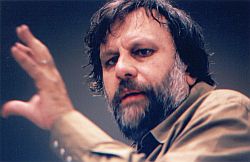 Many American academics and pundits from thinktankland should study the way Slavoj Žižek expresses himself. Passionate, emphatic, uninhibited, eccentric, and humorous — above all, a man who knows what it means to speak your mind. This is a display that shows that deep analysis does not need the protection of cover-your-ass-caveats or manicured sobriety. It can be an act of genuine self-expression.