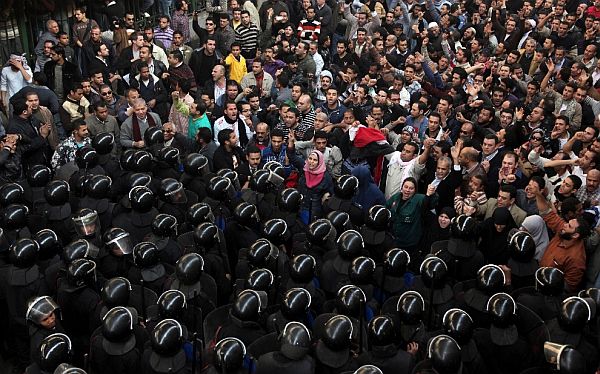
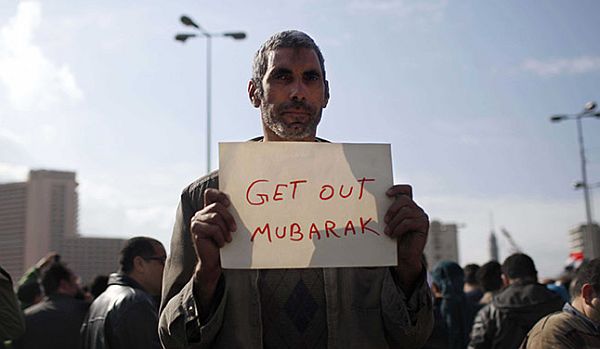
Senior members of the U.S. Congress are debating whether to halt foreign aid to Egypt as a way to hasten President Hosni Mubarak’s exit from power amid continuing protests against his three-decade rule.
Senator Patrick Leahy, the chairman of the panel that controls foreign aid, said he’s prepared to stop all U.S. financial assistance to Egypt — which topped $1.5 billion last year — unless Mubarak steps aside immediately and allows a transitional government to take over.
“If he doesn’t leave, there will not be foreign aid; I mean, it’s as simple as that,” Leahy, a Vermont Democrat, told Bloomberg Television in an interview yesterday. U.S. money “will not go to the Mubarak administration,” Leahy said, adding, “that’s a pipeline that can easily be turned off.”
Today, the Senate passed a resolution calling on Mubarak to begin the transfer of power to an “inclusive, interim caretaker government.”
The Obama administration is discussing with Egyptian officials a proposal for President Hosni Mubarak to resign immediately, turning over power to a transitional government headed by Vice President Omar Suleiman with the support of the Egyptian military, administration officials and Arab diplomats said Thursday.
Even though Mr. Mubarak has balked, so far, at leaving now, officials from both governments are continuing talks about a plan in which, Mr. Suleiman, backed by Sami Enan, chief of the Egyptian armed forces, and Field Marshal Mohamed Tantawi, the Defense Minister, would immediately begin a process of constitutional reform.
The proposal also calls for the transitional government to invite members from a broad range of opposition groups, including the banned Muslim Brotherhood, to begin work to open up the country’s electoral system in an effort to bring about free and fair elections in September, the officials said.
Senior administration officials said that the proposal is one of several options under discussion with high-level Egyptian officials around Mr. Mubarak, though not him directly, in an effort to convince him to step down now.
The officials cautioned that the outcome depended on several factors, not least of all the mood of the protesters on the streets of Cairo and other Egyptian cities and the dynamics within the Egyptian government. Some officials said there was not yet any indication that either Mr. Suleiman or the military were willing to abandon Mr. Mubarak.
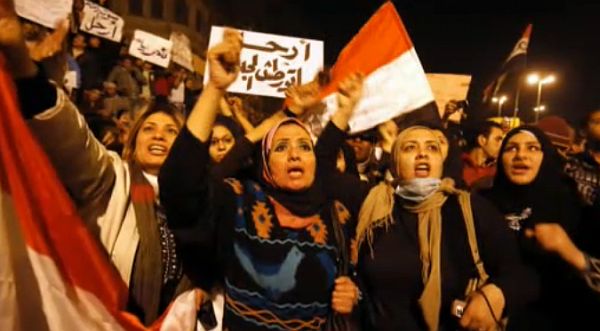
As evidence mounts that the violence in Tahrir Square is a regime-orchestrated attempt to crush dissent and peaceful protest, the manifest flaws in President Mubarak’s plan to remain in office are becoming clear. The Egyptian president, under pressure, committed not to run for a sixth presidential term, but refused to begin a serious process of transition. In essence, he was asking the millions of protesters who had taken to Egypt’s streets in response to 30 years of authoritarian rule to simply trust him. Based on the violent evidence on display in Cairo today and the actions of the regime since the uprising began on January 25th, the protesters have no reason to do so.
As this repressive rearguard action unfolds, the regime is indicating that it is working to preserve the very system that protesters have given their life to bring down. A regime that ruled by fiat and the baton is now using these same tools to defend its power and privileges. Those who have now offered themselves as the vehicles for systemic changes are the very actors that have thwarted political reform for 30 years. Mubarak’s tactical ploy lays bare that he has clearly not understood the calls of the Egyptian people. Now, the very stability prized previously by the United States in its relations with Egypt is no longer possible with Mubarak at the helm. America’s long-term ally is now the primary driver of instability.
When Abdel Haleem Halim approached Hosni Mubarak at a 2002 conference to confront the Egyptian president about rampant unemployment, he says he received a familiar response. Like many of Egypt’s political dissidents, Halim says he was whisked away by the Mubarak regime’s domestic intelligence agents and tortured.
“They would bring me a paper and want me to write and sign a confession,” Halim told ABC News. “But I would refuse to write. So they would torture me because I was defiant.”
Halim claimed that the SSI agents used beatings and electroshock, and that his 2002 encounter was only the latest in a long line of detentions. A veteran political dissident, he said an earlier beating left him with temporary memory loss.
Unlike some victims of the Egyptian government’s security apparatus, however, Halim doesn’t hold the U.S. responsible. Hossam el-Hamalawy, a 33-year-old journalist who says he was tortured by the SSI in 2000, is less forgiving.
“I can’t accept that the U.S government preaches about democracy,” said el-Hamalawy, “while at the same time supporting the Mubarak regime, which has been so brutal to its own people.”
The U.S. State Department has joined international human rights groups in describing a culture of torture within Egyptian’s security agencies, issuing a 2009 report in which it itemized alleged abuses ranging from electroshock to sodomy and said “officials often operated with impunity.” Yet the U.S. government has also funded the Mubarak regime to the tune of more than a billion dollars per year, and since 1995 has used the Egyptians to interrogate terror suspects via extraordinary rendition outside the scrutiny of the U.S. legal system.
Egypt’s Arab Center for the Independence of the Judiciary said today it may ask the International Criminal Court to look into attacks yesterday on demonstrators protesting against President Hosni Mubarak.
“There were attacks on peaceful demonstrators committed by Egyptian regime-backed groups using armed weapons, batons and Molotov cocktails in Tahrir Square,” Nasser Amin, the president of the rights group, said by telephone in Cairo.
“This means there is a possibility of considering those acts crimes against humanity under international law as they involved intentional killings and excessive harm. We are currently documenting these incidents and asking the International Criminal Court to consider them and may at some point submit an official request to the court.”
Reporters Without Borders is horrified by what appears to be an all-out witch-hunt against news media that are covering events in Egypt and is very concerned for all the journalists currently in Cairo, especially on the eve of a major demonstration planned by President Hosni Mubarak’s opponents for tomorrow, which they are describing as the deadline for his departure.
“Theft, violence, arbitrary arrests and extreme violence… the list of abuses against journalists by President Mubarak’s supporters is getting longer by the hour and they are clearly systematic and concerted,” Reporters Without Borders secretary-general Jean-François Julliard said.
“After shutting down the Internet and then reconnecting it at the start of this week, the regime has decided to target media personnel physically by unleashing its supporters in an unprecedented campaign of hatred and violence. This has gone beyond censorship. This is now about ridding Cairo of all journalists working for foreign news media.
Mubarak may be preparing for something which he does not want the world to see. The government is using all tools it can to thwart tomorrow’s big marches in Tahrir Square and elsewhere. They are sending text messages in Arabic through the local mobile phone companies warning people about ‘getting into trouble.’ One message reads: ‘Oh you young people of Egypt, listen to the voice of reason and be warned of rumors. Egypt is above all.’ Mubarak has always portrayed himself as a wise man and the ‘voice of reason.’
Even Fox News is on top of this story:
ABC News has compiled a list of all the journalist who have been in some way threatened, attacked or detained while reporting in Egypt.
Now that so-called “pro-Mubarak supporters” have been unleashed to attack pro-democracy protesters in Cairo, Sarah Carr writes:
The use of hired thugs is classic Mubarak. The regime’s relationship with its people has always depended on intimidation and violence, which proved problematic with the wave of demonstrations and labour protests that have been a growing phenomenon since 2003 – acts of public police rage tend to put the tourists off. In 2005 elections young men were paid to sexually assault female protestors. Last year during the trial of two policemen accused of involvement in the death of Khaled Said a rowdy group of teenagers stood outside the courtroom and accused anti-torture protestors of being Israeli spies, before launching missiles at them. During the elections boys in matching t-shirts danced in front of polling stations while burly colleagues intimated voters on behalf of National Democratic Party candidates.
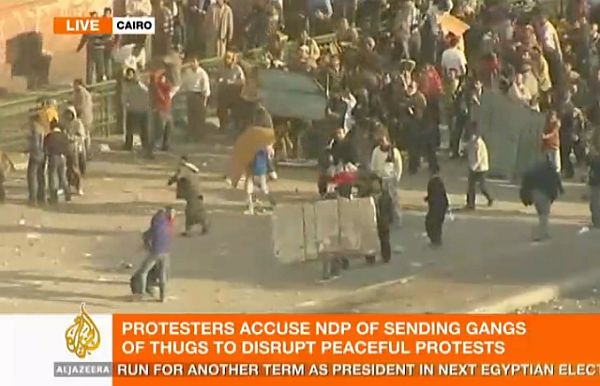
The idea is that these groups of men – who receive a modest daily stipend for their services – can execute regime orders without their actions being directly attributable to them. In the current scenario we are meant to believe that after four days of absolute silence peaceful pro-Mubarak protestors so irrevocably moved by the president’s speech and his promise not to stand for another term decided to organise mass counter protests. And attend these protests on camels and horses. And launch rocks and Molotov cocktails at camping Tahrir protestors whose only act of physical aggression has been against litter in the camp.
Purely coincidentally, the Internet was turned back on in Egypt on the day these millions of Mubarak “loyalists” decided to take to the streets, so the whole world can see the love and respect he commands.
They are a sad, troubled knot of poverty, miseducation and anger, these hired fists, some of them reportedly recruited today for LE 50 (according to activists speaking to thugs detained by anti-government protestors).
More than anything they are a reminder why, no matter what the cost to protestors and to Egyptians struggling to accept the interruption to daily life, the Tahrir occupation must continue. An NDP promise cannot be trusted, and if every last bit of the NDP is not removed Egypt will never heal.
Mubarak’s regime is a cancer that has metastasized and spread to every part of Egyptian society. It has stripped the act of earning a living of its nobility and cheapened the currency of dreams; on our way home we talked to a taxi driver who expressed support for Mubarak. We asked him how exactly he had benefited from Mubarak’s rule and he said “stability”- not opened up new horizons for his children, not given him the opportunity to consider a life of doing something other than taxi-driving. Mubarak has simply ensured that Egypt does not enter into external conflict while declaring a war of never-ending grinding attrition on his own people.
“This is our message to all over the world:
We don’t want to ask anyone for our freedom. We will get our freedom. We are not cowards.”
This was filmed by Philip Rizk and I posted a shorter version without translations a few days ago. He describes the scene:
Following Friday prayers on January 28 we joined protesters marching through the streets of Imbaba in Cairo, Egypt. The crowd of 100 that we joined kept increasing and continuously joined with other marches in the same quarter North West of downtown Cairo. By about 1pm the protesters numbered around 15,000 marching towards Galaa Square and attempting to get across the Nile to Tahrir Square, downtown Cairo. In Galaa square we met two other large marches from Giza and Mohandiseen that had already tried to cross to Tahrir and had come under heavy tear gas fire. Shortly thereafter the converged protesters stormed past the security forces and streamed into Tahrir Square. Soon thereafter the security forces that had used brutal force to stop the protests disappeared and the central square of downtown filled with demonstrators sharing one united call: “down with Hosni Mubarak.” In the early evening protesters burnt down the regime’s National Democratic Party headquarters. The streets were filled with tear gas, burning police vehicles and chants of celebration.
“This is a revolution without leaders. Three Million individuals choosing hope instead of fear and braving death on hourly basis to keep their dream of freedom alive. Imagine that.”
“Bleak outlook for the future of Egypt should revolution fail (god forbid),” wrote the Egyptian blogger, Mahmoud Salem, author of Sandmonkey this morning. His website later went down and he was arrested.
As gunfire rang out around Tahrir Square last night, the prospects for Egypt’s pro-democracy movement did indeed look precarious.
It turns out Salem’s detention was brief — he was roughed up but was able to escape and is now on the run.
Robert Springborg, a professor of national security affairs at the US Naval Postgraduate School, argues that events of the last 24 hours “show us just how clever and experienced [Mubarak] truly is.” Springborg concludes: “The game is, thus, more or less over.” He lays out a compelling argument that the military high command is successfully executing a transfer of power that will ensure Egypt remains under military control. He predicts: “The military will now enter into negotiations with opposition elements that it chooses. The real opposition will initially be ignored, and then possibly rounded up. The regime will do all possible to restore a sense of business as usual.”
For those whose cynicism has led to a belief in the unassailable power of the state, it will be easy at this juncture to see Egypt’s revolution withering. This is indeed a moment that separates those who believe in their own power to shape the future and those who live lives of resignation.
In an interview on Al Jazeera last night, one protester was asked why she and others gathered in Tahrir Square would not go home now they know Mubarak will stand down. “Why,” she responded, “should we believe a government that is trying to kill us. If we leave we now we will then be hunted down, one by one.”
Ayman Mohyeldin reports that the attitude among protesters today is that Tahrir Square is not just the symbolic center of the revolution but has become territory that they will guard and defend until the revolution has been won. Mubarak has underestimated the strength of his own people.
Shortly before his arrest, Mahmoud Salem wrote the following post (thankfully saved and reposted by Lisa Goldman before the Egyptian’s blog went down):
I don’t know how to start writing this. I have been battling fatigue for not sleeping properly for the past 10 days, moving from one’s friend house to another friend’s house, almost never spending a night in my home, facing a very well funded and well organized ruthless regime that views me as nothing but an annoying bug that its time to squash will come. The situation here is bleak to say the least.
It didn’t start out that way. On Tuesday Jan 25 it all started peacefully, and against all odds, we succeeded to gather hundreds of thousands and get them into Tahrir Square, despite being attacked by Anti-Riot Police who are using sticks, tear gas and rubber bullets against us. We managed to break all of their barricades and situated ourselves in Tahrir. The government responded by shutting down all cell communication in Tahrir square, a move which purpose was understood later when after midnight they went in with all of their might and attacked the protesters and evacuated the Square. The next day we were back at it again, and the day after. Then came Friday and we braved their communication blackout, their thugs, their tear gas and their bullets and we retook the square.
We have been fighting to keep it ever since.
That night the government announced a military curfew, which kept getting shorter by the day, until it became from 8 am to 3 pm. People couldn’t go to work, gas was running out quickly and so were essential goods and money, since the banks were not allowed to operate and people were not able to collect their salary. The internet continued to be blocked, which affected all businesses in Egypt and will cause an economic meltdown the moment they allow the banks to operate again. We were being collectively punished for daring to say that we deserve democracy and rights, and to keep it up, they withdrew the police, and then sent them out dressed as civilians to terrorize our neighborhoods. I was shot at twice that day, one of which with a semi-automatic by a dude in a car that we the people took joy in pummeling. The government announced that all prisons were breached, and that the prisoners somehow managed to get weapons and do nothing but randomly attack people. One day we had organized thugs in uniforms firing at us and the next day they disappeared and were replaced by organized thugs without uniforms firing at us. Somehow the people never made the connection.
Despite it all, we braved it. We believed we are doing what’s right and were encouraged by all those around us who couldn’t believe what was happening to their country. What he did galvanized the people, and on Tuesday, despite shutting down all major roads leading into Cairo, we managed to get over 2 million protesters in Cairo alone and 3 million all over Egypt to come out and demand Mubarak’s departure. Those are people who stood up to the regime’s ruthlessness and anger and declared that they were free, and were refusing to live in the Mubarak dictatorship for one more day. That night, he showed up on TV, and gave a very emotional speech about how he intends to step down at the end of his term and how he wants to die in Egypt, the country he loved and served. To me, and to everyone else at the protests this wasn’t nearly enough, for we wanted him gone now. Others started asking that we give him a chance, and that change takes time and other such poppycock. Hell, some people and family members cried when they saw his speech. People felt sorry for him for failing to be our dictator for the rest of his life and inheriting us to his Son. It was an amalgam of Stockholm syndrome coupled with slave mentality in a malevolent combination that we never saw before. And the Regime capitalized on it today.
Today, they brought back the internet, and started having people calling on TV and writing on facebook on how they support Mubarak and his call for stability and peacefull change in 8 months. They hung on to the words of the newly appointed government would never harm the protesters, whom they believe to be good patriotic youth who have a few bad apples amongst them. We started getting calls asking people to stop protesting because “we got what we wanted” and “we need the country to start working again”. People were complaining that they miss their lives. That they miss going out at night, and ordering Home Delivery. That they need us to stop so they can resume whatever existence they had before all of this. All was forgiven, the past week never happened and it’s time for Unity under Mubarak’s rule right now.
To all of those people I say: NEVER! I am sorry that your lives and businesses are disrupted, but this wasn’t caused by the Protesters. The Protesters aren’t the ones who shut down the internet that has paralyzed your businesses and banks: The government did. The Protesters weren’t the ones who initiated the military curfew that limited your movement and allowed goods to disappear off market shelves and gas to disappear: The government did. The Protesters weren’t the ones who ordered the police to withdraw and claimed the prisons were breached and unleashed thugs that terrorized your neighborhoods: The government did. The same government that you wish to give a second chance to, as if 30 years of dictatorship and utter failure in every sector of government wasn’t enough for you. The Slaves were ready to forgive their master, and blame his cruelty on those who dared to defy him in order to ensure a better Egypt for all of its citizens and their children.
After all, he gave us his word, and it’s not like he ever broke his promises for reform before or anything.
Then Mubarak made his move and showed them what useful idiots they all were.
You watched on TV as “Pro-Mubarak Protesters” – thugs who were paid money by NDP members by admission of High NDP officials- started attacking the peaceful unarmed protesters in Tahrir square. They attacked them with sticks, threw stones at them, brought in men riding horses and camels- in what must be the most surreal scene ever shown on TV- and carrying whips to beat up the protesters. And then the Bullets started getting fired and Molotov cocktails started getting thrown at the Anti-Mubarak Protesters as the Army standing idly by, allowing it all to happen and not doing anything about it. Dozens were killed, hundreds injured, and there was no help sent by ambulances. The Police never showed up to stop those attacking because the ones who were captured by the Anti-mubarak people had police ID’s on them. They were the police and they were there to shoot and kill people and even tried to set the Egyptian Museum on Fire. The Aim was clear: Use the clashes as pretext to ban such demonstrations under pretexts of concern for public safety and order, and to prevent disunity amongst the people of Egypt. But their plans ultimately failed, by those resilient brave souls who wouldn’t give up the ground they freed of Egypt, no matter how many live bullets or firebombs were hurled at them. They know, like we all do, that this regime no longer cares to put on a moderate mask. That they have shown their true nature. That Mubarak will never step down, and that he would rather burn Egypt to the ground than even contemplate that possibility.
In the meantime, State-owned and affiliated TV channels were showing coverage of Peaceful Mubarak Protests all over Egypt and showing recorded footage of Tahrir Square protest from the night before and claiming it’s the situation there at the moment. Hundreds of calls by public figures and actors started calling the channels saying that they are with Mubarak, and that he is our Father and we should support him on the road to democracy. A veiled girl with a blurred face went on Mehwer TV claiming to have received funding by Americans to go to the US and took courses on how to bring down the Egyptian government through protests which were taught by Jews. She claimed that AlJazeera is lying, and that the only people in Tahrir square now were Muslim Brotherhood and Hamas. State TV started issuing statements on how the people arrested Israelis all over Cairo engaged in creating mayhem and causing chaos. For those of you who are counting this is an American-Israeli-Qatari-Muslim Brotherhood-Iranian-Hamas conspiracy. Imagine that. And MANY PEOPLE BOUGHT IT. I recall telling a friend of mine that the only good thing about what happened today was that it made clear to us who were the idiots amongst our friends. Now we know.
Now, just in case this isn’t clear: This protest is not one made or sustained by the Muslim Brotherhood, it’s one that had people from all social classes and religious background in Egypt. The Muslim Brotherhood only showed up on Tuesday, and even then they were not the majority of people there by a long shot. We tolerated them there since we won’t say no to fellow Egyptians who wanted to stand with us, but neither the Muslims Brotherhood not any of the Opposition leaders have the ability to turn out one tenth of the numbers of Protesters that were in Tahrir on Tuesday. This is a revolution without leaders. Three Million individuals choosing hope instead of fear and braving death on hourly basis to keep their dream of freedom alive. Imagine that.
The End is near. I have no illusions about this regime or its leader, and how he will pluck us and hunt us down one by one till we are over and done with and 8 months from now will pay people to stage fake protests urging him not to leave power, and he will stay “because he has to acquiesce to the voice of the people”. This is a losing battle and they have all the weapons, but we will continue fighting until we can’t. I am heading to Tahrir right now with supplies for the hundreds injured, knowing that today the attacks will intensify, because they can’t allow us to stay there come Friday, which is supposed to be the game changer. We are bringing everybody out, and we will refuse to be anything else than peaceful. If you are in Egypt, I am calling on all of you to head down to Tahrir today and Friday. It is imperative to show them that the battle for the soul of Egypt isn’t over and done with. I am calling you to bring your friends, to bring medical supplies, to go and see what
Mubarak’s gurantees look like in real life. Egypt needs you. Be Heroes.
Yesterday, Sandmonkey gave the following phone interview with the American conservative blogger, Roger L Simon:
Update: This afternoon, Salem was interviewed by CBS News and described being attacked by police: “People were grabbing rope and telling us they would lynch us. It was a horrific experience.”
Christopher Dickey spoke with Nawal El Saadawi, an 80-year-old protester, about her refusal to go home when the protests in Cairo’s Tahrir Square turned violent. “They have a strategy to frighten us and to starve us,” she said.
To appreciate what is taking place in the Arab world today you have to grasp the historical significance of the events that have started changing rulers and regimes in Tunisia and Egypt, with others sure to follow. What we are witnessing is the unraveling of the post-colonial order that the British and French created in the Arab world in the 1920s and 1930s and then sustained – with American and Soviet assistance – for most of the last half-century.
It is fascinating, if insular, to focus attention, as much Western media are doing, on whether Facebook drove these revolts; or to ask what will happen if the Muslim Brotherhood plays a role in any new Egyptian government. The Arabs are like a bride emerging on her wedding day to face people commenting on whether her shoes match her gloves, when the real issue is how beautiful and happy she is.
The events unfolding before our eyes in Egypt, after Tunisia, are the third most important historical development in the Arab region in the past century, and to miss that point is to perpetuate a tradition of Western Orientalist romanticism and racism that have been a large cause of our pain for all these years. This is the most important of the three major historical markers because it is the first one that marks a process of genuine self-determination by Arab citizens who can speak and act for themselves for the first time in their modern history.
The United States was not responsible for the inequity of Mubarak’s rule, but it did enable and benefit from it. Mubarak was long Washington’s man in Cairo: he kept open the Suez Canal, repressed the Islamists, and maintained peace with Israel. In return, the United States provided much for Egypt, contributing billions in economic assistance over the years to build up the country’s infrastructure, agricultural technology, and public health programs. Yet this U.S. assistance, while certainly contributing to Egypt’s development, also served to undermine the nationalist legitimacy of the regime. After all, how could Mubarak boast of Egyptian pride and ability when USAID employees were nestled in many government ministries?
At the same time, Egyptians came to see that their country’s foreign policy was being warped for the sake of U.S. largesse — and that the jackboots of the Interior Ministry awaited those who objected too loudly to this bargain. The original sin was Sadat’s separate peace with Israel, which Mubarak inherited and scrupulously upheld.
From the perspective of many Egyptians, this arrangement hopelessly constrained Cairo’s power while freeing Israel and the United States to pursue their regional interests unencumbered. Without the threat of war with Egypt, Israel poured hundreds of thousands of Israelis into settlements in the West Bank and the Gaza Strip, invaded Lebanon (twice), declared Jerusalem its capital, and bombed Iraq and Syria. For the United States, Mubarak was pivotal in creating a regional order that made it easier and less expensive for Washington to pursue its interests, from the free flow of oil to the protection of Israel and the prevention of any one country in the region from becoming too dominant. The benefits to Mubarak were clear: approximately $70 billion in economic and military aid over 30 years and the ostensible prestige of being a partner of the world’s superpower.
Amil Khan, a former Reuters Middle East correspondent, writes:
For the best part of a decade, I had the opportunity to see how Mubarak misruled and brutalized his people. In the fertile Nile Delta, where plants can grow so green they seem fluorescent, I visited a village where a local wealthy landowner had pushed small farmers off their land with the help of hired thugs. The villagers had appealed to the police, but the local officer had been bought off. The police reacted in the way they had grown accustomed to a system in which there was no accountability for their actions — they assaulted the most vulnerable. Police troopers raided the village, burned crops, and stole belongings. When they realized that most of the men had fled in fear of mass arrest, they beat the children. The senior officer and the landowner had hoped the villagers would be bullied into submission. When the villagers organized themselves and chose a representative to seek help in Cairo from the judiciary and human rights groups, the troopers returned to the village to track him down. When they failed, they found his wife, ripped off her clothes, and paraded her naked through the village — a warning to others who defied the powers that be.
The wider world didn’t avoid seeing Mubarak’s incompetence and brutality simply because the excesses happened out of sight in the countryside. The outrages were ignored when they happened in central Cairo, too. On May 25, 2005, state security decided to escalate its use of hired thugs as a method of crowd control. Hundreds of young, largely secular left-wing activists gathered in central Cairo to protest for democratic reform. State-security forces penned in the protesters and then sent in the hired goons. In the scuffles, one of the thugs was captured by the activists. I heard him tell a group of activists and journalists that he had been in a police cell the night before for pickpocketing, but was released on the condition that he help police “rough up” people they had told him were “traitors.” Police officials, he said, promised him and the other prisoners a Coke and a Kentucky Fried Chicken meal deal as a reward.
The other thugs made straight for the female protesters and ripped off their clothes and sexually assaulted them as uniformed police officers watched from the sidelines. The fact that a U.S. ally was using sexual violence as a political weapon against secular “natural allies” of democracy a couple of days after the U.S. president’s wife visited the country and gave a speech on women’s rights was little reported abroad. The fact that the regime received little criticism for the tactic, probably convinced Mubarak that employing it was not only cheap but effective — which explains why his regime has resorted to it time and again.
Torture is an endemic problem in Egypt and ending police abuse has been a driving element behind the massive popular demonstrations that swept Egypt over the past week, Human Rights Watch said in a report released today. Prosecuting torture and ending the emergency laws that enable a culture of impunity for the security forces should be a priority for the Egyptian government, Human Rights Watch said.
The 95-page report, “‘Work on Him Until He Confesses’: Impunity for Torture in Egypt,” documents how President Hosni Mubarak’s government implicitly condones police abuse by failing to ensure that law enforcement officials accused of torture are investigated and criminally prosecuted, leaving victims without a remedy.
“Egyptians deserve a clean break from the incredibly entrenched practice of torture,” said Joe Stork, deputy director of the Middle East and North Africa Division at Human Rights Watch. “The Egyptian government’s foul record on this issue is a huge part of what is still bringing crowds onto the streets today.”
The case of Khaled Said, a 28-year-old man beaten to death by two undercover police officers on an Alexandria street in June, dominated headlines and set off demonstrations across the country. The local prosecutor initially closed an investigation and ordered Said’s burial, but escalating public protests prompted the Public Prosecutor to reopen the investigation and refer it to court. “We Are All Khaled Said” is the name of the Facebook group that helped initiate the mass demonstrations on January 25, 2011.
Unlike the bland, state-owned Egyptian station, or its more conservative, Saudi-owned rival Al Arabiya, Al Jazeera has captured the hopes of the crowds gathering on the streets of Cairo.
“The genius of Arab satellite TV,” Abderrahim Foukara, Washington bureau chief for Al Jazeera, once told me, “is that it [has] captured a deep-seated common existential pain called Arab sensibility and turned it into a picture narrative that speaks to something very deep in the Arab psyche.”
Put another way: There is no chance that the world would be watching these extraordinary events play out in Egypt if Egyptians had not watched the Tunisian revolution play out in their living rooms and coffee shops on Al Jazeera.
The media is by no means the only force at play in the continuing upheaval in Egypt, the Tunisian revolution, or the copy-cat demonstrations going on elsewhere in the Arab world. At root is a raw anger fed by decades of political, intellectual, and economic stagnation that has led to a powerful convergence of the region’s three main political trends — pan-Arab nationalism, nation-state nationalism, and Islamism.
However, Arab media have been at the vanguard of articulating this new and explosive development. Arab satellite television, such as Al Jazeera — and the increasingly aggressive ethos of Arab print journalism exemplified by newspapers like Egypt’s Al-Masry Al-Youm and Tunisia’s crusading Kalima Tunisie — have fueled a sense of common cause among Arabs across the region every bit as real as the “imagined communities” that are at the core of the concept of nation.
President Obama has promoted the lie that Hosni Mubarak as the capacity to lead an orderly transition towards a democratic Egypt. Mubarak’s thugs, by spilling the blood of Egyptian people on the streets of Cairo today, have exposed the lie.
It’s time for Obama to stop hiding from the press and come out and call for Mubarak to resign now.
Mustafa el-Gindy, a former independent member of the Egyptian parliament and current member of the opposition, presents the opposition’s plan through which the opposition in concert with the army can lead the the post-Mubarak transition.
White House hiding from the press — David Corn: “WH journos send letter to Gibbs protesting that WH has shut out press in past 2 days, not able to ask POTUS/Gibbs Qs re #Egypt.”
[T]he U.S. had a recent history of backing popular movements in a wide range of countries, in a rainbow of colors, and in an eclectic mix of monikers and symbols. From Georgia to Iran, the will of the people was supported, marketed and managed by Washington as it berated authoritarian regimes and glorified the democratic aspirations of the secular masses.
This noble approach came to a screeching halt on January 25, when like the Tunisians before them, Egyptians took massively to the streets with no banners, no colored wristbands and no slogans other than “the people want the fall of the regime.”
Taken yet again by surprise, Washington pretended to look the other way until the protesters swelled to millions in mere days, while Egypt was cut off from the Internet and mobile calls. Unenthusiastically, US officials mumbled generalities about basic rights to non-violent demonstrations and to communication. And when President Obama addressed his nation personally last night, all he could muster was a patronizing compliment to the Egyptian army and a vague call for an “orderly transition.” Orderly for whom, however, was not specified.
11.02 — @Sandmonkey: “Pro Mubarak people are throwing molotov cocktails on the egyptian museum and setting it on fire. #jan25”
10.57 — Nicholas Kristof: “It’s not quite right to describe what’s happening in #Tahrir as “clashes.” These are attacks by #Mubarak thugs.”
Council on Foreign Relations Egypt expert Steve Cohen said the army’s behavior Wednesday suggested complicity and a possible pretext for imposing martial law.
“How will the military restore order if they are involved in this, if by only standing aside and issuing warnings?” Cook said by e-mail.
“It’s clear that Mubarak, [Vice President Omar] Suleiman and the senior command are still in charge,” he said. “This may provide a pretext for the army to intervene, restore order, and reconstitute the political order.”
“It was massive unrest that ultimately led to the Free Officers’ coup in 1952,” he said. “People will be relieved when order is restored. Sound familiar?”
10.36 — CNN’s Ben Wedeman: “People in Tahrir square begging Obama to intervene. They are terrified a bloodbath is about to occur. #Jan25 #Egypt”
10.17 — Nicholas Kristof: “I tried to interview a young woman who was surrounded and bullied by Mubarak’s thugs. She stood her ground.heroically.” “Then the mob prevented me from talking to her, and she slipped away. It’s #Mubarak thugocracy on #Tahrir.”
The descent into seemingly regime-orchestrated mob violence put the Obama administration under increasing pressure to accelerate Mubarak’s departure.
“This is exactly what we have been saying: that the longer this went on, the more chance of violence,” the Carnegie Endowment for International Peace’s Michele Dunne told POLITICO Wednesday. “I am pretty sure that these ‘pro-Mubarak demonstrators’ are organized by the security forces, who have always used plainclothes thugs to intimidate demonstrators and to turn peaceful demonstrations violent.” …
Dunne said that the Obama administration should privately press Egypt’s military to “restore stability to the country. That is going to mean Mubarak leaving office now and the military negotiating transition arrangements with the opposition.”
10.09 — Nicholas Kristof: “Pro-Mubarak thugs everywhere have same talking points, same signs, same hostility to journalists. An organized crackdown.”
10.05 — Mondoweiss: “Even NBC’s Brian Williams pronounces pro-Mubarak forces ‘recruited and compensated'”
9.59 — BBC: “Prime Minister David Cameron condemns violence in Egypt in joint statement outside Downing Street with UN Secretary General.”
9.59 — Obama administration official handwringer: “We are concerned about detentions and attacks on news media in #Egypt. The civil society that Egypt wants to build includes a free press.”
9.57 — Nicholas Kristof: “Pro-#Mubarak thugs at #Tahrir v hostile to journalists. Several journalists attacked. I was threatened but am fine.”
As’ad AbuKhalil writes: “There are a lot of similarities already between Iran of 1953 and Egypt of 2011. Don’t forget what happened in 1953 in Iran? The CIA then hired armed goons and thugs to defeat the pro-democracy movement. This time around, the armed goons are hired by the regime itself. Mubarak state TV is now showing “pro-Mubarak” demonstrations all over Egypt. These scenes will only fool Obama and his team.”
9.45 — Nicholas Kristof: “In my part of Tahrir, pro-#Mubarak mobs arrived in buses, armed with machetes, straight-razors and clubs, very menacing.”
So much for President Obama’s ability to steer an orderly transition of power in Egypt. When he laid out his vision last night, it’s no wonder he had so little to say about Mubarak’s response. That Mubarak acknowledged the status quo is unsustainable and change must take place, said nothing about his intentions to realign the balance of power.
As the Egyptian president took the call from the White House, two facts must have been uppermost in his mind: the fact that preparations were already in place through which his thugs could unleash chaos on the streets, and the fact that he was being addressed by a spineless American president.
“I urge the [Egyptian] military to continue its efforts to help ensure that this time of change is peaceful,” Obama said last night. Well, as Al Jazeera is now showing, mayhem has been unleashed on the streets around Tahrir Square and the army has done nothing to intervene.
All those in the last few days who have warned about the dangers of mob rule should take note: the mob is on your side.
The New York Times, in its role as state storyteller, spins a fine yarn about how the White House artfully engineered Hosni Mubarak’s removal. A pivotal place in the narrative goes to “Frank G. Wisner, an adroit ex-diplomat whom President Obama had asked hours before to undertake a supremely delicate mission: nudging President Hosni Mubarak of Egypt out of power.”
Senior officials say that as Mr. Wisner traveled to Egypt, Obama officials in Washington were working on his message to Mr. Mubarak: to announce that he would not run for re-election (he did that), and to promise that his son would not run for election (he did not do that).
“No one wanted it to seem as if we were pushing him out,” one administration official said. “That would not serve American interests. It was important for President Mubarak to make the decision.”
Two hours after Mr. Wisner’s plane left Andrews Air Force Base, White House officials sent an e-mail to more than a dozen foreign policy experts in Washington, asking them to come in for a meeting on Monday morning. “Apologies for the short notice in light of a very fluid situation,” the e-mail said.
The Roosevelt Room meeting, led by Benjamin Rhodes, the deputy national security adviser for strategic communications, and two other National Security Council officials, Daniel Shapiro and Samantha Power, examined unrest in the region, and the potential for the protests to spread, according to several attendees.
Significantly, during the meeting, White House staff members “made clear that they did not rule out engagement with the Muslim Brotherhood as part of an orderly process,” according to one attendee, who like others interviewed for this article spoke on condition of anonymity because he did not want to talk publicly about the meeting. The Muslim group had been suppressed by Mr. Mubarak, and Bush administration officials believed it was involved in terrorist activities. It renounced violence years ago.
Several times, two other attendees said, White House staff members said that Mr. Obama believed that Egyptian politics needed to encompass “nonsecular” parties: diplomatic-speak for the Muslim Brotherhood.
“Orderly transition” is now the name of the game, but what remains unclear is whether Mubarak intends on sticking to the script.
After a half-hour conversation this evening, the only element of Mubarak’s thinking that Obama disclosed during his televised remarks was this: “He recognizes that the status quo is not sustainable and that a change must take place.”
That seems to leave open a wide range of possibilities — and one inconvenient fact: Mubarak is still Egypt’s president.
Dictators invariably see themselves as uber-nationalists — right to the point of seeing themselves as indivisible from the nation. Mubarak’s refusal to bow out swiftly means he has chosen chaos. The US and the rest of the world no longer have the luxury of meekly watching from afar.
Mubarak wants to stick around for a few more months — game not over.
Frank Wisner, a former ambassador to Egypt who has good relations with the Mubarak regime, traveled to Cairo at President Obama’s behest to talk to the Egyptian leader about the country’s future.
Wisner delivered a direct message that Mubarak should not be part of the “transition” that the U.S. had called for, according to Middle East experts who spoke on condition of anonymity.
One expert on the region said that in his regular conversations with the Obama administration about the unrest in Egypt, he learned that Wisner’s message to Mubarak was that “he was not going to be president in the future. And this message was plainly rebuffed.”
Reuters — Mubarak will say in a televised speech that he will step down at the next election but would stay in office till then to meet demands of protesters in that period, Al Arabiya TV reported on Tuesday.
New York Times — “President Obama has told the embattled president of Egypt, Hosni Mubarak, that he should not run for another term in elections in the fall, effectively withdrawing American support for its closest Arab ally, according to American diplomats in Cairo and Washington.”
The Rorschach test from Cairo: a dignified and disciplined act of collective prayer? Or a dangerously large gathering of Muslims?
Perhaps more than anything, American perceptions of Islam reveal the extent to which this nation celebrates religion without the slightest notion of piety — not surprising, given the degree to which religion and nationalism have become interwoven.
— —
“It needs to be understood that if the Egyptian government will fall, the Muslim Brotherhood will take its place, and that will cause even worse problems not only for the Middle East, but for the whole world.” This is the assessment of Israel’s Deputy Minister for Galilee and Negev Development Ayoub Kara.
What’s interesting about these kind of the-sky-is-falling predictions coming from Israel and its febrile supporters is that in a matter of months their fears are likely to be proved baseless. To begin with, the great Islamist bogeyman of Egypt, the Muslim Brotherhood, is likely to move from unofficial to legal participation in parliamentary politics quite cautiously. This is a conservative organization in the traditional sense of the term “conservative” — as opposed to the histrionic modern American meaning of the word. Indeed, I doubt that any single political group will be in a rush to grab power during the most difficult period of Egypt’s political rebirth.
The most immediate point of tension between a new Egyptian government and Israel will be over Gaza and this will be the test of the new government’s democratic credentials. Hopefully it will do the right thing and refuse to be complicit in the siege. But of course I’m getting way ahead of events now …
Jeff Jarvis: “Vital, world-changing news is occurring in the Middle East and no one — not the xenophobic or celebrity-obsessed or cut-to-the-bone American media — can bring the perspective, insight, and on-the-scene reporting Al Jazeera English can.”
As the region reconfigures itself, the US should help Israel adjust to a new reality – convincing Israel to withdraw from the Palestinian territories would be the best option, but just explaining to Israel that America now has to deal with an Arab politics that is in its post-dictatorship phase and will henceforth have to be more responsive to public opinion – that will be a necessity.
Indeed — but that could be asserted even more strongly, which is to say, come the day that the US government no longer has at its disposal a clutch of autocratic rulers who depend for their survival on US support, the US will no longer be able to afford the luxury of deferring to Israel’s interests. In other words, this is an opportunity for everyone to grow up — no more pandering to a whiny Zionist brat that has long relied on its ability to manipulate its over-indulgent American parent.
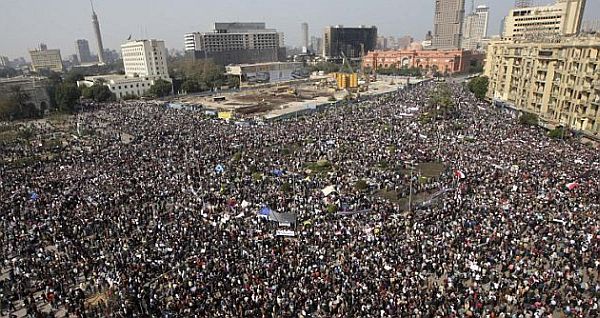
11.16 — Alaa Abd El Fattah: “it looks like across the nationion 4-6 million went out, that’s %5–%8 of the population folks”
The Guardian — Bibliotheca Alexandrina and other cultural sites across Egypt are being protected by Egypt’s young people:
In a statement on the library’s site, Ismail Serageldin tells “friends around the world” that the library is being protected by the city’s youth from the threat of looting by the “lawless bands of thugs, and maybe agents provocateurs” who have materialised since the popular protests sweeping through Egypt’s major cities began several days ago.
“The young people organised themselves into groups that directed traffic, protected neighborhoods and guarded public buildings of value such as the Egyptian Museum and the Library of Alexandria,” he states. “They are collaborating with the army. This makeshift arrangement is in place until full public order returns.”
The Clash of Conservatives! Egyptian revolution causes a split between right-wing xenophobic isolationist Glenn Beck and right-wing xenophobic US hegemonist Bill O’Reilly. Hopefully it won’t take long before all of their hysterical fear-mongering predictions are exposed as baseless. They and many other Americans would be well-served by remembering the courageous and inspiring example that many Egyptian Muslims showed in early January when they offered themselves as human shields, protecting fellow Egyptians who are Christians.
9.04 — While the US State Department is organizing the evacuation of American citizens from Egypt (even though the US acknowledges that there have been no signs of hostility towards Americans), Al Jazeera reports that some tourists from several countries, rather than trying to leave have instead joined the revolution. There are claims that as many as eight million Egyptians across the country are now protesting, calling for Mubarak to stand down. As many as two million are now gathered in Tahrir Square in the center of Cairo.
8.30 — Al Jazeera: Opposition leaders say they will enter into dialogue with Vice President Omar Suleiman after Mubarak stands down.
Simon Tisdall writes: “Suleiman is, in effect, heading a military junta at this point, with all the principal civilian power positions – the presidency, the vice-presidency, the premiership, the defence and interior ministries – held by former senior officers, and with the military itself in full support.
“Mubarak is now reduced to the role of figurehead, sheltering behind this clique. But they will not sacrifice him if they can avoid it. There will be no ignominious flight to Saudi Arabia, like Tunisia’s deposed president, Zine al-Abidine Ben Ali. Mubarak’s pride won’t allow it. The military’s pride won’t allow it.”
New York Times — Obama sends envoy, Frank G. Wisner, to meet Mubarak. No word on what if any message he’s carrying.
Scenes from Tahrir Square:
Interview with anti-government protester at Tahrir Square:
Ahdaf Soueif writes: “Today we have rejected the passivity our rulers have been imposing on us. Our country’s security is being provided by its citizenry. People have automatically taken over the running of their neighbourhoods. On the streets there is unfailing courtesy. The atmosphere in the square sit-ins is celebratory and inclusive.”
Al Jazeera — Erdogan calls for Mubarak to stand down:
EU calls for an orderly transition to a broad-based government:
Bloomberg — The Washington lobbyists in bed with Mubarak
Steven Cook writes: “If anyone ever doubted it, recent events highlight that the armed forces is the pillar of the regime. The National Democratic Party no longer exists. Big business has fled. The police (remember all those arguments about how the police supplanted the military?) forces have collapsed. Only the military remains and thus far they don’t seem to be budging. We are getting into existential territory. The result could be a drawn out stalemate with the military pursuing a holding action while Omar Soleiman’s intelligence service tries to split the opposition. These guys are brutal, but not dumb.”
Helena Cobban writes: “There are many objective reasons why Washington has been unable to intervene to prop up its longtime ally. What, after all, could Washington have hoped to do? It has no strike force of its own capable of swooping in and beating back the protesters, in the way that the British or French empires might have attempted in similar circumstances 100 years ago. And in an era in which protesters can immediately hold up for the cameras of the global media tear gas shells or rubber-coated steel bullets that clearly signal “Made in the USA,” there is not a lot of indirect help Washington could have given Mubarak’s security forces, either.”
Jeremy Scahill writes: “The real threat Al Jazeera poses to authoritarian regimes is in its unembedded journalism. That is why the Bush Administration viewed Al Jazeera as a threat, it is why Mubarak’s regime is trying to shut it down and that is why the network is so important to the unfolding revolutions in the Middle East. It is the same role the network plays in reporting on the disastrous US war in Afghanistan.”
Wadah Khanfar, Director General, Al Jazeera Network, says:
As I write, Egyptian President Mubarak is closing our offices and arresting our journalists. The Egyptian government has removed Al Jazeera from NileSat, the state-owned satellite carrier, delaying our ability to be found on the dial in Egypt and North Africa. We have reappeared through other carriers, while instructions on how to find us go viral across the Internet.
Elsewhere, in the United States, Al Jazeera faces a different kind of blackout, based largely on misinformed views about our content and journalism. Some of the largest American cable and satellite providers have instituted corporate obstacles against Al Jazeera English. We are on the air and on the major cable system in the nation’s capital, and some of America’s leading policymakers in Washington, D.C., have told me that Al-Jazeera English is their channel of choice for understanding global issues. But we are not available in the majority of the 50 states for much of the general public.
We believe all Americans, not just those in senior governmental positions, could benefit from having the option to watch Al-Jazeera English — or not to watch us — on their television screens.
We know the demand is there. We have seen a 2000 percent increase in hits on our English-language website, and more than 60 percent of that traffic originates in the United States. We have seen Jeff Jarvis, in the pages of the Huffington Post, make the case publicly that many are making privately. While millions of Americans have turned to the Internet and to Internet-connected-devices, many more millions should have the freedom to flip to our channel on their remotes — especially when the Middle East is on everyone’s mind.
As the Million Egyptian March takes to the streets of Cairo, is President Obama finally ready to take a strong stand on the side of the people?
In The Guardian, Michael Tomasky writes “Obama is in no position to offer the moral thunder the protesters and their supporters everywhere crave.” Why? Because “the US should not be dictating outcomes any more. The modern world requires a US posture that is more fluid and subtle, and that no longer seeks to call the global shots.”
Having watched events over the last week as closely as one can from a great distance, I would say there has been no lack of moral thunder. It has come from the voices of the Egyptian people.
Having demonstrated their pride, dignity, and collective power with such force, I don’t think they crave anything from Washington or anywhere else — bar the fulfillment of their single demand: that Hosni Mubarak stand down.
To the extent that the expectations of many Egyptians and others are directed towards Washington and Obama, it is perhaps with the hope that anyone who supports democracy would celebrate the extraordinary sight of democracy being born.
Obama’s inhibitions probably say less about the fear of being perceived in the Middle East as the leader of an imperial power which still insists on calling the global shots, than in being seen by his fellow Americans supporting a revolution that they fear.
Indeed, as Benjamin Netanyahu compares the Egyptian revolution of 2011 with the Iranian revolution in 1979, Obama surely fears some form of retribution from AIPAC in 2012 if he is portrayed as having undermined Israel’s security. Above all, the 2012 incumbent presidential candidate does not want to be cast as having played a role in shaping Egypt’s future.
The most courageous thing Obama could do at this point would not be to make some grandiose expression of American support for the Egyptian people — an expression which this late in the day would carry little credibility. No, if he wants to stand up in defense of democracy, he should addressing a domestic audience — one that apparently has lost faith that democracy is a good thing.
If Americans can’t support the democratic rights of Egyptians, what does that say about how seriously we want to protect our own rights? After all, the unalienable rights upon which America was founded were not conceived as American rights but universal human rights. If we don’t stand in solidarity with Egyptians, have we not also lost faith in the principles upon which America was founded?
Obama once declared:
I do have an unyielding belief that all people yearn for certain things: the ability to speak your mind and have a say in how you are governed; confidence in the rule of law and the equal administration of justice; government that is transparent and doesn’t steal from the people; the freedom to live as you choose. These are not just American ideas; they are human rights. And that is why we will support them everywhere.
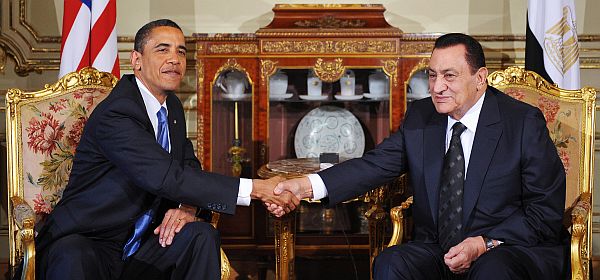
But what held the greater significance? The sentiment and meaning of Obama’s words or the fact that he delivered them as the honored guest of Hosni Mubarak?
This website or its third-party tools use cookies, which are necessary to its functioning. By closing this banner, you agree to the use of cookies.