Category Archives: Iran

Three key lessons from Obama’s China tour

Three key lessons from Obama’s China tour

Russia may be engaged in a geopolitical chess game with the U.S. aimed at recovering from the demise of its great power status, but China is different. It pushes back against U.S. initiatives only when those are deemed inimical to its national interests. Iran is a good example. Beijing’s heavy investment in and reliance on Iran’s energy sector make it extremely averse to serious sanctions or strategies that create political turmoil in Tehran. While insisting on compliance with the non-proliferation regime, Beijing does not believe Iran represents an imminent nuclear weapons threat. And its response to North Korea going nuclear suggests that a nuclear armed Iran is something it could live with.

Obama went to China arguing that its emergence as a major power gives it greater responsibility, as a partner to the U.S., in helping run the world and tackle such global challenges as climate change and Iran. Indeed, there was a collective shudder in Europe’s corridors of power at the idea of global leadership being concentrated in a “G2” partnership between Washington and Beijing. They needn’t have worried. China’s response to Obama could be read as: “Running the world is your gig, we’re focused on running our own country, and ensuring security in our immediate neighborhood. We want harmonious relations with you, but don’t expect us to do anything that we deem harmful to our national interests.” That means no serious sanctions against Iran, regardless of what deals are struck between Washington and Moscow, because China’s national interests require growing Iran’s energy exports. [continued…]

Facebooktwittermail

Cleric wields religion to challenge Iran’s theocracy

Cleric wields religion to challenge Iran’s theocracy

For years, Grand Ayatollah Hossein Ali Montazeri criticized Iran’s supreme leader and argued that the country was not the Islamic democracy it claimed to be, but his words seemed to fall on deaf ears. Now many Iranians, including some former government leaders, are listening.

Ayatollah Montazeri has emerged as the spiritual leader of the opposition, an adversary the state has been unable to silence or jail because of his religious credentials and seminal role in the founding of the republic.

He is widely regarded as the most knowledgeable religious scholar in Iran and once expected to become the country’s supreme leader until a falling-out with Ayatollah Ruhollah Khomeini, the leader of the 1979 revolution and Iran’s supreme leader until his death in 1989.

Now, as the Iranian government has cracked down to suppress the protests that erupted after the presidential election in June and devastated the reform movement, Ayatollah Montazeri uses religion to attack the government’s legitimacy.

“We have many intellectuals who criticize this regime from the democratic point of view,” said Mehdi Khalaji, a former seminary student in Qum and now a senior fellow at the Washington Institute for Near East Policy. “He criticizes this regime purely from a religious point of view, and this is very hurtful. The regime wants to say, ‘If I am not democratic enough that doesn’t matter, I am Islamic.’

“He says it is not an Islamic government.” [continued…]

Facebooktwittermail

U.S. talks tougher on dealing with Iran

U.S. talks tougher on dealing with Iran

The international spokesman for Iran’s main opposition movement called for President Barack Obama to increase his public support for Iranian democrats and significantly intensify financial pressure on Tehran’s elite military unit, the Iranian Revolutionary Guard Corps.

Mohsen Makhmalbaf, during an unofficial visit to Washington, also said Thursday that Iranian opposition leaders supported U.S. efforts to use diplomacy to contain the nuclear ambitions of President Mahmoud Ahmadinejad’s government.

Mr. Makhmalbaf’s remarks came just hours after President Obama expressed growing doubt Thursday during the final day of his Asian tour about his administration’s ability to engage Mr. Ahmadinejad’s government on the nuclear issue.

Mr. Obama emphasized in Seoul that the window for diplomacy was closing and that the U.S. and its allies would begin developing a new set of sanctions against Iran.

“Iran has taken weeks now and has not shown its willingness to say yes to this proposal…and so as a consequence we have begun discussions with our international partners about the importance of having consequences,” Mr. Obama said at a joint news conference with South Korean President Lee Myung-bak.

Mr. Makhmalbaf, who was the campaign spokesman for Iranian presidential challenger Mir Hossein Mousavi, said he believes the current Iranian leadership is incapable of cutting a deal with the West, because the nuclear program is now fundamental to its political survival.

“If they agree not to pursue a nuclear bomb and start negotiations, they will lose their supporters,” Mr. Makhmalbaf said at a lunch hosted by the Carnegie Endowment for International Peace. “Definitely dialogue is better than war. … But can you continue your dialogue without any results?” [continued…]

Editor’s Comment — Well, if you want to use the Israeli-Palestinian conflict as a measure, Washington’s interest in promoting dialogue without results apparently knows no limit.

Facebooktwittermail

Is Iraq shifting to Iran?

Is Iraq shifting to Iran?

Are we witnessing a historic shift in the balance of power in the Persian Gulf, with Iran assuming dominance over Iraq? A recent fact-finding trip to Baghdad and Najaf suggests that such fears are exaggerated.

In 2003, the United States overturned the secular but predominantly Sunni Arab regime of Saddam Hussein and then presided over the installation of a more representative Shiite government in Baghdad. This was a huge gift to Iran—itself a Shiite state—and represented a historic shift. Although Iraq is a majority Shiite state, never in more than a thousand years had a predominantly Shiite government ruled there.

The U.S. invasion removed an implacably hostile enemy of Iran that had invaded it in 1980, fought a brutal eight-year war against it in the southern marshes, and created a Sunni Arab coalition with the intent of overturning the Iranian revolution. In an apparent fit of absentmindedness, the G.W. Bush administration succeeded in removing both of Iran’s key rivals—the Taliban was similarly routed in Afghanistan—effectively elevating Iran to the position of a regional superpower. [continued…]

Facebooktwittermail

Nuclear agency warns of more Iran plants

Nuclear agency warns of more Iran plants

The United Nations atomic watchdog said Iran could be constructing a number of covert nuclear installations in addition to a secret uranium-enrichment facility the Obama administration disclosed in late September.

The International Atomic Energy Agency also said in a quarterly report released Monday that Iranian officials have told the U.N. that Tehran plans to begin operating the previously unknown nuclear-fuel facility outside the holy city of Qom by 2011.

The IAEA report is the last to be released under departing Director General Mohamed ElBaradei. U.S. officials have long criticized the Egyptian for deflecting Washington’s criticism of Iran in official reports. Diplomats said Monday that the latest report was notable for its sharp tone. [continued…]

Facebooktwittermail

Why the neocons turned against the Iranian opposition

Why the neocons turned against the Iranian opposition

The campaign against the National Iranian-American Council and its president, Trita Parsi, intensified today with the publication of a long hit piece in the Washington Times by neoconservative journalist Eli Lake. The piece’s unusual length may be an attempt to disguise the thinness of the allegations it contains. Most of the claims are based on hearsay and speculation, and only two-thirds of the way through the meandering 3000-word article does Lake actually discuss whether any of the evidence actually shows that NIAC has lobbied for the Iranian government. At which point we get this brief sentence:

Two lawyers who read some of the same documents [on which the allegations are founded] said they did not provide enough evidence to conclude that Mr. Parsi was acting as a foreign agent.

One might be forgiven for thinking that this fact is relevant enough to be included in the first few paragraphs. Similarly, despite the thousands of pages of documents that were leaked to him, Lake is unable to show any evidence of a financial relationship between NIAC and the Iranian government. (It’s also worth noting that the question of whether NIAC engages in lobbying is separate from the question of whether it engages in lobbying on behalf of the Iranian government. Lake, who conflates the two questions, provides little evidence for the former and even less for the latter.) In any case, the question of whether any of the allegations might actually be true is then dropped, not to be pursued again for the remainder of the piece. Instead, we get bizarre fixations on facts like Parsi’s Swedish citizenship (which is about as relevant for his standing to work for an Iranian-American organization as Martin Indyk’s Australian citizenship was for his standing to work for an American Jewish organization.) [continued…]

Facebooktwittermail

Defying supreme leader, reformist Khatami continues to question election

Defying supreme leader, reformist Khatami continues to question election

Iran’s moderate former President Mohammad Khatami continued to question the results of the June 12 presidential election, defying the nation’s supreme leader, Ayatollah Ali Khamenei, who said flatly last week that publicly voicing such doubts was illegal.

“We should not decide for people,” Khatami said in an a lengthy interview (in Persian) published today by Jamaran, a news website operated by the family of the Islamic Republic’s revolutionary founder, Ayatollah Ruhollah Khomeini.

“Nor should we restrict our people’s choice and vote,” he said. “Those who do not believe in the people’s vote and even allow themselves to tamper with their votes or ignore them are unfamiliar with the Islamic Republic and revolution.” [continued…]

Facebooktwittermail

Admiral Mullen: Nuclear Iran is existential threat to Israel

Admiral Mullen: Nuclear Iran is existential threat to Israel

The chairman of the U.S. Joint Chiefs of Staff, Adm. Michael Mullen, said last week in Washington that a nuclear Iran would pose an existential threat to Israel.

Mullen said he would prefer that the U.S. work diplomatically to keep the country from acquiring nuclear weapons, but hinted that should such efforts fail, the U.S. air force and navy could be put into action as well.

Ahead of Defense Minister Ehud Barak’s visit to the Pentagon this week, Israeli military sources said they were satisfied with the progress in talks with their American counterparts over acquiring F-35 fighter jets. Israel will pay $135 million per jet if it buys 25, and $100 million if it buys 75.

Meanwhile, Washington has retracted its opposition to installing Israeli-made systems on the jets. However, a disagreement over Israel’s request for complete access to the planes’ computer systems is yet to be resolved.

At a conference at the National Press Club, Mullen said he has spent a significant amount of time with his Israeli counterpart, IDF Chief of Staff Gabi Ashkenazi, and that “it’s very clear to me that a nuclear weapon in Iran is an existential threat to Israel,” according to a transcript released by his office. [continued…]

Iran said to ignore effort to salvage nuclear deal

…members of the Obama administration, in interviews over the weekend, said that they had now all but lost hope that Iran would follow through with an agreement reached in Geneva on Oct. 1 to send its fuel out of the country temporarily — buying some time for negotiations over its nuclear program.

“If you listen to what the Iranians have said publicly and privately over the past week,” one senior administration official said Sunday, “it’s evident that they simply cannot bring themselves to do the deal.” The administration officials spoke on the condition of anonymity because they were speaking about delicate diplomatic exchanges.

Iranian officials told the energy agency on Oct. 29 that they could not agree to the deal that their own negotiators had reached, but they never explained why. Iran has never publicly rejected the deal, but its official reaction has been ambiguous at best.

Dr. ElBaradei insisted he still had hope, but he conceded that the chances were receding.

“I have been saying to the Iranian leadership, privately and publicly, ‘Make use of that opportunity. Reciprocate,’ ” Dr. ElBaradei said last week. But he said that it now appeared that “the foreign policy apparatus in Iran has frozen,” partly because of the country’s own domestic turmoil.

So far, President Obama has said nothing about the stalemate threatening his first, and potentially most important, effort at diplomatic engagement with a hostile foreign government. When the first meeting in Geneva ended Oct. 1, Iranian and American officials said they would meet again later in the month to discuss the nuclear program and the potential for a broader relationship. That meeting never occurred, and none is scheduled. [continued…]

Editor’s Comment — It’s hard to push the narrative that Israel faces an existential threat and that it provides a safe haven for Jews. The “existential threat” argument would simply seem to reinforce what has for decades seemed to be objectively true: America and Europe and much of the rest of the world provide a much safer haven for Jews than does Israel.

In light of this we are likely to hear another argument presented with increasing force: that Israel’s necessity rests in its providing the only base in the world for a Jewish army.

Israel’s ambassador to the US, Michael Oren, in an address to the General Assembly of the Jewish Federations of North America on Sunday noted that the creation of Israel provided the opportunity for the creation of “the first Jewish defense force in 2,000 years” as, in the wake of the Goldstone report, the issue of Israel’s right to exist in now being made subordinate to its right to defend itself.

Haaretz reported:

[Oren] said Israel was now facing questions about its legitimacy, not only from its traditional enemies but also from young people in the U.S., both Jews and non-Jews.

He told the conference that Israel’s ability to withstand the “onslaught of delegitimization” depends on the unity of the Jewish people, not just in Israel, but in communities all over the world.

“Our strength derives from the belief that we have a right to independence in our tribal land, the land of Israel, and that Jews have a right to defend themselves, there and everywhere. That Jews have a right to survive as Jews and as a legitimate nation.”

He seems to be claiming that the ability of Jews to survive anywhere hinges on the ability of Israel to defend itself.

If a Qassam rocket gets fired at Sderot, subtly — perhaps almost imperceptibly — it gets a little more dangerous to be living in Brooklyn.

Really?

Facebooktwittermail

Hezbollah gears up for new war

Hezbollah gears up for new war

Hezbollah is rapidly rearming in preparation for a new conflict with Israel, fearing that Benjamin Netanyahu’s government will attack Lebanon again prior to any assault on Iran’s nuclear facilities.

Last week, Israeli commandos seized a ship in the Mediterranean loaded with almost 400 tonnes of rockets and small arms – which Israel claimed was being sent from Iran to its Hezbollah allies. In dramatic further evidence of growing tensions, the Observer has learned that Hezbollah fighters have been busy reinforcing fixed defence positions north of the Litani river.

Having lost many of its bunkers in the south, Hezbollah is preparing a new strategy to defend villages there.

Although the organisation denied last week that the weapons were intended for its use, senior commanders have done little to disguise the scale of rearmament. “Sure, we are rearming, we have even said that we have far more rockets and missiles than we did in 2006,” said a Hezbollah commander, speaking on condition of anonymity. [continued…]

Editor’s Comment — “We expect the Israelis to come soon, if not this winter, then they will wait until spring, when the ground isn’t too soft for their tanks,” says a Hezbollah commander.

Israel’s readiness to launch an attack on Iran may hinge on its readiness to send tanks back into Lebanon.

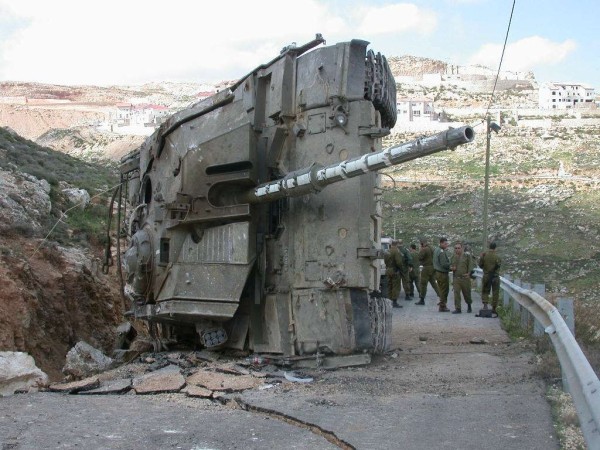
The war on Gaza, even to the extent that it may have served as a training exercise in preparation for another round of fighting with Hezbollah, probably did little to dispel the haunting memories of 2006. The Merkava tank, previously one of the IDF’s most potent symbols of invincibility, ended up exposing Israel’s military vulnerability.

Facebooktwittermail

Iran tested advanced nuclear warhead design – secret report

Iran tested advanced nuclear warhead design – secret report

The UN’s nuclear watchdog has asked Iran to explain evidence suggesting that Iranian scientists have experimented with an advanced nuclear warhead design, the Guardian has learned.

The very existence of the technology, known as a “two-point implosion” device, is officially secret in both the US and Britain, but according to previously unpublished documentation in a dossier compiled by the International Atomic Energy Agency (IAEA), Iranian scientists may have tested high-explosive components of the design. The development was today described by nuclear experts as “breathtaking” and has added urgency to the effort to find a diplomatic solution to the Iranian nuclear crisis.

The sophisticated technology, once mastered, allows for the production of smaller and simpler warheads than older models. It reduces the diameter of a warhead and makes it easier to put a nuclear warhead on a missile. [continued…]

Bunkers or breakthrough?

In his last month as head of the International Atomic Energy Agency, Mohamed ElBaradei finds himself at the explosive crux of the world’s nuclear politics, ferrying messages between the Obama administration and Tehran. “They are talking through me,” he says.

Talking is something, even through a mediator, given all the poisonous U.S.-Iranian history, but time is short. President Obama’s Iran outreach is on the line in the days before ElBaradei departs on Nov. 30. It’s critical that Obama succeed or a futile confrontation-sanctions scenario will be locked in. Any vestigial hopes for a more peaceful Middle East will recede.

Protesters, Iran’s brave campaigners for a freer and more open country, are chanting, “Obama, Obama — either you’re with them or you’re with us.” That must hurt in the Oval Office. The window is narrowing for the president to show that outreach can normalize the psychotic U.S.-Iranian relationship where confrontation only comforts it. I still believe normalization is the last best hope for Iranian reform. [continued…]

Student stuns Iran by criticizing supreme leader

An unassuming college math student has become an unlikely hero to many in Iran for daring to criticize the country’s most powerful man to his face.

Mahmoud Vahidnia has received an outpouring of support from government opponents for the challenge — unprecedented in a country where insulting supreme leader Ayatollah Ali Khamenei is a crime punishable by prison.

Perhaps most surprising, the young math whiz has so far suffered no repercussions from the confrontation at a question-and-answer session between Khamenei and students at Tehran’s Sharif Technical University.

In fact, Iran’s clerical leadership appears to be touting the incident as a sign of its tolerance — so much so that some Iranians at first believed the 20-minute exchange was staged by the government, though opposition commentators are now convinced Vahidnia was the real thing. [continued…]

Facebooktwittermail

Report: U.S. stopped Israel from attacking ‘Hezbollah arms ship’

Report: U.S. stopped Israel from attacking ‘Hezbollah arms ship’

The United States informed Israel of a ship carrying tons of weapons allegedly en route from Iran to Hezbollah, but vetoed Israel’s plans to attack, the A-Sharq Al-Awsat newspaper reported on Friday.

Israel raided the ship in the waters off the coast of Cyprus earlier this week and redirected it to the Ashdod port, where it unloaded 500 tons of weapons. The ship was released back onto its route to Turkey and Egypt late Wednesday, after Israel confirmed that the crew was not connected to the cargo found aboard.

In its report on Friday, A-Sharq Al-Awset cited Israeli sources as saying that Israel had intended to attack the ship but had refrained at the insistence of the U.S. No other source could confirm the report. Hezbollah has vehemently denied any link to the weapons and denounced “Israeli piracy” in international waters. [continued…]

Facebooktwittermail

Opposition supporters clash with Iranian security force

Opposition supporters clash with Iranian security forces

Street battles between Iranian security forces and anti-government demonstrators erupted Wednesday after opposition supporters tried to disturb state-sanctioned rallies marking the 30th anniversary of the takeover of the U.S. Embassy, witnesses and state media reported.

Security forces posted on nearly every street corner in the city center heavily outnumbered protesters and broke up crowds using batons, tear gas and warning shots, state media reported. Foreign media representatives were allowed to cover only the government-sanctioned rally, in front of the building that formerly housed the U.S. Embassy in Tehran.

In Washington, President Obama called on the Iranian government to decide whether it wants to focus on the past or the future. “Iran must choose,” he said in a statement marking the 30th anniversary of what he described as the unjust hostage-taking.

Clashes were reported in several places in the city center and in Shiraz, a city 420 miles south of the capital. Most demonstrators were unable to convene for long periods, as motorcycle units of the Revolutionary Guard Corps arrived to disperse them. [continued…]

Facebooktwittermail

Iran’s politics stand in the way of a nuclear deal

Iran’s politics stand in the way of a nuclear deal

Iran’s leadership has once again equivocated after agreeing to a deal that would ease its nuclear standoff with the West. But this time, that may be as much a product of the nation’s smoldering political crisis as it is a negotiating tactic, political analysts and Iran experts said.

Tehran has yet to state publicly why it objects to the deal, in which it would ship its low-enriched uranium out of the country for additional processing and eventual return as fuel rods for a civilian reactor. But Iran experts say the very caustic, and very public, nature of the debate in Iran over the proposed nuclear deal suggests that the deep divisions cemented by the summer’s disputed presidential election have complicated, if not undermined, the ability to resolve such a major issue.

“Since the 1979 revolution it is rare for the political elite to disagree so openly with an issue of this significance,” said Mehrzad Boroujerdi, a political scientist at Syracuse University. [continued…]

Facebooktwittermail

NIAC and J Street, progressive foreign policy groups, become political targets

NIAC and J Street, progressive foreign policy groups, become political targets

In the usually wonky world of non-profit issue-advocacy organizations, a decidedly political campaign has been waged against foreign policy institutions that promote diplomacy over militarism.

Two relatively new organizations — each covering distinctly opposite ends on the spectrum of Middle Eastern affairs — have been the target of withering public relations attacks in recent weeks and months.

The National Iranian American Council (NIAC), an organization that promotes diplomatic engagement between the U.S. and Iran, sprung to prominence recently for its active media presence in the aftermath of Iran’s disputed elections though its influence in the nation’s capital had been felt long before then. But as NIAC’s voice grew louder in foreign policy circles, so too did the vehemence of its critics. [continued…]

Facebooktwittermail

Opposition in Iran urges continuing challenge

Opposition in Iran urges continuing challenge

As Iran prepares for a major commemorative rally on Wednesday, the leaders of the opposition movement called over the weekend for a renewed challenge to the government, setting the stage for a possible showdown between protesters and the police.

Although the opposition leaders, Mir Hussein Moussavi and Mohammad Khatami, did not openly call for street protests, their remarks were widely seen as a call to arms on a day of considerable symbolic importance.

The occasion is the 30th anniversary of the takeover of the United States Embassy in Tehran by hard-line students on Nov. 4, 1979. The day is marked every year with anti-American rallies. [continued…]

Neocon smear on “Iran’s man in DC?”

Did Michael Goldfarb, a former John McCain staffer and now an editor of the neoconservative Weekly Standard, defame Trita Parsi, the founder and president of the National Iranian American Council, by suggesting that Parsi is working for the Iranian government?

Last week, Goldfarb described Parsi as “the Iranian regime’s man in Washington.” Goldfarb didn’t present any evidence to support this. He stated it as fact and moved on. When I emailed Goldfarb asking if he meant to say literally that Parsi is working for the Iranian government, he doubled down, replying, “If it walks like an ayatollah and quacks like an ayatollah…. Maybe you should do your due dilligence [sic] on Trita Parsi.” [continued…]

Diehl disappointed that Iranian dissidents failing to follow Western playbook

In an op-ed that reveals far more about him than about Iran’s Green Movement, Jackson Diehl expresses disappointment that Iran’s dissidents apparently aren’t all Western-style democrats. Diehl kicks things off with a bit of the dusty old Orientalism:

The enduring nature of Iran is to frustrate outsiders who work by the usual rules of political logic or who seek unambiguous commitments. The West relearned that truth last week as the government of Mahmoud Ahmadinejad dragged a straightforward plan to swap its enriched uranium for fuel rods into a swamp of double talk and counterproposals.

Those crafty Iranians — they’re so crafty! Unlike we Westerners, who always do things that make perfect rational sense. In point of fact, the P5+1’s uranium swap plan was itself a response to Iran’s original idea “to refuel the Tehran research reactor through purchasing fuel assemblies from international providers, including the United States.” Iran has apparently refused the uranium swap plan, and that’s bad news, but it shouldn’t be too much to expect the Deputy Editorial Page Editor of The Washington Post to be able to analyze this without resorting to tired cultural stereotypes. [continued…]

Facebooktwittermail

Why the Iranian nuclear deal was bound to fail

Why the Iranian nuclear deal was bound to fail

The surest sign yet that the Iranian nuclear deal is in deep trouble is its endorsement by Israel’s prime minister, Benjamin Netanyahu.

“A positive first step,” Mr Netanyahu called the deal. This was in marked contrast to his own defence minister, Ehud Barak, who complained earlier that the agreement accorded Iran “legitimisation for enriching uranium for civilian purposes on its soil, contrary to the understanding that those negotiating with it have about its real plans”.

Mr Barak and Mr Netanyahu march in lockstep when it comes to Iran. The reason for their apparent disagreement is simple. Mr Barak dismissed the proposed deal when it looked as if Iran might accept it. Mr Netanyahu’s approval came only after Iran’s response was interpreted by the western powers as a “no”. [continued…]

Why Obama’s Iran policy will fail

While the tone of the Obama administration is different from that of its predecessor, and some of its foreign policies diverge from those of George W. Bush, at their core both administrations subscribe to the same doctrine: Whatever the White House perceives as a threat — whether it be Iran, North Korea, or the proliferation of long-range missiles — must be viewed as such by Moscow and Beijing.

In addition, by the evidence available, Barack Obama has not drawn the right conclusion from his predecessor’s failed Iran policy. A paradigm of sticks-and-carrots simply is not going to work in the case of the Islamic Republic. Here, a lesson is readily available, if only the Obama White House were willing to consider Iran’s recent history. It is unrealistic to expect that a regime which fought Saddam Hussein’s Iraq (then backed by the United States) to a standstill in a bloody eight-year war in the 1980s, unaided by any foreign power, and has for 30 years withstood the consequences of U.S.-imposed economic sanctions will be alarmed by Washington’s fresh threats of “crippling sanctions.” [continued…]

Facebooktwittermail

Turkey plans to dump dollar in trade with Iran

Turkey plans to dump dollar in trade with Iran

Turkey is seeking to switch to payments in national currencies for $10 billion worth of trade with neighbouring Iran to lessen exchange rate risks and bolster trade volumes, a Turkish government source said on Friday.

Turkey has made similar proposals to China and Russia in recent months.

Iran proposed earlier this week during a visit by Turkish Prime Minister Tayyip Erdogan that the two countries should conduct bilateral trade in their own currencies as part of widening economic ties.

Bilateral trade jumped to $10.3 billion in 2008 from $2.4 billion in 2003, with Turkey running a large deficit largely due to its gas imports. Ankara and Tehran aim to boost the volume to $20 billion in the next few years. [continued…]

Turkey, Iran sign strategic deal to carry gas to Europe

Iran and Turkey signed a number of deals on Wednesday to facilitate the efficient flow of gas through Turkey to Europe, including accords on allocating some of Iran’s South Pars gas field to the Turkish Petroleum Corporation (TPAO), allowing Iranian gas to be transported via Turkey and allowing Turkmenistan’s natural gas to be pumped to Turkey via Iran, during Turkish Prime Minister Recep Tayyip Erdoğan’s visit to Turkey’s southeastern neighbor.

Turkish Energy Minister Taner Yıldız said the deals provided advantages for Turkey in the use and the sale of some phases of the South Pars gas field. “Its conditions and prices will be negotiated later,” the minister added. Iran, which has the world’s second-largest natural gas reserves, is Turkey’s second-biggest supplier of natural gas after Russia. Turkey had signed a preliminary deal in November 2008 for Iranian gas to be exported to Europe through Turkey and for Turkey to produce gas in the South Pars field.

The investment would amount to $3.5 billion. But this deal has been delayed by objections from the United States, which opposes new energy deals in Iran as part of Western efforts to isolate Tehran over its nuclear program. [continued…]

Facebooktwittermail