Category Archives: Iraq

Obama promises a long and limited war on ISIS

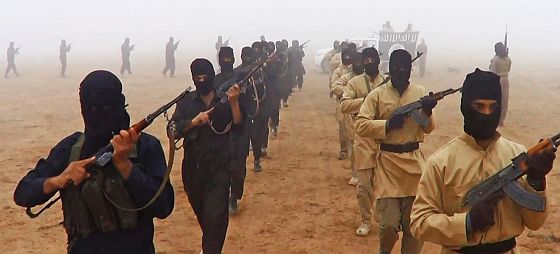
Tony Karon writes: President Barack Obama used the broadest of brushstrokes on Wednesday night to describe his “comprehensive strategy to degrade and ultimately destroy” the Islamic State insurgency, providing few details and skirting discussion of key dilemmas facing any such plan.

The United States will lead a “broad coalition,” Obama said, but its war plan “will not involve American combat troops fighting on foreign soil.” Instead, the campaign would rely on U.S. air power and support for “partner forces on the ground” to put the Islamic State (IS) to flight. The U.S. would supply intelligence, weapons and logistics and training. But it would be up to those forces to drive out the IS.

It was telling that the example he cited as the model for confronting the IS was the approach “we have successfully pursued in Yemen and Somalia for years.” That comparison underscores the message that “ultimately” is the operative word in Obama’s promise to “ultimately destroy” the IS. In both Yemen and Somalia, America’s enemy remains very much intact and active, and the U.S. approach has thus far succeeded in managing and containing the threat, but not in destroying it.

If anything, the challenge of confronting the Islamic State movement in Iraq and Syria is more complex. That’s because the IS is a symptom of the current state of play in regional power struggles that have raged with unprecedented intensity over the past decade; it is not their cause. Yet it is on the warring regional proxy powers that the U.S. must now rely to roll back the IS.

The insurgency’s impressive recent success “is due only in small part to IS itself,” wrote International Crisis Group analyst Peter Harling last week.

“The way has been paved for it by its enemies, who make an impressive roll-call of major players in the region,” he added. [Continue reading…]

Facebooktwittermail

America’s island mentality

“Traveling in Europe made me understand that America has an island mentality: No one exists except us. There’s a whole other world out there, but most Americans – all they know is America” — will.i.am

A recent Pew poll asked Americans about what they perceive as “global threats facing the U.S.” the threat from ISIS being among them. The news is that 67% of Americans view ISIS as a major threat to the U.S. — a threat only exceeded by the threat from “Islamic extremist groups like Al Qaeda.”

I guess that after more than a decade of indoctrination in which we have been led to regard Al Qaeda as the purest distillation of evil ever known, it will take some time for the average American to accept the idea that there could actually be anything worse than Al Qaeda.

Even so, the fact that most Americans now perceive ISIS as a major threat doesn’t really reveal a whole lot more than the fact that most Americans watch television.

What I find more interesting than the numbers is the premise behind the pollster’s question: that something could be a global threat and yet not necessarily be a threat to America.

This is a reflection of the prevailing mentality among Americans: that America and the world are in some sense separable.

America can be engaged with or disengaged from the rest of the world because, supposedly, if we are so inclined, the rest of the world can be shut out while America tends to its own affairs.

Is it any wonder that a nation that has such difficulty in seeing itself as part of and as inseparable from the world, also has difficulty viewing climate change — the greatest challenge facing our planet — as a threat?

The Pew poll found that 52% of Americans view the spread of infectious diseases as a threat to the U.S., lower, for instance, than the perceived threat from North Korea’s nuclear program.

No doubt for most people being questioned, when it comes to infectious diseases the issue of the Ebola outbreak in West Africa will have been uppermost in their minds.

President Obama’s announcement on Sunday about a U.S. response to the crisis again reflects America’s island mentality. This is how he framed the urgency of the issue:

“If we don’t make that effort now, and this spreads not just through Africa but other parts of the world, there’s the prospect then that the virus mutates. It becomes more easily transmittable. And then it could be a serious danger to the United States.”

He also said, “We have to make this a national security priority.”

For the United States, the Ebola outbreak is less of a humanitarian issue than it is a threat to America’s security.

It’s as though if health workers in Africa could guarantee that the disease was contained and there was no risk of it spreading overseas, then the U.S. would have no reason to be concerned.

America sees itself as a generous country, in part because Americans have a staggering level of ignorance about how much foreign aid the U.S. grants.

Americans on average believe that 28% of the federal budget — more than is spent on defense — is spent on foreign aid when in reality it is just 1%! When informed about actual spending, the majority of Americans say that 1% is about right or too much — only 28% say that 1% of the budget is too little.

What these numbers imply is that most Americans perceive the world as a drain on this nation’s resources. Having been led from birth to believe that this is the greatest nation on earth, how could the rest of the world be perceived otherwise?

When Obama lays out his strategy for dealing with ISIS this evening, it goes without saying that one of the central pillars of his argument will be that this organization poses a threat to America’s national security. To present ISIS in any other way would risk implying that the threat which ISIS poses across the Middle East constitutes a sufficiently urgent threat that even if it was to advance no further, this should nevertheless concern Americans. Such an argument would likely elicit a shrug — we don’t live in the Middle East so why should we care?

The idea that we might care because we all live on the same planet, breath the same air, and inhabit the same world, has little traction in the hearts and minds of Americans who see the world as somewhere else.

The idea that those whose lives are not in danger have a responsibility to pay attention to the needs of those in peril, is a humanitarian impulse which in an era of unquestioned realism, is always a lower priority than the national interest.

Returning to the question about global threats, rather than ask Americans a conceptually mangled question about threats to the U.S., it might have been more interesting to try and gauge awareness about actual global threats, which is to say, threats that are global in scale.

These would be — at least by my reckoning:

  • the excessive production of greenhouse gases by human activity resulting in climate change
  • the Holocene extinction — the mass extinction of species and loss of biodiversity that has resulted from human activity
  • population displacement which now exceeds 50 million people, the largest number since World War II
  • industrialized agriculture involving the use of toxic pesticides and genetically modified crops which poisons the food chain, degrades ecosystems, resulting in the loss of topsoil thereby undermining the basis for agriculture
  • nuclear weapons both in existing arsenals and through proliferation
  • infectious diseases including antibiotic resistant superbugs
  • chronic illness caused by unhealthy lifestyles, poor nutrition, and profit driven pharmaceutical protocols promoted by the disease-maintenance industry
  • racism and other forms of intolerance which undermine the growth of political pluralism
  • the endangered ethnosphere in which the accumulated knowledge of indigenous peoples, their languages and cultures is rapidly being lost
  • homogenized global culture in which human aspirations are manipulated in the service of commerce
  • technological dependence through which intelligence is being displaced from minds into devices
  • inequality stemming from inadequate political representation and excessive corporate power
  • ignorance resulting in the proliferation of all the above threats.

Compared with these issues, I don’t believe that ISIS constitutes a global threat, yet it nevertheless poses an urgent threat calling for a global response — a response that should not be artificially separated from the need to envision a post-war Syria.

Facebooktwittermail

NYT Baghdad bureau chief: White House ignored the collapse of Iraq

Tim Arango answering questions at Reddit: it’s not my job to rate the obama administrations actions in iraq. but i will tell you that after 2011 the administration basically ignored the country. and when officials spoke about what was happening there they were often ignorant of the reality. they did not want to see what was really happening because it conflicted with their narrative that they left iraq in reasonably good shape. In 2012 as violence was escalating i wrote a story, citing UN statistics, that showed how civilian deaths from attacks were rising. Tony Blinken, who was then Biden’s national security guy and a top iraq official, pushed back, even wrote a letter to the editor, saying that violence was near historic lows. that was not true. even after falluja fell to ISIS at the end of last year, the administration would push back on stories about maliki’s sectarian tendencies, saying they didn’t see it that way. so there was a concerted effort by the administration to not acknowledge the obvious until it became so apparent — with the fall of mosul — that iraq was collapsing.

Facebooktwittermail

New Iraqi Shiite militia copycats ISIS atrocities

France 24 reports: The Islamic State organisation (IS), a jihadist group that controls parts of Syria and Iraq, is infamous for releasing gory images of the atrocities its fighters commit. But now, a newly-formed Shiite militia fighting IS in Iraq has committed a similar act by recording a video where its combatants pose with severed heads.

This video shows a group of Shiite militiamen holding up two severed heads, which they describe as belonging to IS fighters. Mugging for the camera, the men chant: “We are coming for you! We’ll behead you and make mountains with your skulls!” The men’s clothing, armbands and flag show that they belong to the “Islamic Movement of Iraq”, a little-known militia that was recently formed, and which documents its activities on a Facebook page. The video’s caption indicates it was filmed when the city of Amerli was taken back from IS earlier this month. It was captured by Iraqi soldiers, Kurd peshmerga fighters and Shiite militias, who were aided by US air strikes.

According to the group’s Facebook page, its leader is Alhaj Abou Jabar Alasadi, a man unknown on Iraq’s political scene. Strangely enough, on his own Facebook page, he recently posted a photo of himself posing with Iraq’s former prime minister, Nuri al Maliki, just two weeks after the Shiite politician stepped down. He had been accused of being too sectarian. [Continue reading…]

Facebooktwittermail

Obama expects ISIS to still be in power when he leaves the White House

Rami Khouri: [C]ombining American militarism with Arab dictatorships is probably the stupidest recipe that anybody could possibly come up with to try to fight jihadi movements like al-Qaeda and Islamic State and others, because it was that combination of Arab autocracy and American militarism that actually nurtured and let these movements expand. There has to be a more intelligent, more realistic process that allows the people in the Middle East to roll back these threats. And these people need to be fought; I’m not saying you sit around and do nothing. You have to fight these people and eradicate them…

What do we do about this Islamic State? These guys are taking more territory. They’re enforcing their rule by force, by terrorizing people. And very few people are happily accepting them. They don’t — you know, ordinary people don’t have a choice. If the Islamic State comes in with their guns and chops people’s heads off or crucifies a couple of people, everybody else stays [inaudible]. And this should be a telltale sign that these groups only can operate in zones of chaos. And the United States and others, the British, have helped create these zones of chaos in the last 20 years in Afghanistan and in Iraq, most recently. So, there’s really a lot of shared responsibility for this terrible situation we’re in, but the bottom line is we need to figure out how to fight the two real problems, which Obama keeps repeating as his strategy, the two real problems of autocratic, nondemocratic, abusive, corrupt, pretty inefficient and mediocre Arab government systems, Arab regimes, across the board. And the other one is the repeated use of American, British, Israeli, other military power in the region to try to enforce an order that the West and the Israelis and others feel is suitable for them. Those two problems are two of the root causes of all of these issues that we’re seeing, and the Islamic State is simply a symptom of years and years of this, of these kinds of problems of bad governance.

The driving force behind President Obama’s formulation of a strategy for dealing with ISIS appears to have been the mere fact that he inadvertently revealed he lacked such a strategy.

In other words, the strategy he is about to unveil on Wednesday is not really a strategy for dealing with ISIS; it’s a strategy for dealing with the fact that he looked inept when he said he didn’t have a strategy.

Having been forced by embarrassment to quickly formulate this strategy, it appears to have been stitched together as an effort to deflect earlier criticisms. For instance, in Libya the administration was embarrassed by Obama’s reluctance to lead. This time, the New York Times reports, “the Obama administration is no longer ‘leading from behind,’ but plans to play the central role in building a coalition to counter ISIS.”

Still, by framing this as an operation likely to last longer than his administration, the president wants to insulate himself from the risk of personal failure, while most likely he passes on the most difficult phase to his successor:

The final, toughest and most politically controversial phase of the operation — destroying the terrorist army in its sanctuary inside Syria — might not be completed until the next administration.

What do we do about ISIS?

This isn’t a debate about the pros and cons of military action. As Khouri says: “You have to fight these people and eradicate them.”

If Obama invests less time on message management and more on genuine strategic thinking, then he might see that the coalition he’s trying to build should place at its core the people who have the ability and desire to fight ISIS: Syrians, Iraqis, and Kurds who should not be used as proxy forces following the commands of the Pentagon, but fighters fighting their own war with U.S. and allied support.

Facebooktwittermail

After Syria and Iraq, ISIS makes inroads in South Asia

Reuters reports: Islamic State pamphlets and flags have appeared in parts of Pakistan and India, alongside signs that the ultra-radical group is inspiring militants even in the strongholds of the Taliban and al Qaeda.

A splinter group of Pakistan’s Taliban insurgents, Jamat-ul Ahrar, has already declared its support for the well-funded and ruthless Islamic State fighters, who have captured large swathes of territory in Iraq and Syria in a drive to set up a self-declared caliphate.

“IS (Islamic State) is an Islamic Jihadi organization working for the implementation of the Islamic system and creation of the Caliphate,” Jamat-ul Ahrar’s leader and a prominent Taliban figure, Ehsanullah Ehsan, told Reuters by telephone. “We respect them. If they ask us for help, we will look into it and decide.”

Islamist militants of various hues already hold sway across restive and impoverished areas of South Asia, but Islamic State, with its rapid capture of territory, beheadings and mass executions, is starting to draw a measure of support among younger fighters in the region.

Al Qaeda’s ageing leaders, mostly holed up in the lawless region along the Pakistan-Afghanistan border, are increasingly seen as stale, tired and ineffectual on hardcore jihadi social media forums and Twitter accounts that incubate potential militant recruits. [Continue reading…]

Facebooktwittermail

In the fight against ISIS, a coalition of rivals

The Washington Post reports: The urgent fight to keep Islamic State forces­ from taking over more of Iraq has led the Obama administration to tolerate, and in some cases even approve, things it once would have loudly protested.

When Iraqi Shiite militias, backed by Iran and long branded illegal by the administration, retook the town of Amerli from the Sunni Muslim militants last week, U.S. officials breathed a sigh of relief.

Qassem Suleimani, the head of the Iranian Revolutionary Guard Corps’ Quds Force and usually described as an arch­enemy of the United States, reportedly was present during the battle and was seen days later in an Internet-posted photo shaking hands with a militia fighter.

Farther north, Kurdish fighters have occupied the oil-rich city of Kirkuk, a prize the Kurds have long claimed but which lies outside the borders — recognized by both Baghdad and Washington — of Iraq’s semiautonomous Kurd­i­stan region. Far from insisting the fighters withdraw, the administration is glad that someone is defending the city from the Islamic State.

Such legal and policy niceties have become a luxury in the battle to push back the militants whom President Obama on Friday called “a savage organization” that “poses­ a significant threat” to the United States and its allies.

It is not, as one administration official said with significant under­statement, an ideal situation, and there is widespread recognition that facts are being created on the ground that are likely to cause problems in the future. [Continue reading…]

Facebooktwittermail

Iranian-Saudi agreement on Iraq may be near

Al-Monitor reports: A UN diplomatic source in Beirut told Al-Monitor that an Iranian-Saudi agreement on the formation of the next Iraqi government was almost done. The source, who spoke on condition of anonymity, revealed that the visit by the Iranian Assistant Foreign Minister Hussein Amir Abdul Lahian to Saudi Arabia on Aug. 26 was the move that crowned the agreement.

The source said that some felt a few weeks ago that removing Nouri al-Maliki from the Iraqi Prime Ministry and designating Haider al-Abadi on Aug.11 was the final sign of a Tehran-Riyadh agreement on Baghdad. But this impression was not true.

According to the diplomatic source, the move followed mutual attempts by the two parties to raise their negotiating ceilings. For its part, Iran tried to harden its stance for known reasons; it gave the impression that removing Maliki happened more because of internal Iraqi Shiite calculations linked to the position of Shiite cleric Ali al-Husseini al-Sistani, rather than a Shiite concession to the Sunnis or an Iranian concession to Saudi Arabia in Iraq. These calculations include compensating Maliki’s removal by strengthening his and his team’s position in governing and in the next government, as well as getting paid by the Sunni-Saudi team as a compensation. [Continue reading…]

Facebooktwittermail

As NATO allies unite against ISIS, it’s time for the U.S. to talk to the PKK

The Washington Post reports: The Obama administration accelerated efforts Friday to build an international coalition to combat the Islamic State, winning pledges of support from nine allies but leaving questions about the extent of possible expanded military force.

The United States has waged a series of airstrikes seeking to slow the advance of the Islamic State in northern Iraq and bolster the defenses of Western-allied fighters in the Iraq’s nearby Kurdish region.

But Washington is now eager to broaden the military and diplomatic pressures on the group, which has drawn international condemnation for sending non-Muslim minorities fleeing in fear and waging bloodshed such as mass killings and the beheadings of two American journalists.

The 10-nation alliance, forged at a NATO summit in Wales, could raise worries about deepening Western military engagement in the region nearly three years after the withdrawal of U.S. combat forces from Iraq.

Secretary of State John F. Kerry and Defense Secretary Chuck Hagel used the NATO forum to hold meetings with foreign and defense ministers from nine countries: Britain, France, Germany, Canada, Australia, Turkey, Italy, Poland and Denmark.

The leaders described themselves as the core of an emerging coalition to counter the Islamic State, although they downplayed the prospect of imminent joint military action. They also left unsaid whether they were planning to attack Islamic State’s strongholds in Syria or limit their mission to Iraq. [Continue reading…]

The New York Times adds this tough-talk from Kerry: “There is no containment policy for ISIL,” Secretary of State John Kerry said at the beginning of the meeting, using an alternate acronym for ISIS. “They’re an ambitious, avowed, genocidal, territorial-grabbing, caliphate-desiring quasi state with an irregular army, and leaving them in some capacity intact anywhere would leave a cancer in place that will ultimately come back to haunt us.”

So even though the text of the statement issued by the State Department makes no mention of attacking ISIS in Syria, that’s part of the plan — right?

It’s widely recognized that the most effective force fighting against ISIS is the YPG (People’s Protection Units), the branch of the PKK (Kurdistan Workers’ Party) based in Rojava, Syrian Kurdistan.

When the U.S. claimed success in rescuing thousands of Yazidis trapped on Mount Sinjar, it was YPG fighters on the ground who played the crucial role in creating a safe corridor.

In building its international coalition to fight ISIS, the U.S. will naturally want the support of as many allies as possible, yet what could be the most productive alliance of all — with the PKK — will remain hamstrung unless Washington grows up and ditches its childish anti-terrorism fundamentalism and quickly de-lists the PKK as a so-called terrorist organization.

Not only is this particular designation unwarranted — as Henri Barkey points out, the U.S. should be willing to talk to the PKK when the PKK’s chief adversary, Turkey, is already doing so — but the whole idea of designating organizations and individuals as terrorists is itself an insult to the rule of law. Such labeling functions as a political tool used without much more subtlety than the Catholic church’s practice of branding heretics at the time of the inquisition. Democracy, however, only allows for the designation of illegal actions — not illegal opinions or affiliations.

The necessity of fighting ISIS has arisen not because it promotes a diabolical ideology; it derives from the fact that the members of ISIS are engaging in genocide, ethnic cleansing, war crimes, and crimes against humanity.

Facebooktwittermail

Is the PKK becoming a new Middle East power?

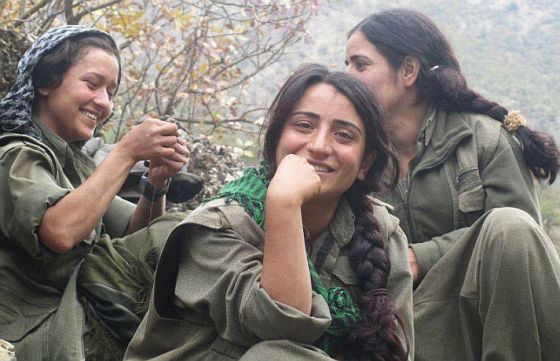
30% of PKK fighters are women.

30% of the PKK’s fighters are women.

The Turkish columnist, Kadri Gursel, writes: [T]he PYD [the Democratic Union Party, the PKK’s Syrian branch] has been able to hold on to these three regions [Ras al-Ain, Kobani and Afrin, in northern Syria] and resist the jihadists for more than two years. Hence, long before IS’ capture of Mosul, the PKK already deserved to be recognized as the Middle East’s only fighting force to defy and resist IS for the struggle it has waged in Rojava [Syrian Kurdistan].

The Kurdish forces in Syria have surprised the world not only with their resolve against the jihadists but also with their female fighters. Against a barbarian mindset that enslaves and sells women as concubines, the PYD has displayed a secular mindset embracing gender equality, which has enormously contributed to its international image.

In Iraq, on the other hand, the PKK has put aside disagreements with the Kurdistan Democratic Party (KDP) to form a national military alliance against the jihadist threat to Iraqi Kurdistan.

That the Western public is already discussing the prospect of the PKK’s removal from the lists of terrorist organizations is a clear indication of how much the PKK’s struggle against the jihadists has contributed to its international standing.

Lauren Bohn reports: Standing in a parched field far from any roads in Turkey’s southeastern mountains, a teary-eyed Sokrun Gunduz clutched photographs of her two absent sons.

Mazlum, 15, is in a Turkish prison under suspicion of collaborating with the Kurdistan Workers Party (PKK), a group branded a terrorist organization by Turkey, the European Union and the United States.

Agit, 22, is in northern Iraq battling the jihadist Islamic State in Iraq and Syria (ISIS) with the same group. The young man is one of thousands of PKK soldiers who have joined the war against ISIS in Kurdish areas of Syria and Iraq, and who have become vital to the international community’s battle against the powerful Islamist insurgency.

“The Kurdish fight has spread,” the 43-year-old grocer said at a recent rally marking the anniversary of the PKK’s armed struggle against Turkey. The group has battled the Turkish state for cultural and political rights and Kurdish self-rule for 30 years in a conflict that has claimed more than 30,000 lives.

“We must protect our Kurdish brothers and sisters,” she said amid a crowd of thousands of PKK fighters and supporters celebrating the 30th anniversary of the group’s struggle. “In doing so, we will finally get our own Kurdish state.”

Many of Turkey’s Kurds – a disenfranchised minority that makes up a fifth of the country’s population – feel revitalized by the PKK’s role in Syria and Iraq, and hope their successes on the battlefield will produce political victories such as greater autonomy, more rights and perhaps even an independent state.

“In a way, we have to thank the Islamic State. They’ve united us, reviving the great Kurdish cause,” said Seyid Narin, a municipal mayor in Diyarbakir, long the center of the Kurdish resistance and separatist movement in southeast Turkey. Ten months ago he lost a son who was fighting in Syria — a second one is now in northern Iraq with the PKK.

“Our struggle is reborn,” he said.

This struggle poses a potential threat to Turkey’s ruling Justice and Development Party (AK Party) which has spearheaded efforts to restart peace talks with the terror group and now tolerates its military role in Turkey.

“Both the (ruling party) and PKK know that ISIS must be stopped … if anything, this fight will bring the AK party and Kurds closer together,” said Bedirhan Akyol, a Kurdish Justice and Development official in Diyarbakir. “The PKK is becoming stronger through this fight, but that won’t have a bad effect on peace talks.”

But Akyol’s positive spin belies a deep unease in Turkey about the PKK’s role fighting ISIS in Syria and its place in society at large. That the long reviled organization has been cast as the hero in the war against homicidal Islamist fighters has prompted alarm and anger in some circles.

The ruling party and the PKK are essentially creating laws that would result in the break- up of Turkey, said Oktay Vural, a leading Turkish opposition politician.

“The terrorists failed to divide Turkey for 30 years, but the country is now being brought to the brink of partition in the name of [Recep Tayyip] Erdogan’s political future,” he wrote in an editorial, referring to the country’s powerful prime minister and president elect.

Even some who do not consider talks with the PKK treasonous, like Vural does, worry that Turkey already has enough on its plate with the regional threat posed by ISIS and a teeming Syrian refugee population, before dealing with the legitimization of a group long branded as terrorists. [Continue reading…]

Facebooktwittermail

Iraq: ISIS executions in Tikrit

Human Rights Watch: New evidence about executions carried out by the Islamic State (IS) in Tikrit after it seized the city in June 2014 triples the estimated death toll and shows additional execution sites, Human Rights Watch said today.

Information from a survivor and analysis of videos and satellite imagery has confirmed the existence of three more mass execution sites, bringing the total to five, and the number of dead to between 560 and 770 men, all or most of them apparently captured Iraqi army soldiers.

“Another piece of this gruesome puzzle has come into place, with many more executions now confirmed,” said Peter Bouckaert, emergencies director at Human Rights Watch. “The barbarity of the Islamic State violates the law and grossly offends the conscience.” [Continue reading…]

Facebooktwittermail

How #ISIS wants to exploit anti-interventionist sentiment in the West

isis

Like any organization that takes messaging seriously, ISIS has to study its audience while crafting its messages.

In its “second message to America,” the blunt warning from the militant group boiled down to this:

… just as your missiles continue to strike our people, our knife will continue to strike the necks of your people… We take this opportunity to warn those governments that enter this evil alliance of America against the Islamic State to back off and leave our people alone.

Beheading Americans — first James Foley and now Steven Sotloff — might seem like a counterproductive way of influencing American public opinion, but ISIS isn’t interested in gaining American sympathy. It just wants the U.S. to back off.

After several months in which it has enjoyed success after success during its often unopposed advance across Iraq, U.S. airstrikes have thrown an unwelcome obstacle in the progress of this would-be Islamic state.

ISIS’s victories have been its biggest recruiting asset and the promise of life in the new caliphate is much more appealing than the prospect of getting bombed by Americans.

ISIS had four American prisoners and now it has just two. Despite its flagrant disregard for the value of human life, there should be no doubt that ISIS applies a brutal but careful calculus in deciding when to sacrifice an American life, given that it has power over so few.

The killing of Foley and Sotloff seems much less like “an announcement of global jihad” than an indication that ISIS feels threatened.

No one inside or outside ISIS can have had any illusions that President Obama — his expressed determination to protect American lives notwithstanding — would base his decisions solely on the need to protect the lives of four American captives. For that reason, neither the death of Foley two weeks ago nor that of Sotloff now, could be expected to manipulate U.S. policy.

Even so, ISIS is surely well aware that America as a country has lost most of its appetite for war and “back off” is a demand that harmonizes with the anti-interventionist sentiment to which everyone in Washington is well attuned.

Even the most gung-ho hawks nowadays always feel obliged to qualify their war-making recommendations with an obligatory promise: no boots on the ground. The Pentagon and the American public collude with each other in sustaining the deceit that military action only becomes war after American soldiers start getting killed. Thus, no boots on the ground supposedly means no war.

Post 9/11, post the war in Iraq and as we approach the end of America’s longest war — the one in Afghanistan that is generally recognized as having accomplished nothing — Americans express less a sense of defeat than an easy resignation that “the problem” is really the nature of the Middle East. “The solution” thus appears patently obvious: have nothing to do with the region.

Yes, ISIS is a monster and we helped create it, but it doesn’t operate in the U.S. And even if we did try to defeat it, we’d more likely make the problem worse and turn the U.S. into a direct target for ISIS attacks.

For many Americans, there’s clearly something comforting in this perspective, but it leaves me wondering: what happened to everyone’s sense of humanity?

We each have many layers of identity, but doesn’t the sense of being human matter more than all the others? Or does being human matter less than being American?

Some commentators argue that the alarm calls about ISIS are being driven by Empire’s insatiable lust for war — suggesting that ISIS is in some sense a manufactured threat.

That’s a view that easily finds traction on the internet, but each time I hear this I have the same reaction: who would have the audacity to make this argument directly to this Yazidi girl?

Here is a child who has to carry a gun to defend herself and her family from ISIS because there is no one else she can rely on. She has been let down by humanity.

Perversely, we now inhabit a world in which the concept of humanity seems to have gradually fallen out of circulation even among people who would have once dubbed themselves humanists.

Supposedly, the only arbiter which can be applied to determine whether the threat posed by ISIS concerns Americans is ISIS’s ability or intention to kill Americans or harm American interests.

In an interview Obama gave in January he said:

[H]ow we think about terrorism has to be defined and specific enough that it doesn’t lead us to think that any horrible actions that take place around the world that are motivated in part by an extremist Islamic ideology is a direct threat to us or something that we have to wade into.

In other words, America should only concern itself with terrorism if and when it poses a threat to America.

It’s easy to understand what has led Obama to this conclusion — it’s part of his measured effort to wind down the war on terrorism.

Yet Obama lacks the political courage, moral conviction, or imagination to propose a new paradigm through which Americans can view the world.

The terrorism paradigm has become so entrenched in the American zeitgeist that this president has done little more than make minor modifications. Indeed, he had done so while expanding the national security state.

Ironically, the failure of the terrorism paradigm is becoming particularly evident in the debate about how the U.S. should respond to ISIS.

As war-weary Americans view the Middle East, it’s worth remembering what happened in South-East Asia after the U.S. withdrew from Vietnam. Within two years the Khmer Rouge in neighboring Cambodia had embarked on the worst genocide since the Holocaust.

Kenneth M. Quinn who later served as U.S. ambassador to Cambodia wrote:

[T]he explanation for the terror and violence that swept Cambodia during the 1970s is that a small group of alienated intellectuals, enraged by their perception of a totally corrupt society and imbued with a Maoist plan to create a pure socialist order in the shortest possible time, recruited extremely young, poor, and envious cadres, instructed them in harsh and brutal methods learned from Stalinist mentors, and used them to destroy physically the cultural underpinnings of the Khmer civilization and to impose a new society through purges, executions, and violence.

As the writer Sean Thomas has noted, the parallels between ISIS and the Khmer Rouge are striking.

In many ways Isis are the Khmer Rouge with prayer mats. Both wear, or wore, black, as if to emphasise their nihilism. Both expanded – even exploded – from stupid wars engendered by the West. Both ruthlessly murdered any rival factions, ensuring that they became the sole standard-bearer for fellow travellers.

The parallels go on. The Khmer Rouge used hallucinatory violence as a technique and leitmotif – ripping foetuses from living women, smashing babies against trees – as do Isis, beheading anyone they fancy and tweeting the result, burying women and kids alive. Just as Isis are fiercely, fundamentally religious – slaughtering the infidels, the heathens, the Christians, the Shia, or even tribes of Sunnis who don’t cut the jihadi mustard, so the Khmer Rouge were fiercely, fundamentally atheist – promising to tear down every temple, and throw every single monk into the sea. Which they did.

The two forces are likewise similar in their aims and accomplishments. The Khmer Rouge managed to kill 2 million Cambodians (a third of the nation’s population), Isis will aim to kill many more than that, and they may well succeed, if they manage to get hold of chemical weapons, dirty bombs, nukes, and/or the lost souls of lonely young men in London, Paris, Moscow, and Detroit. As the KR despised and feared anyone outside their core, Isis believe we – by which I mean everyone on the entire planet who does not submit to their ideals, or convert to their deviant form of Islam – are at once a threat and an abomination, worthy of nothing but death, or grotesque servitude.

There is plenty of evidence that ISIS has committed genocide, war crimes, ethnic cleansing and crimes against humanity — as has the Syrian government. These are crimes that should concern all humanity however far removed some of us might be from the carnage.

If we reassure ourselves that these horrors are occurring somewhere else but not here, we are in a methodical and dispassionate way allowing our own humanity to slowly dissipate. As we gradually become less humane we slowly succumb to a pervasive indifference. If we might once imagined we could feel safe by standing apart from the rest of the world, in the end we will feel nothing.

Facebooktwittermail

Can the Kurdish pesh merga forces rebuild their reputation?

When ISIS fighters advanced on Kurdistan in August, the pesh merga fled the front line and only reclaimed lost ground thanks to U.S. airstrikes. The failure of the Kurdish forces has prompted Kurdish president, Massoud Barzani, to reorganize the army. The New York Times reports:

Last Tuesday, Mr. Barzani signed an amendment to create a more national army. Rather than having a force largely divided between their allegiance to two major parties, the Kurdistan Democratic Party and the Patriotic Union of Kurdistan, officials will integrate the units under the banner of the Ministry of the Pesh Merga.

Officials said consistent training would become the focus. Young men and women, whether they join the military or not, will be given some measure of military training, he said.

“During this long period of time, we failed to create a nationalized pesh merga,” said Mustafa Sayid Qadir, the minister of pesh merga. “We are planning to create and establish a united, nationalized and systematic army.”

Still, many remain skeptical that the political will exists to upend a decades-old power structure. Some officials believe that to encourage the pesh merga restructuring, there should be conditions set on any aid given to the Kurdish government.

“As we know in this part of the world, it is not just about laws on paper, but about political commitment,” said one Kurdish official, speaking on the condition of anonymity because of the sensitivity of the issue. “It can be done, but it could go either way.”

As it stands, experts believe that each of the two parties fields more than 60,000 soldiers, while the ministry can claim just 50,000 in its own ranks.

“The vast bulk of the pesh merga are under the control of the individual political parties,” said Michael Knights, a researcher at the Washington Institute, who has specialized in the Kurdish forces.

Exact numbers of pesh merga fighters are a closely held secret in Kurdistan, but experts like Mr. Knights figure the total has swelled to about 175,000 since the ISIS assault began. Young and old have rushed to the battlefront, dusting off old weapons to assist in the defense of the Kurdish enclave.

But the young fighters have no battle experience. Many of the older pesh merga moved on, starting businesses and embracing the changing face of Kurdistan. And for those who remained, the pesh merga was practically a pension — steady pay for little work. [Continue reading…]

Facebooktwittermail

As battle lines shift in Iraq, Sunnis who welcomed ISIS fear retribution

The Washington Post reports: A day after breaking through a siege by Islamic State militants on the Shiite town of Amerli, Iraqi forces and pro-government militias on Monday pushed their way into nearby villages they accuse of helping to enforce the months-long blockade.

The arrival of the Shiite-dominated armed groups in neighboring Sunni towns raised fears that Sunnis could be targeted in revenge killings.

Sectarian bloodshed has been on the rise since Islamic State militants rampaged across northern Iraq in June, targeting Shiites and minority groups and reinvigorating the country’s violent Shiite militias.

The Sunni jihadist group had surrounded Amerli, a poor Shiite farming hamlet, and had cut off access to food, water, and electricity for two months.

The breakthrough on Sunday came as fighters from Iraq’s various military and paramilitary forces fought their way into the town, with the help of U.S. airstrikes on Islamic State targets in the area.

On Monday, the fighting continued as Iraqi, Shiite and Kurdish Pesh Merga forces swept into the nearby Sunni town of Suleiman Beg and other Sunni villages.

“Suleiman Beg and other villages around Amerli have been fully liberated,” said Na’im al-Aboudi, the spokesman for Asa’ib Ahl al-Haq , an Iranian-trained Shiite militia that once fought U.S. forces and played an active role in some of Iraq’s worst sectarian bloodshed.

By Monday evening, the militia, along with Iraqi troops, were in control of the town and a strategic road linking it to Amerli, Aboudi said.

Much of Suleiman Beg’s population had fled by the time Iraqi forces arrived, area residents and militia fighters said.

Those who remained were pleased to be rid of the Islamic State and its “tactics,” said Shalal Abdul, a Sunni and the head of the local council in the nearby town of Tuz Khurmatu.

But tensions also ran high as area Sunnis who had initially welcomed Islamic State’s presence because of its opposition to Iraq’s Shiite-dominated government, worried that they would now be accused of collaborating with the militants, Abdul said. [Continue reading…]

Facebooktwittermail

Gruesome evidence of ethnic cleansing in northern Iraq as ISIS moves to wipe out minorities

Fresh evidence uncovered by Amnesty International indicates that members of the armed group calling itself the Islamic State (IS) have launched a systematic campaign of ethnic cleansing in northern Iraq, carrying out war crimes, including mass summary killings and abductions, against ethnic and religious minorities.

A new briefing, Ethnic cleansing on historic scale: the Islamic State’s systematic targeting of minorities in northern Iraq, published today presents a series of hair-raising accounts from survivors of massacres who describe how dozens of men and boys in the Sinjar region of northern Iraq were rounded up by Islamic State fighters, bundled into pick-up trucks and taken to village outskirts to be massacred in groups or shot individually. Hundreds, possibly thousands, of women and children, along with scores of men, from the Yezidi minority have also been abducted since the Islamic State took control of the area.

“The massacres and abductions being carried out by the Islamic State provide harrowing new evidence that a wave of ethnic cleansing against minorities is sweeping across northern Iraq,” said Donatella Rovera, Amnesty International’s Senior Crisis Response Adviser currently in northern in Iraq.

“The Islamic State is carrying out despicable crimes and has transformed rural areas of Sinjar into blood-soaked killing fields in its brutal campaign to obliterate all trace of non- Arabs and non-Sunni Muslims.”

Amnesty International has gathered evidence that several mass killings took place in Sinjar in August. Two of the deadliest incidents took place when IS fighters raided the villages of Qiniyeh on 3 August and Kocho on 15 August. The number of those killed in these villages alone runs into the hundreds. Groups of men and boys including children as young as 12 from both villages were seized by IS militants, taken away and shot.

“There was no order, they [the IS fighters] just filled up vehicles indiscriminately,” one survivor of the massacre in Kocho told Amnesty International.

Said, who also narrowly escaped death with his brother, Khaled, was shot five times; three times in his left knee and once in the hip and shoulder. They lost seven brothers in the massacre. Another survivor, Salem, who managed to hide and survive near the massacre site for 12 days described to Amnesty International the horror of hearing others who had been injured cry out in pain.

“Some could not move and could not save themselves; they lay there in agony waiting to die. They died a horrible death. I managed to drag myself away and was saved by a Muslim neighbour; he risked his life to save me; he is more than a brother to me. For 12 days he brought me food and water every night. I could not walk and had no hope of getting away and it was becoming increasingly dangerous for him to continue to keep me there,” he said.

He was later able to escape by donkey and rode to the mountains and then on into the areas controlled by the Kurdistan Regional Government (KRG).

The mass killings and abductions have succeeded in terrorizing the entire population in northern Iraq leading thousands to flee in fear for their lives.

The fate of most of the hundreds of Yezidis abducted and held captive by the Islamic State remains unknown. Many of those held by IS have been threatened with rape or sexual assault or pressured to convert to Islam. In some cases entire families have been abducted. [Continue reading…]

Facebooktwittermail