Category Archives: Israel

The apartheid will end when Israelis have to face its cost

At The National, Tony Karon wrote:

The former US president Jimmy Carter set off a firestorm in 2006 when he said that Israel would have to choose between maintaining an apartheid occupation of the West Bank and Gaza and a two-state peace agreement with the Palestinians. That Mr Carter brokered Israel’s most important peace treaty with an Arab country was immaterial; he was branded an enemy of Israel, an anti-Semite and even a Holocaust-denier.

Israel’s friends in the US reacted out of instinct, knowing that an association with apartheid – South Africa’s erstwhile system of racial oppression – would bring international condemnation and isolation. But there was no word of protest from that quarter last week when Israel’s defence minister said what Mr Carter had. “If, and as long as between the Jordan (River) and the (Mediterranean) Sea there is only one political entity, named Israel, it will end up being either non-Jewish or non-democratic,” warned Ehud Barak, speaking at Israel’s annual Herzliya security conference. “If the Palestinians vote in elections it is a binational state and if they don’t vote it is an apartheid state.”

Which, of course, is exactly what Mr Carter was arguing. The former Israeli prime minister Ehud Olmert warned in November 2007 that without a two-state solution, Israel would “face a South African-style struggle for equal voting rights”, which it would be unable to win because American Jews would not support a state that denies voting rights to all of its subjects.

Haaretz reports that the UN is likely to to refer the findings of the Goldstone report to the International Court of Justice in The Hague:

A decision to bring the report on last year’s Gaza war before the court would follow a debate in the UN General Assembly over Secretary General Ban Ki-Moon’s response to the document last week.

Assembly president Ali Abdussalam Treki announced on Saturday that member states were drawing up a plan of action over Ban’s answer to the report, in which retired South African Judge Richard Goldstone accused both Israel and Hamas of war crimes.

Treki, a senior Libyan diplomat, did not give a target date for a debate by the assembly – but the tone of his press release implied that he would push for a full discussion of the issue, diplomats said.

Facebooktwittermail

Why the U.S. is back on the road to Damascus

Time magazine on the new phase in US-Syrian relations:

Unlike many U.S. embassies in the Arab world that have been forced by security concerns to move from the center of capital cities to fortress-like suburban compounds, the Damascus embassy still occupies prime real estate — just a stone’s throw from the residence of Syrian President Bashar al Assad. Syria’s much feared state security apparatus keeps close tabs on everyone entering and leaving the embassy, but it also helps keeps the embassy relatively safe from the occasional jihadist sneak attack. In turn, living close to the Americans may also help Assad sleep more easily at night, say Damascene wags, because the proximity of the embassy would make the U.S. and Israel think twice about every trying to dropping a bomb on him.

But news that the embassy is set, for the first time in five years, to have have a resident ambassador is a sign that the “can’t live with ’em/can’t live without ’em” U.S.-Syrian relationship is about to enter a new phase. The State Department has presented the credentials of Robert Ford, former U.S. Deputy Ambassador to Iraq, to the Syrian government for approval as ambassador in Damascus, according to the Syrian government. The Ambassador’s residence in Damascus has been empty ever since the Bush Administration accused the Assad regime of orchestrating the 2005 assassination of Lebanese former Prime Minister Rafik Hariri, and removed then-Ambassor Margaret Scobey in protest.

Haaretz reported:

Syria is ready to respond to Israeli “aggression”, Syrian Minister of Information Mohsen Bilal said Sunday, in an escalating war of words between the two countries.

Speaking at a seminar near the Israeli border, Bilal said that Syria would “stand in the face of Israeli ambitions.”

Speaking just kilometres from the Golan Heights – a strategically important plateau at the intersection of Israel, Syria and Lebanon seized by Israel in the 1967 Six-Day War – Bilal said the contentious area was at “the core” of Syria’s interests and vowed it would return to Syria.

Facebooktwittermail

Gates scoffs at Iran nuclear claim

The New York Times reports:

As Iran’s foreign minister met with the chief of the United Nations’ nuclear watchdog agency here, the United States and Germany rejected Iran’s assertion that it was close to accepting an international compromise on its nuclear program.

Western officials expressed deep skepticism toward Tehran’s contention that a deal was close for having uranium enriched abroad for Iran’s controversial nuclear program.

The director general of the International Atomic Energy Agency, Yukiya Amano, said that the Iranians presented no new proposal or counterproposal during a meeting on the sidelines of a security conference here Saturday.

“Dialogue is continuing,” Mr. Amano said. “It should be accelerated. That’s the point.”

Defense Secretary Robert M. Gates said that actions by Iranian leaders did not back up their conciliatory public statements. “Based on the information that I have, I don’t have the sense we are close to an agreement,” he said at the conclusion of talks with Turkish leaders in Ankara.

Julian Borger adds:

The Tehran government has a gift for the theatrical. The arrival of the foreign minister, Manouchehr Mottaki, at the Munich Security Conference was confirmed at the very last moment, and since he got here, Mottaki has held it in the palm of his hand. On Friday night he claimed a deal on Iran’s uranium was close, but then added that it was up to Iran to decide how much of its enriched uranium would be included in the deal. Jam tomorrow, but perhaps not very much.

Today, Mottaki elaborated on his theme at some length, without saying a whole lot more. Asked whether Iran was still willing to export the 1200 kg of low enriched uranium (LEU) provisionally agreed in Geneva last October, he slipped into the opaque language of the bazaar.

It is very common in business, for the buyer to talk about the quantity, while the seller only offers the price. We determine the quantity on the basis of our needs, and we will inform the [international] bodies about our requirements. Maybe it is less than this quantity you have already mentioned [1200kg] or maybe a little more than that quantity that we may need for our reactor.

Mottaki also said that Iran’s nuclear experts had studied the time interval it would take to turn Iranian LEU into 20% enriched uranium in the form of fuel rods, and endorsed that interval. The talk in Geneva was that this would take a year. A few days ago in a television interview, President Mahmoud Ahmadinejad talked of four to five months. Mottaki did not make it clear which time-scale he was talking about.

The Jerusalem Post reports:

An Israeli attack on Iran’s nuclear program will neither completely stop Teheran’s nuclear march, nor bring down the ayatollahs’ regime, according to former Swiss ambassador to Iran Tim Guldimann.

Speaking to The Jerusalem Post on the sidelines of this week’s Herzliya Conference, Guldimann, who knows the Iranian way of thinking well, expressed – as a personal opinion – his deep concern about the military option against Iran.

Guldimann was Swiss ambassador to Iran and Afghanistan from 1999 to 2004. As ambassador to Teheran, Guldimann – now senior adviser and head of the Middle East Project at the Center for Humanitarian Dialogue, Geneva – represented US interests in Iran, acting as a go-between. He gained notoriety for a memorandum he transmitted to the US in 2003, which posited an alleged Iranian proposal for a broad dialogue with the US, with everything on the table – including full cooperation on nuclear programs, acceptance of Israel and the termination of Iranian support for Palestinian armed groups. The proposal was rejected by the Bush administration.

According to Guldimann, the position that unless the international community stops Iran’s nuclear program, Israel would have to do it alone is based on the unproven assumption that Iran will actually go down the road of having a nuclear weapon at its disposal.

“My understanding is that they will not go as far as that. If you say that there is [in Iran] a clear policy of achieving a nuclear capability, I would fully agree. You can define that as a breakout period. But will they make a political decision to produce a bomb? Such a breakout is an absolutely different question,” he says.

The Washington Post says:

China on Thursday threw a roadblock in the path of a U.S.-led push for sanctions against Iran, saying that it is important to continue negotiations as long as Iran appears willing to consider a deal to give up some of its enriched uranium.

“To talk about sanctions at the moment will complicate the situation and might stand in the way of finding a diplomatic solution,” Chinese Foreign Minister Yang Jiechi said at a conference in Paris.

The Guardian reports:

Iran has launched a ­research rocket carrying a mouse, two turtles and worms into space – showing that the country can defeat the west in the battle of technology and that it will soon send its own astronauts, President Mahmoud Ahmadinejad saidtoday.

Iranian state television broadcast images of officials placing the animals inside a capsule in the Kavoshgar 3 (explorer in Farsi) rocket before blast-off, although it did not report where or when the launch took place. The Iranian Students News Agency said the capsule had successfully returned to Earth with its “passengers”.

Western powers fear the technology used by Iran’s space programme to launch satellites and research capsules could also be used to build long-range intercontinental missiles. A US defence expert said the launch underlined the closeness of Iran’s space and military programmes.

Facebooktwittermail

The world according to Bronner is a Jewish one

Philip Weiss writes:

Toward the end of Ethan Bronner’s appearance at Vassar last night, a woman in the aisle melted down yelling at him. “What I’m hearing from you is only one side. Your son is in the IDF. You are Jewish… The way you talk is totally pro-Israel.” Then Fanny Prizant of Woodstock demanded, What is it about the New York Times? Why don’t they have someone else to at least put across the other side of the story?

Prizant was quite upset, and I found myself nodding in agreement. It had been a bizarre evening. It was like a lecture in a Hitchcock film, the setting a gaunt Edwardian-era hall at an upstate NY college, and only a few people in the room are in on the story and the man on the stage is clueless. Prizant’s was the third or fourth hostile question. I wondered why Bronner went through with the lecture to begin with. He must be a little masochistic, or he has a strong sense of journalistic duty. That is how he came off, as a dutiful New York Timesman, a little hectic, with little sense of the new American scene. When the story of his son being in the Israeli army broke, I said it was going to dog him and the Times, and you can see that that is happening.

The problem isn’t the son. It’s Bronner’s degree of identification with Israel. I kept looking at my watch waiting for him to say One Palestinian Name. Finally it came at about minute 45: university president Sari Nusseibeh. I’m pretty sure it was the first mention of any Palestinian he knows. The world according to Bronner is a Jewish one. There was the friend who invited him to an orthodox Westchester congregation. His writer friend in Israel who counseled him to tell Jewish audiences back here that Israel is an apartheid state (and to tell college audiences the opposite; Israeli dissimulation). There was a string of Israeli generals and officials’ names. Meridor, Ben Gurion, Barak, Netanyahu. And Michael Oren–favorably of course.

Facebooktwittermail

Israeli report claims $2bn stolen from Palestinians

Jonathan Cook writes:

Over the past four decades Israel has defrauded Palestinians working inside Israel of more than US$2 billion (Dh7.4bn) by deducting from their salaries contributions for welfare benefits to which they were never entitled, Israeli economists revealed this week.

A new report, “State Robbery”, says the “theft” continued even after the Palestinian Authority was established in 1994 and part of the money was supposed to be transferred to a special fund on behalf of the workers.

According to information supplied by Israeli officials, most of the deductions from the workers’ pay were invested in infrastructure projects in the Palestinian territories – a presumed reference to the massive state subsidies accorded to the settlements.

After the recent easing of restrictions on entering Israel under the “economic peace” promised by Benjamin Netanyahu, the Israeli prime minister, nearly 50,000 Palestinians from the West Bank are working in Israel and continue to have such contributions docked from their pay.

Complicit in the deception, the report adds, is the Histadrut, the Israeli labour federation, which levies a monthly fee on Palestinian workers, even though they are not entitled to membership and are not represented in labour disputes.

Facebooktwittermail

Hamas denied entry to Dubai after killing

From The National:

Dubai’s chief of police, Lt Gen Dahi Khalfan Tamim, confirmed that a Hamas delegation would not be allowed to enter the UAE following the slaying of one of its senior operatives in the emirate.

Mahmoud al Mabhouh was killed in his hotel room on January 20.

Gen Tamim said: “We will not allow a Hamas delegation to enter the country, and we will only deal with the Palestinian Embassy and consulate, which are the official representatives in the country. We do not acknowledge the differences. For us, there is only one Palestine, not two.”

There is frustration in Hamas’ Damascus offices over the way the UAE has handled the killing of al Mabhouh, who they say was a frequent visitor to Dubai.

Speaking on condition of anonymity, one senior Hamas official questioned the speed of Dubai’s response to the killing.

“Al Mabhouh was killed on January 20, but there was no announcement until 29 January. That’s almost 10 days. What was the reason for the delay?” he asked. “Such delays gave lots of time for the murderers to escape.”

Facebooktwittermail

Arab politicians ‘facing increased persecution’ in Israel

Jonathan Cook:

Leaders of the Arab minority in Israel warned this week that they were facing an unprecedented campaign of persecution, backed by the right-wing government of Benjamin Netanyahu, designed to stop their political activities.

The warning came after Said Nafaa, a Druze member of the Israeli parliament was stripped of his immunity last week, clearing the way for him to be tried for a visit to Syria three years ago.

In recent weeks legal sanctions have been invoked against two other Arab political leaders, following clashes with the Israeli security forces at demonstrations against the occupation, and pressure is growing for two more MPs to be investigated.

Arab politicians are particularly concerned about a bill introduced last month requiring all parliamentary candidates to swear loyalty to Israel as a Jewish state. If passed, the seats of the 10 Arab MPs belonging to non-Zionist parties in the 120-member parliament, or Knesset, would be under threat.

Facebooktwittermail

On Israel-Palestine, no more of the same

Yossi Alpher:

President Obama and Mr. Mitchell must recognize that in the current regional strategic lineup, Syria is more relevant than Palestine. Syria’s president, Bashar al-Assad, declares himself ready to deal. A Syrian-Israeli process has a better chance of getting underway than a Palestinian-Israeli process. A successful Syrian-Israeli effort offers the United States, Israel and the moderate Arab states immediate benefits by reducing Iran’s penetration of the Levant, weakening its regional proxies and allies and rendering the U.S. withdrawal from Iraq — a major strategic event of the coming year — more likely to succeed. The mere fact of Israel-Syria negotiations would hurt Hamas, thereby strengthening Mr. Abbas.

Such a potential payoff justifies applying some pressure if necessary on Mr. Netanyahu. It justifies the risk of failure. And it justifies devoting more U.S. diplomatic energy to Damascus instead of Ramallah.

A second revised priority should address Hamas itself. It’s time to recognize that all the strategies mustered against the Hamas “emirate” in Gaza since the takeover of June 2007 have failed. The economic warfare policy invoked by Israel, the Quartet powers — the European Union, the United States, Russia and the United Nations — and Egypt has punished 1.4 million Gazans, impoverished the moderate middle class and empowered and enriched Islamist smugglers, yet has failed to dislodge the Hamas regime. It is plainly counterproductive. Israel’s use of military force in Gaza, most recently a year ago, may have bought it some deterrent time but proved devastating for its international image. Egypt finally acknowledges that its mediation efforts with Hamas have failed. And the fiction that the P.L.O. will soon return to power in Gaza is just that — a fiction.

Facebooktwittermail

The New Intifada

As one pompous ass said to another on Monday: “I can think of few peoples who have contributed more to Western civilization than our two peoples. In both Rome and in Jerusalem, the foundations of Western culture were laid.”

Italian Prime Minister Silvio Berlusconi, at the beginning of a three-day tour of Israel, responded to this self-flattering compliment from Israel’s Prime Minister Benjamin Netanyahu by saying: “We are here to show our recognition and our pride in the fact that we are part of a Judeo-Christian culture that is the basis for European culture.”

Many Israelis might express political contempt for Europe — a reputed well-pool of rising anti-Semitism — yet they still cling to European culture. To be told by a European, as an Israeli diplomat recently was, “we have nothing in common with you,” cuts right to the bone. Without its cherished European and Western identity, Israel has nothing.

This doesn’t say much about European virtues, yet the fact that with increasing frequency prominent Israelis struggle to maintain even a superficially civil bearing, is pushing them outside Europe’s cultural embrace. Israelis are becoming the new barbarians.

Aluf Benn writes:

In a speech at a conference not long ago, an Israeli diplomat serving in a European capital touted Israel’s hoary PR line, distinguishing between “the only democracy in the Middle East” and its autocratic Arab neighbors. “We share common values,” the Israeli told the Europeans. To his surprise, a member of the audience stood up and replied to him: “What common values? We have nothing in common with you.”

In diplomatic conversations, Europeans are critical of Israel because of the Gaza blockade, the construction in the Jewish settlements, the home demolitions in East Jerusalem, the pervasive loathing of the right-wing government and even the social gaps and the way Israel is moving away from the European welfare-state model.

The Netanyahu-Lieberman government is nearly always described as “hard-line” in the foreign media. This is not entirely fair: The government of Ehud Olmert and Tzipi Livni went to war in Lebanon and Gaza and built thousands of apartments for Jews in East Jerusalem and the West Bank settlement blocs – many more than did Netanyahu, who has refrained from employing military force and has declared a 10-month freeze on settlement construction. But they liked the Kadima government because Olmert and Livni made the right noises about their desire for peace and a final status agreement, whereas they don’t believe Netanyahu when he talks about “two states for two peoples.” The fact that Olmert and Livni achieved nothing in the negotiations makes no difference. It’s the intentions that count.

Netanyahu and his aides have answers to the accusations against Israel. The blame for the Gaza blockade lies squarely with the Palestinians, who chose Hamas to reign over them and kidnapped soldier Gilad Shalit. “You are worrying about the humanitarian rights of 1.5 million Palestinians in Gaza. You should be worrying about one Israeli who is being held there,” Netanyahu’s people tell UN representatives.

In East Jerusalem, the government is hiding behind Mayor Nir Barkat and the planning and construction institutions, which are approving building plans for Jews and home demolitions for Palestinians. And for the diplomatic stagnation, it is blaming Palestinian Authority President Mahmoud Abbas, who is refusing to renew the talks.

There is one little problem: The world isn’t buying Israel’s explanations and it isn’t prepared to condemn Palestinian obduracy.

Political scientists Shaul Mishal and Doron Mazza warn of a “white intifada” — apparently they didn’t notice: the West isn’t white anymore — but even if their warning is misnamed, their fear is not misplaced.

The threats to Israel’s legitimacy emanating from the West, may well turn out to be much potent than loudly heralded threats to Israel’s existence coming from the East.

Facebooktwittermail

Turkey’s Prime Minister Erdogan interviewed on Euronews

Euronews, Ali Ishan Aydin: How do you see the future of Turkey-Israel relations? After all that has happened, do you still think Turkey can mediate between Israel and Syria, and other Arab states?

Prime Minister, Recep Tayyip Erdoğan: Israel should give some thought to what it would be like to lose a friend like Turkey in the future. The way they recently treated our ambassador has no place in international politics. We have done our best for Israel-Syria relations. But now we see Benjamin Netanyahu saying ‘I do not trust Erdoğan, but I trust Sarkozy’. Do you have to give a name? This is diplomatic inexperience, too. Because when you say this… How can I trust you if you say you don’t trust me? We have important ongoing agreements between us. How can these agreements be kept going in this climate of mistrust? I think Israel had better take another look at its relations with its neighbours if it believes it is a world power.

Euronews Nial O’Reilly: In recent days the Israeli foreign ministry has accused you of being a cause of the rising tension between your two countries. In fact, it has accused you of anti-semitism. When you review how you handled this incident, do you feel YOU could have handled it more diplomatically?

Prime Minister, Recep Tayyip Erdoğan: I am telling the truth…And I will keep telling the truth. Turkey has an age-old history as a state. When you talk to such a state you must be careful. When innocent civilians are ruthlessly killed, struck by phosphorus bombs, infrastructure is demolished in bombing and people are forced to live in an open-air prison… we can not see this as compatible with the Universal Declaration of Human Rights, simply human rights, and we can not close our eyes to all this happening. 1-30-10

Facebooktwittermail

Israel is very pleased with the cage in which it has trapped Obama

Zvi Bar’el in Haaretz:

Speeches, so it turns out, are an excellent substitute for policy. There’s no solution to the problem of radical Islam? Talk about reaching out in friendship to moderate Islam. The Israeli-Palestinian conflict is stuck? Talk about the legitimate rights of the Palestinians. The war on Al-Qaida is not progressing? Speak of building a nation in Afghanistan. Iran is being impudent? Issue an elegant warning. Wait a year. Let it be forgotten and then make another speech. Erase all that did not succeed, bypass the major crises and continue on to the next year.

Indeed, President Barack Obama’s State of the Union address reveals that what stirred the world’s imagination during the past year, what led to his being awarded the Nobel Peace Prize, what caused sandstorms in Middle Eastern and Muslim states and sowed terror in Israel – simply popped like a bubble. Not a single word on the Middle East peace process. Only a restrained “promise” to Iran’s leaders of “growing consequences.” No new outstretched arm to moderate Islam. A word about human rights? Nothing. Just let us make it through the year in peace.

The great vision came down to local politics. To fighting against tribes, gangs, or, in the case of Israel, nationalist parties. Whoever thought that Obama would fulfill the message of Arab-Israeli peace can, like Obama, kick himself for nurturing lofty expectations. But if Obama can chalk up his meager achievements in the Middle Eastern marketplace to inexperience – as if every U.S. president has to reinvent the wheel – that doesn’t absolve the Israelis from paying the bill.

Gideon Levy:

Looking at the way the right acts makes one go green with envy and want to learn from them. Four hundred criminal cases opened against opponents of the 2005 Gaza Strip disengagement, people who threw oil, acid, garbage and stones at soldiers and police, were closed last week and their criminal record expunged. Fifty-one MKs voted in favor of the closure, nine against. That is the true map of Israeli politics (and society). Only about seven percent of the lawmakers believed that this was a worthless and dangerous decision. All the rest agreed with it, or did not bother to vote or take an interest.

Neither did anyone think to apply a similar rule to 800 protesters against Operation Cast Lead, who were arrested and charged, perhaps because they are Arabs, nor to the dozens arrested for protesting in the East Jerusalem neighborhood of Sheikh Jarrah, perhaps because they are leftists. Left-wing demonstrators never acted as violently as the settlers do, but no one thinks about pardoning them. Not even a semblance of equality before the law, not even the appearance of justice for all – that is unnecessary in a place where public shame no longer exists.

Robert Fisk:

Area C doesn’t sound very ominous. A land of stone-sprinkled grey hills and soft green valleys, it’s part of the wreckage of the equally wrecked Oslo Agreement, accounting for 60 per cent of the Israeli-occupied West Bank that was eventually supposed to be handed over to its Palestinian inhabitants.

But look at the statistics and leaf through the pile of demolition orders lying on the table in front of Abed Kasab, head of the village council in Jiftlik, and it all looks like ethnic cleansing via bureaucracy. Perverse might be the word for the paperwork involved. Obscene appear to be the results.

Palestinian houses that cannot be permitted to stand, roofs that must be taken down, wells closed, sewage systems demolished; in one village, I even saw a primitive electricity system in which Palestinians must sink their electrical poles cemented into concrete blocks standing on the surface of the dirt road. To place the poles in the earth would ensure their destruction – no Palestinian can dig a hole more than 40cm below the ground.

Inside Israeli land grabs, Real News Network:

Uri Avnery:

He hops here and he hops there. Hops to Jerusalem and hops to Ramallah, Damascus, Beirut, Amman (but, God forbid, not to Gaza, because somebody may not like it). Hops, hops, but doesn’t take anything out of his pouch, because the pouch is empty.

So why does he do it? After all, he could stay at home, raise roses or play with his grandchildren.

This compulsive traveling reveals a grain of chutzpah. If he has nothing to offer, why waste the time of politicians and media people? Why burn airplane fuel and damage the environment?

Facebooktwittermail

Hamas to Israel: ‘You may kill us… but we’re going to kill your claimed legitimacy.’

Hamas to Israel: ‘You may kill us… but we’re going to kill your claimed legitimacy.’

The murder of Mahmoud al Mabhouh, a leading member of Hamas’ military wing, the Ezzedine al Qassam Brigades, in Dubai ten days ago, is widely assumed to have been carried out by Mossad, Israel’s intelligence agency.

Speaking in Damascus, Hamas’ political leader, Khalid Meshaal said: “You may kill us, you may hurt us, but we’re going to kill your claimed legitimacy and we will tear the false image you’ve painted in recent decades.”

In 1997, Meshaal was himself the target of an Israeli assassination attempt in Jordan which had been personally ordered by then-as-now Prime Minister Benjamin Netanyahu.*

At this moment, when one might expect Hamas to be promising revenge (which it has), it is significant that it also makes a powerful political statement which thrusts right at the heart of the issue: Israel can kill individuals such as al Mabhouh, but it can’t kill the Palestinian cause. And while Israel might consistently overstate the military threats it faces, the threat that will not yield to sheer might — a threat that is indeed magnified by Israel’s bellicose posture — is the threat to its own legitimacy.

As The National reported:

Israel has killed dozens of Hamas leaders and military figures, including its leader, Sheikh Ahmed Yassin, in a helicopter gunship attack in Gaza in 2004.

In the wake of the 1989 murder of the two Israeli soldiers, Avi Sasportas and Ilan Sadon, the Israeli army arrested al Mabhouh’s family members and demolished his home, the family said.

“They tried to kill him six times,” said al Mabhouh’s mother, Fatima. “They tried to kidnap and poison him in Lebanon and in Syria. As soon as I heard the news of his death, I knew it was the Israelis.”

“They even arrested us,” she said, “but we couldn’t tell them anything about where he was or what he was doing.”

The family said they attempted to travel to Syria for al Mabhouh’s funeral, held yesterday in Damascus, but were turned back at Gaza’s Rafah border with Egypt by Egyptian officials.

“We paid the Egyptian border guards money, and they even took our passports,” Abdel Raouf said. “And then when they saw our names, they said: ‘Are you the family of Mahmoud al Mabhouh?’ and we said: ‘Yes, is it a crime? He is a hero for our country.’”

The family also said they hoped Hamas would carry out a “strong retaliation” for al Mabhouh’s death.

Ynet said:

Senior Hamas official Mahmoud al-Zahar said he believes assassins of senior organization member Mahmoud al-Mabhouh in Dubai arrived in the region as part of Infrastructure Minister Uzi Landau’s entourage.

Landau recently took part in an environmental convention in Abu-Dhabi. In an interview with Al-Jazeera al-Zahar said it was possible the assassins had come with him and entered Dubai under assumed identities, using false passports.

“A week before the assassination Uzi Landau visited the emirates and he may have had people traveling with him under false names and additional citizenships,” he said.

Izzat Rashaq, a top member of Hamas exiled leadership in Damascus, was asked why his organization had waited nine days to issue a formal announcement of al-Mabhouh’s death. He told the Associated Press that Hamas delayed the announcement because it was trying to “reach the Israeli agents who implemented this operation.”

Clayton Swisher at Al Jazeera commented:

… there is little doubt that Netanyahu would be brazen enough to order the al-Mabhouh hit. It would mean little to him that the Emirates recently hosted on its soil an Israeli Minister, Uzi Landau, even in spite of his hard line stance toward Palestinians (Landau famously likened the PLO to Al Qaeda!).

As Netanyahu demonstrated in 1997, he is not afraid to send intelligence operatives into a friendly Arab guests home, break some china, and have them peace out as if nothing ever happened.

Only in this case, the Dubai police do not have the benefit of a captured operative. They’ll have to rely on whatever witness and forensic evidence they can collect. As a law enforcement agency the Dubai Police are known for mercurial investigative standards.

But given the embarrassment al-Mabhouh’s murder is causing, and the fact that other hits have taken place in the Emirates, they’ll likely up their game in this case to try and salvage some prestige.

Meanwhile, The National reported:

As a senior member of Hamas’ military faction, the Ezzedine al Qassam Brigades, al Mabhouh would typically be accompanied by security guards, Mr Nasser said, but had failed to do so on this occasion because no reservations had been made for them with the airline. “Everywhere he goes he takes bodyguards but there was no booking for them on this flight, so he travelled alone,” Mr Nasser explained. “The guards were due to follow him on the next available flight the following day.”

Al Mabhouh, who lived with his family in Damascus, flew to Dubai on January 19. He was murdered in the Al Bustan Rotana on January 20.

According to Hamas, citing information it said it received from Dubai authorities, he was electrocuted while walking in the hotel corridor, dragged into his room, and then strangled.

“We are now very carefully studying our security plans for all senior figures, we are reviewing all our measures to make sure that we are as well protected as possible,” Mr Nasser said.

“We do not have all of the details yet but maybe he [al Mabhouh] made a telephone call about his plans from a mobile that was intercepted.”

Mr Nasser added: “It is also standard for airlines to fax advance notice of their passengers, so that may have given the assassins a chance.”

Dubai’s police chief, Lt Gen Dahu Khalfan Tamim, confirmed that al Mabhouh had entered the country on a passport bearing his real name.

While involvement of Mossad, Israel’s overseas security agency, had not been ruled out as part of the ongoing investigation, Lt Gen Tamim said his officers were “pursuing individual suspects, not an organisation”.

“We know everything about the suspects’ identity due to the strong evidence they left behind, and we will contact several countries which are connected to the suspects to provide us with all the necessary information,” he said.

In a statement issued on Friday, the Dubai authorities said the suspects were mostly European passport holders and members of an “experienced criminal gang” who had been monitoring al Mabhouh’s movements.

* Consider how much the world has changed in the last decade. In 1997, Netanyahu was widely criticized for sending assassins into a neighboring friendly state. Canada recalled its ambassador from Israel in protest at the use of Canadian passports by Mossad operatives. President Clinton was quoted as saying of Netanyahu: “I cannot deal with this man. He is impossible.”

This time around, if it is proved that Israeli assassins are on the loose, will there be even a murmur from the State Department? Will a president who prefers the much blunter tool of a Hellfire missile when ordering an assassination have anything to say about how Israeli hit men conduct their operations?

No, because we now live in an age where politically-sanctioned murder has been legitimized by a press corp that kowtows to political norms however questionable might be their legality or moral legitimacy.

Facebooktwittermail

Segregation blues

Segregation blues

I spent the day in Nazareth recently, doing a story about Israeli Arabs in hi-tech, and when I got in the car with the (Jewish) photographer to leave, I said to him, “Isn’t it a relief to talk to Arabs as regular people?” He smiled in agreement.

I had the same feeling when I was doing a story on B’Tselem, the anti-occupation NGO in Jerusalem, and found myself making coffee in the kitchen next to an Arab woman who was getting a glass from the cupboard or something. We were together for about a minute, I don’t remember any conversation, any particular notice we took of each other. It was only afterward that I felt this revelation: For a minute, I wasn’t living in a segregated country. For a minute, the sharing of space with an Arab, as equals, was unremarkable.

This is a vision of life in this country as most Jews and Arabs, I think, wish it could be – and it’s so amazingly rare. We cross paths, but usually on opposite sides of a counter or standing next to each other in line. With few exceptions, we live in segregated neighborhoods, our kids go to segregated public schools, they play in segregated parks.

Nearly 25 years ago, not long after I moved to Israel, I rented an apartment in the Kababir neighborhood of Haifa, right on the informal border between the Jewish section and Arab section. The building had two Arab families along with about 10 Jewish families. I’d see one of the Jews talking with one of the Arabs in front of the building, griping about the plumbing, about the noise – the things neighbors talk about. I got to know one of the Arab families, and once they invited me in to their apartment.

It’s only in the decades since then that I’ve realized how rare an experience that was for an Israeli Jew. [continued…]

Holocaust remembrance is a boon for Israeli propaganda

Israel’s bigwigs attacked at dawn on a wide front. The president in Germany, the prime minister with a giant entourage in Poland, the foreign minister in Hungary, his deputy in Slovakia, the culture minister in France, the information minister at the United Nations, and even the Likud party’s Druze Knesset member, Ayoob Kara, in Italy. They were all out there to make florid speeches about the Holocaust.

Wednesday was International Holocaust Remembrance Day, and an Israeli public relations drive like this hasn’t been seen for ages. The timing of the unusual effort – never have so many ministers deployed across the globe – is not coincidental: When the world is talking Goldstone, we talk Holocaust, as if out to blur the impression. When the world talks occupation, we’ll talk Iran as if we wanted them to forget.

It won’t help much. International Holocaust Remembrance Day has passed, the speeches will soon be forgotten, and the depressing everyday reality will remain. Israel will not come out looking good, even after the PR campaign. [continued…]

Facebooktwittermail

Did The American Conservative just get hacked by Zionists?

Did The American Conservative just get hacked by Zionists?

Philip Weiss drew my attention to an article that caught Andrew Sullivan‘s eye: Jihadism, anti-Jihadism and Palestine by Daniel Larison. It appears at Pat Buchanan’s The American Conservative. But if you follow the link at this time (1.20 PM Eastern) you won’t find much — just a GoDaddy.com placeholder.

TAC got hacked. By who?

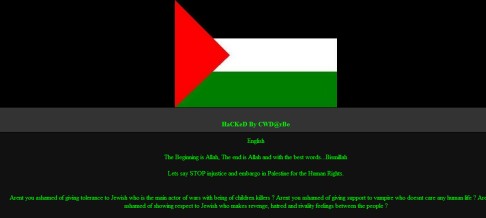
This is where it gets interesting. The Google cache page shows this — a statement by an ostensibly Turkish pro-Palestinian hacker/group. Here’s a screenshot:

If that looks familiar it’s probably because you read about the hacking of The Jewish Chronicle in Britain a week ago. The text and image appear to be the same:

There is one difference — the claim of authorship. The hackers of the Chronicle identified themselves as “PALESTINIAN MUJAHEEDS” whereas the TAC hackers used this name: “HaCKeD By CWD@rBe”.

So what can we infer? Some Turkish pro-Palestinians don’t know much about the American media? Perhaps.

The American Conservative is certainly a counter-intuitive target to pick. It’s one of the few American publications that acknowledges the legitimacy of the Palestinian cause and it is by no stretch of the imagination an Israel-friendly publication.

So who might the Palestinian Mujaheeds be? A Google search indicates that the name had never shown up until the Jewish Chronicle attack.

The equation between Palestinians and Mujahadins is a strange one to make — unless that is you happen to be an anti-Jihadist of the type that figures in Daniel Larison’s article. He writes:

The Palestinian cause generates remarkable reactions in Western anti-jihadists. For most of them, it is an article of faith that Palestinians, or at least the organized factions that speak for them, are just about as bad and hostile to “the West” as Al Qaeda itself, and so there is no point in attempting to make any deal with them. As far as they are concerned, the correct response is to back Israeli policies to the hilt, and to throw up as many obstacles to anyone here at home who would attempt to use U.S. influence to change those policies. The Bush-era habit of lumping together every Islamic revolutionary, militant and terrorist group under some catch-all term of “Islamofascism” made it easier to lump all these causes together, which is oddly enough exactly what jihadists would like, and once they were lumped together they could be that much more easily demonized together.

Now is that the kind of statement that a pro-Palestinian Turk believes should be blocked from public viewing? It’s conceivable but rather improbable. Much more plausible is the idea that a pro-Israeli hacker finds the expression of such views particularly unpalatable.

It’s not always possible to judge who you are dealing with simply by seeing the colors on the flag that they choose to waive.

Meanwhile, as TAC deals with the damage done by “HaCKeD By CWD@rBe”, be sure to look at Daniel Larison’s piece which I’ve reposted here. It’s essential reading.

Facebooktwittermail

Jihadism, anti-Jihadism and Palestine

Jihadism, anti-Jihadism and Palestine

A lot of ink has been spilled since 9/11 trying to argue that bin Laden doesn’t really care about Palestine. But that’s always been silly — nobody knows what he “really” cares about, and it doesn’t especially matter since he talks about it a lot and presents it as a major part of his case against the United States. An Israeli-Palestinian peace agreement surely would not convince bin Laden or al-Qaeda and its affiliated movements to give up their jihad — but it would take away one of their most potent arguments, and one of the few that actually resonates with mass publics. Marc Lynch (via Andrew)

One of the reasons there has been a consistent effort to deny that Bin Laden has any “real” interest in the Israeli-Palestinian conflict is that such an interest, sincere or not, suggests jihadist groups are fueled by U.S. and allied policies, or at least that they successfully exploit U.S. and allied policies for propaganda purposes. Washington would then be faced with at least one of two unpalatable truths. Either our policies are correct and necessary, but strategically disastrous in their effects on Arab and Muslim public opinion and jihadist recruiting, or they are and incorrect and unnecessary while also being strategically disastrous. Washington would then have to decide if it wants to live with perpetual, low-level conflict occasionally exploding into major military campaigns every decade, or if it wants to make enough policy changes (and push our allies to make similar changes) to reduce that conflict to a bare minimum.

For most of the last decade, our preference in and out of government has been to deny that U.S. and allied policies had anything to do with jihadist attacks and their ability to recruit and win sympathizers. This acknowledgement would be to “blame the victim,” so that even if it were the correct analysis it was politically incorrect to say it out loud. Instead we have been treated to a whole host of explanations for why jihadist violence exists and why it tends to be directed at the U.S. and our allies. The lamest of these has been rather popular, namely the claim that “they hate us for our freedom,” or modernity or secularism or whatever it is that the person making the argument finds worthwhile about the West and sees lacking in Muslim countries. Then, of course, there is the trusty appeal to the enemy’s insanity. Unlike us, they are not really rational, and so their actions cannot be explained by referring to anything so mundane and normal as political grievances.

Finally, there is the religious essentialist argument that jihadism is what Islam requires at its core, and therefore there is no way to weaken it without some dramatic transformation of the entire religion. This last argument has won more sympathizers because the people trying to challenge it inevitably go to the opposite extreme and simply ignore or dismiss past Islamic conquests as having nothing to do with Islam. If the essentialist argument really held up, however, Algerians would still be attacking France, Central Asian Muslims would still be warring against the Russians, and Saudis would have been attacking American targets long before the 1990s. We do see cases where separatist movements involving Muslim populations’ breaking away from non-Muslim states become intertwined with and dependent on jihadist groups, because these are the groups providing assistance and because they lend an extra religious and ideological veneer to the conflict that wins the separatists more sympathy abroad. As a general rule, when the cause of the political grievances has disappeared, violent resistance also disappears.

Anti-jihadists like to invoke one or more of these arguments. I am reminded again of a quote from George Kennan in which he described the flaws of the popular anticommunism of his day. His words apply to popular anti-jihadism almost perfectly:

They distort and exaggerate the dimensions of the problem with which they profess to deal. They confuse internal and external aspects of the communist threat. They insist on portraying as contemporary things that had their actuality years ago [bold mine-DL]….And having thus incorrectly stated the problem, it is no wonder that these people consistently find the wrong answers.

Even when anti-jihadists are willing to acknowledge that Al Qaeda uses the grievances of Muslim populations in Iraq or Palestine for propaganda purposes, they will usually hold that changing policy or addressing those grievances to minimize the effectiveness of the propaganda is a form of capitulation. We are supposed to be engaged in “global counterinsurgency,” but we must take little or no account of the stated motivations of jihadists and the reasons why many millions more sympathize with their immediate goals while often deploring the means they use.

The Palestinian cause generates remarkable reactions in Western anti-jihadists. For most of them, it is an article of faith that Palestinians, or at least the organized factions that speak for them, are just about as bad and hostile to “the West” as Al Qaeda itself, and so there is no point in attempting to make any deal with them. As far as they are concerned, the correct response is to back Israeli policies to the hilt, and to throw up as many obstacles to anyone here at home who would attempt to use U.S. influence to change those policies. The Bush-era habit of lumping together every Islamic revolutionary, militant and terrorist group under some catch-all term of “Islamofascism” made it easier to lump all these causes together, which is oddly enough exactly what jihadists would like, and once they were lumped together they could be that much more easily demonized together.

On the whole, it seems that the more sympathetic to or at least understanding of Palestinian grievances a Western observer is, the less willing he is to endorse standard anti-jihadist arguments. Likewise, the more one agrees with anti-jihadist arguments, the more reflexively hostile to Palestinian grievances one tends to be. When most Western anti-jihadists hear that Bin Laden has tied the Christmas bomber attack to the cause of Palestine and specifically to the treatment of Gaza, or when they learn that the bomber who killed the seven CIA operatives claimed that the Gaza operation early last year had driven him to jihadism, the conclusion they draw is not that there was and is something wrong with U.S. and Israeli policies with respect to Palestinians. There is no sudden revelation that the inexcusable blockade of Gaza is politically unwise as well as morally wrong.

On the contrary, the support Bin Laden expresses for the Palestinian cause makes that cause seem to most Western anti-jihadists to be that much more indistinguishable from Al Qaeda’s goals and therefore that much more antithetical to Western interests. This might very well be another purpose in Bin Laden’s exploitation of Palestinian grievances: to harden Western audiences against Palestinian claims even more by linking his cause to Palestine, which will make Americans in particular less interested in supporting an administration that tries to exert pressure in support of a peace settlement. Bin Laden would like to appropriate the Palestinian cause, which Palestinians definitely do not want, and most Western anti-jihadists would like nothing more than to let him have it. So while Lynch is right that resolving this conflict would deprive jihadists of one of their great sources of effective propaganda, our own anti-jihadists will do their utmost to thwart all efforts to that end.

Facebooktwittermail

Haiti: Obama’s Katrina — and Israel’s mission accomplished

Haiti: Obama’s Katrina

Four years ago the initial medical response to Hurricane Katrina was ill equipped, understaffed, poorly coordinated and delayed. Criticism of the paltry federal efforts was immediate and fierce.

Unfortunately, the response to the latest international disaster in Haiti has been no better, compounding the catastrophe.

On Tuesday, Jan. 12, a major earthquake overwhelmed a country one hour south of Miami whose inhabitants include American citizens and their relatives. Thanks to the Internet, pictures of the death and destruction were familiar to the world within hours, and the need for a massive influx of relief and specialized medical care was instantaneously apparent. While particular fatalities such as head injuries or massive blood loss are rarely treatable in mass casualty situations, delayed deaths from infection may be preventable.

On Wednesday, the day after the quake, we organized a relief team in cooperation with the U.S. State Department and Partners in Health (a Boston-based humanitarian organization) to provide emergency orthopedic and surgical care. We wanted to reach the local hospitals in Haiti immediately—but were only allowed by the U.S. military controlling the local airport to land in Port-au-Prince Saturday night. We were among the first groups there. [continued…]

Israeli team preparing to leave Haiti

The Israeli medical and rescue team in Haiti will finish operations on the devastated island nation in the next few days, according to the Israel Defense Forces.

The team’s members are set to return to Israel by Thursday.

The decision to bring the team home came after the arrival of additional aid forces to Haiti, including military and civilian assistance from the United States that is now providing regular medical services, according to a statement released Monday by the IDF. Local hospitals also are functioning as well. [continued…]

Facebooktwittermail

International Holocaust Day becomes Attack Goldstone Day

Israel: Goldstone Report anti-Semitic

The world will mark International Holocaust Day on Wednesday. Monday will see President Shimon Peres fly to Berlin and Prime Minister Benjamin Netanyahu leave for a visit to the Auschwitz death camp in Poland. They will be joined by Foreign Minister Avigdor Lieberman in Budapest and Information Minister Yuli Edelstein in New York.

Before meeting with United Nations Secretary-General Ban Ki-moon, Edelstein referred to the report accusing Israel of committing war crimes in Gaza, calling it “anti-Semitic”.

Israel’s political echelon plans to slam then distortions in the Goldstone Report on International Holocaust Day of all days, in order to point to an anti-Semitic trend which blames the victims of Palestinian rockets. [continued…]

Editor’s Comment — 2009 saw a record number of anti-Semitic attacks – especially after the release of the Goldstone Report… well, no, it was actually in the three months immediately after the war on Gaza. I guess Judge Goldstone just got swept up in the rise in anti-Semitism.

The war on Gaza couldn’t possibly have driven the rise in anti-Semitism. Or could it? I wonder…

Benjamin Netanyahu: Israel will never quit settlements

The Israeli prime minister has taken part in tree-planting ceremonies in the West Bank while declaring Israel will never leave those areas.

Benjamin Netanyahu said the Jewish settlements blocs would always remain part of the state of Israel.

His remarks came hours after a visit by US envoy George Mitchell who is trying to reopen peace talks between Israel and Palestinians.

A Palestinian spokesman said the comments undermined peace negotiations.

“Our message is clear: We are planting here, we will stay here, we will build here. This place will be an inseparable part of Israel for eternity”, the prime minister said. [continued…]

Does Israel have an immigrant problem?

TThe presence of a large, non-Jewish population [of foreign workers] in the Jewish state stirs great unease. In November, Finance Minister Yuval Steinitz blamed foreign workers for a rise in unemployment and a “widening of social gaps”; the mayor of Eilat, Meir Yitzhak Halevi, recently called them a “burden on the welfare authorities.” He added: “They consume alcohol and have introduced cases of severe violence.” The situation is routinely described in the media as a ticking social time bomb. The military estimates that as many as 1 million Africans could try to cross into Israel (though the Office of the U.N. High Commissioner on Refugees puts the number at 45,000).

Responding to such concerns, Prime Minister Benjamin Netanyahu announced on Jan. 10 that Israel will build two fences along the Egyptian border — one around Eilat, the other near Gaza — in the hope of staunching the flow of “infiltrators and terrorists.” Construction is expected to take several years, and the fence will be entirely on Israeli territory. Netanyahu also directed the Justice Ministry to formulate a plan to sanction businesses that hire illegal immigrants. “This is a strategic decision to ensure the Jewish and democratic character of the state of Israel,” Netanyahu said. “Israel will remain open to war refugees but we cannot allow thousands of illegal workers to infiltrate into Israel via the southern border and flood our country.” There is reason to be skeptical. For two decades, Israeli policy toward foreign workers and refugees, has been widely regarded as a complete failure.

Foreign workers first arrived in Israel in the late 1980s to address a sudden labor shortage caused by the outbreak of the first Intifada. Following the Six Day War in 1967, Israel issued work permits to Palestinians for menial, low-wage jobs, primarily in construction and agriculture. By 1987, the year the Intifada began, Palestinians comprised nearly 8 percent of the Israeli labor force. The uprising, which prevented Palestinians from traveling back and forth to jobs inside Israel, threw the economy into crisis. In response, the Israeli government began to import workers from abroad. By 2000, foreign workers comprised 12 percent of the Israeli workforce. [continued…]

Facebooktwittermail

Does Gilbert Bigio make Israel look good?

Does Gilbert Bigio make Israel look good?

When Amos Radian, Israel’s Dominican Republic-based ambassador to the nations of the eastern Caribbean, spoke to the Jerusalem Post last week, he was unequivocal in expressing appreciation towards the Bigio family.

Gilbert Bigio, a Syrian Jew and honorary consul for Israel in Haiti also happens to be among the wealthiest men in that impoverished nation. The day before Israel’s relief team was due to arrive in Haiti, Ambassador Radian spoke to Reuven Shalom Bigio, son of the business magnate.

“Tomorrow the Israel Air Force is coming with two jets and 250 people and I have no place to put them,” Radian told Bigio. The response was swift as the Israelis were provided with Bigio-owned land to set up a field hospital. Radian said that the assistance provided “made us look so good”.

The billionaire industrialist’s loyalty to Israel is unquestionable. As the Jerusalem Post report said:

Gilbert Bigio’s own father came to Haiti in 1925 and was active in the Jewish community. He played a role in Haiti’s support for Israeli statehood in the November 1947 vote at the United Nations.

“Being in a city where there’s no synagogue, prayers are done at our house, Israel to us is the motherland. It’s the rock. It’s how we identify ourselves,” said Reuven Bigio. His father’s support for Israel’s mission here was immediate: “His desire to help was unconditional.”

Does the Bigio family have an unconditional desire to help Haitians? Not as far as one can tell.

In 2004, the Miami Herald reported on Haiti’s tiny and wealthy Jewish community and spoke to its de facto leader. Bigio saw no reason why the huge disparity between his own wealth and the poverty of those around him should breed in them any resentment.

Bigio, 68, lives in a big, beautiful house in Petionville, one of the few upscale neighborhoods in Port-au-Prince. Behind the well-guarded house is a luxurious swimming pool and a gazebo for outdoor parties.

Like most of the other Jews who remain in Haiti, Bigio is considered extremely wealthy in a country where 50 percent of the population is illiterate and 76 percent of children under 5 are underweight or suffer from stunted growth.

“I don’t think there’s resentment against people who are rich here,” says the retired businessman, who speaks English, French and Haitian Creole. “If you know how to manage success, people admire you instead of hate you.”

Cite Soleil, a seaside shantytown of more than 300,000 people residing in homes made of cinder blocks with tin roofs, has been described as poorer than India’s infamous slums of Calcutta. It is also the home of the Bigio business empire.

“Our purpose is to improve the quality of life of the communities we reach,” the GB Group says in its mission statement. A Haiti Information Project report from Cite Soleil published in January 2008 suggests otherwise.

While the surrounding residents of Cite Soleil are forced to literally eat dirt to stave off hunger, Bigio is a billionaire whose family supported the first coup against Aristide and reportedly helped to back the movement that forced his second ouster in 2004.

One need not look very far to see where Gilbert Bigio’s interests lie in relation to Cite Soleil. According to his own company’s web site his family maintains controlling interests in sixteen of Haiti’s largest companies. They are also the largest Haitian partner in the wireless communications giant Digicel, a mammoth company based in Ireland that has nearly cornered the cellular market in the Caribbean. Bigio’s family is not merely wealthy amidst a sea of poverty stricken residents in Haiti, his family represents the Über-wealthy who have benefited most since Aristide’s second ouster in 2004.

The Office of Foreign Assets Control of the US government blocked all of the Bigio family’s holdings in US banks following the brutal military coup against Aristide in 1991. Since Aristide’s second ousting in 2004, the financial wealth of the Bigio family along with those of other well off Haitian clans such as the Mevs, Brandts, Acras and Madsens have nearly doubled according to a confidential source at a private accounting firm.

Meanwhile, Israel’s image-boosting relief effort in Haiti is about to wrap up its operations – its medical and rescue team is set to return home by Thursday.

Facebooktwittermail