Category Archives: Israel

Associating with anyone from the West is dangerous

Associating with anyone from the West is dangerous

Associating with anyone from the West is dangerous. In these times, those abroad play a delicate but vital role. Their assistance in disseminating information from Iran is crucial but any form of intervention, be it military (the bombing of nuclear facilities) or economic (increased sanctions), is only incredibly destructive. Each threat of military aggression or proposed negotiation deadline makes “green” efforts more difficult. And increased economic sanction deteriorates our lives and safety. Some think the two recent airplane crashes may have been affected by our country’s lack of access to parts and planes.

This is our movement. We appreciate and continue to ask for global solidarity but this struggle is for Iranians. I believe that Nobel Peace Price laureate Shireen Ebadi’s statements echo the wider sentiments of the Iranian people. While speaking in Germany, she stated: “I am against economic sanctions and military interventions… Diplomatic ties must not be severed, instead the embassies could be downgraded to consulates. This would not harm the Iranian people, but it would illustrate the government’s isolation.” Keeping the table open with no conditions and encouraging dialogue with all factions in Iran is vital. However, it must be done extremely carefully so as not to provide any means of leverage for Ahmadinejad. [continued…]

Strong words from Iran’s opposition

The Iranian opposition leader Mir Hussein Moussavi spoke out more strongly than ever before on Monday against the arrests and killings of protesters, hours before Iran’s supreme leader ordered the closing of a “nonstandard” prison apparently in an effort to deflect rising criticism over the issue.

“How can it be that the leaders of our country do not cry out and shed tears about these tragedies?” Mr. Moussavi said, in comments to a teachers’ association that were posted on his Web site. “Can they not see it, feel it? These things are blackening our country, blackening all our hearts. If we remain silent, it will destroy us all and take us to hell.”

Mr. Moussavi’s angry tone appeared to reflect the steadily rising toll of those killed — some after being beaten in prison — in the crackdown that followed the disputed June 12 presidential election. A funeral was held in Tehran on Monday for Amir Javadi-Far, a student activist who died in prison after being arrested, and reports emerged of still more deaths. [continued…]

Iran’s protesters: phase 2 of their feisty campaign

Phase 2 has begun. Six weeks after millions took to the streets to protest Iran’s presidential election, their uprising has morphed into a feistier, more imaginative and potentially enduring campaign.

The second phase plays out in a boycott of goods advertised on state-controlled television. Just try buying a certain brand of dairy product, an Iranian human-rights activist told me, and the person behind you in line is likely to whisper, “Don’t buy that. It’s from an advertiser.” It includes calls to switch on every electric appliance in the house just before the evening TV news to trip up Tehran’s grid. It features quickie “blitz” street demonstrations, lasting just long enough to chant “Death to the dictator!” several times but short enough to evade security forces. It involves identifying paramilitary Basij vigilantes linked to the crackdown and putting marks in green — the opposition color — or pictures of protest victims in front of their homes. It is scribbled antiregime slogans on money. And it is defiant drivers honking horns, flashing headlights and waving V signs at security forces. (See pictures of Iran’s presidential election and its turbulent aftermath.)

The tactics are unorganized, largely leaderless and only just beginning. They spread by e-mail, websites and word of mouth. But their variety and scope indicate that Iran’s uprising is not a passing phenomenon like the student protests of 1999, which were quickly quashed. This time, Iranians are rising above their fears. Although embryonic, today’s public resolve is reminiscent of civil disobedience in colonial India before independence or in the American Deep South in the 1960s. Mohandas Gandhi once mused that “even the most powerful cannot rule without the cooperation of the ruled.” That quotation is now popular on Iranian websites. [continued…]

Gates says U.S. overture to Iran is ‘not open-ended’

Strains between the United States and Israel surfaced publicly in Jerusalem on Monday, as Defense Secretary Robert M. Gates tried to reassure Israelis that American overtures to Iran were not open-ended, and as Defense Minister Ehud Barak of Israel expressed impatience with the Americans for wanting to engage Iran at all.

“I don’t think that it makes any sense at this stage to talk a lot about it,” Mr. Barak said at a joint news conference with Mr. Gates at the King David Hotel in Jerusalem, referring to the American offer to talk to Iran about giving up its nuclear program. Nonetheless, he said Israel was in no position to tell the United States what to do.

But, alluding to a potential Israeli military strike against Iran if it gains nuclear weapons capability, he added: “We clearly believe that no options should be removed from the table. This is our policy, we mean it, we recommend to others to take the same position, but we cannot dictate to anyone.”

Later, Prime Minister Benjamin Netanyahu met with Mr. Gates, and his office released a statement saying that he had pressed Mr. Gates on the need to use “all means” to keep Iran from gaining a nuclear weapon. [continued…]

Russia and Iran join hands

The United States may think of Russia as a strategic partner when it comes to Iran. In reality, the geostrategic tensions between Washington and Moscow are still powerful enough to warrant a common approach by Russia and its eastern neighbor Iran with respect to a deterrent strategy towards the intrusive Western superpower.

This week, a small but significant clue is on full display with joint Russia-Iran military exercises in the Caspian Sea involving some 30 vessels. This is partially disguised by a benign environmental cause.

The maneuver, dubbed “Regional Collaboration for a Secure and Clean Caspian”, combines security and maritime objectives in the Caspian Sea, the world’s largest lake and also a main energy hub that is now the scene of competing alternatives for energy transfer. It signals a new trend in Iran-Russia military cooperation that will most likely increase in the near and intermediate future in light of Iran’s observer status at the Shanghai Cooperation Organization. The continuing standoff over Iran’s nuclear program should affect this warming of relations. [continued…]


Facebooktwittermail

Iran ready to strike Israel’s nuclear sites

Iran ready to strike Israel’s nuclear sites

Iran issued a blunt warning to Israel on Saturday that it will launch missile strikes on Israel’s nuclear facilities in the event that the Islamic republic is attacked by the Jewish state. The threat from the head of Iran’s Revolutionary Guard came after a test of Israel’s Arrow missile defence system on Wednesday was reported to have been a ‘resounding failure’.

Inside Iran’s political establishment, President Mahmoud Ahmadinejad after being forced to yield to pressure from the Supreme Leader, Ayatollah Khamenei, who opposed his choice of Esfandiar Rahim Mashai as first vice president, has instead appointed the controversial candidate as his new adviser and head of the presidential office. [continued…]

Facebooktwittermail

Painting Obama as an enemy will hurt Israel badly

Painting Obama as an enemy will hurt Israel badly

In light of the public brawling between Prime Minister Benjamin Netanyahu and U.S. President Barack Obama, we can expect to start seeing graffiti saying things like “America, get out,” “Obama is an Arab” and “Neither a broker nor honest.”

In the new Israeli debate, America is slowly beginning to be perceived as an enemy – and the dispute is going personal: Our prime minister versus their president. Yesterday, he simply demanded that Israel adopt the two-state solution, then called for a freeze on construction in the settlements (without agreeing to settle for “only” the completion of projects already underway), and now he wants to divide Jerusalem. Not Netanyahu – Obama. [continued…]

Facebooktwittermail

White House sends A-Team to Israel to try to overcome settlements impasse, talk Iran

White House sends A-Team to Israel to try to overcome settlements impasse, talk Iran

A flurry of upcoming meetings between senior U.S. and Israeli officials suggest that Washington is determined to try to overcome the current impasse. Defense Secretary Robert Gates arrives in Israel Monday for talks with Israeli Defense Minister Ehud Barak and other leaders. Aides declined to discuss the secretary’s agenda at all except to confirm the trip.

Mitchell too is headed back to Israel Sunday, after visits today in Abu Dhabi, and Damascus tomrrow, and before going on to Egypt and Bahrain. One notes that Mitchell’s and Gates’s trips might overlap, and that both have Defense Minister Barak as one chief interlocutor.

National Security Advisor Gen. James. L. Jones also confirmed to Foreign Policy that he plans to lead a separate multiagency team that reportedly includes officials from the Treasury Department, CIA, as well as NSC Senior Director for the Central Region Dennis Ross to Israel for meetings next Wednesday with Israeli national security advisor Uzi Arad and others. Iran is expected to be the major focus of these talks, which are separate from the Gates’ trip, a U.S. defense official said. Some Iran watchers believe if Iran hasn’t responded to the offer for talks by September, that the process for organizing a tougher sanctions regime targeting Iran will begin to get underway at the U.N. General Assembly in September and subsequent G-20 meeting in Pittsburgh, although administration and outside sources have indicated Russia is not likely to support such measures until after the end of the year. [continued…]

An Economist debate: This house believes that Barack Obama’s America is now an honest broker between the Israelis and the Arabs

Daniel Levy: “Brokering real progress on Israel-Palestine is now more readily understood as being in the US national interest. An especially compelling case can also now be made on why a two-state solution is urgent for Israel and its future as a democracy, and there are new progressive dynamics in America’s Jewish community and in online political organising that support this trend.

“Against this backdrop, Mr Obama is staking out that role of the honest-enough broker. His administration has made public its disagreement with Israel’s settlement policy, unequivocally calling for a full freeze. US relations with Syria have been upgraded. The president has made a point of reaching out to the Arab and Muslim worlds, notably in his Cairo speech, and has done so respectfully, eschewing the arrogant and lecturing tone of his predecessor. Obama has conveyed his determination to realise a two-state solution, just last week telling American Jewish leaders that he would be ‘evenhanded’, having honest conversations with and putting pressure on both the Israeli and Arab sides.” [continued…]

U.S., Israel abort missile test

Israeli and U.S. military officials this week aborted a test of a missile-defense shield under development by the two countries, raising questions about the reliability of Israel’s defenses against a potential Iranian attack.

The news, which military officials were careful not to characterize as a failure of the Israeli missile-defense program, comes amid heightened tensions in the Middle East over the strengthening of Iranian hawks loyal to Iranian President Mahmoud Ahmadinejad.

Mr. Ahmadinejad’s recent electoral victory has fueled renewed debate in Washington and European capitals about whether to rely on continued diplomacy to curb what the U.S. and Israel see as Iran’s intention to build nuclear weapons. Iran says its nuclear program is for peaceful purposes. [continued…]

Israeli warships’ passage through Suez Canal causes a stir

There’s no sneaking a warship through the Suez Canal, so it’s best to sail through and remain coy.

Israel has done just that. At least two of its missile-class Saar 5 warships and a Dolphin submarine have sailed through the canal in recent weeks, prompting conjecture about Israel’s intentions. Possible scenarios include the sending of a message to Iran about Israeli military might and giving the impression that Israel and Egypt, which controls the Suez, are closely cooperating against regional security threats.

The Israeli government has said little about why the vessels were on missions that took them through the Suez, but they come as Israel has grown insistent on stopping Iran’s nuclear program. That fits in with Prime Minister Benjamin Netanyahu’s attempts to link the resolution of the Israeli-Palestinian conflict with agreements from Arab states to help Israel counter Iran. [continued…]

Facebooktwittermail

The “swiftboating” of Human Rights Watch

The “swiftboating” of Human Rights Watch

Last week witnessed a concerted attack against the credibility of the NGO Human Rights Watch (HRW), seeking to link supposed fundraising activities in Saudi Arabia with that organization’s criticism (“bias”, according to its detractors) of Israeli practices in the occupied territories, also claiming HRW is soft peddling on Saudi violations. It started in a Wall Street Journal piece, the Israeli prime minister’s office and spokespeople weighed in, and then AIPAC and the rightwing blogosphere got onboard. The attack on HRW has now been ratcheted up according to last week’s Jerusalem Post.

The former right-wing Israeli Government Minister, Natan Sharansky (also an ex-refusenik, President George W. Bush’s favorite author and occupation apologist) claims that HRW “has become a tool in the hands of dictatorial regimes to fight against democracies.” Ron Dermer, director of policy planning in the Israeli Prime Minister’s Office adds: “We are going to dedicate time and manpower to combating these groups; we are not going to be sitting ducks in a pond for the human rights groups to shoot at us with impunity”.

The apparent trigger for this assault on a group that represents the global gold standard in human rights monitoring, analysis, and advocacy, was a visit by HRW’s Middle East-North Africa director, Sarah Lee Whitson, to the Saudi kingdom. I happened to find myself on a panel at The Century Foundation discussing the Middle East with Whitson just days before this storm broke — I went back and watched tapes of that panel discussion. To accuse Whitson of being soft on the Saudis or somehow singling out Israel for criticism is quite astonishing as I’m sure you’ll agree if you take ten minutes to listen to her presentation — of that, more in a moment. [continued…]

Facebooktwittermail

US-Israeli tensions

‘No difference to U.S. between outpost, East Jerusalem construction’

The United States views East Jerusalem as no different than an illegal West Bank outpost with regard to its demand for a freeze on settlement construction, American sources have informed both Israel and the Palestinian Authority.

This clarification came in the context of a growing crisis in U.S.-Israel relations over the planned construction of some 20 apartments for Jews in the Shepherd Hotel, in East Jerusalem’s Sheikh Jarrah neighborhood. The U.S. has demanded that the project be halted, but Prime Minister Benjamin Netanyahu told the cabinet meeting Sunday that “Israel will not agree to edicts of this kind in East Jerusalem.” [continued…]

Netanyahu-Mitchell meeting postponed again

Prime Minister Benjamin Netanyahu’s scheduled meeting with US Mideast envoy George Mitchell has been postponed at least until the end of the month.

Another meeting between the two, which was set to take place in Paris last month, was also cancelled.

Mitchell was originally scheduled to arrive in Israel on Sunday and later hold meetings with senior Palestinian officials in Ramallah. Jerusalem did not state the official reason for the delay, but some officials suspect it relates to the fact that the Netanyahu and Obama administrations have yet to resolve their differences on the issue of settlement expansion in the West Bank, among other things. [continued…]

What Netanyahu wants from Obama’s ‘self-hating Jews’

Who is to blame for the latest dispute with the United States over the new neighborhood going up in Jerusalem’s Sheikh Jarrah area? Mayor Nir Barkat? Certainly not. Prime Minister Benjamin Netanyahu, who stood behind him? Ridiculous. Any child knows that everything is the fault of other Jews: Rahm Emanuel and David Axelrod, two American administration officials who are inciting President Barack Obama against their own people.

This is not the first time that “self-hating Jews” have given us trouble. In negotiations over the separation of forces agreement in the 1970s, U.S. secretary of state Henry Kissinger, the scion of a family of Jewish refugees who had escaped from Nazi Germany, earned the anti-Semitic epithet “Jewboy” in Israel. At the end of the 1980s, when president George H.W. Bush dared to argue that the peace process does not jibe with settlement expansion, the Shamir government instigated a campaign against “the ‘Jewboy’ trio”: Dennis Ross, Aaron Miller and Dan Kurtzer. Now it is the turn of Obama’s Jewish confidantes to be the scapegoats.

It is easy to imagine what an uproar there would be in Jerusalem if an Arab leader or newspaper dared to claim that an American president was favorable to Israel because of the influence of a Jewish adviser. Netanyahu, who spent many years in the United States, knows very well the extent to which Jewish administration officials in key positions are sensitive to the slightest hint of dual loyalty – to their birthplace and their historic homeland. It turns out that for him, politics bends the iron-clad rule that “all Jews are responsible for one another.” [continued…]

Israeli settlers versus the Palestinians

In a hilltop suburb South of Jerusalem called Efrat, Sharon Katz serves a neat plate of sliced cake inside her five-bedroom house, surrounded by pomegranate, olive and citrus trees that she planted herself. She glances out the window at the hills where, she believes, David and Abraham once walked. “We are living in the biblical heartland,” she sighs.

It is a heartland the prophets would not recognize, replete as it is with pizza parlor, jazz nights at the coffee shop, grocery store and yellow electronic gate with machine-gun-wielding guards. Efrat is one of 17 settlements that make up a bloc called Gush Etzion, located not in Israel but in the occupied West Bank. The Katzes (Sharon, husband Israel and five children) consider themselves law-abiding citizens. They publish a small community magazine and take part in civic projects. Sharon raises money for charity by putting on tap-dancing and theater shows. And yet to much of the outside world, the Katzes are participating in an illegal land grab forbidden by the Geneva Conventions, which prohibit an occupying power from settling its own civilians on militarily controlled land. Some Israelis have admitted as much. While Benjamin Netanyahu, then as now Prime Minister, was negotiating with Palestinian leader Yasser Arafat in 1998, Foreign Minister Ariel Sharon got on Israeli radio and urged Israelis to settle more land fast. “Grab the hilltops, and stake your claim,” he said. “Everything we don’t grab will go to them.” [continued…]

Vatican teaching Hezbollah how to kill Jews, says pamphlet for IDF troops

The Pope and the cardinals of the Vatican help organize tours of Auschwitz for Hezbollah members to teach them how to wipe out Jews, according to a booklet being distributed to Israel Defense Forces soldiers.

Officials encouraging the booklet’s distribution include senior officers, such as Lt. Col. Tamir Shalom, the commander of the Nahshon Battalion of the Kfir Brigade. [continued…]

Facebooktwittermail

Jerusalem – 7/19

Netanyahu: Israel rule over Jerusalem not up for discussion

Prime Minister Benjamin Netanyahu said Sunday that Israel’s sovereignty over Jerusalem was not a matter up for discussion. The prime minister’s comments came after the U.S. State Department told Israeli envoy Michael Oren that Israel must halt a construction project in East Jerusalem.

Netanyahu told ministers at the weekly cabinet meeting that Jerusalem is the united capital of Israel and that all citizens are allowed to purchase property in any part of the city they choose. [continued…]

‘U.S. tells Israel to halt East Jerusalem building’

The United States has told Israel it must halt an East Jerusalem construction project in accordance with the Obama administration’s demands for a complete freeze on settlement building, Israeli radio stations reported on Sunday.

The State Department summoned Israeli Ambassador Michael Oren over the weekend to advise him that the project developed by American millionaire Irving Moskowitz should not go ahead, according to both Israel Radio and Army Radio.

Moskowitz, an influential supporter of Israeli settlement in East Jerusalem, purchased the Shepherd Hotel in 1985 and plans to tear it down and build housing units in its place. The hotel is located near a government compound that includes several government ministries and the national police headquarters. [continued…]

Facebooktwittermail

US-Middle East – 7/18

New Hope for Peace: What America Must Do to End the Israel-Palestine Conflict part 1

New Hope for Peace: What America Must Do to End the Israel-Palestine Conflict part 2

Revisiting Obama’s Riyadh meeting

US relations with Saudi Arabia are always something of a proverbial black box. And President Barack Obama’s meeting with Saudi King Abdullah last month was no exception. A late add-on to Obama’s planned June itinerary to Egypt, Germany, and France and conducted at King Abdullah’s horse ranch outside of Riyadh, the June 3 meeting was quickly overtaken by coverage of Obama’s high-profile June 4 speech to the Muslim world from Cairo.

But two sources, one a former U.S. official who recently traveled there and one a current official speaking anonymously, say the meeting did not go well from Obama’s perspective. What’s more, the former official says that Dennis Ross has told associates that part of what prompted Obama to bring him on as his special assistant and NSC senior director for the “Central Region” last month was the president’s feeling that the preparation for the trip was insufficient. The White House vigorously disputes all of that, some of which was previously reported by the New York Times.

Sources say Obama was hoping to persuade the king to be ready to show reciprocal gestures to Israel, which Washington has been pushing to halt settlements with the goal of advancing regional peace and the creation of a Palestinian state.

“The more time goes by, the more the Saudi meeting was a watershed event,” said the former U.S. official who recently traveled to Riyadh. “It was the first time that President Obama as a senator, candidate, or president was not able to get almost anything or any movement using his personal power of persuasion.” [continued…]

Report urges continued U.S. diplomatic push

The U.S. should proceed cautiously in its engagement strategy with Iran, while moving quickly toward final-status negotiations between Israelis and Palestinians, according to a new report by a team of veteran diplomats and Middle East policymakers.

The policy paper, released Wednesday by the Israel Policy Forum (IPF), an organisation that promotes U.S. diplomatic engagement in the Middle East, expresses support for President Barack Obama’s ambitious Middle East strategy.

Entitled “After Cairo and Iran: Next Steps for U.S. Diplomacy in the Middle East“, it recommends continuing attempts to engage Iran, but shifting primarily to back-channel rather than public talks in response to the recent political turmoil following June’s disputed presidential elections. [continued…]

Israel to drop Arabic names

Thousands of road signs are the latest front in Israel’s battle to erase the Arab heritage from much of the Holy Land, according to critics in both Israel and the wider Arab world.

Israel Katz, the transport minister, announced this week that signs on all major roads in Israel, East Jerusalem and possibly parts of the West Bank would be “standardised”, converting English and Arabic place names into straight transliterations of the Hebrew name.

Currently, road signs include the place name as it is traditionally rendered in all three languages.

Under the new scheme, the Arab identity of important Palestinian communities will be obscured: Jerusalem, or “al Quds” in Arabic, will be Hebraised to “Yerushalayim”; Nazareth, or “al Nasra” in Arabic, the city of Jesus’s childhood, will become “Natzrat”; and Jaffa, the port city after which Palestine’s oranges were named, will be “Yafo”. [continued…]

Facebooktwittermail

US-Middle East – 7/17

Obama, Foxman and Israel’s purpose

Abe Foxman, President of the Anti-Defamation League and a stalwart cheerleader for Israel in Washington, has been worried about President Barack Obama ever since the new Administration took office. When Obama named Senator George Mitchell as his Mideast envoy, Foxman actually complained that the problem with Mitchell was “meticulously fair and even handed,” which he insisted was not a desirable approach for the U.S. to take to the Israeli-Palestinian conflict.

Ever since Obama’s Cairo speech, Foxman’s concerns have become more pronounced. It’s not that the Anti Defamation League president didn’t take heart from Obama’s insistence that Israel’s security is sacrosanct; or that “he made strong statements against anti-Semitism and Holocaust denial.” No, his concern — among others — was that Obama should have “made clear that Israel’s right to statehood is not a result of anti-Semitism and the Holocaust.”

He’s not the only one who argues this, of course; many on the Zionist right have long insisted that the movement claimed sovereignty in Palestine not on the basis of the Holocauast, but claiming to represent the continuity of the Hebrews of Judea thousands of years ago. [continued…]

Obama meets the Lobby

This past Monday, President Obama met with the heads of a number of prominent Jewish groups, to talk about the state of U.S.-Israeli relations and the future direction of U.S. Middle East policy. Virtually all the news reports I’ve seen suggest that the attendees had a cordial and candid discussion. After reading through various accounts, I have three comments.

First, although a few individuals in the Israel lobby continue to downplay its influence, the very fact that this meeting was held is additional testimony to its important role in shaping U.S. Middle East policy. Why was Barack Obama taking time from his busy schedule to meet with the heads of groups like AIPAC, the Anti-Defamation League, J Street, Hadassah, and the Conference of Presidents of Major American Jewish Organizations (among others)? Simple: he knows that these groups have a lot of political power. He also knows that the success of his Middle East policy depends in large part on getting significant support from them. In a political system like ours, where well-organized interest groups routinely wield disproportionate influence over the issues they care about, holding a White House sit-down with these key leaders was smart politics.

Second, the meeting also makes it clear that there have been significant changes within the lobby over the past several years, and that there is an evident rift between those who think the United States should continue to the same “special relationship” with Israel, and those who believe that it would be in Israel and America’s interest if Washington adopted a more candid and nuanced policy toward the Jewish state. It is noteworthy that the invitees included representatives from both J Street and Americans for Peace Now — groups that openly favor a two-state solution and have been backing Obama’s campaign to halt all construction in the settlements. Maybe even more noteworthy, the more hard-line groups were remarkably restrained in defending the settlement enterprise. [continued…]

Israeli author’s Zionist novel creates controversy

The idea for Israeli author Alon Hilu’s latest novel, “The House of Dajani,” came to him one day in a Tel Aviv cafe when he began mentally stripping the city to its roots.

Where he ended was with an Arab boy in the 1890s, at his family farm near what would become the Jewish metropolis, hallucinating about a future in which an army invades and builds skyscrapers over the land.

The novel based on Hilu’s ruminations has now embroiled him in an intense discussion of Israeli letters and the identity of the Jewish state. Critics have labeled the book anti-Semitic, lambasted what they call its loose use of historical details and branded Hilu’s unflattering portrayal of early Zionist immigrants as an effort to undermine the state. Admirers awarded the book Israel’s richest literary prize, only to have their decision reversed over conflict-of-interest allegations. [continued…]

Palestinian Authority closes down Al Jazeera offices

The other day I mentioned the explosive allegations made by PLO political section head Farouq Qaddoumi that Mahmoud Abbas and Mohammed Dahlan had conspired with Israel and the U.S. to have Yasir Arafat killed. Abbas has called Qaddoumi’s statement “lies” and threatened punishment, and rumors are that Qaddoumi will soon be expelled from his position in the PLO; Qaddoumi has presented documents that he claims prove his contention. His comments to a group of Jordanian journalists have led to a minor diplomatic crisis between the Palestinian Authority and Jordan. That will pass. But they have also led a defensive Mahmoud Abbas to order the closure of the Al Jazeera offices in the West Bank.

That’s a major mistake, and all too typical of the way the Palestinian Authority and most other Arab governments have approached critical media over the years. Shutting down critical media outlets represents the bad habit of the official Arab order, which has never adjusted to the contentious new media (whether Al Jazeera or political blogs). [continued…]

Facebooktwittermail

EDITORIAL: Does Joe Biden want Israel to attack Iran?

Does Joe Biden want Israel to attack Iran?

Or, let’s phrase the question another way: is Joe Biden stupid?

He might speak a bit more freely than politicians are supposed to in this day and age, but I don’t think Biden is stupid. And I don’t think he gave Israel a green light to attack Iran. This is the part of his interview with George Stephanopoulos aired yesterday where the issue came up:

George Stephanopoulos: [The Israeli] Prime Minister Netanyahu has made it pretty clear that he agreed with President Obama to give until the end of the year for this whole process of engagement to work. After that, he’s prepared to make matters into his own hands.

Is that the right approach?

Joe Biden: Look, Israel can determine for itself – it’s a sovereign nation – what’s in their interest and what they decide to do relative to Iran and anyone else.

Stephanopoulos: Whether we agree or not?

Biden: Whether we agree or not. They’re entitled to do that. Any sovereign nation is entitled to do that. But there is no pressure from any nation that’s going to alter our behaviour as to how to proceed.

What we believe is in the national interest of the United States, which we, coincidentally, believe is also in the interest of Israel and the whole world. And so there are separate issues.

If the Netanyahu government decides to take a course of action different than the one being pursued now, that is their sovereign right to do that. That is not our choice.

Stephanopoulos: But just to be clear here, if the Israelis decide Iran is an existential threat, they have to take out the nuclear programme, militarily the United States will not stand in the way?

Biden: Look, we cannot dictate to another sovereign nation what they can and cannot do when they make a determination, if they make a determination that they’re existentially threatened and their survival is threatened by another country.

Stephanopoulos: You say we can’t dictate, but we can, if we choose to, deny over-flight rights here in Iraq. We can stand in the way of a military strike.

Biden: I’m not going to speculate, George, on those issues, other than to say Israel has a right to determine what’s in its interests, and we have a right and we will determine what’s in our interests.

Earlier in the interview, Biden had reiterated that the US along with the other members of the permanent five plus one, Britain, China, France, and Russia, plus Germany, remain prepared to sit down and negotiate with Iran on its nuclear programme. Indeed, he went so far as to suggest that if Iran is willing to respond to the offer of engagement then this means that the regime has begun to change course and that “the protesters probably had some impact on the behavior of an administration that they don’t like at all.”

When pressed on whether the policy of engagement should now be put on hold, Biden insisted that the invitation was still out there and that “we have to wait to see how this sort of settles out.”

So what’s going on here? Biden wants to tell the Iranians we’re still ready to talk and at the same time he wants to tell the Israelis its OK if you go ahead and bomb Iran — we won’t get in your way?

Contrary to what the headlines suggest, the message I believe that Biden really wanted to drive home was that the administration remains committed to its policy of engagement.

When asked whether the US would modify its approach in response to choices Israel makes he said it would not. He said: “there is no pressure from any nation that’s going to alter our behavior as to how to proceed.”

By focusing on national sovereignty and Israel’s right to determine its own choices he was pointing to the fact that Israel and the US do not operate in tandem. And at a moment when Iran has been the focus of global condemnation he did not want it to appear that the US dictates what Israel can or cannot do.

If the Israeli government acts in a way that conflicts with America’s national interest then it should do so with the foreknowledge that this administration has already made it increasingly clear that it will not support Israel’s national interests at the expense of America’s national interest. Israel will no longer be treated like a rambunctious teenager that is given extra latitude by doting parents.

That’s a tough message — but it doesn’t readily reduce itself to a sensational headline.

Still skeptical about my interpretation? Well let’s consider another aspect of the conventional wisdom: Israel’s eagerness to strike Iran.

There has been no shortage of declarations by Israel’s hawkish leaders that would lead one to conclude that the only thing standing in the way of an attack was Washington. Hence, once provided with the requisite green light there would be nothing else holding Israel back. Indeed, with Obama’s policy of engagement now being viewed doubtfully by elements within most political camps, it might well appear that it’s no longer a question of if but simply when an attack will be launched.

But consider: isn’t this perception of Israeli-US power dynamics exactly the one that the Israelis would want sustained? On the one hand it perpetuates the image of Israel as lacking few internal inhibitions on its own use of military power. At the same time it maintains the expectation that whenever Israel launches an attack or starts a war it does so with American consent and collusion.

The one thing that Israel does not want unmasked is its own uncertainty: the fact that — all the bellicose rhetoric notwithstanding — it does not actually know whether it could effectively execute the military operation, nor is it confident that operational success would not also yield a strategic disaster.

John Bolton might be confident, but the confidence of a neocon sitting in Washington probably provides little comfort to anyone in Tel Aviv.

Facebooktwittermail

EDITORIAL: Corruption: ‘the greatest single existential threat to Israel’

Corruption: ‘the greatest single existential threat to Israel’

At the web site of the neoconservative magazine, Commentary, Michael B Oren (who is in line to become Israel’s next ambassador to the United States) moves away from the standard position on existential threats to Israel. Seeing an array of existential threats, Oren says that among those, that posed by a nuclear-armed Iran would itself constitute “not one but several existential threats.” Even so, he does not see the risk of Israel being wiped off the map as preeminent among the dangers Israel faces.

This is where Oren locates the greatest threat to Israel’s survival:

Recent years have witnessed the indictment of major Israeli leaders on charges of embezzlement, taking bribes, money laundering, sexual harassment, and even rape. Young Israelis shun politics, which are widely perceived as cutthroat; the Knesset, according to annual surveys, commands the lowest level of respect of any state institution. Charges of corruption have spread to areas of Israeli society, such as the army, once considered inviolate.

The breakdown of public morality, in my view, poses the greatest single existential threat to Israel. It is this threat that undermines Israel’s ability to cope with other threats; that saps the willingness of Israelis to fight, to govern themselves, and even to continue living within a sovereign Jewish state. It emboldens Israel’s enemies and sullies Israel’s international reputation. The fact that Israel is a world leader in drug and human trafficking, in money laundering, and in illicit weapons sales is not only unconscionable for a Jewish state, it also substantively reduces that state’s ability to survive.

When it comes to Oren’s remedy, he sounds less than convincing:

…corruption must be rooted out through a revival of Zionist and Jewish values. These should be inculcated, first, in the schools, then through the media and popular culture. The most pressing need is for leadership.

Perhaps there’s another route — one that’s presumably compatible with Jewish values yet can make no claim to being specifically Judaic: the promotion of public integrity.

Corruption is the most glaring expression of a conflict between words and actions. The gap that separates what Israel’s leaders say from what they do is what renders their utterances worthless. But although such leaders are viewed with cynicism by those who have witnessed how deeply ingrained this lack of integrity has become, that cynicism can easily be washed away if promises are fulfilled through actions.

While Israel’s pathological political culture has been shaped by many powerful internal forces there has also been for many decades an external enabler: the United States.

Having previously given Israel’s leaders a free pass, the US could, if it chose, help break the cycle of corruption.

From an unexpected quarter an opportunity is now emerging through which Israel could reclaim some international faith in the value of its word.

Israel’s US-enabled policy of “nuclear ambiguity” has frayed beyond repair. A policy which was never anything more than a bargain of deceit does nothing more than give Israel an excuse for excluding itself from an international debate within which its unacknowledged nuclear arsenal is a central factor.

Now, the Obama administration’s top arms control negotiator, Assistant Secretary of State Rose Gottemoeller, has effectively declared that the era of nuclear ambiguity is over and that Israel’s nuclear arsenal cannot forever remain outside the regime of the nuclear non-proliferation treaty.

“Universal adherence to the NPT itself, including by India, Israel, Pakistan and North Korea … remains a fundamental objective of the United States,” Gottemoeller said at the UN on Tuesday.

The Jerusalem Post reported:

Former prime minister Ariel Sharon’s chief strategist, Dov Weisglass, said Gottemoeller’s comments were very alarming.

“If these statements indicate a change in American policy on this issue, I believe this may be the most worrisome development for Israel’s security in many years,” he told Army Radio.

The Washington Times reported:

Ms. Gottemoeller endorsed the concept of a nuclear-free Middle East in a 2005 paper that she co-authored, “Universal Compliance: A Strategy for Nuclear Security.”

“Instead of defensively trying to ignore Israels nuclear status, the United States and Israel should proactively call for regional dialogue to specify the conditions necessary to achieve a zone free of nuclear, chemical, and biological weapons,” she wrote.

The paper recommends that Israel take steps to disarm in exchange for its neighbors getting rid of chemical and biological weapons programs as well as Iran forgoing uranium enrichment.

If soon-to-be ambassador Oren is serious about reversing Israel’s problem with corruption, maybe he needs to put into practice the art of political leadership and press Prime Minister Netanyahu to take a bold political initiative by bringing Israel out of the nuclear closet.

Is this likely to happen? Hardly. Why? Because Israel does not perceive Iran so much as an existential threat as much as a strategic threat to its regional military dominance.

Entering the NPT and eventually disarming would not threaten Israel’s existence but would destroy its privileged status as a rogue nation able to resist international pressure.

If Obama really wants to sharpen his challenge to Netanyahu when they meet later this month, perhaps who can present him with this choice: keep your nuclear arsenal and learn how to live with a nuclear Iran, or, sign up for the creation of a non-nuclear Middle East. Nukes or no nukes. Which do you want?

Facebooktwittermail

Israeli war talk

Israel threatens military strike on Iran

President Shimon Peres has threatened that Israel will take military action against Iran if talks proposed by the US president Barack Obama fail to halt Iran’s nuclear programme. In an interview on the Israeli Kol Hai radio station on Sunday, Mr Peres warned that if the talks don’t soften the approach of the Iranian president, “we’ll strike him”.

Mr Peres ruled out the possibility of Israel engaging in a unilateral attack, and said: “We certainly cannot go it alone, without the US, and we definitely can’t go against the US. This would be unnecessary.”

The Israeli president’s statement comes just a few days after the US Vice President Joe Biden issued a high-level warning to Israel’s new government that it would be “ill advised” to launch a military strike against Iran.

Mr Peres also suggested that the arrest last week of 49 alleged agents of Hizbollah by Egyptian authorities was a blow to the Iranian president’s ambitions. [continued…]

Editor’s CommentIsrael threatens to attack Iran has become a dog-bites-man story. What’s significant here is that Peres went out of his way to say that Israel will not go it alone. An attack either gets US backing or it’s not going to happen.

The subtext here is that the Israelis are becoming genuinely afraid of a US-Israeli rift. And the driving force behind this rift is one that the Israel lobby is powerless to rein in: Avigdor Lieberman.

The diplomatic sleight of hand that the Israelis love to play is to gloss over disagreements and brush away criticisms by suggesting that the differences only exist in the eye of the beholder — that Israel and the US are of one heart, indivisible. But no one makes this posture more difficult than Lieberman, a man who is now too powerful to dismiss as a somewhat harmless embarrassment.

As Douglas Bloomfield wrote in the Jerusalem Post on Sunday, Lieberman “could do what the Arabs and their supporters could only dream of – drive a wedge between Americans and Israel.”

Netanyahu and threat of bombing Iran — the bluff that never stops giving?

Israel does not have the military capability to successfully eliminate Iran’s nuclear program. Even the most successful bombing campaign would only set back the known program for a few years — without affecting any potential clandestine program. This is not classified information. Military experts are well aware of Israel’s capabilities — and its limits.

Yet, the threat of military action, or rather the bluff, serves a purpose: Threats of military action militarizes the atmosphere. It creates an environment that renders diplomacy less likely to succeed — it may even prevent diplomacy from being pursued in the first place.

In the Iranian case, Netanyahu’s tough talk undermines the Obama administration’s prospects for diplomacy in the following ways.

Getting to the negotiating table has proven an arduous task for the US and Iran. Both sides are currently testing each other’s intentions, asking themselves if the other side is serious about diplomacy or if the perceived desire for talks is merely a tactical maneuver to either buy time or build greater international support for more confrontational policies down the road. From Tehran’s perspective, uncertainty about Washington’s intentions during the Bush administration was partly fueled by the insistence of the military option remaining on the table. Tehran seemed to fear entering negotiations that could have been designed to fail, since that could strengthen the case for military action against Iran. [continued…]

U.S. may drop key condition for talks with Iran

The Obama administration and its European allies are preparing proposals that would shift strategy toward Iran by dropping a longstanding American insistence that Tehran rapidly shut down nuclear facilities during the early phases of negotiations over its atomic program, according to officials involved in the discussions.

The proposals, exchanged in confidential strategy sessions with European allies, would press Tehran to open up its nuclear program gradually to wide-ranging inspection. But the proposals would also allow Iran to continue enriching uranium for some period during the talks. That would be a sharp break from the approach taken by the Bush administration, which had demanded that Iran halt its enrichment activities, at least briefly to initiate negotiations.

The proposals under consideration would go somewhat beyond President Obama’s promise, during the presidential campaign, to open negotiations with Iran “without preconditions.” Officials involved in the discussion said they were being fashioned to draw Iran into nuclear talks that it had so far shunned.

A review of Iran policy that Mr. Obama ordered after taking office is still under way, and aides say it is not clear how long he would be willing to allow Iran to continue its fuel production, and at what pace. But European officials said there was general agreement that Iran would not accept the kind of immediate shutdown of its facilities that the Bush administration had demanded. [continued…]

Iran says it controls entire nuclear fuel cycle

Iran now controls the entire cycle for producing nuclear fuel with the opening of a new facility to produce uranium fuel pellets, the Iranian president said Saturday.

Mahmoud Ahmadinejad made the speech two days after the inauguration of the facility which produces uranium oxide pellets for a planned 40-megawatt heavy-water nuclear reactor near the town of Arak, central Iran.

Production of nuclear fuel pellets is the final step in the long, complicated chain of nuclear fuel cycle. The U.S. and its allies have expressed concern over Iran’s developing nuclear program for fear it masks a nuclear weapons program — a charge Iran denies. [continued…]

Differences with US on Mideast ‘semantic’: Israel

Differences between Israel and the United States over the Middle East conflict are fundamentally semantic and will be harmonised within a few weeks, an Israeli minister said on Saturday.

“There are differences of approach toward the problems in the Middle East between our government and the administration of (US President Barack) Obama, but they point more to wording and semantics than to reality,” Transport Minister Israel Katz told public radio.

Israel’s hawkish new Prime Minister Benjamin Netanyahu “has already had meetings with American leaders, and our policies will converge,” he added. [continued…]

Israel lobbies Russia on Iranian arms sales

Israel has lobbied Russia to pull away from selling a strategic air-defense system to Iran but has received only vague assurances, Israeli defense sources said on Monday.

Last week Israel agreed to supply surveillance drones worth $50 million to Russia. The Israeli Haaretz newspaper said this followed a pledge by Moscow not to sell Iran the S-300, which could protect Iranian nuclear facilities against air strikes.

An Israeli defense official said he had no knowledge of such an undertaking by Russia in its talks with Israel on the matter. Moscow has given mixed messages on the prospects of Iran buying S-300s, a deal one Russian newspaper valued at $800 million. [continued…]

U.S. troops take part in Israel X-Band radar test

U.S. troops took part in a missile defense exercise in Israel last week that for the first time incorporated a U.S.-owned radar system deployed to the country in October.

About 100 Europe-based troops continue to operate the X-Band radar, which is intended to give Israel early warning in the event of a missile launch from Iran.

While it’s not a permanent assignment for U.S. troops, as long as the radar is in use, U.S. personnel will be there to operate it, U.S. European Command said. [continued…]

Facebooktwittermail

Israel’s threats

Israel expected to hold back on Iran

Robert Gates, US defence secretary, has said Israel is unlikely to attack Iran this year to prevent Tehran from developing a nuclear weapon.

In an interview with the Financial Times, Mr Gates said there was still enough time to persuade Iran to abandon what is widely perceived to be a nuclear weapons programme.

Mr Gates said he does not expect Israel – which believes the US estimate for when Iran could develop a nuclear weapon is too sanguine – to take military action this year.

“I guess I would say I would be surprised…if they did act this year,” said Mr Gates. [continued…]

Israel’s awful new government

Israeli leaders and their advocates have already promoted a full-court blitz demanding that the United States “stop” Iran, or Israel will be forced to do so on its own. In part, this is bluster, as few analysts believe Israel is able to attack Iran on its own, and no one believes that Iran wouldn’t retaliate, which would force the United States into the middle of the conflict. However, this emphasis on Iran serves another useful purpose for Netanyahu and Lieberman: Not only does it remove Palestinian independence and potential Israeli peace treaties with the Arab world from U.S. focus, but it sets the agenda for the U.S.-Israeli talks that are to take place this May.

So far, the Obama administration has kept its cards close to the vest — there’s little sign of how it will engage Israel’s new administration on such fundamental differences in policy. But one thing is certain. The longer the United States waits, the harder it will be for the Israeli government to back down from its positions. And it is clear, looking at the challenges facing the United States throughout the Middle East, that placing Israel’s occupation of the West Bank on the back burner is only going to add fuel to the many brush fires the United States is already fighting in the region. Dealing with a hostile and recalcitrant enemy in Afghanistan and Pakistan is hard enough, but the Obama administration may find that dealing with a hostile and recalcitrant ally brings its own set of challenges. [continued…]

Will Netanyahu attack Iran?

European governments are practicing evacuating their citizens from Iran in case a “third party” strikes the nuclear installations. Israel’s veiled threats “that no option should be lifted from the table,” which were meant to push the international community to intensify pressure and sanctions on Iran to prevent war, have had the opposite effect. The international community has become convinced that Israel will act on its own, so it does not need to do a thing. [continued…]

Editor’s Comment — Irrespective of whether Israel is ultimately a free agent, for Robert Gates to refer to Israeli intentions as though they are something about which Americans can only guess, does not seem to be in American interests. It burnishes Israel’s image of unpredictability and it implies that the US lacks the power to rein in its ally at a critical juncture.

It’s one thing for the Obama administration to want to show that Israeli interests and US interests don’t always coincide, but to suggest that the US has no leash strong enough to hold back the mad dog will merely have the effect of creating the appearance of complicity. If the US truly sees Israel as a maverick state that in the international arena is a law unto itself, then it’s time to question the basis of the US-Israeli alliance.

Facebooktwittermail

Israel targets Sudan — and Tehran or Washington?

Three Israeli airstrikes against Sudan

Israel has conducted three military strikes against targets in Sudan since January in an effort to prevent what were believed to be Iranian weapons shipments from reaching Hamas in the Gaza Strip, ABC News has learned.

Earlier this week, CBSNews.com was the first to report that Israel had conducted an airstrike in January against a convoy carrying weapons north into Egypt to be smuggled into the Hamas-controlled Gaza Strip.

But actually, since January, Israel has conducted a total of three military strikes against smugglers transporting what were believed to be Iranian weapons shipments destined for Gaza, a U.S. official told ABC News. [continued…]

Israel carried out 3 attacks on Sudan arms smugglers

Ehud Olmert hinted on Thursday at Israel’s suspected role in the reported air-strike.

“We operate everywhere where we can hit terror infrastructure – in close places, in places further away, everywhere where we can hit terror infrastructure, we hit them and we hit them in a way that increases deterrence,” said Olmert, speaking at a conference in Herzliya.

“It was true in the north in a series of incidents and it was true in the south, in a series of incidents,” he added. “There is no point in going into detail, and everybody can use their imagination. Those who need to know, know. And those who need to know, know that there is no place where Israel cannot operate. There is no such place.” [continued…]

Military clash with Iran

Iran is in fact forcing a direct military confrontation upon Israel. We are not only talking about President Mahmoud Ahmadinejad’s exaggerated verbal passion or the Iranian nuclear project.

Thus far, Iran conducted a war of attrition against Israel via its emissaries: Hizbullah, Hamas, and other Palestinian groups. At this time, the war is reaching new peaks; it will be impossible to continue ignoring them while only engaging with the emissaries.

Based on foreign reports, the Air Force bombed about two months ago, in Sudan, a shipment of medium-range rockets with a range of 70 kilometers (roughly 40 miles,) apparently the Fajar 3 model.

This is not a small missile. In fact, it is a missile that the Iranians are manufacturing especially for the Gaza Strip, so that it can be dismantled to several pieces and smuggled in through the Gaza tunnels. This is also the way they produced the special Grad rockets for Gaza: Disassembled models, made in Iran, and designated for smuggling. [continued…]

Editor’s Comment — I’m in no position to judge the credibility of the claims being made about an arms smuggling route through Sudan or the type of rockets said to be destined for Gaza. However, these air strikes do seem to signal a strategic escalation in hostilities between Israel and Iran.

Israeli commentator, Alex Fishman says:

    The “tight grip theory,” namely, clasping the State of Israel from both the north and south, turns Iran into a concrete enemy, rather than a theoretical one.

This is a significant shift in Israeli rhetoric. Instead of hyperventilating about the threat that Iran will pose if it acquires the ability to construct nuclear weapons, the Iranian threat is now being shunted into the present with the effect that intelligence assessments about Iran’s nuclear status become irrelevant.

Iran is being cast as posing a clear and present danger to Israel. In other words, for those who hold this position, nothing more needs to happen for Israel to justify an attack on Iran.

The question, as always, is this: where is Israel more intent on exerting pressure? In Tehran or Washington?

Is this about threatening Iran, or is it about undermining US-Iranian diplomacy?

An open hand and a fist

We should not underestimate the courage and self-confidence it took for Obama to make several gestures toward Iran since taking office. He reflects real strength, political realism and much humility in being able to reverse many aspects of the belligerent Bush approach.

Yet the flaw in the Obama approach is a lingering streak of arrogance that is reflected in both the tone and the substance of his messages.

This is most obvious in his insistence — after telling the Iranians that they are a great culture with proud traditions, which presumably they already knew — on lecturing Iran about the responsibilities that come with the right to assume its place in the “community of nations,” and then linking Iran’s behavior with “terror of arms” and a “capacity to destroy.”

It is difficult to see how Washington feels the positive gestures of reaching out can be reconciled with an irrepressible need to lecture others about the rules of righteous nationhood. [continued…]

Facebooktwittermail

EDITORIAL: The rise of Israeli extremism

The rise of Israeli extremism

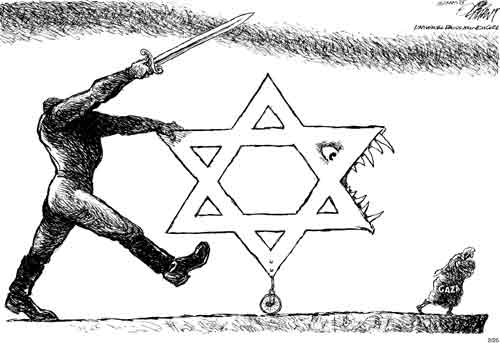
The cartoonist, Pat Oliphant, caused a stir this week with a cartoon (below) which Anti-Defamation League director, Abraham Foxman, said: “employs Nazi imagery by portraying Israel as a jack-booted, goose-stepping headless apparition. The implication is of an Israeli policy without a head or a heart.”

Did Oliphant go too far? Or was he merely using incendiary symbolism to draw attention to the ruthlessness of the Zionist war machine?

The role of the Israeli Defense Forces chief rabbi in portraying the war on Gaza as a religious war has been widely reported. Brig Gen Avichai Rontzki used a line from a classical Hebrew text and turned it into a war slogan: “He who is merciful to the cruel will end up being cruel to the merciful.”

Another rabbi, David Bar Hayim, conveyed a similar message in a broadcast on Israel National News TV where he cited scriptural authority when saying: “In a time of war, one does not distinguish between the different individuals on the enemy side of the fence, of the conflict. One has to fight the enemy … without any thought for such distinctions.” (A statement interestingly reminiscent of the Bush doctrine.) The rabbi also said: “I don’t believe that there are any innocent [Palestinian] civilians in this situation.”

Christopher Hitchens observes:

Peering over the horrible pile of Palestinian civilian casualties that has immediately resulted, it’s fairly easy to see where this is going in the medium-to-longer term. The zealot settlers and their clerical accomplices are establishing an army within the army so that one day, if it is ever decided to disband or evacuate the colonial settlements, there will be enough officers and soldiers, stiffened by enough rabbis and enough extremist sermons, to refuse to obey the order. Torah verses will also be found that make it permissible to murder secular Jews as well as Arabs. The dress rehearsals for this have already taken place, with the religious excuses given for Baruch Goldstein’s rampage and the Talmudic evasions concerning the assassination of Yitzhak Rabin. Once considered highly extreme, such biblical exegeses are moving ever closer to the mainstream.

The extremists are already on the march — literally. And they are being provided with the full support of the state of Israel.

Earlier this week, supporters of Rabbi Meir Kahane descended on the Israeli-Palestinian town of Umm al-Fahm (which was established in 1265).

A hundred militant Zionists, each protected by 25 Israeli police officers, had a simple message for the residents.

“We are going to conquer back Umm al-Fahm” and tell its residents that it is part of Eretz Yisrael (Greater Israel) and that “we are the owners of Eretz Yisrael.”

Just to be clear: Umm al-Fahm is within the 1967 borders of Israel and is populated by Arab Israeli citizens.

The demonstration was also reported by Al Jazeera:

Ynet later reported:

After deeming the Umm al-Fahm march a success, Israel’s extreme right announced it plans to publish regular reports on activities in Arab towns and villages.

“We intend on forming a monitoring committee to counter any infringements of the law in the Arab sector. The committee will be headed by Knesset Member Michael Ben Ari (National Union) and other right-wing activists will serve as members as well,” a rightist source told Ynet Tuesday.

Radical right-wing activist Itamar Ben Gvir explained: “The committee will be made up of subsections, with each section in charge of different things, like building violations, affiliation with terror groups, and infringing on Jewish freedom of movement.” The Right, he added, is now contemplating holding processions in other Arab towns as well.

While the majority of Israelis might identify themselves as secular, with militant nationalism on the rise, religious zealotry and military power have become fused together in the conception of an embattled state that needs show little restraint in its efforts to defend itself.

The spirit of Israel’s indomitable military might is captured in the video below: “Don’t Mess With The IDF.”

It’s tone might seem adolescent, yet it is adolescents and young adults who fill the ranks of the IDF and who celebrated the war in Gaza by adorning themselves with T-shirts that advocate shooting pregnant Muslim women. (Anyone seeing this video who understands Hebrew is welcome to explain the lyrics in a comment. The passage in English comes from The Matrix: Reloaded, which an Israeli reviewer said: “intentionally or not, is the most powerful pro-Israel movie since Cast a Giant Shadow — the story of the Independence War — and Operation Thunderbolt — the story of the Entebbe rescue.”)

Update: The soundtrack for this video combines “The Last Zionist” by Israeli rappers Subliminal and Hazel, followed by “We Are Still Here” by the Dutch DJ Korsakoff.

Facebooktwittermail

GUEST CONTRIBUTOR – John Robertson: Obama’s outreach and the hierarchy of ‘enlightened nations’

Obama’s outreach and the hierarchy of ‘enlightened nations’

John Mearsheimer (of the University of Chicago, and co-author with Stephen Walt of the much-touted/much-reviled The Israel Lobby) has an important essay in the latest London Review of Books, in which he argues (as has Walt) that the Charles Freeman affair has exposed the Israel Lobby and created some new space for public debate about its excessive and harmful impact on the making of US foreign policy. Continue reading

Facebooktwittermail

Israel’s cloak of democracy is falling away

An Israeli foreign minister who won’t wear velvet gloves

Lieberman is not a passing phenomenon. He represents the integration into Israeli politics of the million immigrants from the former Soviet Union. These new immigrants have displaced the old Labour party, once the elite of the country and the so-called party of peace. In every Labour voter there was a sepia-tinted memory of a kibbutznik taking his horse to be shod in an Arab village. If this fantasy of Jewish-Arab co-operation was ever true, it stopped being so in the 1920s. But the Labour party has always felt that somehow the Arabs can be forced to love, or just get along with, Zionism – a viewpoint which used to sell easily in Europe and the US, even if it never corresponded with facts on the ground. Continue reading

Facebooktwittermail

EDITORIAL: Will Clinton allow Israel to violate US sovereignty?

Will Clinton allow Israel to violate US sovereignty?

A few weeks ago Ehud Olmert was bragging about his ability to dictate to President Bush how the US should vote in the UN Security Council. Now Israel is laying down “red lines” on how the US should negotiate with Iran.

What is surprising is not the degree of influence that Israel assumes it has over US foreign policy but that the Israelis choose to parade their power so publicly. Israel’s leaders are embarrassing the Israel lobby!

“I have no problem with what Olmert did,” Abraham Foxman, national director of the Anti-Defamation League, told The Forward in January. “I think the mistake was to talk about it in public.

“This is what friendships are about. He was not interfering in political issues. You have a relationship, and if you don’t like what is being done, then you go to the boss and tell him.”

And this is exactly how the lobby wants to frame US-Israeli relations: that they are based on a level of intimacy that allows Israel to discreetly petition its powerful friend.

Start telling “the boss” what to do and you risk becoming a cause of embarrassment. Keep doing it repeatedly and more and more Americans will understand why President Clinton once said in reference to then-Prime Minister Netanyahu: “Who the fuck does he think he is? Who’s the fucking superpower here?

If anyone should be laying down red lines at this particular time — a time when it’s not clear whether the two-state solution is being rushed to the emergency room or the morgue — it is the US that should unequivocally be telling the Israelis: no more settlements.

Instead, it’s being reported that Israel has plans to double the number of Jewish settlers in the occupied territories.

When Hillary Clinton should be threatening to withdraw the diplomatic cover that the US provides Israel by perpetuating a phony peace process, instead, the Israelis are attempting to set ground rules on how the US should approach Iran.

Ironically, there is so far little indication that Israel need harbor much fear of rapprochement between the US and Iran. Clinton has already made it known that she sees little chance of talks being productive and the Obama administration in spite of having successfully used diplomatic engagement as an effective campaign gambit, has yet to demonstrate that it has a radically different perspective from the Bush administration. How so?

Whereas Bush treated talks with Iran as a reward that must be withheld, Obama is treating them as a reward that can be offered. The presupposition that in and of itself an opportunity to talk directly to Washington has inherent value, has not been questioned.

If talks are used as a bait, when Iran refuses to swallow the bait, the US and its allies will turn around and declare that Iran is unwilling to negotiate. While that might serve Israel and the US in persisting to cast Iran as a rogue state, it will merely confirm to the Iranians that there has never been a genuine interest in diplomatic engagement.

Real engagement hinges on the US credibly offering Iran positive rewards — not merely the offer that it can avoid being punished.

Effective diplomacy is driven by the belief that talking has the power to yield positive results; not the idea that failed talks can provide useful leverage.

In Israel’s efforts to circumscribe the reach of US diplomacy, items three and four of its “red lines” are particularly interesting:

    3. A time limit must be set for the talks, to prevent Iran from merely buying time to complete its nuclear development. The talks should also be defined as a “one-time opportunity” for Tehran.
    4. Timing is critical, and the U.S. should consider whether it makes sense to begin the talks before Iran’s presidential election in June.

Israel is terrified that the clock is running out — but it’s not the clock leading to a nuclear Iran; it’s the horrific prospect that Mahmoud Ahmadinejad could lose his position as a president who is easy to demonize and be replaced by Mohammad Khatami — the face of moderation.

If Khatami returns to the presidency, Benjamin Netanyahu is going to find it incredibly difficult to persuade anyone that the world faces a greater threat from Iran than it does from Great Depression II. Time is indeed running out.

Facebooktwittermail