Category Archives: Israel

NEWS & ANALYSIS: Trusting Hamas

All power to Hamas …

During the years 2000-2006, Hamas obtained all the war medals it needed by steering what has become called the al-Aqsa Intifada. There was no higher reward for the leaders of Hamas than an esteemed reputation in the Islamic world, the ability to inflict pain on Israel, discredit Yasser Arafat, and achieve martyrdom; the ultimate goal of jihadis worldwide. By 2006, it was clear that something was still missing for Hamas. It was the opportunity to rule; the chance to dictate policy and be recognized not only by Arabs and Muslims but by the international community as well.

That, of course, in addition to their conviction that they could run a state, combat corruption and find jobs for the Palestinians. They sincerely believed – and still do – that they can deliver if given the chance. This is actually why they were voted into office in 2006. Palestinians did not vote for them because they promised to annihilate the state of Israel. They actually did not use that during their parliamentary race but rather, campaigned on a social agenda, banking on the bankruptcy of Fatah and the numerous shortcomings that surfaced after the death of Arafat in November 2004. It was a pragmatic victory rather than an ideological one. The Palestinians voted for Hamas because they promised better schools, more security, less bureaucracy and no corruption. Voters included seculars and Christians.

Giving them the full burden of government would have sidelined them from the resistance – the way it did to Fatah after 1993. They would have been too busy cleaning up house in the civil service, inspecting schools, and building roads, to lead a proper resistance. They made several important gestures towards Israel and the Americans, however, crying “Uncle” without actually saying it, because they wanted recognition as statesmen rather than guerilla warriors. Decision-makers in Washington, however, refused to listen, seeing Hamas as no different from al-Qaeda, because of its Islamic program. Instead of taking advantage of the situation, Israel brought Hamas back to the fold of the resistance (what they know how to do best). [complete article]

Egypt: Hamas, Fatah should control Gaza border together

Cairo wants Hamas and Fatah to jointly operate the border crossing between Gaza and Egypt, a spokesman for Egyptian President Hosni Mubarak said yesterday.

Meanwhile, the border was closed yesterday by mutual agreement of Egypt and Hamas, 12 days after the Islamic organization blew up the wall that sealed it.

Speaking after a meeting between Mubarak and European Union foreign policy chief Javier Solana, presidential spokesman Suleiman Awad said that Egypt would not allow the border to reopen. “Egypt is a respectable country,” he said. “You can’t break open its borders and throw stones at its soldiers.”

What Egypt would prefer, he said, is for the Rafah crossing to reopen under the same arrangements that were in place before Hamas took over Gaza last June – namely, under Palestinian control alongside EU monitors. The monitors left after the Hamas takeover, causing the crossing to be shut. Now, said Awad, “the ball is in the Europeans’ court.” [complete article]


Facebooktwittermail

NEWS & ANALYSIS: Debatable targets

Al-Qaida claims responsibility for shooting attack near Israeli Embassy in Mauritania

Al-Qaida claimed responsibility early Sunday morning for Friday’s shooting attack near the Israeli Embassy in Mauritania that wounded three French nationals.

The international terrorist organization urged Muslim states to cut all ties to Israel. Mauritani, an Islamic republic that straddles black and Arab Africa, is one of the few Arab League states to have diplomatic relations with Israel.

Israeli sources said they believe the embassy was not in fact the target of the attack, but rather an adjacent restaurant frequented by foreign diplomats. The attack followed recent public calls by political parties in Mauritania for the government to sever ties to Jerusalem. [complete article]

Al Qaeda said to focus on WMDs

After a U.S. airstrike leveled a small compound in Pakistan’s lawless tribal regions in January 2006, President Pervez Musharraf and his intelligence officials announced that several senior Al Qaeda operatives had been killed, and that the top prize was an elusive Egyptian who was believed to be a chemical weapons expert.

But current and former U.S. intelligence officials now believe that the Egyptian, Abu Khabab Masri, is alive and well — and in charge of resurrecting Al Qaeda’s program to develop or obtain weapons of mass destruction.

Given the problems with previous U.S. intelligence assessments of weapons of mass destruction, officials are careful not to overstate Al Qaeda’s capabilities, and they emphasize that there is much they don’t know because of the difficulty in getting information out of the mountainous area of northwest Pakistan where the network has reestablished itself. [complete article]

Al-Qaeda ‘killing’ spawns doubts

It was unusual for Islamist websites to break the news of the death of an important al-Qaeda operative as they did this week in the case of Abu Laith al-Libi.

Two such websites – Ekhlaas.org and as-Sahab – which usually carry statements from al-Qaeda leaders, reported the story.

These websites and al-Qaeda and its affiliates usually deny any report of their operatives’ deaths because the loss of a leading member of the network could be demoralising for its rank and file.

This change could mean one of two things. [complete article]

Facebooktwittermail

INTERVIEW: Sibel Edmonds

Sibel Edmonds: ‘Buckle up, there’s much more coming.’

In the last few weeks, London Times has run a series of articles about the so-called ‘Sibel Edmonds case’: (For sale: West’s deadly nuclear secrets,’ FBI denies file exposing nuclear secrets theft‘ and ‘Tip-off thwarted nuclear spy ring probe‘)

Former FBI translator Sibel Edmonds stumbled into a world of espionage, nuclear black market, narcotics trafficking, money laundering, and corruption at the highest levels of the US government.

I interviewed Sibel on Sunday regarding the current investigation and reporting by the Times, the failures of the US media, and last week’s decision by the Bush administration to legalize the sale of nuclear technology to Turkey, in an apparent effort to exonerate prior criminal activity by officials in his administration. [complete article]

Facebooktwittermail

NEWS, ANALYSIS & OPINION: After the siege

Whose monopoly now?

First there was delight. Senior officials in Israel said that Egypt had taken on this trouble called Gaza. You could almost hear the chadenfreude in their voices. After not wanting to hear about Gaza or its refugees for a generation, Egypt received both, explosively. Now, at last, there will be a responsible country, and not Israel, to deal with the refugees.

Egypt will also have to safeguard the blasted gate, which looks like a modern sculpture, prevent the passage of explosives and terrorists and supervise the behavior of Hamas, because otherwise it will bear the consequences. The feeling is that Egypt has become a true enemy state at last, Syria-style. Just as Damascus is perceived as responsible for the actions of Hezbollah, so Cairo will be the custodian of Hamas. And what could be better for Israel than to have an address to turn to that is not an organization but a state, which at any given moment can have the screws applied to it in the form of sanctions that will affect not 1.5 million Palestinians but 75 million Egyptians?

Hey, Hamas really showed Egypt what’s what this time. But this approach ignores two facts. First, it was not Egypt that breached the barrier. Egypt did what any humane country would be expected to do in this situation, albeit quite belatedly. It allowed hundreds of thousands of crushed people to enter its territory to stock up on what they have been unable to buy in Gaza for months, nearly two years, in fact. Egypt’s government capitulated to public pressure, as every government is expected to do. President Hosni Mubarak understood that even his great loathing for Hamas could no longer justify his being dragged in the wake of an inhumane Israeli policy, the more so with masses of Egyptians demanding that he take action to save Palestinians, no matter how Israel defines them. [complete article]

Israeli ‘economic warfare’ to include electricity cuts in Gaza

Saying they were waging “economic warfare” against the Gaza Strip’s Hamas leaders, Israeli officials told the Supreme Court on Sunday that the military intends to start cutting electricity to the Palestinian territory and continue restricting fuel.

The statements by Israel’s state attorney, outlining Defense Ministry plans, came in response to a lawsuit filed by Israeli and Palestinian rights groups.

The organizations are asking the Supreme Court to make Israel end fuel restrictions that caused power blackouts in the Gaza Strip this month. The activists argue that the restrictions constitute collective punishment of Gaza’s 1.5 million people and violate international law. [complete article]

No way to avoid Hamas now

On Jan. 16, I interviewed Hamas leader Khaled Meshaal in his well-guarded office here in Damascus. He told me Hamas is interested in reaching a cease-fire with Israel, though he said Israel still rejects this idea completely. He said that Hamas – which has a long and close relationship with Egypt’s main political opposition movement, the Muslim Brotherhood – considers its support within the Arab countries an important asset. While we talked, Yemen’s president, Ali Abdullah Saleh, called. During their five-minute conversation, Mr. Meshaal asked President Saleh to work hard to help lift the siege on Gaza.

Meshaal said Hamas seeks a better relationship with the US. “We are not against the American people, but against this administration. We are not against American interests. Every state has the right to have its own interests – but not at the expense of other peoples.”

The State Department’s designation of Hamas as a foreign terrorist organization had caused big problems for the organization, he admitted. But “American policy is also affected badly,” he argued, “because it finds itself fighting the wrong wars.” [complete article]

See also, Abbas wins int’l backing for PA control at Egypt-Gaza border (Haaretz).

Facebooktwittermail

OPINION: The ‘problem of evil’ in postwar Europe

The ‘problem of evil’ in postwar Europe

Ever since its birth in 1948, the state of Israel has negotiated a complex relationship to the Shoah. On the one hand the near extermination of Europe’s Jews summarized the case for Zionism. Jews could not survive and flourish in non-Jewish lands, their integration and assimilation into European nations and cultures was a tragic delusion, and they must have a state of their own. On the other hand, the widespread Israeli view that the Jews of Europe conspired in their own downfall, that they went, as it was said, “like lambs to the slaughter,” meant that Israel’s initial identity was built upon rejecting the Jewish past and treating the Jewish catastrophe as evidence of weakness: a weakness that it was Israel’s destiny to overcome by breeding a new sort of Jew.

But in recent years the relationship between Israel and the Holocaust has changed. Today, when Israel is exposed to international criticism for its mistreatment of Palestinians and its occupation of territory conquered in 1967, its defenders prefer to emphasize the memory of the Holocaust. If you criticize Israel too forcefully, they warn, you will awaken the demons of anti-Semitism; indeed, they suggest, robust criticism of Israel doesn’t just arouse anti-Semitism. It is anti-Semitism. And with anti-Semitism the route forward —or back—is open: to 1938, to Kristallnacht, and from there to Treblinka and Auschwitz. If you want to know where it leads, they say, you have only to visit Yad Vashem in Jerusalem, the Holocaust Museum in Washington, or any number of memorials and museums across Europe.

I understand the emotions behind such claims. But the claims themselves are extraordinarily dangerous. When people chide me and others for criticizing Israel too forcefully, lest we rouse the ghosts of prejudice, I tell them that they have the problem exactly the wrong way around. It is just such a taboo that may itself stimulate anti-Semitism. [complete article]

Facebooktwittermail

NEWS & OPINION: The Bush administration’s dirty bomb

Tip-off thwarted nuclear spy ring probe

Ainvestigation into the illicit sale of American nuclear secrets was compromised by a senior official in the State Department, a former FBI employee has claimed.

The official is said to have tipped off a foreign contact about a bogus CIA company used to investigate the sale of nuclear secrets.

The firm, Brewster Jennings & Associates, was a front for Valerie Plame, the former CIA agent. Her public outing two years later in 2003 by White House officials became a cause célèbre.

The claims that a State Department official blew the investigation into a nuclear smuggling ring have been made by Sibel Edmonds, 38, a former Turkish language translator in the FBI’s Washington field office.

Edmonds had been employed to translate hundreds of hours of intercepted recordings made during a six-year FBI inquiry into the nuclear smuggling ring. [complete article]

Why Bush wants to legalize the nuke trade with Turkey

According to FBI whistleblower Sibel Edmonds, there is a vast black market for nukes, and certain U.S. officials have been supplying sensitive nuclear technology information to Turkish and Israeli interests through its conduits. It’s a scathing allegation which was first published by the London Times two weeks ago, and Edmonds’ charge seems to be on the verge of vindication.

In likely reaction to the London Times report, the Bush Administration quietly announced on January 22 that the president would like Congress to approve the sale of nuclear secrets to Turkey. As with most stories of this magnitude, the U.S. media has put on blinders, opting to not report either Edmonds’ story or Bush’s recent announcement. [complete article]

Facebooktwittermail

NEWS & OPINION: Collective punishment of Gaza

Strong in numbers

Here we have the yardstick for security success: the number of Palestinians killed. As in the most primeval wars, the heads of the defense establishment are boasting about the number of people Israel has killed. Their job is to ensure protection for the residents of the state. And, as we know, the residents of the “Gaza perimeter” are not receiving this protection. So the death toll has become the measure of their success.

Shin Bet head Yuval Diskin briefed the cabinet last week about the “achievements” of his organization: 810 Palestinians killed during the past two years. His predecessor, Avi Dichter, once appeared before the editorial board of Haaretz and proudly presented a sophisticated slideshow from his laptop computer: a pie chart of Palestinian casualties, in several colors. Last week, the brigade commander in Gaza, Colonel Ron Ashrov, defined the operation in the Zeitun neighborhood as “very successful.” Why? Because his troops killed 19 Palestinians in a single day and further inflamed the conflagration in the South. How depressing, morally and in practical terms, to think that this is the measure of success. [complete article]

Olmert: No fuel? Gazans can walk

“We won’t allow a situation in which people in Sderot walk around in fear day and night, while Gazans lead a completely normal life,” olmert told his faction members. “We won’t allow for a humanitarian crisis, but have no intention of making their lives easier. And the harder their lives, excluding humanitarian damage, we will not allow them to lead a pleasant life.

“As far as I am concerned, all of Gaza’s resident can walk and have no fuel for their cars, as they live under a murderous regime.” [complete article]

The poor and the sick suffer as Israel cuts power to Gaza

Mansour Rahal lay unconscious in the intensive care unit of Gaza City’s Shifa hospital, linked to an electrically powered ventilator, the coloured monitor above his head showing his heart, respiration and oxygen saturation rate.

On Thursday last week, he was driving his donkey cart through Beit Lahiya when it was destroyed by a missile which targeted militants in a nearby car – it also killed his mother and older brother. His hopes of survival yesterday depended on there being enough diesel to keep in operation the four generators which were Shifa’s only source of power.

His doctor, Kamal al-Geathny, said: “If the fuel runs out for the generators and we have no power, he and six other patients in this unit will die.”

This was the scene at the hospital before Israel authorised limited supplies of fuel and medicine to Gaza last night after a wave of international condemnation for its act of “collective punishment” in imposing a four-day total embargo, which had left much of the Strip without electricity. [complete article]

Defusing the Gaza time bomb

The Gaza Strip suffers from sky-rocketing unemployment and poverty, and lacks medicine, fuel, electricity, food, and other essential commodities. It is virtually cut off. It also is the most likely trigger for the next Arab-Israeli war.

In the past few weeks, Palestinian militant groups have fired rockets and mortars into Israel. Israeli incursions and aerial attacks have resulted in Palestinian casualties, including one that killed the son of one of Hamas’s senior leaders. The situation is untenable, and both sides know it. Israel is unlikely to stand idly by as Hamas’s arsenal grows and attacks continue. Hamas undoubtedly will retaliate for the deaths. Neither can afford to back down. [complete article]

Facebooktwittermail

NEWS: Turkish-Israeli network sold nuclear secrets

FBI denies file exposing nuclear secrets theft

The FBI has been accused of covering up a key case file detailing evidence against corrupt government officials and their dealings with a network stealing nuclear secrets.

The assertion follows allegations made in The Sunday Times two weeks ago by Sibel Edmonds, an FBI whistleblower, who worked on the agency’s investigation of the network.

Edmonds, a 37-year-old former Turkish language translator, listened into hundreds of sensitive intercepted conversations while based at the agency’s Washington field office.

She says the FBI was investigating a Turkish and Israeli-run network that paid high-ranking American officials to steal nuclear weapons secrets. These were then sold on the international black market to countries such as Pakistan and Saudi Arabia.

One of the documents relating to the case was marked 203A-WF-210023. Last week, however, the FBI responded to a freedom of information request for a file of exactly the same number by claiming that it did not exist. But The Sunday Times has obtained a document signed by an FBI official showing the existence of the file. [complete article]

Facebooktwittermail

NEWS: Eye on Iran

Israel launches advanced spy satellite

Israel launched an advanced spy satellite Monday that will be able to track events in Iran, the country it considers its top foe, even at night and in cloudy weather, defense officials said.

The TECSAR satellite is of particular importance for Israel because it can be used to keep tabs on Iran’s nuclear program, which the U.S. and Israel fear is a cover for pursuing nuclear weapons, they said. [complete article]

Iran’s supreme leader rebuffs Ahmadinejad in gas row

The political authority of the Iranian president, Mahmoud Ahmadinejad, suffered a serious blow today after the country’s most powerful figure sided with MPs by ordering him to supply cheap gas to villages undergoing power cuts amid an unexpectedly harsh winter.

In a humiliating rebuff, Ayatollah Ali Khamenei, Iran’s supreme leader who has the final say over all state matters, ordered the enactment of a law requiring the government to provide £500m of gas supplies from emergency reserve funds.

Ahmadinejad had refused to implement the measure, accusing parliament of exceeding its powers in passing the bill in response to plummeting temperatures and gas cuts, which have left many areas without heating during the country’s coldest winter in years.

At least 64 people are reported to have died after gas supplies were turned off in sub-zero temperatures. The cuts, belying Iran’s status as possessor of the world’s second biggest natural gas reserves, have provoked public outrage and threaten to turn a mood of rumbling unhappiness into a winter of discontent for Ahmadinejad. [complete article]

Iran sanctions ripple past those in power

Sanctions weren’t supposed to hurt Majid Taleghani. But the Iranian book publisher says they have forced him to increase prices and scale back the number of titles he issues.

“In the past few weeks, the price of South Korean paper has soared at least 25%,” Taleghani complained, chain-smoking nervously. “Why? South Korean banks refuse to open letters of credit. They won’t work with Iranian banks anymore.”

President Bush’s recent tour through the Middle East was meant in part to rally U.S. allies against Iran before talks Tuesday in Berlin by members of the U.N. Security Council and Germany over the possibility of imposing a third round of sanctions on Iran to pressure the government to halt its nuclear program.

A year after the Security Council first imposed sanctions, they clearly have begun to have an effect. But in an echo of the debate over sanctions against Iraq under Saddam Hussein in the 1990s, diplomats and economic analysts disagree sharply over whether such measures would pressure those in power to change their policies or merely hurt the Iranian people. [complete article]

Facebooktwittermail

NEWS: Canadian government embarrasses itself

Torture awareness manual ‘wrongly’ lists Cdn allies, to be rewritten: Bernier

Foreign Affairs Minister Maxime Bernier found himself backtracking Saturday over his department’s training manual that lists the U.S. and Guantanamo Bay as sites of possible torture – alongside such countries as Iran and Syria.

In a statement, Bernier said he regretted the embarrassment caused by the public disclosure of the manual, adding that it contains a list that “wrongly” includes some of Canada’s closest allies.

Bernier said the manual is neither a policy document, nor a statement of policy, and that he has directed it to be reviewed and rewritten. [complete article]

Facebooktwittermail

NEWS ROUNDUP: January 20

Israel test-fires ballistic missile after Iran warning
Israel successfully test-fired a long-range ballistic missile on Thursday, a senior official told AFP, days after warning “all options” were open to prevent archfoe Iran from obtaining atomic weapons.

U.S. plays down chance of Iran resolution soon
The United States on Friday played down the chance of major powers agreeing on new U.N. sanctions against Iran when ministers meet in Berlin next week, underlining discord over how to proceed with Tehran.

Discontent Surges in Iraq
In the depths of a strangely cold winter in the Middle East, Iraqis complain that the lights are not on, the kerosene heaters are without fuel and the water doesn’t flow — and they blame the government.

Violence increases and tensions rise among Iraqi Shiites
A police raid Saturday on an extremist Shiite Muslim mosque thought to be the headquarters of an extremist cult capped a weekend of violence in southern Iraq, while elsewhere tensions between Iraq’s Shiite-led government and renegade Shiite cleric Moqtada al Sadr continued to escalate.

Hamas police force recruits women in Gaza
The policemen of Hamas now have company: since the Islamic group took over here last June it has been recruiting policewomen as well.

Hezbollah taunts Israel with claims of soldiers’ remains
Hezbollah’s leader, Sheik Hassan Nasrallah, on Saturday made his first public appearance here since the 2006 war with Israel, restating his claim that the militant group possessed the remains of several Israeli soldiers left on the battlefields of southern Lebanon.

Israel closes all Gaza border crossings, citing Palestinian rocket attacks
Israel closed all border crossings with the Gaza Strip on Friday, cutting off at least one aid shipment, and bombed the empty Interior Ministry building of the Palestinian Authority, which was already a ruin after a previous Israeli bombing.

Right-wing party quits Israeli coalition
A right-wing party quit Israeli Prime Minister Ehud Olmert’s governing coalition Wednesday in protest of the revived peace talks with the Palestinians, but the move poses no immediate threat to his rule.

Facebooktwittermail

OPINION & EDITOR’S COMMENT: Toward a nuclear-free world

Toward a nuclear-free world

The accelerating spread of nuclear weapons, nuclear know-how and nuclear material has brought us to a nuclear tipping point. We face a very real possibility that the deadliest weapons ever invented could fall into dangerous hands.

The steps we are taking now to address these threats are not adequate to the danger. With nuclear weapons more widely available, deterrence is decreasingly effective and increasingly hazardous.

One year ago, in an essay in this paper, we called for a global effort to reduce reliance on nuclear weapons, to prevent their spread into potentially dangerous hands, and ultimately to end them as a threat to the world. The interest, momentum and growing political space that has been created to address these issues over the past year has been extraordinary, with strong positive responses from people all over the world. [complete article]

Editor’s Comment — Strengthening the NPT requires that nuclear states who refuse to sign the treaty must as a consequence face penalties. The outlaw states are India, Pakistan, North Korea, and Israel. For as long as the United States — with a nod and a wink — allows Israel to maintain the pretense that it is not a nuclear-armed state, it will be impossible to credibly apply pressure on the others. If the United States wants to show the world that it is really serious about disarmament, Israel must be forced out of its nuclear closet.

Facebooktwittermail

EDITORIAL: It’s not the end of times – just the end of Bush

It’s too late, baby

Yesterday, in an address to government and business leaders in Abu Dhabi, President Bush said, “Iran’s actions threaten the security of nations everywhere. So the United States is strengthening our longstanding security commitments with our friends in the Gulf — and rallying friends around the world to confront this danger before it is too late.”

Bush may take comfort in the knowledge that, according to Prime Minister Ehud Olmert’s spokesman Mark Regev and as the Jerusalem Post reports, “Israel and the US are ‘on the same page‘ regarding the gravity of the Iranian nuclear threat and their commitment to thwart it.” Even so, when Bush says “before its too late” to his Arab friends, most of them are probably taking comfort in completing that line with, “before its too late… for Bush to do anything about it.” He frets about only twelve months left on the clock — the rest of the world can’t wait for his term to end.

Witness the spectacle of an international “incident” that after a few days has devolved into a debate about a Filipino Monkey. The only comfort the White House can take from this drama is that the press never even noticed when the stage upon which it was set, came into question.

Iranian speedboats threatened US warships in international waters in the Straits of Hormuz. So far only one analyst — Kaveh L Afrasiabi, writing in Asia Times — has pointed out the most basic factual error in this account: there are no international waters in the Straits of Hormuz.

Let’s repeat that: there are no international waters in the Straits of Hormuz. The U.S. ships were in Iranian territorial waters exercising the “right of transit passage” afforded to them in international law by the UN Convention on the Law of the Sea (UNCLOS) which the United States has signed but which Congress has yet to ratify. This is why in the video of the incident, a U.S. naval officer can be heard saying, “I am engaged in transit passage in accordance with international law.”

However provocatively the Iranian speedboats might have been behaving, if from the outset, this incident had been reported as occurring inside Iranian territorial waters, the Pentagon’s first task would have been to educate the press and the public about some of the technicalities of international law as it applies to the Straits of Hormuz. That lesson would have sucked the air out of the story and Bush would have landed in Tel Aviv deprived of what he was clearly eager to employ in his latest round of fear-mongering rhetoric. Absent this rallying cry, there might have been a tiny possibility that he pay a bit of attention to the real concerns that resonate across the region.

Facebooktwittermail

OPINION: It’s not about Iran

It’s not about Iran

As President Bush travels through the Middle East, the prevailing assumption is that Arab states are primarily focused on the rising Iranian threat and that their attendance at the Annapolis conference with Israel in November was motivated by this threat. This assumption, reflected in the president’s speech in the United Arab Emirates yesterday, could be a costly mistake.

Israel and the Bush administration place great emphasis on confronting Iran’s nuclear potential and are prepared to engage in a peace process partly to build an anti-Iran coalition. Arabs see it differently. They use the Iran issue to lure Israel and the United States into serious Palestinian-Israeli peacemaking, having concluded that the perceived Iranian threats sell better in Washington and Tel Aviv than the pursuit of peace itself.

Many Arab governments are of course concerned about Iran and its role in Iraq, but not for the same reasons as Israel and the United States. Israel sees Iran’s nuclear potential as a direct threat to its security, and its support for Hezbollah and Hamas as a military challenge.

Arab governments are less worried about the military power of Hamas and Hezbollah than they are about support for them among their publics. They are less worried about a military confrontation with Iran than about Iran’s growing influence in the Arab world. In other words, what Arab governments truly fear is militancy and the public support for it that undermines their own popularity and stability.

In all this, they see Iran as a detrimental force but not as the primary cause of militant sentiment. Most Arab governments believe instead that the militancy is driven primarily by the absence of Arab-Israeli peace.

This argument has been a loser in Washington, rejected by many and not taken seriously by others. The issue of Iran gets more traction inside the Beltway. [complete article]

Facebooktwittermail

NEWS & ANALYSIS: The Iranian threat

Saudi cannot be launchpad for Iran attack: report

A leading Saudi newspaper on Saturday ruled out any attempt by the United States to use the oil-rich Gulf kingdom as a launchpad for a possible war on Iran over Tehran’s disputed nuclear programme.

Two days before a visit to Saudi Arabia by US President George W. Bush, the pro-government daily Al-Riyadh said: “We refuse to be used to launch wars or tensions with Iran. [complete article]

Iran’s Revolutionary Guard in secret Iraq talks with US

The head of the Iranian Revolutionary Guard Corps slipped into the green zone of Baghdad last month to press Tehran’s hardline position over the terms of the current talks with American officials, it was claimed last week.

Iraqi government sources say that Major-General Mohammed Ali Jafari, 50, travelled secretly from Tehran. Jafari appears to have passed through checkpoints on his way into the fortified enclave that contains the American embassy and Iraqi ministries, even though he is on Washington’s “most wanted” list. [complete article]

Iran encounter grimly echoes ’02 war game

There is a reason American military officers express grim concern over the tactics used by Iranian sailors last weekend: a classified, $250 million war game in which small, agile speedboats swarmed a naval convoy to inflict devastating damage on more powerful warships.

In the days since the encounter with five Iranian patrol boats in the Strait of Hormuz, American officers have acknowledged that they have been studying anew the lessons from a startling simulation conducted in August 2002. In that war game, the Blue Team navy, representing the United States, lost 16 major warships — an aircraft carrier, cruisers and amphibious vessels — when they were sunk to the bottom of the Persian Gulf in an attack that included swarming tactics by enemy speedboats. [complete article]

Iran urges agency to settle atomic case

Iran’s supreme leader, Ayatollah Ali Khamenei, told the visiting chief of the International Atomic Energy Agency on Saturday that Iran’s nuclear case should be handled by the I.A.E.A. and not the United Nations Security Council, which has imposed two rounds of sanctions on Tehran. [complete article]

Israel stressed to Bush that Iran is a nuclear ‘threat’: general

Iran poses a real nuclear threat and Israel made that point clear to US President George W. Bush during his visit this week, an Israeli defence official said Saturday. [complete article]

Facebooktwittermail

NEWS & EDITOR’S COMMENT: The unraveling of Israel’s nuclear ambiguity

CIA reveals: We said in 1974 that Israel had nuclear weapons

The Central Intelligence Agency, backed by bodies including the State Department’s Bureau of Intelligence and Research and the Defense Intelligence Agency, determined in August 1974 that Israel had nuclear “weapons in being,” a “small number” of which it “produced and stockpiled.”

Israel was also suspected of providing nuclear materials, equipment or technology to Iran, South Africa and other then-friendly countries.

This top secret document, consigned to the CIA’s vaults for almost 32 years, was suddenly released to the public this week, during U.S. President George W. Bush’s visit to Israel and on the eve of his trip to the Persian Gulf. [complete article]

Editor’s Comment — For several decades, Israel has adopted a position of so-called “nuclear ambiguity,” asserting that it would not be the first state to introduce atomic weapons to the Middle East. The United States has colluded in allowing this claim to rest unchallenged — even though it is widely understood that Israel does in fact possess a nuclear arsenal estimated to range from 70 to 400 warheads.

The first indications that the United States’ position might change occurred during Robert Gates’ confirmation hearings in which he included Israel among the nuclear states that surround Iran. Documents released by the Nixon Library a few weeks ago confirm that in 1969, Henry Kissinger warned President Nixon about Israel’s nuclear capabilities and that the “Israelis, who are one of the few peoples whose survival is genuinely threatened, are probably more likely than almost any other country to actually use their nuclear weapons.” A year ago, Ehud Olmert provoked a storm of criticism inside Israel by being the first Israeli prime minister to make reference to Israel’s nuclear arsenal.

It seems to be a matter of time (months or even weeks?) before Israel decides to unambiguously come out of the nuclear closet. If this happens, the nuclear equation changes across the whole region. Will it trigger a Middle East nuclear arms race? Will it help empower those who argue that the only effective way of challenging Iran’s nuclear program is through turning the whole region into a nuclear-weapon-free zone? Or will the United States attempt to contrive a policy that claims that Israel has a unique “right” to possess nuclear weapons and exempt itself from international treaties?

Facebooktwittermail

NEWS & EDITOR’S COMMENT: Bush — tough as Bambi in challenging Israel

Differing opinions fail to dent Israel’s love affair with Bush

The Israeli Prime Minister, Ehud Olmert, declared last night that Israel reserved the right to expand existing Jewish settlements in Arab East Jerusalem and in parts of the West Bank that it hopes to retain in any final peace deal.

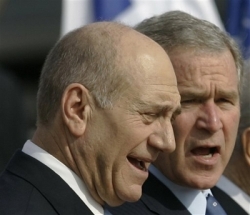
bush-olmert.jpgIn terms which appeared to defy earlier sharp criticism by the US Secretary of State, Condoleezza Rice, Mr Olmert made it clear in front of President George Bush that he regarded such expansion as outside the “moratorium” he has promised on new settlement building. His declaration came as the US President, on his first visit in office to Israel, used some of his strongest language yet in demanding the dismantling of separate settlement outposts which are illegal even under Israeli law. Mr Bush said at a joint news conference last night: “We have been talking about it for four years – illegal outposts. They ought to go.”

Mr Olmert did not demur from that and repeatedly emphasised that Israel was very serious about advancing a negotiating process over the coming year. Mr Bush said the resumption of formal negotiations between Mr Olmert and the Palestinian President, Mahmoud Abbas, presented a historic moment, a historic opportunity. [complete article]

Gaffe overshadows Bush visit

“You’ll be happy to know, my whole motorcade of a mere 45 cars was able to make it through without being stopped,” Bush said after being asked about the 30-minute journey from Jerusalem and Ramallah.

“I’m not so exactly sure that’s what happens to the average person.”

Bush was forced to travel by car to meet Mahmoud Abbas, the Palestinian president, in the West Bank after his helicopter was grounded by bad weather.

The journey took him through an Israeli security checkpoint and within sight of the separation barrier.

Bush said that he could understand why Palestinians were “frustrated” by the checkpoints, but they were necessary to “create a sense of security for Israel”. [complete article]

Editor’s Comment — If Americans had to live under the same kind of stranglehold as do Palestinians in the West Bank, there would be more than 800,000 roadblocks across this country. To speak of “frustration” wouldn’t even hint at the level of anger ordinary people would feel at this extraordinary curtailment of freedom.

For Bush to joke about not getting stopped at an Israeli checkpoint shows a staggering degree of insensitivity — though it will hardly surprise or shock the average Palestinian.

Ramallah demo brands Bush ‘war criminal’

Angry demonstrators in the West Bank town of Ramallah branded US President George W. Bush a “war criminal” on Thursday as locals said he would do nothing for the plight of the Palestinians.

Security forces, out in force to ensure the security of the American leader on his first trip to the occupied Palestinian territory, used batons and tear gas as they charged around 200 demonstrators who were chanting “Bush, war criminal!” and “Bush out!”.

While their leader Mahmud Abbas gave Bush a red carpet welcome on the second day of his Middle East tour, ordinary Palestinians were dismisssive. [complete article]

Bush predicts Mideast peace treaty before he leaves White House

President Bush today predicted that a Mideast peace treaty would be completed by the time he leaves office, but undercut that optimism with harsh criticism of Hamas militants who control part of the land that could form an eventual independent Palestine.

Bush said he’s convinced that both Israeli and Palestinian leaders understand “the importance of democratic states living side by side” in peace, and noted that he has a one-year deadline for progress on his watch. He named Lt. Gen. William Fraser III, assistant to the Chairman of the Joint Chiefs of Staff, to monitor steps that both sides are making on the peace process, a U.S. official told The Associated Press. [complete article]

See also, From Palestinians, harsh view of Bush (NYT).

Facebooktwittermail

NEWS, ANALYSIS, OPINION & EDITOR’S COMMENT: Bush’s trip notes

Bush’s last throw against Iran

The leitmotif of Bush’s high-profile tour of the Middle East is unmistakably Iran. But Washington’s Iran policy lies in tatters and it has no choice but to ratchet up anti-Iran rhetoric, though it realizes there are no takers in the Middle East for such rhetoric of fire and brimstone. The danger now is that Tehran may choose to hunker down and prefer to deal with the next US administration.

Tehran once heeded back-channel pleas from Ronald Reagan’s campaign managers not to negotiate the hostage crisis with the Carter administration in its final months in the White House so that Reagan could claim the credit for the denouement. Bush is certainly better placed than Carter insofar as presidential hopefuls such as Barack Obama and Mike Huckabee would never do such a Reaganite thing on him.

Actually, the danger to the Bush legacy comes from faraway places. Continued delay in constructively engaging Iran will only open the gateway wider for the international community to encroach into a region that until four years ago used to be the exclusive strategic preserve of the US. China is already wading deep into the region, and Russia too. The S-300 missiles from Russia are a sign that US dominance of the Middle East is in serious jeopardy. [complete article]

See also, Bush calls Iran ‘threat to world peace’ (CNN).

Israeli leaders greet Bush with warning for Iran

President Bush began an eight-day Middle East peace mission Wednesday as Israeli leaders warned him and the world not to forget about the regional threat that Iran poses.

Standing on the airport tarmac with Bush looking on shortly after his arrival, Israeli President Shimon Peres relegated peace talks with the Palestinians to secondary status and issued a warning to Iran.

“We take your advice not to underestimate the Iranian threat,” Peres said.

“Iran should not underestimate our resolve for self-defense.” [complete article]

Talking to Iran?

Shortly before Christmas, over dinner in his palace, one of the ruling sheiks of the United Arab Emirates told this reporter he had not been at all surprised by the release of the National Intelligence Estimate that said Iran had suspended its nuclear weapons program back in 2003.

“We were warned by Rafsanjani to expect a very big, very surprising announcement out of Washington,” the sheik said. “He knew it was coming.”

Akbar Hashemi Rafsanjani, former president of Iran and chairman of the country’s Assembly of Experts, also chairs the special council that mediates between the ayatollahs and the Parliament whenever there is a dispute. Derisively nicknamed “Akbar Shah” by his enemies, he is also the head of what is widely reckoned to be Iran’s richest family. Born into a prosperous family of pistachio farmers, he is the link between the ayatollahs, politics and the business community.

Seen as something of a moderate by Iranian standards, Rafsanjani is believed in the Gulf states to have long maintained his own back channels to Washington — hence his supposed advance knowledge of the NIE. [complete article]

Editor’s Comment — As an indication of the importance of President Bush’s trip to the Middle East, his press secretary, Dana Perino, is blogging the trip — though being too diffident to use the actual term “blog”, the White House is modestly calling her record, Trip Notes. Since she’s only two days into this bold new communications venture, I should perhaps refrain from passing judgment, but I was hoping to be able to find at least one — just one — memorable line. The best I could find was this: “As we descended into Tel Aviv, many of us looked out the window to see a country that some of us have only seen in pictures.” Perino was one of the many, but was she also one of the some? I guess divulging whether she’s been to Israel before or how many of her trip mates are on a return trip would be way too personal.

In light of the focus of the current trip, Perino might want embellish her “notes” a bit and see if she can make them at least as interesting as Mahmoud Ahmadinejad’s blog. Here’s a recent entry of his:

To read or to write, that is the question!‎ 2007/11/18
In the Name of Almighty God-the All-Knowing, the Most Lovingly ‎Compassionate

Since my last post on the blog, a few months have passed. But this doesn’t ‎mean that I have not been keeping my promise of spending fifteen minutes per week ‎on it. As a matter of fact, I have spent more than the allocated time on the blog. The ‎magnitude of the reception and acclamation from the viewers was beyond ‎expectations. So I had to decide how to spend the limited time that I have allocated ‎for the blog; should I write new notes or respect those viewers who kindly and ‎generously have shared their thoughts and opinions with me and sent messages and read ‎their numerous received messages. ‎

‎***‎

As you know, the purpose of running this blog is to have a direct and mutual ‎contact and communication with the viewers and even though I have received many ‎messages from the viewers to update the blog and write new notes, I preferred to write ‎less and spend more time on reading the viewers’ messages – and not let this ‎communication tool become just a one-way medium.‎

‎***‎

I personally have read those messages that are considered to be short. I even ‎have read those messages that have started with a sentence like “I know that the ‎president is not going to read this message, but….” ‎

Also some of my trusted students have shortened the long messages for me ‎and have prepared a statistical report regarding all of the messages which I have read ‎and studied those too. God willing, a portion of the overall analysis of the messages ‎and its interesting results will be posted on the blog in the future.‎

‎***‎

I am apologetic to those who have been waiting for my new posts, but ‎fortunately overall, the analysis of the messages has got to a point that I can start ‎writing here again. ‎

I would like to use this opportunity and ask those of you who intend to send ‎me messages through blog, to make it as brief as you can. Thank you.
Written by Mahmoud Ahmadinejad at 23:24

Now if the White House really wants to push the envelope and follow Ahmadinejad’s lead, the Trip Notes from the Middle East should include at least one entry from the president and also be open to comments. On Ahmadinejad’s blog, comments are not as strictly moderated as one might expect, such as the comment from one “John Jacobs” from the United States: “I hate you. you are retarted. that simple mentally retarted.” The remarks of an irate pastry chef?

Facebooktwittermail