Category Archives: Israel

NEWS: Egypt outrages Israel; Israel ready to talk to Syria; Syria alienates France

Egypt opens crossing so Palestinians can return

Egypt opened its main crossing into the Gaza Strip on Wednesday to allow more than 2,000 Palestinian pilgrims — including at least one official of the armed Hamas movement — to return to their homes there, outraging Israel in a growing dispute over border security.

The return followed a month of increasingly bitter words between the two neighbors over Egypt’s policing of its border with Gaza, which Israeli Foreign Minister Tzipi Livni last month described as “terrible.”

The friction between the two long-standing partners in U.S.-brokered peace deals comes as President Bush prepares to visit the region next week with a goal of smoothing the way for further peace accords. [complete article]

Israel signals willingness to reopen talks with Syria

Following a softening of the Bush administration’s opposition to Israeli-Syrian contacts, the Israeli government is actively exploring the possibility of reopening negotiations with Syria, according to Israeli sources and a senior Republican lawmaker who visited Damascus last week.

The Republican lawmaker, Senator Arlen Specter of Pennsylvania, spoke after meeting last Sunday, December 30, with Syrian President Bashar al-Assad and conveying a message from Israel’s prime minister, Ehud Olmert.

Specter, accompanied by Democratic Rep. Patrick Kennedy of Rhode Island, told Assad that Israel is still waiting for a response to its request that Syria take public actions to prove its readiness for peace negotiations. For Specter, this message was seen as giving a green light to negotiations. “The time is right now, and prospects are very good,” the senator told reporters in Damascus after meeting Assad. “The parties will continue talks through intermediaries, and it’s my hope and expectation at some point, if preliminary progress has been made, the U.S. government would be ready, too.” [complete article]

Israel does not expect war with Iran: Peres

Israeli President Shimon Peres said he did not believe a war with Iran would be necessary but called for the end of the current government in Tehran, in an interview published Wednesday.

Peres told the German daily Sueddeutsche Zeitung that Iranian President Mahmoud Ahmadinejad was dangerous for Israel and the region but that other means could be used to contain the threat. [complete article]

Syria’s foreign politics

The French president, Nicolas Sarkozy, has made good on his threat to take action against Syria on account of its presumed role in blocking the election of a new president of Lebanon. Speaking in Cairo at the end of a holiday-cum-official visit, Mr Sarkozy said that France will henceforth suspend all diplomatic contact with Syria “as long as we do not have proof of their [the Syrians’] willingness to allow Lebanon to have a consensus president”. In a further swipe at the regime of Syria’s president, Bashar al-Assad, Mr Sarkozy said that France was willing to bankroll the tribunal that has been established under UN auspices to try those charged with the assassination of Rafiq al-Hariri, a former Lebanese prime minister, and a series of subsequent political murders in Lebanon—Syrian involvement is strongly suspected, although Mr Assad has consistently denied responsibility.

Mr Sarkozy’s exasperation follows several weeks of intensive French diplomacy aimed at working with Syria on a solution to the Lebanese presidential impasse. The French president dispatched several of his senior foreign policy advisers to Damascus, and spoke to Mr Assad on the telephone on three occasions in pursuit of a breakthrough. This approach appeared to mark a shift from that of the outgoing president, Jacques Chirac, in that it invited Syria to wield its influence in Lebanon. Mr Chirac had been the architect of a joint policy with the US that sought to extirpate all Syrian influence over Lebanese affairs in the interest of enabling Lebanon to achieve full independence and sovereignty over its territory. [complete article]

Eight Gazans killed by IDF fire; Katyusha hits north Ashkelon

A Katyusha rocket fired by Palestinian militants in the Gaza Strip on Thursday morning struck an open field in northern Ashkelon, the furthest distance a rocket has struck yet – traveling some 16.5 kilometers.

Also Thursday, at least eight Palestinians were killed by Israel Defense Forces fire in several separate incidents in the Gaza Strip, including at least four militants. [complete article]


Facebooktwittermail

NEWS: The existential threat to Iran

U.S. institute: Israel could survive nuclear war

If a nuclear war between Israel and Iran were to break out 16-20 million Iranians would lose their lives – as opposed to 200,000-800,000 Israelis, according to a report recently published by the Washington-based Center for Strategic and International Studies (CSIS), which is headed by Anthony H. Cordesman, formerly an analyst for the US Department of Defense. The document, which is largely theoretical due to the lack of verified knowledge in some areas – specifically in terms of Israel’s nuclear capability – paints various scenarios and attempts to predict the strategies of regional powers, as well as the US.

The report assesses that a nuclear war would last approximately three weeks and ultimately end with the annihilation of Iran, due to Israel’s alleged possession of weapons with a far larger yield. Israel, according to the assessment, would have a larger chance of survival. The report does not attempt to predict how many deaths would eventually be caused by possible nuclear fallout. [complete article]

See also, Iran needs no uranium enrichment: Russia’s Lavrov (Reuters) and Iran plans 19 more nuclear plants (AP).

Facebooktwittermail

NEWS: Syria waiting for Bush to go; Egypt critical of Israel Lobby; Israel not planning to reprimand itself for use of cluster bombs

Israel’s Foreign Ministry: Syria feels peace must wait for next U.S. president

She Syrian administration is waiting out the Bush presidency, and only intends to enter a serious diplomatic process with Israel when the next United States administration takes over in 2009, according to the Foreign Ministry’s intelligence assessment.

“Damascus is interested in an agreement with Israel, but only according to Syria’s conditions and with American involvement,” Nimrod Barkan, who heads the ministry’s political research department, told the Knesset Foreign Affairs and Defense Committee on Monday.

“The Syrian surface-to-surface missile threat has increased in the past year,” he added. “Israel’s deterrence against Syria and Hezbollah still exists and even increased during 2007, but we must watch closely for the possibility that the deterrence could weaken.”

Barkan added that the U.S. twice tried to “open a door for Syria” in 2007, but Damascus failed to meet the administration’s demands regarding its continued involvement in Lebanon. [complete article]

Egypt FM: Pro-Israeli lobby is harming our relations with U.S.

Egyptian Foreign Minister Ahmed Aboul Gheit on Wednesday accused the Israeli lobby in Washington of straining its relations with the United States by using the issue of smuggling across the Gaza border as an excuse to cut U.S. military aid to Cairo.

The remarks came hours before a scheduled meeting between Egyptian President Hosni Mubarak and Defense Minister Ehud Barak at the Red Sea resort of Sharm el-Sheik where they were expected to discuss the cross-border weapons smuggling to Gaza militants.

“The latest months have seen the Israeli lobby’s efforts to harm Egypt’s interests with the (U.S.)Congress,” Aboul Gheit told reporters. “The Israeli lobby inside the Congress was behind some positions adopted by Congress and the Israeli media campaign in the last few months falls within this trend.”

Another senior Egyptian official echoed Aboul Gheit’s comments, accusing Israel of trying to influence U.S. aid to Egypt. He referred to video footage that Israel passed to the United States in which Egyptian soldiers are seen taking part in the weapons smuggling. The official said that this is a “blatant attempt to interfere in internal Egyptian matters,” adding that “in the videos there is nothing” and that “the construction of settlements is very damaging the peace process”. [complete article]

Israel won’t prosecute for use of cluster bombs in Lebanon

Israeli military prosecutors announced Monday that they would not press charges over the army’s use of cluster bombs during the war against Hezbollah guerrillas in Lebanon, actions that had been widely criticized by human rights organizations.

The announcement came as Israeli and Palestinian negotiating teams met here Monday evening for the second time since the American-sponsored peace conference in Annapolis, Md.

Cluster bombs are not prohibited in warfare, but their use is criticized because they contain “bomblets” that explode over a wide area and may strike unintended targets. In addition, bomblets that fail to explode become, in effect, land mines that can be detonated by civilians long after fighting has stopped. More than 30 Lebanese are said to have been killed by munitions left behind after the monthlong war in 2006. [complete article]

Facebooktwittermail

NEWS, ANALYSIS & OPINION: Working with Iran

The case for talking to Tehran

Israel is in state of strategic paralysis. Its longstanding policy on Iran — depict Tehran as a global threat, pressure Washington to prevent Iran from going nuclear, and evade an American-Iranian dialogue — has been dealt a severe blow by the recently released National Intelligence Estimate.

The Iran policy Israel has pursued to date must now be put aside and a genuine effort must be made to develop a Plan B that recognizes the new strategic realities in the region. A broad diplomatic opening between Washington and Tehran is increasingly likely, and it is a distinct probability that an American-Iranian deal will entail some level of enrichment on Iranian soil. Arab states can be expected to step up efforts at rapprochement in order to avoid lagging behind the United States in warming up to Iran, making a policy of containing and isolating Tehran more and more difficult to pursue.

Israeli interests, therefore, would best be served by Jerusalem throwing its weight behind genuine diplomacy with Tehran in order to ensure that it is not left out of an American-Iranian deal. [complete article]

Russia, Iran tighten the energy noose

Foreign ministers are busy people – especially energetic, creative diplomats like Russia’s Sergei Lavrov and Iran’s Manouchehr Mottaki, representing capitals that by tradition place great store on international diplomacy.

Therefore, the very fact that Lavrov and Mottaki have met no less than four times in as many months suggests a great deal about the high importance attached by the two capitals to their mutual understanding at the bilateral and regional level.

Moscow and Tehran have worked hard in recent months to successfully put behind them their squabble over the construction schedule of the Bushehr nuclear power plant in Iran. The first consignment of nuclear fuel for Bushehr from Russia under the International Atomic Energy Agency safeguards finally arrived in Tehran on Monday. “We have agreed with our Iranian colleagues a timeframe for completing the plant and we will make an announcement at the end of December,” said Sergei Shmatko, president of Atomstroiexport, which is building Bushehr. [complete article]

U.S. releases Iranian detained in Kurdish city in 2004

The American military has released an Iranian detainee, officials from the U.S. and Iran said Wednesday, as the two countries prepared for a new round of talks on security in Iraq.

The Iranian Embassy identified the man as Haydar Alawi, who was detained in the northern Kurdish city of Sulaymaniya in July 2004. The U.S. military gave a different version of the name, Sayed Hadir Alawi Mohammed, but provided no other information.

The detention of Iranian nationals by U.S. forces in Iraq has been an ongoing issue in relations between the three countries. [complete article]

Facebooktwittermail

NEWS & EDITOR’S COMMENT: Promoting democracy in Israel; war on Hamas

Adalah center says it may seek supranational regime in ‘all historic Palestine’

The Arab minority rights center, Adalah, is considering a proposal calling for a “democratic constitution for a supranational regime in all of historic Palestine,” including the territory of Israel and the Palestinian Authority. This constitutes a shift from the proposed Democratic Constitution that Adalah offered as a constitution for Israel.

While it is not clear when this change occurred, Adalah sources said Wednesday that the effort does not aim to do away with Israel or delegitimize its existence.

Adalah announced in its monthly newsletter Wednesday that it seeks to establish a group of international experts, including Palestinians and Israelis, to help “finalize the text of the Democratic Constitution.”

In its proposal for a constitution for all historic Palestine, Adalah points to the European Convention on Human Rights as a model. [complete article]

For Israel’s Arab citizens, isolation and exclusion

Fatina and Ahmad Zubeidat, young Arab citizens of Israel, met on the first day of class at the prestigious Bezalel arts and architecture academy in Jerusalem. Married last year, the couple rents an airy house here in the Galilee filled with stylish furniture and other modern grace notes.

But this is not where they wanted to live. They had hoped to be in Rakefet, a nearby town where 150 Jewish families live on state land close to the mall project Ahmad is building. After months of interviews and testing, the town’s admission committee rejected the Arab couple on the grounds of “social incompatibility.” [complete article]

Editor’s Comment — The difference between Israel and South Africa is that the South African whites took pride in their racism and thus gave it a name and a rationale. Most Israeli Jews on the other hand are too attached to their pluralistic Western image and thus an approach described as ensuring “social compatibility” refuses to accept its real name: apartheid.

Israelis cool to an offer from Hamas on a truce

Officials in the Israeli prime minister’s office reacted coolly on Wednesday to an indirect approach by the Hamas leader in Gaza offering talks on a truce.

The offer was relayed through an Israeli reporter, Sleman al-Shafhe, of Channel 2 television. On a news broadcast on Tuesday night, Mr. Shafhe said Ismail Haniya, the leader of the Hamas government in Gaza, had called him earlier in the day to convey a message to the Israelis.

According to Mr. Shafhe, Mr. Haniya said he had the ability to stop the rocket fire directed at Israel from Gaza, on condition that Israel stopped the killing of Palestinians there and lifted the blockade of Gaza.

Mr. Haniya’s call followed Israeli military strikes that killed at least 10 Palestinians in Gaza between Monday night and Tuesday morning, in a concerted effort to suppress the rocket fire. Eight of those killed were from Islamic Jihad, which has been responsible for most of the recent rocket fire, and included a top commander of the group’s military wing, Israeli officials said. [complete article]

Israeli operations in Gaza meet little resistance in Washington

As Israel stepped up air attacks on Gaza this week, the Bush administration refrained from blocking any measures or criticizing Israel’s activity.

The Israeli Air Force last week renewed the practice known as “targeted killing” against members of the Palestinian Islamic Jihad group in Gaza. Israeli officials have said in recent weeks that if rocket fire against Israeli towns is not stopped, further escalation might be imminent, including a full-scale ground incursion into the Hamas-controlled strip.

Administration officials have directed all the blame for the deteriorating situation in Gaza onto Hamas, which seized control of the area in June. Israel, according to diplomatic sources in Washington, was not asked to scale down its actions or to refrain from a ground operation. “I haven’t heard of any red light,” an Israeli official said. The administration’s policy since the recent Annapolis, Md., peace summit entails a two-pronged approach toward the Palestinian Authority. On one hand, Washington will allow Israel to take tough measures against Hamas-ruled Gaza. On the other hand, assistance will be increased to the government of Fatah leader Mahmoud Abbas in the West Bank. At a December 17 donor conference in Paris, the administration pledged $550 million in aid to Abbas’s P.A., an amount that exceeds any previous American financial assistance to the Palestinians. [complete article]

Facebooktwittermail

NEWS: Israel’s new intelligence estimate – mixed threats

Exclusive: Annual Israeli Intelligence Estimate

Deep pessimism alongside cautious optimism- those are the two key principles that emerge from this year’s Annual Israeli Intelligence Estimate. The report will be presented to the security cabinet in several days time by IDF Intelligence Chief Major-General Amos Yadlin, but the highlights are here for you now in a Ynet exclusive report.

The aforementioned pessimism concerns Iran’s nuclear ambitions. The American National Intelligence Estimate “dropped quite a bomb” on Israel’s struggle against Iran’s nuclear program, said officials within Israel’s defense establishment. The US report only diminishes the likelihood that the international community will impose harsh, effective sanctions on Iran and also that the US itself will strike Iranian nuclear facilities.

“It is clear to us now that no one will do the work for us,” one of the report’s authors told Ynet, Israel can now rely solely on its own military capabilities, if and when the Iranian nuclear program achieves its aims.

The differences of opinion among the Israeli and American intelligence communities stem from different methodologies for analyzing raw data. Washington and Jerusalem are in almost total agreement regarding the known facts, as the two supply each other with whatever information they posses. [complete article]

Israel: US Iran report may spark war

Israel’s public security minister warned Saturday that a U.S. intelligence report that said Iran is no longer developing nuclear arms could lead to a regional war that would threaten the Jewish state.

In his remarks — Israel’s harshest criticism yet of the U.S. report — Avi Dichter said the assessment also cast doubt on American intelligence in general, including information about Palestinian security forces’ crackdown on militant groups. The Palestinian action is required as part of a U.S.-backed renewal of peace talks with Israel this month.

Dichter cautioned that a refusal to recognize Iran’s intentions to build weapons of mass destruction could lead to armed conflict in the Middle East. [complete article]

Israeli envoys to U.S. to argue Iran still aiming for nuclear bomb

Israel has dispatched an unscheduled delegation of intelligence officials to the U.S. to try to convince it that Iran is still trying to develop nuclear weapon – contrary to the findings of a recent U.S. intelligence report, security officials say.

The delegation, which set off last week on its unscheduled mission, will wind up its visit this week, the officials said. They spoke on condition of anonymity because they were not authorized to discuss the matter with the media.

It was not clear what type of material the Israeli delegation – for the most part military intelligence officers – presented to U.S. officials.

“The U.S. and Israel will also hold additional joint formal meetings on the matter in coming weeks,” the Israeli officials said. “Israel will use these forums to try to persuade the Americans that Iran is trying to development nuclear weapons, and intends to present information classified as top secret for security reasons,” the officials said. [complete article]

Facebooktwittermail

NEWS: Israeli official: U.S. is not doing enough on Iran nukes

Israeli official: U.S. is not doing enough on Iran nukes

A senior Israeli official has fiercely criticized U.S. President George Bush’s administration for the way it has dealt with the Iranian nuclear issue.

The official said that the administration was not doing what was required of it to create an international coalition and wide agreement to pressure Iran over its nuclear program.

Criticism from senior members of Israel’s political echelon with regard to U.S. policy on the matter is rare. The official mainly spoke out against Bush’s failure to enlist support from China, Russia and, to a certain extent, India, for increasing pressure on Iran and North Korea. [complete article]

Facebooktwittermail

NEWS & ANALYSIS: Israel and American Jewish organizations respond to NIE

Israel warns Iran to co-operate or pay price

Israel has warned Iran to either co-operate with the West over its uranium enrichment program or face military action.

Ron Prosor, Israel’s newly appointed ambassador to Britain and one of his country’s leading experts on Iran’s nuclear program, said that Tehran could enrich enough uranium to make an atomic bomb by 2009.

“At the current rate of progress, Iran will reach the technical threshold for producing fissile material by 2009,” he said.

“This is a global threat and it requires a global response.

“It should be made clear that if Iran does not co-operate, then military confrontation is inevitable. It is either co-operation or confrontation.”

Mr Prosor, who served Ehud Olmert, the Israeli Prime Minister, as his senior adviser on Iran, said that time for resolving the nuclear issue was rapidly running out. But he was non-committal about the possibility of Israel launching military action. [complete article]

Intel bombshell sends community scrambling to hold line on Iran threat

American Jewish groups are scrambling to reformulate their message on Iran following the release this week of a new American intelligence report that states with “high confidence” that Tehran halted its nuclear weapons program four years ago.

In a conference call Tuesday hurriedly arranged by the umbrella body of Jewish organizations, communal leaders decided to immediately send letters to the presidential candidates from both parties, urging them to continue pushing for sanctions against Iran.

According to participants in the conference call, concern is high that the unexpected conclusions drawn in the National Intelligence Estimate not only may lead Washington to withdraw the threat of military action against Iran but may also erode the recently reached international consensus on pressuring Iran to abandon its nuclear ambitions. [complete article]

Israeli policy on Tehran unchanged by American assessment

Israel will continue reviewing the implications of the U.S. intelligence assessment that Iran has no nuclear program, and will not stop its diplomatic and public relations efforts against the Iranian bomb, government officials decided yesterday.

The statement came after a meeting called by Prime Minister Ehud Olmert to discuss the significance of the U.S. National Intelligence Estimate.

Olmert said at the meeting that Israel’s strict working assumption had not changed. [complete article]

Is Iran NIE a blessing in disguise for Israel?

The US National Intelligence Estimate’s assertion that Iran currently does not have a nuclear weapons program has caused much frustration in Israel. Deputy Defense Minister Ephraim Sneh referred to the report as a lie at a recent breakfast in New York, and Infrastructure Minister Binyamin Ben-Eliezer reportedly “doesn’t buy” its findings.

Though the report aggravates Israel’s effort to compel Washington to pursue an increasingly harsh line against Tehran, all is not lost for Israel. In fact, despite these initial knee-jerk reactions, the NIE may very well end up being a blessing in disguise for the Jewish state by pulling Israel out of its state of paralysis vis-à-vis Iran.

Israel has long been at odds with Washington’s intelligence agencies. It started sounding the alarm bells on Iran’s nuclear program back in 1991, arguing that in the post-Cold War world, Iran and Shi’ite fundamentalism were emerging as the new strategic threat to the Middle East.

The Israeli warnings were met with great skepticism and surprise within the Beltway. After all, only a few years earlier – at a time when Iran’s revolutionary fervor was still riding high – the Israelis had gone to great lengths to bring Iran and the US back on talking terms, dismissing all notions that Iran was a threat. [complete article]

Facebooktwittermail

EDITORIAL: When reason prevails

When reason prevails

To some political observers there is something vaguely disappointing about witnessing events shaped by reason. Reasonable behavior is somewhat predictable and lacks the zest and drama of the unexpected.

In as much as news-watching is driven by the stimulating effect of the shock of the new, there is then a tendency for one revelation to trigger a desire that this be followed by a cascade of revelations. In the current context, this is provoking a notion that now, anything could happen.

In a game of whack-a-mole, as soon as the National Intelligence Estimate had knocked down the notion of the “mad mullahs”, the image of “mad dog” Israel popped up.

For the past several years, U.S. intelligence analysts have doubted hawkish U.S. and Israeli rhetoric that Iran is dominated by “mad mullahs” — clerics whose fanatical religious views might lead to irrational decisions. In the new NIE, the analysts forcefully posit an alternative view of an Iran that is rational, susceptible to diplomatic pressure and, in that sense, can be “deterred.”

“Tehran’s decisions are guided by a cost-benefit approach rather than a rush to a weapon irrespective of the political, economic and military costs,” states the NIE. Asked if this meant the Iranian regime would be “deterrable” if it did obtain a weapon, a senior official responded, “That is the implication.” He added: “Diplomacy works. That’s the message.”

But not so fast, says Seymour Hersh — “there’s always Israel… Israel can always decide to take military action.” And on CNN last night, Hersh continued. “I’m told that Olmert had a private discussion with Bush about it during Annapolis — before Annapolis. Bush briefed him about it.” This contradicts National Security Adviser Stephen Hadley’s claim that Bush was not briefed on the NIE until Wednesday — the day after the Annapolis Conference. Indeed, there is further evidence that the Israelis were informed well before the conference.

In today’s Haaretz, Amos Harel writes:

Israel has known about the report for more than a month. The first information on it was passed on to Defense Minister Ehud Barak, and to Shaul Mofaz, who is the minister responsible for the strategic dialog with the Americans. The issue was also discussed at the Annapolis summit by Barak and U.S. Secretary of Defense Robert Gates, and it seems also between Bush and Prime Minister Ehud Olmert.

What surprised Israel is the sharp turn from the previous line presented by the DNI [Director of National Intelligence, Mike McConnell], and the fact the report was made public. Based on his short comments yesterday, it seems Barak, like Olmert, is trying to avoid open disagreement with the U.S. government.

But the issue of the NIE is expected to create tension on two levels. It will cloud the tight cooperation between the two countries intelligence agencies, since now it will no longer look as if it is only a disagreement over timing, but a fundamental disagreement over Iran’s intentions. It will also cause a feeling of distress on the Israeli side, as now it will seem that the U.S. is abandoning Israel to fight alone.

But is there really much likelihood that Israel would take on the fight alone?

Some would argue that Israel’s September 6 strike on Syria was intended as a warning shot — a signal to Tehran that “mad dog” Israel can, if it chooses, just as easily strike Iranian targets. At the time, it was certainly easy to accept such an interpretation. Now, things look different.

It seems more reasonable — in accordance with the principle of Ockham’s razor (cleaving to the simplest explanation) — to believe that bombs dropped on Syria were intended to send a message to Syria, not Iran. The message? Just because of last summer’s mess in Lebanon, don’t get the idea that you’d stand a chance in a military confrontation with Israel. We can hit you whenever we want, wherever we want. Now we’ve made that clear, we’re ready to talk.

When it comes to Iran, the political challenge now is for those who until very recently were hysterically presenting Iran as the greatest threat to the world, to make an about face without losing face and say that Iran can now effectively be engaged.

Those still feeling the sting of the NIE’s claims will predictably revive Rumsfeld’s line of reasoning that the absence of evidence is not evidence of absence. But this always was, and remains, a faultless yet deceptive line of reasoning since the absence of evidence is not evidence of concealment. Just as there are still those who believe that Saddam Hussein’s WMD were never found because they were so well hidden, the same line is being used again: “The Israelis interpret the evidence to mean the Iranians have almost certainly continued to conduct their military nuclear program in secret.”

That’s all well and good, but while the masters-of-secrecy argument might have some limited value in sustaining the image of Iran’s government as a nefarious and deceptive entity, at the same time, it’s hard to plausibly argue in favor of missile strikes on targets so well hidden that their locations are unknown.

The neocons know the game is up and some of them are being surprisingly quick to concede the fact. Norman Podhoretz sees the intelligence community engaged in a scheme to “head off the possibility that the President may order air strikes on the Iranian nuclear installations.” But even if the father of neoconservatism doesn’t like what he sees, he concedes that the plot has worked.

Robert Kagan, perhaps the most nimble-minded among the neocons, says, “With its policy tools broken, the Bush administration can sit around isolated for the next year. Or it can seize the initiative, and do the next administration a favor, by opening direct talks with Tehran.” Part of Kagan’s motive for advocating talks now is that this “would give the United States a better chance to frame the discussion, at home and abroad.” Which is to say, a better chance for Kagan and his friends to frame the issues.

Be that as it may, the opportunity that has now opened up needs to be grasped. The question is, who is going to quickest off the mark in becoming the strongest advocate of a bold and strategic policy shift? Those who have nothing to advocate will do no more than sustain the culture of political reactivity in which nothing really gets said and nothing much gets done.

So far there are no signs that inside Bush’s brain there are any new neuronal pathways being tickled by an action potential. It’s time for Iran to “come clean” he says — and Ahmadinejad could say just the same. If the absence of cunning is a precondition for U.S.-Iranian talks, they’re not going to happen.

But Bush’s isn’t the only voice that needs to be heard right now. There are a bunch of folks waltzing around America at the moment claiming they want to lead the nation. OK. Now’s the time to show your mettle. And just in case anyone needs reminding: whether or not Iran has an active program for developing nuclear weapons, it does remain the strategically most important country in the Middle East.

The release of the NIE may have the effect of making presidential candidates think that Iran can quietly be dropped from the political agenda. This would be a mistake. The opportunity here is not limited to finding a new way to approach Iran; with some courage and imagination the conversation could actually start to shift away from its myopic focus on national security threats and towards a new focus on engagement. Instead of talking about how America must lead the world, save the world or protect itself from the world, it’s time to start talking about working together and raising America’s awareness of a convergence of national and global interests.

Facebooktwittermail

EDITORIAL: Diplomacy on the ascent

A “different dynamic” in American diplomacy

If war follows the failure of diplomacy, it’s natural that the failure of war should lead to the resurrection of diplomacy. George Bush might not clearly grasp this, but there are strong indications that it is obvious to many of his closest advisers. The latest evidence comes from Lebanon.

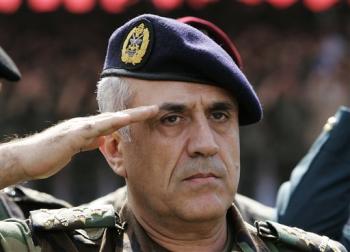
genmichelsuleiman.jpgFor the last week, Lebanon has been without a president but now, after a standoff that has lasted months, the political factions (always simplistically described in the Western media as being pro-Western or pro-Syrian) appear to have agreed on a compromise. Washington didn’t make it happen but it could have stood in the way. Instead, the administration is now willing to accept that Lebanon’s next president, Syria’s preferred candidate, will be General Michel Suleiman.


Some commentators predicted this outcome months ago. Back on August 15, a blogger calling himself, “Outlaw Josey Wales,” wrote, “The powers-that-be have decided General Michel Suleiman/Sleiman will be the next president of Lebanon.” Today, the Wall Street Journal (via Syria Comment) reports:

In recent days [pro-Western] March 14 politicians, with Washington’s consent, agreed to a compromise candidate for the presidency. Gen. Michel Suleiman, commander of the Lebanese Armed Forces, worked closely with Damascus during its military occupation of Lebanon and is already receiving support from some of Syria’s Lebanese political allies.

March 14 leaders say the general’s selection, while not their first choice, could help stabilize Lebanon, because of his leadership of a Lebanese military increasingly viewed as a unifying force in their country.

“Michel Suleiman is well-known to the Hezbollah and the Syrians,” said Walid Jumblatt, a key leader of March 14. “If the Syrians don’t want Suleiman, it means they don’t want stability in Lebanon.”

The concession on the Lebanese president comes amid a broader push by the U.S. and its allies to re-engage Damascus in other ways. American and Israeli strategists view this initiative as aimed at breaking Syria’s alliance with Iran, Hezbollah and the Palestinian militant group Hamas, which have all increased their influence across the Middle East in recent years. It is also aimed at gaining greater support from Syria in cutting off militants infiltrating into Iraq.

The administration wants to characterize the Lebanese presidential choice as a concession by its allies:

A high-ranking US official was quoted by the Kuwait News Agency (KUNA) as saying that Washington has no objections to agreements among the Lebanese on the election of army commander General Michel Suleiman for president. “The US did not strike any deal with Syria regarding Lebanon at the Annapolis conference,” the official, who spoke on condition of anonymity told KUNA. “We understand the concerns of the Lebanese on this issue,” he added. “The US is separating Lebanon from the other pending problems in the region.” The US official said that Lebanon is not up for negotiation, especially not with Syria. “We only refer to Lebanese-Syrian relations when we are calling on Damascus to stop meddling in Lebanon’s internal affairs,” he said.

Mark those words carefully: If the US did not strike any deal with Syria regarding Lebanon at the Annapolis conference it was because the deal had been struck in advance. This is what the New York Times reports:

Syria, the most important outside influence over Lebanese politics, had hesitated until the last minute over whether to attend the conference.

Immediately after the talks, Syrian allies in Lebanon endorsed the first major political breakthrough. Analysts say the talks could thaw strained relations between Syria and the United States.

“The Syrians did not want to go to Annapolis, and without them the conference would have been a failure and would have weakened the Arabs,” said Talal Atrissi, a political analyst and sociologist at Lebanese University. “The Syrians traded their participation, which did not cost them anything, with a deal on the Lebanese presidency.”

Another breakthrough then came after the conference when on Thursday, Christian leader Michel Aoun, a retired general and a former army chief who was seeking the presidency himself and is backed by Syria, indicated that he is “open” to Suleiman becoming president. Lebanese commentator, Michael Young, that day had written, “Aoun will swallow poison before saying yes to Suleiman.” I guess the poison was less bitter than Young imagined.

So why should observers in the United States be surprised by the latest turn of events in the generally mystifying process of Lebanese politics? Here’s why. This is what the astute Syrian political analyst and journalist Sami Moubayed has to say:

…if the Syrians are able to get their way, they would opt for Michel Suleiman, the current army commander. Washington DC is not too enthusiastic about him because he is politically independent; too independent for Washington’s taste. He is committed to combating Israel, supporting Hizbullah, and friendship with Syria. His one slogan has been “Israel is the enemy”, something that greatly pleases Damascus but is frowned upon by 14 March. If elected, he would certainly work for a greater role for Hizbullah in the government, and might even turn a blind eye to their activities in south Lebanon, as did Elias Hrawi in the early 1990s, and Lahoud in 1998-2006. Also to the displeasure of 14 March was a recent remark by the army commander, “Fatah Al-Islam is linked to Al-Qaeda not Syria.”

Washington has plenty of reasons not to like Suleiman. The fact that they have now given their consent to his becoming Lebanon’s next president makes it quite transparent: the realpolitik faction inside the administration is not simply ready to do business with Syria — business is already underway.

Facebooktwittermail

NEWS & ANALYSIS: Confronting Iran

War is peace, sanctions are diplomacy

The White House is pressing ahead with its stated goal of persuading the UN Security Council to pass far-reaching sanctions to punish Iran for refusing to suspend its nuclear research program. Sanctions are what President George W. Bush is referring to when he pledges to nervous US allies that he intends to “continue to work together to solve this problem diplomatically.” The non-diplomatic solution in this framing of the “problem,” presumably, would be airstrikes on nuclear facilities in the Islamic Republic.

With its portrayal of UN and unilateral US sanctions as part of a diplomatic effort, the Bush administration has successfully confused much media coverage of the Iranian-Western confrontation over Iran’s enrichment of uranium. Sanctions are punitive measures, not serious diplomacy, and the Bush administration has never undertaken a sustained diplomatic initiative aimed either at inducing Iran to cease enriching uranium or at soothing broader US-Iranian tensions. Meanwhile, the Bush administration’s persistent refusal to take military options “off the table,” combined with its intensified rhetoric against Iran, has made sanctions palatable to allies, as well as to some of the most dovish members of Congress and the American public — but without addressing the political disputes that keep the US and Iran on a collision course. Congress, by and large, has merely greased the skids. [complete article]

U.S. electronic surveillance monitored Israeli attack on Syria

The U.S. provided Israel with information about Syrian air defenses before Israel attacked a suspected nuclear site in Syria, Aviation Week & Space Technology is reporting in its Nov. 26 edition.

The U.S. was monitoring the electronic emissions coming from Syria during Israel’s Sept. 6 attack, and while there was no active American engagement in the operation, there was advice provided, according to military and aerospace industry officials.

The first event in the raid involved Israel’s strike aircraft flying into Syria without alerting Syrian air defenses. The ultimate target was a suspected nuclear reactor being developed at Dayr az-Zawr. But the main attack was preceded by an engagement with a single Syrian radar site at Tall al-Abuad near the Turkish border.

The radar site was struck with a combination of electronic attack and precision bombs to allow the Israeli force to enter and exit Syrian airspace unobserved. Subsequently all of Syria’s air-defense radar system went off the air for a period of time that encompassed the raid, U.S. intelligence analysts told Aviation Week. [complete article]

Editor’s Comment — This report presents further evidence that, as Gareth Porter suggested earlier this week, “a more plausible explanation for the strike [than its being aimed at destroying a purported Syrian nuclear facility, is] that it was a calculated effort by Israel and the United States to convince Iran that its nuclear facilities could be attacked as well.”

A plan to attack Iran swiftly and from above

Massive, devastating air strikes, a full dose of “shock and awe” with hundreds of bunker-busting bombs slicing through concrete at more than a dozen nuclear sites across Iran is no longer just the idle musing of military planners and uber-hawks.

Although air strikes don’t seem imminent as the U.S.-Iranian drama unfolds, planning for a bombing campaign and preparing for the geopolitical blowback has preoccupied military and political councils for months.

No one is predicting a full-blown ground war with Iran. The likeliest scenario, a blistering air war that could last as little as one night or as long as two weeks, would be designed to avoid the quagmire of invasion and regime change that now characterizes Iraq. But skepticism remains about whether any amount of bombing can substantially delay Iran’s entry into the nuclear-weapons club. [complete article]

Iran warns of domino effect of nuclear attack

Iran warned today that an attack on its nuclear facilities would trigger a “domino” effect across the Middle East as deeply divided world powers met to review Teheran’s co-operation with United Nations resolutions.

Mohamed ElBaradei, the head of the UN’s International Atomic Energy Agency (IAEA) has endorsed Iranian promises that access to suspected nuclear facilities will increase in the months ahead. At a meeting of the body’s 35-country board of governors in Vienna today, battle lines were drawn both over Mr ElBaradei’s faith in an Iranian blueprint and the text of the IAEA’s latest report which said Iran had cleared up several key questions about its past research.

America and Britain are pushing for the UN to quickly impose a third round of sanctions on Iran to reinforce the drive to close the Islamic Republic’s secret programme of atomic research, which appears to be slowly yielding the capability to make a nuclear weapon.

China and Russia, which have not yet swung behind new sanctions, appear poised to back Mr ElBaradei’s calls for negotiators to be given more time. [complete article]

Iran’s Ahmadinejad slammed for accusing rivals

Iranian President Mahmoud Ahmadinejad is facing increasing criticism for his virulent personal attacks on rivals and acting as both “plaintiff and judge” in legal cases, media reported on Thursday.

He has drastically upped the stakes ahead of March parliamentary elections by accusing opponents of being “traitors” for not supporting the government’s confrontational stance in the nuclear crisis.

“The general climate of the country has been overwhelmed by propaganda against individuals,” complained an angry editorial in the hardline Jomhouri Eslami newspaper, close to Iran’s clerical establishment. [complete article]

Facebooktwittermail

NEWS & EDITOR’S COMMENT: Iran not scared by Israel (after strike on Syria)

Iranian FM: Israel is no military match for Tehran

Iran’s Foreign Ministry said on Monday that Israel poses no military threat to Iran, adding that any aggression on Israel’s part would spark retaliation and accusing Israel of trying to sabotage relations between Tehran and the International Atomic Energy Agency.

“The Zionist regime [Israel] is less than nothing to pose any kind of threat to Iran,” ministry spokesman Mohammad Ali Hosseini told reporters Sunday when questioned about recent comments on Tehran’s nuclear program made by Israeli officials.

It was not clear what Israeli threat Hosseini was referring to, but his statement came as Iran continues to defy international demands that it suspends uranium enrichment, a process that can produce fuel for a nuclear reactor or fissile material for a bomb. [complete article]

Editor’s Comment — I’ll hazard a guess about what Hosseini was referring to: the Israeli strike on Syria on September 6. Maybe this is the last Syria strike story — the one in which not even the word “Syria” appeared.

Facebooktwittermail

OPINION: War talk about Iran is a mistake

The spy who wants Israel to talk

Efraim Halevy, the former head of the Israeli intelligence agency Mossad, titled his memoirs “Man in the Shadows.” But now that he’s out in the sunlight, the 72-year-old retired spy chief has some surprisingly contrarian things to say about Iran and Syria. The gist of his message is that rather than constantly ratcheting up the rhetoric of confrontation, the United States and Israel should be looking for ways to establish a creative dialogue with these adversaries.

Halevy is a legendary figure in Israel because of his nearly 40 years of service as an intelligence officer, culminating in his years as Mossad’s director from 1998 to 2003. He managed Israel’s secret relationship with Jordan for more than a decade, and he became so close to King Hussein that the two personally negotiated the 1994 agreement paving the way for a peace treaty. So when Halevy talks about the utility of secret diplomacy, he knows whereof he speaks.

Of course, Halevy looks like the fictional master spy George Smiley — thinning hair, wise but weary eyes, the rumpled manner of someone who might have been a professor in another life. And Halevy has the gift of anonymity: You would look right past him in a crowded room, never imagining that he was the man who had conducted daring secret missions. After he appeared here with former CIA director George Tenet at a conference sponsored by the Brookings Institution’s Saban Center, Halevy agreed to sit down for an interview.

Halevy suggests that Israel should stop its jeremiads that Iran poses an existential threat to the Jewish state. The rhetoric is wrong, he contends, and it gets in the way of finding a peaceful solution to the Iranian nuclear problem.

“I believe that Israel is indestructible,” he insists. Iranian President Mahmoud Ahmadinejad may boast that he wants to wipe Israel off the map, but Iran’s ability to consummate this threat is “minimal,” he says. “Israel has a whole arsenal of capabilities to make sure the Iranians don’t achieve their result.” Even if the Iranians did obtain a nuclear weapon, says Halevy, “they are deterrable,” because for the mullahs, survival and perpetuation of the regime is a holy obligation. [complete article]

Facebooktwittermail

EDITORIAL: Nuclear risks and nuclear realities

Nuclear risks and nuclear realities

General Musharraf today tossed a bone to his lapdogs in Washington — a promise of elections — and the White House wagged its tail and quickly applauded what it sees as “a good thing” — even while Pakistan’s dictator continued to bludgeon his political opponents. Three Pakistani politicians and a union leader were charged with treason today for making anti-government speeches and now face possible death sentences and in an attempt to thwart a protest rally, 500 members of Benazir Bhutto’s opposition party were arrested.

Having been a steady recipient of US aid — his military receives $100 million monthly in direct cash transfers which Musharraf can use however he pleases — the general is unlikely to be moved by threats that he might not be rewarded with any more F-16s.

Musharraf’s power and the White House’s impotence was further reinforced by the image of Deputy Secretary of State John Negroponte appearing on Capitol Hill in defense of Bush’s “indispensable” ally. “No country has done more in inflicting damage on the Taliban,” Negroponte said, yet in a little noticed development, it seems possible that even while Musharraf was instituting martial law in Pakistan and releasing Taliban prisoners, in Afghanistan Pakistan’s intelligence services might have had a role in the assassination of one of the Taliban’s most serious opponents. “The killing of Sayed Mustafa Kazimi, the 45-year-old Hazara Shi’ite leader from Parwan province of Afghanistan, to the northwest of Kabul, bears all the hallmark of a political assassination,” writes M K Bhadrakumar in Asia Times. He continues:

Evidently, those who plotted his assassination had a grand design. The Taliban lack the political sophistication to work with such foresight and planning. Of course, the Taliban have an old feud with the Hazara Shi’ites dating to the murder of Mazari in March 1995, when the Taliban, already approaching Kabul, entrapped him after inviting him for peace talks. He was tortured and murdered before his body was thrown out of a helicopter somewhere near Ghazni.

Observers of the Afghan scene may have forgotten the incident, but what comes readily to mind is that the suspicion still lingers that Mazari’s murder was the handiwork of Pakistan’s Inter-Services Intelligence (ISI).

The finger of suspicion must once again turn to the ISI over Kazimi’s killing, which raises the issue of what would be gained by removing him from the political landscape.

First, he comes from a region of Afghanistan which is very sensitive. Those who know the Afghan chessboard would acknowledge the supreme importance of controlling the provinces of Baghlan and Parwan. They form the gateway to the northern Amu Darya region, the Panjshir Valley to the east and the central Hazarajat region respectively.

Control of the mountain passes to the west of Baghlan was bitterly contested between the Taliban and the Northern Alliance. The hub was extremely important strategically. In political terms, it is possible to say that without exercising control of the hub, there can be no effective unity between the non-Pashtun ethnic groups of Tajiks and Hazaras (and even the Uzbekis).

Baghlan connects the predominantly Tajik areas with the Hazarajat region and is also on the main communication line between Kabul and Mazar-i-Sharif in the Amu Darya region. Baghlan itself is a mosaic where Pushtuns, Tajiks and Hazaras have traditionally vied for influence and control.

Kazimi hailed from Parwan and did much of his political work in his early years in Baghlan province, where he was quite popular. There is no better way of creating volatility, if not mayhem, in that sensitive region than through a political assassination. The ISI has used targeted political assassinations with devastating effect in Afghanistan many a time at critical junctures on the battlefield.

As everyone knows, Washington can only focus its attention on one thing at a time and with all eyes now on Pakistan, opportunities for reckless maneuvers present themselves elsewhere. Yet there are compelling reasons why Pakistan now looks like the most dangerous country in the world. Washington’s confidence in the security of Pakistan’s nuclear arsenal is largely invested in its confidence in one man: Lt. Gen. Khalid Kidwai, head of the special branch of the military known as the Strategic Plans Division in charge of operations and security. Kidwai represents what one former State Department official describes a the only “safe box within Pakistan’s army.” Irrespective of Kidwai’s close ties to U.S. military officials, the inherent vulnerability of Pakistan’s nuclear weapons has long been understood.

In October 2001, nuclear weapons expert, David Albright wrote:

Several observers have suggested that if Pakistan suffers a coup by forces hostile to the United States, the US military should be ready to provide security over the nuclear weapons (or even to take the weapons out of Pakistan entirely) without the permission of the Pakistani authorities.13 Others have raised the possibility of asking President Musharraf to allow the United States or China to take possession of Pakistan’s nuclear weapons during a coup.

Although such responses appear possible in theory, their implementation could be extremely difficult and dangerous. A U.S. military action to seize or cripple Pakistan’s strategic nuclear assets may encourage India to take similar action, in essence to finish the job. Even if India does nothing, a new Pakistani government may launch any remaining nuclear weapons at U.S. forces or against India.

In addition, removing the nuclear weapons would not be enough. The new government would inherit the facilities to make nuclear weapons. Extensive bombing would thus be required at several nuclear sites, including the relatively large Khushab reactor and New Labs reprocessing plant. These types of attacks risk the release of a large amount of radiation if they are to ensure that the facility is not relatively quickly restored to operation.

No wonder Washington is now in a state of paralysis. The administration’s fears will only be reinforced as critics such as Senator Biden compares Pakistan to Iran when in 1979 it shook off its own US-backed dictator.

As for present-day Iran, President Ahmadinejad’s announcement that Iran has 3,000 working uranium-enriching centrifuges is leading to renewed fears that Israel might respond by bombing the country’s nuclear facilities. In a familiar pattern, this warning was reported in The Times and then echoed around the Israeli press. Israel’s Transportation Minister Shaul Mofaz, who is also a former defense minister and IDF chief of General Staff, told the Conference of Presidents of Major American Jewish organizations in New York, “Iran’s nuclear program is proceeding like an express train. The diplomatic efforts to thwart Iran are like a slow train. If we cannot derail the Iranian train from the tracks, we are on the verge of a nuclear era that will totally alter the regional reality.” Yet the longer the crisis in Pakistan continues, the more widely it will be recognized that, as Ariel Sharon might have put, the nuclear realities on the ground are more significant than those that lie beyond the horizon.

Indeed, as one observer astutely notes:

An Iranian-instigated chemical or biological attack against Israel or the United States has been within the capability of the Iranian regime for at least a decade, and yet they have not launched one. Nor have the Iranians committed 9/11-style terrorist spectaculars against the U.S. homeland despite the relative ease and low cost of such attacks.

All this suggests that Iran understands, and respects, the limits of its aggression. Despite the end times rhetoric issuing forth from its demagogic president, the country has assiduously avoided acts that would invite a massive military retaliation. This is not indicative of a nation longing for a nuclear conflagration.

If Washington is to develop a new way of approaching Iran, the substance of one such means of engagement was outlined in Congress yesterday by Flynt Leverett. Testifying to the House Subcommittee on National Security and Foreign Affairs, Leverett said:

…when one asks Iranian diplomats, academics and officials what is required from the United States to condition a fundamental improvement in U.S.-Iranian relations, these Iranian interlocutors routinely talk about American acceptance of the Islamic Republic and recognition of a legitimate Iranian role in the region—and it is precisely American acceptance of the Islamic Republic and recognition of legitimate Iranian interests that is the core of what I describe as a “security guarantee”.

If in the eyes of President Bush, Pakistan’s military dictator can appear “indispensable,” is Iran’s desire for recognition of its own legitimacy really such a tall order? For this or any future administration to undergo such a shift in its alignments it needs to put aside the prism through which only strategic threats and assets can be seen and recognize that it is dealing with people and with nations. America’s interests can ultimately only be served by respecting the interests of others.

Facebooktwittermail

EDITORIAL: The real world of torture

Jack Bauer vs. Abdallah Higazy — Fiction vs. Reality

jackbauer.jpgabdallah-higazy.jpg

According to a new CNN poll, 69 percent of Americans believe that waterboarding is a form of torture. Even so, a staggering 40 percent of Americans polled believe that the US government should be allowed to use this form of torture to get information from suspected terrorists.

Commentators on this issue have expressed moral outrage — “waterboarding is killing America’s soul,” proclaims the Philadelphia Daily News‘ “Attytood.” Some see this as an afront to American pride — Keith Olbermann challenges President Bush by saying, “[We don’t condone torture] because we’re Americans, sir, and we’re better than that. We’re better than you.” While there are those who express indifference — the Wall Street Journal regards this as “mostly a political sideshow.”

Yet for those 40 percent of Americans who favor the use of torture, their view has in all likelihood been clearly expressed by Democratic Senator, Charles Schumer, who in a 2004 Senate hearing said:

I think there are probably very few people in this room or in America who would say that torture should never ever be used, particularly if thousands of lives are at stake. . . . It is easy to sit back in the armchair and say that torture can never be used, but when you are in the foxhole it is a very different deal. And I respect, I think we all respect the fact that the President is in the foxhole every day.

This then is how the issue is being framed: on one side are those who see themselves adopting the moral high ground — though their critics perceive them as being holier-than-thou, starry-eyed idealists; and on the other side are those who believe in the necessity of making tough choices in extreme circumstances — though their opponents see them as having lost their moral bearings.

At the center of this debate is an argument of perceived necessity. And the narrative that animates this argument, borrowed from Israel and used there in an earlier debate on the legitimacy of torture, is the “ticking bomb” scenario.

The scenario itself is fanciful. We are all familiar with the suspense movie in which the reality of what is feared is confirmed by making the audience privilege to the whereabouts of a bomb and the time left before it will explode. In post-9/11 America the impact of such dramas has been heightened by the likes of Fox TV’s fictional counter-terrorism agent, Jack Bauer. Let’s face it, for a population that forms most of its understanding of the world through television, such imagery has a visceral impact. But in Israel itself, where the danger of terrorism is more tangible and ubiquitous, the ticking bomb scenario is itself no less a product of fiction and has served no less as a political tool. As Stephen Langfur wrote in 1996:

Israel wants to present itself as an enlightened democracy on the Western model, but it has locked itself into the role of Occupier, with the result that toward part of the population under its control it must behave like a police-state. The “ticking bomb scenario” offers an exceptional, border-line situation, in which everyone can understand that even an enlightened democracy might have to use torture. What Israel does, therefore, is to extend the fantasy of the bomb in the crowded building to include analogous situations—even remotely analogous. Israel can then allow its security apparatus to approach interrogations as if they were all “ticking bombs.” Thus it can keep wearing the mask of an enlightened democracy, while functioning like a police-state. The “ticking bomb scenario,” for which torture is useless, “koshers” other situations where torture can be useful.

Indeed, Langfur points out that Israeli General Security Service officials used the ticking bomb argument to intimidate judges. After all, who would be willing to curtail an interrogation and thereafter be accused of having failed to prevent carnage? Yet in practice, so-called ticking bombs turned out to be prisoners who had been held in detention for weeks — plenty of time for plots to be revised and for the seeming inevitability of any attack to evaporate.

If an interrogation method’s “necessity” was to be based on the magnitude of a risk averted, then any technique applied to bring about the desired result would surely be justifiable. On what basis could one say that it was acceptable to use waterboarding to make the prisoner fear that he was about to drown, yet bleach could not be poured in his eyes, if in both cases the justification for the brutality was the necessity of saving innocent Israeli or American lives? If brutality can be graded on a scale, then on what basis can we say that in one instance the end justify the means while in another it does not, when necessity is determined by the end and not the means?

The issue here cannot be addressed or resolved by considering fictional scenarios. Instead we need to focus on reality and fortunately there is already one case that provides the perfect litmus test: the case of Abdallah Higazy.

On December 17, 2001, Higazy was detained and questioned by the FBI and then held as a material witness, suspected of being an accomplice in the 9/11 attacks on the World Trade Center in New York. He had been staying in a nearby hotel and was thought to have been in possession of an air-band transceiver capable of air-to-air and air-to-ground communication that could have been used as a beacon to direct the hijacked aircraft into their targets, the Twin Towers. As a terrorist suspect Higazy was as hot as they get.

Under interrogation he kept on changing his story. He had to be lying. FBI agents said they gave Higazy a “polygraph” yet the United States Court of Appeals opinion [PDF] quotes the suspect as saying that the test produced “intense pain.” The court opinion states that “Higazy asked whether anybody else had ever suffered physical pain during the polygraph, to which [FBI Special Agent Michael] Templeton replied: “[i]t never happened to anyone who told the truth.” Was Higazy being given a polygraph or was he being electrocuted?

The court opinion continues:

Higazy alleges that during the polygraph, Templeton told him that he should cooperate, and explained that if Higazy did not cooperate, the FBI would make his brother “live in scrutiny” and would “make sure that Egyptian security gives [his] family hell.” Templeton later admitted that he knew how the Egyptian security forces operated: “that they had a security service, that their laws are different than ours, that they are probably allowed to do things in that country where they don’t advise people of their rights, they don’t – yeah, probably about torture, sure.”

If so-called harsh interrogation methods can be justified, Abdallah Higazy was surely the perfect candidate to be given the third degree. He was suspected of having played an instrumental role in the worst terrorist attack the world has ever seen. This must have been — as Vice President Cheney would say — a no-brainer. Or not?

Anyone familiar with the name, Abdallah Higazy, will of course know that he was completely innocent. The FBI quickly realized as much when a few weeks after Higazy’s detention an airline pilot showed up looking for the radio transceiver he had left behind when he had been evacuated from his hotel on September 11.

When FBI Special Agent Templeton was interrogating his suspect, were Cheney’s words from September 16, 2001, still fresh in his mind?

We also have to work, though, sort of the dark side, if you will. We’ve got to spend time in the shadows in the intelligence world. A lot of what needs to be done here will have to be done quietly, without any discussion, using sources and methods that are available to our intelligence agencies, if we’re going to be successful. That’s the world these folks operate in, and so it’s going to be vital for us to use any means at our disposal, basically, to achieve our objective.

Templeton certainly went to the dark side, but the terrorist he was after wasn’t there. The question that needs to be addressed now and that needs to be the concern of the next attorney general is not what methods of interrogation can be applied in a ticking bomb scenario; it is this: how should the law have protected Abdallah Higazy?

Interrogation is a means of inquiry, not a method of punishment. In the war on terrorism, the presumption of innocence should not be treated as a legal luxury — it is a recognition that suspects are not always (contrary to what the administration would have us believe) the worst of the worst, but on the contrary that with unfortunate frequency they have included the innocent.

Forget about ticking time bombs and remember Abdallah Higazy. After all, those who now want to justify torture do so in the name of protecting the innocent.

Facebooktwittermail

ANALYSIS & EDITOR’S COMMENT: Deep in the (well-populated, well-connected, fertile) desert

Tourist trips to the Box-on-the-Euphrates

Is the Box-on-the-Euphrates in a remote place?

Details like that might seem insignificant, but they are not. Often, it seems to me, intelligence judgments are supported by informal bits of “color” or what you might call the gouge — circumstantial details that aren’t part of any official briefing, but appear in loose talk to bolster a judgment. Recall the “viewing stand” that North Korea never built, but nonetheless contributed to a false alarm about North Korean nuclear testing in Spring 2005.

One detail in the Box-on-the-Euphrates story that seems to lend credence to the “nuclear reactor” hypothesis is that the site is remote, and therefore suspicious. Here is how Martha Raddatz at ABC put it:

The official said the suspected nuclear facility was approximately 100 miles from the Iraqi border, deep in the desert along the Euphrates River. It was a place, the official said, “where no one would ever go unless you had a reason to go there.”

But the claim the the location is remote is, itself, an exaggeration. [complete article]

Editor’s Comment — As I pointed out a week ago, the fact that the Box on the Euphrates is not in a remote location is evident simply from studying Google Earth images. It’s very easy to zero in on the site’s location because the Euphrates river valley comprises two broad ribbons of rich agricultural land in the middle of which an arid interlude — no more than a few miles long — divides the river valley. This is the spot that, from a narrow-angle view, looks like the middle of nowhere.
middle of nowhere
Syria is not the American mid-West — in other words, agriculture is not highly mechanized and thus requires plenty of labor. Close to the “isolated” location that the media has only depicted in close aerial shots, there are lots of towns and villages. A surfaced road and a railway track run either side of the “nuclear” site. By no definition of the expression, can this be called “the middle of nowhere” — unless, that is, it’s an expression being used by those parochial observers who regard Syria itself as the middle of nowhere.

Facebooktwittermail

OPINION: Nuclear hypocrisy

No exceptions

How can a country, which according to endless foreign reports has kept secret for years several atomic weapons, manage to rally the international community in a struggle against a neighboring country that insists on acquiring nuclear energy? What do Israeli politicians answer to those asking why Iran should not be allowed to acquire the same armaments that are already in the arsenals of neighboring countries, like Pakistan and India? The common response is that “Iran is the sole country whose president, Mahmoud Ahmadinejad, declares openly that he intends to destroy the state of Israel.” This argument is a double-edged sword, par excellence, used by a country that sports a radiant nuclear glow (according to foreign press reports, of course), and who has a senior minister, one assigned to dealing with strategic threats, who has threatened to bomb the Aswan Dam.

What will Israel’s policy – or for that matter, America’s – be, if in Iran’s upcoming elections, Ahmadinejad were to give way to a more moderate leader, who were to announce that Iran recognizes Israel’s right to exist within the 1967, borders? Will Iran become one of the “moderate” Muslim states, like, say, Pakistan, which is allowed to develop nuclear weapons? There was a day when our friend the Shah ruled Iran, and then came the Ayatollahs, with whom we were happy to trade arms, until the whole affair became muddled. Regimes come and go, but nuclear weapons are forever. [complete article]

Facebooktwittermail

ANALYSIS: Is Israel about to attack Hezbollah?

Is Israel about to attack Hizballah?

Is Israel laying the ground for pre-emptive air strikes against targets belonging to the militant Shi’ite group Hizballah in Lebanon?

Tensions have been building along the Lebanon-Israel border in recent days. The Israeli army was engaged last week in large-scale military exercises in northern Israel, close to the border with Lebanon, putting into practice the lessons learned from last year’s 34-day war against Hizballah. The exercises took place at the same time as Israeli jets conducted a growing number of mock air raids and overflights in Lebanese airspace. Israeli aircraft fly in Lebanese airspace on a near daily basis, but last week Lebanese army anti-aircraft units fired at the jets for the first time since the end of the war.

Hizballah, too, is reported to have carried out over the weekend its largest ever military manouevers in south Lebanon. According to a report Monday in Lebanon’s Al-Akhbar newspaper, Hizballah’s three-day exercise was a response to the Israeli army’s own maneuvers and was intended, according to quoted Hizballah sources, to “deter the enemy from undertaking any further Lebanese adventures.” [complete article]

Facebooktwittermail