Category Archives: Israel

NEWS & EDITOR’S COMMENT: Ho hum… first use of nukes since 1945?

Al-Jazeera: Strike on Syria was made by U.S. Air Force with tactical nukes

The September 6 raid over Syria was in fact carried out by the US Air Force, Al-Jazeera’s Web site reported in Arabic Friday, quoting unnamed Israeli and Arab sources as saying that two strategic US jets armed with tactical nuclear weapons executed the attack on a nuclear site under construction.

The sources were quoted as saying that Israeli F-15 and F-16 jets only provided cover for the US fighter-bombers, which carried one tactical nuclear weapon apiece. The site was hit by one bomb and totally destroyed. The use of nukes might account for the fact that the suspected plant was effectively erased from the earth, with few if any traces remaining, according to satellite photos. [complete article]

New satellite surveillance system was key Israeli tool in Syria raid

In addition to the military objective of destroying the target, the raid on Syria also had important international and domestic political overtones, notes one Israeli official. The goal was to send a strategic signal to the region about Israel’s willingness to act. Moreover, for the IAF, the mission was an important step. The armed forces are grappling with lessons learned from last year’s Lebanon war and a potential budget shift to the ground forces. As a result, the air arm wanted to signal its continued importance to national defense. [complete article]

Editor’s Comment — Former CIA officer Philip Giraldi, recently asserted that the Box-on-the-Euphrates story bears all the marks of a “classic disinformation” campaign. I beg to differ. I think the script here comes straight out of The Onion. How else can we account for such a wildly meandering narrative that spans every quarter from historic event — the first offensive use of nuclear weapons since “Fat Man” obliterated Nagasaki on August 9, 1945 — to the prosaic — a theatrical piece of budgetary infighting as the Israeli Air Force competes against the Israeli Army for a larger slice of the IDF sheqel pie — to the absurd — a Syrian super secret, so secret it couldn’t be revealed to Syria’s own military?

What next? It was Osama bin Laden’s hide out and he got killed in the attack?

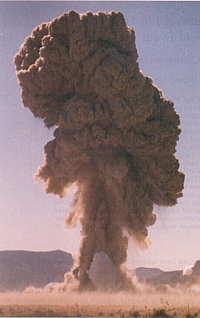
And just in case anyone wants to think seriously about the idea that a tactical nuclear weapon was used to destroy the Box on the Euphrates (or “tall building shaped like a square” to use the IAEA’s more technically precise nomenclature), this is what an explosion equivalent to a low-yield (5kt) nuclear explosion looks like:
misersgold.jpg
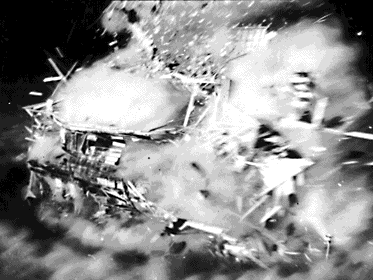
This is what happens to a house located 1,100 meters away a somewhat larger (16kt) explosion:
blast8.gif
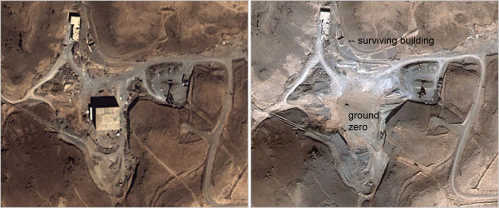
And this is a picture of the Syrian site after the attack:
noboxontheeuphrates.jpg
Note, a small building just 300 meters directly up from “ground zero” was still standing after the attack. That’s a clue — there was no nuclear shockwave that ripped through this gully.


Facebooktwittermail

NEWS: Syria’s “tall building shaped like a square”

Syria nuclear probe may be inconclusive

The IAEA has been studying before-and-after commercial aerial photos of the site and has asked Syria for explanations. But Syria has not replied and the pictures alone are unlikely to yield conclusions, the diplomat told Reuters.

“IAEA experts are looking back at the evolution of this facility. But with these pictures alone they feel they may be unable to draw conclusions,” the diplomat, familiar with IAEA affairs but not authorised to speak on the record, told Reuters.

“If the IAEA got credible indications from anyone of nuclear procurement or activity, that would be different. But imagery of a tall building shaped like a square, that’s not enough (to tell whether or not the site may have been a nuclear site).” [complete article]

Facebooktwittermail

EDITORIAL: The box on the Euphrates

The box on the Euphrates

Writing in The American Conservative, former CIA officer Philip Giraldi sees in the Syrian-nuclear-reactor story the hallmarks of a disinformation campaign:

In the intelligence community, a disinformation operation is a calculated attempt to convince an audience that falsehoods about an adversary are true, either to discredit him or, in an extreme case, to justify military action. When such a campaign is properly conducted, information is leaked to numerous outlets over a period of time, creating the impression of a media consensus that the story is true, as each new report validates earlier ones.
[…]
The [news] pieces [on the target of the Israeli air attack in Syria] have a common thread: they rely entirely on information provided by Israeli sources without independent corroboration. And the ongoing play they are getting in the international media, without much critical commentary and without direct attribution to Israel, mark them as classic disinformation.

As nuclear proliferation expert Jeffery Lewis notes, the latest revelation — that the “box-on-the-Euphrates” is at least four years old, its existence having already been noted by the intelligence community (IC) — provides a compelling explanation why national security adviser Stephen J. Hadley has kept such a tight lid on the dissemination of the “new” intelligence: “we’d already looked at the building and Hadley knew what the IC would say.”

In the absence of further hard evidence, the ensuing commentary and analysis, most of which is extremely sketchy, has nevertheless become conventional wisdom in part because a few usually reliable sources have given the narrative a veneer of credibility:

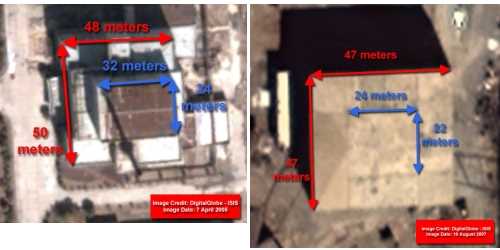
    — Respected former IAEA inspector, David Albright, has lent support to the idea that the box resembles the North Korean Yongbyon reactor based on not a lot more than the fact that the two buildings share the same diameter footprint. But whereas Yongbyon comprises a larger box with smaller boxes stacked on top of it, the image of the Syrian cube has been helpfully marked up with locations for imaginary boxes. “There also appears to be a faint square on top of the Syrian building’s roof. It is unclear whether something would be built there, but its dimensions, 24 meters by 22 meters, are consistent with the subsequent construction of an upper roof.” Four years after this faint square was first photographed, it remained a faint square [PDF].

boxes.jpg

    Global Security‘s John Pike refers to the site as being located in “the middle of nowhere” — everyone has now seen images of the barren location — yet one only needs to spend a few minutes on Google Earth to discover that the Box on the Euphrates lies right in the middle of Syria’s agricultural heartland with sizable communities either direction from this supposedly isolated location.

middle of nowhere

    This makes it all the more strange that nothing in the images appear to indicate the existence of a secure perimeter to this facilitiy — something that can easily be discerned if one looks at similar resolution images of, for instance, Israel’s nuclear facility at Dimona. However laid-back the Syrians might be, I’d wager that come the day that there was anything of high value at this site, there would be some serious security to keep out unwelcome intruders.
    — Washington’s high priest of gossip, Chris Nelson, after originally being convinced that the facility was related to Scud missile assembly, has now been won over to the nuclear reactor theory. The “evidence” that shifted his opinion? The fact that US-North Korea negotiator Chris Hill, in his recent Congressional testimony, did not refuted the theory. The absence of a denial is the same as an affirmation? Not according to my understanding of logic.

So what do we really know at this point?

A large cube-shaped building next to the Euphrates was visible from space in 2003. Given its size it must have taken a while to construct. The primary structure looked pretty much the same from above in August 2007. New images reveal that it’s not there now, the site has been leveled and it is reasonable to assume that the site clearing occured after, and very likely as a result of, an Israeli air force attack on September 6, 2007.

Do we have hard evidence that Syria was engaged in constructing a nuclear reactor? Not yet. Are any journalists hunting down that hard evidence? Probably not — why go to the trouble when you can kick back and get paid for schmoozing with John Bolton.

Meanwhile, IAEA director Mohamed ElBaradei is pissed off about the “bomb first and then ask questions later” approach. “I think it undermines the system and it doesn’t lead to any solution to any suspicion, because we are the eyes and ears of the international community. It’s only the agencies and inspectors who can go and verify the information.” He notes that in all the years that John Bolton and his cohorts have been making accusations about a Syrian nuclear program, “we have not received information about any nuclear-related activities, clandestine nuclear-related activities in Syria.”

Perhaps then we can infer that the real target of the Israeli strike was not a nuclear facility: it was the IAEA inspections processa troublesome log that the neocons are eager to clear off the road leading to Tehran.

Facebooktwittermail

OPINION: The Israeli intelligence attack on Egypt

War against Egypt in the winter

The profound frustration because war did not break out with Syria during the summer – although there are some who argue that the summer has not yet ended – is being vented by channeling the anger against another neighbor: Egypt. October is an appropriate month to set upon a state that meticulously adheres to the peace accord it signed with Israel about 30 years ago.

In briefings with Israeli journalists, intelligence officials claim that Egypt wants to see “Israel bleeding.” Perhaps it even aspires to revoke the peace accord or reach an agreement with Hamas to appease the Muslim Brotherhood, the experts suggest in an erudite explanation. In Israel, Egypt serves the role Syria fills in the United States. It is responsible for Hamas’ increased military strength, for the smuggling of weapons via tunnels, for the continued firing of Qassams and for smuggling drugs and women across the border.

Israel is furious that Egypt allowed about 80 Hamas explosive experts – allegedly trained in Iran – to enter the Gaza Strip. As if the Qassams had been waiting for them to arrive. In fact, Egypt represents an excellent culprit because it can also be punished – by freezing U.S. economic assistance, for instance. The purveyors of these intelligence briefings would do well to calm down a bit. Israel itself did not succeed in preventing arms smuggling, even when it controlled every centimeter of Gaza. Tunnels were dug under Israel’s nose and used for smuggling and perpetrating lethal attacks. Israel has yet to repair some sections of the fence along its border with Egypt because the money allocated for this, NIS 200 million, disappeared somewhere. [complete article]

Facebooktwittermail

NEWS & EDITOR’S COMMENT: Israel can live with a nuclear Iran

Israel’s foreign minister: Iran nukes pose little threat to Israel

Foreign Minister Tzipi Livni said a few months ago in a series of closed discussions that in her opinion that Iranian nuclear weapons do not pose an existential threat to Israel, Haaretz magazine reveals in an article on Livni to be published Friday.

Livni also criticized the exaggerated use that Prime Minister Ehud Olmert is making of the issue of the Iranian bomb, claiming that he is attempting to rally the public around him by playing on its most basic fears. Last week, former Mossad chief Ephraim Halevy said similar things about Iran. [complete article]

Editor’s Comment — While George Bush warns the world that Iran’s pursuit of nuclear weapons could lead to World War III, Israel’s foreign minister says, behind closed doors — in other words in a situation where she means what she says — that Iranian nuclear weapons would not pose an existential threat to Israel.

This should be banner headline news. The Washington press corp should be hounding administration officials, demanding an explanation for this utterly glaring clash of perspectives. Instead, what do we get? Silence.

This is what things have come down to: We live in a state where the dissemination of information is controlled much more efficiently than it was in the Soviet Union. At least the Russians understood they were being lied to. Most Americans, on the other hand, are completely ignorant of the incestuous relationship between the press and the government. In this system shaped by unspoken agreements, there is no need for some clumsy Ministry of Information. All the managing editors of the major outlets can be relied upon to shape their products (within an acceptable latitude) in alignment with political and commercial power — even when that means that they knowingly makes themselves instruments of an altogether avoidable disaster. They will plead that they are merely messengers, yet they are no less culpable than the lunatics in political office. They choose what to report and what to ignore.

(Note: As of 10.00GMT 10/26/07, the Haaretz magazine article referred to above has not appeared. If/when it is posted (it might only be available in print), it should appear here.)

Facebooktwittermail

NEWS & EDITOR’S COMMENT: Syria levels the rubble

Satellite photos show cleansing of Syrian site

New commercial satellite photos show that a Syrian site believed to have been attacked by Israel last month no longer bears any obvious traces of what some analysts said appeared to have been a partly built nuclear reactor.

Two photos, taken Wednesday from space by rival companies, show the site near the Euphrates River to have been wiped clean since August, when imagery showed a tall square building there measuring about 150 feet on a side.

The Syrians reported an attack by Israel in early September; the Israelis have not confirmed that. Senior Syrian officials continue to deny that a nuclear reactor was under construction, insisting that Israel hit a largely empty military warehouse. [complete article]

Editor’s Comment — Who destroyed the evidence? We have been given to understand that the square building at the Syrian site was blown up by Israeli bombs. If anyone was concerned about demonstrating what the building was for, perhaps it should have been left in tact. Independent IAEA investigators could have determined what was there. Israel’s rumored accusations might have been substantiated — or not.

Instead, now all we have are satellite images revealing something and its absence, along with purported intelligence photos taken on the ground somewhere yet no means to establish the authenticity of that evidence — evidence which thus far has not been made publicly available.

The Syrian site has now been cleared, or “cleansed,” as Pravda-style the Times reports. So what? Syria does not have an open democratic government — but that’s not news, is it?

Facebooktwittermail

NEWS, OPINION & EDITOR’S COMMENT: The secret that can’t be told

The right confronts Rice over North Korea policy

A fight has erupted between conservatives on national security and Secretary of State Condoleezza Rice over the Bush administration’s pursuit of diplomacy with North Korea in the face of intelligence that North Korea might have helped Syria begin construction on a nuclear reactor.

The debate moved to Capitol Hill on Wednesday, when Ms. Rice had a tense private meeting with Representative Ileana Ros-Lehtinen of Florida, the senior Republican on the House Foreign Affairs Committee. Just days earlier, Ms. Ros-Lehtinen was the co-author of an opinion article questioning the White House approach, which offers incentives to North Korea to dismantle its nuclear program.

That article also criticized the Bush administration for what it called the “veil of secrecy” surrounding intelligence that led to an Israeli airstrike in Syria last month on the suspected reactor site, and for the fact that only a handful of lawmakers have been briefed on the subject. [complete article]

What happened in Syria?

We are concerned that, although the Bush administration refuses to discuss the Israeli airstrike with the American people or with the majority of Congress, it has not hesitated to give information on background to the press to shape this story to its liking. New York Times writer David Sanger authored and coauthored articles on Oct. 14 and 15 that appeared to reflect extensive input from senior policy makers. Washington Post writer Glenn Kessler coauthored an article on Sept. 21 that also cited inside information from the administration. We believe this is unacceptable. [complete article]

Editor’s Comment — And where exactly in the contract of employment for journalists at the New York Times and the Washington Post does it say that reporters are meant to help the White House shape a story to its liking? Is that under the “business as usual” clause?

Hoekstra and Ros-Lehtinen do of course have their own ax to grind here, but if two Republican members of the secret circle say that the secret should be let out, what are we waiting for? And while these members of Congress are pressing the White House, why not the Israeli government too? It was an Israeli air strike after all.

And then there’re a few more details about the evidence. Why is the building next to the Euphrates being referred to as a “pumping station” rather than as “a building that might be a pumping station”? The photo in the Times doesn’t appear to show evidence of pipelines running between the purported pumping station and the building purported to house a future reactor. Moreover, no one spells out the necessity of having a water pumping station nearby what is claimed to be a gas-cooled reactor. But then again, all of these are questions that should be addressed by the IAEA and not half-assed journalists, unaccountable government officials, uninformed politicians, and blogging dilettantes.

Facebooktwittermail

NEWS: Israel expands collective punishment of Gaza

Israel moves to further isolate Gazans

Ratcheting up pressure on Palestinians in the Hamas-controlled Gaza Strip, Israel prepared to cut electricity supplies to Gazans in retaliation for an escalation in cross-border rocket and mortar attacks by Palestinian militants.

After declaring Gaza an “enemy entity” in September, Israel has kept Gaza’s borders sealed save for humanitarian foodstuffs and medicines. The policy has triggered dramatic inflation, shuttered businesses, and spurred demand for black-market goods smuggled through tunnels that were once used by gun runners and drug dealers.

“The market now takes all food that you smuggle, also spare parts and medication,” says Hashem, a tunnel-owner from the border town of Rafah who spoke on the condition that his last name not be used.

Analysts say the goal of Israel’s policy of isolating Gaza seems to be to pressure Gazans to turn against Hamas, which has led the area since it wrested control from the Palestinian Authority in June. Other observers warn that the pressure is likely to backfire, creating more volunteers for militant groups and stirring sympathy for Hamas. [complete article]

An economic tailspin in Gaza

Life in Gaza has entered a state of suspended animation.

The usually busy streets are free of traffic. Stores and factories are closed. Unemployment is on the rise as tens of thousands of people have lost their jobs in the last four months.

Israel stages regular air strikes on suspected militants and keeps warning that it might launch a military invasion if the daily rocket and mortar attacks continue.

And residents say they are waiting for the other shoe to drop. [complete article]

Facebooktwittermail

NEWS & EDITOR’S COMMENT: Pinpointing what?

Photographs said to show Israeli target inside Syria

Independent experts have pinpointed what they believe to be the Euphrates River site in Syria that was bombed by Israel last month, and satellite imagery of the area shows buildings under construction roughly similar in design to a North Korean reactor capable of producing nuclear material for one bomb a year, the experts say.

Photographs of the site taken before the secret Sept. 6 airstrike depict an isolated compound that includes a tall, boxy structure similar to the type of building used to house a gas-graphite reactor. They also show what could have been a pumping station used to supply cooling water for a reactor, say experts David Albright and Paul Brannan of the Institute for Science and International Security (ISIS).

U.S. and international experts and officials familiar with the site, who were shown the photographs yesterday, said there was a strong and credible possibility that they depict the remote compound that was attacked. Israeli officials and the White House declined to comment. [complete article]

Editor’s Comment — There is now a “strong and credible possibility” that satellite photographs reveal the target of Israel’s strike on Syria. Which is to say, the photographs reveal where Israel hit — not what Israel hit.

It’s thus curious that with mantra-like repetition we keep on being told that the site in Syria resembled a “North Korea-style reactor.” No such thing exists. There is no North Korean style of nuclear reactor. All the North Koreans did was make use of the declassified design of the Magnox reactor first used in the UK at Calder Hall — it’s a design that has been publicly available for 50 years! It involves the use of unrefined uranium, there is no containment dome; gas — not water — is the coolant. The facility is housed in non-descript industrial buildings which means it’s almost impossible for satellite imagery to provide hard evidence that such buildings would have been designed to contain a reactor. Such evidence would have to be gathered by IAEA inspectors on the ground and since Syria — unlike Israel — is a signatory of the Non-Proliferation Treaty, Syria would presumably be legally required to provide inspectors access to the site. Rather than push for the evidence to be exposed, Israel preferred to destroy it.

Israel, we are being led to assume, has a greater interest in disregarding international law than in demonstrating to its allies and the rest of the world that Syria might have been engaged in developing a clandestine weapons program. Given that Israel clearly has complete contempt for world opinion, why should the world not with equal contempt dismiss Israel’s fears?

Facebooktwittermail

NEWS: The damning photos we don’t get to see

The case for Israel’s strike on Syria

…as ABC News reported in July, the Israelis made the decision to take the facility out themselves, though the U.S. urged them not to. The Bush administration, with Secretary of State Condoleezza Rice and Defense Secretary Robert Gates leading the way, said the Israelis and the U.S. should “confront not attack.”

The official said the facility had been there at least eight months before the strike, but because of the lack of fissionable material, the United States hesitated on the attack because it couldn’t be absolutely proved that it was a nuclear site.

But the official told ABC News, “It was unmistakable what it was going to be. There is no doubt in my mind.” [complete article]

Editor’s Comment — Hmmm… “A senior U.S. official” has no doubt in his mind — sounds like Cheney or someone who spends too much time in his company. And of course there’s no reason why we would need to see the compelling photographic evidence when we can see such excellent computer graphics.

Facebooktwittermail

NEWS: The Syrian nuclear mirage

U.N. nuclear agency examines Syria images

U.N. experts have begun analyzing satellite imagery of the Syrian site struck last month by Israeli warplanes, looking for any signs it was a secret nuclear facility, diplomats said Friday.

It was unclear where the material was obtained or what exactly it showed. One of the diplomats, who is linked to the International Atomic Energy Agency, said the experts were studying commercial images, contrary to earlier suggestions they came from U.S. intelligence.

Separately, a senior diplomat familiar with the issue indicated the experts were looking at several possible locations for the Israeli strike. Two other diplomats said initial examination of the material found no evidence the target was a nuclear installation, but emphasized it was too early to draw definitive conclusions. [complete article]

Syrians disassembling ruins at site bombed by Israel, officials say

While expressing concern over the prospect that Syria may have decided to launch a nuclear program in secret, some weapons experts question why neither Israel nor the United States made any effort before the secret attack — or in the six weeks since — to offer evidence to the International Atomic Energy Agency, a move that would trigger an inspection of Syria by the nuclear watchdog.

“The reason we have an IAEA and a safeguard system is that, if there is evidence of wrongdoing, it can be presented by a neutral body to the international community so that a collective response can be pursued,” said Daryl Kimball, executive director of the Arms Control Association. “It seems to me highly risky and premature for another country to bomb such a facility.” [complete article]

US intelligence does not show Syrian nuclear weapons program, officials say

One US intelligence source familiar with the events expressed concern about recent news reports describing Syria as having a functioning nuclear weapons program and cautioned against attributing those reports to the US intelligence community.

“The allegations that North Korea was helping to build a nuclear reactor have not been substantiated by US intelligence,” said this intelligence official, adding, “ but that hasn’t stopped Dick Cheney and his minions at the NSC, Elliot Abrams and Steve Hadley, from leaking the information [to the press], which appears to be misleading in the extreme.” [complete article]

See also, Syrian “copy” of Yongbyon? (Arms Control Wonk) and Syrian’s comment on bomb target mistranslated: U.N. (Reuters).

Facebooktwittermail

ANALYSIS: A former CIA officer’s speculations on the Israeli attack on Syria

On the mysterious Israeli air attack on Syria

Having dealt with Arabs for more than fifty years now, often in situations very similar to this one, I have no trouble understanding why the Syrian reaction to the Israeli bombing attack last month has been carefully muted. Asad cannot afford a military confrontation with Israel at this time. His air force and army could be effectively wiped out by the IDF in a few hours. And he has no desire to broadcast the fact that his air defense forces (some of which, I am told, consist of very expensive new ground-to-air rocketry purchased from Russia but not yet operational) were impotent to respond in the face of such a deep and brazen Israeli penetration of the Syrian motherland. It would be plainly foolhardy for the Syrians to attempt confrontation with the IDF when their military establishment is in such a parlous state as it is today. I therefore find it perfectly understandable that Asad has chosen not to fly off the handle over this incident, and why his Arab neighbors and supposed brothers in arms have likewise decided that the better part of valor is to pretend they haven’t noticed. [complete article]

Facebooktwittermail

ANALYSIS: The sparks of a conflagration

Ticking clocks and ‘accidental’ war

Whilst Washington looks at the Iranian prospects through the prism of a binary, to bomb or to acquiesce decision, facing President Bush over the remainder of his presidency, the actors in the region see the conflict as imminent and arriving in a roundabout way, through the backdoor – either via escalation of Western and Israeli tension with Syria; or from events in Lebanon, or a combination of both interacting with each other. All these key actors are convinced that conflict, should it occur, will convulse the entire region. They see the Wursmer ‘engineered’ war that ultimately will extend to Iran, as almost upon them; and they wonder at the silence from Europe and from informed observers in the US. Is it, they speculate, that everyone is so focused on Iraq, and so convinced that Iraq will be the arena in which the decision on Iran will be shaped, that they have forgotten to attend to the backdoor that David Wurmser (until last month Dick Cheney’s Middle East adviser) already has a foot around? [complete article]

Facebooktwittermail

ANALYSIS & EDITOR’S COMMENT: Cheney takes a sabbatical

Pre-emptive caution: the case of Syria

It was President Bush who, a year after the Sept. 11 terrorist attacks, rewrote America’s national security strategy to warn any nation that might be thinking of trying to develop atomic weapons that it could find itself the target of a pre-emptive military strike.

But that was the fall of 2002, when the world looked very different from how it does in the fall of 2007. Now, the case of Syria, which Israeli and American analysts suspect was trying to build a nuclear reactor, has become a prime example of what can happen when Mr. Bush’s first-term instincts run headlong into second-term realities.

Five years later, dealing with nations that may have nuclear weapons ambitions — but are also staying within the letter of the Nuclear Nonproliferation Treaty — looks a lot more complicated than it once did. [complete article]

Editor’s Comment — If it depends on journalists like David Sanger, he’s probably right in predicting that, “It may be months or years before all the mysteries surrounding the attack on Syria become clear.” Meanwhile, Sanger seems happy to keep on drinking the White House Kool-Aid. Should we be concerned about the chances for a U.S. attack on Iranian nuclear facilities? Far from it, Sanger reports, since those ubiquitous senior officials he’s been hanging out with assure him that the administration is far too prudent. “Iran, they say, has too many ways to strike back at American interests — in Iraq, in the oil markets and throughout the Middle East.” Does the vice president know that? In Sanger’s analysis, Cheney in conspicuously absent. The administration is now being controlled by pragmatic realists, while the president is focused on his diplomatic achievements.

Getting a deal with North Korea to disgorge its own nuclear fuel and weapons may require looking past whatever North Korea might have sold to another country. And it may mean engaging the Syrians, even before they answer the question of what, exactly, they were building in the desert.

Who could have predicted such a sunny turn of events? The only question now is, how can the Israelis be persuaded to sign up with the diplomatic program. What Sanger implies is that a White House, sobered by experience, may offer Israel wise council but that there’s not much chance they’ll listen.

And as for those readers who still have nagging questions about what happened on September 6, the latest word from Israel is that it is “plausible” and “logical” that a nuclear reactor under construction was hit. The IAEA has put in a request for information.

Facebooktwittermail

OPINION: The courage to chart new ground and take bold steps

‘Failure risks devastating consequences’

The Israeli-Palestinian peace conference announced by President Bush and scheduled for November presents a genuine opportunity for progress toward a two-state solution. The Middle East remains mired in its worst crisis in years, and a positive outcome of the conference could play a critical role in stemming the rising tide of instability and violence. Because failure risks devastating consequences in the region and beyond, it is critically important that the conference succeed.

Bearing in mind the lessons of the last attempt at Camp David seven years ago at dealing with the fundamental political issues that divide the two sides, we believe that in order to be successful, the outcome of the conference must be substantive, inclusive, and relevant to the daily lives of Israelis and Palestinians. [complete article]

See also, Only Bush can (Akiva Eldar), Egypt suggests delaying Mideast peace meet (AFP), and Rice says time for a Palestinian state (AFP).

Facebooktwittermail

OPINION & EDITOR’S COMMENT: The phoenix of preventive war arises from Syrian ashes

Preemption, Israeli style

Last month, one of the more mysterious episodes in the history of the Arab-Israel conflict began to leak slowly into the news. Although the facts are still unconfirmed, what seems to have happened has major implications not only for the region but even more for the laws of war and preemption that President Bush has been trying to redefine ever since his 2002 national security strategy paper.

First, Syrian spokesmen complained that Israeli planes had violated their country’s airspace on Sept. 6 — and had been driven off, or so they said. Within a few days came stories — mostly from anonymous sources — that the planes had fired into Syria; these were followed by still other stories that a target had in fact been hit. But what was it?

After further journalistic digging, the most plausible accounts said that the Syrian targets were related to nuclear weapons activity and may even have been manned by North Koreans. Later reports suggest some dispute within the U.S. government about how far Syria had progressed in achieving its nuclear ambitions, but these same reports confirm that this is what Israel was targeting.

The obscurity of this episode results in part from uncharacteristically tight lips in Jerusalem and Damascus. But that is not the whole of the reason. There has also been a deafening silence from the international community and especially from the other states of the region. This highly unusual reaction is one of the oddest parts of the whole episode and, in some ways, the most meaningful. [complete article]

Editor’s Comment — The neoconservatives and their Iraqi allies famously predicted that American soldiers would be greeted in Baghdad with sweets and flowers. As if to outdo themselves in making wild predictions, with Iran now the target, the suggestion being floated by Joshua Muravchik and other neocons is that alarming predictions about the consequences of a US/Israeli attack on Iran are being vastly overstated. The lesson from Syria, so we are supposed to believe, is that a strike on Iran’s nuclear facilities will be greeted by deafening silence.

Eager to boost her stock in the Israel lobby and implying to neocons that there is such a thing as life-after-Cheney, Hillary Clinton was unequivocal in expressing her support for the Israeli attack:

“We don’t have as much information as we wish we did. But what we think we know is that with North Korean help, both financial and technical and material, the Syrians apparently were putting together, and perhaps over some period of years, a nuclear facility, and the Israelis took it out. I strongly support that.”

Clinton’s Iran vote: the fallout

Senators Joe Biden and Chris Dodd voted against it. Senator Barack Obama said he would have voted against it if he had voted. Former Senator John Edwards implied he would have voted against it if he could vote.

And Senator Hillary Rodham Clinton? She voted in favor of the measure in question, which asked the Bush administration to declare Iran’s 125,000-member Revolutionary Guard Corps a foreign terrorist organization. Such a move — more hawkish than even most of the Bush administration has been willing to venture so far — would intensify America’s continuing confrontation with Iran, many foreign policy experts say.
[…]
Think of it as Iran declaring that the United States military is a terrorist organization because it carries out President Bush’s orders. Such a move, say some Iran experts — including some advisers to the Clinton campaign who declined to publicly criticize their possible boss — runs the risk of further alienating the Iranian population, because many Iranians are tied to the Revolutionary Guard or its many offshoots and enterprises in some way.

“What Senator Clinton and the other legislators who voted for this bill don’t seem to realize is that the Revolutionary Guards are not Al Qaeda,” said Karim Sadjapour, an Iran expert at the Carnegie Endowment for International Peace. “They’re not a group of voluntary jihadists signing up to fight the United States. Many are conscripts taken from the regular army.” [complete article]

Facebooktwittermail

NEWS & EDITOR’S COMMENT: “Nuclear project” – story still under construction

Analysts find Israel struck a nuclear project inside Syria

Israel’s air attack on Syria last month was directed against a site that Israeli and American intelligence analysts judged was a partly constructed nuclear reactor, apparently modeled on one North Korea has used to create its stockpile of nuclear weapons fuel, according to American and foreign officials with access to the intelligence reports.

The description of the target addresses one of the central mysteries surrounding the Sept. 6 attack, and suggests that Israel carried out the raid to demonstrate its determination to snuff out even a nascent nuclear project in a neighboring state. The Bush administration was divided at the time about the wisdom of Israel’s strike, American officials said, and some senior policy makers still regard the attack as premature.
[…]
The officials did not say that the administration had ultimately opposed the Israeli strike, but that Secretary of State Condoleezza Rice and Defense Secretary Robert M. Gates were particularly concerned about the ramifications of a pre-emptive strike in the absence of an urgent threat.

“There wasn’t a lot of debate about the evidence,” said one American official familiar with the intense discussions over the summer between Washington and the government of Prime Minister Ehud Olmert of Israel. “There was a lot of debate about how to respond to it.”
[…]
The partly constructed Syrian reactor was detected earlier this year by satellite photographs, according to American officials. They suggested that the facility had been brought to American attention by the Israelis, but would not discuss why American spy agencies seemed to have missed the early phases of construction.

North Korea has long provided assistance to Syria on a ballistic missile program, but any assistance toward the construction of the reactor would have been the first clear evidence of ties between the two countries on a nuclear program. North Korea has successfully used its five-megawatt reactor at the Yongbyon nuclear complex to reprocess nuclear fuel into bomb-grade material, a model that some American and Israeli officials believe Syria may have been trying to replicate.
[…]
While Bush administration officials have made clear in recent weeks that the target of the Israeli raid was linked to North Korea in some way, Mr. Bush has not repeated his warning since the attack. In fact, the administration has said very little about the country’s suspected role in the Syria case, apparently for fear of upending negotiations now under way in which North Korea has pledged to begin disabling its nuclear facilities.

While the partly constructed Syrian reactor appears to be based on North Korea’s design, the American and foreign officials would not say whether they believed the North Koreans sold or gave the plans to the Syrians, or whether the North’s own experts were there at the time of the attack. It is possible, some officials said, that the transfer of the technology occurred several years ago. [complete article]

Editor’s Comment — In spite of the fact that hard evidence has yet to be produced, let’s for now take it as given that Syria was building some type of nuclear facility and that it was destroyed by an Israeli air attack. Although the Times notes, as has been repeated so often, that “information about the raid has been wrapped in extraordinary secrecy,” the question — why the secrecy? — remains all important.

Suppose Israel was reluctant to be perceived as having acted without US support and it waited until it got the green light from Washington — except, when the green light came, it came from the Vice President’s office. Now that would be one incredibly compelling reason for secrecy from all quarters! That’s something neither Cheney, nor Bush, nor Olmert could afford to reveal.

Of course I speculate, but while this story remains so murky, speculation will be rife.

Facebooktwittermail

NEWS: The mirage of Middle East peace

Haniyeh, Meshal urge Abbas not to fall into ‘trap’ of peace summit

Haniyeh, who was dismissed from office after Hamas overran Gaza in June, criticized Abbas for planning to attend next month’s U.S.-sponsored international peace conference, meant to provide support for an Israeli-Palestinian peace deal. He cautioned the PA chairman “not to give this occupier legitimacy on our land.”

“Don’t fall into the trap of the coming conference. Don’t make new compromises on Jerusalem, on our sovereignty,” Haniyeh urged.

Khaled Meshal echoed the warning in a holiday message on Hamas radio. And he urged Abbas, who set up his own government in the West Bank after Hamas’ Gaza takeover, to accept the Islamists’ invitations for dialogue.

“Abbas and his allies will find out that they are pursuing nothing but a mirage,” Meshal said, referring to the conference. [complete article]

Hamas offers talks with Fatah

Hamas has said it will hold reconciliation talks with Fatah and hinted it may be ready to give up control of the Gaza Strip it seized in June. [complete article]

Senior Fatah official rules out reconciliation with rival Hamas

Palestinian Chairman Mahmoud Abbas’s Fatah faction ruled out talks with Hamas on Thursday, while Israel said any such dialogue with the Islamists could “torpedo” a peace deal. [complete article]

Stalemate threatens Mideast peace talks

Israeli Prime Minister Ehud Olmert and Palestinian Authority President Mahmoud Abbas put negotiators to work last week with instructions to make progress in advance of a U.S.-sponsored peace conference tentatively set for next month. Yet the talks have reached an impasse, aides said, prompting the two leaders to look to Secretary of State Condoleezza Rice to salvage the effort during a six-day visit to the region starting this weekend. [complete article]

U.S. grills Israel over road planned on Palestinian land

United States Secretary of State Condoleezza Rice said Thursday that she asked the Israel’s ambassador to the U.S., Sallai Meridor
for clarifications about an Israeli plan to build a road near Jerusalem, partly on confiscated Palestinian land. Palestinians charge the construction will cut them off from Jerusalem. [complete article]

Israel-Palestine talks must be inclusive, urge U.S. graybeards

To succeed, next month’s Israeli-Palestinian conference here should establish and endorse the contours of a permanent peace accord and secure the participation of Arab states that do not currently recognize Israel, including Syria, according to a letter sent Wednesday to President George W. Bush from a bipartisan group of eight former top US policy-makers. [complete article]

Facebooktwittermail