Category Archives: Israel

NEWS & EDITOR’S COMMENT: Time for Israel to cut the crap

Syria tells journalists Israeli raid did not occur

Israel has been unusually quiet about the attack on Sept. 6 and has effectively imposed a news blackout about it. Benjamin Netanyahu, the Israeli opposition leader, on Sept. 19 became the first public figure in Israel to acknowledge that an attack had even taken place. Some Israeli officials have said, though not publicly, that the raid hit a nuclear-related facility that North Korea was helping to equip, but they have not specified where.

On Monday, journalists toured the agricultural center at the government’s invitation to prove, Mr. Mehdi said, that no nuclear weapons program or Israeli attacks occurred there. “The allegations are completely groundless, and I don’t really understand where all this W.M.D. talk came from,” Mr. Mehdi said, referring to weapons of mass destruction.

“There was no raid here — we heard nothing,” he added. [complete article]

Editor’s Comment — It’s much harder to prove that something didn’t happen than that it did but Syria has shown where the bombs didn’t fall. The onus is now on Israel. Stop playing games. Release the IAF in-flight videos so that we can see the time, the coordinates, the targets, and the explosions. If no such evidence is forthcoming, then the Syrians should be believed. And in that event, the press needs to engage in some serious self-examination. Why is it still so willing to allow itself to be the delivery system for imaginary weapons of mass destruction?

Facebooktwittermail

ANALYSIS & EDITOR’S COMMENT: Iran – Israel’s enemy of convenience

Iran, the inflatable bogey

If Iran is, as Netanyahu and his allies in the U.S. suggest, irrationally aggressive, prone to a suicidal desire for apocalyptic confrontation, then both diplomacy and deterrence and containment are ruled out as policy options for Washington. The “Mad Mullahs,” as the neocons call them, are not capable of traditional balance of power realism. In the arguments of Netanyahu and such fellow travelers as Norman Podhortez and Newt Gingrich, to imagine that war against the regime in Tehran is avoidable is to be as naïve as Chamberlain was in 1938.

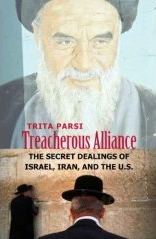
treaterousalliance.jpgHowever, as I discovered in the course of researching my book Treacherous Alliance – the Secret Dealings of Israel, Iran and the United States, not only does Netanyahu’s characterization of Iran have little relationship to reality; Netanyahu himself knows this better than most. Outside of the realm of cynical posturing by politicians, most Israeli strategists recognize that Iran represents a strategic challenge to the favorable balance of power enjoyed by Israel and the U.S. in the Middle East over the past 15 years, but it is no existential threat to the Israel, the U.S. or the Arab regimes.

And that was the view embraced by the Likud leader himself during his last term as prime minister of Israel. In the course of dozens of interviews with key players in the Israeli strategic establishment, a fascinating picture emerged of Netanyahu strongly pushing back against the orthodoxy of his Labor Party predecessors, Yitzhak Rabin and Shimon Peres, which treated Iran as one of Israel’s primary enemies. Not only that, he initiated an extensive discreet program of reaching out to the Islamic Republic. [complete article]

Editor’s Comment — Without wanting to understate Israel’s capacity for irrational behavior, it’s worth asking whether for the Israeli right there is one issue to which all others are subordinate. I would say that there is and that it is the consolidation of the territorial expansion that Israel has been engaged in for the last 40 years through building settlements in the West Bank. Even today, The Guardian reports on yet more seizure of Palestinian land that will allow a huge expansion of settlements. The greatest threat to this ongoing expansionist enterprise would come from the revival of the long-stalled peace process. The relentless construction of settlements, the construction of an apartheid road system separating Israeli and Palestinian traffic, and the construction of the so-called security barrier — these are all ways of making it clear, declarations to the contrary notwithstanding, that Israel has no intention of withdrawing to the 1967 borders.

And how does Iran fit into this equation? It presents a useful diversion through which in the shadow of a supposed existential threat, the development of the West Bank can continue all the way to the end of a window of opportunity — otherwise known as the Bush administration.

While Netanyahu’s neoconservative supporters in Washington can’t wait to see the bombs rain down on Iran, my suspicion (and it’s nothing more than that) is that Bibi will play the 1938 rhetoric for all it’s worth even while the prospect of a nuclear-armed Iran doesn’t cause him to loose a wink of sleep. Indeed, a silver-lining for Israel from a nuclear Iran is that that would provide the Jewish state with the perfect opportunity to come out of its own nuclear closet. It could claim that it was remaining true to its assertion that it would not have been the first state to “introduce” nuclear weapons to the region even if it was the first to deploy them — it simply didn’t make a fanfair about the fact; there was no declaration, no introduction. And with the balance of power having shifted towards Iran, the Israel lobby in Washington would have an easy time sustaining the United States’ financial commitment to Israel’s defense into perpetuity.

Having said that, a line that’s almost as popular as Netanyahu’s “1938”, is John McCain’s, “There is only one thing worse than the United States exercising a military option, that is a nuclear armed Iran.” The question thus remains, does the US and/or Israel truly believe that in such an attack the benefits outweigh the risks?

If Israel’s recent incursion into Syrian airspace was really as momentous an event as all the neocon chest-thumping would suggest, how come we still don’t know what happened? What might have been seen as a muscle-flexing exercise directed at Iran, at this point looks more like a very cautious dip of one toe in some icy water. While its success as a PR exercise is beyond question, its military significance remains in doubt.

And while the Iran-baiting rhetoric coming from American officials in Iraq has been escalating for months and months, it remains possible that the threshold will never be crossed from words to war. Everyone is playing an extremely dangerous game, yet the contest between those competing for the title, “master of destiny,” is a struggle between men, not one of whom has a clear view of the future.

Facebooktwittermail

NEWS & EDITOR’S COMMENT: The longer this goes on, the less we know

An Israeli strike on Syria kindles debate in the U.S

It has long been known that North Korean scientists have aided Damascus in developing sophisticated ballistic missile technology, and there appears to be little debate that North Koreans frequently visited a site in the Syrian desert that Israeli jets attacked Sept. 6. Where officials disagree is whether the accumulated evidence points to a Syrian nuclear program that poses a significant threat to the Middle East.

Mr. Cheney and his allies have expressed unease at the decision last week by President Bush and Ms. Rice to proceed with an agreement to supply North Korea with economic aid in return for the North’s disabling its nuclear reactor. Those officials argued that the Israeli intelligence demonstrates that North Korea cannot be trusted. They also argue that the United States should be prepared to scuttle the agreement unless North Korea admits to its dealing with the Syrians.

During a breakfast meeting on Oct. 2 at the White House, Ms. Rice and her chief North Korea negotiator, Christopher R. Hill, made the case to President Bush that the United States faced a choice: to continue with the nuclear pact with North Korea as a way to bring the secretive country back into the diplomatic fold and give it the incentive to stop proliferating nuclear material; or to return to the administration’s previous strategy of isolation, which detractors say left North Korea to its own devices and led it to test a nuclear device last October.

Mr. Cheney and Stephen J. Hadley, the national security adviser, also attended the meeting, administration officials said.

The Israeli strike occurred at a particularly delicate time for American diplomatic efforts. In addition to the North Korean nuclear negotiations, the White House is also trying to engineer a regional Middle East peace conference that would work toward a comprehensive peace accord between Arabs and Israelis.

The current and former American officials said Israel presented the United States with intelligence over the summer about what it described as nuclear activity in Syria. Officials have said Israel told the White House shortly in advance of the September raid that it was prepared to carry it out, but it is not clear whether the White House took a position then about whether the attack was justified. [complete article]

Editor’s Comment — Never has a story been told at such length while revealing so little.

Ever since this story broke, among the neocons, the engine that has kept it running is this bizarre proposition: the unprecedented Israeli veil of secrecy concerning the nature of its target is what “proves” that the target was so significant. But on the contrary, what the secrecy has done is create on open field for speculation ranging from this being a “dry run” in preparation for an attack on Iran (though since that would have undermined the element of surprise, a bit of Iran-directed saber rattling is more plausible); a demonstration of Israel’s ability to disable Syria’s air defenses (though it’s hard to understand why, if they could do this, Israel would want to publicize the fact and thereby give their adversaries a heads-up); and of course, an attack on a “nuclear facility.” And whereas last month it was being reported that Israeli commandos had gathered “samples” at the site providing forensic evidence of the connection to North Korea (North Korean mud off a North Korean boot?), we’re now told that “officials disagree … whether the accumulated evidence points to a Syrian nuclear program that poses a significant threat to the Middle East.” Strip away New York Times waffle, and that can be read as, there is no clear evidence that there is anything qualified to be called a Syrian nuclear program.

When it comes to the known facts, at this point we don’t actually know for a fact that Israel did anything more than penetrate Syrian air space. One of the few journalists who has actually attempted to report this story by visiting the location of the “strike” was told by locals that they heard sonic booms but no explosions.

How many more weeks do we have to wait before the neocon rumor mill runs out of steam and we can conclude what could have been assumed well before now: the reason the veil of secrecy has been held down so tight is because there’s nothing behind it!

As for my own theory about what happened, it is this: Israel’s new defense minister and would-be future prime minister, Ehud Barak, wanted to demonstrate that he’s a man of action who can restore Israel’s military pride after last year’s disastrous performance in Lebanon. The “strike” was a fake act of war in which the IAF gambled that Syria would not rise to the bait. The absolute secrecy was intended to hide this risky charade. Instead it provided an open season for neocon rumormongering about North Korea, Iran, the State Department and any other conceivable target of opportunity.

Facebooktwittermail

NEWS: Israel in new land grab before U.S. ‘peace’ summit

Israeli army orders confiscation of Palestinian land in West Bank

The Israeli army has ordered the seizure of Palestinian land surrounding four West Bank villages apparently in order to hugely expand settlements around Jerusalem, it emerged yesterday.

The confiscation happened as Israeli and Palestinian negotiators met to prepare the ground for a meeting hosted by President George Bush in the United States aimed at reviving a diplomatic solution to the conflict.

However, critics said the confiscation of land suggested that Israel was imposing its own solution on the Palestinians through building roads, barriers and settlements that would render a Palestinian state unviable. [complete article]

Facebooktwittermail

NEWS: Syria’s air defense; Israel’s military installations

Report: Iran worried over Syrian air defense failure in IAF strike

Iran is concerned over the failure of Syria’s air defense systems to detect the Israel Air Force non-stealth aircraft that reportedly carried out an attack inside Syria last month, the American weekly Aviation Week reported on its Web site on Wednesday.

According to the report, Israel was able to disrupt Syria’s radar and air defense systems and render them ineffective during the IAF strike. The Web site reported that Israel used an electronic device, installed in a plane that circled the area, to disrupt Syria’s defenses.

The weekly maintained that Iran is especially concerned over the failure of Syria’s Russian-made radar systems. Iran has used similar systems in the past, and is slated to purchase more radar equipment in a future deal worth $750 million. This equipment is apparently designated to protect Iran’s nuclear facilities against attacks from the air. [complete article]

Google Earth zooms in on Israel military sites

Sensitive installations, Air Force bases with their planes and helicopters, missile bases and even the nuclear reactor in Dimona have never been photographed better. A recent Google Earth update shows satellite pictures that make it possible to see clear, sharp pictures of military and civilian targets all across Israel. [complete article]

Facebooktwittermail

NEWS: Nassrallah blames Israel for assassinations; Israel turns away wounded Palestinians

Nasrallah blames Israel for killings in Lebanon

Hezbollah leader Hassan Nasrallah on Friday accused Israel of killing anti-Syrian figures in Lebanon to cause strife and drag his militant movement into fighting other Lebanese communities.

In a televised speech broadcast to his supporters to mark “Al Quds” day, Nasrallah said Israel has a network of agents working in Lebanon who are responsible for the political killings.

Nasrallah, whose group leads the pro-Syrian opposition to Lebanon’s U.S.-backed government, also warned the parliamentary majority against picking a president of their own to run the country if talks with the opposition failed, and called for polling the general population on their choice if the lawmakers fail to reach agreement. [complete article]

Doctors: Only severely wounded Palestinians allowed into Israel

Israel is allowing entry to only the most severly wounded Palestinians, and not to those at risk of losing limbs or suffering other debilitating handicaps, according to Physicians for Human Rights.

Hundreds of people were injured during the June clashes in the Gaza Strip between Hamas and Fatah. However, only those whose lives were in danger were allowed into Israel for treatment. Others, whose injuries endangered “only” their quality of life, remained in the Gaza Strip for treatment, PHR wrote to the defense minister and the health minister.

Out of 44 requests to transfer injured individuals for treatment in Israel, 16 were refused by authorities in Israel, PHR said. In some cases, this meant physicians in Gaza had to amputate limbs because treatment was delayed too long. [complete article]

Facebooktwittermail

OPINION: Israeli apartheid

Israelis fighting Israeli apartheid

I’ve never imagined a simple equation between the non-racial democracy for which we fought (and which we won) in South Africa and achieving a unitary state democratic solution for Israel and the Palestinians. Indeed, I’ll admit to being anything but dogmatic on just how that conflict is to be solved. While in principle, I’d certainly prefer a unitary democratic state with full democratic equality for all its citizens, I can see the considerable differences between our situation and the one in Israel/Palestine that render a single state solution exceedingly difficult. At the same time, I can also see that Israel’s systematic territorial expansion may already have rendered a Palestinian state unviable. (For more on this issue, listen to Ali Abunimah and Akiva Eldar debate the unitary vs. two-state solution on Canadian radio.)

But what’s clear enough is that for the past 40 years, there has been only one state between the Jordan River and the Mediterranean Sea, and that state has been Israel. And Israel has been an apartheid state: Like South Africa, it’s a democracy ruled by law for one group of people, and a military-colonial regime for another. [complete article]

My favorite ‘anti-Semite’

The utterly charming thing about the Zionist Thought Police is their apparent inability to restrain themselves, even from the very excesses that will prove to be their own undoing. Having asked sane and rational people to believe that Jimmy Carter is a Holocaust denier simply for pointing out the obvious about the apartheid regime Israel maintains in the occupied territories, the same crew now want us to believe that Archbishop Desmond Tutu is an anti-Semite. No jokes! That was the reason cited for Tutu being banned from speaking at St. Thomas University in Minneapolis. “We had heard some things he said that some people judged to be anti-Semitic and against Israeli policy,” explained university official Doug Hennes.

The “anti-Semitic” views Tutu had expressed were in his April 2002 speech “Occupation is Oppression” in which he likened the occupation regime in the West Bank, based on his personal experience of it, to what he had experienced as a black person in South Africa. He recalled the role of Jews in South Africa in the struggle to end apartheid, and expressed his solidarity with us through our centuries of suffering. But then turning to the suffering inflicted on the Palestinians, he issued an important challenge, one that might just as well have been uttered by a Jewish biblical prophet: [complete article]

Facebooktwittermail

FEATURE: Israel’s attack on the USS Liberty

New revelations in attack on American spy ship

The Johnson administration did not publicly dispute Israel’s claim that the attack [on June 8, 1967, the fourth day of what would become known as the Six-Day War,] had been nothing more than a disastrous mistake. But internal White House documents obtained from the Lyndon B. Johnson Presidential Library show that the Israelis’ explanation of how the mistake had occurred was not believed.

Except for McNamara, most senior administration officials from Secretary of State Dean Rusk on down privately agreed with Johnson’s intelligence adviser, Clark Clifford, who was quoted in minutes of a National Security Council staff meeting as saying it was “inconceivable” that the attack had been a case of mistaken identity.

The attack “couldn’t be anything else but deliberate,” the NSA’s director, Lt. Gen. Marshall Carter, later told Congress.

“I don’t think you’ll find many people at NSA who believe it was accidental,” Benson Buffham, a former deputy NSA director, said in an interview.

“I just always assumed that the Israeli pilots knew what they were doing,” said Harold Saunders, then a member of the National Security Council staff and later assistant secretary of state for Near Eastern and South Asian affairs.

“So for me, the question really is who issued the order to do that and why? That’s the really interesting thing.” [complete article]

See also, USS Liberty Memorial.

Facebooktwittermail

NEWS & EDITOR’S COMMENT: The Israeli attack on Syria. Revealed: nothing

Israeli army begins to release details on Syrian air raid

Israel on Tuesday eased a strict news blackout on an airstrike in Syria last month, allowing the first publication of reports it struck an unspecified “military target” deep inside Syrian territory.

Israel’s military censor had imposed a total blackout on coverage of the Sept. 6 airstrike. But Tuesday, the office allowed preliminary details to be published after Syria’s president, Bashar Assad, confirmed the airstrike in a televised interview.

“Israeli air force planes attacked a military target deep inside Syria on Sept. 6, the military censor allowed for publication today,” Israel’s Army Radio reported. The headline on the web site of the Maariv newspaper was, “Now it can be revealed: Israel attacked in Syria,” while the Haaretz newspaper led with the military’s permission to publish “the fact” of Israel’s attack. [complete article]

Editor’s Comment — The AP ready-made headline for this piece is, “Israel Releases Details on Syrian Raid.” The IHT editor inserted the small qualification “begins to.” Either way, the truth is that now that the veil of censorship has been lifted, it has revealed nothing. Not one detail. To speak of an unspecified military target deep inside Syria is to announce that there is nothing to announce. And to place that informational empty space under a headline referring to the release of details is Orwellian.

Facebooktwittermail

NEWS: Staying on the straight and narrow — really narrow

McCain: No Muslim president, U.S. better with Christian one

GOP presidential candidate John McCain says America is better off with a Christian President and he doesn’t want a Muslim in the Oval Office.

“I admire the Islam. There’s a lot of good principles in it,” he said. “But I just have to say in all candor that since this nation was founded primarily on Christian principles, personally, I prefer someone who I know who has a solid grounding in my faith.” [complete article]

“Amen” for Israel, say Christian Zionists

7,000 mostly evangelical Christians from across the world flocked to the Holy Land this week to celebrate the Jewish festival of Sukkoth and to show support for Israel.
[…]
Not all Christians back Israel. The Vatican’s envoy in the Holy Land and bishops from three other churches last year accused the Christian Zionist movement of promoting “racial exclusivity and perpetual war.”

While pilgrims in Israel this week were keen to visit Jewish towns and settlements, few appeared to venture into Palestinian towns, or meet many Arabs during their stay.

“We dare not go into the Palestinian areas and anyway they are not open to us,” said Elizabeth Lee, a Pentecostal Christian from Malaysia who has been to Israel 40 times.

Many pilgrims saw the Israeli conflict with the Palestinians as an extension of U.S. President George W. Bush’s “War on terror,” and talked about a clash between good and evil.

Mark Burns is an ardent Israel supporter who runs Christian radio stations in Illinois and brings groups every year to the Holy Land to donate blood and money.

“Christians who read the Hebrew scriptures know God made a promise with Israel,” he said. “People who are clueless about the Old Testament can be persuaded to support the other side.” [complete article]

Editor’s Comment — And there I was thinking this web site might help a few folks understand the Middle East better when I should have been studying the Old Testament. Dang!

Facebooktwittermail

OPINION: How to make Iraq look like whipped cream

So what about Iran?

A respected American paper posted a scoop this week: Vice-President Dick Cheney, the King of Hawks, has thought up a Machiavellian scheme for an attack on Iran. Its main point: Israel will start by bombing an Iranian nuclear installation, Iran will respond by launching missiles at Israel, and this will serve as a pretext for an American attack on Iran.

Far-fetched? Not really. It is rather like what happened in 1956. Then France, Israel and Britain secretly planned to attack Egypt in order to topple Gamal Abd-al-Nasser (“regime change” in today’s lingo.) It was agreed that Israeli paratroops would be dropped near the Suez Canal, and that the resulting conflict would serve as a pretext for the French and British to occupy the canal area in order to “secure” the waterway. This plan was implemented (and failed miserably).

What would happen to us if we agreed to Cheney’s plan? Our pilots would risk their lives to bomb the heavily defended Iranian installations. Then, Iranian missiles would rain down on our cities. Hundreds, perhaps thousands would be killed. All this in order to supply the Americans with a pretext to go to war. [complete article]

Facebooktwittermail

NEWS: Israelis favor use of nuclear weapons

Poll: 72% of Israelis back use of nuclear arms in certain circumstances

Some 72 percent of Israelis support the use of nuclear weapons in certain circumstances, according to the results of a Canadian survey released Monday, Army Radio reported.

The number of Israeli respondents in favor of destroying the world’s nuclear arms was lower than any of the six countries questioned in the Canadian Institute of Strategic Studies poll, the radio said.

Pollsters said the Israeli response demonstrated that the public is primarily concerned with national defense mechanisms in the face of a threat from a nuclear Iran. [complete article]

Israel submits nuclear trade plan

Israel has pushed a key group of nations engaged in nuclear trade to adopt new guidelines allowing the international transfer of nuclear technology to states that have not signed on to nonproliferation rules, and the move may complicate the Bush administration’s efforts to win an exemption for India to engage in such trade.

Documents outlining Israel’s proposal were distributed to the 45-member Nuclear Suppliers Group (NSG) in March and have circulated on Capitol Hill in recent days, just as the administration is pushing to clear the final hurdles blocking a groundbreaking agreement with India. [complete article]

Facebooktwittermail

NEWS: Saudis revive hope for Palestinian national unity government

Saudis urge Hamas and Fatah to form new coalition

Saudi Arabia – potentially a key player in current diplomatic moves on the Middle East – has warned that Fatah and Hamas will have to form a new coalition if any peace accord between Israel and the Palestinians is going to work.

At the same time it has expressed cautious optimism about the international Middle East conference called by George Bush for November – without yet committing itself to attend, as Israel and the United States would like it to.

The latest, relatively candid, summary of the Saudi position came during the meeting of the UN General Assembly in New York on the fringes of which the Saudi Foreign Minister, Prince Saud al-Faisal, met the US Secretary of State, Condoleezza Rice, and top officials from Gulf states. [complete article]

Facebooktwittermail

OPINION & EDITOR’S COMMENT: Israel and the world can live with a nuclear Iran

The world can live with a nuclear Iran

In case Bush does decide to attack Iran, it is questionable whether Iran’s large, well-dispersed and well-camouflaged nuclear program can really be knocked out. This is all the more doubtful because, in contrast to the Israeli attacks on Iraq back in 1981 and on Syria three weeks ago, the element of surprise will be lacking. And even if it can be done, whether doing so will serve a useful purpose is also questionable.

Since 1945 hardly one year has gone by in which some voices — mainly American ones concerned about preserving Washington’s monopoly over nuclear weapons to the greatest extent possible — did not decry the terrible consequences that would follow if additional countries went nuclear. So far, not one of those warnings has come true. To the contrary: in every place where nuclear weapons were introduced, large-scale wars between their owners have disappeared.

General John Abizaid, the former commander of United States Central Command, is only the latest in a long list of experts to argue that the world can live with a nuclear Iran. Their views deserve to be carefully considered, lest Ahmadinejad’s fear-driven posturing cause anybody to do something stupid. [complete article]

Editor’s CommentMartin van Creveld, a world-renowned professor of military history at the Hebrew University of Jerusalem, has a habit of being bluntly truthful. This is what he said in an interview earlier this year:

“We are in no danger at all of having an Iranian nuclear weapon dropped on us. We cannot say so too openly, however, because we have a history of using any threat in order to get weapons … thanks to the Iranian threat, we are getting weapons from the U.S. and Germany.”

“Our armed forces are not the 30th strongest in the world, but rather the second or third… We possess several hundred atomic warheads and rockets that can launch them at targets in all directions. Most European capitals are targets of our air force … We have the capability to take the world down with us. And I can assure you that this will happen before Israel goes under.”

Facebooktwittermail

NEWS & ANALYSIS: Iran – an enemy of convenience

Senate urges Bush to declare Iran Guard a terrorist group

The Senate approved a resolution on Wednesday urging the Bush administration to designate Iran’s Islamic Revolutionary Guard Corps as a foreign terrorist organization, and lawmakers briefly set aside partisan differences to approve a measure calling for stepped-up diplomacy to forge a political solution in Iraq.

Since last month, the White House has been weighing whether to declare the Revolutionary Guard Corps a terrorist group or to take a narrower step focusing on only the Guard’s elite Quds Force. Either approach would signal a more confrontational posture by declaring a part of the Iranian military a terrorist operation. [complete article]

The secret dealings of Israel, Iran, and the United States

TRITA PARSI: Israel has for a very long time been a critical factor in America’s formulation of a policy vis-à-vis Iran. But what’s really interesting is that the influence of Israel has gone in completely different directions, if we just go back fifteen years. During the 1980s, in spite of the Iranian Revolution, in spite of Ayatollah Khomeini’s many, many harsh remarks about Israel, far, far worse than what anything Ahmadinejad has said so far, Israel at the time was the country that was lobbying the United States to open up talks with Iran to try to rebuild the US-Iran relations, because of strategic imperatives that Israel had. Israel needed Iran, because it was fearing the Arab world and a potential war with the Arabs.

After 1991, ’92, that’s when you see the real shift in Israeli-Iranian relations, because that’s when the entire geopolitical map of the Middle East is redrawn. The Soviet Union collapses. The last standing army of the Arabs, that of Saddam Hussein, is defeated in the Persian Gulf War. And you have an entirely new security environment in the Middle East, in which the two factors, the Soviets and the Arabs, that had pushed Iran and Israel closer together suddenly evaporate. But as their security environment improves, they also start to realize that they may be ending up in a situation in which they can become potential threats to each other. And that’s when you see how the Israelis shift 180 degrees. Now the Israeli argument was that the United States should not talk to Iran, because there is no such thing as Iranian moderates.

And ever since, the Israelis and the pro-Israel interest in the United States have lobbied to make sure that there is no dialogue or there’s no rapprochement between the United States and Iran. And the Iranians have done similar things. They have undermined every US foreign policy initiative in the Middle East that they feared would be beneficial to Israel. So the real shift in Israeli-Iranian relations come after the Cold War, not with the revolution in 1979. [complete article]

Facebooktwittermail

RUMOR: The world’s best-circulated rumor

The world according to John Bolton

FOREIGN POLICY: It’s been a tense week on the nuclear front, with Syria accusing Israel of invading its airspace, and then North Korea blasting Israel for doing so. You’ve been one of the only people who have spoken openly about the likelihood that Israel bombed nuclear facilities in Syria. If that were the case, why do you think Israel wouldn’t announce it had done so?

JOHN BOLTON: Well, I don’t think we really know what the target of the Israeli raid was. There seems to be a lot of indication that there was a North Korean-Syrian project in the nuclear field, although obviously the details of that are not known. And what that suggests is that we need very clear answers from the North Koreans in the context of the six-party talks [as to] whether indeed they are proliferating nuclear technology, whether they’re outsourcing their program—or just exactly what it is they’re doing.

Now, what the Israeli raid actually hit, I don’t think people know. I was certainly reacting against the notion that it was an attack on a shipment of missiles bound from Iran to Hezbollah, because I don’t think the Israelis would take the risks inherent in an attack on Syrian territory against a target like that. To me, it suggests that it was a higher-value target, and a nuclear facility of some kind would definitely qualify. But what exactly the target is, I don’t know myself, and I’m not sure that there’s anything but speculation out there at this point. [complete article]

Congress throws covert Israeli attack on Syria out into the open

As Israel and the United States struggle to maintain a veil of ambiguity over Israel’s alleged air strike against Syria earlier this month, Congress is bringing the issue out into the open and giving American sanction to an event that now seems all but confirmed.

Democrat Robert Wexler from Florida introduced a resolution this week supporting Israel’s covert operation and backing the country’s right to defend itself “in the face of an imminent nuclear or military threat from Syria.”

“This is the world’s worst-kept secret,” Wexler told the Forward this week, stressing that his proposed resolution did not reveal anything that wasn’t already reported in the world press. [complete article]

Hillary Clinton says she supports ‘apparent’ IAF action in Syria

New York Senator Hillary Clinton said on Wednesday evening that she supports what she said was the Israel Air Force’s “apparent” action against a nuclear facility in Syria.

Clinton spoke during a televised debate for the leading candidates vying for the Democratic nomination for U.S. president.

The candidates largely evaded questions on the incident, on which foreign media has speculated but Israel remains quiet. The moderator of the debate, Tim Russert of NBC, raised the issue of Syria when asking whether the candidates would support an Israeli strike on Iran, should it acquire nuclear capabilities. [complete article]

Editor’s Comment — Clinton and Congress don’t need to know what happened in Syria before they voice their support. Fat chance they’ll be counseling restraint when it comes to Iran.

Facebooktwittermail

NEWS: North Korea objects to US-Israeli nuclear hypocrisy; Israel lobbies to import nuclear material; Texas forms alliance with Israel

North Korea accuses US of helping Israel develop nuclear weapons

North Korea accused the United States on Tuesday of actively providing nuclear weapons assistance to Israel while seeking to deprive other countries of the right to peaceful nuclear programs. [complete article]

Documents show Israel lobbying to import nuclear material

Israel is looking to a U.S.-India nuclear deal to expand its own ties to suppliers, quietly lobbying for an exemption from nonproliferation rules so it can legally import atomic material, according to documents made available Tuesday to The Associated Press.

The move is sure to raise concerns among Arab nations already considering their neighbor the region’s atomic arms threat. Israel has never publicly acknowledged having nuclear weapons, but is generally considered to possess them. [complete article]

See also, At U.N., Iranian leader is defiant on nuclear efforts (WP) Iran frees fourth US dual national (Reuters).

Texas governor announces establishment of Texas-Israel Chamber of Commerce

Gov. Rick Perry announced on Tuesday the establishment of the Texas-Israel Chamber of Commerce, an agency meant to foster economic exchange and academic collaboration between the two.

Perry also said he has asked the directors of the Employees Retirement System and Teachers Retirement System to divest their funds from companies doing business with Iran. The governor said Texans will not condone Iran’s support of terrorism.

“I personally believe that any company that does business with Iran is actively assisting those who seek to harm American men and women who are serving in the Middle East and funds terror attacks on our allies in the region,” Perry said.

“And so, today, as we usher in a new era of relations between Texas and Israel, we speak of a grand vision of a world where terror is defeated by kinship, economic partnerships create new opportunity and people are free to work and live in peace,” he added. [complete article]

Editor’s Comment — And when will Texas lead the way and establish its own embassy in Jerusalem?

Facebooktwittermail

EDITORIAL: Ahmadinejad’s free speech

Ahmadinejad’s free speech

Mahmoud Ahmadinejad did something yesterday that neither President Bush nor Vice-President Cheney have the courage to do: stand up and speak in front of an unfriendly college audience. How can America’s leaders claim that they are defending freedom when they are so clearly afraid of it?

In the Bush-Cheney lexicon, “free speech” is something that can be confined to a zone out of earshot and out of sight; it is something whose value is cathartic rather than political. They regard free speech as a form of free expression that serves the psychological needs of the individual rather than the political needs of a healthy democracy.

America has over the last six years become infected by this impoverished view of free speech. It is a right that seemingly only benefits those who exercise it, while society merely tolerates its performance. Thus, as he introduced President Ahmadinejad, Columbia president Lee Bollinger wanted to assure the nation that no one in his illustrious university was in jeopardy of being influenced by anything that Iran’s president might say. Continue reading

Facebooktwittermail