Israel’s naval blockade of the Gaza Strip violates international law, a panel of human rights experts reporting to a U.N. body said on Tuesday, disputing a conclusion reached by a separate U.N. probe into Israel’s raid on a Gaza-bound aid ship.
The so-called Palmer Report on the Israeli raid of May 2010 that killed nine Turkish activists said earlier this month that Israel had used unreasonable force in last year’s raid, but its naval blockade of the Hamas-ruled strip was legal.
A panel of five independent U.N. rights experts reporting to the U.N. Human Rights Council rejected that conclusion, saying the blockade had subjected Gazans to collective punishment in “flagrant contravention of international human rights and humanitarian law.”
The four-year blockade deprived 1.6 million Palestinians living in the enclave of fundamental rights, they said.
Turkish Prime Minister Recep Tayyip Erdogan on Monday called on Egyptians to adopt a secular constitution, noting that secularism does not mean renouncing religion.
A secular state respects all religions, Erdogan said in an interview with the private satellite TV channel Dream before heading to Egypt for a two-day visit.
“Do not be wary of secularism. I hope there will be a secular state in Egypt,” Erdogan said.
He stressed that people have the right to choose whether or not to be religious, adding that he is a Muslim prime minister for a secular state.
Erdogan said Egypt needs to meet some requirements for establishing a modern state, including better management of human resources, more attention to education, improved management of financial resources and eliminating corruption.
Erdoğan, visiting Egypt at the start of a North Africa tour, said Israel continued taking steps that undermine its own legitimacy, noting that it killed nine Turks on an aid ship trying to break the blockade of Gaza last year and more recently shot dead five Egyptian soldiers.
He reiterated that a UN report defending the Israeli blockade of Gaza as legal was “null and void” for Turkey and insisted that Turkey’s relations with Israel will not return to normal unless Israel apologizes for the 2010 raid, pay compensation for families of the victims and lifts the blockade of Gaza.
“Turkey does not recognize the Gaza blockade,” Erdoğan said, reiterating that Turkey will take measures to ensure freedom of navigation in the eastern Mediterranean and vowed that Turkey will press for an International Court of Justice review of the blockade.
“States, just like individuals, have to pay the price for murders, for acts of terrorism they committed so that we can live in a more just world,” he said.
The Turkish prime minister also said the Israeli-Palestinian conflict was a “matter of humanity” and added that the current status quo can no longer be maintained. He vowed support for Palestinian efforts for recognition at the UN General Assembly. “Our Palestinian brothers should be able to have their own state. It is time for the flag of Palestine to fly at the UN,” he said, calling on the Arab League countries to support the Palestinian bid.
Turkey’s Military Electronics Industry (ASELSAN) has produced a new identification friend or foe (IFF) system for Turkish jet fighters, warships and submarines and the new software, contrary to the older, US-made version, does not automatically identify Israeli planes and ships as friends, a news report said on Tuesday.
The new IFF has already been installed in Turkish F-16s and is expected to be installed in all Navy ships and submarines, the report, published in Turkish daily Star, said. It will be fully operational when it is installed in all military planes, warships and submarines.
The F-16 jet fighters, purchased from the US, came with pre-installed IFF software that automatically identifies Israeli fighters and warships as friends, disabling Turkish F-16s from targeting Israeli planes or ships. ASELSAN-made IFF will allow Turkish military commanders to identify friends and foes on the basis of national considerations.
Turkey was unable to make modifications to the friend or foe identification codes in US-made F-16s, while Israel was given a different version of the software allowing Israeli authorities to make modifications. Israel was also authorized to view the version given to Turkey, according to Star.
Turkey said on Tuesday that its military may launch a ground offensive against terrorist Kurdistan Workers’ Party (PKK) targets in northern Iraq at any time in accordance with ongoing talks with Iraqi Kurdish officials as part of cooperation against the PKK.
Interior Minister İdris Naim Şahin said in response to questions from reporters as to whether Turkey is pondering a ground operation in northern Iraq that talks with the Kurdish regional administration in northern Iraq are still under way and that a cross-border ground offensive could be launched at any time just like aerial strikes. In August, the Turkish military launched aerial attacks on PKK targets in northern Iraq, killing up to 160 terrorists.
The PKK uses its bases in northern Iraq to launch attacks on Turkey. Its Iranian wing, the Party for a Free Life in Kurdistan (PJAK), is also involved in clashes with Iranian forces.
Last week, Foreign Ministry Undersecretary Feridun Sinirlioğlu travelled to Iraq and discussed the issue of the fight against terrorism, as well as bilateral and regional issues, with Iraqi Kurdish officials. Sinirlioğlu’s visit to Iraq comes amid a surge in PKK attacks on Turkish troops. Dozens of troops were killed in PKK attacks over the past couple of months.
Leader of the outlawed Kurdistan Workers’ Party (PKK) has demanded an apology from Israel for helping the capture of PKK’s jailed leader Abdullah Öcalan back in 1999 after reports that Israel may use the PKK against Turkey in the face of increasing tensions between the two countries.
Karayılan’s remarks came three days after a report suggesting that Israeli Foreign Minister Avigdor Lieberman offered to hold meetings with leaders of the PKK in response to Turkey’s sanctions on Israel due to its refusal to apologize for flotilla deaths.
Karayılan told pro-PKK Firat news agency on Monday that the PKK is a “principled organization” and that it is not a movement that “could be used against any state.”
Israeli daily Yedioth Ahronoth reported on Friday that the hawkish Israeli foreign minister had been planning to meet with PKK leaders in Europe to discuss cooperation with the terrorist group in every possible way. Lieberman has been planning a series of measures to retaliate against Turkey over an apology row, including providing military aid to the outlawed PKK, the daily said.
We are all going to be invited to the funeral of the two-state solution if and when the UN General Assembly announces the acceptance of Palestine as a member state.
The support of the vast majority of the organization’s members would complete a cycle that began in 1967 and which granted the ill-advised two-state solution the backing of every powerful and less powerful actor on the international and regional stages.
Even inside Israel, the support engulfed eventually the right as well as the left and center of Zionist politics. And yet despite the previous and future support, everybody inside and outside Palestine seems to concede that the occupation will continue and that even in the best of all scenarios, there will be a greater and racist Israel next to a fragmented and useless bantustan.
The charade will end in September or October — when the Palestinian Authority plans to submit its request for UN membership as a full member — in one of two ways.
It could be either painful and violent, if Israel continues to enjoy international immunity and is allowed to finalize by sheer brutal force its mapping of post-Oslo Palestine. Or it could end in a revolutionary and much more peaceful way with the gradual replacement of the old fabrications with solid new truths about peace and reconciliation for Palestine. Or perhaps the first scenario is an unfortunate precondition for the second. Time will tell.
Prime Minister Benjamin Netanyahu’s cabinet on Sunday approved a plan to relocate tens of thousands of Bedouin from their unrecognized villages into settlements with official state status.
The plan emerges from the Prawer Report, drafted to find a solution to the problem of unrecognized villages in the Negev.
As part of the plan, some 20,000 to 30,000 Bedouon will be relocated to recognized settlements including Rahat, Khura and Ksayfe. The plan also includes financial compensation for those relocated, as well as alternate plots of land. The program is estimated to cost the state NIS 6.8 billion.
Opponents of the plan have accusing the government of evacuating people from their homes for no justified reason and against their will.
Bedouin representative called the decision “a declaration of war,” and some 150 members of the community gathered outside the prime minister’s office in Jerusalem on Sunday to protest the decision.
“This stupid government will be responsible for a Bedouin Intifada in the Negev,” said Arab MK Taleb al-Sana, who took part in the protest.
Adalah, the Legal Center for Arab Minority Rights in Israel, slammed the government’s approval of the plan as a major violation of basic rights, pointing out that it would result in the uprooting of tens of thousands of people and the demolition of many Bedouin villages.
The Association for Civil Rights in Israel in June submitted its objections to the Prawer Report and argued that the conditions it sets for recognizing Bedouin villages are prejudicial.
These include meeting minimal levels of population density, contiguity and economic sustainability. The criteria established, the organization maintains, flout principles of equality and justice in the distribution of resources. “If the same criteria were applied to the Jewish population, whole settlements – including community settlements, observatories, kibbutzim and moshavim – would be doomed,” the association notes.
Moreover, according to its claims, Bedouin villages are planned without considering the needs of the population, which is largely agrarian and rural, not urban. The association also opposes making any planning for the Bedouin conditional on settling disputes over land ownership.
Jordanian King Abdullah II said Monday that Israel’s position in the Middle East has deteriorated in the wake of the recent wave of Arab uprisings, telling a group of intellectuals that the Palestinians now have a “more secure future” than Israel.
Israel’s position is “more problematic than it has been in the past”, Abdullah told the group of authors and academics gathered at the royal palace in Amman, according to Army Radio.
The Jordanian king told the group that he had expressed these views on a recent visit to the United States. An Israeli intellectual told the king that he believed that the Arab Spring would serve Israeli interests, whereupon Abdullah answered he felt that the opposite would be true.
King Abdallah also related to proposals advocated by some Israeli rightists that his country fulfill the national aspirations of the Palestinian people. Abdallah called this so-called “Jordanian option” an unacceptable fantasy plan. He said that Jordan can never take the place of a substitute Palestinian homeland.
The king added that no American or European official has ever pressured him to support a solution to the Palestinian refugee problem that would come at the expense of the kingdom, according to Israel Radio.
Turkish Prime Minister Tayyip Erdogan saw “cause for war” with Israel last year after a deadly raid on a Turkish ship headed for Gaza, according to a transcript of a recent interview.
State news agency Anatolia released late on Sunday what it said was an original Turkish-language transcript of an interview Erdogan gave to Al Jazeera television last week. It included elements not broadcast as well as original wording for sensitive comments that had been transmitted only in Arabic translation.
Among previously unpublished elements, Erdogan said Israel’s deadly raid last year on the Gaza-bound flotilla would have justified going to war: “The attack that took place in international waters did not comply with any international law. In fact, it was cause for war. However, befitting Turkey’s greatness, we decided to act with patience,” he said.
The transcript in Turkish from Anatolian, apparently provided by Erdogan’s office, also gave the following account of the prime minister’s response to a question on what Turkey would do to ensure free passage for its ships in the Mediterranean.
“Right now, without a doubt, the primary duty of Turkish navy ships is to protect its own ships,” Erdogan said.
“This is the first step. And we have humanitarian aid that we want to carry there. This humanitarian aid will not be attacked any more, as it was the case with Mavi Marmara.”
Egyptian activists and politicians accused the ruling military leaders of breaking a promise to end emergency law, after authorities said they would reintroduce special security courts following an attack on the Israeli embassy.
Eight months after protesters toppled President Hosni Mubarak and the military took power on an interim basis, many supporters of the protest movement say they are concerned that the military rulers are backsliding on reform pledges.
Ending emergency law, seen as a tool of Mubarak’s repression, has long been a key demand.
Israel pulled its ambassador out of Egypt after protesters stormed the building housing Israel’s embassy on Friday night.
Egypt’s military rulers said they would try suspects in emergency state security courts. Emergency law would now apply in cases such as blocking of roads, publishing false information and weapons possession, they said.
The measures add to a list of developments that activists say worry them, including the banning of cameras from important trials including that of Mubarak himself, and the army’s failure so far to set a firm date for a parliamentary election.
“The new procedure violate the constitutional decree that the military council issued after Mubarak, in which it pledged to end the state of emergency within six months and said a public referendum had to take place for it to be extended,” Mohamed Adel, leader of the April 6 youth group, told Reuters.
“Egyptian law has many rules against thugs and terrorism, so I still don’t see a reason to extend emergency law,” he added.
Presidential candidate Mohamed ElBaradei said: “It is the normal right of every Egyptian to be tried in front of an ordinary judge, but it is unfortunately not what we see as we are relying more on military and extraordinary courts.”
Emergency law was widely applied under Mubarak’s rule to stifle opposition. The law, in place for decades, gives the state ultimate powers to question or detain citizens.
It was due to be lifted before the parliamentary election which is expected anytime starting November. No poll date has yet been set, although the army has said procedures for a vote, such as voter registration, will start in September.
The Muslim Brotherhood, one of Egypt’s most organised political groups, condemned the use of emergency courts in one of its strongest statements against the military to date. The group, expected to benefit from an early vote, has tended to take a softer line than other activists in the past.
“We confirm our rejection of any attempt to abuse the events to issue martial laws or decrease the margin of freedoms,” the group’s political wing, the Freedom and Justice party, said.
The Islamist group condemned violence by protesters targeting the embassy and other police sites, but also blamed the army for not taking a tough enough stance against Israel.
Presidential hopeful and former Brotherhood leader Abdel Moneim Abul Futuh said he feared the new security measures were “part of a pre-prepared scenario to take over the revolution.”
“I warn the governing power in Egypt against moving forward in this path. And I hope everyone knows the Egyptian people will not allow such scenarios and will not allow their revolution to be aborted.”
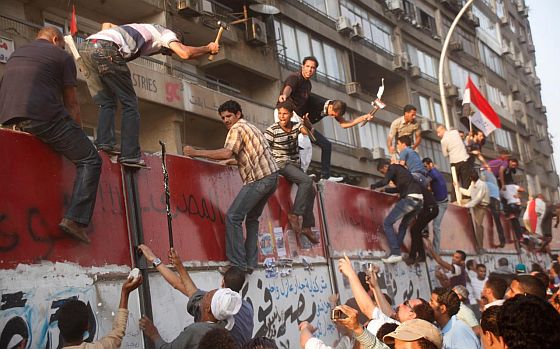
Egyptians marched on the Israeli embassy in Cairo on Friday, demolished a wall built around the embassy building to protect it and stormed the Nile tower block that houses the mission.
Egyptian security forces raided the offices of an Egyptian affiliate of the Al Jazeera news network known for attentive coverage of street protests, eliciting allegations on Sunday of a crackdown on the news media as the military-led transitional government seeks to ensure law and order after allowing an angry mob to invade the Israeli Embassy over the weekend.
The raid on the television network came as both the Egyptian and Israeli governments began tentative steps to repair the diplomatic breach between the awkward allies after the embassy attack on Friday night.
The raid also came after a warning last week by Egypt’s minister of media, Osama Heikal, that the government would take legal action against stations that “endanger the stability and security” of the nation, and some analysts said they feared the raid could signal a broader effort to curtail the new freedoms of expression experienced since the uprising that ousted former President Hosni Mubarak this year.
The network, Al Jazeera Live Egypt, was founded in the aftermath of the uprising and has become known for its attentive, if not sensational, coverage of street protests, including the Israeli Embassy attack on Friday. The raid forced the network to halt its programming for a period before it resumed broadcasting from Al Jazeera’s headquarters in Doha, Qatar.
Officials of the Interior Ministry said they had raided the network because it lacked a license, and that neighbors had complained about noise. Numerous satellite channels have sprung up since the revolution, and Mr. Heikal, the media minister, said in his statement last week that the government would stop issuing new permits because of concerns about broadcasts that endangered stability.
But Islam Lotfy, a lawyer for the channel, said the channel had applied for a license in March without a response.
According to identical accounts offered by Egyptian officials and foreign diplomats in Cairo, Egypt had asked Israel before the developments of last Friday to keep the Israeli ambassador in Tel Aviv and to reduce the volume of its staff to the minimum, but Netanyahu insisted on sending the ambassador back only a few days before the latest protest.
“We are not expelling him, but we thought a long holiday for the Israeli ambassador in Egypt would be useful for all of us now; unfortunately, Israel thought otherwise and when anger erupted on Friday evening they had to solicit the intervention of the Americans who sent a plane to carry him and the rest of the staff out of Egypt,” said one official.
Today, there is a tacit agreement between Egypt and Israel that the long holiday for the ambassador is in place and there are guarantees offered by Cairo to both Washington and Tel Aviv that stepped up security measures will be in place to prevent another attack on the embassy.
In the Islamist Al-Dawa Al-Salafiya (Salafist Call) reaction statement to the protesters’ storming of the Israeli embassy in Cairo on 9 September, they slammed the attack as “not thought-out,” which will work in the favour of Israel.
The Salafist movement claims that the 9 September mobbing of the embassy “will work in favour of Israel and will transform them from perpetrators to victims and the focus will shift from our demands to amend the Camp David agreement to Israel’s calls for help to protect their embassy in Egypt.”
The movement also pointed out that the “Egyptians are united in their hate for Israel (thank God). We must fight cultural normalisation [with Israel] and we should push for the international isolation of Israel.”
The group also condemned the statement released by President Obama in which he told Egypt to “honour its international obligations to safeguard the security of the Israeli embassy,” and reminded the US president that Egypt has changed after the January 25 Revolution.
The statement also claimed that most of the calls for violence are actually from a US-backed ex-police officer, Omar Afifi, who resides in the US and uses the internet to incite divisions in Egypt.
The Israeli government must be exhilarated that it is no longer being held responsible for the chaotic events taking place in Egypt. Instead they are now being portrayed as victims of a different “foreign hand,” which sponsored the storming of their embassy in Cairo.
Friday’s incident at the Israeli Embassy, in which thousands of angry protestors – surprisingly – managed to storm the embassy, is being portrayed by Egypt’s flagship newspaper Al-Ahram as fueled by elements of the “counter-revolution” that seeks the fall of the Egyptian state.
In its main headline, the paper speaks of “the involvement of a number of neighboring countries in providing ‘huge beyond imagination’ funds to Egyptian NGOs.”
Justice Minister Abdel Aziz al-Guindi told Al-Ahram that a country from the Gulf gave LE181 million to a small Egyptian NGO.
Guindi added that he has received a report that shows that several neighboring countries have offered million of pounds to Egyptian human rights and civil society organizations, some of which are not registered.
He also said that he has submitted a report to the head of the Supreme Council of the Armed Forces (SCAF) and the prime minister to take appropriate action against the inflow of funds, adding that the cabinet will announce the report’s findings within the next few days.
Guindi added that these “foreign hands” – and local ones – have been behind other incidents of violence in Egypt, seeking to sabotage state institutions, undermine national security, and intimidate citizens.
One might cast doubt over the relationship between the demonstrations in front of the Israeli Embassy and a small NGO receiving millions of pounds, but Al-Ahram doesn’t address such logical inconsistencies.
An editorial in the same paper echoes the article’s sinister tone, with a lead blaring, “The secrets of the plot facing Egypt.”
It reads, “Today, the details of the plot facing Egypt are appearing. The plot doesn’t challenge the Egyptian revolution only; more dangerously, it aims to make Egypt reel in chaos.”
Following the events at the Israeli Embassy, the Egyptian government announced its intent to fully implement the decades-old Emergency Law.
It’s easy to forget that the repeal of the state of emergency was a top demand of protesters who took the streets against former President Hosni Mubarak in January and February. That mood has clearly changed now, although the SCAF declared last month that they had begun the process of ending the state of emergency before parliamentary elections that are expected to be held in November.
Despite this very fact, state-run Al-Gomhurriya praised the move of fully implementing the exceptional measures enshrined in the widely-reviled law. The newspaper runs a lengthy feature quoting “legal experts” defending the re-implementation of the law, saying that such a move would restore the prestige of the state and its stability.
At some point, will it dawn on the Israelis that constructing walls is not the magic solution to all their security problems?
After Israel enraged many Egyptians by killing five border guards on August 18 (a sixth who was shot in the same incident died today), the Israeli government thought it would be prudent to install a 15-foot concrete barrier around its embassy in Cairo.
The construction of a wall outside the embassy was almost a provocation to people to come and bring it down. The symbolism of a wall was not lost on any one and merely angered people.
After protesters stormed the embassy on Friday night, Egyptian authorities only moved in to protect the Israeli staff after the Obama administration interceded on Israel’s behalf. Even then, it took two hours before U.S. Secretary of Defense Leon Panetta was able to speak to Supreme Military Council head Mohamed Hussein Tantawi.
“There’s no time to waste,” Panetta reportedly told Tantawi in the 1 A.M. call, warning of a tragic outcome that “would have very severe consequences.”
The U.S. source also said that Tantawi failed to answer incoming calls from U.S. officials throughout the evening, finally answering after more than two hours of attempts.
Nominally, Egypt is one of Israel’s only allies in the Middle East, but as Israelis are now acutely aware, there’s a big difference between an alliance with Hosni Mubarak and cordial relations with the Egyptian people.
Israel has now pulled out all its embassy staff and their families leaving behind just one diplomat, its deputy ambassador who has taken refuge at the US embassy.
The flight of the Israelis from Egypt comes just a few days before Turkish Prime Minister Recep Tayyep Erdogan is about to arrive in Cairo where he will address a meeting of Arab foreign ministers on Tuesday. Some reports say that he might travel from Cairo for a brief visit to Gaza.
The [Israel] Foreign Ministry has now decided to proceed with the formulation of a diplomatic and security “toolbox” to be used against the Turks. The first move would be to issue a travel warning urging all Israeli military veterans to refrain from traveling to Turkey. The advisory will be especially harsh as it will also urge Israelis to refrain from boarding connections in Turkey.
Another planned Israeli move is the facilitation of cooperation with Turkey’s historic rivals, the Armenians. During Lieberman’s visit to the United States this month, the foreign minister is expected to meet with leaders of the Armenian lobby and propose anti-Turkish cooperation in Congress.
The implication of this move could be Israeli assistance in promoting international recognition of the Armenian holocaust, a measure that would gravely harm Turkey. Israel may also back Armenia in its dispute vis-à-vis Turkey over control of Mount Ararat.
Lieberman is also planning to set meetings with the heads of Kurdish rebel group PKK in Europe in order to “cooperate with them and boost them in every possible area.” In these meetings, the Kurds may ask Israel for military aid in the form of training and arms supplies, a move that would constitute a major anti-Turkish position should it materialize.
The PKK is a “U.S. Government Designated Foreign Terrorist Organizations” in the State Department’s current list of foreign terrorist organizations. In the event that Israel starts providing the PKK with weapons, Israel itself will need to be considered for inclusion in the State Department’s list of State Sponsors of Terrorism. Were it to be listed, this would mean that it would be illegal for the United States to continue providing military aid and economic assistance to Israel.
Turkish Prime Minister Recep Tayyip Erdogan reiterated on Saturday his country’s intent to refer the legality of Israel’s Gaza blockade to The Hague, adding a criticism of U.S. President Barack Obama’s position regarding Israel’s 2010 of a Turkish Gaza-bound flotilla.
Speaking a convention of businessmen in the central Turkish city of Kayseri broadcast live on Turkey’s state news channel TRT Erdogan vowed to continue the legal struggle for justice for the nine people killed in the raid.
“We will carry this struggle to The Hague and Erdogan criticizes Obama,” the Turkish premier said, criticizing Turkish opposition leaders for what he described as “acting as advocates for Israel.”
Erdogan was also deeply critical of the United States position on the Mavi Marmara incident, pointing out that he had to point out to Obama how the attack had left nine Turks dead from wounds inflicted by 35 bullets mostly fired from close range, one of them an American passport holder.
“I asked President Obama whether the reason he showed no interest in one of his nationals being killed was because [the victim] was [ethnically] Turkish – he didn’t reply,” said Erdogan.
A warning by Turkish Prime Minister Recep Tayyip Erdoğan to Israel reiterating his country’s firmness on ensuring freedom of navigation in the eastern Mediterranean sent shockwaves throughout the region after it was interpreted as a prelude to a naval confrontation with its former ally.
But officials in Ankara made clear on Friday that Erdoğan’s remarks during an interview with Al Jazeera were quoted out of context. Some of his quotes were compiled later both by Al Jazeera and Reuters in a way that implied these quotes had followed each other, the same officials said. “Turkish warships, in the first place, are authorized to protect our ships that carry humanitarian aid to Gaza,” Erdoğan was quoted as saying by Reuters in the interview, broadcast by Al Jazeera with an Arabic translation.
“From now on, we will not let these ships be attacked by Israel, as what happened with the Freedom Flotilla,” Erdoğan was also quoted as saying by Reuters.
In the Turkish version of the text of the interview provided by the Anatolia news agency, however, Erdoğan, in response to a question on ensuring the freedom of navigation in the eastern Mediterranean, says: “At the moment, no doubt, Turkish warships are first of all liable to protect their own ships. This is the first step. And there is humanitarian aid which we will extend. Our humanitarian assistance will no longer be attacked as happened in the case of the Mavi Marmara.”
A senior government official speaking to Today’s Zaman on Friday said Erdoğan’s remarks cannot be interpreted to mean that Turkey has been preparing to send humanitarian aid ships to the region that will be escorted by Turkish warships. “We have put forth a principle by saying that we will ensure the freedom of navigation in the eastern Mediterranean and that this field is not an Israeli playground.
As long as Israel does not interfere in the freedom of navigation, we do not plan on sending any warships to escort humanitarian aid ships,” the official, who requested anonymity due to the sensitivity of the issue, told Today’s Zaman. “The misquoted remarks suggest that we have been readying to provide a warship to escort each humanitarian aid ship. This is not the case. However, Turkey will protect its citizens’ rights in the event of any interference in international waters,” the official added.
A group of about 30 protesters broke into the Israeli Embassy in Cairo Friday and dumped hundreds of documents out of the windows after a day of demonstrations outside the building in which crowds swinging sledge hammers and using their bare hands tore apart the embassy’s security wall.
Israel’s ambassador, Yitzhak Levanon, his family and other embassy staff rushed to Cairo airport and left on a military plane for Israel, said airport officials who spoke on condition of anonymity because they were not authorized to speak to the media.
Israeli officials refused to comment on the ambassador’s departure.
Hundreds of protesters converged on the embassy throughout the afternoon and into the night, tearing down large sections of the graffiti-covered security wall outside the 21-story building housing the embassy. Egyptian security forces made no attempt for hours to intervene.
Just before midnight, a group of protesters reached a room on one of the embassy’s lower floors at the top of the building and began dumping Hebrew-language documents from the windows, said an Egyptian security official who spoke on condition of anonymity because he was not authorized to speak to the media.
In Jerusalem, an Israeli official confirmed the embassy had been broken into, saying it appeared the group reached a waiting room on the lower floor. He spoke on condition of anonymity because he was not permitted to release the information.
No one answered the phone at the embassy late Friday.
Meanwhile, U.S. President Barak Obama spoke with Prime Minister Benjamin Netanyahu about the situation at the Israeli Embassy in Cairo.
The President’s office said in a statement that Obama expressed great concern about the situation at the Embassy, and the security of the Israelis serving there.
The statement said Obama “reviewed the steps that the United States is taking at all levels to help resolve the situation without further violence, and to call on the Government of Egypt to honor its international obligations to safeguard the security of the Israeli Embassy.”
Obama and Netanyahu agreed to stay in close touch until the situation is resolved.
Turkey said on Thursday it would escort aid ships to Gaza and would not allow a repetition of last year’s Israeli raid that killed nine Turks, setting the stage for a potential naval confrontation with its former ally.
Raising the stakes in Turkey’s row with Israel over its refusal to apologise for the killings, Prime Minister Recep Tayyip Erdoğan told Al Jazeera television that Turkey had taken steps to stop Israel from unilaterally exploiting natural resources in the Mediterranean.
“Turkish warships, in the first place, are authorised to protect our ships that carry humanitarian aid to Gaza,” Erdoğan said in the interview, broadcast by Al Jazeera with an Arabic translation.
“From now on, we will not let these ships to be attacked by Israel, as what happened with the Freedom Flotilla,” Erdoğan said.
Referring to Erdoğan’s comments, Israeli Foreign Ministry spokesman Yigal Palmor said: “This is a statement well-worth not commenting on.”
Relations between Turkey and Israel, two close US allies in the region, have soured since Israeli forces boarded the Gaza-bound Mavi Marmara aid ship in May 2010.
A month after an unusual terror attack killed eight Israelis along a desert highway approaching the Red Sea, the incident remains shrouded in mystery, especially in Gaza, where Israeli officials insist the complex, military-style attack was orchestrated but where no group has taken responsibility. “Usually the problem is more than one group takes credit after a successful operation,” says Taheri Al-Nunu, a spokesman for Hamas, the militant group that governs Gaza. Hamas had immediately denied knowledge of the attack, and hurriedly surveyed the other militant groups operating in the enclave. “All of them denied it.”
Among them was the Popular Resistance Committees, the group Israel almost immediately blamed for the attack, and promptly launched what it called a reprisal strike. Before the fighting was finished in the desert outside the resort city of Eilat, a missile from an Israeli drone exploded outside a house in Rafah, near the Egyptian border. The PRC’s top commander and two aides were killed, as well as a two-year-old child.
Afterward, the group continued to deny responsibility — also unusual in a society that celebrates lives lost opposing the Israeli occupation. As a senior Hamas official put it, with a frown: “After their leaders were killed, you would expect people to be proud.”
Israeli security officials tell TIME that the link to the PRC was as clear as the orders they monitored in real time from Gaza to the Sinai Peninsula where the militants waited in ambush. In a new detail, one official states that two of the five bodies recovered after the fighting have been identified as Gaza residents. The official did not say how the identity was confirmed, which will do little to end speculation about the incident.
“If the Israelis have any proof, give it,” says Ahmed Yusuf, a former Hamas official who now runs a Gaza think tank. “I met with these people for the Popular Resistance. They said, ‘We want to distance ourselves from what happened in Eilat and wondered why they were threatening us.'”
Israel’s fallout with long-time ally Turkey is no isolated spat that will be repaired any time soon; it’s a dramatic illustration that no amount of U.S. backing can prevent the growing international isolation resulting from Israel’s handling of the Palestinian issue. Indeed, the unconditional nature of Washington’s backing may, in fact, have become dysfunctional to Israel’s diplomatic standing: A U.S. domestic political climate in which challenging Israel on anything is about as wise as threatening to cut medicare payments leaves Washington unable to restrain the most right-wing government in Israeli history from its most self-destructive urges, while economic changes and the radical policies adopted by the United States in the decade since 9/11 have left Washington’s influence in the Middle East at its weakest since World War II.
The trigger for Turkey expelling Israel’s ambassador, cutting defense ties and vowing to wage a diplomatic campaign against the blockade of Gaza and in support of the Palestinian move for recognition of statehood at the United Nations was the Netanyahu government’s refusal to apologize for the killing of nine Turkish citizens and a Turkish American in last year’s raid on the Gaza flotilla. The Obama Administration had tried to broker a rapprochement involving some form of Israeli apology, which Prime Minister Benjamin Netanyahu had reportedly been inclined to accept but his ultranationalist foreign minister and key coalition partner (as well as rival) Avidgor Lieberman refused to countenance it.
The breakdown, however, is about a lot more than an apology: The flotilla itself, after all, had sailed in direct challenge to the Gaza blockade, with the support of the Turkish government — an expression of the fact that Ankara was no longer willing to follow its NATO allies, under U.S. leadership, in turning a blind eye to the plight of the beleaguered Palestinians. Israeli leaders and their most enthusiastic boosters in Washington like to paint this as a sign that Turkey had “gone over” to the region’s Iranian-led “resistance” camp, but despite the ruling AK Party’s roots in moderate political Islam and its insistence on a political solution to the nuclear standoff with Iran, Turkey is in fact a regional rival for influence with Tehran. Ankara’s stance on the Palestinians, like its refusal to support or enable the Bush Administration’s invasion of Iraq and its stance on the Iran nuclear issue or its break with the Syrian regime of President Bashar al-Assad, is based on its own reading of what’s good for the region — which is quite different from Washington’s — and on Turkish public opinion. And, as if to underscore the fact that its break with Israel doesn’t threaten its commitment to NATO, Turkey announced last week that it had agreed to host radar installations for a NATO missile defense system targeting Iran.
Turkey’s actions also reflect a growing international impatience with and loss of faith in Washington’s handling of the Israeli-Palestinian conflict. Israel is worried, with good reason, that Egypt — whose foreign policy has been made more responsive to public opinion by the overthrow of the Israel-friendly U.S.-backed President Hosni Mubarak last February — may follow the Turkish example.
Rising tensions with some of its closest and most important allies have left Israel increasingly isolated ahead of a momentous vote on Palestinian independence at the United Nations.
Troubles with Turkey, Egypt and even the U.S. are adding to Israel’s headaches ahead of the vote, which is shaping up to be a global expression of discontent against the government of Prime Minister Benjamin Netanyahu.
The Palestinians plan to ask the United Nations this month to recognize their independence in the West Bank, Gaza Strip and east Jerusalem – areas captured by Israel in the 1967 Mideast war – probably by embracing them as a “nonmember observer state.” The measure is expected to pass overwhelmingly in the U.N. General Assembly.
The assembly’s decisions are not legally binding, so the vote will be largely symbolic. But the Palestinians hope the measure will increase the already considerable pressure on Israel to withdraw from occupied territories, and add leverage should peace talks resume. The Palestinians refuse to negotiate while Israel continues to expand Jewish settlements in the West Bank and east Jerusalem.
Ghassan Khatib, a spokesman for the Palestinian government in the West Bank, said Israeli isolation is playing right into Palestinian hands. “We are seeing that result in increased support for us in the United Nations,” he said.
On Wednesday, China announced it would support the Palestinian bid. And a French Mideast envoy, Valerie Hoffenberg, said she had been fired after publicly arguing against the Palestinian initiative. France has not publicly said how it will vote, but her comments signaled that the government favors the Palestinians.
The “Periphery Doctrine” has been a cornerstone of Israel’s strategic approach to the Middle East since the state’s foundation. Devised by David Ben Gurion and Eliahu Sassoon, an Israeli Middle East expert who became Israel’s first diplomatic representative in Turkey, the doctrine was based on maintaining alliances with non-Arab states and ethnic minorities in the region as a counterweight to pan-Arabism. Though three countries — Iran, Ethiopia, and Turkey — became key regional allies of Israel, Ben Gurion was keenly aware that the relationships were temporary, and could not substitute for peace with Israel’s Arab neighbors (something Ben Gurion ironically tried to manufacture through his “activist” foreign policy of unilateral military strikes and disproportionate force). From Turkey’s perspective, the relationship with Israel was never a proper strategic alliance, but rather a means of establishing leverage against nationalistic Arab governments.
This week’s events delivered the death knell to the terminally ill Periphery Doctrine. Following the Palmer/Uribe report’s factually flawed claims about the legality of Israel’s siege on the Gaza Strip and Israeli Prime Minister Benjamin Netanyahu’s refusal to apologize for Israel’s execution-style massacre of 9 activists on the deck of the Mavi Marmara — “We need not apologize!” the Prime Minister boomed three times during a recent press conference — the Turkish government significantly downgraded its relations with Israel. Turkey not only expelled Israel’s ambassador from Ankara, it suspended all military relations between the two states. Turkish Prime Minister Recep Tayyip Erdogan has suggested further sanctions will follow, exposing Netanyahu’s bravado as empty and self-destructive.
Though Netanyahu claimed today in a speech that “we sincerely want improved relations” with Turkey, he reiterated his refusal to apologize. The optics of the speech, which featured Netanyahu addressing a crowd of naval officers and hailing the bravery of the commandos who stormed the Mavi Marmara, were calculated to project an image of defiance. Meanwhile, elements in the Israeli political arena, security establishment and media are cultivating public opinion for an open conflict with Turkey, and with no apparent shortage of enthusiasm.
When Shamai K. Leibowitz, an F.B.I. translator, was sentenced to 20 months in prison last year for leaking classified information to a blogger, prosecutors revealed little about the case. They identified the blogger in court papers only as “Recipient A.” After Mr. Leibowitz pleaded guilty, even the judge said he did not know exactly what Mr. Leibowitz had disclosed.
“All I know is that it’s a serious case,” Judge Alexander Williams Jr., of United States District Court in Maryland, said at the sentencing in May 2010. “I don’t know what was divulged other than some documents, and how it compromised things, I have no idea.”
Now the reason for the extraordinary secrecy surrounding the Obama administration’s first prosecution for leaking information to the news media seems clear: Mr. Leibowitz, a contract Hebrew translator, passed on secret transcripts of conversations caught on F.B.I. wiretaps of the Israeli Embassy in Washington. Those overheard by the eavesdroppers included American supporters of Israel and at least one member of Congress, according to the blogger, Richard Silverstein.
In his first interview about the case, Mr. Silverstein offered a rare glimpse of American spying on a close ally.
He said he had burned the secret documents in his Seattle backyard after Mr. Leibowitz came under investigation in mid-2009, but he recalled that there were about 200 pages of verbatim records of telephone calls and what seemed to be embassy conversations. He said that in one transcript, Israeli officials discussed their worry that their exchanges might be monitored.
Those same officials are probably now chuckling as they read this story.
A story that could have shed much needed on light on the extent of the Israeli government’s influence in Congress is instead now a story about the FBI tied up with a blogging melodrama. Moreover, the ability for the FBI to continue conducting this kind of surveillance may well have been impaired.
Predictably, there are commentators who see this as an opportunity to attack the FBI and defend Israel.
Should the FBI, then, be spying on embassy conversations? Much of it is probably a waste of time and resources, which includes having to punish Leibowitz for transgressing the law. Israeli prime minister Benjamin Netanyahu himself has made no secret of his desire to take out Iran’s facilities. What Israeli leader wouldn’t want to do so—if the costs didn’t exceed the benefits? It doesn’t require monitoring the phones of the Israeli embassy to figure that out.
Oh. And we can take it as a given that such a cost-benefit analysis conducted by Israel would reach a conclusion that also served US interests?
The reason the US government sees the need to closely monitor the clandestine activities of Israel inside the United States is precisely because the interests of the two governments do not perfectly overlap.
As for Shamai K. Leibowitz — who Heilbrunn refers to as a “self-appointed whistle-blower” (is there any other kind?) — I have my doubts whether he really was a whistle-blower of any kind.
Anyone who has sensitive information that they believe as a matter of conscience needs to get into the public domain should choose their outlet carefully. A leak that goes up in smoke creates more mystery than revelation.
Did Leibowitz like the idea of becoming a whistle-blower but then had second thoughts when he realized he could end up in jail? Or was he one blogger sharing some hot information with another blogger without thinking carefully about where this might lead?
This website or its third-party tools use cookies, which are necessary to its functioning. By closing this banner, you agree to the use of cookies.