Category Archives: Israel

Israel’s ability to kill Americans with impunity

Roger Cohen writes:

Here’s what the United Nations report on Israel’s raid last year on the Turkish-flagged Mavi Marmara had to say about the killing of a 19-year-old U.S. citizen on board:

“At least one of those killed, Furkan Dogan, was shot at extremely close range. Mr. Dogan sustained wounds to the face, back of the skull, back and left leg. That suggests he may already have been lying wounded when the fatal shot was delivered, as suggested by witness accounts to that effect.”

The four-member panel, led by Sir Geoffrey Palmer, a former prime minister of New Zealand, appears with these words to raise the possibility of an execution or something close.

Dogan, born in upstate New York, was an aspiring doctor. Little interested in politics, he’d won a lottery to travel on the Gaza-bound vessel. The report says of him and the other eight people killed that, “No evidence has been provided to establish that any of the deceased were armed with lethal weapons.”

I met Dogan’s father, Ahmet, a professor at Erciyes University in Kayseri, last year in Ankara: His grief was as deep as his dismay at U.S. evasiveness. It’s hard to imagine any other circumstances in which the slaying in international waters, at point-blank range, of a U.S. citizen by forces of a foreign power would prompt such a singular American silence.

Unless, that is, one considers the case of the USS Liberty, the American ship that was attacked by Israeli forces in international waters in 1967 during the Six-Day War, resulting in the deaths of 34 crew members and the injury of 170.

Two squadrons of US Navy fighter-bombers were sent to repel the unprovoked Israeli attack and could have reached the Liberty in time to prevent a torpedo attack that killed 26 Americans, but the operation was aborted. As far as the White House was concerned, it was more important to avoid embarrassing Israel than it was to protect American lives.

After newly declassified government documents were released in 2007, the Chicago Tribune reported:

J.Q. “Tony” Hart, then a chief petty officer assigned to a U.S. Navy relay station in Morocco that handled communications between Washington and the 6th Fleet, remembered listening as Defense Secretary Robert McNamara, in Washington, ordered Rear Adm. Lawrence Geis, commander of the America’s carrier battle group, to bring the jets home.

When Geis protested that the Liberty was under attack and needed help, Hart said, McNamara retorted that “President [Lyndon] Johnson is not going to go to war or embarrass an American ally over a few sailors.”

McNamara, who is now 91, told the Tribune he has “absolutely no recollection of what I did that day,” except that “I have a memory that I didn’t know at the time what was going on.”

The Johnson administration did not publicly dispute Israel’s claim that the attack had been nothing more than a disastrous mistake. But internal White House documents obtained from the Lyndon B. Johnson Presidential Library show that the Israelis’ explanation of how the mistake had occurred was not believed.

Except for McNamara, most senior administration officials from Secretary of State Dean Rusk on down privately agreed with Johnson’s intelligence adviser, Clark Clifford, who was quoted in minutes of a National Security Council staff meeting as saying it was “inconceivable” that the attack had been a case of mistaken identity.

The attack “couldn’t be anything else but deliberate,” the NSA’s director, Lt. Gen. Marshall Carter, later told Congress.
[…]
For all its apparent complexity, the attack on the Liberty can be reduced to a single question: Was the ship flying the American flag at the time of the attack, and was that flag visible from the air?

The survivors interviewed by the Tribune uniformly agree that the Liberty was flying the Stars and Stripes before, during and after the attack, except for a brief period in which one flag that had been shot down was replaced with another, larger flag — the ship’s “holiday colors” — that measured 13 feet long.

Concludes one of the declassified NSA documents: “Every official interview of numerous Liberty crewmen gave consistent evidence that indeed the Liberty was flying an American flag — and, further, the weather conditions were ideal to ensure its easy observance and identification.”


Facebooktwittermail

Can Israel adapt to democracy?

While Israel’s ability to develop internally as a democracy is shackled by the undemocratic nature of Zionism, it’s hardly surprising that the growth of democracy outside Israel — notably in Turkey and Egypt — presents a conundrum for the Jewish state: how can harmonious relations be maintained with historically friendly governments without also attempting to cultivate friendly relations with the people that those governments represent?

Democracy is a simple idea: people matter. And if Israel doesn’t get this, it doesn’t get democracy.

İhsan Dağı writes:

Public opinion has had an increasing impact on Turkey’s foreign policy-making in recent years. Democratization and a growing participation in civil society, due to economic development and the EU accession process, have empowered public opinion to assert itself on the matter of foreign affairs, which was not the case a decade ago. Thus Turkey’s relationship with Israel was questioned whenever Israel engaged in violent policies in the region, like the war in Lebanon and the attacks on Gaza. Public reaction to Israeli aggression in the region is bound to be taken into consideration by a government that is accountable to its people.

Especially after the killing of eight Turks and one Turkish-American aboard the Mavi Marmara by Israeli soldiers, public opinion is ever more important. It will be very difficult to win the people over to a rapprochement with Israel, without at least an official apology and compensation.

It is therefore a mistake to assume that the Erdoğan government is the source of the problem, and to claim that Turkish-Israeli relations would return to normal under a non-AK Party government. To refute this I will say two things: First, the AK Party government is only responding to the public mood and demands. Second, the AK Party is very unlikely to disappear from the political scene in Turkey. That is to say that both the current public mood and the AK Party’s rule appear as though they will be around for a while. So instead of sitting and waiting in vain for them to disappear, Israel and its friends should try to not lose Turkey’s support permanently.

My advice to the Israeli government is that it should get used to living and working with the AK Party government, and to try to understand the “new Turkey” because even in a future post-AK Party period things will never be the same as in days past.

Facebooktwittermail

Ankara and Tel Aviv, collision course or path to progress?

Haaretz reports:

Turkey on Monday informed Israel’s top diplomat in Ankara that nearly all senior Israeli embassy personnel must leave the country by Wednesday.

Ella Ofek, the deputy to the Israeli ambassador to Turkey and the person currently in charge of the Israeli embassy in Ankara, was summoned to the Turkish Foreign Ministry on Monday. Ofek was informed that all Israeli diplomats ranked above the level of second secretary, including the IDF military attaché, must depart Turkey by Wednesday.

The only Israeli diplomats permitted to remain include embassy spokesman Nizar Amir and personnel who provide consular services.

Facebooktwittermail

Turkish FM says flotilla issue not just between Israel and Turkey

Today’s Zaman reports:

Firmly opposing the portrayal of the recent escalation of the crisis between Turkey and Israel solely as a bilateral affair which must be resolved between the two countries, Turkey’s Foreign Minister Ahmet Davutoğlu has warned that when dealing with Israel’s lethal 2010 raid on a Gaza-bound aid flotilla, in which nine pro-Palestinian activists were killed, the international community should not ignore the fact that Israel’s repeated breaches of international law and ethics lie at the core of the issue.

Davutoğlu made these remarks when he was called upon to answer various questions concerning a new set of Turkish measures against Israel from his European counterparts at an informal meeting of the European Union. The meeting on Saturday gathered together 27 ministers from EU member countries, as well as their counterparts from Iceland, Turkey, Croatia, Montenegro and Macedonia, all nations aspiring to join the bloc, in the Baltic Sea resort of Sopot, Poland.Davutoğlu was the last minister to take the stage, where he answered questions apparently prompted by his announcement Friday in Ankara that Turkey has downgraded its diplomatic ties with Israel to the level of second secretary, and giving the Israeli ambassador and other high-level diplomats until Wednesday to leave the country.

In other measures against Israel, Turkey suspended military agreements, promised to back legal suits brought against Israel by the families of the raid victims, and vowed to take steps to ensure that freedom to navigate is maintained in the eastern Mediterranean.

Speaking with Today’s Zaman late on Saturday en route from Sopot to Turkey, Davutoğlu said he first explained to the assembled ministers how the situation in the eastern Mediterranean has been prone to escalating tensions due, to the unresolved Cyprus conflict and the ongoing crisis in Syria. “I brought up the issue of the overall dynamics in the eastern Mediterranean. I noted that everyone should be careful, and told them about the Israel issue. Everyone came up to me and asked if there is anything they can do about it. They agree that Turkey is right, and they advise us to ease up the tension. I told them that it is an issue in its own right for us, with or without the Arab Spring or the Middle East conflict. When the incident happened a year ago, there was no Arab Spring. It is about principles for us. Our people were murdered by an army outside of combat conditions,” Davutoğlu told Today’s Zaman.

“I told them that this is what upset us: Among those detained on that ship there were people from most of the countries sitting around this table. We brought them from Tel Aviv to İstanbul and sent them back to their countries. When our people returned, the issue was suddenly dubbed an Israeli conflict. If they had stayed there, it would have been your issue too. This is not a particular issue between us and Israel; it is an issue between Israel and international law and ethics and the international community. So if you want to help, go tell Israel to apologize and pay compensation. If you just do that, that would be best help,” the minister added. The foreign minister was referring to the fact that the Mavi Marmara, aboard which eight Turks and one Turkish-American were killed during the May 31, 2010 raid, was part of a flotilla which included about 600 activists from 32 different countries, including Australia, Belgium, Canada, Greece, France, Sweden and the US.

Facebooktwittermail

Israelis visiting Turkey shocked when treated like Turks visiting Israel

Ynet reports:

About 40 Israeli passengers on board a Turkish Airlines flight from Tel Aviv to Istanbul were held for several hours by local police on Monday after their passports had been taken away from them. The passengers said that the Turkish police officers were disrespectful, claiming that such an incident was unprecedented.

“I think that the police officers didn’t even know what they were looking for,” one of the passengers told Ynet. “They apparently got an order to detain us, one by one. Everyone was in shock; we didn’t know what they were going to do to us. Obviously this was done intentionally in order to create an unpleasant feeling.”

“They asked us why we came here, opened our bags, checked how much money we have and what we have on our laptops,” he added.

As shocked as these Israelis might have been, Barak Ravid reports that the treatment of Turkish citizens visiting Israel is actually much worse.

[Israeli] Foreign Ministry officials told Haaretz on Monday that over the past year, there were dozens of complaints on the part of Turkish citizens who claimed they were humiliated by Israeli security personnel at Ben-Gurion airport.

The officials also said that almost every Turkish citizen who arrives at Ben-Gurion airport undergoes a routine procedure of extensive, humiliating examinations that also include undressing to one’s underwear.

“Turkish citizens are always separated from the rest of the passengers at the airport,” said a Foreign Ministry official.

“When their luggage is thoroughly examined and they undergo extensive questioning they understand it comes from security needs, but when they get to the strip search part it breaks them and they are humiliated. Many Turkish businesspeople and tourists have complained about this in the past. This humiliation ceremony of Turkish citizens is a routine matter.”

Facebooktwittermail

‘Israel’s bullying in eastern Med is over’

Hürriyet Daily News reports:

The eastern Mediterranean will no longer be a place where Israeli naval forces can freely exercise their “bullying” practices against civilian vessels, a Turkish official said Friday.

The official said this would be the outcome of Foreign Minister Ahmet Davutoğlu’s statement earlier in the day that “Turkey would take every precaution it deems necessary for the safety of maritime navigation in the eastern Mediterranean.”

Davutoğlu’s statement about providing maritime safety in the eastern Mediterranean grabbed the most attention among the various sanctions against Israel the foreign minister announced Friday. He did not further elaborate, however, on what he meant by taking “every precaution.”

The Turkish foreign minister’s statement will likely spark a new faceoff between Turkey and Israel, the region’s strongest armies, in the eastern Mediterranean. A potential confrontation between the two countries’ navies would have serious negative consequences for regional stability.

Turkish diplomats told the Hürriyet Daily News that the Turkish Navy will be more visible in the eastern Mediterranean through regular patrolling in international waters. “A more aggressive strategy will be pursued. Israel will no longer be able to exercise its bullying practices freely,” one said.

Facebooktwittermail

Turkey to challenge Gaza blockade at International Court of Justice

The Guardian reports:

Turkey is to challenge Israel’s blockade on Gaza at the International Court of Justice, amid a worsening diplomatic crisis between the once close allies.

The announcement by Turkish foreign minister Ahmet Davutoglu appears to rebuff UN secretary general Ban Ki-moon’s attempt to defuse the row over Israel’s armed assault on a Gaza-bound aid flotilla in which nine people were killed.

Turkey dramatically downgraded its relations with Israel, cutting military ties with its former ally and expelling the country’s ambassador over his government’s refusal to apologise for the killings of eight Turkish citizens and a Turkish American last May.

Ban said today that the two countries should accept the recommendations of a UN report that examined the incident. The report found Israel had used “excessive and unreasonable” force to stop the flotilla approaching Gaza, but that it was justified in maintaining a naval blockade on the Palestinian enclave.

But Davutoglu later dismissed the report, stating it had not been endorsed by the UN and was therefore not binding.

“What is binding is the International Court of Justice,” he told Turkey’s state-run TRT television. “This is what we are saying: let the International Court of Justice decide.

“We are starting the necessary legal procedures this coming week.”

Facebooktwittermail

Egypt’s Israel problem

Yasmine El Rashidi writes:

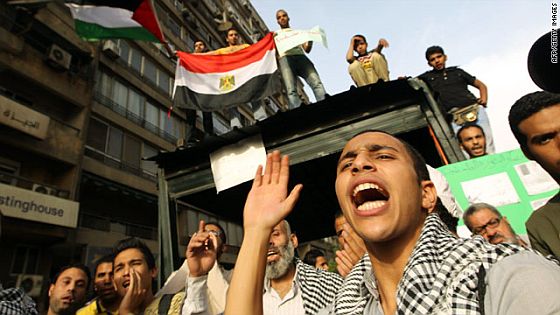
The Israeli embassy in Cairo is tucked away on the top two levels of a twenty-one-floor residential tower ten minutes from Tahrir. It is flanked by graying buildings and a usually traffic-clogged bridge. Nearby are Cairo University and the National Zoo. In the past, its busy location served it well; it was inconspicuous, and under Mubarak, the security around the building was so tight that even reaching the barricades surrounding it felt like a feat. In one of the more revealing signs of change in the New Egypt, however, it has now become the focus of the public’s attention and the site of unobstructed demonstrations.

On August 18, when Israeli forces opened fire in the direction of Egypt’s border, killing five conscripts, hundreds of angered Egyptians spontaneously marched to the embassy in protest. The Israeli shooting had been triggered by an attack on two buses heading from Bersheeba to Eilat; Israeli authorities alleged that the fleeing assailants were Palestinians who had taken advantage of the security vacuum that has emerged in Egypt since the revolution to infiltrate Israeli territory from Gaza via the Sinai. The protesters were outraged; both at the “accidental” killing of the soldiers, and at the implication that it was Egypt’s fault. The army was swift to deploy additional force to protect the already high-security embassy when the news broke, and alongside the usual concrete barricades and corrugated metal shields, there were now tanks, riot police, and rows of armed soldiers. “Give us your guns and send us to Sinai,” the protesters shouted at them. “The blood of our soldiers will not be in vain. Egyptian blood is not cheap.” The soldiers simply stood by.

With Mubarak now gone, many of his business cronies (including his close friend Hussein Salem, who orchestrated the gas deal) behind bars, and the nation in the grips of a new kind of nationalism, the question of what will become of relations with Israel has become critical. For the ruling Military Council, adhering to Camp David comes at a cost, but until it finds a better alternative—one that includes strategic training, resources, and intelligence support, as well as regional security guarantees—it is worth the price.

But for all the major contenders for Egypt’s new civilian leadership—including both secular and Islamist candidates—the status quo is as intolerable as Mubarak himself. Indeed, since the fall of Mubarak, almost every political question—from the referendum and the rules for forming parties to the new constitution—has been controversial and divisive. Yet on the Israel issue there has been a wide consensus. In front of the Israeli embassy last week, westernized, English-speaking activists stood side-by-side with Salafis, Muslim Brothers, working class Egyptians, and educated elite. As someone pointed out, this was a “mini-Tahrir.”

On August 20, even as the government was figuring out its own response to the killings, a group of political parties and presidential hopefuls met at the headquarters of the Islamist Al-Wasat party to discuss “how to handle the Israeli question.” The coalition was not only Islamist: it included Amr Moussa, Ayman Nour, Hisham Al-Bastawisi, George Ishaq, and representatives of the Al-Wafd, Al-Ghad, El-Hadara, El-Asala and El-Nahda Parties. After the meeting, the group announced that the Mubarak regime, which was a “strategic treasure” to Israel, is gone forever. “It has been replaced by a strong nation that doesn’t know weakness and knows how to get justice for the blood of its martyrs. In the face of this crime, the Egyptians have united across ideologies, political parties, police and army and put aside their differences for the sake of the nation.” The coalition announced a list of eight demands to be handed to SCAF. They include banning Israeli naval forces from passing through the Suez Canal, raising Egyptian armed forces presence in Sinai, and reconsidering the gas deal.

Government sources have since told me that SCAF and the interim cabinet are being “forced to seriously consider” public demands to reset its Israel policies and that “discussions are taking place.” Troop allowances in the Sinai are likely to be where the interim government presses for change, as well as re-examining the controversial gas deal. “What the Egyptian public wants is important, but many of the demands are too drastic—they would escalate a situation in ways nobody would want,” Major-General Badin told me by phone last week.

The Israeli embassy sit-in was suspended on August 27, one day after a “million man march” in which 8,000-odd protesters demonstrated in Cairo, Alexandria, and governorates across Egypt. Although the Israeli ambassador was not asked to leave and the Egyptian envoy to Israeli was not recalled, the protesters could claim a few successes. The Israelis had issued several statements of apology and regret, a joint investigation had reportedly begun, more Egyptian troops would be allowed into the Sinai’s Zone C (an area on the eastern border of Sinai where only limited and light-armed Egyptian police presence is allowed according to Camp David).

Perhaps most significantly (and despite general Badin’s insistence that it wouldn’t) the flag over the Israeli embassy had in fact been removed: a young Egyptian, Ahmad El-Shahat scaled the 21-story building and brought it down on the night of August 21, replacing it with an Egyptian one. The “Flagman,” as he came to be known, instantly became a national hero. Hamdeen Sabahi, the presidential hopeful and head of the Karama party, sent “a salute of pride to Ahmad El-Shahat, the public hero who burned the Zionist flag that spoiled the Egyptian air for 30 years.” The governor of Sharqiya, just east of Cairo, honored Shahat with an apartment and job. Across the Arab world too, he was hailed. For seven days, the army left the Egyptian flag on the building, but foreign ministry officials were quick to tell me that “it won’t last. The army is letting the protesters vent steam. Give it a week, the [Israeli] flag will be up again.”

On August 29, at 2:37 PM, it happened. A middle-aged man stuck his head out of the window of the Israeli embassy building’s twentieth floor, scanned the streets and bridge and horizon for possible protesters, and when the coast seemed clear replaced the by-then tattered Egyptian flag with a crisp new Israeli one. A security guard at a building next door who witnessed it said it took about seven minutes. It took about half that time for the news to spread. On Twitter and Facebook, Egyptians quickly started calling for El-Shahat to return to the embassy. “Get that damn flag down,” someone tweeted.

Facebooktwittermail

Do the Gaddafis hope to take refuge in Israel?

As Hosni Mubarak approaches the end of his life inside a prison cell in Egypt, he might be having second thoughts about his decision to turn down an offer of asylum that came from Israel a few months ago.

The idea that Israel has some affection for Arab tyrants might have something to do with a story about the Gaddafis that now emerges from an interesting source.

The Associated Press reports:

An Austrian politician says one of Muammar Gadhafi’s sons told him Libya was ready to sign a peace treaty with Israel once the fighting in his country ended.

David Lasar also said Thursday that Seif al-Islam, Gadhafi’s longtime heir apparent, also told him he was ready to act as a middleman to secure the release of an Israel soldier held for more than four years by Hamas, the Palestinian faction controlling Gaza.

Lasar, a Vienna municipal political with the rightist Freedom Party, was in Libya last month on a trip coordinated between his party and Ayoub Kara, an Israeli deputy minister.

Lasar is Jewish, while Kara is a Druze, and both occasionally assume positions and take on missions that are unusual for their government or party.

In July, Der Spiegel reported on the growing ties between the far right in Israel and the far right in Europe — in spite of the latter’s long history of antisemitism.

The partners that the European right-wing has sought out in Israel are, perhaps not surprisingly, well to the right of center. Kara himself, a member of the minority Druze religious community who enjoys close ties with Netanyahu, opposed the Israeli withdrawal from the Gaza Strip and is a loyal supporter of Jewish settlements in the West Bank. Gershon Mesika, a settler leader in the West Bank, received the populist delegation in December. Hillel Weiss and David Ha’ivri, both proponents of “neo-Zionism,” a movement which holds the belief that it is impossible to live in peace with Arabs, traveled to Germany last April for a conference hosted by the small, German right-wing populist movement Pro-NRW.

Their hope is that a pan-European platform will begin to emerge that values Israel as an important bastion in resisting the advancing tide of Islam. And they think, with the populist right making electoral gains across Europe in recent years, the smart bet is on Strache and Co [that being Heinz-Christian Strache and his Freedom Party of Austria (FPÖ)].

“The reasonable right parties have their roots at home. The Germans in Germany, the Swedes in Sweden and so on,” says David Lasar, a member of the Vienna city government for the FPÖ. “I think that Israel is also a country that says this is our homeland and we can’t open the borders and let everyone in as happened in Europe. That is a reason that Israel today has more trust in the right-wing parties in Europe than in the left-wing parties.”

Lasar himself is Jewish and is one of the key players in ongoing efforts to tighten relations between Israel and the Europeans. And his view on Israel is one which would seem to be at odds with his party’s past positions on the Middle East. Whereas Lasar is skeptical of peace negotiations which would require Israel to give up East Jerusalem or to withdraw from the settlements, the FPÖ has traditionally been allied with Arab leaders such as Moammar Gadhafi and remained skeptical of America’s hard-line position on Iran.

That, though, Strache made clear, is changing. “There are areas where we Europeans cannot sleep, where we can’t remain silent,” says Strache. “Israel is in danger of being destroyed. Were that to happen, it would also result in Europe losing its foundation for existence.”

So how do the Gaddafis fit into this picture?

The FPÖ, one of several right-wing populist parties gaining in popularity across Europe, is viewed with distaste by many for its strident opposition to Austria’s Muslim immigrant population. The party is also deeply skeptical of the European Union and efforts to prop up the common currency. Many see the FPÖ and its right-wing allies across the Continent as being too close to the extreme right wing for comfort.

But it is also no secret that Strache’s party has long had close ties to the Gadhafi clan. Former FPÖ leader Jörg Haider became friendly with Gadhafi’s second-oldest son, Saif al-Islam Gadhafi, when the Libyan was studying in Vienna in the 1990s. Haider visited Tripoli for the first time in 1999 and returned several times thereafter, getting to know Moammar Gadhafi in the process.

Following an internal party spat, Haider split off from the FPÖ in 2005 and founded the Alliance for the Future of Austria (BZÖ). And in 2008, the right-wing leader died in a car accident.

The two parties rejoined forces soon thereafter and the FPÖ, Strache said, has maintained relations with the Gadhafi clan.

So why is this story coming out now about Saif al-Islam claiming Libya was ready to sign a peace treaty with Israel and also negotiate the release of Gilad Shalit? None of the Gaddafi family seems well-placed right now for taking major initiatives in international diplomacy.

On the other hand, if they don’t want to suffer the same fate as Mubarak, maybe the possibility of asylum in Israel looks quite attractive to the Gaddafis, so it wouldn’t be a bad time to burnish their image as Zionist-friendly peacemakers.

Facebooktwittermail

Turkey expels Israeli diplomats, suspends military ties after UN report

Today’s Zaman reports:

In the face of a leaked United Nations panel report on the Mavi Marmara incident, which includes accusations both against Israel and Turkey, Turkey on Friday announced that it is further reducing diplomatic relations and cutting military ties with Israel over the country’s refusal to apologize for last year’s deadly raid on a Gaza-bound flotilla.

The decision effectively expels Israeli diplomats in Turkey.

“The time has come for Israel to pay for its stance that sees it above international laws and disregards human conscience,” Foreign Minister Ahmet Davutoğlu said at a press conference in Ankara. “The first and foremost result is that Israel is going to be devoid of Turkey’s friendship.”

Davutoğlu said the UN report “displayed the violence committed by the Israeli soldiers,” but also criticized it for describing Israel’s naval blockade as a legitimate security measure and in line with international law.

He stated that Turkey is downgrading its diplomatic representation in Israel from charge d’affaires to the level of second secretary, suspending all military agreements with Israel, and that Turkey will, as the country with the longest coastal line in the eastern Mediterranean, take necessary measures pertaining to freedom of navigation, lend full support to the victims of the flotilla incident in their legal efforts to seek their rights and will seek a review of the Israeli blockade of Gaza by the International Court of Justice (ICC) as Turkey does not recognize the blockade.

Haaretz reports:

Speaking to reporters in Istanbul later Friday, [Turkish President Abduallah] Gul said that Israel apparently “did not understand how determined Turkey was to show it has not forgotten the events of the past,” adding that Turkey “would always defend our citizens’ rights,” saying that the “steps announced today were just the first phase.”

“In accordance with Israel’s stance, it is possible that more steps may come in the future,” the Turkish president added, saying of the UN’s Gaza flotilla report that “as far as we’re concerned that reports doesn’t exist.”

Gul also said that Turkey had considered to sanction Israel for its refusal to apologize sooner, but instead waited since it wanted to “give some of our good-willed allies the opportunity to end the crisis.”

The Jerusalem Post reports on how at least one member of Israel’s Knesset has become so incensed by Turkey’s response to the killing of its own citizens, that he imagines the Obama administration might be willing to include Turkey in the “axis of evil”! Dream on Danny!

Following a Turkish ultimatum warning Israel to apologize for the raid of the Mavi Marmara or face snactions, Likud MK Danny Danon on Thursday sent a letter to US Secretary of State Hillary Clinton calling on Washington to declare Turkey a “terror-supporting state.”

“Turkey has gotten closer to Iran and constitutes a direct continuation of the axis of evil. The government in Washington must answer the Turkish problem before it is too late,” Danon wrote.

Danon called for economic and diplomatic sanctions against Turkey until Ankara changes its ways and abandons the way of terror.

“The Turks have crossed the line. They supported the flotilla, they support terror and they dare to ask Israel to apologize to them,” Danon stated in response to the ultimatum.

Danon’s views are not shared by all members of the Knesset. Haaretz reports:

In response to the Turkish announcement, two of the Knesset’s leading Israeli Arab voices later Friday voiced support of the decision to expel the Israeli envoy to Ankara, with United Arab List-Ta’al chairman Ahmed Tibi saying that “these days, whoever kills pays,” adding that “eventually, Israeli arrogance will lead to an apology by the most extreme and arrogant of Israel’s governments.”

“In Turkey, the blood of those killed can be heard screaming from the soil and from the sea,” Tibi added.

Balad MK, and flotilla participant, MK Hanin Zuabi called the Turkish decision a “strong and dramatic move, but it is the “right response to a continued disregard of human life, of the pride of the nations of the regions, and of the sovereignty of neighboring states.”

“Turkey will not be the last country to put an end to Israeli arrogance and aggressiveness,” Zuabi added. The Israeli Arab MK also tied the recent wave of Israeli social protest with the Turkish move, saying that “just as Israelis are beginning to seriously consider a new social order, they must also consider a new diplomatic order in which Israel will pay a heavy price for its policy of oppression, occupation, and belligerence.”

Facebooktwittermail

How Israel got away with murder on the Mavi Marmara

The long-delayed and long-awaited UN report [PDF] on the Mavi Marmara massacre has finally been released by the New York Times.

I guess the newspaper feels a responsibility that it should spin this as much in Israel’s favor as possible before the report get’s officially released.

“Report Finds Naval Blockade by Israel Legal but Faults Raid,” says the headline. The siege is OK. Executing unarmed activists is not OK.

“Israel considers the report to be a rare vindication for it in the United Nations,” we are told.

There are a few unpleasant pesky detail however. Go all the way down to paragraph seventeen of the Times article and we learn:

The report assailed Israel for the way in which the nine were killed and others injured. “Forensic evidence showing that most of the deceased were shot multiple times, including in the back, or at close range has not been adequately accounted for in the material presented by Israel,” it says. The report does, however, acknowledge that once on board the commandos had to defend themselves against violent attack. The report also criticizes Israel’s subsequent treatment of passengers, saying it “included physical mistreatment, harassment and intimidation, unjustified confiscation of belongings and the denial of timely consular assistance.”

Like so many elements of the Israeli-Palestinian conflict, the events on the Mavi Marmara produced two fiercely competing narratives, each full of self-justification and contempt for the other.

And couldn’t we move forward so much more easily if it wasn’t for those fiercely competing narratives.

But just a minute. The panel — even if it’s conclusion amounted to saying, can’t you all just learn to get along — did actually note that Israel provided no information whatsoever on the circumstances in which nine men were killed. And had those deaths not occurred, there would have been no inquiry.

Let’s repeat that. After nine men were killed on board the Mavi Marmara on May 31, 2010, and the United Nations conducted a commission of inquiry into this incident, Israel provided no information whatsoever on the circumstances in which each of these deaths occurred.

The Israeli Point of Contact sought to explain to the Panel that the chaotic circumstances of the situation, made it “difficult to identify specific incidents described by soldiers as related to a specific casualty from among the nine activists who died during the takeover.” This is greatly to be regretted.

Indeed — especially since the evidence — bullets shot between the eyes or in the back of the head — strongly suggests that several of these deaths involved cool calculation. In other words, these were execution-style killings.

These are the descriptions of deaths about which the UN panel regrets Israel could offer no further information:

In the Panel’s view the following facts are of particular concern and have not been adequately answered in the material provided by Israel. Although the Israeli Point of Contact provided a general response to these points, he was unable to provide the Panel with more detailed information, particularly with respect to the death of the passenger described below:

  • Seven of the nine persons killed received multiple gunshot wounds to critical regions of the body: Ali Bengi, Cengiz Akyüz, Çetin Topçuoğlu, Fahri Yaldız, Furkan Doğan, İbrahim Bilgen and Necdet Yıldırım.
  • Five of those killed had bullet wounds indicating they had been shot from behind: Cengiz Akyüz, Çetin Topçuoğlu, Necdet Yıldırım, Furkan Doğan and İbrahim Bilgen. This last group included three with bullet wounds to the back of the head: Cengiz Akyüz, Çetin Topçuoğlu and Furkan Doğan. İbrahim Bilgen was killed by a shot to the right temple.
  • Two people were killed by a single bullet wound: Cevdet Kılıçlar was killed by a single shot between the eyes; and Cengiz Songür was killed by a shot to the base of the throat.
  • At least one of those killed, Furkan Doğan, was shot at extremely close range. Mr. Doğan sustained wounds to the face, back of the skull, back and left leg. That suggests he may already have been lying wounded when the fatal shot was delivered, as suggested by witness accounts to that effect.
  • No evidence has been provided to establish that any of the deceased were armed with lethal weapons. Video footage shows one passenger holding only an open fire hose being killed by a single shot to the head or throat fired from a speedboat.
Facebooktwittermail

Language becomes a political weapon in Israel

Mya Guarnieri writes:

Speaking to the US congress in May, Israeli Prime Minister Benyamin Netanyahu boasted that his country is a beacon of freedom in the Middle East and North Africa, that it is the only place where Arabs “enjoy real democratic rights”.

It’s true that Palestinian citizens of Israel have some democratic rights, like the vote. But, as Netanyahu told congress: the “path of liberty is not paved by elections alone.” And the summer months have seen an acceleration of worrisome anti-democratic trends.

First, the Knesset passed the anti-boycott law, a move that was widely condemned as a strike against free speech and democracy. Even some of Israel’s staunchest supporters expressed concern.

Now lawmakers have introduced a bill that proposes to change the definition of Israel as “Jewish and democratic” to “the national home of the Jewish people”.

If passed, the legislation would become part of Israel’s Basic Laws, which are used as a working constitution.

Whenever a conflict between democracy and Jewish values arises, the new definition of Israel would allow courts and legislators to favour the latter. According to Haaretz, the proposed bill will also make halacha, Jewish religious law, “a source of inspiration to the legislature and the courts”. And, in the spirit of favouring the Jewish character of the state over a state for all its citizens, the legislation would also downgrade Arabic from an official language to one with “special status”.

Arabic is the mother tongue of 20 per cent of Israel’s citizens. It has been an official language of the land since 1924, when the British mandate set three: English, Hebrew, and Arabic.

Facebooktwittermail

Turkish FM: No more delays for UN report on Israel

Today’s Zaman reports:

Ankara has refused to comply with Israel’s request seeking a delay of the UN report on the Mavi Marmara flotilla raid for another six months, reportedly designed to cut Israeli Prime Minister Benjamin Netanyahu some slack until he gets more political backing at home in Israel.

“It is not remotely possible for us to agree to a six-month delay,” said Turkish Foreign Minister Ahmet Davutoğlu from Sarajevo, where he was visiting as part of his tour of the Balkans during Eid al-Fitr. “For us the deadline [for the formal apology from Israeli officials] is the day the UN report gets released, or we resort to Plan B,” said the minister without further elaborating on what might constitute the premises of the alternative “B” route.

The UN-led Palmer Report, initially expected to be released in February 2011, has already seen multiple delays that Turkish officials blame on Israeli leaders who have taken one step forward and two steps back on the issue of an apology and compensation demanded by Turkey in the aftermath of the Mavi Marmara raid that brought about a diplomatic crisis between the two countries.

Although not conclusively determined, the UN report is expected to be released by UN Secretary-General Ban Ki-moon some time in early September and shed light on the investigation carried out concerning the deadly flotilla raid that is the reason of the year-long impasse between the old allies in the region.

Facebooktwittermail

Is BDS campaign working?

Ynet reports:

Many Israeli agricultural products have been recently targeted by the Israel boycott campaign: tomatoes, peppers, citrus fruit, carrots, melons, strawberries and celery. But the flowers have been the primary obsession of the divestment movement, which wants to strangle the Israeli economy.

Agrexco, Israel’s leading flower exporter, has recently declared bankruptcy, partially due to the global boycott of its produce, according to some reports. More than 20 organizations in Europe in 13 countries endorsed a boycott of Agrexco.

International pressure, boycotts and sanctions on South Africa’s apartheid government played a major role in ending its power. Modeled on that global campaign, the anti-Israel boycott movement has notched notable victories of late, while making use of an old Marxist lexicon (“imperialism,” “colonialism,” “occupation,” and “settler society”).

The first symbol of the anti-Israel economic campaign, Caterpillar, was far removed from the Western public consciousness. Yet Israeli roses were a better Jewish scapegoat, as flowers are a pillar of Israel’s economy (in the 1980s Israel became the world’s number two flower exporter. Agrexco was boycotted because it’s partially owned by the Israeli government and because the company has some farms in the Jordan Valley and in Tekoa, a settlement at the gates of the Judean desert.

Facebooktwittermail

Israel’s social protest leaders mull pulling up stakes after ‘march of million’ rally

Haaretz reports:

Social protest leaders are starting to discuss what to do about the tent camps scattered around the country once the summer’s demonstrations come to a head with the “march of the million” scheduled for Saturday night.

They are considering a call to dismantle the tent cities after the march, which will include a mass rally at Tel Aviv’s Kikar Hamedina. The leaders noted, however, that local activists may well ignore such a call and keep the camps standing. Moreover, there are many homeless people in the camps who have nowhere else to go.

The tent element of the protests has been waning. On Tel Aviv’s Rothschild Boulevard, many of the tents stand empty. There are no longer activities, lectures and debates there, and at night the street is often quiet.

Although complaints from area residents have been piling up at city halls across the country, local authorities have made very few moves to take down tent cities.

Facebooktwittermail

On Israel, the New York Times is perniciously one-sided

At Adbusters, Matthew A. Taylor writes:

Although the spin is hard to detect for the average reader, New York Times reportage of Middle East affairs is perniciously biased. In their seminal book, Israel-Palestine on Record: How the New York Times Misreports Conflict in the Middle East, Princeton professor Richard Falk and media critic Howard Friel argue that “the Times regularly ignores or under-reports a multitude of critical legal issues pertaining to Israel’s policies, including Israel’s expropriation and settlement of Palestinian land, the two-tier system of laws based on national origin evocative of South Africa’s apartheid regime, the demolition of Palestinian homes, and use of deadly force against Palestinians.” In other words, what is not said by the New York Times may be even more important than what is said.

In June of 2010, a year and a half after the Israeli military launched what a United Nations investigation described as “a deliberately disproportionate attack designed to punish, humiliate and terrorize a civilian population,” the New York Times sent a photographer into Gaza to capture a slice of daily life. Ethan Bronner, the Times Jerusalem bureau chief, wrote the narrative for the photo essay entitled “Gaza, Through Fresh Eyes,” in which he gushes about “jazzy cellphone stores and pricey restaurants … endless beaches with children whooping it up … the staggering quality of the very ordinary.” Seemingly lifted from an apolitical travel magazine, Bronner’s article merely alludes to families who have been “traumatized,” and omits any mention of the UN allegations of recently committed Israeli war crimes and human rights violations. Other than an oblique reference to “destroyed buildings” and “rubble,” Bronner’s travelogue also elides the vast civilian infrastructure Israel destroyed during the onslaught, including chicken farms, a flour mill, a sewage treatment plant, a UN school, vast tracts of civilian housing, government buildings, a prison, police stations, TV stations, newspapers … and between 600 and 700 factories, workshops and businesses. The impression left by Bronner? Gaza is an OK place; nothing remarkable to see there, least of all evidence of Israeli war crimes; move along, move along.

(H/t Mondoweiss)

Facebooktwittermail

New Palestinian strategy document will make it difficult for U.S. to oppose UN vote

Akiva Eldar writes:

Prime Minister Benjamin Netanyahu is probably aware that when it comes to a media event, like a speech at the UN General Assembly, President Shimon Peres doesn’t have to be asked twice to sacrifice himself for the nation. Someone who has been watching the honorable president for decades once told me that Peres is blessed with a unique characteristic: He always knows how to adjust reality according to his needs at the time.

So Peres will easily be able to convince himself that the nation ‏(if not the entire universe‏) is demanding that he travel to New York next month to represent the prime minister at the assembly declaring a Palestinian state. But this time Peres is expected to face opposition from close associates.

“How can Peres promise the world that Netanyahu has accepted the two-state solution based on the 1967 borders when he himself has long since lost his faith in Netanyahu’s intention of reaching such an agreement?” asked one of them. The source adds, “Can the president repeat the words he said in the spring of 2009 at the AIPAC conference in Washington, to the effect that Netanyahu wants to make history and peace is his primary interest?”

It’s true that Netanyahu is making history. On his watch the UN General Assembly is expected to recognize an independent Palestinian state by a huge majority. The wording of the draft, crafted in recent days by the Fatah leadership, is designed to enable even “problematic” countries such as Germany, Italy, the Netherlands and the Czech Republic to climb on board, or at least abstain.

This version will make it difficult for the United States and the Marshall Islands, and even for Israel, to explain their votes against the proposal. Instead of recognizing Palestine within the 1967 borders, it will state that the permanent borders will be determined in negotiations with Israel based on the borders of June 4, 1967. This approach made it possible to enlist the support of leading moderates in Hamas, who claim that recognition of the 1967 borders before the signing of a final-status deal means waiving the claim to the right of return.

Several of those people are signatories to a new strategic position paper, drafted by more than 50 Palestinian government officials, researchers and advisers − members of the Palestine Strategy Group. This is the forum that in 2008 composed a document recommending that the leadership transfer the conflict to the United Nations.

The new document presents the Palestinian strategy both before and after the UN vote.

Among the participants in the group’s workshops over the past year in Jericho, Gaza and Istanbul were Omar Abdel Razek, the former finance minister in the Hamas government in the West Bank, and Nasser al-Shaer, that government’s education minister. Next to them sat senior Fatah officials including associates of Palestinian President Mahmoud Abbas − former Foreign Minister Nabil Shaath and senior adviser Mohammad Shtayyeh. Other signatories are Naser al-Kidwa, a former Palestinian observer at the United Nations, Fatah Deputy Secretary General and Communications Minister Sabri Saydam, and former economics minister and businessman Mazen Sinokrot.

Already in the preface, the authors stress that “strategic unity,” now greatly enhanced by the reconciliation process, is a key condition for putting together an effective strategy. The document’s starting point: Given the Israeli government’s intransigence, the option of settling the conflict via bilateral negotiations − the path pursued by the Palestinian leadership for 20 years − is no longer available.

Most of the document’s authors support the option of an independent Palestinian state within the 1967 borders, with Jerusalem as its capital and a fair arrangement that will fulfill the right of return and the compensation of the Palestinian refugees. The document rejects the possibility of continuing the status quo, maintaining that the endless negotiations provide cover for expanding the settlements and consolidating the occupation. The authors also erase from the agenda the option of a Palestinian state with temporary borders and limited sovereignty, under effective Israeli control.

If the strategy of a diplomatic struggle for Palestinian independence − including sanctions, turning to the International Criminal Court and nonviolent resistance as in Egypt and Tunisia − does not change the situation, the group recommends switching to what the document calls Plan B: dismantling the Palestinian Authority and restoring responsibility for the West Bank’s inhabitants to Israel. The authors are not ignoring the price their public would pay for that, but wonder what honorable option would remain.

If it turns out that this option is unattainable, the authors recommend working toward a model of a binational state or democratic state without distinction between Israel and Palestinian citizens. Another possibility is a confederation between Jordan and the Palestinian state.

The authors recommend explaining to the Israelis that they must forget the plan for unilateral withdrawal from the West Bank, with restrictions on the movement of Palestinians, and the dream of annexing Gaza to Egypt and the West Bank to Jordan.

They hope their neighbors will understand that the realistic alternatives to a genuine negotiated settlement will be far worse for Israel’s security.

Most participants in the workshops rejected an armed struggle against a foreign occupation and especially the use of violence against civilians. But the authors warn that a change in strategy from an attempt to achieve political independence to a conflict like the anti-apartheid struggle in South Africa will play into the hands of extremists in the region.

“Should this happen, not just Israel’s legitimacy will be under threat, but its very existence, ” they conclude. “And this will have been brought about by Israel itself.”

Facebooktwittermail