Category Archives: Lands

The U.S. and Russia are fighting about missile defense when they should be settling differences

Fred Kaplan writes: The Standard Missile 3, or SM-3 as it’s called, is purely defensive; it works not by blowing up a missile in midair but by slamming into it with great force; in other words, it couldn’t be turned into an offensive weapon, even if some future Western leader wanted it to be.

But from Russia’s point of view, that’s not the issue. As one military adage has it, the only purely defensive weapon is a foxhole, and a battery of antimissile missiles doesn’t change this fact. In the odd world of nuclear strategy, a nation deters an attack by posing a credible threat of “retaliation in kind.” Side A attacks Side B; Side B strikes back against Side A; therefore, Side A doesn’t attack in the first place. But imagine that Side A has an effective missile-defense system. Side A attacks Side B; Side B strikes back, but most of its missiles get shot down before reaching their targets; therefore, Side B is unable to “retaliate in kind.” Both sides do the calculation and understand the strategic imbalance, and therefore (so goes the theory), Side A dominates Side B — intimidates it into doing certain things in A’s favor — without having to go to war.

This is why Russian officials see missile defense systems as a threat. It’s a concept they learned from the Americans. In the 1950s and early ’60s, many American nuclear strategists, notably Herman Kahn, author of the best-seller On Thermonuclear War, advocated anti-ballistic-missile systems as an explicit adjunct to an offensive first-strike strategy: The U.S. launches a nuclear attack on the USSR; the USSR strikes back with the few nuclear missiles that survived the first strike; the U.S. shoots them down with its antimissile missiles. Or, more to the point, the U.S. has the capability to do these things — which puts the U.S. in a dominant position in international confrontations.

In the mid-1960s, when Secretary of Defense Robert McNamara proposed a treaty banning anti-ballistic missiles in the United States and Soviet Union, some Russian officials were puzzled: Why ban defensive weapons, they asked? McNamara schooled them on nuclear strategy; he essentially wanted to avoid the destabilizing situation that Herman Kahn wanted to foster and exploit. The Russians learned the lesson. [Continue reading…]


Facebooktwittermail

Cavorting with extremism: UK cracks down at home, befriends extremists abroad

By Brian Whitaker, May 18, 2016

Today Queen Elizabeth will deliver her annual speech to the British parliament setting out the government’s programme for the next 12 months. High on the list of proposals is a renewed effort to combat “extremism”, and one idea is to establish a register of “extremists” – similar to the register of sex offenders – intended “to stop radicals infiltrating schools, colleges, charities and care homes, where they could brainwash vulnerable young people or disabled adults into violence”.

The problem with this, as with the rest of the government’s “counter-extremism” policy, is how to define “extremism”. In a recent article for The Independent, Liberal Democrat MP Alistair Carmichael explained:

“The [government’s] current definition of extremism as ‘the vocal or active opposition to our fundamental values, including democracy, the rule of law, individual liberty and the mutual respect and tolerance of different faiths and beliefs’ is drafted so widely that it will not only catch terrorist sympathisers but perhaps even those who oppose the government, believe the monarchy should be abolished or disagree with same-sex marriage.”

But the problem goes deeper than that. Last Sunday a spectacular event featuring TV celebrities and 900 horses was held at Windsor Castle to mark the Queen’s 90th birthday. The royal family were in attendance and, seated at the Queen’s right-hand side was a man who by any reasonable interpretation of the government’s definition would be considered an extremist: the king of Bahrain.

Continue reading

Facebooktwittermail

‘Brexit’ vote worries European immigrants living in Britain

The New York Times reports: For years, Britain’s relatively vibrant economy has attracted a steady flow of young people fleeing a lack of opportunity in their home countries on the Continent. London in particular is full of young Europeans, who have helped give the city its dynamic, global feel. From entrepreneurs, bankers and fashion designers to artists, waiters and students, all are free to resettle in Britain and make their futures here without so much as a visa.

No one knows for sure what would happen to them if Britain voted to leave the European Union — their immigration status would have to be worked out in the negotiations that would follow — but the debate itself has left some of the young people feeling fearful, frustrated and even angry.

“Maybe I’m too much of a drama queen, but I feel that it’s such a bold statement against immigrants and Europeans,” said Alejandro Macías, 31, a Spaniard who lived in Germany before moving to Britain to work in an audience research company.

If Britain votes out, three-quarters of citizens from other European Union countries who are working in the country would not meet current visa requirements for overseas workers, according to a report by the Migration Observatory at Oxford University. The impact would be greatest for workers in agriculture and the hospitality industry, it said.

There are concerns that London in particular would suffer if the flow of skilled immigrants fell. About a million European Union citizens from other countries work in London, a city of more than 8.5 million people. [Continue reading…]

Facebooktwittermail

The map ISIS hates

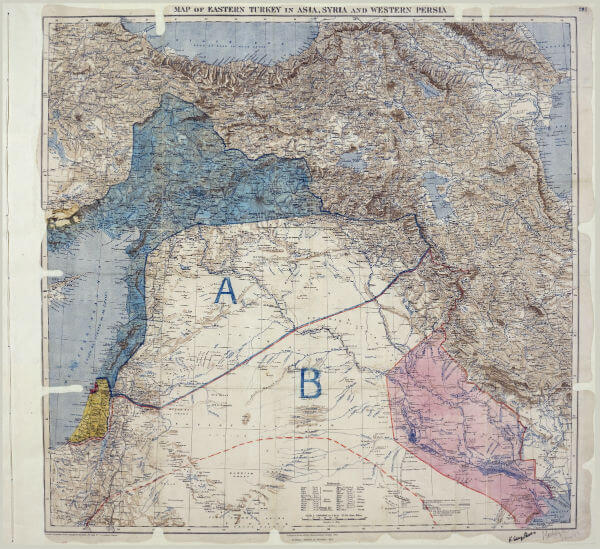
sykes-picot

In 2014, Malise Ruthven wrote: When the jihadists of ISIS (the Islamic State of Iraq and Syria) tweeted pictures of a bulldozer crashing through the earthen barrier that forms part of the frontier between Syria and Iraq, they announced — triumphantly — that they were destroying the “Sykes-Picot” border. The reference to a 1916 Franco-British agreement about the Middle East may seem puzzling, coming from a radical group fighting a brutal ethnic and religious insurgency against Bashar al-Assad’s Syria and Nouri al-Maliki’s Iraq. But jihadist groups have long drawn on a fertile historical imagination, and old grievances about the West in particular.

This symbolic action by ISIS fighters against a century-old imperial carve-up shows the extent to which one of the most radical groups fighting in the Middle East today is nurtured by the myth of precolonial innocence, when the Ottoman Empire and Sunni Islam ruled over an unbroken realm from North Africa to the Persian Gulf and the Shias knew their place. (Indeed, the Arabic name of ISIS — al-Dawla al-Islamiya fil-Iraq wa al-Sham — refers to a historic idea of the greater Levant (al-Sham) that transcends the region’s modern, Western-imposed state borders.)

But why is Sykes-Picot so important? One reason is that it stands near the beginning of what many Arabs view as a sequence of Western betrayals spanning from the dismantling of the Ottoman Empire in World War I to the establishment of Israel in 1948 and the 2003 invasion of Iraq. The Sykes-Picot agreement — named after the British and French diplomats who signed it — was entered in secret, with Russia’s assent, in May 1916 to divide the Arab provinces of the Ottoman Empire into British and French “spheres of influence.” It designated each power’s areas of future control in the event of victory by the Triple Entente over Germany, Austria, and their Ottoman ally. Under the agreement Britain was allocated the coastal strip between the Mediterranean and the river Jordan, Transjordan and southern Iraq, with enclaves including the ports of Haifa and Acre, while France was allocated south-eastern Turkey, northern Iraq, all of Syria and Lebanon. Russia was to get Istanbul, the Dardanelles, and the Ottoman Empire’s Armenian districts.

Under the 1920 San Remo agreement, which built on Sykes-Picot, the Western powers were free to decide on state boundaries within these areas. The international frontiers — with Iraq’s framed by the merging of the three Ottoman vilayets of Mosul, Baghdad, and Basra — were consolidated by the separate mandates granted by the League of Nations to France in Lebanon and Syria, and to Britain in Palestine, Transjordan, and Iraq. The frontier between French-controlled Syria and British-controlled Iraq included the desert of Anbar province that was bulldozed by ISIS this month.

Kept hidden for more than a year, the Anglo-French pact caused a furor when it was first revealed by the Bolsheviks after the 1917 Russian Revolution — with the Syrian Congress, convened in July 1919, demanding “the full freedom and independence that had been promised to us.” Not only did the agreement map out — unbeknownst to the Arab leaders of the time — a new system of Western control of local populations. It also directly contradicted the promise that Britain’s man in Cairo, Sir Henry McMahon, had made to the ruler of Mecca, the Sharif Hussein, that he would have an Arab kingdom in the event of Ottoman defeat. In fact, that promise itself, which had been conveyed in McMahon’s correspondence with the Sharif between July 1915 and January 1916, left ambiguous the borders of the future Arab state, and was later used to deny Arab control of Palestine. McMahon had excluded from the proposed Arab kingdom “portions of Syria lying to the west of the districts of Damascus, Homs, Hama and Aleppo [that] cannot be said to be purely Arab.” This clause led to lengthy and bitter debates as to whether Palestine — which Britain meanwhile promised as a homeland for Jews under the terms of the November 1917 Balfour Declaration — could be defined as lying “west” of the vilayet, or district, of Damascus. [Continue reading…]

Facebooktwittermail

For Twitter, ties to CIA create worse ‘optics’ than links to Russian government

L Gordon Crovitz writes: Silicon Valley’s hostility to U.S. intelligence and law enforcement reached a new low last week when Twitter rejected the Central Intelligence Agency as a customer for data based on its tweets — while continuing to serve an entity controlled by Vladimir Putin.

The Wall Street Journal broke the news that Twitter decided U.S. intelligence services could no longer buy services from Dataminr, which has a unique relationship with Twitter. Dataminr is the only company Twitter allows to have access to its full stream of hundreds of millions of daily tweets and sell the resulting intelligence to customers. Dataminr applies “big data” algorithms to identify unusual developments in real time. Customers who can profit from knowing about events instantly, such as hedge funds and news publishers, pay a hefty price for the alerts.

For the past two years, Dataminr provided its service to the CIA under a pilot program. The CIA and Dataminr then negotiated a contract to continue the service, but sources say Twitter CEO Jack Dorsey vetoed the contract at the last minute because he objects to the “optics” of continuing to help intelligence agencies. It’s unclear what happens to a small agreement Dataminr previously made with the Department of Homeland Security. With the new policy dictated by Twitter, Dataminr should drop the claim on its website that it includes “clients in the public sector, providing information first when there are lives at stake.”

Among the customers still getting the Dataminr alerts is RT, the broadcaster created and funded by the Russian government. Vladimir Putin has said that the government runs RT to “try to break the Anglo-Saxon monopoly on the global information streams.” RT disclosed it is a Dataminr customer in its news account of Twitter barring the CIA. Agents of Russia’s Federal Security Service, formerly known as the KGB, have full access via RT to the alerts now being denied to the CIA. [Continue reading…]

Facebooktwittermail

Why Putin tolerates corruption

Ivan Krastev writes: Russian elites have the right to be corrupt, but only if they have proved their loyalty. Paradoxically, the West’s sanctions against business figures closest to the Russian president helped whitewash some of the most notoriously corrupt Russian oligarchs and allow Russian propaganda to present them as selfless defenders of the motherland.

Ultimately, the most important reason for Mr. Putin’s reluctance to declare a war on corruption is that any anti-corruption campaign will inspire the public to demand change. It plays not only on the public’s anger, but also on its aspirations. And it is precisely this demand for change that the Kremlin fears most. Unlike in China, leaders in Russia avoid promising that life will be better tomorrow; what they promise is that things will not get worse. And unlike in China, they can afford to do so because the Russian economy is driven not by the entrepreneurial energy of the masses, but by natural resources.

This is why the Russian government is ready to acknowledge corruption’s ubiquity — the slickest propaganda couldn’t convince people otherwise. But the government also advances the idea that corruption is a way of life and is thus a natural phenomenon. In a way, corruption is like vodka: You know it hurts, but Russia is unimaginable without it. [Continue reading…]

Facebooktwittermail

Afghanistan’s ‘ghost soldiers’: Thousands enlisted to fight Taliban don’t exist

The Guardian reports: From about 8.30pm until well after midnight, the dark blue sky above Babaji lit up, as rockets and flares crisscrossed above this cluster of villages close to Helmand’s provincial capital, Lashkar Gah.

At a mud fortress beyond a river bridge painted in the tricolours of the Afghan flag, 24 members of the Afghan border police dug in. They were not supposed to be there.

“We were not trained to fight on the front line,” said Cpt Ghulam Wali Afghan, the commander, when the Guardian visited the post.

As their name suggests, Wali Afghan’s men are meant to protect Afghanistan’s porous border, where smugglers cross with copious drugs, weapons and people.

But seven months ago, the captain and 122 other ABP men were relocated to Babaji, some 300km from the frontier with Pakistan in an effort to bolster the defence against the Taliban, who continue to capture territory the international coalition spent years getting little more than a slippery grip on.

On their first day on the front line, three border police were killed, said Raz Mohammad, a soldier stationed in Babaji. “For two months, we had trouble getting to know the area,” he said.

The police eventually repelled the Taliban assault. But with the calm of the poppy harvest over, and the fighting season just beginning, it is unlikely that the ABP officers will return to the border anytime soon.

With an estimated 25,000 troops officially based in Helmand, the government should have enough muscle to confront the Taliban.

The problem is many of those troops don’t exist.

Across Afghanistan, lists of troops and police officers are filled with fake names, or the names of men killed in the fighting, but not officially declared dead. Captain Wali and his men are in Babaji to fill the void of these “ghost soldiers”.

A recent investigation by Helmand’s provincial council found that approximately 40% of enlisted troops did not exist. The authors of an analysis commissioned by the Afghan government – and obtained by the Guardian – said the share might be even higher. [Continue reading…]

Facebooktwittermail

French plan to hold Israel-Palestine conference postponed indefinitely

Middle East Eye reports: A conference on the peace process between Israelis and Palestinians, due to be held on 30 May in Paris, has been postponed, French President Francois Hollande said on Tuesday.

“[US Secretary of State] John Kerry cannot come on May 30 so it has been delayed. It will take place in the summer,” he told French radio.

Hollande said it was vital for France to take “a strong initiative” in the dispute.

“If not… what will happen? Settlement building, attacks,” he said.

The original date for the conference falls on the US Memorial Day holiday honouring members of the armed forces who died in combat.

“We’re in discussions right now with the French about any possible alternative date that might better work for the secretary,” State Department spokesman John Kirby said Monday, though he added that Kerry’s agenda is currently “jammed”.[Continue reading…]

Facebooktwittermail

In fight against Western decadence, Iranian prosecutor attacks ‘actions that run counter to the values of the establishment’

The New York Times reports: Iran’s judiciary unleashed one of its periodic crackdowns on social media permissiveness on Sunday, announcing the arrest of eight people involved in online modeling without a mandatory head scarf and questioning another woman, a former model, live on state television on Sunday.

A blogger, Mehdi Abutorabi, 53, who managed a publishing tool called Persian Blog, was also detained, the semiofficial student news agency ISNA reported Monday.

The former model, Elham Arab, 26, had been something of an Instagram star, posting pictures of herself in bridal gowns with eye-catching, dyed-blond hair. But on Sunday, months after her Instagram account had been shut down, she wore a pious black scarf and matching gloves as she was questioned by two prosecutors during a live television program.

In sharp contrast to the happy and glamorous images of herself posted online, Ms. Arab spoke of her “bitter experiences” in Iran’s technically illegal modeling industry and warned young women to think twice before posting pictures of themselves online. “You can be certain that no man would want to marry a model whose fame has come by losing her honor,” she said.

The head scarf issue often features prominently in the constant tug of war between powerful hard-liners and Iran’s increasingly urbanized and worldly society. Iran’s laws require that all women, even visiting foreigners, cover their hair out of a traditional respect for culture and morality. Many hard-liners view the obligatory veil as a last-ditch defense against what they say is an onslaught of Western cultural decadence.

But the main culprit was not Ms. Arab, Tehran’s public prosecutor, Abbas Jafar-Dolatabadi, concluded on the television program. No, the main offender was “the enemy,” Iran’s household label for the West and its unwanted influences.

“The enemy is investing in order to create a generation without any willpower,” the prosecutor said of social media. “We must refrain from any actions that run counter to the values of the establishment.” [Continue reading…]

IranWire reports: In March, Iran’s online authorities shut down the Instagram pages of several well-known models, as well as those of hair salons and photography workshops. In their place, online visitors found a large blue frame with the caption “These pages are blocked by the authority of Operation Spider 2 to open security cases by order of the judiciary.” They did not provide any details about the operation, which became known as “the spider attacks.”

Now, Dolatabadi has explained what the so-called “spider attacks” were all about. “In the past two years, a lot of good things have been done in the fight against hair salons and fashion workshops related to modeling,” he said. “In operations Spider 1 and Spider 2, around 50 hair salons, 50 fashion workshops, and 50 photography workshops were prosecuted. Individuals were arrested and pages were shut down by the supervisor of the Prosecution Office for Media Crimes.”

At the same time, the website Gerdab, which promotes news about Revolutionary Guards’ online activities, reported on what it called the successes of Operation Spider 2 over the past two years.

Gerdab’s report accused the “secret supporters and operators of Instagram” of attempting to subvert the “Islamic Iranian lifestyle.” It championed what it called an important achievement in combating “modeling and vulgarity.”

“The first phase resulted in the creation of an accurate database of more than 300 Instagram pages,” the report said, quoting the Organized Cyberspace Crimes Unit of the Revolutionary Guards. “The database is an intelligent collection of specifics about these pages such as postings, followers, those who are followed, the ‘likes,’ the comment writers, addresses of [account users on sites] such as Facebook, Line, and Telegram, and emails, phone numbers, addresses and bank account numbers.” [Continue reading…]

Facebooktwittermail

An aristocrat’s view of Beirut

Michael Specter writes: The Sursocks are among the oldest and richest of the Christian families in Lebanon. And at the age of 94, Lady Cochrane, a Sursock by birth, may be the last great dame of the Levant. Lucid and acerbic, she seems like a cross between the Dowager Countess of Grantham and one of the less savory Mitford sisters. We had tea late one afternoon in her library, which, because it is the “coziest” place in the house, also serves as her sitting room. (This particular cozy room has 33-foot ceilings and mahogany walls and enormous 17th-century paintings. A collection of Flemish tapestries lines the entrance vestibule and dining room.)

Lady Cochrane, dressed crisply in a brown blouse, silk salmon foulard and houndstooth skirt, met me in the middle of the great hall, which features a double flight of marble stairs at its center. I asked the most obvious question first: Were you here during the civil war?

“Always,” she replied, as if my question was slightly insulting. “It’s where I live.”

Even today it is hard to walk three blocks in Beirut without seeing a building pockmarked with machine gun fire or mortar rounds, and yet the Sursock Palace was pristine. I wondered how that was possible.

“ I believe we were somehow respected,” she said matter-of-factly. “Because one day I was in the middle of the hall where you came in.” A crowd of what she referred to as “young ruffians” walked into the house. “I knew that these people would go from house to house, burgle and ruin them,” she said. (I wondered whether the words “ruffian,” and “burgle” had ever before been used to describe the vengeful packs of murderers that held sway in Beirut during the war.)

“I was alone,” she said, “and I thought, this is terrible. There must have been 50 of them. With big guns. I thought, they are just going to murder me. They saw me at a distance, and then they all went upstairs,” she said. “I tried to stay calm as best I could. After a time, they came down and I thought they must have just destroyed everything or stolen things.” She said this all with a kind of effortless serenity.

“But they did not pinch one single thing,” she continued, shaking her head in amazement 30 years later. “Except for an old poniard that had been hanging on the wall. There were two of them with exquisite Chinese handles. Very rare. They stole one and left the other where it was. I have always felt quite certain they didn’t care about the handle. Probably threw it away. They only wanted the dagger itself.”

Lady Cochrane explained that her staff had buried most of the valuables at the start of the hostilities. And there were a lot of them to bury. (“After it was over my own butler had trouble finding everything,” she said. “He hid it all so well.”)

She is horrified by the city she now inhabits. “When I was a child, Beirut was the most beautiful city. Full of gardens. Then bad government got a hold of the place. Now, after years of war and neglect it is nothing but a generalized slum.”

It was perhaps not the most nuanced analysis, but I had to ask one more question: What had happened?

“Democracy, young man,” she said. “Democracy. We never had a proper leader, and eventually the place began to fall apart.” [Continue reading…]

Facebooktwittermail

Al Qaeda leaders turns to Syria, with a plan to challenge ISIS

The New York Times reports: Al Qaeda’s top leadership in Pakistan, badly weakened after a decade of C.I.A. drone strikes, has decided that the terror group’s future lies in Syria and has secretly dispatched more than a dozen of its most seasoned veterans there, according to senior American and European intelligence and counterterrorism officials.

The movement of the senior Qaeda jihadists reflects Syria’s growing importance to the terrorist organization and most likely foreshadows an escalation of the group’s bloody rivalry with the Islamic State, Western officials say.

The operatives have been told to start the process of creating an alternate headquarters in Syria and lay the groundwork for possibly establishing an emirate through Al Qaeda’s Syrian affiliate, the Nusra Front, to compete with the Islamic State, from which Nusra broke in 2013. This would be a significant shift for Al Qaeda and its affiliate, which have resisted creating an emirate, or formal sovereign state, until they deem conditions on the ground are ready. Such an entity could also pose a heightened terrorist threat to the United States and Europe.

Qaeda operatives have moved in and out of Syria for years. Ayman al-Zawahri, the group’s supreme leader in Pakistan, dispatched senior jihadists to bolster the Nusra Front in 2013. A year later, Mr. Zawahri sent to Syria a shadowy Qaeda cell called Khorasan that American officials say has been plotting attacks against the West.

But establishing a more enduring presence in Syria would present the group with an invaluable opportunity, Western analysts said. A Syria-based Qaeda state would not only be within closer striking distance of Europe but also benefit from the recruiting and logistical support of fighters from Iraq, Turkey, Jordan and Lebanon. [Continue reading…]

Facebooktwittermail

Al-Qaeda affiliates are threatening West Africa’s most peaceful cities

The Washington Post reports: In a city where nightclubs and mosques coexist peacefully, Islamist violence long felt like a foreign problem — something residents watched on news clips from the Middle East or other parts of ­Africa.

“We just didn’t worry very much about it,” said Abdullaye Diene, the deputy imam of the country’s largest mosque. “Here you can spend your nights drinking at the disco and then shake the hand of the imam.”

But Senegal and its neighbors are facing a new threat from extremists moving far from their traditional strongholds in northwest Africa. Since November, militant groups have killed dozens of people in assaults on hotels, cafes and a beachside resort in West Africa, passing through porous borders with impunity.

The attacks have occurred in countries that had been rebounding from political turbulence, such as Ivory Coast and Burkina Faso. Now fears of such bloodshed are growing in this pro-Western democracy, which serves as a ­regional hub for international ­organizations. [Continue reading…]

Facebooktwittermail

ISIS, growing stronger in Libya, sets its sights on fragile neighbor Tunisia

The Washington Post reports: The families arrived at the cemetery in the night carrying the bullet-riddled corpses of their sons and brothers, residents recalled. One by one, the bodies were placed in unmarked graves, outcasts even in death.

The dead men had been fighters for the Islamic State. All Tunisians, they had crossed into Libya to join the terrorist group’s affiliate there. In March, they returned with other radicalized Tunisians in an attempt to seize Ben Guerdane, a smuggling hub 20 miles from the border. Dozens of the militants were killed in fierce clashes with security forces, including at least 10 who were raised here in the southeastern corner of the country.

Only eight were buried in the cemetery.

“Some families refused to take the bodies,” said Samir Naqi, a senior police official.

That Ben Guerdane, long known as an incubator for jihadists, was not captured was a victory for Tunisia. But the attack and its aftermath revealed the North African nation’s fragility as it struggles to contain the toxic fallout from the Arab Spring uprisings five years ago, and represented an escalation in the Islamic State’s ambitions.

Tunisians form the largest contingent of foreign fighters in Syria and Iraq. But with U.S. and Russian airstrikes hammering them there, and travel bans and stricter border controls in place, more Tunisians are joining the Islamic State in Libya. Increasingly, Libya’s conflict is spilling into Tunisia, the only country to emerge as a functioning democracy after the revolutions. [Continue reading…]

The Guardian reports: Leading foreign ministers from Europe and the Middle East are to meet in Vienna on Monday under the joint chairmanship of the US and Italy to discuss how to bolster support for the UN-backed Libyan government in the face of deepening splits in the country over political legitimacy, oil resources and Islamic State.

Elaborate plans to send thousands of Italian-led troops to the area are either on hold, or have been abandoned. But the west is still desperate to find ways to strengthen the political authority of the Tripoli-based government since it will help create a single military Libyan force able both to defeat Isis and tighten the control of refugees leaving the lawless coastland for Italy.

Special forces from the US, UK, France and Italy are operating in various parts of Libya, sometimes backing different military forces and hindering efforts to reunite Libyan politics behind the UN government of Fayez al-Sarraj. [Continue reading…]

Facebooktwittermail

ISIS cancels fighters’ holidays as it prepares to defend Raqqa

The Telegraph reports: Isil has cancelled holidays for militants in its Syrian stronghold of Raqqa as it maximises available manpower ahead of a feared international assault on the city.

Over the past two weeks, the group has accelerated its drive to defend Raqqa, sources inside the area told The Telegraph, digging trenches alongside checkpoints and strengthening a network of underground bunkers.

“Isil cancelled holidays, increased the number of shifts, and asked all members to be present – even the administrators,” said a source in regular contact with civilians inside the city.

Although the extremist group is far from defeat, it is under pressure across several battlefronts, losing strongholds including the Iraqi city of Ramadi in December and the ancient town of Palmyra in March. As Kurdish and Syrian rebel forces prepare to edge towards Raqqa, the city is frequently the target of airstrikes by the US-led coalition, as well as the Syrian air force and Russian warplanes that began an air campaign in the country in late September.

In an attempt to block the view of circling drones, the militants have started hanging sheets across shop-fronts and homes. They are also believed to have moved several key headquarters underground. [Continue reading…]

Facebooktwittermail

Afghan president inching closer to peace deal which could later serve as a blueprint for a deal with the Taliban

The Washington Post reports: President Ashraf Ghani is inching closer to a peace deal with the leader of a militant group that, though largely inactive now, was a powerful force during Afghanistan’s civil war in the 1990s.

But a spokesman for the president said Sunday that Ghani has held off on finalizing the 25-point peace plan with warlord Gulbuddin Hekmatyar’s Hezb-i-Islami group because of “minor differences.”

Dawa Khan Menapal, the spokesman, said: “This is a process. There are some minor differences. It may take one day, maybe weeks or even longer.” The talks began in 2014.

Hekmatyar has been a thorn in the government’s side since the fall of the Taliban in 2001. But his group has been only marginally active in recent years. Its last major attack occurred in 2013, when a suicide bombing killed 15 people, including six U.S. soldiers.

Still, Ghani has been pursuing a peace plan with Hekmatyar, one that political analysts say would serve as a potential blueprint for a far more complicated deal with Taliban insurgents. [Continue reading…]

Facebooktwittermail

Israel tells France it’s not interested in multilateral peace talks

The Washington Post reports: French officials said Sunday that they will continue to press ahead with plans to host a multilateral Middle East peace conference later this year, despite hearing, in blunt language, that Israel doesn’t really like the idea.

French Foreign Minister Jean-Marc Ayrault met with Prime Minister Benjamin Netanyahu on Sunday to promote what diplomats are calling the “French Initiative,” a still evolving and admittedly vague diplomatic project that seeks to bring global attention to the Israeli-Palestinian conflict and find consensus among the international community on how to move forward with a two-state solution.

The French are planning to host about 30 foreign ministers — from Europe and the Middle East as well as Russia, China and India — at a preparatory meeting at the end of this month, which could lead to a peace conference later this year.

Neither Israel nor the Palestinians, who support the French Initiative, will attend the May meeting in Paris.

U.S. Secretary of State John F. Kerry has not said whether he would be there.

Israeli officials have been pressing Washington to pour cold water on the French effort, which seeks to fill the vacuum left behind by the Obama administration, which declared that it would not be making any major move to bring Israel and the Palestinians back to the negotiating table. [Continue reading…]

Facebooktwittermail

Kurdish militants reportedly shoot down Turkish security forces helicopter

The Washington Post reports: They were used to stalk Russian helicopters in Afghanistan, and the United States has worked hard to keep them out of chaotic Syria. But now Kurdish guerrillas battling Turkey’s security forces may now have shoulder-fired missiles — an acquisition analysts say will seriously challenge Turkish air power and potentially intensify fighting in the region.

On Saturday, media affiliated with the Kurdistan Workers’ Party (PKK), a leftist militant group battling the Turkish state, posted a video purporting to show a fighter downing a Cobra attack helicopter with a man-portable air-defense system — or MANPADS — in the mountains of southeastern Turkey on Friday morning. Arms observers said this is the first time they have seen PKK fighters successfully using MANPADS in their four-decade fight against the Turks.

About four minutes into the video, the fighter, clad in camouflage fatigues, crouches on a verdant hillside with the weapons system on his shoulder. When the launcher locks on its target — a helicopter whirring noisily on the horizon — the fighter stands to fire. The heat-seeking missile swoops through the air and strikes the Cobra’s tail, sending the aircraft spinning and eventually crashing into the mountainside. [Continue reading…]

Facebooktwittermail

Turkish military’s influence rises again

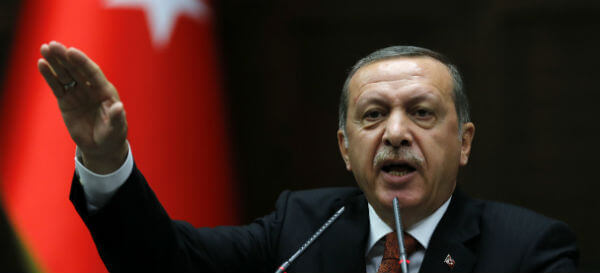
erdogan

The Wall Street Journal reports: After 13 years of being methodically marginalized during Recep Tayyip Erdogan’s tenure atop Turkish politics, the army is regaining its clout as the president sidelines his political rivals.

Turkey’s military, which has forced four civilian governments from power since 1960, is re-emerging as a pivotal actor alongside Mr. Erdogan, who has long viewed the army as a potentially dangerous adversary.

Mr. Erdogan’s moves to sideline political opponents — he forced out his handpicked prime minister this month amid a power struggle — has cleared the way for Turkey’s generals to play a greater role in shaping Mr. Erdogan’s attempts to extend his global influence.

Turkish generals are tempering Mr. Erdogan’s push to send troops into Syria, managing a controversial military campaign against Kurdish insurgents, and protecting Turkey’s relations with Western allies who view the president with suspicion. By steering clear of politics, they re-emerged as a central player in national security decisions.

“The Turkish military is the only agent that wants to put on the brakes and create checks-and-balances against Erdogan,” said Metin Gurcan, a former Turkish military officer who now works as an Istanbul-based security analyst.

It is in Syria where the military is most clearly acting as a check on the president. When Mr. Erdogan last year debated sending Turkish forces into Syria to set up a safe zone for those fleeing the fighting, military leaders expressed strong reservations, former Turkish officials and allies of Mr. Erdogan said. That, they said, helped put the idea on hold.

The debate returned last week when Mr. Erdogan threatened to send Turkish troops into Syria to end weeks of Islamic State rocket attacks on a Turkish border town.

Sending large numbers of combat troops into Syria is still a hard sell for the military, allies of Mr. Erdogan and U.S. officials said. If Turkey were to act without the support of the U.S. and its other North Atlantic Treaty Organization allies, the military fears its soldiers could be bombed by Russian jets and would face international condemnation.

“This is a very realistic headquarters. They know what Turkey’s armed forces are capable of. They’re not adventurous,” said Can Kasapoglu, a defense analyst with the Center for Economic and Foreign Policy Studies, a Turkish think tank.

The Turkish military and Mr. Erdogan’s press office both declined to discuss their relationship.

The restoration of the Turkish army’s influence has resurrected concerns all the way up to the presidential palace that generals might try to topple Mr. Erdogan, a polarizing figure whose extensive crackdown on domestic dissent has triggered alarm in Western capitals, according to people familiar with the matter. [Continue reading…]

Facebooktwittermail