Reuters reports: The leader of al Qaeda’s Syrian wing tried unsuccessfully at a recent meeting to convince rival Islamist factions to merge into one unit, several insurgency sources have told Reuters.
Abu Mohamad al-Golani, head of the Nusra Front, even suggested he was willing to change the name of his group if the others, including the powerful Ahrar al-Sham organisation, agreed to the deal, the sources said.
But he made clear that Nusra would not cut its ties with al Qaeda, and its allegiance would remain to Ayman al-Zawahri, who took over as leader after U.S. Navy SEALS killed Osama bin Laden in 2011.
Much was riding on the outcome of the meeting, which the sources said took place about 10 days ago.
Nusra and Ahrar al-Sham are the most powerful groups in northern Syria: when they briefly teamed up with other Islamists last year in an alliance called the Fatah Army, the rebels scored one of their biggest victories by seizing the city of Idlib. [Continue reading…]
Category Archives: Lands
Ban Ki-moon to Israel: Don’t shoot the messenger
Secretary general of the United Nations, Ban Ki-moon, writes: In Israel and the occupied Palestinian territories, 2016 has begun much as 2015 ended — with unacceptable levels of violence and a polarized public discourse. That polarization showed itself in the halls of the United Nations last week when I pointed out a simple truth: History proves that people will always resist occupation.
Some sought to shoot the messenger — twisting my words into a misguided justification for violence. The stabbings, vehicle rammings and other attacks by Palestinians targeting Israeli civilians are reprehensible. So, too, are the incitement of violence and the glorification of killers.
Nothing excuses terrorism. I condemn it categorically.
It is inconceivable, though, that security measures alone will stop the violence. As I warned the Security Council last week, Palestinian frustration and grievances are growing under the weight of nearly a half-century of occupation. Ignoring this won’t make it disappear. No one can deny that the everyday reality of occupation provokes anger and despair, which are major drivers of violence and extremism and undermine any hope of a negotiated two-state solution. [Continue reading…]
Battered by war, Iraq now faces calamity from dropping oil prices
The New York Times reports: Iraqis seeking to withdraw money from banks are told there is not enough cash. Hospitals in Baghdad are falling back to the deprivation of the 1990s sanctions era, resterilizing, over and over, needles and other medical products meant for one-time use.
In the autonomous Kurdish region in the north, the economic crisis is even worse: government workers — and the pesh merga fighters who are battling the Islamic State — have not been paid in months. Already, there have been strikes and protests that have turned violent.
These scenes present a portrait of a country in the midst of an expensive war against the Islamic State that is now facing economic calamity brought on by the collapse in the price of oil, which accounts for more than 90 percent of the Iraqi government’s revenue.
Analysts and officials, though, say much tougher economic times are ahead, even as they insist the war will be largely unaffected because of help from foreign powers determined to defeat the Islamic State. The United States, for instance, recently extended new loans to Iraq to buy weapons, and other countries are stepping up with donations of arms and ammunition. [Continue reading…]
In Sisi’s Egypt there is close to zero tolerance for dissent
The New York Times reports: A popular Egyptian cartoonist was arrested Sunday on charges of running a website without a license, the Interior Ministry said, in the latest escalation of a campaign to silence the government’s online critics.
The cartoonist, Islam Gawish, 26, who has 1.6 million Facebook followers, was arrested during a police raid on the offices of a news website based in Cairo. Although his satirical cartoons have been published online, Mr. Gawish was not seen as an especially vehement critic of President Abdel Fattah el-Sisi.
It was the most prominent arrest since the Jan. 25 anniversary of the 2011 uprising that ultimately toppled President Hosni Mubarak, which had been preceded by a wave of arrests and closures that focused on democracy activists and well-known cultural spaces in downtown Cairo.
Although Mr. Sisi’s government has silenced many critical voices in Egypt’s major news media, either by arresting journalists or forcing them into exile, it has struggled to contain free speech on the Internet, which is one of the few forums for open dissent at a time when public protest has been all but outlawed.
Facebook and other social media sites, which played a role in organizing the 2011 uprising, are popular with millions of Egyptians, but a few high-profile prosecutions have sent a warning to users about the limits of tolerance for political discussion.
In October a military court handed down a three-year jail sentence to Amr Nohan, a 22-year-old law graduate who had posted to his Facebook page an image that depicted Mr. Sisi with Mickey Mouse-style cartoon ears.
In recent weeks, the authorities arrested five people who are accused of administering hundreds of Facebook pages that were sympathetic to the banned Muslim Brotherhood and that had sought to encourage public protest on Jan. 25.
The circumstances of Mr. Gawish’s arrest, which follows the recent closing of the Townhouse Gallery arts space in central Cairo and a raid on the offices of a book publisher, seemed to signal that the government is seeking new ways to silence even moderate forms of dissent. [Continue reading…]
The failure of Egypt’s democratic transition was not inevitable

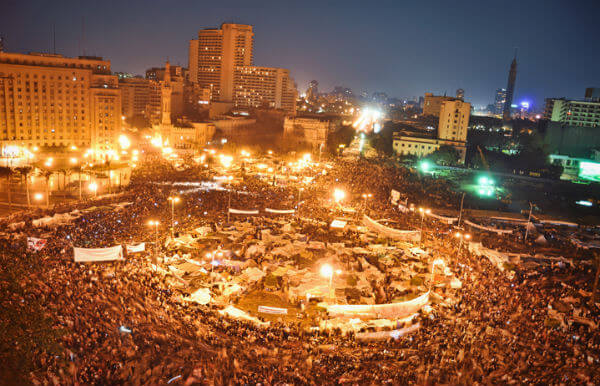
Michael Wahid Hanna writes: The fifth anniversary of the 2011 Egyptian uprising has produced an oddly structuralist set of reflections in which the failure of its democratic transition has taken on an almost foreordained quality. Influential political science interpretations of the Egyptian uprising’s failure have focused analytical attention on structural factors, such as the role of a politicized and overreaching military, the uneven balance of power between the Muslim Brotherhood and its non-Islamist competitors, the former regime’s political structure and the weakness of transitional institutions.
Structure matters, of course. But so does agency. Overly structural interpretations miss the decisive impact of highly contingent events, deflects responsibility from the political actors whose choices drove the transition off course and can lead to unwarranted skepticism about the possibility of meaningful political change.
Egypt’s transition to a legitimate, civilian-led political order after the popular mobilization of January 2011 always faced long odds, but the failure of the transition was never inevitable. Structural explanations of the July 2013 military coup gloss over the fear and uncertainty that shaped political decision-making over the previous two years. The political openings of 2011 were real and potentially transformative and could have provided a platform for slow but sustainable change. Structural analysis should not become an excuse for political malpractice or an analytical surrender to the necessity of autocracy. Different decisions by key political actors such as the military, the Muslim Brotherhood and the National Salvation Front could have shaped a very different political environment. [Continue reading…]
Masked men in Stockholm threaten to ‘punish’ refugee children
The Guardian reports: A gang of masked men have been detained in Stockholm after distributing leaflets threatening to punish “north African street children roaming” the Swedish capital.
Police said one man had been charged with assaulting a police officer and the others had been charged with wearing a mask in public, which is illegal in Sweden, and for causing a public disturbance.
A police spokesman told local media the men detained were believed to have gathered “with the purpose of attacking refugee children”.
According to the Swedish newspaper Aftonbladet, up to 100 masked men marched into central Stockholm on Friday to hand out leaflets carrying the message “It’s enough now” and threatening to give the “north African street children who are roaming around” the “punishment they deserve”.
This week an employee at a refugee centre for unaccompanied youths in Mölndal, near Gothenburg, was fatally stabbed, allegedly by a young man living at the centre.
The killing of Alexandra Mezher, 22, has led to questions about overcrowded conditions in some refugee centres, with too few adults and employees to take care of children, many of whom are traumatised by war. [Continue reading…]
10 children among the dead as refugee boat capsizes off Turkey
The New York Times reports: One photo showed a small boy, perhaps 3 years old, dressed for a mild winter — dark blue pants and coat, a sky blue sweater for extra protection. The grown-up who had dressed him for the journey — barely five miles across the Aegean Sea — had cared enough to put on matching socks, with little blue cars. The boy was lying face up on the rocks. A winter hat, sky blue with a white pom-pom, covered his lifeless face.
The little boy was among 37 people — most of them believed to be Syrians fleeing war and trying to reach European shores — who died when their boat capsized on Saturday and washed up on the rocky shoals of the Turkish coast. At least 10 children died in the accident, according to reports from The Associated Press, which came as the rival parties in Syria were in Geneva, squabbling over the terms of sitting down for peace talks.
Another photo showed a Turkish rescue worker carrying a child, slightly older, maybe old enough to be in first grade. He was wearing jeans and a red life jacket. His eyes appeared to be half open, staring at the rescue worker who was putting him into a body bag. [Continue reading…]
Greece resists role as European Union’s gatekeeper
The New York Times reports: On a recent weekday, 40 buses jammed into the parking lot of a gas station near the Macedonian border, carrying thousands of refugees who had survived a perilous crossing on wintry seas from Turkey.
Now they were approaching ground zero in the intensifying debate over how to curb the unceasing stream of men, women and children from war-ravaged and poor nations in the Middle East and Africa heading to the safety and prosperity of Europe.
After trying and largely failing to persuade Turkey to stem the flow, Europe has reached a critical point in the migrant crisis. With few options left, short of halting the war in Syria, much of the Continent is coalescing around proposals that would harden the border with Macedonia and effectively turn Greece into a giant processing center for migrants.
At the border crossing here — one of the busiest gateways for migrants on the path north and the site of occasional violence between the authorities and frustrated migrants — Greece has played that filtering role to some degree for months. In theory, Greece is allowing only Syrians, Iraqis and Afghans to continue toward their preferred destinations in Germany and Austria. [Continue reading…]
We are Syria’s moderate opposition — and we’re fighting on two fronts
Asaad Hanna writes: Last October the UN special envoy for Syria, Steffan de Mistura, invited Syrian military factions to engage in dialogue with the regime through the so-called Four Committees Initiative. The initiative was rejected by the factions out of mistrust, but it did reveal the elevated number of opposition fighters that were active in Syria: 74 military factions signed the rejection statement, the smallest of which numbered 1,000, while others totalled more than 10,000.
Crucially, none of these 74 are internationally classified as extremists. The moderate opposition is not a myth. Syrians do not need foreign fighters to help them fight Isis; they have indigenous fighters, better acquainted with the land and able to confront any aggressor, particularly where there is firm international will to support them to do so.
The Syrian armed opposition is fighting a war on two fronts: against Assad and against Daesh. Assad’s barbarity has driven Syrians from their homes and resulted in the deaths of hundreds of thousands of Syrians over the past five years.
On the other side, we are facing Daesh, a terrorist group whose creation Assad must take some of the responsibility for. Daesh is helping the Assad regime by fighting us, the armed moderate opposition. The relationship between the two should not be in doubt.
Whenever we have made advances and secured victories, Daesh has defended the Assad regime. For example, we have seen Daesh launch offensives in order to draw Free Syrian Army forces away from battle, to ease pressure on the regime. During a battle near Qardaha – the birthplace of Bashar al-Assad – the armed opposition was achieving great victories until Daesh suddenly launched an attack on a key military position in the nearby city of Aleppo, killing a number of Free Syrian Army commanders. Just three days later they withdrew, at which point they handed the area over to regime forces. [Continue reading…]
Russia is exploiting Syria’s Kurds and U.S. frustrations to complicate the fight against ISIS
Huffington Post reports: As Syria peace talks begin in Geneva, America’s key partners on the ground feel neglected, excluded and increasingly receptive to a man who says the U.S has the war-torn country all wrong — Russian President Vladimir Putin.
Putin’s government this week used the process of deciding who would attend the negotiations to endear Russia to the Syrian Kurds, whose militia has chalked up high-profile victories against the self-described Islamic State group with U.S. air support.
Moscow repeatedly demanded that the talks should include the most powerful Kurdish political organization, the radically leftist PYD. Its co-president Salih Muslim said this week that the party — controversial among Western and Muslim-backed Syrian Arab nationalist groups — did not receive an invitation. The Middle East Eye reported Friday that he stopped by Geneva and then promptly left.
Conversely, Washington stayed relatively silent.
The Kurds now feel that though they have become close enough to the United States to host America’s Special Operations troops, receive U.S. weapons through a Pentagon-vetted program for an Arab-Kurdish rebel force and share Islamic State targets with American intelligence, the Obama administration abandoned them in the run-up to the high-profile talks, according to analysts close with Kurdish leaders.
“These talks started in a very troublesome manner with the Kurds not being there,” said Mutlu Civiroglu, a Washington-based analyst who monitors the Syrian Kurds. “Kurds being the pioneers of the fight against ISIS, having lost more than 4,000 fighters, were sure they were going to be invited.”
Michael Werz, a senior fellow at the Center for American Progress who just returned from a major Kurdish conference in Brussels, told The Huffington Post the current view among some in the PYD is, “we know that the Russians are going to betray us, but they’re the only ones actually lobbying for us to be part of the Geneva talks.”
“‘We are the only secular fighting force, we are the only movement giving freedom to women, and the United States doesn’t even stand up to the Turks when it comes to participating in the peace negotiations,” Werz added in his summing up of Kurdish sentiment. “‘Nobody is publicly supporting us, so what are we supposed to do?'”
The popularity of that thinking is a problem for Washington because it could bolster distrust among Syrian Kurds already nervous about their fledgling relationship with the U.S. [Continue reading…]

Iraq: Possible war crimes by Shia militia
Human Rights Watch: Members of Shia militias, who the Iraqi government has included among its state forces, abducted and killed scores of Sunni residents in a central Iraq town and demolished Sunni homes, stores, and mosques following January 11, 2016 bombings claimed by the extremist group Islamic State, also known as ISIS. None of those responsible have been brought to justice.
Two consecutive bombings at a café in the town of Muqdadiya, in Diyala province, some 130 kilometers north of Baghdad, on January 11, killed at least 26 people, many of them Sunnis, according to a teacher who lives near the café. ISIS claimed the attacks, saying it had targeted local Shia militias, collectively known as Popular Mobilization Forces, which are formally under the command of the prime minister. Members of two of the dominant militias in Muqdadiya, the Badr Brigades and the League of Righteous forces, responded by attacking Sunnis as well as their homes and mosques, killing at least a dozen people and perhaps many more, according to local residents.
“Again civilians are paying the price for Iraq’s failure to rein in the out-of-control militias,” said Joe Stork, deputy Middle East director at Human Rights Watch. “Countries that support Iraqi security forces and the Popular Mobilization Forces should insist that Baghdad bring an end to this deadly abuse.” [Continue reading…]
‘I have never seen such destruction’ as in Yemen, says aid worker
PBS Newshour reports: Fighting in Yemen after rebels overthrew the government in early 2015 has created a dire humanitarian situation unparalleled even in places as battle-scarred as Syria, according to a Doctors Without Borders worker.
“I’ve worked in war zones for the past 11 to 12 years, in some of the worst conflicts like Syria, but I have never seen such destruction conducted in such a short period as in Yemen,” wrote Michael Seawright from Auckland, New Zealand.
Seawright served as project coordinator for Doctors Without Borders in the Middle Eastern region. “I was based in Saada, in the north, in a Houthi-controlled area that was experiencing almost daily attacks from coalition air forces. These airstrikes were often close to our facilities and we clearly felt their effects,” he wrote. [Continue reading…]
Boko Haram burns children alive in northeast Nigeria
The Associated Press reports: A survivor hidden in a tree says he watched Boko Haram extremists firebomb huts and heard the screams of children among people burned to death in the latest attack by Nigeria’s homegrown Islamic extremists.
Scores of charred corpses and bodies with bullet wounds littered the streets from Saturday night’s attack on Dalori village just 5 kilometers (3 miles) from Maiduguri, the birthplace of Boko Haram and the biggest city in the northeast, according to survivors and soldiers.
The shooting and burning continued for four hours, survivor Alamin Bakura said, weeping on a telephone call to The Associated Press. He said several of his family members were killed or wounded. [Continue reading…]
Syrian peace talks — fake diplomacy is no diplomacy

An editorial in The Guardian says: There can be no more urgent matter than putting an end to the terrible human tragedy and the lethal regional destabilisation produced by the Syrian conflict. This is a war in which 300,000 people have died, which has internally displaced half the country’s population and which has caused more than 4 million to flee the country altogether. Syria has become the worst humanitarian catastrophe of our time. The plight of its people is also dangerously destabilising Europe and exposing weaknesses in its institutions. If the humanitarian crisis were not enough on its own, then the need to resolve Europe’s refugee crisis at its source would be reason enough to pay close attention to the peace talks that are scheduled to begin on Friday in Geneva. Yet even getting everyone round the table is looking fraught.
In the current climate, the stated aim of the talks appears breathtakingly ambitious. Mandated by a UN resolution passed in December, their purpose is to organise a gathering of representatives of both the Assad regime and opposition groups, in the hope that it could eventually lead to the formation of a new government, and later, elections. At this stage of a devastating war, it is tempting to see the very possibility of talks as an achievement in itself. Yet for several reasons there is a danger that they amount to nothing more than fake diplomacy.
First, the question of protecting Syrian civilians has all but fallen off the agenda. There can be no progress without attention to their plight. Second, western powers seem to have made key political concessions to Russia and Iran, the main enablers of the Assad regime. As as result, the Syrian dictator will feel even more empowered to pursue the mass targeting of his own countrymen and to continue a war of attrition in the belief that he will ultimately come out the winner. [Continue reading…]
How the politics of fear and the crushing of civil society imperil global rights

Kenneth Roth writes: Fear stood behind many of the big human rights developments of the past year. Fear of being killed or tortured in Syria and other zones of conflict and repression drove millions from their homes. Fear of what an influx of asylum seekers could mean for their societies led many governments in Europe and elsewhere to close the gates. Fear of mounting terrorist attacks moved some political leaders to curtail rights and scapegoat refugees or Muslims. And fear of their people holding them to account led various autocrats to pursue an unprecedented global crackdown on the ability of those people to band together and make their voices heard.
In Europe and the United States, a polarizing us-versus-them rhetoric has moved from the political fringe to the mainstream. Blatant Islamophobia and shameless demonizing of refugees have become the currency of an increasingly assertive politics of intolerance.
These trends threatened human rights in two ways, one well known, the other less visible. The high-profile threat is a rollback of rights by many governments in the face of the refugee flow and the parallel decision by the self-declared Islamic State, or ISIS, to spread its attacks beyond the Middle East. The less visible threat is the effort by a growing number of authoritarian governments to restrict civil society, particularly the civic groups that monitor and speak out about those governments’ conduct. [Continue reading…]
Danish migration law: A sign of things to come?
UN launches Syria peace talks despite opposition boycott — updated
Update below — Reuters reports: The first Syria peace talks for two years were a “complete failure” before they started on Friday, a Western diplomat said, after the United Nations announced it would press ahead with them despite an opposition boycott.
Opponents of President Bashar al-Assad said they were far more concerned with fending off a Russian-backed military onslaught, with hundreds of civilians reported to be fleeing as the Syrian army and allied militia tried to capture a suburb of Damascus and finish off rebels defending it.
U.N. envoy Staffan de Mistura has invited the Syrian government and an opposition umbrella group to Geneva for “proximity talks”, in which they would meet in separate rooms.
But so far the main opposition High Negotiations Committee (HNC) has refused to attend, insisting it wanted an end to air strikes and sieges of towns before talks can start. The boycott defies Washington, which has urged the opposition to take up the “historic opportunity” for the talks, without preconditions. [Continue reading…]
UPDATE — Reuters reports: The main Syrian opposition grouping agreed to attend United Nations-sponsored peace talks which began in Geneva on Friday, reversing a boycott that had threatened to wreck the first attempt to find a diplomatic solution to the war in two years. [Continue reading…]
Joint statement regarding the main principles of any negotiation process in Syria
Over 200 Syrian organisations and more than 790 individuals, including civil society organisations, local councils, NGOs and refugee groups, have laid out their expectations of the Geneva III peace process, and demanded the immediate implementation of confidence building measures, in a new declaration released this week.
The Syrian cause is at a pivotal moment following recent political and field developments coupled with regional and international agreements – including the Vienna Declaration and Security Council Resolution 2254 – that have called for the launch of a negotiated political process between the Syrian opposition and regime.
In preparation for a political process, international envoys and diplomats tasked with the Syrian file have continuously engaged representatives of Syrian civil society on the political process and issued multiple proposals calling for the participation of civil society in any discussions or negotiations between the Syrian regime and opposition.
The signatories of this declaration – both organizations and individuals – hereby affirm that Syrian civil society would not have emerged but for the March 2011 revolution; a revolution that resisted all tyrannical restrictions of a regime that consistently suppressed calls for basic freedom and the formation of civil society since 2000 through the sacrifices of its people, the suffering of its detainees and the souls of its martyrs.
The signatories also affirm that the main conflict in Syria remains with the leadership of the ruling regime based in Damascus and its repressive policies that have led the country down a catastrophic path.
The signatories of this declaration further affirm that in order for Syria to be put on the road to salvation, the Syrian people and what remains of Syrian state institutions must be liberated from this brute force and that civil society, in its many manifestations, must play a key role in furthering the March 2011 revolution and its values. Only then can Syrians realize peace through justice and thereby transition to a democratic pluralistic system where equal rights and responsibilities are granted to all Syrians. And if indeed civil society is to participate in the political process, it must be those members of civil society who emerged from the womb of the struggle for freedom and dignity and sided with the people’s just demands who should participate. [Read the complete declaration with list of signatories.]