Category Archives: Lands

Istanbul has more Syrian refugees than all of Europe says David Miliband

The Associated Press reports: Nearly 60% of refugees are living in cities today and there are currently more Syrian refugees in Istanbul than in all the rest of Europe, the head of the International Rescue Committee has said.

David Miliband told The Associated Press in an interview Monday that “the iconic image” of a refugee being someone in a camp has changed.

He said so many people are fleeing conflict and chaos that there’s no room for them in camps. Equally important, he said, is that most people don’t want to be in refugee camps and when they’re displaced for a long time, they want to earn a living — even if that means working in the black market.

Miliband gave the example of Istanbul, without citing any figures. The International Rescue Committee said there are currently more Syrian refugees in Istanbul – some 366,000 – than the rest of Europe put together.

Currently, there are 20 million refugees in the world, including 2 million in Turkey, and 40 million people uprooted and displaced in their own countries, which Miliband called “a grisly world record.” [Continue reading…]

Facebooktwittermail

What Russia’s own videos and maps reveal about who they are bombing in Syria

Bellingcat reports: The Russian Federation launched an air campaign on 30 September 2015, allegedly targeting Islamic State (or ISIS) positions in Syria. The Russian Ministry of Defense (MoD) has been releasing selected videos on its YouTube channel ever since. Bellingcat began geolocating and independently verifying videos published by the Russian MoD after initial reports from the ground indicated that Russian airstrikes have instead destroyed positions held by the Free Syrian Army and other groups rather than ISIS.

Bellingcat has geolocated, verified, and visualised each airstrike published by the Russian MoD on its official YouTube channel as of 25 October. The outcome of our work is unequivocal: the overwhelming majority of Russian airstrikes have targeted positions held by non-ISIS rebel groups posing a more immediate threat to the Syrian regime and its head, Bashar al-Assad. In contrast, ISIS strongholds have rarely been attacked. The methodology and results of the investigation are laid out below.

We noticed that, for many videos, the Russian MoD adds a description in Russian before the video of the strike itself begins. A longer, more in-depth description is also appended to each upload, along with the title of the video. For the verification process, each video was uploaded to Bellingcat’s Checkdesk verification project. We Google-translated the description and pasted the original one in Russian alongside to keep track of the information in an independently managed online space. [Continue reading…]

Facebooktwittermail

Iran’s generals are dying in Syria

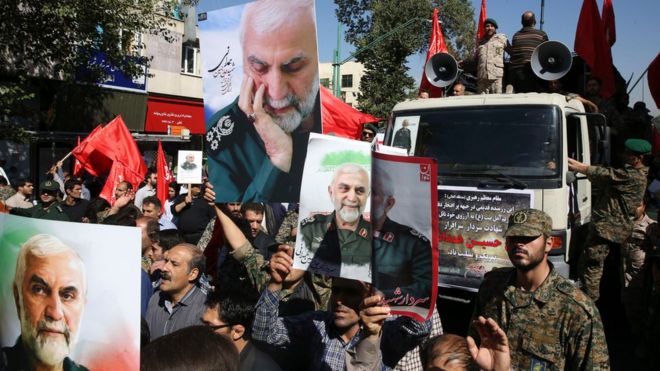
Robin Wright writes: The Islamic Republic described the first men to die as a few young “volunteers” deployed to protect symbols of the faith. The numbers have escalated since then. In June, the Islamic Republic News Agency reported that more than four hundred volunteers from Iran, including Afghan refugees living in the country, had died in Syria so far. Iranian news agencies and social media are now rife with stories about senior officers killed in Syria on the war’s toughest front lines. Last week, Iran’s Fars News Agency reported that the death toll hit eight in just two days. The funerals have become major events, sometimes drawing thousands onto Tehran’s streets to escort the coffins to Zahra’s Paradise.

Iran has increasingly been forced to acknowledge its losses—including at least four generals in the past year—with some reports suggesting that twice that number have been killed since the intervention began. Brigadier General Hossein Hamedani, who was killed on October 8th, was given a state funeral. Iran’s Supreme Leader, Ayatollah Ali Khamenei, personally called on Hamedani’s family to convey his condolences. Khamenei’s official Twitter account, in English, lauded the general for fulfilling his “martyrdom wish.”

Hamedani’s death was a setback for Iran—and possibly for Syria, too. According to Jane’s Defense Weekly, Syria’s regular Army has been halved since the war began, in 2011. Assad has increasingly relied on leaders in Iran to develop strategy, and counted on Hezbollah, Iran’s proxy force in Lebanon, to provide new fighters. Hamedani was the senior Iranian tactician in northern Syria, where the regime is simultaneously fighting Western-backed rebels, the Islamic State, a local Al Qaeda franchise, and smaller militias. Hamedani was a hero of the war with Iraq—the deadliest modern conflict in the Middle East—and his death was the most notable Iranian military loss since that war ended. [Continue reading…]

Facebooktwittermail

Russian airstrikes in Syria appear to violate laws of war, says Human Rights Watch

Human Rights Watch: At least two air strikes in northern Homs on October 15, 2015, that local residents believed to be Russian, apparently violated the laws of war. The air strikes killed a total of 59 civilians, residents said, including 33 children and a commander of the local armed opposition group. Russia should investigate the attacks.

The deadliest attack hit a house in the village of Ghantou, where the extended Assaf family had taken shelter, killing a reported 46 family members, all civilians, including 32 children and 12 women, first responders and local activists said. The victims were related to a local commander affiliated with the opposition Free Syrian Army (FSA), but witnesses said that he was away from the home at the front lines. The second air strike, on the neighboring town of Ter Maaleh, hit near a bakery, and according to local witnesses, killed at least 13 civilians as well as a local FSA commander who was a Syrian army defector. It is not clear whether he was the intended target, as neither Russia nor Syria have issued statements about the specific air strikes. [Continue reading…]

Facebooktwittermail

Yemen hospital hit by Saudi-led air strike: Medecins Sans Frontieres

Reuters reports: A hospital in north Yemen run by medical aid group Medecins Sans Frontieres (MSF) was bombed in a Saudi-led air strike, wrecking the facility and lightly wounding two staff members, the group said on Tuesday.

A Saudi-led Arab coalition intervened in Yemen’s civil war in March to try to restore its government after its toppling by Iran-allied Houthi forces, but a mounting civilian death toll has alarmed human rights groups.

“Our hospital in the Heedan district of Saada governorate was hit several times. Fortunately, the first hit damaged the operations theater while it was empty and the staff were busy with people in the emergency room. They just had time to run off as another missile hit the maternity ward,” MSF country director Hassan Boucenine told Reuters by telephone from Yemen.

“It could be a mistake, but the fact of the matter is it’s a war crime. There’s no reason to target a hospital. We provided (the coalition) with all of our GPS coordinates about two weeks ago,” he said. [Continue reading…]

Facebooktwittermail

Poets are the latest target in crackdown by Iranian hardliners

The Associated Press reports: Two Iranian poets jailed for their work and sentenced to 99 lashes apiece for shaking hands with members of the opposite sex are the latest targets in a crackdown that analysts say pits hard-liners against those offering new glimpses of life in the Islamic Republic.

The sentences follow a pattern of arrests and convictions targeting activists, journalists and artists that has served as a grim backdrop to President Hassan Rouhani’s efforts to soften the country’s image and improve relations with the West, including through the landmark nuclear agreement reached last summer.

Hard-liners in the police, judiciary and military view any rapprochement with the West as a threat to the Islamic Republic and a sign of moral decay. Rights groups and analysts say those targeted in the ongoing crackdown on expression in Iran also serve as pawns in the hard-liners’ struggle with moderates ahead of February’s parliamentary elections.

“I think people thought with the nuclear deal, there would be sort of a bit of a thaw as well or a bit of an opening up,” said Karin Deutsch Karlekar, the director of Free Expression Programs at PEN America, an organization promoting literature and freedom of speech. “I think the judiciary is sort of pushing back and trying to make clear that there isn’t going to be that opening people were hoping for.” [Continue reading…]

Facebooktwittermail

Taliban and Russian interests may converge in fight against ISIS

The Daily Beast reports: The Taliban are not as lonely as they once were. The pariahs who protected Osama bin Laden and quickly collapsed when the U.S. counter-attacked after September 11, 2001, have been developing contacts with neighboring states and even with Russia, driven out of Afghanistan in 1989.

There’s nothing simple about this picture, and, interestingly, it appears partly tied to Russian efforts to oppose the spread in Afghanistan of groups pledging allegiance to the so-called Islamic State in Syria and Iraq. That same concern has helped to forge links between the Taliban and their longtime enemies in Iran.

And the Russian connection is emerging, ironically, at the same time that Afghanistan’s Uzbek warlord and vice president, Abdul Rashid Dostum, has openly warmed to his onetime allies in Russia and tried to strengthen ties to the former Soviet states on Afghan frontier.

Dostum visited Moscow and Grozny this month and launched an offensive just last week in provinces near the Turkmenistan border. Dostum lumped the Taliban together with Daesh, a common Arabic acronym for the Islamic state, on his enemies list.

“The countries of the Commonwealth of Independent States from Russia to Tajikistan and Turkmenistan, all these states are willing to stand with us against Daesh [one of the acronyms for the so-called Islamic State], against extremism, against the bloodthirsty Taliban,” Dostum declared.

But The Daily Beast has learned that Russia and some of these neighboring states may be playing a double game, or, at the very least keeping their options open if the Taliban manage to retake power. [Continue reading…]

Facebooktwittermail

The African lion: What faster decline of apex predator means for ecosystems

By Matt Hayward, Bangor University

There is nothing as awe-inspiring as watching the brutal power of a lion capturing its prey. At close range, their throaty roars thump through your body, raising a cold sweat triggered by the fear of what these animals are capable of doing now, and what they once did to our ancestors. They are the most majestic animals left on our planet, and yet we are currently faced with the very real possibility that they will be functionally extinct within our lifetime.

In fact, lion populations throughout much of Africa are heading towards extinction more rapidly than previously thought, according to new research by Oxford biologist Hans Bauer and colleagues, published in PNAS. The team looked at 47 sites with credible and repeated lion surveys since 1990, and found they were declining everywhere in Africa aside from four countries: Botswana, Namibia, South Africa and Zimbabwe.

West and Central African lion populations have a 67% chance of halving in size in just two decades, and East African populations a 37% chance. Almost all large lion populations that once exceeded 500 individuals outside of southern Africa are declining. These declines in Africa’s apex predator occur at the same time that the continent’s mega-herbivores are also plummeting.

Continue reading

Facebooktwittermail

Saving Syria’s ‘lost generation’

The Atlantic reports: It wasn’t long after the onset of the Great Recession that academics and headline writers began referring to recent college graduates as a “lost generation.” Faced with unemployment rates for their cohort higher than at any time since World War II, young Americans seemed doomed to a lifetime of lower earnings and savings. But even at the peak of pessimistic predictions, pundits had to acknowledge: Those with college degrees were relatively well-off compared to those without.

What, then, do you call an entire generation that never even finishes college? That’s the threat facing Syria’s young adults. In the years leading up to the current civil war, enrollment figures for Syrian tertiary education had been climbing steadily upward—from 12 percent of the college-age population in 2002, according to the UNESCO Institute for Statistics, to 26 percent in 2010, on the eve of the Syrian uprising. Now, the estimated 100,000 university-qualified refugees currently scattered throughout the Middle East and Europe must place their hopes in schools outside Syria—and that’s to say nothing of those still inside the country, where few educational institutions remain functional. In neighboring Turkey, Lebanon, and Jordan, all of which have been overwhelmed with refugees since the start of the conflict, only a fraction of students have found ways to continue their studies, despite the number of Syrian students in Turkish universities, for example, reportedly quadrupling in recent years. With professors and researchers displaced as well, Syria’s entire university infrastructure is at risk. [Continue reading…]

Facebooktwittermail

Russian warplanes shatter tenuous truce forcing thousands of Syrians to flee

The New York Times reports: For almost two years, the village in the Syrian countryside north of the city of Homs had been relatively calm, profiting from a tenuous truce between the government and rebel groups that had made it a refuge for thousands of desperate people displaced by the war.

But the peace was shattered earlier this month, when Russian warplanes started attacking the village, Ter Ma’aleh, killing at least a dozen people and sending most of the residents into hurried exile.

The assault on the village was part of a wider escalation of violence across the country that has displaced tens of thousands of people in just weeks and led relief workers to warn that Syria is facing one of its most serious humanitarian crises of the civil war.

The intensity of the fighting, they say, is fueling increased desperation as a growing number of Syrians are fleeing to neighboring countries and, especially, to Europe. More than 9,000 migrants a day crossed into Greece last week, according to the International Organization for Migration, the most since the beginning of the year. [Continue reading…]

Facebooktwittermail

Glenn Greenwald: Support for Syrian rebels is legitimate in spite of Al Qaeda’s presence

Glenn Greenwald writes: I personally don’t view the presence of Al Qaeda “affiliated” fighters as a convincing argument against supporting Syrian rebels. It’s understandable that people fighting against an oppressive regime – one backed by powerful foreign factions – will align with anyone willing and capable of fighting with them. Moreover, the long-standing US/UK template of branding anyone they fight and kill as “terrorists” or “Al Qaeda” is no more persuasive or noble when used in Syria by Assad and the Russians, particularly when used to obscure civilian casualties. And regarding the anti-Assad forces as monolithically composed of religious extremists ignores the anti-tyranny sentiment among ordinary Syrians motivating much of the anti-regime protests, with its genesis in the Arab Spring. [Continue reading…]

This statement might confuse some of Greenwald’s readers — at least I’m sure it would have if he had made it the lead of his latest column. Instead, this recognition that alliances of convenience are inevitably formed during any attempt to overthrow a tyrannical regime, was more of an afterthought buried deeply within a diatribe aimed at the BBC.

Greenwald goes on to assert: “It’s not a stretch to say that the faction that provides the greatest material support to Al Qaeda at this point is the U.S. and its closest allies.”

He might not think it’s a stretch — many others would beg to differ.

The idea that Al Qaeda inside or outside Syria is backed by the U.S. government should be treated with the same amount of scorn as claims that 9/11 was an “inside job.”

Why?

American concerns about weapons falling into the wrong hands has and continues to be obsessive, as a Wall Street Journal report in January made clear.

It didn’t take long for rebel commanders in Syria who lined up to join a Central Intelligence Agency weapons and training program to start scratching their heads.

After the program was launched in mid-2013, CIA officers secretly analyzed cellphone calls and email messages of commanders to make sure they were really in charge of the men they claimed to lead. Commanders were then interviewed, sometimes for days.

Those who made the cut, earning the label “trusted commanders,” signed written agreements, submitted payroll information about their fighters and detailed their battlefield strategy. Only then did they get help, and it was far less than they were counting on.

Some weapons shipments were so small that commanders had to ration ammunition. One of the U.S.’s favorite trusted commanders got the equivalent of 16 bullets a month per fighter. Rebel leaders were told they had to hand over old antitank missile launchers to get new ones — and couldn’t get shells for captured tanks.

On those occasions where U.S. supplied weapons are known to have ended up in the hands of Al Qaeda, this has been a major embarrassment to the Obama administration.

Even now, after a month in which Russia has conducted more than 800 airstrikes in Syria, rebels have yet to be supplied with the most basic form of effective air defense — MANPADs, though this may soon change — and the flow and use of TOW anti-tank missiles remains tightly regulated.

What continues to get obscured by those who insist on pushing the narrative of rebels heavily armed by the U.S. and its allies, is the enduring imbalance of military power in this war: the fact that the Assad regime and its allies continue to maintain air dominance largely unchallenged.

Facebooktwittermail

In Golan, a battle looms between Iran and Israel

Jean-Loup Samaan writes: More than four years into the Syrian conflict, the Golan Heights have become the centre of gravity for an indirect war between Iran and Israel. This was not an inevitable turn of events, as the area had been home to one of the quietest borders in the Middle East for decades. Although Israel seized the plateau in 1967 and unilaterally annexed it in 1981, the Golan had not witnessed clashes like South Lebanon or the Sinai Peninsula. This dramatically changed with the worsening of the war in Syria.

By the end of 2012, Iran and Hizbollah had sent hundreds of fighters to support the Bashar Al Assad regime. Fights with Syrian rebels, in particular Jabhat Al Nusra, increased on the Syrian side of the Golan and its vicinity. In April 2013, the Qusayr battle saw Hizbollah deploying a contingent of more than 1,200 men. In the following months, a war of attrition emerged in Quneitra and the Qalamoun mountains, with a new major battle flaring in Yabroud in February 2014.

But progressively it appeared that Hizbollah and the Iranians were not solely fighting Syrian rebels, but turning the Golan into a new forward base to target Israel. Various reports claim that tunnels and bunkers are being built to prepare for the next conflict with the Israeli military.

Soon the Israelis reacted by playing a rather ambiguous game with Syrian rebels on the other side of the border. Although it was common knowledge that medical care had been provided to Syrian civilians in Israeli hospitals, the United Nations Disengagement Observation Force based in the Golan were, by 2014, describing something bigger. [Continue reading…]

Facebooktwittermail

Harsh conditions are foiling Russian jets in Syria

USA Today reports: Russian warplanes sent to Syria to back the regime of Bashar Assad are breaking down at a rapid rate that appears to be affecting their ability to strike targets, according to a senior Defense official.

Nearly one-third of Russian attack planes and half of its transport aircraft are grounded at any time as the harsh, desert conditions take a toll on equipment and crews, said the official who was not authorized to speak publicly about sensitive intelligence matters.

The Russians appear to be having difficulty adapting to the dusty conditions, and the number of airstrikes they have conducted seems to have dipped slightly.

“For deployed forces, that’s a hideous rate,” said Richard Aboulafia, an aviation analyst at the Teal Group, an aerospace consulting firm.

Russian President Vladimir Putin deployed warplanes, including Russia’s advanced Fullback ground-attack jet, helicopters and troops to a base near Latakia, Syria, in September. In addition, at least a dozen transport planes have been stationed there.

“They could have bad operating procedures, inadequate supplies of spare parts and support crews,” Aboulafia said. [Continue reading…]

Facebooktwittermail

Extreme heatwaves could push Gulf climate beyond human endurance, study shows

The Guardian reports: The Gulf in the Middle East, the heartland of the global oil industry, will suffer heatwaves beyond the limit of human survival if climate change is unchecked, according to a new scientific study.

The extreme heatwaves will affect Abu Dhabi, Dubai, Doha and coastal cities in Iran as well as posing a deadly threat to millions of Hajj pilgrims in Saudi Arabia, when the religious festival falls in the summer. The study shows the extreme heatwaves, more intense than anything ever experienced on Earth, would kick in after 2070 and that the hottest days of today would by then be a near-daily occurrence.

“Our results expose a specific regional hotspot where climate change, in the absence of significant [carbon cuts], is likely to severely impact human habitability in the future,” said Prof Jeremy Pal and Prof Elfatih Eltahir, both at the Massachusetts Institute of Technology, writing in the journal Nature Climate Change.

They said the future climate for many locations in the Gulf would be like today’s extreme climate in the desert of Northern Afar, on the African side of the Red Sea, where there are no permanent human settlements at all. But the research also showed that cutting greenhouse gas emissions now could avoid this fate. [Continue reading…]

Facebooktwittermail

Morocco poised to become a solar superpower with launch of desert mega-project

The Guardian reports: The Moroccan city of Ouarzazate is used to big productions. On the edge of the Sahara desert and the centre of the north African country’s “Ouallywood” film industry it has played host to big-budget location shots in Lawrence of Arabia, The Mummy, The Living Daylights and even Game of Thrones.

Now the trading city, nicknamed the “door of the desert”, is the centre for another blockbuster – a complex of four linked solar mega-plants that, alongside hydro and wind, will help provide nearly half of Morocco’s electricity from renewables by 2020 with, it is hoped, some spare to export to Europe. The project is a key plank in Morocco’s ambitions to use its untapped deserts to become a global solar superpower.

When the full complex is complete, it will be the largest concentrated solar power (CSP) plant in the world , and the first phase, called Noor 1, will go live next month. The mirror technology it uses is less widespread and more expensive than the photovoltaic panels that are now familiar on roofs the world over, but it will have the advantage of being able to continue producing power even after the sun goes down. [Continue reading…]

Facebooktwittermail

A new generation of Palestinian resistance

Yassmine Saleh writes: Over the past several days, Palestinian youth in the West Bank have been exerting their political power — destroying parts of the Separation Wall surrounding the city of Abu Dis with a large hammer, rallying against the attacks on Jerusalemite Palestinians in the Old City, and clashing with Israeli soldiers at checkpoints.

The current wave of youth protest is not an anomaly in the Palestinian struggle against the Israeli occupation and colonization. Palestinian society is a young society. Youths make up a third of the population, with fully 30 percent of people between the ages of fifteen and twenty-nine. In Jerusalem, 35.2 percent of the population is below the age of fifteen. And young people have been the driving force behind recent uprisings, such as the First Intifada in 1987–93 and the Second Intifada in 2000–05.

The First Intifada was a watershed in the history of resistance to Israeli occupation and featured mass forms of popular resistance. People of all ages and social groups united in that struggle against the occupation.

Neighborhood committees started to watch over the security of every neighborhood. When schools and universities were closed under military orders, teachers in every neighborhood gathered students to continue their classes. Agricultural relief committees, founded in the late 1970s and early 1980s, started writing how-to booklets on home-based agriculture to counter the months and weeklong curfews that the Israeli army sometimes imposed on parts of the West Bank.

“Intifada” would come to English as a synonym for “uprising” in its wake.

The uprising today is taking new forms. [Continue reading…]

Facebooktwittermail

Netanyahu pledges that Israel will ‘forever live by the sword’

Haaretz reports (via Mondoweiss): Prime Minister Benjamin Netanyahu said Monday that although he doesn’t want a binational state, “at this time we need to control all of the territory for the foreseeable future.”

MKs who took part in the Knesset Foreign Affairs and Defense Committee meeting — where the prime minister spoke — told Haaretz that Netanyahu turned to the politicians and said, hinting at the anniversary of Yitzhak Rabin’s assassination: “These days, there is talk about what would happen if this or that person would have remained. It’s irrelevant; there are movements here of religion and Islam that have nothing to do with us.” Netanyahu then turned to opposition MKs and said: “You think there is a magic wand here, but I disagree. I’m asked if we will forever live by the sword — yes.” [Continue reading…]

Facebooktwittermail

Netanyahu considers move that might divide ‘united’ Jerusalem

The Times of Israel reports: ime Minister Benjamin Netanyahu is considering revoking the permanent residency status of East Jerusalemite Arabs in a measure aimed at halting an ongoing spate of terror attacks, many of which have emanated from Arab neighborhoods of the city.

Netanyahu raised the idea in a security cabinet meeting two weeks ago, according to a Sunday report from Channel 2 news.

The proposal came as the security cabinet passed a slew of measures designed to prevent further Palestinian attacks in the current wave of unrest.

“We need to examine the possibility of canceling their residency. There needs to be a discussion about it,” Netanyahu reportedly said.

The proposal would affect some 80,000 people, according to the report.

The idea was met with surprise by some in the cabinet who saw the move as a step toward dividing Jerusalem through ceding control over Arab neighborhoods. [Continue reading…]

Facebooktwittermail