Category Archives: Lands

Jihadis see wide-ranging ceasefire deal brokered by Iran and Turkey as a historic victory

Hassan Hassan reports: Syrian Islamist rebels linked to al-Qaida have struck a wide-ranging ceasefire deal with Bashar al-Assad’s regime. If it holds, the agreement will in effect cede sovereignty of the city of Idlib, create a de facto no-fly zone, and freeze the conflict in several hotspots.

The 25-point deal was brokered by Iran, acting for Damascus, and by Turkey, representing the rebel coalition Jaish al-Fateh, which includes the al-Qaida-affiliated Jabhat al-Nusra. The deal, which urges UN monitoring and implementation, covers 14 towns in the north and south of the country, where intense fighting along sectarian lines had devastated the ranks of all those fighting, taken a bloody toll on civilians left in the area and ravaged towns and infrastructure.

The accord may not hold, especially now that Russia is scouting targets in the ceasefire zone and after reports that renewed clashes erupted between the two sides when pro-regime forces fired into Taftanaz, a town north of Idlib specified in the deal. But the deal itself and the circumstances that led to it are worth pondering.

If it holds it will be a remarkable development in the Syrian conflict. Rebels are claiming the deal as a strategic triumph at a time when Russia is sending extra forces to help prop up Assad’s regime, and western voices that once called for the president’s ousting are apparently softening. It also follows a three-month offensive by pro-Assad Hezbollah forces to clear Al-Zabadani, a southern city near the Lebanese border. It suggests that, even as the tide of foreign opinion is turning towards him, Assad is so hard-pushed he is willing to accept unpalatable realities on the ground in return for military breathing space.

Sources from Jabhat al-Nusra said terms were seen as favourable to Jaish al-Fateh. The jihadi coalition’s chief cleric, Abdullah al-Muhaysini, also heralded the deal as a historic victory for the anti-Assad forces.

Most important, the agreement prohibits the regime from flying helicopters or planes in certain areas controlled by Jaish al-Fateh in Idlib, even to drop aid and ammunition to fighters on the ground. That deprives Damascus of the air power that has been perhaps its biggest advantage over rebel forces, sowing both death and fear around the country. [Continue reading…]


Facebooktwittermail

Russia’s move into Syria upends U.S. plans

The Washington Post reports: Russia’s expanding military intervention in Syria has the potential to tilt the course of the war in favor of Syrian President Bashar al-Assad, leaving U.S. policies aimed at securing his departure in tatters and setting the stage for a new phase in the four-year-old conflict.

Exactly what Russia intends with its rapidly growing deployment of troops, tanks and combat aircraft in the Assad family heartland on Syria’s northern coast is difficult to discern, according to military experts and U.S. officials, who say they were not consulted on the Russian moves and were caught off guard by the intervention.

Already, however, the Russian activity has thrown into disarray three years of U.S. policy planning on Syria, derailing calculations about how the conflict would play out that may never have come to fruition and now almost certainly won’t.

Foremost among those was the expectation, frequently expressed by officials in the Obama administration, that both Iran and Russia would eventually tire of supporting the embattled Syrian regime and come around to the American view that Assad should step down as part of a negotiated transition of power. The conclusion of the nuclear talks with Iran in July further raised hopes that Washington and Tehran would also find common ground on Syria.

Instead, the arrival of hundreds of Russian marines, sophisticated fighter jets and armor at a newly expanded air base in the province of Latakia appears to signal a convergence of interests between Moscow and Tehran in support of Assad.

The intervention has given the regime a much-needed boost at a time when government loyalists had been losing ground to the opposition, and it has been broadly welcomed by Syria, Iran and their allies. [Continue reading…]

Facebooktwittermail

How Putin is using Syria to distract Russians from issues closer to home

The New York Times reports: A funny thing happened on the way to the United Nations General Assembly, where President Vladimir V. Putin of Russia will speak on Monday for the first time in 10 years.

In the weeks leading up to the meeting, the war in Ukraine all but disappeared from the state-run television channels that monopolize news coverage in Russia. In its place: War in Syria!

There was Dmitry Kiselyov, the infamous news anchor who repeatedly accused Washington of plotting every step of the Ukraine crisis, instead damning the Islamic State. “The barbarian caliphate in the Middle East is an absolute evil, slithering in the direction of Russia,” he said, “But we have a firm ally in the Middle East: Syria. To surrender it means inviting terrorists to come to us.”

With that, Mr. Kiselyov introduced a report by a prominent war correspondent, formerly stationed in eastern Ukraine, who filed the latest in a series of dispatches suggesting that the valiant Syrian military could not win on its own.

The Kremlin’s effort to change the conversation at home to Syria marks an important, if ultimately temporary, shift. It shows that Mr. Putin’s military and diplomatic moves leading up to the United Nations meeting are aimed as much at his domestic audience as the international front. [Continue reading…]

Facebooktwittermail

Russian troops in Syria could end up helping ISIS, report claims


The Guardian reports: The deployment of Russian troops in Syria could end up helping Islamic State as they have been sent to areas where they are most likely to fight other groups opposed to Isis, according to a new report.

The Royal United Services Institute (Rusi) report comes ahead of a US-Russian summit meeting at the UN on Monday, when Barack Obama will question Vladimir Putin on the intention behind Russia’s deepening military involvement in Syria, according to US officials.

The Iranian president, Hassan Rouhani – also in New York for the UN general assembly meeting – rejected suggestions that his country was operating in concert with Russia against Isis. “I do not see a coalition between Iran and Russia on fighting terrorism in Syria,” Rouhani said. [Continue reading…]

The Associated Press reports: Iraq will begin sharing “security and intelligence” information with Russia, Syria and Iran to help combat the advances of the Islamic State group, the Iraqi military announced Sunday.

A statement issued by the Iraqi Joint Operations Command said the countries will “help and cooperate in collecting information about the terrorist Daesh group,” using the Arabic acronym for the Islamic State group.

Iraq has long had close ties with neighboring Iran and has coordinated with Tehran in fighting the advance of IS — which controls about a third of Iraq and Syria in a self-declared caliphate. Iranian commanders have helped lead Iraqi Shiite militiamen in combat. [Continue reading…]

Facebooktwittermail

Hezbollah joins Russia, Iran, Syria and Iraq in ‘4+1 Alliance’

NOW reports: A leading pro-Hezbollah daily claimed on Tuesday that the party has joined a new counter-terror alliance with Moscow and that Russia will take part in military operations alongside the Syrian army and Hezbollah.

Al-Akhbar’s editor-in-chief Ibrahim al-Amin wrote that secret talks between Russia, Iran, Syria and Iraq had resulted in the birth of the new alliance, which he described as “the most important in the region and the world for many years.”

“The agreement to form the alliance includes administrative mechanisms for cooperation on [the issues of] politics and intelligence and [for] military [cooperation] on the battlefield in several parts of the Middle East, primarily in Syria and Iraq,” the commentator said, citing well-informed sources.

“The parties to the alliance are the states of Russia, Iran, Syria and Iraq, with Lebanon’s Hezbollah as the fifth party,” he also said, adding that the joint-force would be called the “4+1 alliance” – a play on words referring to the P5+1 world powers that negotiated a nuclear deal with Iran.

The Al-Akhbar article came hours after Israeli Prime Minister Benjamin Netanyahu reportedly reached an agreement with Russian President Vladimir Putin in Moscow over the latter country’s major military build-up in Syria. [Continue reading…]

Facebooktwittermail

Thousands enter Syria to join ISIS despite global efforts

The New York Times reports: Nearly 30,000 foreign recruits have now poured into Syria, many to join the Islamic State, a doubling of volunteers in just the past 12 months and stark evidence that an international effort to tighten borders, share intelligence and enforce antiterrorism laws is not diminishing the ranks of new militant fighters.

Among those who have entered or tried to enter the conflict in Iraq or Syria are more than 250 Americans, up from about 100 a year ago, according to intelligence and law enforcement officials.

President Obama will take stock of the international campaign to counter the Islamic State at the United Nations on Tuesday, a public accounting that comes as American intelligence analysts have been preparing a confidential assessment that concludes that nearly 30,000 foreign fighters have traveled to Iraq and Syria from more than 100 countries since 2011. A year ago, the same officials estimated that flow to be about 15,000 combatants from 80 countries, mostly to join the Islamic State. [Continue reading…]

Facebooktwittermail

U.S.-trained fighters in Syria gave equipment to al-Qaeda affiliate

The Washington Post reports: American-trained Syrian fighters gave at least a quarter of their U.S.-provided equipment to al-Qaeda’s affiliate in Syria early this week, the U.S. Central Command said late Friday.

In a statement correcting earlier assertions that reports of the turnover were a “lie” and a militant propaganda ploy, the command said it was subsequently notified that the Syrian unit had “surrendered” some of its equipment — including six pickup trucks and a portion of its ammunition — to Jabhat al-Nusra, al-Qaeda’s arm in Syria.

The acknowledgment is the latest discouraging report regarding the $500 million train-and-equip program, which Gen. Lloyd J. Austin III, head of Central Command, said last week had only “four or five” trained Syrian fighters active in Syria. Since then, the military has said approximately 70 fighters have been added.

The Centcom statement called the new information on the equipment, “if accurate . . . very concerning and a violation of the Syria train and equip program guidelines.”

It said the equipment had been turned over voluntarily, adding that the New Syrian Force had indicated that on Monday and Tuesday, it “gave” the equipment to a suspected Jabhat al-Nusra “intermediary.” [Continue reading…]

Facebooktwittermail

Saudi Arabia doesn’t ‘do’ refugees – it’s time to change that

By Julie M. Norman, Queen’s University Belfast

As the Syrian refugee crisis has garnered global attention in recent weeks, Saudi Arabia and other Gulf states have faced increasing criticism, from sources both domestic and international, for failing to open their borders to those displaced by the conflict.

On social media, political cartoons and hashtags shaming the Gulf states’ inaction have been widely shared and circulated, as have maps and human rights reports slamming Saudi Arabia and its neighbours for offering zero resettlement spaces to refugees.

Saudi Arabia has previously responded to such criticism by pointing to the estimated $700m in humanitarian aid it has given to support Syrian refugees in Lebanon and Jordan. Then, last week, a government official told the Saudi Press Agency (SPA) that Saudi Arabia has received nearly 2.5m Syrians since the conflict began, just not as refugees.

Though the numbers claimed by the unnamed official appear unsubstantiated at best and spurious at worst, it is likely that Saudi Arabia has in fact welcomed between 100,000 and 500,000 Syrians on visas.

This very unclear data is just another sign of the fundamental problem: Saudi Arabia and the Gulf states simply don’t “do” refugees.

Continue reading

Facebooktwittermail

While some Americans are afraid of refugees, many are not

The New York Times reports: In many parts of the country, including South Carolina, the Syrian crisis has elicited calls for compassion and offers of help: On Sept. 13, hundreds of people gathered in University City, a suburb of St. Louis, to ask the federal government to accept “as many Syrian refugees as possible” in the area, according to the St. Louis chapter of the Council on American-Islamic Relations.

This week, the mayors of 18 American cities, including Bill de Blasio of New York and Eric Garcetti of Los Angeles, sent a letter to President Obama urging him “to increase still further the number of Syrian refugees the United States will accept for resettlement.” The mayors asserted that the United States had a “robust screening and background check” system in place for refugees, who, they said, “have helped build our economies, enliven our arts and culture, and enrich our neighborhoods.”

But even before the Syrian crisis dominated headlines worldwide, resettlement agencies had noted a rise in anti-refugee sentiment in parts of the United States, said Melanie Nezer, vice president of policy and advocacy at HIAS, a Jewish nonprofit that works with refugees. In the last two decades, they have increasingly placed people in smaller communities to try to avoid the high cost of living in traditional immigrant magnets like New York and Los Angeles. At the same time, unemployment and tight budgets have prompted some local governments to fight the placement of refugees.

In South Carolina, a number of influential Upstate religious leaders have embraced the refugee program. The Rev. D.J. Horton, senior pastor of Anderson Mill Road Baptist Church, said dozens from his flock of 2,300 had already completed refugee support training. “It’s very hard to read your Bible, especially your New Testament, and refuse refuge to people who are vulnerable,” he said. [Continue reading…]

Facebooktwittermail

How GCHQ tracks web users’ online identities

The Intercept reports: There was a simple aim at the heart of the top-secret program: Record the website browsing habits of “every visible user on the Internet.”

Before long, billions of digital records about ordinary people’s online activities were being stored every day. Among them were details cataloging visits to porn, social media and news websites, search engines, chat forums, and blogs.

The mass surveillance operation — code-named KARMA POLICE — was launched by British spies about seven years ago without any public debate or scrutiny. It was just one part of a giant global Internet spying apparatus built by the United Kingdom’s electronic eavesdropping agency, Government Communications Headquarters, or GCHQ.

The revelations about the scope of the British agency’s surveillance are contained in documents obtained by The Intercept from National Security Agency whistleblower Edward Snowden. Previous reports based on the leaked files have exposed how GCHQ taps into Internet cables to monitor communications on a vast scale, but many details about what happens to the data after it has been vacuumed up have remained unclear.[Continue reading…]

Facebooktwittermail

Why are the Gulf states so reluctant to take in refugees?

By Rana Jawad, University of Bath

Europe’s reaction to the refugee crisis has hardly been a calm and considered one; with fences erected and border controls reinstated, the continent’s governments are struggling to agree on a response.

But at least Europe’s governments are acting. In the Middle East, things are rather different. In particular, the Arab Gulf States are catching serious flack for their response to the crisis – or rather, their failure to respond.

One big question is reverberating in the minds of the general public, expert observers and policy-makers; why have the Gulf states, who are among the richest countries in the world, not taken in any Syrian refugees? There’s no need to rewrite the commentary that’s already out there: many articles have provided useful statistics and background information on the international conventions and treaties the Persian Gulf countries are signed up to, and their failure to honour them.

What all this misses, though, is the general lack of social justice and a social welfare ethos in the Persian Gulf and Middle East in general. This is a complex story about the mindset of a region in disunity and disarray.

Continue reading

Facebooktwittermail

Long before the refugee crisis, the world’s powers had failed the people of Syria

Rula Jebreal writes: More than two weeks have passed since the lifeless body of 3-year-old Aylan Kurdi washed ashore on a Turkish beach, forcing the world to confront the tide of Syrian asylum seekers massing at Europe’s borders. In the grim aftermath, the international response has both impressed and disappointed, as millions of hero-citizens have taken to the streets to demand compassion and offer support—and millions of others have countered with bigotry. A few countries have cracked open their borders; too many others have slammed them shut. Yet, as debate has raged over how best to respond to the crisis, there has been shockingly little discussion as to why the refugees are fleeing Syria—and how the last four years of botched international policy has helped trigger the refugee exodus.

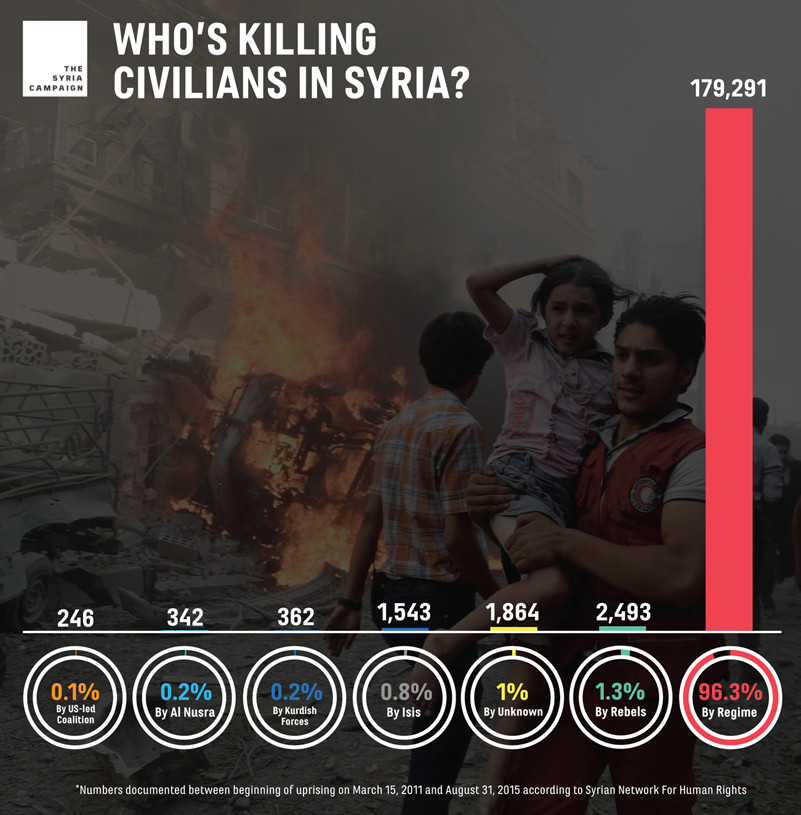
Of the thousands crossing the Mediterranean, most are fleeing the orgy of violence unleashed four years ago by President Bashar al-Assad against the citizens of his own country. That violence burst into view with the death of another young boy, 13-year-old Hamza al-Khateeb, whose brutal murder at the hands of police in the town of Daraa served as a kind of bloody prologue to the drowning death of Aylan Kurdi. Much like Kurdi, al-Khateeb was swept up by events far bigger than he was; after joining friends and family at an April 2011 protest, he was detained and then tortured. As images of al-Khateeb’s mutilated young body circulated across the Internet, mass protests erupted across Syria—from Daraa to Damascus, Aleppo to Homs—only to be met by the full, punishing force of the Assad military.

If the world’s powers had set their red line then, at the torture of al-Khateeb and the regime’s decimation of Daraa, it is possible that there might have been no refugee crisis today. But instead of supporting the revolution when it was a largely unarmed affair, the globe’s power players turned Syria into a geopolitical chessboard, actively sponsoring various sides of the conflict without concern for the civilian population. The United States and its Gulf allies pumped money and weapons into a murky constellation of rebel factions, empowering Al Qaeda affiliates that indirectly spawned the rise of the so-called Islamic State, or ISIS. Meanwhile, Russia and Iran funneled weapons, training, and funding to Assad and Hezbollah, the Lebanese Shiite militia, ensuring that the regime stayed afloat even as it subjected an untold number of Syrians to industrial-style torture and the terror of barrel bombings. [Continue reading…]

Facebooktwittermail

Putin supports Assad in ‘fighting terrorism’

CBS News: Charlie Rose: So you would like to join the United States in the fight against ISIS? That’s part of why you’re there [in Syria]. Others think that while that may be part of your goal, you’re trying to save the Assad administration because they’ve been losing ground and the war has not been going well for them. And you’re there to rescue them.

Vladimir Putin (through translator): Well, you’re right. And it’s my deep belief that any actions to the contrary in order to destroy the legitimate government will create a situation which you can witness now in the other countries of the region or in other regions, for instance in Libya, where all the state institutions are disintegrated. We see a similar situation in Iraq.

And there is no other solution to the Syrian crisis than strengthening the effective government structures and rendering them help in fighting terrorism. But at the same time, urging them to engage in positive dialogue with the rational opposition and conduct reform. [Continue reading…]

Aron Lund writes: the Kremlin has every reason to continue blurring the already indistinct dividing line between “extremist” and “moderate” rebels upon which Western states insist. Even though this neatly black and white categorization of Syria’s murky insurgency is at least partly fiction, it remains a politically indispensable formula for Western states that wish to arm anti-Assad forces. Which is precisely why erasing this distinction by extending airstrikes against all manners of rebels as part of an ostensibly anti-jihadi intervention, may turn out to be Putin’s long-term plan.

Blanket attacks on Syrian rebels on the pretext that they are all “al-Qaeda” would lead to much outraged commentary in the Western and Arab press. But to the Russian president it doesn’t matter if you think he’s Mad Vlad or Prudent Putin. He isn’t trying to win hearts and minds, least of all those of the Syrian rebels or their backers. Rather, he is trying to change the balance of power on the ground while firing missile after missile into the West’s political narrative.

Whatever one thinks of that, it is a big and bold idea of the sort that sometimes end up working. [Continue reading…]

While Putin reinforces the perception that the Assad regime is inseparable from the Syrian state, Scott Lucas writes: In Syria, the “state” and the “regime” are not the same thing. The state is the apparatus that administers the country and provides services, including education, health, and official papers that allow Syrians to marry, register property, or travel outside the country. The regime is a collection of informal networks based on personal, family, community, religious, and other ties that control the upper ranks of the state apparatus.

Before the uprising, most Syrians had an informal understanding of this distinction, particularly in areas of the country where social services were well-provided. In short, they were able to draw a line between the local branch of the Ministry of Water Resources, to which they could appeal if they had problems with their water supply, and the plainclothes officer from the Political Security Directorate who came inquiring at their door.

During the war, the regime has managed to blur this distinction to its advantage. [Continue reading…]

Facebooktwittermail

Who is Putin really protecting Assad from?

Mark N. Katz writes: Although the West may not like Assad, Russian officials and commentators are saying, his authoritarian regime is preferable to an even worse one that IS would establish that would pose a real threat to Western, as well as Russian, interests. Furthermore, Assad regime forces are needed in order to stop IS from taking over more — or even the rest — of Syria. Western insistence that Assad must step down, then, is foolish since this would gravely weaken the forces fighting against IS. The West should work with Moscow and the Assad regime against the common IS threat, and not against them.

This argument is based on the premise that the Assad regime is actively fighting against IS. There have been numerous reports, though, that the Assad regime and IS have actually not been fighting with each other, or not doing so very much. A widely quoted study by IHS Jane’s Terrorism and Insurgency Center at the end of last year noted that the Assad regime’s “counterterrorism operations…skew heavily towards groups whose names aren’t ISIS. Of 982 counterterrorism operations for the year up through Nov. 21 [2014], just 6 percent directly targeted ISIS.”

In February of this year, Time reported on a Sunni businessman with close ties to the Assad regime describing various forms of actual cooperation between the Assad regime and IS, including how the Assad regime buys oil from IS-controlled oil facilities, how Syria’s two main mobile phone operators provide service and send repair teams to IS-controlled areas, and how Damascus allows food shipments to the IS capital, Raqqa.

At the beginning of June 2015, US Embassy Damascus “accused the Syrian government of providing air support to an advance by Islamic State militants against opposition groups north of Aleppo.” In July, Turkish intelligence sources claimed that “an agreement was made between the Assad regime and ISIS to destroy the Free Syrian Army in the country’s north.”

Why would the Assad regime not fight against IS and even cooperate with it? Both of them have an interest in weakening their common foes: Syrian opposition groups supported by Turkey, Saudi Arabia, Qatar, and other countries. [Continue reading…]

Facebooktwittermail

Russian soldiers: Don’t send me to Syria

The Daily Beast reports: A group of Russian contract soldiers have refused to go on “an assignment,” as their army command referred to it in the papers they received about their secret deployment. The document did not have any return date. To their astonishment, the soldiers learned, nearly at the last minute, the country for their final destination was Syria. The scandalous case is now being investigated. The soldiers were threatened with severe punishment for their disobedience—a charge of state treason, their lawyer Ivan Pavlov told The Daily Beast, punishable by up to 20 years in prison in Russia.

“All the soldiers are asking for was a clear official order, so their widows would be paid compensations if they get killed abroad. Soldiers have a right to demand proper paperwork, they should always do that before they depart, otherwise their families would not receive a ruble,” Valentina Melnikova, head of the Committee of Soldiers’ Mothers, a Russian organization representing the troops’ families, told The Daily Beast.

But instead of providing the contract soldiers with the official paperwork, the army command reported them to investigators, according to the lawyer. Russian authorities have confirmed they provide weapons and military advisers to the Syrian government, as Moscow has for years, but deny Russian soldiers are being deployed into combat in Syria. [Continue reading…]

Facebooktwittermail

The rise and fall of Erdogan’s Turkey

Der Spiegel reports: Traveling through Turkey reveals a country divided. On the one side, there is Erdogan’s Turkey. It includes his hometown on the Black Sea, cities of Anatolia’s economic miracle, such as Kayseri, and of course Ankara, the seat of power. The other side is the land of his enemies. It stretches from Kurdish Diyarbakir, where people fear for their lives, to the Qandil Mountains, where Kurdish fighters have holed up, and finally to Istanbul, the nucleus of Turkish democracy.

Gültan Kisanak closes her eyes as the window panes in her office begin to shake. Every few minutes, fighter planes thunder over the town hall of Diyarbakir heading toward the Qandil Mountains. There, in the autonomous region of Kurdistan, the Turkish air force has been bombing positions of the banned Kurdistan Workers’ Party (PKK) since July 24.

Kisanak, 54, is a sturdy woman whose gray hair falls down to the shoulders of her pink blazer. Since early 2014, she has been the co-mayor of Diyarbakir — the first woman to hold the job. The pro-Kurdish HDP party, which received more than 80 percent of the vote here in June, mandates that all important offices are shared between one man and one woman.

During the election campaign, the HDP billed itself not only as a party for the Kurds, but also as an advocate of gender equality and gay rights. Above all, its candidates promised to challenge Erdogan’s plan of establishing a presidential republic. As it became clear that the HDP had received a solid 13 percent of the vote on June 7, people in Diyarbakir, the largest city in the southeast, were jubilant. They danced in the streets to an endless chorus of car horns and fireworks. All that was only three months ago. Today, the mood is grim. By nightfall, it’s quiet. Stores close early and people prefer to stay home out of fear for their lives. [Continue reading…]

Facebooktwittermail

Israeli cabinet approves lethal force against non-lethal threats

The New York Times reports: Israel’s security cabinet approved a series of measures on Thursday as part of a crackdown on rock throwing and firebombing by Palestinians in Jerusalem, including minimum sentences and greater leeway for the police to open fire — steps that opponents say contravene basic legal principles and may only escalate the violence.

Police officers will now be authorized to use Ruger rifles that fire .22-caliber bullets, which have less impact than other types of live ammunition but can still be lethal or cause serious injury.

Under the new regulations, police have permission to open fire not only when their own lives are threatened, as was the case previously, but also when there is “an immediate and concrete danger” to civilians, according to a government statement.

In addition, the government is preparing legislation to impose minimum prison terms of four years — the maximum is 20 years — for adults who throw rocks, homemade firebombs or shoot fireworks directly at people during confrontations. Increased fines will be imposed on convicted minors, ages 14 to 18, and their parents, and child support benefits will be revoked for jailed minors, the statement added. [Continue reading…]

Facebooktwittermail