Gideon Levy writes: The United Nations Human Rights Council’s report did not tell us anything new. We did not need to wait a year to know that Israel (and Hamas) committed war crimes; there was no need to impanel a committee to know that Israel went wild in Gaza; there was no need to bother judge Mary McGowan Davis in order for her to tell us that it is unacceptable to drop a one-ton bomb in the middle of a neighborhood. We have known that for a long time.
The UN report also did not tell us anything new about Israel’s response. There was no need to publish it to know the scope of unreceptiveness and denial within Israeli society, the low level to which the Israeli media stooped in finally allowing itself to become an agent of propaganda, and the lack of interest that all this killing and destruction in Gaza arouse in Israel. We have known all that for a long time.
The world knows the fundamental truths, and every commission repeats them like a parrot, and nothing changes: Israel ignores international law. It is convinced that it applies to all countries, except for itself. According to its combat theory, when the life of one Israeli soldier is at stake it is alright to wreak havoc with everything, and when Israel says everything it means everything. There is no chance Israel will change its doctrine of death and destruction, unless it is punished severely. Therefore this report, like all its predecessors, has no value at all.
If the Goldstone Report, which described in harsher colors a less brutal attack, did not prevent Operation Protective Edge, then why do we need all these reports? If the international community, which knew in real time what the Israel Defense Forces was doing in Gaza, did not respond immediately with actions that would stop it, then there is no reason for these commissions of inquiry after the fact.
If in the wake of this commission, too, the international community does not take practical steps against war criminals, then there is no further reason for commissions. [Continue reading…]
Category Archives: Lands
ISIS carries out the second-largest massacre since the declaration of its ‘caliphate’
The Syrian Observatory for Human Rights reports: “Islamic State” carries out the second- largest massacre since the declaration of its alleged “caliphate” and kills at least 146 civilians in the city of Ayn al- Arab and its countryside.
SOHR could document the death of at least 120 civilians in the last 24 hours in the city of Ayn al- Arab (Kobani), where local, medical and field sources informed SOHR that at least 120 citizens killed by gunshots fired by IS militants who attacked the city yesterday dawn after they could infiltrate to the city wearing uniforms of YPG and allied rebel brigade. The sources reported to SOHR that among the victims there are dozens of elderlies, children and women, where 72 civilians killed in Halnaj area while the rest died in the neighborhood of Maqtala in the city of Ayn al- Arab. About 200 other citizens were wounded too, some of them in critical situation. Information reported more victims killed by IS militants whose 28 of them killed in the clashes so far. Meanwhile, the clashes are still taking place with IS groups besieged by YPG inside the city. This massacre is considered the second- largest massacre committed by IS since the declaration of its alleged “caliphate” after the massacre carried out against al- Shaitat tribe where more than 930 people of the tribe executed by IS in the eastern countryside of Deir Ezzor. [Continue reading…]
Terrorist attacks in France, Tunisia and Kuwait kill dozens
The New York Times reports: Terrorists attacked sites in France, Tunisia and Kuwait on Friday, leaving a bloody toll on three continents and prompting new concerns about the spreading influence of jihadists.
In France, attackers stormed an American-owned industrial chemical plant near Lyon, decapitated one person and tried unsuccessfully to blow up the factory.
In Tunisia, gunmen opened fire at a beach resort, killing at least 27 people, officials said. At least one of the attackers was killed by security forces.
And the Islamic State claimed responsibility for a suicide bombing in one of the largest Shiite mosques in Kuwait City during Friday prayers. The bomb filled the hall with smoke and left dead and wounded scattered on the carpet, according to witnesses and videos posted online. Local news reports said at least 24 people had been killed and wounded in the assault, which was extraordinary for Kuwait and appeared to be a deliberate attempt to incite strife between Shiites and Sunnis.
In a message circulating on social media, the Islamic State called the suicide bomber “one of the knights of the Sunni people.”
There was no immediate indication that the attacks had been coordinated. But the three strikes came at roughly the same time, and just days after the Islamic State, the militant group also known as ISIS or ISIL, called for such operations during the Muslim holy month of Ramadan. [Continue reading…]
Families of American hostages held captive in Syria felt U.S. officials had abandoned them
Lawrence Wright writes: Five American families, each harboring a grave secret, took their seats around a vast dining table at the home of David Bradley, a Washington, D.C., entrepreneur who owns the media company that publishes The Atlantic. It was May 13, 2014, and in the garden beyond the French doors, where magnolias and dogwoods were in bloom, a tent had been erected for an event that Bradley’s wife, Katherine, was hosting the following evening. The Bradleys’ gracious Georgian town house, on Embassy Row, is one of the city’s salons: reporters and politicians cross paths at off-the-record dinners with Supreme Court Justices, software billionaires, and heads of state.
The families weren’t accustomed to great wealth or influence. Indeed, most of them had never been to Washington before. Until recently, they had not known of one another, or of the unexpected benefactor who had brought them together. They were the parents of five Americans who had been kidnapped in Syria. The Federal Bureau of Investigation had warned the families not to talk publicly about their missing children — and the captors had threatened to kill their hostages if word leaked out — so each family had been going to work and to church month after month and reassuring colleagues and neighbors and relatives that nothing was wrong, only to come home and face new threats and ransom demands. After hiding the truth for so long, the families were heartened to learn that others were going through the same ordeal, and they hoped that by working together they might bring their children home. [Continue reading…]
Yemeni heritage, Saudi vandalism
Lamya Khalidi writes: For more than 10 years, I was one of a number of American and Yemeni archaeologists surveying and excavating sites dating to the fabled South Arabian kingdoms and beyond, to prehistoric times. We were members of the Dhamar Survey Project, started by the University of Chicago and named for a historic town in highland Yemen.
The team spent decades exploring the magnificent megalithic monuments and walled towns of a civilization that developed terraced agriculture as early as the third millennium B.C., an ancient tradition that has stunningly etched the entire surface area of the region’s steep mountains like a topographical map. The project collected thousands of artifacts from more than 400 sites, including tools, pottery, statuary and inscriptions in ancient South Arabian languages.
We ensured that all of these artifacts, evidence of ancient cultures that traded at great distances during the Neolithic period and eventually built roads to link the highland towns to major incense trade routes, were deposited in the Dhamar Regional Museum. There, they were restored and studied by foreign teams and Yemeni archaeologists, and put on display.
This museum has just been obliterated from the air. In a matter of minutes, the irreplaceable work of ancient artisans, craftsmen and scribes — not to mention the efforts of Yemeni and foreign researchers who have dedicated years of their lives to studying and preserving this legacy — were pulverized. The museum and its 12,500 artifacts were turned to rubble by Saudi bombs. [Continue reading…]
Theft of Saudi documents suggests an Iranian hack
The Washington Post reports: The purported theft of confidential Saudi documents that have been released by WikiLeaks bears the hallmarks of Iranian hackers linked to cyberattacks in more than a dozen countries, including the United States, according to cybersecurity experts and Middle East analysts.
Last week, WikiLeaks published about 70,000 of what it said were half a million documents obtained from Saudi Arabia’s Foreign Ministry. The transparency advocacy group promises more releases of the diplomatic cables, whose authenticity has not been independently verified.
Experts said that the cables, apparently stolen over the past year, paint an unflattering portrait of Saudi diplomacy as reliant on oil-wealth patronage and obsessed with Iran, the kingdom’s chief rival, but appeared to contain no shocking revelations. [Continue reading…]
Inside the hack of the century
Peter Elkind writes: On Monday, Nov. 3, 2014, a four-man team from Norse Corp., a small “threat-intelligence” firm based in Silicon Valley, arrived early for an 11:30 a.m. meeting on the studio lot of Sony Pictures Entertainment, in the Los Angeles suburb of Culver City. They were scheduled to see Sony’s top cybersecurity managers to pitch Norse’s services in defending the studio against hackers, who had been plaguing Sony for years.
After a quick security check at the front gate and then proceeding to the George Burns Building on the east side of the Sony lot, the Norse group walked straight into the unlocked first-floor offices of the information security department, marked with a small sign reading info sec. There was no receptionist or security guard to check who they were; in fact, there was no one in sight at all. The room contained cubicles with unattended computers providing access to Sony’s international data network.
The visitors found their way to a small sitting area outside the office of Jason Spaltro, Sony’s senior vice president for information security, settled in, and waited. Alone. For about 15 minutes.
“I got a little shocked,” says Tommy Stiansen, Norse’s co-founder and chief technology officer. “Their Info Sec was empty, and all their screens were logged in. Basically the janitor can walk straight into their Info Sec department.” Adds Mickey Shapiro, a veteran entertainment attorney who helped set up the meeting and was present that day: “If we were bad guys, we could have done something horrible.”
Finally Spaltro, who’s worked at Sony since 1998, showed up and led them to a nearby conference room, where another studio information security executive was waiting. The meeting began, and as Stiansen described how Norse scopes out potential threats, Spaltro interrupted: “Boy, that could really help us with that North Korean film!” According to the four Norse representatives, Spaltro explained that he was worried about a Seth Rogen comedy called The Interview that the studio was preparing to release on Christmas Day. It featured a plot to assassinate Kim Jong-un, the country’s actual leader. Recalls Stiansen: “They said North Korea is threatening them.” (Sony denies any mention of a North Korean cyberthreat.)
After about an hour the Sony team declared the session “very productive,” according to the Norse team, and promised to be in touch. They departed, leaving the visitors to find their own way out.
Three weeks later — starting at about 7 a.m. Pacific time on Monday, Nov. 24 — a crushing cyberattack was launched on Sony Pictures. Employees logging on to its network were met with the sound of gunfire, scrolling threats, and the menacing image of a fiery skeleton looming over the tiny zombified heads of the studio’s top two executives.
Before Sony’s IT staff could pull the plug, the hackers’ malware had leaped from machine to machine throughout the lot and across continents, wiping out half of Sony’s global network. It erased everything stored on 3,262 of the company’s 6,797 personal computers and 837 of its 1,555 servers. To make sure nothing could be recovered, the attackers had even added a little extra poison: a special deleting algorithm that overwrote the data seven different ways. When that was done, the code zapped each computer’s startup software, rendering the machines brain-dead.
From the moment the malware was launched — months after the hackers first broke in — it took just one hour to throw Sony Pictures back into the era of the Betamax. The studio was reduced to using fax machines, communicating through posted messages, and paying its 7,000 employees with paper checks.
That was only the beginning of Sony’s horror story. [Continue reading…]
Why cyber war is dangerous for democracies
Moisés Naím writes: This month, two years after his massive leak of NSA documents detailing U.S. surveillance programs, Edward Snowden published an op-ed in The New York Times celebrating his accomplishments. The “power of an informed public,” he wrote, had forced the U.S. government to scrap its bulk collection of phone records. Moreover, he noted, “Since 2013, institutions across Europe have ruled similar laws and operations illegal and imposed new restrictions on future activities.” He concluded by asserting that “We are witnessing the emergence of a post-terror generation, one that rejects a worldview defined by a singular tragedy. For the first time since the attacks of Sept. 11, 2001, we see the outline of a politics that turns away from reaction and fear in favor of resilience and reason.”
Maybe so. I am glad that my privacy is now more protected from meddling by U.S. and European democracies. But frankly, I am far more concerned about the cyber threats to my privacy posed by Russia, China, and other authoritarian regimes than the surveillance threats from Washington. You should be too. [Continue reading…]
The day after a nuclear deal with Iran
Hooman Majd writes: Iranian president Hassan Rouhani may soon discover that negotiating a nuclear deal was the easy part of his job. He is likely to have a much more difficult time in office — with pressure from his opponents and his supporters — once the initial euphoria of a deal passes. Not only will he have to show that the nuclear deal does indeed better the lives of ordinary Iranians by drastically improving the economy, he will no longer have the excuse of the nuclear deal in delaying his other campaign promises. And he will still have his hardline opponents, even less willing to grant him another popular achievement, nipping at his heels on every issue, particularly any issue that relates to a loosening of social restrictions and building a new relationship with the U.S. in the aftermath of a deal.
With only days to go until the deadline to ink such a comprehensive nuclear deal with Iran — and this is a deadline that, unlike the others in the eighteen month long negotiations saga, will need to be adhered to, at least to within a few days — it’s safe to assume that a deal will be struck. My confidence is based on the political capital spent in both Washington and Tehran, the political will in both capitals to move past a crisis that has benefited neither party and the presumption in both capitals that the time for a nuclear deal is now or never.
On the brink of this historic agreement, it’s useful to ask “what next?” for Iran and more importantly, for Iranians. The future of this nation of some 80 million, sitting at the crossroads of the East and West, on top of bountiful energy supplies, and in the center of — if not a factor in — multiple regional crises with knock-on effects, is tied to the future of the entire world, whether we like it or not. [Continue reading…]
Iran nuclear talks: Clearing the final hurdles
Reza Marashi writes: As officials from Iran and the permanent members of the United Nations Security Council plus Germany (P5+1) negotiate around the clock in Vienna, the self-imposed June 30 deadline steadily approaches to seal a comprehensive nuclear deal. The Obama and Rouhani administrations should be commended: The amount of progress made in the past eighteen months is greater than the preceding decade combined. The two sides are now on the cusp of a historic deal that will be one of the greatest foreign policy achievements in recent memory.
Standing in the way of victory are two key issues, both of which are resolvable: Sanctions relief, and inspections and verification.
Finding the right formula for sanctions relief will likely be the most challenging issue in Vienna. If Washington offers sanctions relief that does not provide practical value for Tehran, it will correspondingly diminish the practical value for Iranian decision-makers to uphold their end of the bargain. Iran gave more than it received in the interim nuclear deal, and is looking to collect on that investment. The P5+1 believes it must maintain the architecture of sanctions to ensure Iranian compliance. Splitting the difference will require compromise on two fronts: Multilateral sanctions and unilateral sanctions. [Continue reading…]
Operation Hannibal: Why Israel risks killing its own soldiers rather than see them get captured
Dan Ephron writes: On the morning of August 1, 2014, during the broadest Israeli assault on the Gaza Strip in years, a squad of Hamas fighters emerged from a shaft in the ground near the town of Rafah and ambushed three Israeli soldiers. The Israelis, members of an elite reconnaissance unit from the Givati Brigade, had been searching for a tunnel in the area, one of a network that the militant group Hamas had built under the Palestinian territory in recent years. In humid 80-degree heat, a firefight ensued that killed two of the Israelis and one of the Palestinians. It lasted less than a minute.
The war in Gaza, which had raged for three weeks by then and claimed the lives of dozens of Israelis and some 1,500 Palestinians, seemed to be tapering off. The ambush near Rafah would have gone down as one more skirmish. But as the surviving Palestinians retreated, they did something that would turn that Friday into the bloodiest day of the summer and embroil Israel in a possible war-crimes ordeal that reverberates even now: They dragged the third Israeli, Lieutenant Hadar Goldin, with them underground.
The sound of the gunfire drew other Israeli soldiers to the site, including Lieutenant Eitan Fund, the reconnaissance unit’s second-in-command. What Fund saw when he got there — bodies on a sandy road and an opening in the ground a few feet away — filled him with dread. Dead soldiers were disturbing enough, but for Israel, a missing fighter was about the worst possible outcome of any battlefield engagement. The last time Hamas had seized a soldier was in 2006: Corporal Gilad Shalit’s captivity lasted five years and set off a searing national trauma.
Fund, who was 23, had come to know Goldin during an officers’ training course. The two had also studied at the same religious seminary in the West Bank before their service. Fund radioed the details to his brigade commander, Col. Ofer Winter, and asked permission to take a squad underground. Winter instructed the lieutenant to drop a grenade and lower himself in. He then announced over the radio the start of a controversial procedure that Israel deploys when a soldier is taken captive: “Hannibal, Hannibal.”
To the military in the United States and around the world, Israel serves as a kind of laboratory for battle tactics, especially those involving counterinsurgency. Its wars with guerrilla groups like Hamas and Lebanon’s Hezbollah — four in the past nine years — are pored over for the lessons they hold and the questions they raise. The story of Hadar Goldin raises one question in particular: How far should a modern military go to prevent one of its own from being captured?
For the United States, the answer has centered mostly on technology. Today’s American troops go into battle with portable computers and GPS devices, including a system known as Blue Force Tracking that allows commanders in Humvees to “see” their forces in the arena. Ground troops are also monitored by satellites and drones. This combination of new technologies has produced a staggering drop in battlefield captives in Afghanistan and Iraq compared with previous wars. But the risks of combat remain great: U.S. Army Sergeant Salvatore Giunta became the first living Medal of Honor recipient in the war in Afghanistan, in part, for rescuing a comrade being dragged away by the Taliban during an ambush in 2007.
Israel has its own technology, of course, but it supplements those tools with a tactic the army revived in the aftermath of the Shalit ordeal — code word Hannibal — that calls for a massive use of force when a soldier is captured. Two Israelis familiar with the wording of the classified procedure described it to me as measured and restrictive. But from conversations with others, including more than a dozen Israelis in and out of uniform, it’s clear that soldiers often interpret it as something less nuanced—a kind of signal from commanders that a dead Israeli fighter is better than a captured one. Fund seemed to share that interpretation. As he entered the shaft, he told one of his squad members: “If you see something, open fire, even if it means killing Hadar or wounding Hadar.” [Continue reading…]
British men who fought the Assad regime are now hiding from their own government
BuzzFeed reports: It was at the beginning of 2013 that Shaam decided he needed to fight in Syria. He was volunteering on the country’s border with Turkey in an aid convoy after finishing his university degree back home in the UK. The Syrian revolution had descended into civil war as a multitude of rebel groups took up arms to fight the regime of dictator Bashar al-Assad. “After seeing [the regime] dropping barrel bombs and children crying in the streets,” Shaam tells BuzzFeed News, “I had to do something.”
A few months later, he says, he travelled from the UK to the outskirts of the city of Idlib to fight with a composite of militias at the frontline of what has become one of the most brutal wars in recent history.
But while he initially travelled with the hope of “toppling Assad” and paving the way for what he hoped would be “real freedom for the Syrian people”, little more than a month later he decided to return home, disillusioned with both the prospect of fighting the regime and, in the wake of violent Islamist movements, whether “moderate” opposition forces – such as the one he joined – could really succeed.
But while Shaam believes he’s adjusted back into British society, he says he’s not been able to speak about his experiences in Syria since returning. Furthermore, he’s living in hiding, fearful that the British government could arrest him under the belief that he is a terrorist threat – despite the fact that he fought against Assad’s regime. [Continue reading…]
ISIS just lost its Libya stronghold
Institute For The Study Of War reports: The Islamic State of Iraq and al-Sham (ISIS)’s affiliate in Libya lost control of its eastern stronghold of Derna after tensions with a local Islamist militia escalated into violent conflict on June 9, 2015. Gunmen from ISIS allegedly assassinated Abu Salim Martyrs Brigade (ASMB) leader Nasser al-Aker, who was a senior member of the al-Qaeda-associated Libyan Islamic Fighting Group (LIFG).
The Mujahedeen Shura Council of Derna (MSC Derna), an umbrella group controlled by ASMB, released a statement declaring jihad on ISIS in Derna soon after the assassination. Clashes erupted across the city. Anti-ISIS forces cleared ISIS from central Derna and captured ISIS’s headquarters on June 13, despite ISIS’s defensive deployment of multiple SVBIEDs [Suicide Vehicle-Borne Improvised Explosive Devices]. ISIS now holds no territory inside the city.
Social media reports from activists within Derna indicate strong local animosity towards ISIS. Derna’s residents organized demonstrations against ISIS on June 11 and 12, and according to unconfirmed rumors may have been armed by ASMB to participate in military operations against ISIS. [Continue reading…]
Splitting the Islamists: ISIS’s creeping advance in Libya
Frederic Wehrey and Ala’ Alrababa’h write: Since the Islamic State first announced its presence in Libya in late 2014, it has expanded to attack cities across much of the country, ranging from Benghazi in the east to Misrata and Tripoli in the west, and even in the southern deserts. At this point, the self-proclaimed Islamic State in Libya includes thousands of fighters, possibly 3,000 or even 5,000, with many of them being foreign volunteers from Tunisia, Algeria, Egypt, or Saudi Arabia.
Even though some observers tend to portray the rise of the Islamic State in Libya as the result of a ruthless and brilliant strategy, its advance appears to be largely opportunistic, occasioned by the fissures, distraction, and incapacity of rival factions. Where the group senses an opening, it moves, tapping into various kinds of disenchantment to divide opponents and attract potential recruits, whether among disillusioned Islamists, aggrieved tribes, or marginalized minor factions.
While it is hard to speak of a coherent strategy of the Islamic State in Libya, one consistent element of its approach has been to weaken other Islamist groups, in order to present itself as the only viable alternative for Islamists in the country. [Continue reading…]
Climate change judgement in the Hague could inspire a global civil movement
The Guardian reports: “You have been negotiating all my life”, cried out 21-year-old Anjali Appadurai from the lectern of a UN climate change conference four years ago. The activist, speaking on behalf of her nation’s youth, could have speaking for anyone who has taken a mild interest in more than two decades of international negotiations on climate change and stood aghast as world leaders have failed to protect the most basic of human rights – to exist.
But today, thanks to 886 Dutch citizens who decided to sue their government, all of that may change. We may not have to wait for the politicians to save us – the lawyers may step in instead. In the first successful case of its kind, a judge in the Hague has ruled that the Dutch government’s stance on climate change is illegal and has ordered them to take action to cut greenhouse gas emissions by a hefty 25% within five years.
Lawyers say the precedent it sets could trigger similar cases all around the world. Already, in Belgium, 8, 000 citizens are preparing for a similar court case, with others pointing to another possible lawsuit in Norway. Although the case is only binding within the Netherlands, lawyers say that it will inspire lawyers and judges considering similar cases in many other countries. [Continue reading…]
America’s embattled Christian majority?
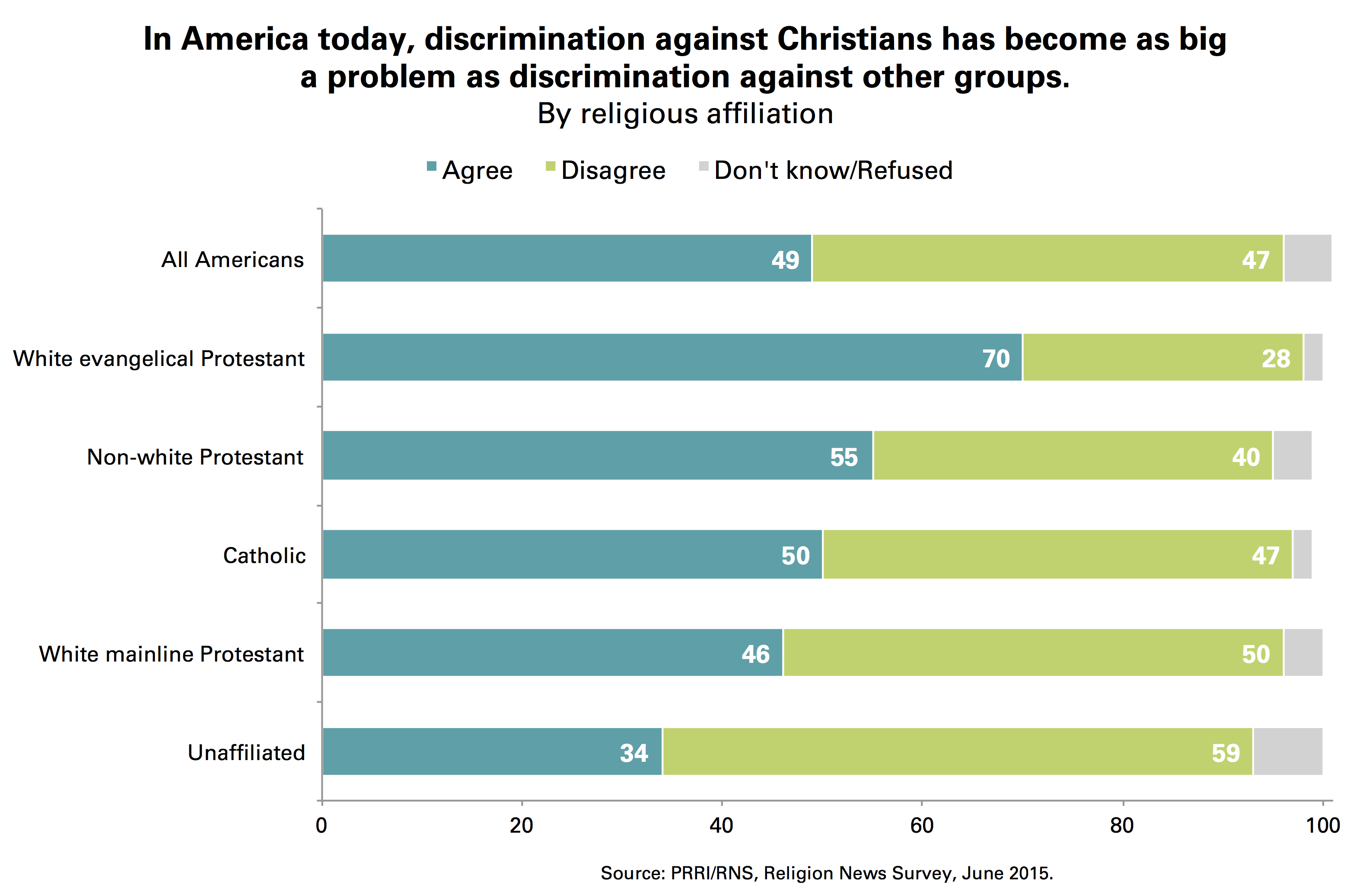
In America, 72% of the adult population identify themselves as Christian.
That, to my mind, makes this demographically (though of course not constitutionally) a Christian country.
And yet, among white evangelical Protestants, 70% believe that discrimination against Christians has become as big of a problem as discrimination against other groups!
The persecuted majority?
Do Christians get harassed by the police? Get discriminated against by landlords or employers? Get harsher jail sentences? Suffer any of the other forms of discrimination experienced by many minorities in this country?
Or, do some Christians simply resent living under a democratic constitution that separates Church and State?

How many lives will be saved by flag control?
John Cassidy writes: After living in this country for almost thirty years, I confess I find it hard to write about gun massacres. They are just too familiar, and too depressing. An alienated post-adolescent, almost always white, gets a gun, or guns, and exorcises his demons by killing as many people as he can. Then follows an equally predictable media outpouring, with round-the-clock coverage on cable, lengthy accounts in the serious papers, harrowing profiles of the victims, and why-oh-why editorials aplenty. Flags are flown at half-mast. Politicians, especially those who represent the area in which the massacre occurs, say that something needs to be done about gun control.
Nothing much happens, of course, and, after a while, we move onto the next incident. Back in the nineteen-eighties and -nineties, for some reason, fast-food restaurants and post offices were the sites of some of the deadliest incidents. Then came a series of school massacres, including at Columbine, where Eric Harris and Dylan Klebold killed twelve high-school students and a teacher, and at Virginia Tech, where Seung-Hui Cho killed thirty-two people before taking his own life. In Newtown, Connecticut, in December, 2012, a twenty-year-old misfit named Adam Lanza murdered twenty elementary schoolchildren, and six of their teachers, before taking his own life, too. Then there were the 2012 shootings in Aurora, Colorado: twelve people gunned down at a midnight showing of “The Dark Knight Rises.”
Which leads us to Charleston, and the latest atrocity. In this case, of course, we have the complicating and insidious factor of racism to consider. The suspected shooter, Dylann Roof, didn’t choose the Emanuel African Methodist Episcopal Church at random. The evidence suggests that his alienation took the form of embracing white-supremacy claptrap, and that he wanted to kill black people specifically. When Roof reached Emanuel A.M.E., which is one of the oldest and best-known black churches in the country, on Wednesday evening, the members of a prayer group he encountered were so nice to him that he hesitated to go through with his “mission,” he has reportedly told police. Sadly, he managed to overcome his humane impulses.
President Obama, Hillary Clinton, and many others, including my colleagues David Remnick and Jelani Cobb, have pointed out how this tragedy reminds us that, in Obama’s words, “We don’t have to look far to see that racism and bigotry, hate and intolerance, are still all too alive in our world.” Did we really need reminding, though? The United States was partly built on racial cleansing and slavery: racism, and racist violence, have long been a part of its social fabric, as have efforts to root out these evils and eradicate them.
In the wake of last week’s events, attempts to confront racial bigotry need to be renewed and intensified, with particular attention being paid to right-wing groups that propagate hatred on the Internet and elsewhere. But the historic battle against racism and racial subordination shouldn’t distract from the other pressing policy issue at hand. On the death certificates of eighty-seven-year-old Susie Jackson, seventy-year-old Ethel Lance, and the rest of the victims, the cause of death won’t be listed as racism: it will be gunshot wounds. Roof’s despicable views didn’t kill anybody: the weapon he used was a .45 mm Glock handgun, which, according to the police, he bought at a local gun store. [Continue reading…]
Nomi Prins: Jeb! The money! Dynasty!
Money, they say, makes the world go round. So how’s $10 billion for you? That’s a top-end estimate for the record-breaking spending in this 1% presidential election campaign season. But is “season” even the right word, now that such campaigns are essentially four-year events that seem always to be underway? In a political world stuffed with money, it’s little wonder that the campaign season floats on a sea of donations. In the case of Jeb Bush, he and his advisers have so far had a laser-focus on the electorate they felt mattered most: big donors. They held off the announcement of his candidacy until last week (though he clearly long knew he was running) so that they could blast out of the gates, dollars-wise, leaving the competition in their financial dust, before the exceedingly modest limits to non-super PAC campaign fundraising kicked in.
And give Jeb credit — or rather consider him a credit to his father (the 41st president) and his brother (the 43rd), who had Iraq eternally on their minds. It wasn’t just that Jeb flubbed the Iraq Question when a reporter asked him recently (yes, he would do it all over again; no, he wouldn’t… well, hmmm…), but that Iraq is deeply embedded in the minds of his campaign team, too. His advisers dubbed the pre-announcement campaign they were going to launch to pull in the dollars a “shock-and-awe” operation in the spirit of the invasion of Iraq. Now, having sent in the ground troops, they clearly consider themselves at war. As the New York Times reported recently, the group’s top strategist told donors that his super PAC “hopes to ‘weaponize’ its fund-raising total for the first six months of the year.”
The money being talked about: $80-$100 million raised in the first quarter of 2015 and $500 million by June. If reached, these figures would indeed represent shock-and-awe fundraising in the Republican presidential race. As of now, there’s no way of knowing whether they’re fantasy figures or not, but here’s a clue to Jeb’s money-raising powers: according to the Washington Post, his advisers have been asking donors not to give more than a million dollars now; they are, that is, trying to cap donations for the moment. (As the Post’s Chris Cillizza wrote,“The move reflects concerns among Bush advisers that accepting massive sums from a handful of uber-rich supporters could fuel a perception that the former governor is in their debt.”) And having spent just about every pre-announcement day for months doing fundraisers and scouring the country for money, while preserving the fiction that he might not be interested in the presidency, Jeb, according to the New York Times, bragged to a group of donors that “he believed his political action committee had raised more money in 100 days than any other modern Republican political operation.”
Let’s not forget, of course, that we’re not talking about anyone; we’re talking about a Bush. We’re talking about the possibility of becoming number three (or rather Bush 45) in the Oval Office. We’re talking about what is, by now, a fabled money-shaking, money-making, money-raising machine of a family. We’re talking dynasty and when it comes to money and the Bushes (as with money and that other potential dynasty of our moment), no one knows more on the subject than Nomi Prins, former Wall Street exec and author of All the Presidents’ Bankers: The Hidden Alliances That Drive American Power. In her now ongoing TomDispatch series on the political dynasties of our moment, fundraising, and the Big Banks, think of her latest post as an essential backgrounder on the election you have less and less to do with, in which Wall Street, the Koch brothers, Sheldon Adelson, and the rest of the crew do most of the essential voting with their wallets. Tom Engelhardt
All in
The Bush family goes for number three (with the help of its bankers)
By Nomi Prins[This piece has been adapted and updated by Nomi Prins from her book All the Presidents’ Bankers: The Hidden Alliances That Drive American Power, recently out in paperback (Nation Books).]
It’s happening. As expected, dynastic politics is prevailing in campaign 2016. After a tease about as long as Hillary’s, Jeb Bush (aka Jeb!) officially announced his presidential bid last week. Ultimately, the two of them will fight it out for the White House, while the nation’s wealthiest influencers will back their ludicrously expensive gambit.
And here’s a hint: don’t bet on Jeb not to make it through the Republican gauntlet of 12 candidates (so far). After all, the really big money’s behind him. Last December, even though out of public office since 2007, he had captured the support of 73% of the Wall Street Journal’s “richest CEOs.” Though some have as yet sidestepped declarations of fealty, count on one thing: the big guns will fall into line. They know that, given his family connections, Jeb is their best path to the White House and they’re not going to blow that by propping up some Republican lightweight whose father and brother weren’t president, not when Hillary, with all her connections and dynastic power, will be the opponent. That said, in the Bush-Clinton battle to come, no matter who wins, the bankers and billionaires will emerge victorious.