Reuters reports: Iraq’s Prime Minister-designate Haider al-Abadi said on Sunday during talks with Iran’s foreign minister that international efforts would be necessary to destroy Islamic State Sunni militants who have seized swathes of his country and of Syria.
Foreign Minister Mohammad Javad Zarif of Iran, a Shi’ite Muslim regional power likely to wield influence over the formation of Abadi’s new cabinet, reaffirmed Tehran’s support for Iraq’s territorial unity and its fight against militants.
“Abadi pointed to the presence of many dangers posed in the region as a result of the existence of the terrorist gang Islamic State which requires regional and international efforts to exterminate this terrorist organization,” his office said in a statement after the talks with Zarif. [Continue reading…]
Category Archives: Lands
Teenager describes being used as a human shield by Israeli soldiers
The New York Times reports: A Palestinian teenager says that Israeli soldiers detained him for five days last month, forcing him to sleep blindfolded and handcuffed in his underwear and to search and dig for tunnels in Khuza’a, his village near Gaza’s eastern border, which was all but destroyed in the fighting.
The teenager, Ahmed Jamal Abu Raida, said the soldiers assumed he was connected to Hamas, the militant Islamist group that dominates Gaza, insulted him and Allah and threatened to sic a dog on him.
“My life was in danger,” Ahmed, 17, said in one of two lengthy interviews on Thursday and Friday. As soldiers made him walk in front of them through the neighborhood and check houses for tunnels, he added, “In every second, I was going to the unknown.”
His assertions, of actions that would violate both international law and a 2005 Israeli Supreme Court ruling, could not be independently corroborated; Ahmed’s father, Jamal Abu Raida, who held a senior position in Gaza’s Tourism Ministry under the Hamas-controlled government, said the family forgot to take photographs documenting any abuse in its happiness over the youth’s return, and disposed of the clothing he was given upon his release. The case was publicized Thursday by Defense for Children International-Palestine, an organization whose reports on abuses of Palestinian youths in West Bank military jails have been challenged by the Israeli authorities.
The Israeli military confirmed that troops had suspected Ahmed of being a militant and detained him during their ground operation in Gaza, noting his father’s affiliation with Hamas. A military spokesman promised several times to provide more details, but ultimately did not deal with the substance of the allegations, saying they had “been referred to the appropriate authorities for examination.”
A military statement also challenged the credibility of D.C.I.-Palestine, which accused the Israeli military of using Ahmed as a human shield by coercing him to engage in military actions. Throughout the current conflict, Israel has argued that Hamas uses Gaza residents as human shields by conducting militant activity in crowded public places.
“D.C.I.-Palestine’s report represents a perverse inversion of a truth in which Hamas persistently engages in the use of human shields, while the I.D.F.’s code of conduct rejects, in absolute terms, such behavior,” the military statement said, using the abbreviation for the Israel Defense Forces.
Israeli soldiers could not have used human shields because they are all good boys who follow the rules.
What kind of imbecile in the IDF sees fit to present this line of reasoning? Israeli arrogance, in its contempt for the intelligence of others, is itself a form of idiocy.
In 2010, Haaretz reported:
The southern command military court convicted two Israeli soldiers on Sunday of using human shields during Operation Cast Lead, Israel’s offensive in the Gaza Strip, in the winter of 2008-2009.
The soldiers were convicted of offenses including inappropriate behavior and overstepping authority for ordering an 11-year-old Palestinian to search bags suspected to have been booby trapped.
The conviction is the first such conviction for what is termed in the Israel Defense Forces “neighbor procedure” – the use of human shields during searches and pursuits, which has been outlawed.
Note: this was the first conviction — not the first occurrence.
Moreover, when the report notes that the use of human shields has been outlawed, this alludes to two facts:
1. That the use of human shields was standard practice in the IDF, and
2. that even after Israel’s high court ruled that the use of human shields was illegal, the IDF tried to get the ruling overturned.
The fact that the IDF failed in that effort, does not infer that individual soldiers stopped viewing the use of human shields as serving their interests — merely that those engaging in this practice would understand that they would need to take greater effort to avoid getting caught.

Aviva Chomsky: What’s at stake in the border debate
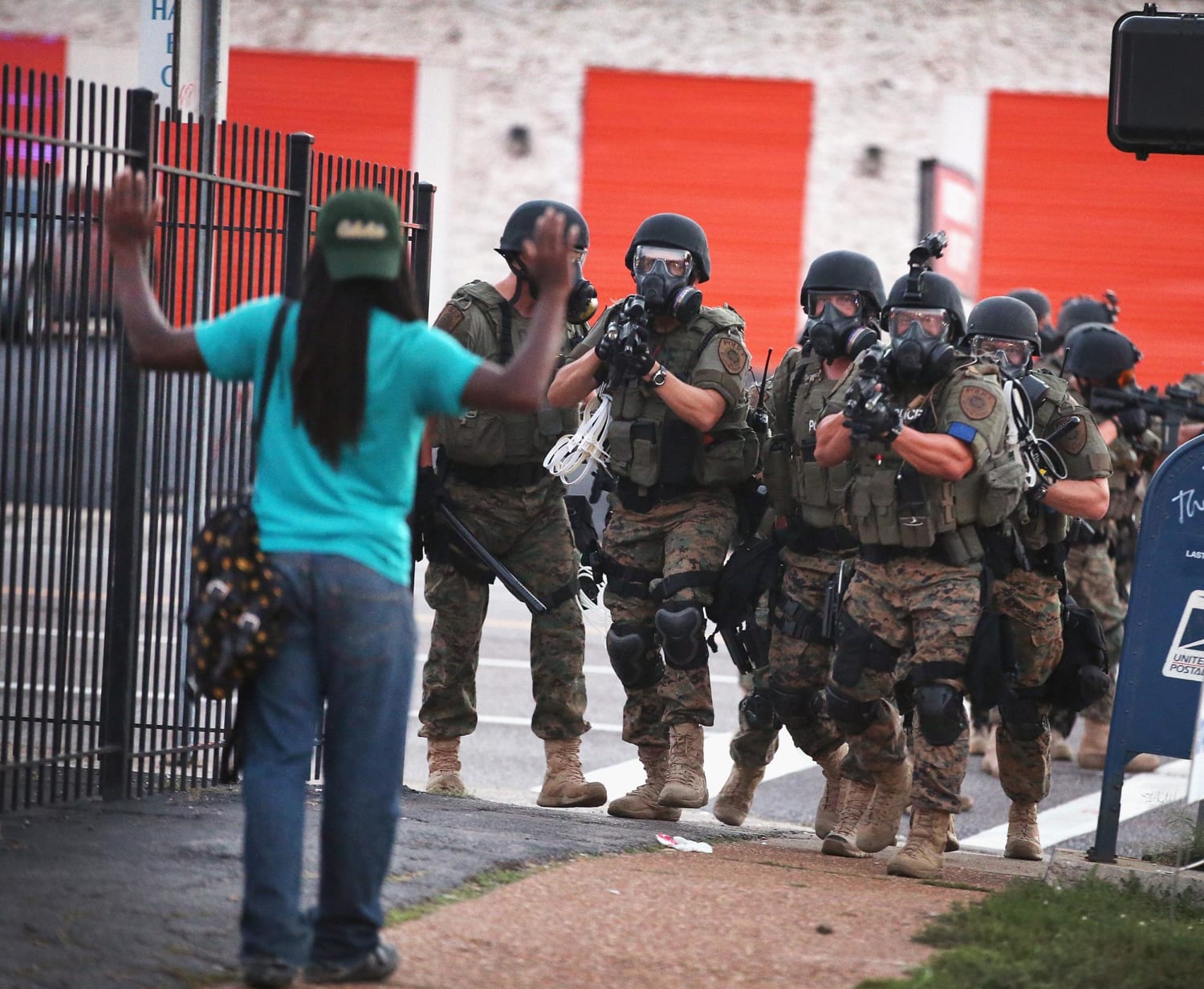
The militarization of the police has been underway since 9/11, but only in the aftermath of the six-shot killing of an unarmed teenager in Ferguson, Missouri, with photos of streets in a St. Louis suburb that looked like occupied Iraq or Afghanistan, has the fact of it, the shock of it, seemed to hit home widely. Congressional representatives are now proposing bills to stop the Pentagon from giving the latest in war equipment to local police forces. The president even interrupted his golfing vacation on Martha’s Vineyard to return to Washington, in part for “briefings” on the ongoing crisis in Ferguson. So militarization is finally a major story.
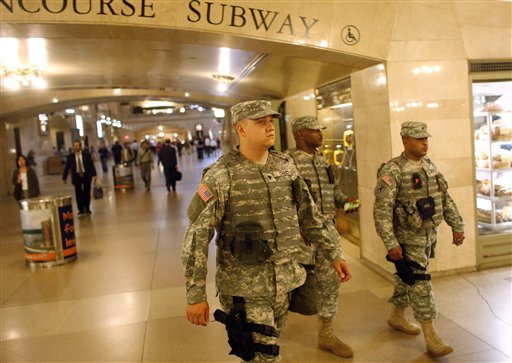
And that’s no small thing. On the other hand, the news from Ferguson can’t begin to catch the full process of militarization this society has been undergoing or the way America’s distant wars are coming home. We have, at least, a fine book by Radley Balko on how the police have been militarized. Unfortunately, on the subject of the militarization of the country, there is none. And yet from armed soldiers in railway stations to the mass surveillance of Americans, from the endless celebration of our “warriors” to the domestic use of drones, this country has been undergoing a significant process of militarization (and, if there were such a word, national securitization).
Perhaps nowhere has this been truer than on America’s borders and on the subject of immigration. It’s no longer “give me your tired, your poor, your huddled masses yearning to breathe free.” The U.S. is in the process of becoming a citadel nation with up-armored, locked-down borders and a Border Patrol operating in a “Constitution-free zone” deep into the country. The news is regularly filled with discussions of the need to “bolster border security” in ways that would have been unimaginable to previous generations. In the meantime, the Border Patrol is producing its own set of Ferguson-style killings as, like SWAT teams around the U.S., it adopts an ever more militarized mindset and the weaponry to go with it. As James Tomsheck, the former head of internal affairs for U.S. Customs and Border Protection, put it recently, “It has been suggested by Border Patrol leadership that they are the Marine Corps of the U.S. law enforcement community. The Border Patrol has a self-identity of a paramilitary border security force and not that of a law enforcement organization.”
It’s in this context that the emotional flare-up over undocumented Central American children crossing the southern border by the thousands took place. In fact, without the process of militarization, that “debate” — with its discussion of “invasions,” “surges,” “terrorists,” and “tip of the spear” solutions — makes no sense. Its language was far more appropriate to the invasion and occupation of Iraq than the arrival in this country of desperate kids, fleeing hellish conditions, and often looking for their parents.
Aviva Chomsky is the author of a new history of just how the words “immigration” and “illegal” became wedded — it wasn’t talked about that way not so many decades ago — and how immigrants became demonized in ways that are familiar in American history. The Los Angeles Times has hailed Undocumented: How Immigration Became Illegal for adding “smart, new, and provocative scholarship to the immigration debate.” As in her book, so today at TomDispatch, Chomsky puts the most recent version of the immigration “debate” into a larger context, revealing just what we prefer not to see in our increasingly up-armored nation. Tom Engelhardt
America’s continuing border crisis
The real story behind the “invasion” of the children
By Aviva ChomskyCall it irony or call it a nightmare, but the “crisis” of Central American children crossing the U.S.-Mexican border, which lasted for months amid fervent and angry debate, is now fading from the news. The media stories have been legion, the words expended many. And yet, as the “crisis” leaves town, as the sound and fury die down and attention shifts elsewhere (even though the children continue to arrive), the real factors that would have made sense of what’s been happening remain essentially untouched and largely unmentioned. It couldn’t be stranger — or sadder.
Since late June 2014, the “surge” of those thousands of desperate children entering this country has been in the news. Sensational stories were followed by fervent demonstrations and counter-demonstrations with emotions running high. And it’s not a debate that stayed near the southern border either. In my home state, Massachusetts, Governor Deval Patrick tearfully offered to detain some of the children — and that was somehow turned into a humanitarian gesture that liberals applauded and anti-immigrant activists decried. Meanwhile the mayor of Lynn, a city north of Boston, echoed nativists on the border, announcing that her town didn’t want any more immigrants. The months of this sort of emotion, partisanship, and one-upmanship have, however, diverted attention from the real issues. As so often is the case, there is so much more to the story than what we’ve been hearing in the news.
ISIS now appears to have grabbed SA-24 state-of-the-art antiaircraft missiles
#Syria #Raqqa #IslamicState seized manpads (portable anti aircraft missiles) from #Tabqa airbase pic.twitter.com/PytDn7pTyS
— Mark (@markito0171) August 24, 2014
The photo above allegedly shows an ISIS fighter inside the newly captured Tabqa military airbase outside Raqa in Syria. He appears to be holding a Russian SA-24 manpad (man-portable air defense system) containing a missile. This is a state-of-the-art antiaircraft missile system — not a leftover from the Soviet era.
C.J. Chivers writes:
It can be fired effectively at aircraft head-on, from the side, or from the rear, and has features to overcome the countermeasures on modern military aircraft designed to confuse and thwart heat-seeking missiles. It also has a longer range, a proximity fuse and a larger warhead. It is, in short, one of the graver threats in the manpads class.
In their rush to evacuate the air base, the Syrian air force also appears to have left lots of fighter aircraft behind.
No doubt it’s widely assumed that ISIS does not possess trained pilots in its ranks, but at this point we should probably stop making assumptions.
The leader of ISIS is ‘a classic maneuver warrior’
NPR recently talked to retired U.S. Marine Col. Gary Anderson about Abu Bakr al-Baghdadi, or Caliph Ibrahim as the leader of the self-anointed Islamic State prefers to be known.
Gary Anderson writes: Abu Bakr al-Baghdadi is not a formally trained military commander. However, he is not illiterate or a common thug such as Abu Musab al-Zarqawi who led al Qaeda in Iraq until his death in 2006. Al-Baghdadi holds a doctorate in theology from a theological seminary and appears to be a keen student of American tactics as they were passed on to the Iraqi Army, as well as the military practices of his Syrian Baathist opponents. Whether he is a military prodigy or merely a very talented student and practitioner of military art is irrelevant. To date, he has shown himself to be a very effective commander.
Like the prophet Mohammed from whom he claims descent, al-Baghdadi sees himself as a soldier-Imam and recognizes no difference between fighting, governing, and religion. This allows him to flow seamlessly between mediums. If we write him off as a mere terrorist, we make the mistake of underestimating him. He is generally considered to be a crackpot by serious Islamic scholars, but he controls a tract of land that includes most of al-Anbar province, much of eastern Syria, and Iraq’s second largest city; that makes him a serious player in the region. However, we should also beware of making him out to be ten feet tall. If we are going to deal with him, we need to understand how he fights and governs as well as his strengths and weaknesses.
There is both military art and science behind al-Baghdadi’s recent successes. His approach is different from western military leadership practices, but it is not unique in history. He seems to have borrowed some elements of the warfighting styles of the Prophet Mohammed and Genghis Khan as well as the some political-strategic approaches of Lenin and Hitler. Whether these were adopted from a study of history or the serendipitous outcome of pure talent is somewhat irrelevant. To date, al-Baghdadi has achieved significant results. We can’t fully understand his thought process but we can study his methods and the principles he employs.
Like the forces of Genghis Khan, al-Baghdadi’s army consists of a small group of professionals; they are largely comprised of veteran foreign fighters. To enhance unit cohesion, al-Baghdadi appears to keep them in national units. This also helps internal communication as the chance of confusion due to dialects is reduced by keeping countrymen together.
Al-Baghdadi has surrounded himself with loyal, battle hardened sub-commanders who he trusts enough to send on independent missions. This reliance on commanders empowered to make decisions based on the intent of the overall commander allows agility unheard of in Damascus and Baghdad where commanders are judged more on perceived loyalty to the leader than on competence. This is a great tactical advantage for the self-proclaimed Caliph.
The army of the newly proclaimed Caliphate is well versed in the theory and practice of maneuver warfare. Maneuver Warfare is not just about movement. It is about putting of all of your force’s effects where they will do the most damage to the enemy. Al-Baghdadi has proven adept at the key tenants of maneuver warfare:
Avoiding Surfaces and Exploiting Gaps. Al-Baghdadi understands the concept of striking the enemy where he is weak and avoiding his foes’ strengths; this is true of physical military capability as well as the exploitation of enemy moral weaknesses. He exploits reconnaissance and intelligence to gauge whether an operation is doable. In Mosul, al-Baghdadi judged Iraqi army leadership to be rotten to the core and was able to take the city with a main force of about 800 men routing thousands of Iraqi government security forces after their leaders fled. However, when Iraqi government commandos provided steadfast resistance at the Baji oil fields, al-Baghdadi’s commander on the scene recognized a surface and moved on to softer targets.
Attack the Enemy’s Moral Cohesion. Through the selective use of terror, al-Baghdadi has gotten inside the opponent’s decision cycle. Iraqi government commanders in Baghdad found themselves issuing orders to subordinate leaders who have left the field. Junior soldiers woke up to see their commanders boarding mini-busses and panicked fearing the fate of fellow soldiers who had previously surrendered only to be massacred. This deliberate use of terror is selective as was the case with Genghis Khan. He massacred the populations of the first cities of any region that he attacked, and the word got around that resistance was futile. The great Khan conquered many cities, but based on his reputation, he had to lay siege to very few.
Employ Useful Idiots as Fifth Columns and Auxiliaries. Here, al-Baghdadi has skilfully used tactics that he may well have learned from reading about Hitler and Lenin; like them, he has used Sunni unhappiness with the Shiite/Alawite governments in Baghdad and Damascus respectfully to create alliances of convenience that swell his ranks, provide intelligence, and potentially incite local uprisings that force government foes to be looking for potential enemies in all directions.
Recent interviews with Sunni sheikhs and former Baathist officials fighting alongside Baghdadi’s forces indicate that they think they can control al-Baghdadi in the end. This sounds frighteningly similar to comments by German conservatives about Hitler in the early 1930s and Russian liberals about Lenin in the immediate aftermath of the 1917 revolution. Once the usefulness of these partners had diminished and the two dictators consolidated power; many of the collaborators found themselves in concentration camps, in front of firing squads, or on the wrong end of a rope.
We Americans have had an obsession with destroying jihadist leadership cadres. In many cases, we have merely culled out older leadership only to see it replaced with more ambitious and competent leaders. That raises the question of how indispensable al-Baghdadi is to his movement. Mohammed’s death slowed jihadist momentum for years while his successors fought for power, and the Sunni-Shiite split still divides Islam today. The possibility of al-Baghdadi’s jihad imploding is one potential outcome if we are successful in eliminating him. Jihads have a bad tendency to turn inward on themselves and this one seems already to be doing so with the Zawahiri-Baghdadi split. An intramural fight for control among Baghdadi’s would-be successors would undoubtedly weaken the movement. But there is another scenario.
The Genghis Khan model is another potential outcome. Like the great Khan, Baghdadi has stressed initiative and independent action among his subordinates. If he designates a successor, the potential for internal conflict may be lessened. When Genghis died, there was a reasonably smooth succession; and the Mongol Hordes rumbled on. [Continue reading…]
ISIS advances towards the borders of Turkey as West considers options
The Guardian reports: Islamic State extremists are pushing to secure the border between Turkey and north-western Syria as the main gateway for recruits to join the caliphate they have imposed across much of eastern Syria and western Iraq.
Large numbers of jihadists from Islamic State (formerly Isis) are moving this weekend towards the Turkish border area, about 60 miles north of Aleppo, in columns of armoured trucks that they looted from abandoned Iraqi military bases. The area is now one of the most active front lines in the group’s attempt to redraw the borders of the Levant, a campaign that will have huge ramifications for Turkey.
Residents and Syrian opposition militants in the town of Marea, close to the Turkish border, on Saturday said that Isis had advanced to within sight of the town and had sent envoys to negotiate access.
Turkey Syria“They could storm in like the Mongols, if they wanted to,” said a fighter from Syrian rebel group Islamic Front. “But they’re trying to be nice. We have dealt with them before. There is no reconciling with them. We will have to fight.”
The Syrian opposition fought a bitter and costly war with Isis in the same area in January, ousting them from ground they had used as a rallying point for foreign fighters and for a successful push into Iraq. The six-week battle cost the lives of more than 2,500 opposition fighters and allowed the Syrian regime, together with its proxies, to slowly encircle Aleppo from the north-west, a move which is likely to prove decisive in the Syrian civil war.
Since that battle, the flow of foreign fighters from across the Turkish border to Isis has slowed. Isis now wants to reverse that, making it easier for anyone who wants to join them to cross a 130-mile strip of the frontier that has been used by the vast majority of foreign fighters, including British and European jihadists. [Continue reading…]
ISIS seizes military air base cementing its control over Raqa province in Syria
AFP reports: Jihadists from the Islamic State group have seized the Tabqa military airport, the last remaining Syrian army base in northern Raqa province, a monitoring group and state media said Sunday.
The Syrian Observatory for Human Rights said there were still clashes taking place on the outskirts of the airport, but that it was under control of the militants.
Observatory director Rami Abdel Rahman said the bodies of “dozens” of Syrian troops killed in the battle for the airport were still inside the facility.
Syrian state television, meanwhile, said troops had staged an “evacuation” of the airport after heavy fighting.
“After heavy fighting by the forces defending the Tabqa airport, our forces implemented a regrouping operation after the evacuation of the airport,” state television said in a breaking news alert.
It added that troops were launching “precision strikes” against “terrorist groups” in the area, inflicting heavy losses.
The capture came after IS fighters launched a fourth assault on Tabqa overnight, in a bid to cement their control over Raqa province. [Continue reading…]
ISIS allegedly tipped off to U.S. operation to free Foley from Antakya
Today’s Zaman: A secret planned United States military operation in Syria this summer to save US journalist James Foley before he was beheaded by the terrorist Islamic State of Iraq and the Levant (ISIL) was ultimately unsuccessful because ISIL was tipped off about the plan when its members saw Americans asking about the hostages in the province of Antakya, in Turkey.
A Syrian source close to ISIL, which is also knows as the “Islamic State,” told Reuters that the ISIL militants learned about the operation after Americans were desperately looking for their hostages or any information about the. The source, who spoke to Reuters on the condition of anonymity, said: “They [Americans] met people in Antakya and asked questions. Afterwards, the operation became expected. The state [ISIL] anticipated the operation and took precautions. They expected it and that is why they probably changed the location of the hostages.” [Continue reading…]
U.S. has called Israel’s use of Hellfire missiles ‘disgraceful’ yet new supplies will not be delayed
The Washington Post reports: An Israeli missile attack that killed 10 civilians sheltering in a U.N. school here early this month prompted a call for restraint from the U.S. government over what the State Department described as a “disgraceful’’ act.
Yet what Israel used in that Aug. 3 strike, according to the United Nations, was a Hellfire missile — a U.S.-made weapon. The incident was one of many in the ongoing six-week-old war in the Gaza Strip in which weapons sold to Israel by the United States and some European nations have played a prominent role.
In the fighting between Israel and the Islamic militant group Hamas, the Palestinian death toll now tops 1,900, with nearly three-fourths of the dead being civilians, according to the United Nations.
Of the arms suppliers that have criticized Israel for those civilian deaths, Spain and Britain have announced plans to suspend or review their exports of arms and military-related equipment to Israel. President Obama has offered similar criticism, but U.S. officials also said in recent days that a new transfer of Hellfires will not be delayed. [Continue reading…]
Hamas opposes the killing of civilians, says Meshaal
In an interview with Yahoo News, the political leader of Hamas on Friday vigorously rejected any comparison to ISIL terrorists and pledged that the Palestinian militant group will start giving warnings to Israelis about impending rocket attacks in order to avoid the killing of innocent civilians.
As much of the world expressed revulsion over the beheading of American journalist James Foley by an ISIL executioner, Hamas political chief Khaled Meshaal took pains to distance his organization from the Islamist militant group that has conducted a murderous rampage across a large swath of Syria and Iraq.
“This is an opportunity for me to say we are against the killing of any civilians, any journalists,” Meshaal said in the interview. But he then turned the accusation against Israel. “The question is who is killing the civilians,” he said, asserting that more than 15 journalists have been killed during the Israeli assault on Gaza. [Continue reading…]
U.S. considers military action against ISIS in Syria
The New York Times reports: The Obama administration is debating a more robust intervention in Syria, including possible American airstrikes, in a significant escalation of its weeks-long military assault on the Islamic extremist group that has destabilized neighboring Iraq and killed an American journalist, officials said Friday.
While President Obama has long resisted being drawn into Syria’s bloody civil war, officials said recent advances by the Islamic State in Iraq and Syria had made clear that it represents a threat to the interests of the United States and its allies. The beheading of James Foley, the American journalist, has contributed to what officials called a “new context” for a challenge that has long divided the president’s team.
Officials said the options include speeding up and intensifying limited American efforts to train and arm moderate Syrian rebel forces that have been fighting both ISIS as well as the government of President Bashar al-Assad. Another option would be to bolster other partners on the ground to take on ISIS, including the Syrian Kurds.
But American officials said they would also take a look at airstrikes by fighter jets and bombers as well as potentially sending Special Operations forces into Syria, like those who tried to rescue Mr. Foley and other hostages on a mission in July. One possibility officials have discussed for Iraq that could be translated to Syria would be a series of unmanned drone strikes targeting ISIS leaders, much like those conducted in Yemen, Somalia and Pakistan.
Whether Mr. Obama would actually authorize a new strategy remained unclear and aides said he has not yet been presented with recommendations. The president has long expressed skepticism that more assertive action by the United States, including arming Syrian rebels as urged in 2011 by Hillary Rodham Clinton, then the secretary of state, would change the course of the civil war there. But he sent out a top adviser on Friday to publicly hint at the possibility a day after the chairman of the Joint Chiefs of Staff said ISIS could not be defeated without going after it in Syria.
“If you come after Americans, we’re going to come after you, wherever you are,” Benjamin J. Rhodes, the president’s deputy national security adviser, told reporters in Martha’s Vineyard, where Mr. Obama is on a much-interrupted vacation. “We’re actively considering what’s going to be necessary to deal with that threat and we’re not going to be restricted by borders.” [Continue reading…]
This report quotes Stephen Miles, advocacy director of Win Without War, saying: “We’ve seen this movie before and we know how it ends.”
Is that right?
Let’s refresh everyone’s memory: the last time a militant group seized control of large portions of two states and created a de facto state of its own… the last time would be?
Oh! It’s never happened before.
Whatever movie Miles is referring to was a work of fiction because despite the fact that we have witnessed 13 years of uninterrupted war, the current situation in the Middle East bears little resemblance to the chapters of air war, invasions, occupations, and insurgencies that came before.
No doubt ISIS has its own strategic thinkers and they study history carefully, gleaning whatever useful lessons they can find from Afghanistan, Iraq, Yemen, Somalia, and Mali. But when the Pentagon says that we are witnessing something new, this isn’t just fear-mongering hype — this really is something new and the government officials who are now trying to come up with a response seem to be struggling more to catch up with the present than to be guilty of their much more common practice: overstating the magnitude of whatever happens to have been dubbed the global threat du jour.
MI5 zeroes in on James Foley’s murderer
“I remember when I was young, I had big dreams, I wasn’t just your usual thug…”
This is a line from the British rapper “L Jinny” singing “Dreamer.” His real name is Abdel-Majed Abdel Bary, a young Londoner who has emerged as one of the leading suspects in the murder of James Foley.
The Daily Mail reports: Abdel-Majed Abdel Bary, 23, is a former musician whose music has been played on BBC Radio 1.
For more than a decade he lived with his mother Ragaa in a £1million house in Maida Vale, West London, which is owned by Westminster Council.
He walked out of the family home in 2013 to fight in Syria, saying that he was ‘leaving everything for the sake of Allah’.
He later boasted online about the battles he had fought.
Friends said Bary – an aspiring rapper on the ‘grime’ music scene – grew increasingly radical and violent after mixing with thugs linked to hate preacher Anjem Choudary.
Bary is one of six children of Egyptian militant Adel Abdul Bary, who was granted political asylum in the UK in 1993.
In 2012 he was extradited to the US, where he was wanted in connection to the 1998 United States embassy bombings in East Africa which killed hundreds of people.
The Independent adds: He came to national attention earlier this year, when he posted a picture of himself holding a severed head on Twitter after resurfacing in Syria.
The gruesome picture, believed to have been taken in the Isis stronghold of Raqqa, was captioned: “Chillin’ with my homie or what’s left of him.”
New UN report counts 191,369 Syrian-war deaths — but the true toll is probably much higher
Vox: A new UN report says that at least 191,369 people have been killed in the Syrian conflict so far. That number is astounding: it is the equivalent of the entire population of Salt Lake City being wiped out, or Tallahassee. However, the true number of casualties is almost certainly much higher.
Patrick Ball, Executive Director of the Human Rights Data Analysis Group and one of the report’s authors, explained to me that this new report is not a statistical estimate of the number of people killed in the conflict so far. Rather, it’s an actual list of specific victims who have been identified by name, date, and location of death. (The report only tracked violent killings, not “excess mortality” deaths from from disease or hunger that the conflict is causing indirectly.)
To be included in the report, a death had to be identified and documented by one of the five organizations gathering data on the ground in Syria: the Syrian Center for Statistics and Research, the Syrian Network for Human Rights, the Violations Documentation Centre, the Syrian government, or the Syrian Observatory for Human Rights.
The report does not extrapolate from that data to determine an overall estimate of deaths from the conflict. That means that it is almost certainly an undercount, and the true death toll could be thousands, tens of thousands, or even hundreds of thousands higher. [Continue reading…]
As part of its black economy, oil sales earn ISIS $2 million every day
Luay Al Khatteeb writes: The United Nation Security Council dramatically escalated the conflict with the Islamic State of Iraq and Levant (ISIL), Al Nusra Front (JNF) and other Al Qaeda splinter groups by passing UN Resolution 2170 in August 2014, thereby expanding the range of retaliatory measures (short of military action) against individuals associated with those groups. This UN Security Council is the latest in a series of draconian UN Resolutions against terror groups pursuant to its responsibility of Forgotten Obligations and affirming its primary role as peacekeepers enshrined in the UN Charter.
The cumulative effect of these resolutions recognizes the long term threat posed by ISIL which was addressed by President Obama in a White House briefing on the 18 August. What Obama did not address however was ISIL’s threat to global energy security, which forms (in part) the premise of this article.
The implications of these UN resolutions for ISIL are clear. The UN Security Council has effectively decided to cut off ISIL’s main lifeline, which is the illicit black economy derived mainly from the oil resources under its control. Consequently, ISIL’s ability to recruit and equip members, consolidate gains if not expand its theatre of operations will be affected. Furthermore, middle men including financiers, arms dealers, traders and Member States now face punitive action for failing to comply.
Whilst I have aired my thoughts on the main features of ISIL’s black market economy, I set out in this Article, my analysis of the background and significance of the UN’s latest bold move against ISIL, ANF and other Qaeda splinters.
Contrary to the media’s one dimensional portrayal of ISIL as a bunch of nihilist extremists, ISIL have moved relatively fast and in a relatively sophisticated manner to create an ‘ad-hoc’ black market economy over the territories it controls. ISIL is no longer desperate for donors’ funding to continue and expand their operations given they now possess a loosely integrated and thriving black economy consisting of approximately 60% of Syria’s oil assets and 7 oil producing assets in Iraq. It has successfully achieved a thriving black market economy by developing an extensive network of middlemen in neighboring territories and countries to trade crude oil for cash and in kind.
ISIL’s estimated total revenues from its oil production are around USD $2 million a day! Put simply, ISIL are in a position to smuggle over 30,000 barrels of crude oil a day to neighboring territories and countries at a price of between USD $25 to USD $60 per barrel depending on the number of middle men involved. [Continue reading…]
Iraqi officials launch investigation into attack on Sunni mosque
The Wall Street Journal reports: Officials attempting to form a unity government in Iraq sought to quell sectarian tensions on Saturday by sending a team of investigators to the scene of an attack a day earlier on a Sunni mosque that killed scores and is suspected to have been carried out by Shiite militia men.
Investigators, parliamentarians and military officials arrived at the scene of the massacre in Diyala province, in an apparent response to demands by Sunni politicians that the perpetrators of the attack be quickly identified and brought to justice.
The move was seen as an attempt to salvage a delicate political process to form a new, more inclusive government, as Iraq faces a violent insurgency led by Sunni militants calling themselves the Islamic State that has seized large parts of the country.
Officials from Iraq’s Health Ministry said on Saturday that the death toll from Friday’s attack had risen to 70. While Sunni figures in Diyala, a province about 100 miles northeast of Baghdad, said the attack was carried out by Shiite gunmen, authorities in Iraq’s central government said the identities of perpetrators were being investigated. The security committee in the restive province suggested the massacre was conducted by members of the Islamic State in an effort to drive a wedge between Sunnis and Shiites as the groups seek reconciliation.
As the investigation began, in a separate incident a suicide bomber drove a car packed with explosives into an Interior Ministry intelligence building in Baghdad, killing four people and wounding 35, according to Iraqi officials. [Continue reading…]
Most Gazans want long-term truce but oppose disarmament
Ynet: In a survey released Saturday by the Palestinian Center for Public Opinion (PCPO), the majority of Gaza’s residents said that they supported a long-term agreement for peace with Israel, but that disarmament of the Gaza Strip was an unacceptable demand from the Jewish State.
PCPO workers went door to door to ask their subjects some important questions and 87.6% of those asked said that they wanted a long-term agreement to be reached to stop the fighting, but even more, 93.2% said that disarmament of Hamas and the Gaza Strip was out of the question.
Israel destroys entire apartment building housing 48 families in Gaza
The Associated Press reports: Israeli aircraft fired two missiles at a 12-story apartment tower in downtown Gaza City on Saturday. They collapsing the building, sent a huge fireball into the sky and wounded at least 22 people, including 11 children, witnesses and Palestinian officials said.
Israel has launched some 5,000 airstrikes against Gaza in nearly seven weeks of fighting with Hamas, but Saturday’s strike marked the first time an entire high-rise was toppled. The explosion shook nearby buildings.
This is what is left of a twelve story apartment building in #Gaza following an Israeli airstrike today pic.twitter.com/Ew4PAIC3Lb
— Asma (@LibyanBentBladi) August 23, 2014
We must treat ISIS like a state to defeat it
Faysal Itani writes: The international community does not yet understand the Islamic State of Iraq and Syria (ISIS). Governments are accustomed to thinking of religious militants as networks of terrorists, saboteurs, assassins and opportunists hiding among the population – quintessential non-state actors, fighting the state. These ideas are obsolete against ISIS. ISIS is no mere militia; in its territory, it is the state. Its claims to statehood are neither unfounded nor ridiculous. Its control of vast territory and resources make it arguably the most powerful religious militant group in modern history. Just as states have strengths, however, they also have weaknesses. Exploiting these weaknesses is the only way to defeat ISIS – counterterrorism is not enough – but addressing the ISIS problem starts with understanding it.
ISIS will inevitably launch terrorist attacks on the United States. At present, however, the group is more focused on capturing land, territory, and resources, and fulfilling its dream of re-establishing the Islamic caliphate. ISIS’ proximate enemy is therefore not the United States, but any individuals, groups or governments standing in its path to statehood. As shown by its limited actions in Iraq, the United States has chosen to contain rather than destroy ISIS, and the group can certainly live with this. Having watched core al Qaeda sink into near irrelevance, ISIS has learned that, without secure territory, recruits and resources, it cannot confront the West. Indeed, even such a confrontation is just a means to a much broader, more ambitious end of de facto statehood.
Given the group’s limited size and ideological eccentricity, ISIS’ state-building project has been a surprising success. However, being a state carries obligations and commitments that expose ISIS to failure. By declaring a caliphate, ISIS committed itself to preserving and expanding its borders and controlling populations, including would-be dissidents. By projecting an image of confidence, control and inevitable victory, ISIS continues to attract local and foreign recruits, while co-opting its opponents or intimidating them into submission. Interrupting and rolling back some of its dramatic battlefield successes would have an enormous psychological impact, heartening its opponents, shattering its image of invulnerability and encouraging popular uprisings against it – insurgencies against the jihadist insurgents-turned-governors. [Continue reading…]