AFP reports: As recently as the 1970s, Baghdad was lauded as a model city in the Arab world. But now, after decades of seemingly endless conflict, it is the world’s worst city.
That is, at least, according to the latest survey by the Mercer consulting group, which when assessing quality of life across 239 cities, measuring factors including political stability, crime and pollution, placed Baghdad last.
The Iraqi capital was lumped with Bangui in the conflict-hit Central African Republic and the Haitian capital Port-au-Prince, the latest confirmation of the 1,250-year-old city’s fall from grace as a global intellectual, economic and political centre.
Residents of Baghdad contend with near-daily attacks, a lack of electricity and clean water, poor sewerage and drainage systems, rampant corruption, regular gridlock, high unemployment and a myriad other problems.
“We live in a military barracks,” complained Hamid al-Daraji, a paper salesman, referring to the ubiquitous checkpoints, concrete blast walls and security forces peppered throughout the city.
“The rich and the poor share the same suffering,” the 48-year-old continued. “The rich might be subjected at any moment to an explosion, a kidnapping, or a killing, just like the poor.
“Our lives are ones where we face death at any moment.”
It was not always so for the Iraqi capital. [Continue reading…]
Category Archives: Lands
Syrian army says has control of western Homs province
Reuters reports: Standing at the gate of a Crusader castle captured from insurgents less than 24 hours before, a Syrian army officer declared on Friday that forces loyal to President Bashar al-Assad were now in control of the western half of Homs province.
The securing of the area follows three months of gains by government forces against opposition groups and serves two aims – cutting rebel supply routes from Lebanon, which borders Homs, and securing a highway that connects the capital to the coast.
Controlling this road is especially important for Assad as it is used to transport chemical weapon agents to be shipped out and destroyed under an international agreement.
Syrian authorities, battling a three-year-long insurgency against Assad, blame security problems for being months behind schedule, citing attempted attacks on convoys carrying chemical agents last month.
Multiple army checkpoints punctuate the 160 km (100 mile) drive from Damascus to the Crac des Chevaliers fortress – a UNESCO World Heritage site – but no sign of opposition forces.
The Syrian army convoy and journalists passed by several towns in the Qalamoun mountain range that were also recently captured by the army.
Syrian soldiers raised the national flag on the battlements of Crac des Chevaliers on Thursday after a three-month siege. Its fall followed the army’s retaking on Sunday of Yabroud – one of the last rebel-held towns along the Damascus-Homs highway. [Continue reading…]
Libya’s guns free-for-all fuels region’s turmoil
The Associated Press reports: At the heart of the Libyan capital, the open-air Fish Market was once a place where residents went to buy everything from meat and seafood to clothes and pets. Now it’s Tripoli’s biggest arms market, with tables displaying pistols and assault rifles. Ask a vendor, and he can pull out bigger machine guns to sell for thousands of dollars.
Libya, where hundreds of militias hold sway and the central government is virtually powerless, is awash in millions of weapons with no control over their trafficking. The arms free-for-all fuels not only Libya’s instability but also stokes conflicts around the region as guns are smuggled through the country’s wide-open borders to militants fighting in insurgencies and wars stretching from Syria to West Africa.
The lack of control is at times stunning. Last month, militia fighters stole a planeload of weapons sent by Russia for Libya’s military when it stopped to refuel at Tripoli International Airport on route to a base in the south. The fighters surrounded the plane on the tarmac and looted the shipment of automatic weapons and ammunition, Hashim Bishr, an official with a Tripoli security body under the Interior Ministry, told The Associated Press.
In a further indignity, the fighters belonged to a militia officially assigned by the government to protect the airport, since regular forces are too weak to do it.
Only a few weeks earlier, another militia seized a weapons’ shipment that landed at Tripoli’s Mitiga Airport meant for the military’s 1st Battalion, Bishr said. Among the weapons were heavy anti-aircraft guns, which are a pervasive weapon among the militias and are usually mounted on the back of pickup trucks. [Continue reading…]
Reuters reports: A bomb exploded on the runway of Libya’s main airport on Friday, the transport minister said, highlighting the deteriorating security situation in the north African country almost three years after Muammar Gaddafi was ousted.
Supposedly one of the best guarded places in Libya, unknown people managed to get onto the runway at Tripoli International Airport, plant an explosive device at dawn and detonate it using a timer, Transport Minister Abdelqader Mohammed Ahmed said.
Israel solves water shortage with desalination — but ignores environmental costs
McClatchy reports: Israel has gone through one of the driest winters in its history, but despite the lean rainy season, the government has suspended a longstanding campaign to conserve water.
The familiar public messages during recent years of drought, often showing images of parched earth, have disappeared from television despite weeks of balmy weather with record low rainfalls in some areas.
The level of the Sea of Galilee, the country’s natural water reservoir, is no longer closely tracked in news reports or the subject of anxious national discussion.
The reason: Israel has in recent years achieved a quiet water revolution through desalination.
With four plants currently in operation, all built since 2005, and a fifth slated to go into service this year, Israel is meeting much of its water needs by purifying seawater from the Mediterranean. Some 80 percent of domestic water use in Israeli cities comes from desalinated water, according to Israeli officials.
“There’s no water problem because of the desalination,” said Hila Gil, director of the desalination division in the Israel Water Authority. “The problem is no longer on the agenda.”
The struggle over scarce water resources has fueled conflict between Israel and its neighbors, but the country is now finding itself increasingly self-sufficient after years of dependency on rainfall and subterranean aquifers. [Continue reading…]
Moscow signals concern for Russians in Estonia
Reuters reports: Russia signaled concern on Wednesday at Estonia’s treatment of its large ethnic Russian minority, comparing language policy in the Baltic state with what it said was a call in Ukraine to prevent the use of Russian.
Russia has defended its annexation of Ukraine’s Crimea peninsula by arguing it has the right to protect Russian-speakers outside its borders, so the reference to linguistic tensions in another former Soviet republic comes at a highly sensitive moment.
Russia fully supported the protection of the rights of linguistic minorities, a Moscow diplomat told the United Nations Human Rights Council in Geneva, according to a summary of the session issued by the U.N.’s information department.
“Language should not be used to segregate and isolate groups,” the diplomat was reported as saying. Russia was “concerned by steps taken in this regard in Estonia as well as in Ukraine,” the Moscow envoy was said to have added.
The text of the Russian remarks, echoing long-standing complaints over Estonia’s insistence that the large Russian minority in the east of the country should be able to speak Estonian, was not immediately available.
But amid the growing Crimea crisis, Estonia, Latvia and Lithuania – which like Ukraine were all parts of the old Soviet Union – have expressed growing apprehension over Moscow’s intentions. [Continue reading…]
Poland speeds up missile defence plan amid Ukraine crisis
Reuters reports: Poland has decided to speed up its tender for a missile defence system, the Defence Ministry said, in a sign of Warsaw’s disquiet over the tension between neighbouring Ukraine and Russia.
“By the end of this year we want to already have chosen an offer. That is the acceleration by several months, compared to our original plans, that we are talking about,” Czeslaw Mroczek, Deputy Defence Minister, told Reuters.
The NATO member had planned to determine the supplier of its missile defence system in 2015, but the crisis in Ukraine and concerns about Russia’s annexation of Crimea have prompted officials to speed up the timetable.
There are four bidders: France’s Thales, in a consortium with European group MBDA and the Polish state defence group; the Israeli government; Raytheon of the United States; and the MEADS consortium led by Lockheed Martin.
One of the bidders, MEADS, said the tender was worth about $5 billion (3 billion pounds), but experts say the whole missile defence system could be worth as much as 40 billion zlotys (7 billion pounds), including maintenance costs. It is to be completed by the end of 2022.
Mroczek said the decision to accelerate the process was partly caused by Russia’s military intervention in Ukraine’s Crimea Peninsula. [Continue reading…]
Crimea crisis could reduce sanctions pressure on Iran
Barbara Slavin writes: As a short round of nuclear talks wound up Wednesday in Vienna, much of the world media’s focus has remained on the East-West standoff over Crimea. For Iran watchers, that has posed the question of whether the fallout from the Ukraine crisis will affect Russia’s behavior in multilateral negotiations with Iran.
For now, it appears that the impact on the talks themselves has been negligible. Catherine Ashton, the chief European negotiator, told reporters that the discussions had been “substantive and useful” and that negotiators from the five permanent members of the U.N. Security Council plus Germany (the P5+1) would meet their Iranian counterparts again in Vienna next month.
Having achieved an interim accord last November, negotiators have made some progress but remain far from resolving the complex technical issues that make a long-term agreement, in the words of a senior Obama administration official, akin to a “Rubik’s Cube.”
A more worrisome impact of the Ukraine crisis, however, may be that Russia is tempted to soften its compliance with multilateral sanctions against Iran if the United States and the European Union escalate what so far have been limited measures to punish about two dozen Russians and pro-Moscow Ukrainians for Russia’s reabsorption of Crimea. This becomes more likely if, as now seems probable, a long-term nuclear accord with Iran has not been achieved by July 20, at which point last year’s interim deal would have to be renewed if negotiations are to continue. [Continue reading…]
Syrian Electronic Army ‘leak’ of Microsoft billing promotes its own agenda
Is Bashar al-Assad a defender of human rights? Does the Syrian Electronic Army respect free speech? No and no. But do either have an interest in exploiting the widespread fears of government surveillance? You bet!
If the leaking of Microsoft documents revealing the charges it makes for complying with FBI requests, serves the public interest (which it probably does), no one should conclude on that basis that the Syrian Electronic Army having facilitated this leak, had any interests in mind other than its own and the government it supports.
Daily Dot reports: Microsoft often charges the FBI’s most secretive division hundreds of thousands of dollars a month to legally view customer information, according to documents allegedly hacked by the Syrian Electronic Army.
The SEA, a hacker group loyal to Syrian President Bashar al-Assad, is best known for hijacking Western media companies’ social media accounts. (These companies include the Associated Press, CNN, NPR, and even the Daily Dot.) The SEA agreed to let the Daily Dot analyze the documents with experts before the group published them in full.
The documents consist of what appear to be invoices and emails between Microsoft’s Global Criminal Compliance team and the FBI’s Digital Intercept Technology Unit (DITU), and purport to show exactly how much money Microsoft charges DITU, in terms of compliance costs, when DITU provides warrants and court orders for customers’ data.
In December 2012, for instance, Microsoft emailed DITU a PDF invoice for $145,100, broken down to $100 per request for information, the documents appear to show. In August 2013, Microsoft allegedly emailed a similar invoice, this time for $352,200, at a rate of $200 per request. The latest invoice provided, from November 2013, is for $281,000.
None of the technologists or lawyers consulted for this story thought that Microsoft would be in the wrong to charge the FBI for compliance, especially considering it’s well within the company’s legal right to charge “reasonable expenses.” Instead, they said, the documents are more of an indication of just how frequently the government wants information on customers. Some of the DITU invoices show hundreds of requests per month.
For ACLU Principal Technologist Christopher Soghoian, the documents reiterated his stance that charging a small fee is a positive, in part because it creates more of a record of government tracking. In 2010, Soghoian actually chided Microsoft for not charging the Drug Enforcement Agency for turning over user records when instructed to by courts, noting that companies like Google and Yahoo did.
Nate Cardozo, a staff attorney for the Electronic Frontier Foundation, agreed, and told the Daily Dot the government should be transparent about how much it pays. [Continue reading…]
Iraqi forces, images testify to atrocities in new fighting
Reuters reports: The video shows a male corpse lying in the dirt, one end of a rope tied around his legs, the other fastened to the back of an armored Humvee.
Men in Iraqi military uniforms mingle by the vehicle. Someone warns there might be a bomb on the body. One hands another his smartphone. Then he stands over the body, smiles, and offers a thumbs-up as his comrade takes a photo. The Humvee starts to move, dragging the dead man behind it into the desert.
The short video was shown to Reuters last week by an Iraqi national police officer. It captures what appear to be Iraqi soldiers desecrating the corpse of a fighter from the Islamic State of Iraq and Levant (ISIL), a group reconstituted from an earlier incarnation of al Qaeda in Iraq.
“This is very normal,” said the Baghdad-based police officer, who has many friends now fighting around the Sunni city of Ramadi. “Our guys get killed at the hands of al Qaeda. Why don’t we do the same to them? This is self-defense.”
Almost three months after Prime Minister Nuri al-Maliki declared war on Sunni militants in Iraq’s western Anbar province, the fighting seems to have descended into a series of brutal atrocities, often caught on video and in photographs by both militants and Iraqi soldiers. [Continue reading…]
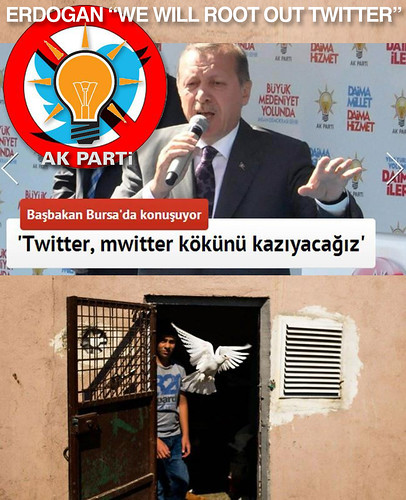
Erdogan blocks Twitter. #ErdoganBlockedTwitter now trending — in Turkey
Hurriyet Daily News reports: The number of messages tweeted by users in Turkey has not dropped since access to Twitter was banned, statistics have shown. What’s more, the hashtags #TwitterisblockedinTurkey and #TurkeyBlockedTwitter became trending topics worldwide only a few hours after Prime Minister Recep Tayyip Erdoğan announced his intention to “wipe out” the microblogging website.
According a report from Twitturk, which records the statistics of Turkish Twitter users, over half a million tweets were posted in just 10 hours, despite the ban.
That number would mark no sharp fall from the average number of tweets posted in the country, which is around 1.8 million per day.
“I don’t care what the international community says. Everyone will witness the power of the Turkish Republic’s state,” Erdoğan said when he announced the ban.
Everyone is now witnessing the power of the state and the fact that it is less than Turkey’s prime minister seems to have imagined.
What that seems to imply is that when Erdoğan issued his order, no one around him had the guts to tell him it wouldn’t work.
Either that, or they purposefully set him up, knowing that this show of strength would quickly become a very public display of his impotence.
Hours after Erdoğan’s threat, Turkish gov’t restricts access to Twitter
Today’s Zaman reports: Hours after Turkish Prime Minister Tayyip Erdoğan threatened to shut down Twitter and other social media platforms, government has restricted access to Twitter in most parts of the country, citing a court ruling on Thursday.
During a rally, Erdoğan said he did not care about the international response, his latest outburst in an increasingly bitter election campaign.
Hours after his threat, the Turkish government rushed to partially restrict access to Twitter, sparking public outrage on social media as people sought ways to avoid the restriction.
Thousands of tweets flooded in Twitter, vehemently criticizing the government ban. With partial ban on Twitter, Turkey now stands along with countries such as N.Korea, China, Saudi Arabia, Iran and Russia on internet freedom. [Continue reading…]
Turkish users: you can send Tweets using SMS. Avea and Vodafone text START to 2444. Turkcell text START to 2555.
— Policy (@policy) March 20, 2014
Ukrainian nationalists hand Russians propaganda coup with video of assault
Robert Mackey reports: Since a coalition of Ukrainian opposition groups took control of Independence Square in Kiev and held it long enough to undermine the authority of President Viktor Yanukovych, the Russian government and news media outlets under Kremlin control have consistently focused on the part played by far-right, nationalist demonstrators who manned the barricades there during deadly clashes with the police.
To counter the perception fostered in Moscow that the interim government in Kiev, which took power after Mr. Yanukovych fled the country, is led by neo-Nazis and fascist thugs, pro-Western Ukrainian activists have drawn attention to voices of moderation and tolerance in their coalition. One part of that effort was a YouTube video letter to the Russian people from prominent Ukrainian musicians and artists who appealed, in Russian, for peace, love and understanding from their neighbors. “There are no ‘Nazis’ here; your brothers are here,” the singer Valeriy Kharchyshyn said in the video. “We love you and we don’t want war.”
In that context, a highly discordant note was struck by video posted on YouTube this week that showed three men who represent the Ukrainian nationalist party Svoboda in Parliament berating the head of Ukraine’s state broadcaster over his decision to cover the Kremlin ceremony marking the annexation of Crimea. [Continue reading…]
America’s regime of institutionalized torture
Sadhbh Walshe writes: Sarah Shourd still has nightmares about the 13 months she spent in solitary confinement in Iran. “It reduces you to an animal-like state,” she tells me. Shourd recalled the hours she spent crouched down at the food slot of her cell door, listening for any sign of life. Or pounding on the walls until her knuckles bled. Or covering her ears to drown out the screams – the screams she could no longer distinguish as her own – until she felt the hands of a prison guard on her face, trying to calm her.
Shourd was captured by the Iranian government in 2009, along with her now husband Shane Bauer and their friend Josh Fattal, when they accidentally crossed over the border during a long vacation hike. The three have just released a book called A Sliver of Light about their subsequent incarceration. Shourd spent less time in Evin prison than Bauer and Fattal, but she was held in solitary confinement for her entire stay. Her devastating account of how this isolation almost caused her to unravel will, no doubt, shock many American readers. They should be even more shocked, however, to know that there are tens of thousands of prisoners held in isolation in American prisons every day – and the conditions to which they’re subjected are not much better than Shourd’s in Iran.
Indeed, ‘the hole’ in the US is sometimes even worse than the worst public horror stories.
Scientific studies have shown that it can take less than two days in solitary confinement for brainwaves to shift towards delirium or stupor (pdf). For this reason, the United Nations has called on all countries to ban solitary confinement – except in exceptional circumstances, and even then to impose a limit of no longer than 15 days so that any permanent psychological damage can be averted. Shourd spent a total of 410 days in solitary and was diagnosed with post-traumatic stress disorder after her release. She still has trouble sleeping. But since returning home, she has spent much of her time trying to draw attention to the plight of more than 80,000 Americans who are held in isolation on any given day, some of whom do not count their stay in days or months, but in years and even decades. [Continue reading…]
Xenophobia in Russia at an all-time high, experts say
Paul Goble writes: Xenophobia and hate crimes against members of other ethnic groups, after having declined in Russia between 2009 and 2012, have now risen to unprecedented levels, the result of what many see as the Putin regime’s backing for ethnic Russian pride, according to experts in Moscow.
In yesterday’s Yezhednevny Zhurnal, Vera Alperovich says that “the outburst of ethnic violence” in Russia “is visible even to the uninterested observer” and that the main victims are migrants from Central Asia and the Caucasus who suffer both from organized attacks and individual violence.
Two other trends are especially worrisome, she writes: the growth in the number of attacks by organized groups and increases in the number of attacks against anyone with a dark skin, Jews, ethnic Chinese and Roma (gypsies), the latest confirmation that xenophobia tends to spread from new targets to old ones, especially if officials do not counter it.
2013 was a record year in terms of the number of attacks against immigrants, she says, and she recounts some of the most notorious cases, including the July violence in Pugachev in Saratov oblast. What made that clash stand out is that ultra-right groups were not involved; instead, the population appears to have acted more or less spontaneously. [Continue reading…]
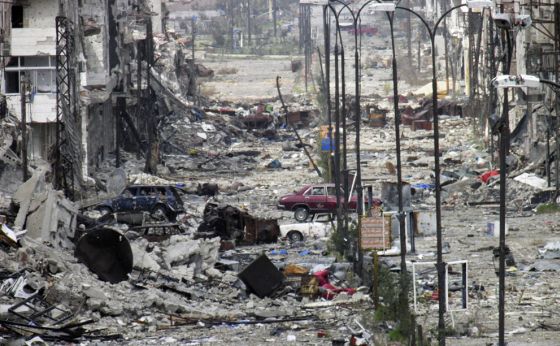
Syria: A country in ruins after three years of war
Click the photo above to see 36 more grim reminders of the devastation caused, above all, by the Assad regime’s unwillingness to accede to the legitimate demands of the Syrian people for freedom and democracy.
From the outset of what was initially a peaceful uprising, Assad made it clear that had no reservations about using violence to crush political dissent, and yet for many Western observers who had just been cheering on an ostensibly peaceful revolution in Egypt, Syria’s revolution became unpalatable as soon as the opposition picked up weapons.
Yet remember these words: “Where choice is set between cowardice and violence, I would advise violence. I prefer to use arms in defense of honor rather than remain the vile witness of dishonor.”
That was the choice most Syrians faced: to either cower in response to ruthless authoritarian rule, or to fight back.
And who offered this advice to use arms? Mahatma Gandhi.
The cost of fighting has been higher than any country should ever bear, but the power to choose a different course has rested in Bashar al Assad’s hands from day one. This catastrophe did not have to happen.
Nearly half of Syria’s chemical arms supply removed
The New York Times reports: Nearly half of Syria’s chemical stockpile for weapons use has now been removed from the war-ravaged country, the organization helping to oversee the elimination of the deadly arsenal reported on Wednesday.
The organization said in a statement that two shipments, including some of the most lethal chemicals from the stockpile, were delivered on March 14 and 17 to the Syrian port of Latakia, where they were transferred to cargo ships, making a total of 10 exported shipments so far.
“The latest movements increased the portion of chemicals that have now been removed from Syria for destruction outside the country to more than 45 percent,” said the statement, issued by the Organization for the Prohibition of Chemical Weapons, the Hague-based group that is collaborating with the United Nations to ensure the arsenal’s destruction.
The statement was the first progress report on the Syrian government’s commitment to getting rid of the chemicals since the Syrians proposed a revised timetable for exporting them early this month. The timetable’s revision, which calls for the job to be finished by the end of April instead of Feb. 6 as originally planned, came after Syria missed deadlines in the destruction effort and was widely criticized internationally.
The statement also appeared to suggest that Russia and the United States were continuing to cooperate in pressuring Syria to comply with its pledges on chemical weapons, despite the crisis in Ukraine, which has deeply chilled relations between Moscow and Washington. [Continue reading…]
Putin becomes a Russian ethnic nationalist
Kimberly Marten writes: There are two ways to talk about a Russian person or thing in the Russian language. One way, “Rossisskii,” refers to Russian citizens and the Russian state. Someone who is ethnically Chechen, Tatar, or Ukrainian can be “Rossisskii” if they carry a Russian passport and live on Russian territory.
Up until now that is how Russian President Vladimir Putin has always referred to the Russian people. Even the rather aggressive pro-Putin Russian youth movement of a few years back, Nashi (or “ours”) — with its summer camps, mass calisthenics rallies, and ugly jeering at opposition politicians — was always careful to use the word “Rossisskii.” While some critics like Valeria Novodvorskaya portrayed Nashi as if it were some kind of updated version of the Hitler youth, the group in fact never took on an ethnic slant.
That all changed on Tuesday. In his Kremlin speech to the two houses of the Russian parliament, Putin made a fateful choice. Instead of sticking to the word “Rossisskii,” he slipped into using “Russkii,” the way to refer in the Russian language to someone who is ethnically Russian. Putin said, “Crimea is primordial “Russkaya” land, and Sevastapol is a “Russkii” city.” He went on to say, “Kiev is the mother of “Russkie” cities,” in a reference to the ancient city of Kievan Rus’. (This reference must have grated on the ears of Ukrainian nationalists; as scholar Andrew Wilson points out, the historiography of Rus’ is fraught with the question of contested national origins.)
When speaking of the collapse of the Soviet Union, Putin added, “Millions of ‘Russkii’ went to sleep in one country and woke up in another, instantly finding themselves ethnic minorities in former Soviet republics, and the ‘Russkii’ people became one of the largest, if not the largest, divided nation in the world.”
Putin thereby signaled a crucial turning point in his regime. He is no longer simply a Russian statist, an old KGB man who wants to recapture Soviet glory, as Brookings analysts Fiona Hill and Clifford Gaddy argued in their fascinating 2013 biography. Instead Putin has become a Russian ethnic nationalist. [Continue reading…]
Dependence on Russia is likely to leave Crimea’s economy in a precarious state
The New York Times reports: Many A.T.M.s in this sun-dappled seaside resort city in Crimea, and across the region, have been empty in recent days, with little white “transaction denied” slips piling up around them. Banks that do have cash have been imposing severe restrictions on withdrawals.
All flights, other than those to or from Moscow, remain canceled in what could become the norm if the dispute over Crimea’s political status drags on, a chilling prospect just a month before tourist season begins in a place beloved as a vacation playground since czarist times.
Even with the West imposing sanctions to punish Russia’s invasion of Crimea, President Vladimir V. Putin faces a far steeper financial liability as he pushes to annex the peninsula, which lacks a self-sustaining economy and depends heavily on mainland Ukraine for vital services, including electricity and fresh water.
“Ukraine can quite easily cut off Crimea,” said Oleksandr Zholud, an economist with the International Center for Policy Studies in Kiev, the Ukrainian capital. “From an economic point of view it looks like a sinkhole.” [Continue reading…]