Category Archives: Russia

Editor of independent Russian news site replaced with pro-Kremlin figure

n13-iconThe Guardian reports: In what appears to be part of a growing state crackdown on liberal media, the editor of a major independent Russian news website has been replaced by a Kremlin-friendly editor after running an interview with a controversial Ukrainian nationalist.

Lenta.ru announced on its site on Wednesday that Galina Timchenko, who had worked there since its founding in 1999, would immediately be replaced by Alexei Goreslavsky, the former editor of the pro-Kremlin internet publication Vzglyad. Goreslavsky is currently deputy general director for external communications at the Afisha-Rambler-SUP media holding that owns Lenta.ru.

The news came only hours after the state communications watchdog issued a warning to Lenta.ru over a recent interview with Dmytro Yarosh, leader of the Ukrainian ultranationalist paramilitary group Right Sector, which played a key role in the protests that ousted President Viktor Yanukovych. The Investigative Committee of Russia, the country’s main federal investigator, has charged Yarosh, who recently announced he would run for president in Ukraine’s May elections, with inciting terrorism over a post on a Right Sector social network page that called on Russia’s most-wanted terrorist, Doku Umarov, to “activate his struggle.”

But a letter posted on Lenta.ru and signed by 69 employees and correspondents said Goreslavsky’s appointment amounted to “direct pressure on the Lenta.ru editorial staff” and a violation of censorship laws. Lenta.ru’s editorial policy, which embraced controversial topics and was often critical of the Kremlin, won the site a wide readership, including 13.6 million unique visitors last month, according to Rambler.ru rankings.

“This is absolutely a political situation,” said Lenta.ru’s night editor, Pavel Borisov. “Galina Timchenko was the best editor-in-chief I ever had. I don’t plan to work with Goreslavsky.” The change in editor came with no warning, he added. [Continue reading…]

Facebooktwittermail

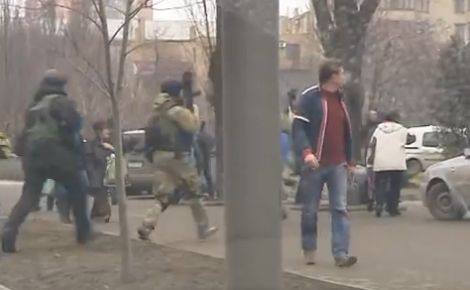
Blackwater in Ukraine? No, it was Alpha

Yesterday I laid out a timeline suggesting how the Blackwater-in-Ukraine story may have evolved. I did not, however, attempt to identify the armed men in the video that has kept this rumor alive in social media.

Thanks to a reader who said that the Ukrainian press identified the armed men as “Спецназ (Alpha) СБУ,” I have been able to piece together the story.

The elite Alpha special operations unit is attached to the Security Service of Ukraine.

The reason for their appearance outside the regional administrative building in Donetsk was given in the following local press report, Преступности.Нет (English version):

In Donetsk day 3 March during the seizure of the regional state administration of protesters attacked the ex-Governor of area Andrey shishatskiy.

It is reported by channel «Donbass» on his Youtube page.

So, the footage shows a group of people, among them people with the Russian flag in his hands, and beat former Governor of Donetsk region Shishatskiy.

According to the TV company, beat it from the attackers, interferes with the police and the special forces of the security service of Ukraine covers of his departure.

As is known, today the building of the Donetsk regional Council were captured by a group of Pro-Russian activists, who declared about the illegitimacy of Kyiv and declared himself the new authorities in Donetsk region.

This is the video showing former Governor Shishatskiy being attacked. Although the Alpha unit is not shown, they can be seen in another news report on the same incident.

alpha-donetsk

Before any of the dozens of copies of the video labelled “USA military mercenary BlackWater in Ukraine (Donetsk)” appeared on YouTube, the same video had been posted with this title: “Alpha” – Donetsk. 03/03/2014. The video’s description says: “After the Russian provocations, Special Forces of Alpha security appeared in Donetsk.”

No mention of Blackwater.

Facebooktwittermail

Ukraine, Russia, and the differing conceptions of fascism

a13-iconJeremy Hicks writes: All parties have been drawing historical analogies to interpret the Ukraine crisis: Hillary Clinton and western commentators have compared Putin to Hitler, the annexation of Crimea to the Sudetenland, and referred to appeasement. The Russians insist that the pro-European Ukrainians are fascists.

While the presence of the genuine neo-Nazis of the Svoboda party in Ukraine’s interim government is undeniable, it seems paradoxical that both the West and Russia legitimise their positions by reference to World War II, and opposition to the Nazis. To understand this situation better, it helps to examine quite how different Russian and Western memories of the war really are.

As the West recalls it, World War II saw democracy take a stand against tyranny – but only after prevaricating through appeasement, at the immediate cost of Czechoslovakia and the ultimate price of the Holocaust. The war’s main lesson is the importance of universal human rights, and the need to oppose expansionist dictators intent on small annexations or lesser crimes before they invade at will and commit mass murder.

From the Russian perspective, when it is discussed at all, appeasement is seen as confirmation of Western hypocrisy, and as the factor that drove the Soviets to sign a non-aggression pact with Hitler in self-defence. But in Russia, the real story of World War II begins with the Nazi invasion of the USSR in June 1941. The victims of the unchecked rise of Nazism are not so much the Jewish population of occupied Europe, but rather Russia and Russians. They were both the Nazis’ primary victims and the principal heroes of their defeat. Fascism is therefore not seen in terms of its anti-Semitic and anti-democratic dimensions, but as an anti-Russian phenomenon springing from Western Europe. [Continue reading…]

Facebooktwittermail

Air links between Crimea and Kiev are severed

The New York Times reports: The airport in the regional capital of Simferopol was closed on Tuesday to all flights except those heading to and from Moscow, in the boldest display yet of Russia’s tightening control over Crimea.

The announcement that air links had been severed between Crimea and the Ukrainian capital of Kiev raised the possibility that the peninsula might be closed off indefinitely from the rest of Ukraine, and it immediately prompted a sellout of tickets for connecting flights on Aeroflot, the Russian national carrier.

Even as Russia consolidated its grip on the embattled peninsula, diplomatic efforts between the Obama administration and the Kremlin appeared stalled, with the two sides continuing to engage in menacing military exercises and trade threats of economic retaliation. [Continue reading…]

Facebooktwittermail

‘Blackwater’ in Ukraine: The etiology of a conspiracy theory

(Update: I did a follow-up post on this. Two pieces on Blackwater in Ukraine is probably more than twice as many as the story merits.)

e13-iconOn February 28, soon after unidentified pro-Russian troops had seized control of Crimea, the Daily Beast blasted the headline: “Exclusive: Russian ‘Blackwater’ Takes Over Ukraine Airport.”

The presence in Crimea of well-armed and well-organized troops with no markings or identification was fueling lots of speculation about whether they were Russians. Josh Rogin believed he had part of the answer:

Private security contractors working for the Russian military are the unmarked troops who have now seized control over two airports in the Ukrainian province of Crimea, according to informed sources in the region.

“Private security contractors” isn’t very punchy for a headline and the name Blackwater has plenty of suitably sinister connotations, so the soldiers got dubbed as a Russian ‘Blackwater’ — no doubt the inclusion of that name also served as an effective traffic booster for the Daily Beast.

As the situation in Crimea rapidly changed, whether Rogin’s “informed sources” turned out to be reliable on this specific question quickly became a moot point. However, there’s every indication that his headline just as quickly morphed and took on a new life of its own.

For someone in Moscow, the irritation of seeing Russia’s operatives tarred with an infamous American name may have then given way to a much more interesting idea. Take away the quotes and make it Blackwater in Ukraine — there’s a story!

On March 2, a post appeared on a livejournal page belonging to “stbcaptain” which claimed, “According to our Ukrainian friends,” (“По информации наших украинских друзей”) up to 300 people employed by “Greystone Limited” had arrived at Kiev’s international airport that night, noting Greystone’s connection to Xe Services, formerly known as Blackwater.

Two days later, Voltaire Network, a favorite watering hole for conspiracy theorists, ran the headline, “US mercenaries deployed in Southern Ukraine.” The source for their brief report: Russian political scientist Alexander Dugin.

That Dugin’s name was linked to this story so early in its creation, is probably quite significant. While Voltaire refers to him simply as a political scientist, he is also the leading ideologist behind the Eurasia Movement seeking the restoration of the Russian Empire.

“Rather than rejecting totalitarian ideologies, Eurasianism calls upon politicians of the twenty-first century to draw what is useful from both fascism and Stalinism,” writes Timothy Snyder from Yale.

Dugin is committed to the break up of Ukraine. In a “letter to the American people on Ukraine” published on the website Open Revolt, which is affiliate with the white supremacist American Front, Dugin wrote on March 8:

Ukraine as it was during the 23 years of its history has ceased to exist. It is irreversible. Russia has integrated Crimea and declared herself the guarantor of the liberty of the freedom of choice of the East and South of Ukraine (Novorossia).

The same day that Voltaire posted its Dugan-sourced “U.S. mercenaries” story, a strange video appeared on YouTube, “USA military mercenary BlackWater in Ukraine (Donetsk),” posted on the obscure iRusTV channel. The video shows a group of men dressed in paramilitary gear, supposedly on the streets of the eastern Ukrainian city of Donetsk, running around in confusion.

Iran’s Press TV aired the video, claiming that locals were shouting “Blackwater!” at the armed men.

The shouting, however, is actually being directed at a civilian (a government worker perhaps), and the word which sounds vaguely like “Blackwater” is in fact Работай, which means “work” (as in “go back to work”).

The headline-hungry Daily Mail then leaped into the fray with “Has Blackwater been deployed to Ukraine? Notorious U.S. mercenaries ‘seen on the streets of flashpoint city’ as Russia claims 300 hired guns have arrived in country.

With the story now having received the imprimatur of the Western mainstream media, Moscow’s RT was ready to jump in, while assuming a cautious posture by adding plenty of ostensibly judicious caveats — the authenticity of the videos being “hard to verify” and so forth.

Ivan Fursov, writing his report as an RT “op-edge” column, says:

Surely these men were not Blackwater – simply because such a company does not exist anymore. It has changed its name twice in recent years and is now called Academi.

The latest article on the case, published by the Daily Mail, claims that though these people did look like professional mercenaries, they conducted the operation too openly.

Of course, such is the fodder for conspiracy theories: those planting the seeds don’t need to make any assertions of fact. All they need do is tease the imagination of an audience filled with febrile minds — the minds of people who are willing to believe almost any story if it happens to validate their own rigid worldview.

In what appears to be an organized effort to spread the propaganda, Blackwater in Ukraine videos are now being uploaded onto lots of new YouTube accounts.

Facebooktwittermail

Putin and the rise of Eurasianism

f13-iconLeon Neyfakh writes: What is Vladimir Putin up to? The crisis in Ukraine, brought to a boil when Russia’s president sent troops into the Crimean peninsula, has created almost a cottage industry of guessing at the autocratic leader’s intentions from one day to the next.

When it comes to Putin’s long-term strategy, however, there is at least one concrete plan that offers some insight, and one specific date that Russia observers are looking ahead to. That date, Jan. 1, 2015, is expected to mark the birth of an important new organization linking Russia with an as-yet-undetermined constellation of its neighboring countries—an alliance Putin has dubbed the Eurasian Union.

Currently, only two nations besides Russia, Belarus and Kazakstan, have signed on. A number of other post-Soviet states, including Armenia, Kyrgyzstan, and Tajikistan, have signaled interest in joining. It’s expected to build on an existing regional trade pact to establish common policies on labor migration, investment, trade, and energy.

But from the moment Putin announced his plan, experts have believed he sees it as the linchpin of something much larger: a new geopolitical force capable of standing up to Russia’s competitors on the world stage in a way it hasn’t been able to since the fall of the Soviet Union. “We suggest a powerful supranational association capable of becoming one of the poles in the modern world,” wrote Putin in the 2011 op-ed in which he first described his vision.

For all its ambition and the grandeur of its name, the Eurasian Union hasn’t been discussed much in the West outside of foreign-policy circles; when asked about it recently, the State Department declined to comment. This does not mean US officials aren’t worried about its implications. In December 2012, then-Secretary of State Hillary Rodham Clinton made a remark that, to date, seems to represent the American government’s only public position on Putin’s idea: “There is a move to re-Sovietise the region,” she said. And while of course the new entity wouldn’t be called the USSR, she said, “Let’s make no mistake about it. We know what the goal is and we are trying to figure out effective ways to slow down or prevent it.”

It’s tempting to see it that way, not least because Putin famously once said the breakup of the Soviet Union was “the greatest geopolitical catastrophe of the century,” and has also reportedly promised that the Eurasian Union would be based on the “best values of the Soviet Union.” But to say the project is simply an effort to reassemble the USSR is crude and incorrect, say Russia analysts. Instead, Putin’s efforts should be seen as a realization of an entirely different, and much less familiar idea called Eurasianism — a philosophy that has roots in the 1920s, and which grew out of Russia’s longstanding identity crisis about whether or not it should strive to be a part of Europe.[Continue reading…]

Facebooktwittermail

Crimean Tatars face tough choice: dig in, or flee

n13-iconThe Kyiv Post reports: After an evening prayer in the town of Bakhchisaray in southern Crimea, a handful of Crimean Tatars stand guard near the mosque where they pray to protect it and their people from a possible attack by pro-Russian militarized groups and ordinary criminals who they say increasingly roam the peninsula since the invasion of Russian troops in late February.

In recent days, unknown persons have been going around Crimean Tatar villages and marking their homes with white crosses, sowing panic among many women and outraging the men. The police here, who have been disoriented following the abrupt – and many claim illegal – change of power in Crimea last month, have neglected their duties.

This has left the Crimean Tatars themselves to move to ensure the safely of their homes and villages.

“Every evening men gather and patrol the streets to prevent provocations,” said Seitumer Seitumirov, 28, an economist by education. [Continue reading…]

Facebooktwittermail

Fears rise of Russian invasion extending into eastern Ukraine; gunmen seize two journalists in Crimea

n13-iconThe Los Angeles Times reports: As Ukrainian officials prepared to campaign in the United States this week for more international support ahead of a Russian-backed referendum on secession in Crimea, Moscow complained Monday of “lawlessness” in eastern Ukraine, raising fear it might widen its military intervention to include that region.

The Kremlin said in a statement that Ukrainian right-wing extremists, taking advantage of the “complete neglect” of the new Western-oriented government in Kiev, were threatening order in eastern Ukraine. In addition, the statement said, Russian citizens trying to cross the border into Ukraine were being turned back by Ukrainian border agents.

The allegations added to the increasingly heated rhetoric flying between Kiev and Moscow, and sparked concern that the Kremlin was setting up a pretext for a new military incursion. President Vladimir Putin has justified aggressive moves by pro-Russian forces in Crimea, in southern Ukraine, on the grounds of needing to protect ethnic Russians on the strategically valuable peninsula, though no independent group has identified any instances of danger or abuse. [Continue reading…]

Reuters adds: Unidentified gunmen have seized two Ukrainian journalists in Crimea, Reporters Without Borders said on Monday, warning that those behind attacks on the media were trying to turn the region into a “black hole for news”.

“The forces controlling the Crimea are responsible for the fate of these journalists,” Christophe Deloire, secretary general for the press freedom watchdog, said in a statement.

Facebooktwittermail

Watch: The deportation, exile and return of the Crimean Tartars

f13-iconAurélie Campana writes: In April 1944, after two and half years of German occupation, the Soviet forces regained control of Crimea. The reconquest was hardly completed when the Crimean Tatars were deported en masse on the false accusation of having collectively collaborated with the Nazis. This Muslim Turkic-speaking minority then represented 19.4% of the population of the peninsula, where Russians represented over 50%.

On May 18, 1944, in the early morning, soldiers of the People’s Commissariat of Internal Affairs (NKVD, the former KGB) entered Tatars’ houses by force and announced to their astonished and incredulous occupants their immediate deportation because of acts of “massive collaboration”. They were given only twenty to thirty minutes to gather some personal belongings. Without further delay, they were then conveyed to several stations, where they were loaded into cattle trains. In the matter of three days, nearly 180,014 Crimean Tatars were deported from the peninsula. At the same moment, most of the Crimean Tatar men who were fighting in the ranks of the Red Army were demobilized and sent into labor camps in Siberia and in the Ural mountain region. The demobilized soldiers were released after Stalin’s death in 1953 and allowed to return to their families in their place of exile.

Over 151,000 Crimean Tatar deportees were sent to Uzbekistan; the rest of the population was conveyed to regions of the Union of Soviet Socialist Republics (USSR), mostly in Kazakhstan, Tajikistan, the Ural region, the Mari Autonomous Soviet Socialist Republic, and for some, to the region of Moscow (Broŝevan and Tygliânc, 1994: 85). The conditions of the transfer by train were particularly difficult; they were fatal for many of them, especially as the majority of the deportees were women, children and old people. The weakest ones were carried off by malnutrition, thirst, cold, overcrowding and diseases that spread rapidly in packed train carriages. [Continue reading…]

Facebooktwittermail

Putin’s Western army of whataboutists

o13-iconMichael Moynihan writes: Readers of a certain vintage will likely recall the oleaginous, Brooklyn-accented Vladimir Pozner, an American citizen domiciled in Moscow who regularly popped up on television in the waning days of the Cold War, propagandizing on behalf of the Kremlin. Pozner was a rather impressive practitioner of whataboutism, the debate tactic demanding that questions about morally indefensible acts committed by your side be deflected with pettifogging discussion of unrelated sins committed by your opponent’s side. Soviet tanks lumbering through the streets of Prague? Yes, but what about the mistreatment of the Native Americans? East Germany’s reluctant citizens penned in by an imposing cement wall, ringed by trigger-happy border guards? A necessary “anti-fascist protection barrier,” sure, but…what about Hiroshima?

Even after the collapse of the Soviet dictatorship, Pozner found it difficult to shake the whataboutist habit and rote moral equivalence. “Yes, there are dissidents and maybe they consist of one percent or two percent of the population,” he told PBS in 1999. “But you’ve had your dissidents and you don’t treat them all that well.”

And there he was last week on CNN, where he is now a contributor, at the start of what distressingly looks to be a new Cold War, discussing the results of Crimea’s referendum on splitting from Ukraine and rejoining Russia. And he sounded surprisingly reasonable. “I don’t know whether President Putin will accept [the referendum results],” Pozner told Jake Tapper. “I don’t know whether he’ll say okay, let’s take them into our federation, but if he does, let’s not forget that Crimea is part of Ukraine.”

Pozner might have softened in his dotage, but there is a Spetsnaz division of Westerners ready to take the place he once occupied, arguing on Moscow’s behalf, employing the familiar whataboutism and blame shifting away from Vladimir Putin and towards the Obama administration. [Continue reading…]

Facebooktwittermail

Crimea secession referendum does not have a ‘No’ option

n13-iconTime reports: Crimea, which voted to put the question of secession from Ukraine to a referendum, has released a ballot with severely limited choices, and all of the options come with strings attached

“No” is not an option in the upcoming referendum in Crimea on whether to split from Ukraine.

The Crimean parliament — which voted to put the question to a referendum Thursday, despite opposition from the new Ukrainian government and from the United States — has released the ballot for the March 16 on its website. The referendum gives voters in the autonomous region the option to secede from Ukraine and join Russia, or to return to policies that give Crimea even greater autonomy from Kiev — opening the door to join Russia down the line, the regional English-language news source KyivPost reports. But the status quo is not an option. [Continue reading…]

Facebooktwittermail

Ukraine’s East: ‘The people have nowhere to work — it’s like Detroit’

n13-iconBloomberg reports: Along the road that stretches east from the regional capital of Donetsk toward Ukraine’s border with Russia, crumbling Soviet apartment complexes quickly give way to shabby villages of squat houses with aluminum-sheet roofs and shuttered windows. Settlements clustered around the remnants of coal mines that fed the former Soviet Union and minted the eastern province now stand mostly in disrepair.

In Snizhne, 50 miles east of Donetsk and roughly a dozen miles from the Russian border, privatization and restructuring have closed all but two of the 17 government-run coal mines that fed the town in the 1990s. “The people have nowhere to work—it’s like Detroit in America,” says Sergey Vasilivich, who used to own a business transporting and sorting coal from small local mines to private buyers. “There’s a real depression in this city.” Today, small, semilegal mine shafts operate on the fringes of the economy with a blatant lack of regard for safety and workers’ rights. Many miners have lost their jobs, and young people have left for greener pastures. Many in Snizhne see themselves as ethnic Russians and would have no problem joining with Russia, especially because they think it would help the stunted local economy.

As pro-Russian tensions continue to simmer in the east, the interim government in Kiev is trying to keep a lid on separatist rhetoric in the industrial heartland, where small but vocal protests in Donetsk against the new government continue to rage. In an effort to pacify the local population, the central authorities on March 2 appointed Sergei Taruta, an oligarch with roots in the east, governor of the Donetsk region. With about 5 million people, it’s Ukraine’s most densely populated province.

Taruta faces not only the loud chants of pro-Russian protesters in front of government headquarters, but also a depressed economy, a legacy of corruption, lack of popularity, and the institutional stasis of a local government authority composed of members from ousted President Viktor Yanukovych’s Party of Regions, which could thwart Taruta’s attempts at reform at any turn.

“His decision [to accept the position] is a risky one,” says Oleksandr Kliuzhev, a political analyst and program coordinator of the Committee of Voters of Ukraine, a nongovernmental organization in Donetsk. “There are real pro-Russian tendencies here—they don’t hide them. These emotions were held in check before by the Party of Regions. … Our politicians played the Russia card, but the new risk is that there are politicians promising union with Russia and we haven’t had this risk before.” [Continue reading…]

Facebooktwittermail

This is what occupation looks like: Russian provocation and Serbian Chetniks in Crimea

e13-icon“We are often told our actions are illegitimate, but when I ask, ‘Do you think everything you do is legitimate?,’ they say ‘yes’,” President Vladimir Putin said at a press conference on Tuesday. “Then I have to recall the actions of the United States in Afghanistan, Iraq, and Libya, where they either acted without any U.N. sanction or completely distorted the content of such resolutions, as was the case with Libya.”

For many critics of U.S. military action over the last thirteen years, Putin’s words resonate deeply.

There’s no question that when U.S. Secretary of State John Kerry says, “You just don’t in the 21st century behave in 19th century fashion by invading another country on completely trumped up pre-text,” the hypocrisy in a top U.S. government official saying this, is glaring.

But here’s the problem: it’s starting to sound like for many of the people now chanting “Hypocrisy!”, they see hypocrisy as worse than occupation. Indeed, this insistence on focusing on the lack of integrity of Western political leaders is becoming an excuse to ignore or legitimize the Russian invasion of Crimea.

In his latest report from Crimea, Simon Ostrovsky offers a close-up view of the Russian occupation.

A Serb commander belonging to the Chetnik movement, controlling a checkpoint between Sevastopol and Simferpol and supporting the occupation, says — without a hint of irony — “it would be better to resolve this issue internally.” He sees himself and the Russians as part of this “internal” solution. (It should be noted that the Chetniks have a history of involvement in ethnic cleansing, mass murder and other war crimes.)

If a Serb, having traveled hundreds of miles to Crimea, identifies himself as part of an internal solution, this begs the question: how would he define external?

I guess an example would be OSCE observers invited by Ukraine’s interim government — that’s why they got shot at when they attempted to enter Crimea.

But here’s a final thought: if you think occupation is only a problem when it’s conducted by Americans or Israelis, then maybe it’s time to ask yourself whether you really understand the meaning of the word hypocrisy.

Facebooktwittermail

Threats from Moscow, ignored by Kiev: what next for the Ukrainian soldiers in Crimea?

n13-iconThe Observer reports: The two Ural trucks, full of troops, arrived under cover of darkness and a pea-souper fog at the Ukrainian missile defence base outside Sevastopol late on Friday night, and rammed their way through the gates. Once inside, the Russian troops fanned out and screamed that they would shoot to kill if the Ukrainians did not surrender.

After some brief tussles the situation was calmed and the Russians eventually left, their trucks racing out of the base.

Outside, members of a local “self-defence” volunteer unit harassed journalists, and the deputy commander of the base briefly appeared to give comments. “We ignored their orders and eventually they left,” he said, as one of the masked volunteers shone a light in his face and tried to stop him speaking. “I guess they will be back soon.”

There are several thousand Ukrainian military personnel on more than a dozen bases across the Crimea, creating what could be the most explosive problem facing the Russians in their operation to annex the peninsula.

Uncertain of their status since the Crimean parliament announced that it wants the territory to join with Russia, the soldiers feel threatened by Moscow and abandoned by Kiev. Having sworn an oath to Ukraine, they could now, within a week, find themselves in one country and their homes and families in another. [Continue reading…]

Facebooktwittermail

Ukraine facing loss of its navy as Russian forces in Crimea dig in

n13-iconReuters reports: Lashed by the wind as it whips across Crimea’s biggest lake, a third of Ukraine’s warships have nowhere to go and nothing to do but rise and fall on its choppy waves.

Russian forces have blocked their only exit point to the Black Sea by sinking two ageing vessels there, and Russia’s well-armed Moskva missile cruiser can be seen treading water a short distance off the coast, with menace.

With six more of Ukraine’s two dozen warships similarly blockaded and Russian forces building up their strength ahead of a referendum that seems likely to result in Crimea becoming part of Russia, Ukraine is facing the humiliating loss of its navy.

Pacing up and down a spartan room in an outbuilding overlooking a row of warships, support vessels, and tugboats, Brigade Commander Vitaly Zvyagintsev says he can’t believe the Russian Black Sea Fleet – with whom the Ukrainian navy regularly held exercises in the past – has turned hostile.

“I have two theories,” he told Reuters in an interview. “The first is that they want to prevent Ukrainian ships leaving their base and blockading them as they are us now. The second is that they want to make sure that if and when Crimea joins Russia, Ukraine can’t get its ships back.”

“Georgia doesn’t have a fleet any more and the same thing could now happen with Ukraine,” he said gloomily, referring to the 2008 Russia-Georgia war which ended with Russian forces taking control of a fifth of Georgia’s territory.

The Ukrainian navy has around 25 warships including one submarine, 15 support vessels of different categories and around 15,000 men under arms, 10,000 of whom are based on the Crimean Peninsula. [Continue reading…]

Facebooktwittermail

Russia, Ukraine feud over sniper carnage

n13-iconThe Associated Press reports: One of the biggest mysteries hanging over the protest mayhem that drove Ukraine’s president from power: Who was behind the snipers who sowed death and terror in Kiev?

That riddle has become the latest flashpoint of feuding over Ukraine — with the nation’s fledgling government and the Kremlin giving starkly different interpretations of events that could either undermine or bolster the legitimacy of the new rulers.

Ukrainian authorities are investigating the Feb. 18-20 bloodbath, and they have shifted their focus from ousted President Viktor Yanukovych’s government to Vladimir Putin’s Russia — pursuing the theory that the Kremlin was intent on sowing mayhem as a pretext for military incursion. Russia suggests that the snipers were organized by opposition leaders trying to whip up local and international outrage against the government.

The government’s new health minister — a doctor who helped oversee medical treatment for casualties during the protests — told The Associated Press that the similarity of bullet wounds suffered by opposition victims and police indicates the shooters were trying to stoke tensions on both sides and spark even greater violence, with the goal of toppling Yanukovych.

“I think it wasn’t just a part of the old regime that (plotted the provocation), but it was also the work of Russian special forces who served and maintained the ideology of the (old) regime,” Health Minister Oleh Musiy said.

Putin has pushed the idea that the sniper shootings were ordered by opposition leaders, while Kremlin officials have pointed to a recording of a leaked phone call between Estonia’s foreign minister and the European Union’s foreign policy chief as evidence to back up that version.

This much is known: Snipers firing powerful rifles from rooftops and windows shot scores of people in the heart of Kiev. Some victims were opposition protesters, but many were civilian bystanders clearly not involved in the clashes. Among the dead were medics, as well as police officers. A majority of the more than 100 people who died in the violence were shot by snipers; hundreds were also injured by the gunfire and other street fighting. [Continue reading…]

Facebooktwittermail

Is this Russia’s Stuxnet? Experts analyze Snake, Uroburos, Turla malware samples dating back to 2005

n13-iconTechworld reports: The mysterious ‘Uroburos’ cyberweapon named last week in Germany has been stalking its victims since as far back as 2005 and large enterprises and governments need to pay urgent attention to the threat it poses, UK security firm BAE Systems has urged.

German firm G Data’s recent analysis dubbed it ‘Uroburos’ while it is also known to some security firms as ‘Turla’. BAE Systems’ Applied Intelligence division, which today published its own research, prefers the catchier ‘Snake’ but under any name the picture is alarming.

According to BAE Systems, It now transpires that Snake has been slithering silently around networks in the US and its NATO allies and former Soviet states for almost a decade, stealing data, getting ever more complex and modular and remaining almost invisible.

To be clear, this isn’t any old malware. Snake is just too long-lived, too targeted, too sophisticated, too evasive, too innovative. It appears to be on par with any of the complex cyberweapons attributed to the US such as Flame, first analysed by Kaspersky Lab in 2012.

After several months of research, the UK firm takes what we know a lot further, offering for the first time some objective data on targets. Culling data from malware research sites (i.e. those to which suspected malware samples are submitted for inspection), it has been spotted 32 times in the Ukraine since 2010, 11 times in Lithuania, 4 times in the UK, and a handful of times altogether from the US, Belgium, Georgia, Romania, Hungary and Italy.

These are very small numbers but BAE Systems believes that on past experience they are highly indicative. While they represent a tiny fraction of the number of infections that will have occurred in these countries and beyond, they can be used to reliably infer that Snake has been aimed at Western and Western-aligned countries pretty much exclusively.

In a week Russia planted boots on the ground in the Crimean region of the Ukraine, this is an unfortunate coincidence because while BAE Systems refused to name the state as the culprit, G Data and others are convinced that the links are suspicious.

Hints of the malware’s provenance have surfaced from time to time. In 2008, the US Department of Defense (DoD) reported that something called, Agent.btz had attacked its systems, an incident later attributed on more than one occasion to the Russian state without further elaboration. [Continue reading…]

The 2008 attack targeted U.S. Central Command. A few days ago, threats coming from the Syrian Electronic Army via Twitter were also directed at #CENTCOM, an indication perhaps that this group, linked to the Assad regime, has its roots in Russia.

Softpedia reports: “SEA advises the terrorist Obama to think very hard before attempting ‘cyberattacks’ on Syria,” the hackers wrote on Twitter. “We know what Obama is planning and we will soon make him understand that we can respond.”

So far, the Syrian hacktivists have mainly targeted media organizations whose reporting they don’t like. Social media accounts have been compromised, and websites have been defaced. However, they claim that their attacks against the US government will not be of “the same kind.”

“The next attack will prove that the entire US command structure was a house of cards from the start. #SEA #CENTCOM,” reads the last tweet they posted.

The #CENTCOM hashtag suggests that the hackers’ next target is the US Central Command (centcom.mil).

The Syrian Electronic Army’s announcement comes shortly after the New York Times published an article about the United States’ intention to develop a battle plan against Syria. The use of cyber weapons is being taken into consideration.

Facebooktwittermail