AFP reports: A leading anchor on Russian state television on Sunday described Russia as the only country capable of turning the United States into “radioactive ash”, in an incendiary comment at the height of tensions over the Crimea referendum.
“Russia is the only country in the world realistically capable of turning the United States into radioactive ash,” anchor Dmitry Kiselyov said on his weekly news show on state-controlled Rossiya 1 television.
Kiselyov made the comment to support his argument that the United States and President Barack Obama were living in fear of Russia led by President Vladimir Putin amid the Ukraine crisis.
His programme was broadcast as the first exit polls were being published showing an overwhelming majority of Crimeans voting to leave Ukraine and join Russia.
He stood in his studio in front of a gigantic image of a mushroom cloud produced after a nuclear attack, with the words “into radioactive ash”.
“Americans themselves consider Putin to be a stronger leader than Obama,” he added, pointing to opinion polls which then popped up on the screen.
“Why is Obama phoning Putin all the time and talking to him for hours on end?” he asked.
Kiselyov has earned a reputation as one of Russia’s most provocative television news hosts, in particularly with his often blatantly homophobic remarks.
But he is also hugely influential with his weekly news show broadcast at Sunday evening prime time.
Putin last year appointed Kiselyov head of the new Russia Today news agency that is to replace the soon to be liquidated RIA Novosti news agency with the aim of better promoting Russia’s official position. [Continue reading…]
Category Archives: Russia
Foes of America in Russia crave rupture in ties
The New York Times reports: As Russia and the United States drift toward a rupture over Crimea, the Stalinist writer Aleksandr A. Prokhanov feels that his moment has finally arrived.
“I am afraid that I am interested in a cold war with the West,” said Mr. Prokhanov, 76, in a lull between interviews on state-controlled television and radio. “I was very patient. I waited for 20 years. I did everything I could so that this war would begin. I worked day and night.”
Mr. Prokhanov is an attack dog whose career has risen, fallen and risen again with the fortunes of hard-liners in the Kremlin. And it is a measure of the conservative pivot that has taken place in Moscow in Vladimir V. Putin’s third presidential term that Mr. Prokhanov and a cadre of like-minded thinkers — a kind of “who’s who of conspiratorial anti-Americanism,” as one scholar put it — have found themselves thrust into the mainstream.
For centuries, Russian history has been driven by a struggle between ideas, as reformers and revanchists wrestled over the country’s future. Mr. Putin keeps a distance from the ideological entrepreneurs clustered around the Kremlin, leaving his influences a matter of speculation.
But it became clear last week, as the United States threatened to cut off Russian corporations from the Western financial system, that influential members of the president’s inner circle view isolation from the West as a good thing for Russia, the strain of thought advanced by Mr. Prokhanov and his fellow travelers. Some in Mr. Putin’s camp see the confrontation as an opportunity to make the diplomatic turn toward China that they have long advocated, said Sergei A. Karaganov, a dean of the faculty of international relations at the Higher School of Economics in Moscow.
“This whole episode is going to change the rules of the game,” Mr. Karaganov said of Crimea, which is holding a referendum on secession on Sunday. “Confrontation with the West is welcomed by all too many here, to cleanse the elite, to organize the nation.” [Continue reading…]
Putin wins in Russia only by escalating his war rhetoric
Masha Gessen writes: Vladimir Putin has won. In Russia, support for his war in Ukraine is overwhelming. And his approval rating has finally recovered after falling drastically in December 2011, when the Russian protest movement erupted.
Putin claimed reelection to his third term as president in March 2012, as mass demonstrations were taking place in cities and towns across Russia. Official tallies said he won with 63 percent of the vote, but independent exit polls suggested he captured about 50 percent — hardly a show of overwhelming support for a virtually unopposed candidate (none of the four opponents he handpicked for the ballot had campaigned).
After the election, Putin began cracking down on opponents while mobilizing his shrinking constituency against an imaginary enemy: strong, dangerous, Western and, apparently, homosexual. Laws were passed restricting public assembly and the activities of nongovernmental organizations; about three dozen people of various political and social stripes were jailed for protesting.
The crackdown proved effective: When the risks of demonstrating became extremely high and the benefits apparently nonexistent, the number of protests and protesters dwindled; the loose leadership structure of the 2011-12 protest movement dissolved in a haze of mutual recriminations.
As for the mobilization effort, the results were mixed: Putin’s approval rating, as measured by the Levada Center, Russia’s only independent polling organization, bounced back soon after his reelection but sank again and then plateaued. The high approvals that he enjoyed in his first decade at the helm, around 70 percent, were a distant memory. [Continue reading…]
For many of those observers who view Putin as having been pushed into a corner by Western governments who recklessly and foolishly hijacked Ukrainian politics, the Russian president is a cool realist acting in Russia’s national interests, doing what any responsible leader would do.
One of the multiple problems with this interpretation of what is currently unfolding is that it discounts the effects of the psychological imperatives to which Putin is now strapped.
A full-scale invasion of Ukraine might seem irrational now that Crimea is already fully under Russian control — 93% of voters are reported to have supported Crimea becoming part of Russia. But Putin’s next choices may be shaped much less by his assessment of Russia’s geopolitical interests than they are by the image of a strong leader around which he has drummed up so much popular support. He has been stacking up more and more reasons to continue his military advance, leaving less and less room to climb down without appearing to have lost his courage.
Ukraine’s fallen statues of Lenin are not just a rejection of Russia
Srećko Horvat writes: A spectre is haunting Europe – the spectre of Lenin.
Back in 2011 Ukraine was preparing to host Euro 2012. The government decided to release a promotional video titled Switch On Ukraine. Among the sites shown in the video was Liberty Square in the north-eastern city of Kharkiv. But something was missing. When the sun rose over the square, instead of an 8.5 metre-high statue of Lenin there was only an empty plinth. Someone had digitally erased the politically problematic icon.
In 2013 another statue of Lenin, this time in Kiev’s central plaza – once known as October Revolution Square and now known as Euromaidan – was smashed by angry protesters using sledgehammers. Many have correctly identified this as the key point in Ukraine’s political crisis. According to one estimate, of the nearly 1,500 Lenin memorials across Ukraine, protesters have destroyed around 100 of them, from Poltava to Chernihiv, from Zhytomyr to Khmelnytskyi.
This is nothing new of course. During the very beginning of the violent dissolution of Yugoslavia, I remember vividly how communist and anti-fascist monuments were torn down by nationalists who believed that democracy had finally arrived. Some urinated on them, others blew them up. In the period from 1990 to 2000 at least 3,000 monuments were torn down in Croatia alone.
Is the monument mayhem in Ukraine any different? It is: last week, residents of Kharkiv – the same town where the symbolic erasure of Lenin started in 2011 – installed barricades around the statue of Lenin after fending off an attack by Euromaidan revolutionaries. Even if the protesters weren’t defending the image of Lenin so much as exhibiting their attachment to Putin this is a remarkable state of affairs.
To return to the former Yugoslavia for the moment: according to the last statistics from the World Bank, the unemployment rate among young people in Bosnia and Herzegovina is 57.9%. This ex-Yugoslav state is not yet part of the European Union, but is already approaching Greece’s 60% rate. The newest member of the EU, neighbouring Croatia, is third in the union when it comes to youth unemployment, at 52%.
So this is what we got by getting rid of communism and entering the EU. [Continue reading…]
For a Crimean self-defense recruit, loyalty to the Soviet Union can now be renewed through loyalty to Russia
Alexander Sukhinin, recruit, Crimean self-defense army: “I already took an oath once. It was an oath to the Soviet Union. Russia is an assignee of Soviet Union, so now I proved that I am faithful to my first oath.”
Do you support or oppose imperialism?
If you're against imperialism, you really should support these guys #March4Ukraine pic.twitter.com/xGPzxbKDJe
— Carl Gardner (@carlgardner) March 16, 2014
Will Russia risk an all-out invasion of Ukraine?
Andrew S Bowen writes: In September 2013, Russia unnerved the Baltic States and several NATO countries by holding military exercises on the borders of Lithuania, Latvia, Estonia, Poland, and in the Kaliningrad enclave that involved an estimated 70,000 troops. Earlier, in April, the Russian Air Force had practiced mock bombing runs near Swedish air space. The unease caused by these events — along with many others, including the resumption of a Russian Naval task force in the Mediterranean and international flights of strategic bombers — was considerable, prompting many analysts to remark on the Russian military’s resurgent confidence and capability. It was confidence and capability born of a massive modernizatsiia program designed to remedy the inadequacies exposed by the 2008 war with Georgia, and to create a modern, professional military capable of protecting Russia’s status as a great power.
Today, Russia is flexing that newfound military might in Crimea and on its eastern border with Ukraine, where it is massing troops and carrying out a series of military exercises. As the clock ticks down toward a referendum on secession for the Black Sea peninsula, fear is mounting about a full-scale invasion of the Ukrainian heartland — this time, involving Russian troops with insignias on their uniforms. But as analysts speculate about Moscow’s intentions, the question that led most observers to discount the possibility of a Russian takeover of Crimea remains unanswered: To what end?
The most likely answer is that the Crimean invasion — and the current military exercises along the Ukrainian border — is intended to signal to the new government in Kiev that Russia’s interests are not to be ignored. In that case, they would represent a continuation of Russia’s efforts to negate any incipient relationship between Ukraine and the EU that would threaten Moscow’s influence in the region. As my colleague and FP columnist Michael Weiss notes, “That’s why the Kremlin has created a shadow EU known as the Customs Union, which includes Russia, Belarus and Kazakhstan, and whose sole mission seems to be keeping ex-satellites from being lured into Brussels’ orbit.” [Continue reading…]
50,000 rally in Moscow against Putin’s intervention in Ukraine

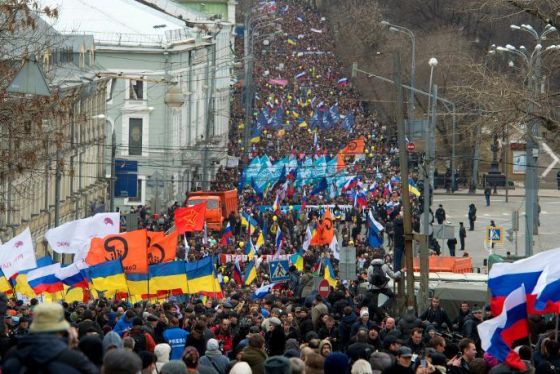
AFP reports: Around 50,000 people rallied in central Moscow Saturday in protest at Russia’s intervention in Ukraine, a day before the Crimean peninsula votes on switching to Kremlin rule.
Waving both Ukrainian and Russian flags and shouting slogans heard during the anti-government protests in Kiev, the demonstrators urged Russian President Vladimir Putin to pull troops back from a Cold War-style confrontation.
Marchers carried placards reading “Putin, get out of Ukraine” and others comparing Russia’s move on Crimea with the Nazi annexation of the Sudetenland as Europe rushed headlong into World War II.
Many of the protesters adopted the chants and slogans of Ukraine’s popular uprising that ousted President Viktor Yanukovych last month.
University professor Yelena Orlova, 47, whose sign read “Ukraine is a sovereign state”, said she did not expect the rally would change her government’s position, but believed it was her duty to speak out.
“I don’t agree with the policy of Putin,” she told AFP. “I am against the annexation of Crimea. I think Russia should respect the borders of Ukraine.” [Continue reading…]
Which march would you join?
A reader here just left a comment complaining about my “frothing support for the heathens who took Kiev by force,” and said, “I wish the people of Crimea the best and hope the vote tomorrow goes for separation from the u.s. / e.u.”
I can only imagine what kind of Manichean worldview lurks behind the reference to “heathens,” but the general sentiment here seems to one that is not uncommon among stalwart critics of American power. It seems to work like this:
If a prominent political leader antagonizes the U.S. and its European allies (I refer of course to the well-known demons de jour: Fidel Castro, Slobodan Milošević, Hugo Chávez, Mahmoud Ahmadinejad, Muammar Gaddafi, Bashar al-Assad, Vladimir Putin) and that individual is then vilified in the media, the mere fact that this person is being targeted in this way is taken as a sign that he must be doing something right. He symbolizes the rejection of Western hegemony and is conferred honorary membership to a select group of über-rebels who have the courage take a dramatic stand defying Western imperialism.
I am not immune to experiencing this sentiment, since power needs to be poked in the eye occasionally, yet that doesn’t mean that we should ignore the failings of those who are doing the poking.
But that’s what all too often happens when criticism of the US/the West becomes an obsession: it makes authoritarian rule become excusable.
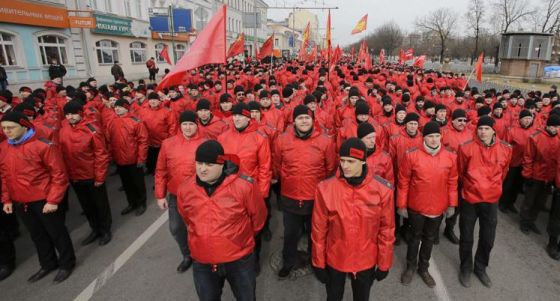
To anyone who thinks that tomorrow the people of Crimea are about to release themselves from the stifling grip of European influence in exchange for a warm embrace from Russia, I simply ask: who do you imagine you would have felt more comfortable marching alongside in Moscow today?
The disciplined young men in the “Brotherhood and Civil Resistance March,” or with activists like Ilya Yashin who have the guts to say: “We are patriots and Putin is Russia’s enemy”?

Reuters: “The pro-Russian patriotic procession was held to express support to Russian speakers living in Crimea and Ukraine and protest against the policies conducted by new Ukrainian authorities, according to organisers.”
Russia preparing for full-scale invasion of Ukraine
The Interpreter: Russia now has a massive force of tanks, troops, artillery, aircraft, and naval forces in position to potentially invade mainland Ukraine from Crimea in the south, but also from positions east and north of Ukraine. However, today reports are pouring in from across Russia of even more firepower on the move:
Moving tanks Omsk, Saratov, St.Pete, more photos like that popping up. Expect full-scale intervention beyond #Crimea pic.twitter.com/ZsDoa8QUK0
— Fabian Burkhardt (@sanwaldinjo) March 14, 2014
Should Ukraine have given up its nuclear arsenal?
The Guardian reports: Ukraine’s prime minister Arseniy Yatsenyuk has accused Russia of demonstrating unacceptable “military aggression” which has “no reason and no grounds”.
Moscow has deployed 10,000 troops along its border with Ukraine, deepening the crisis in Crimea ahead of a last desperate effort by the US secretary of state, John Kerry, to broker a deal with his Russian counterpart, Sergei Lavrov, in London on Friday.
Yatsenyuk told the UN security council on Thursday he is convinced Russians do not want war. He urged Russia’s leaders to heed the people’s wishes and return to dialogue with Ukraine. “If we start real talks with Russia, I believe we can be real partners,” Yatsenyuk said.
He said Ukraine gave up the world’s third-largest nuclear arsenal in 1994 in exchange for guarantees of its independence and territorial integrity. After Russia’s recent actions, Yatsenyuk said, “it would be difficult to convince anyone on the globe not to have nuclear weapons”. [Continue reading…]
In an op-ed for the New York Times yesterday, John Mearsheimer wrote: The West has few options for inflicting pain on Russia, while Moscow has many cards to play against Ukraine and the West. It could invade eastern Ukraine or annex Crimea, because Ukraine regrettably relinquished the nuclear arsenal it inherited when the Soviet Union broke up and thus has no counter to Russia’s conventional superiority.
No doubt, if Israel’s leaders are ever pushed into a position where they need to defend retaining their own nuclear arsenal, they will surely be tempted to cite Professor Mearsheimer’s position — that giving up such weapons can turn out to be regrettable.
Let’s suppose, however, that Ukraine was still bristling with nuclear weapons — at its peak its arsenal was larger than those of Britain, France, and China combined — are we to imagine that its interim government would now be making veiled threats to incinerate Moscow? Are we to suppose that Russian forces would have stayed out of Crimea? After all, how many wars have Israel’s nuclear weapons prevented?
It seems just as likely that in the current situation, Putin would be arguing that Russia had no choice but take over the whole of Ukraine — not under the pretext of protecting ethnic Russians but in the name of defending global security, his argument being that in an unstable Ukraine, “loose nukes” pose a threat to everyone.
What seems regrettable is not that Ukraine gave up its nuclear weapons but that the security guarantees it was given for doing so appear to have been worthless.
Russia blocks access to major independent news sites
Electronic Frontier Foundation reports: Russia’s government has escalated its use of its Internet censorship law to target news sites, bloggers, and politicians under the slimmest excuse of preventing unauthorized protests and enforcing house arrest regulations. Today, the country’s ISPs have received orders to block a list of major news sites and system administrators have been instructed to take the servers providing the content offline.
The banned sites include the online newspaper Grani, Garry Kasparov’s opposition information site kasparov.ru, the livejournal of popular anti-corruption crusader Alexei Navalny, and even the web pages of Ekho Moskvy, a radio station which is majority owned by the state-run Gazprom, and whose independent editor was ousted last month and replaced with a more government-friendly director.
The list of newly prohibited sites was published earlier today by Russia’s Prosecutor General, which announced that the news sites had been “entered into the single register of banned information” after “calls for participation in unauthorized rallies.” Navalny’s livejournal was apparently added to the register in response to the conditions of his current house arrest, which include a personal prohibition on accessing the Internet. [Continue reading…]
Straight talk on the U.S. and Ukraine
Stephen Zunes writes: It’s been interesting to observe the large numbers of people who suddenly think they’re experts on the ongoing crisis in Ukraine — both those on the left who blame it on Obama for intervening too much and those on the right who blame it on Obama for not intervening enough.
As someone who has spent his entire academic career analyzing and critiquing the U.S. role in the world, I have some news: While the United States has had significant impact (mostly negative in my view) in a lot of places, we are not omnipotent. There are real limits to American power, whether for good or for ill. Not everything is our responsibility.
This is certainly the case with Ukraine.
On the right, you have political figures claiming that Obama’s supposed “weakness” somehow emboldened Moscow to engage in aggressive moves against Crimea. Sarah Palin, for example, claims that Obama’s failure to respond forcefully to Russia’s bloody incursion into Georgia in 2008 made Russia’s “invasion” possible, despite the fact that Obama wasn’t even president then and therefore couldn’t have done much.
Even some Democrats, like Delaware senator Chris Coons, claim that Obama’s failure to attack Syria last fall made the United States look weak.
In reality, there seems to be little correlation between the willingness of Moscow to assert its power in areas within its traditional spheres of influence and who occupies the White House: The Soviets invaded Hungary in 1956 when Eisenhower was president; the Soviets invaded Czechoslovakia in 1968 when Johnson was president; the Soviets successfully pressed for martial law in Poland in 1981 when Reagan was president; the Russians attacked Georgia in 2008 when Bush was president. In each case, as much as these administrations opposed these actions, it was determined that any military or other aggressive counter-moves would likely do more harm than good. Washington cannot realistically do any more in response to Russian troops seizing Crimea in 2014 in the name of protecting Russian lives and Russian bases than Moscow could do in response to U.S. troops seizing Panama in 1989 in the name of protecting American lives and American bases. [Continue reading…]
Putin’s counter-revolution
James Meek writes: The Russians and Ukrainians of the 1990s were able to temper regret at the collapse of the USSR with their own knowledge of the dismembered country’s shortcomings. A generation later, this is less and less the case. Many of the most articulate and thoughtful Russians and Ukrainians, those of middle age who knew the realities of Soviet life and later prospered in the post-Soviet world, have moved abroad, gone into a small business or been intimidated: in any case they have been taken out of the political arena. In Russia and Russophone Ukraine the stage is left to neo-Soviet populists who propagate the false notion of the USSR as a paradisiac Russian-speaking commonwealth, benignly ruled from Moscow, a natural continuum of the tsarist empire, disturbed only by Nazi invaders to whom ‘the west’ are heirs and the only obstacle to its re-creation. If you were born after 1985 you have no remembered reality to measure against this false vision, just as you have no way to situate those charming Soviet musical comedies of the 1960s and 1970s, idyllic portrayals of an idealised Russophone socialism, brightly coloured and fun, propaganda now in a way they weren’t when they were made. This is the context that has made it possible for Vladimir Putin and his government to sell Russia’s opportunistic invasion of Ukraine to his own people and to Ukrainian neo-Soviets: the idea that it undoes what should never have been done, an artificial division of Russian-speaking Eurasia by fascists/the West/America/rabid Ukrainian nationalists – in neo-Soviet discourse, avatars of a single anti-Russian monster.
The truth is that Russia and Ukraine have been reunited for a long time, in a corrupt mosaic dominated by Moscow. Putin didn’t begin invading Ukraine to bring it back into the fold but to stop it escaping. He established a patriarchal-oligarchic police state in Russia; the now universally despised Ukrainian president-in-exile, Viktor Yanukovich, was well on his way to establishing one in Ukraine; the leaders of Belarus and the Central Asian republics have established similar repressive polities. Russophone Ukrainians have real fears about Ukraine’s new leaders. Putin’s great fear is that the people of a future better Ukraine might inspire an entirely different unification with their East Slav brethren on his side of the border – a common cause of popular revolt against him and other leaders like him. The revolution on Maidan Nezalezhnosti – Independence Square in Ukrainian – is the closest yet to a script for his own downfall. In that sense the invasion is a counter-revolution by Putin and his government against Russians and Ukrainians alike – against East Slav resistance as a whole.
The Maidan revolution wasn’t a purely ethnic Ukrainian uprising, although ethnic Ukrainians seem to have taken the lead in storming police lines. In the week I spent in Kiev in the immediate aftermath of the revolt I met no one who objected to my speaking Russian. On Maidan there are ethnic Russians speaking Ukrainian and ethnic Ukrainians speaking Russian. In one of the sagging khaki tents pitched on the square I met Vladimir Malyshev, a 44-year-old from St Petersburg, who came to the city to join the demonstrations late last year after a period spent in the anti-Putin movement in Russia. ‘It’s the one form of struggle that seems possible against the particular kind of power that’s appeared in the post-Soviet space: these gangs of criminals and bandits – they can be fought by gathering a large enough group of people to defy them. You can’t bribe or destroy this force. My experience here confirmed that this was possible. It happened.’ [Continue reading…]
Putin’s dystopian vision of a united, patriotic Russia
Maxim Trudolyubov writes: President Vladimir Putin’s decision to slip soldiers in unmarked uniforms into Crimea this month and escalate the race for control over other Russian-speaking parts of Ukraine shows that former assumptions about Moscow’s political behavior no longer apply. The United States and the European Union may still consider sanctions as a tool to check Moscow’s foreign policy, but to Mr. Putin, the threat of such sanctions means little: He has already factored them into his plans.
The chain of events the Kremlin has set in motion contains a message not only for Western policy makers, but also for the Russian plutocrats and corrupt officials who keep much of their wealth in the West. Mr. Putin is letting his Western adversaries know that he is telling his Russian enemies and financially corrupt friends: “If you won’t straighten up and behave as patriots, I am ready to throw you under the bus. If the laws prohibiting you to feather your nests abroad or to serve as ‘foreign agents’ do not persuade you, Western sanctions will do the job.”
After the Russia-supported president of Ukraine, Viktor F. Yanukovych, fled his country on Feb. 22, the Kremlin went into emergency mode. Since then, key decisions have been made by a group of Russia’s top security officials. The diplomatic, military and business establishments have been pushed to the side. [Continue reading…]
How the Russia Today propaganda apparatus operates
BuzzFeed reports: Staci Bivens knew something was seriously wrong when her bosses at Russia Today asked her to put together a story alleging that Germany — Europe’s economic powerhouse — was a failed state.
“It was me and two managers and they had already discussed what they wanted,” Bivens, an American who worked in RT’s Moscow headquarters from 2009 through 2011, said of a meeting she’d had to discuss the segment before a planned reporting trip to Germany. “They called me in and it was really surreal. One of the managers said, ‘The story is that the West is failing, Germany is a failed state.’”
Bivens, who had spent time in Germany, told the managers the story wasn’t true — the term “failed state” is reserved for countries that fail to provide basic government services, like Somalia or Congo, not for economically advanced, industrialized nations like Germany. They insisted. Bivens refused. RT flew a crew to Germany ahead of Bivens, who was flown in later to do a few standups and interviews about racism in Germany. It was the beginning of the end of her RT career.
“At that point I’d been there for a little bit and I’d had enough of the insanity,” Bivens said. She stayed until the end of her contract in 2011 and didn’t make an effort to renew it.
Judging by interviews with seven former and current employees, Bivens’ story is typical. [Continue reading…]
U.N. refugee chief warns world powers not to forget Syria conflict
Reuters reports: The head of the United Nation’s refugee agency said on Tuesday it must be ready in case Ukraine’s crisis causes refugees to flee Crimea, but his biggest worry is that “a total disaster” could occur if the international community diverts its attention away from Syria’s conflict.
Antonio Guterres, the head of the U.N.’s High Commission for Refugees (UNHCR), said in an interview that little progress was being made in efforts by the United States and Russia, now at loggerheads over Ukraine, to bring Syria’s warring sides together after the collapse of talks in Geneva last month.
“In the moment in which we need the most relevant countries in the world to be able to come together to narrow their differences and to try to find a way to move into peace for Syria, this tension around Ukraine will obviously not help,” Guterres told Reuters while visiting Washington to discuss Syria’s refugee crisis.
“I hope that those that have the most important responsibility in world affairs will be able to understand that forgetting Syria will be a total disaster,” he said. [Continue reading…]
Ukraine crisis: Six reasons why U.S. use of military forces is unthinkable
Loren Thompson writes: The interim prime minister of Ukraine was in Washington this week, and according to the New York Times, he was asking just one thing of U.S. leaders. He said as a signatory to a 1994 treaty guaranteeing the security of Ukraine, America “must defend our independent, sovereign state.” Some members of Congress sound like they agree, especially Republicans who are using Washington’s slow response to Russian occupation of the Crimea as the latest evidence that President Obama is weak when it comes to dealing with America’s enemies.
If Obama looks weak, it is mainly because he sees the danger of decisive action in a place that matters far more to Russia than America. Over the last two decades, the United States has gotten used to fighting enemies with modest military capabilities and crackpot leaders, but Russia is a much more imposing player. If Washington somehow stumbled into a military confrontation with Moscow, the U.S. would probably lose and in the process run huge risks to its larger interests.
Most Americans seem to understand this — a CNN poll this week found three-quarters of respondents opposed to even giving military aid to Kiev, with far fewer backing use of U.S. forces. Nonetheless, some hardliners seem to think America’s military might play a role in forcing Russian leader Vladimir Putin to back away from what they see as a return to the expansionist foreign policies of the Cold War era. Here are six reasons why using U.S. military power in the current crisis would be a strategic miscalculation of epic proportions. [Continue reading…]