Category Archives: Syria

Israel tracks Syria’s Western jihadis, worried about their return

Reuters reports: Israel is working with allies abroad to track Westerners fighting in Syria, concerned that such militants could attack Israeli or Jewish targets once back home, a senior Israeli official said on Tuesday.

Of an estimated 10,000 foreign combatants among rebels battling Syrian President Bashar al-Assad, around 20 percent are from the West and that number is rising, the official said.

“Think of a scenario, even one of them returning and getting instructions from someone he worked with, someone he fought beside, someone like (the al Qaeda-linked) Nusra Front, to carry out an attack,” said the official, who is privy to intelligence assessments. “This has been keeping us very, very busy lately.”

The official, who declined to be named because of the sensitivity of the issue, said Israel was coordinating monitoring efforts with Western countries, whose legal options against fighters returning home were limited.

Facebooktwittermail

Syria: barrel bombs ‘kill 87 children’ in Aleppo

Reuters reports: More than 300 people, 87 of them children, have been killed in a week of air raids on the northern Syrian city of Aleppo and nearby towns by President Bashar al-Assad’s forces, a monitoring group said on Monday.

Many were killed by so-called barrel bombs dropped from helicopters, the Syrian Observatory for Human Rights said.

Syrian authorities say they are battling rebels who have controlled parts of Syria’s biggest city and most of the surrounding countryside for the past 18 months.

But human rights groups have condemned the use of the improvised bombs – oil drums packed with explosives and metal fragments, and rolled out of the aircraft cargo bay – as indiscriminate bombardment. [Continue reading…]

Facebooktwittermail

Foreign fighters in Syria still remain a small fraction of the opposition

The International Centre for the Study of Radicalisation: We estimate that – from late 2011 to 10 December 2013 – between 3,300 and 11,000 individuals have gone to Syria to fight against the Assad government. These figures include those who are currently present as well as those who have since returned home, been arrested or killed.

Based on the credibility of various sources, our own judgement, and the feedback we have received since publishing our April estimate, we believe the “true” figure to be above 8,500. This would mean that the numbers have nearly doubled since April, with a particularly steep increase among non-Arabs, especially Westerners.

While Arabs and Europeans continue to represent the bulk of foreign fighters (up to 80 per cent), we have identified individuals from Southeast Asia, North America, Australia, and (non-Arab) Africa. Overall, we believe that residents and citizens from at least 74 countries have joined militant opposition groups in Syria. [Continue reading…]

Facebooktwittermail

Syria ‘abducting civilians to spread terror’, UN says

BBC News reports: UN human rights investigators say the Syrian government is using what they call “enforced disappearances” as part of a widespread campaign of terror against civilians.

Thousands of people have been taken away, with most never seen again, their report says.

Disappearances on such a scale could be a crime against humanity, it adds.

It notes that some opposition groups have begun taking hostages – which also constitutes a human rights violation.

Facebooktwittermail

Bashar al Assad’s talent for survival

Annia Ciezadlo writes: If there’s one thing those who know him agree on, it’s that Bashar Al Assad is awfully eager to please. Friends and even some enemies portray the Syrian president as a kind and generous man, always ready to use his connections to provide a favor: for a job, a heart operation, or just the permit the government has required, under Syria’s authoritarian form of socialism, to buy a tank of propane gas for cooking food. “Easygoing,” say diplomats who have faced him in negotiations. “I would have described him as a real gentleman, before this,” says a Damascene businessman who was part of Assad’s social circle and has now fled the country to escape its ongoing civil war.

The subtext here is that Assad is weak; the polite phrasing, among educated Syrians, has always been that he “does not have the qualities of a leader.” That is to say, he does not have the gravitas of his ruthless, gnomic father, Hafez Al Assad, who ruled the country from 1970 until June 2000. Other Syrians put it less delicately. They call him donkey, giraffe, taweel wa habeel — a Levantine putdown for a big, bumbling doofus. Diplomats, analysts, and a few heads of state have been just as harsh, predicting his imminent downfall since the day he took power.

Two-thousand thirteen was the year when it seemed as if those predictions would finally come true. As the uprising against him ground into its third summer, his regime lost territory and international legitimacy. Saudi Arabia and other Gulf states lavished cash and weaponry on rebel fighters. Even the United States was reluctantly edging closer to supporting the revolution with something more than words. Then, on August 21, Assad’s regime used the nerve gas sarin to kill hundreds of Syrian civilians, crossing the “red line” that Barack Obama had said would prompt a U.S. military response. It looked like the end. If a formerly untouchable military dictator like Hosni Mubarak could go down in Egypt, then why not Syria’s lanky, lisping president?

What outsiders have been slow to realize is that in the game Assad is playing, a weak man (or one perceived that way) can cling to his throne just as tenaciously, and violently, as a strongman. Over the course of his reign, he has learned how to turn his biggest shortcomings—his desire for approval, his tendency toward prevarication—into his greatest assets. The world wants him to give up the chemical munitions he used against his own citizens, and he has begun to do that. The world wants an end to the conflict that has killed more than 100,000 Syrians and displaced millions more; his government is now willing to participate in peace talks. This nebbishy second son, who was never meant to inherit the family regime, has proved exceptionally talented in the art of self-preservation. [Continue reading…]

Facebooktwittermail

Syria: Are ‘extremists’ and ‘al Qa’eda’ taking over towns in the North?

Scott Lucas writes: For several months, EA’s analysts have argued against a simplistic reduction of Syria’s conflict to a takeover by “extremists” and “jihadists”.

It appears to have been a futile effort, at least with respect to most leading Western media. Headlines proclaim the takeover of much of northern Syria by the Islamic State of Iraq and as-Sham, even though the group has only a fraction of the fighters in the insurgency and is being challenged by other leading factions. They dwell on the phrase “Al Qa’eda-linked”, even with insurgents who have no such connection. A cartoon in The Economist shows the genie of a menacing, bearded man — holding a sub-machine gun and a blood-stained knife — emerging from a bottle to face President Assad.

The repetition of images like these has intersected with — and may have even fed — a shift among some Western governments to consider Assad’s stay in power, fearing the supposedly lone alternative of “extremist” rule of Syria.

Yet, occasionally, a reporter or analyst offers a detailed examination of the situation in Syria’s northern towns that returns to our argument: the political picture is far more complex than these easy, scary headlines.

On Wednesday, Aymenn Jawad al-Tamimi wrote for the Brown Moses blog about the town of Al-Bukamal in Deir Ez Zor Province near the border with Iraq, captured by insurgents last year.

Asking the question, “Who exactly controls or is present in the town?”, al-Tamimi finds no less than six groups: Kata’ib Junud al-Haq, Katiba Bayariq al-Sunna, Kata’ib Allahu Akbar, Liwa Allahu Akbar, Liwa al-Mujahid Omar al-Mukhtar, and Liwa al-Qadisiya al-Islamiya.

None of these groups has received the media attention given to the Islamic State of Iraq and as-Sham, although Kata’ib Junud al-Haq is the local affiliate of another bogeyman, the “terrorist”/”Al Qa’eda-linked” Jabhat al_Nusra. So, to answer his question, al-Tamimi goes through a granular examination of evidence from websites and social media.

He finds stories of shifting alliances: for example, Kata’ib Junud al-Haq sided with the Islamic State of Iraq and as-Sham this spring but switched to ISIS’s rival Jabhat al-Nusra. Other groups are affiliated with the Free Syrian Army, or with factions of the Islamic Front.

He finds clashes between groups, followed by cease-fires, most recently in September.

In the main, he finds that almost all the groups are made up of Syrians rather than foreign “extremists”, moving outside Al-Bukamal to fight throughout Deir Ez Zor Province. [Continue reading…]

Facebooktwittermail

UN envoy says Iran could attend Syria talks

Al Jazeera reports: Whether or not Iran will be among the nations invited to attend Syrian peace talks in Switzerland is still a source of disagreement between the UN and the United States, peace envoy Lakhdar Brahimi has said.

Speaking at a news conference in Geneva on Friday, Brahimi underlined that Tehran was not completely off the list of those who would attend Geneva 2, despite US objections.

“On Iran, we haven’t agreed yet. It’s no secret that we in the United Nations welcome the participation of Iran, but our partners in the United States are still not convinced that Iran’s participation would be the right thing,” Brahimi told reporters after talks with US and Russian officials.

Facebooktwittermail

Hexamine may be the smoking gun implicating the Assad regime in the Ghouta chemical attacks

The New York Times reports: Buried in the annex of a United Nations inquiry into chemical weapons use in Syria is information that some outside analysts say could further implicate the government of Syria in the deadliest of the five confirmed attacks.

The investigators, who released their final report last week, said they had found a chemical called hexamethylenetetramine from environmental samples in Ghouta, the Damascus suburb that was the site of the deadliest attack, on Aug. 21. Hexamine, as the chemical is also known, can be used as an additive in the production of chemical weapons using sarin, the nerve agent, according to analysts, along with other commercial uses. The Syrian government happens to have a stockpile of hexamine; it is part of a list of chemicals scheduled to be destroyed as part of the deal to dismantle Syria’s chemical weapons program.

United Nations investigators who conducted the inquiry pointedly steered clear of assigning blame for any of the attacks. The investigators have declined to explain Syria’s purpose in amassing the hexamine, a common commercial chemical.

But some experts who reviewed the panel’s final report said the presence of hexamine at Ghouta was in some ways akin to the police finding red lipstick in a woman’s purse that matches collar stains on a murder victim. While considered circumstantial evidence, it added to information in the panel’s interim report on Ghouta released in September, on the type of projectiles used that appeared to implicate the Syrian government.

The hexamine connection was pointed out last week by Dan Kaszeta, an independent security consultant and former officer in the United States Army’s Chemical Corps. He argued that the presence of hexamine pointed to the involvement of the government in the attack on Ghouta. [Continue reading…]

Among the commentators trying to make sense of this issue, Kaszeta is probably the only chemical weapons expert whose knowledge of sarin is not only technical but also includes direct experience in handling the material. He says he “spent weeks debriefing guys who used to make the stuff back in the 1950s.”

In his preliminary analysis of the findings presented by the UN, he writes:

Hexamine was discovered in a wide variety of the environmental samples. Hexamine also appears in the declared inventory of significant chemicals reported by the OPCW after disclosure and inspections subsequent to Syria’s accession to the Chemical Weapons Convention. It would have been informative if the UN and OPCW had explained why they considered hexamethylenetetramine (‘hexamine’) to be considered as a chemical of significance to this investigation. I do not think that hexamine’s normal uses as a heating fuel and component of some conventional explosives do not merit its inclusion as a chemical of concern by the OPCW, nor would it merit inclusion in the declared stockpile that needs to be destroyed.

However, based on numerous sources of information I have deduced the chemical warfare significance of hexamine, both in the numerous environmental samples and in the declared chemical inventory. Hexamine is apparently being used by the Syrian government as an additive to binary Sarin. The inspections subsequent to the UN/OPCW investigation covered by this report reveal that the Syrian concept of operations was to employ binary chemical weapons.

Binary Sarin weapon systems combine methylphosphonic difluoride, also known as DF, with isopropyl alcohol to form Sarin. The resulting mixture has a lot of residual acid in it, in the form of hydrogen fluoride (HF), which is highly destructive, possibly to the point of ruining the weapon system. The US Army’s cold war era Sarin program used isopropylamine to reduce this excess HF. Several chemists and engineers knowledgeable in the matter have confirmed to me that hexamine is useful as a Sarin additive for the same reason. One hexamine molecule can bind to as many as four HF molecules. This would explain the declared Syrian stockpile of 80 tons of hexamine. Interestingly, the same stockpile contains 40 tons of isopropylamine as well.

I consider the presence of hexamine both in the field samples and in the official stockpile of the Syrian government to be very damning evidence of government culpability in the Ghouta attacks. 7 weeks of research on this subject reveal no public domain evidence of hexamine being used in this way in other Sarin programs. The likelihood of both a Syrian government research and development program AND a non-state actor both coming up with the same innovation seems negligible to me. It seems improbable that some other actor wanting to plant evidence would know to freely spread hexamine around the target areas.

Facebooktwittermail

West signals to Syrian opposition Assad may stay

Reuters reports: Western nations have indicated to the Syrian opposition that peace talks next month may not lead to the removal of President Bashar al-Assad and that his Alawite minority will remain key in any transitional administration, opposition sources said.

The message, delivered to senior members of the Syrian National Coalition at a meeting of the anti-Assad Friends of Syria alliance in London last week, was prompted by rise of al Qaeda and other militant groups, and their takeover of a border crossing and arms depots near Turkey belonging to the moderate Free Syrian Army, the sources told Reuters.

“Our Western friends made it clear in London that Assad cannot be allowed to go now because they think chaos and an Islamist militant takeover would ensue,” said one senior member of the Coalition who is close to officials from Saudi Arabia.

Noting the possibility of Assad holding a presidential election when his term formally ends next year, the Coalition member added: “Some do not even seem to mind if he runs again next year, forgetting he gassed his own people.”

The shift in Western priorities, particularly the United States and Britain, from removing Assad towards combating Islamist militants is causing divisions within international powers backing the nearly three-year-old revolt, according to diplomats and senior members of the coalition. [Continue reading…]

Facebooktwittermail

Syria’s chemical weapons to travel by guarded convoy before destruction

The Guardian reports: Syria’s chemical weapon arsenal is to be taken cross-country in Russian armoured trucks guarded by Syrian government troops and tracked by American satellite navigation equipment on its way to the Mediterranean coast.

The unprecedented and precarious two-week operation will take the cargo – 500 tonnes of chemical components of sarin and VX nerve agents and canisters of mustard gas – from 12 sites around the country to the port of Latakia, where they will be loaded onto Danish and Norwegian cargo ships.

China will provide surveillance cameras and ambulances on stand-by in case of any accidents, while Finland has offered to provide its own emergency response teams.

The ships will sail under Danish and Norwegian naval escort to an unnamed Italian port to be transferred to a US vessel, the Cape Ray, which will be carrying two chemical reactor chambers to neutralise the chemical weapons while at sea. On-board tankerswill store the by-products for later incineration. [Continue reading…]

Facebooktwittermail

U.S. open to engaging with the Islamic Front in Syria

The Cable reports: As the moderate faction of the Syrian rebellion implodes under the strain of vicious infighting and diminished resources, the United States is increasingly looking to hardline Islamists in its efforts to gain leverage in Syria’s civil war. The development has alarmed U.S. observers concerned that the radical Salafists do not share U.S. values and has dismayed supporters of the Free Syrian Army who believe the moderates were set up to fail.

On Monday, the State Department confirmed its openness to engaging with the Islamic Front following the group’s seizure of a Free Syrian Army headquarters last week containing U.S.-supplied small arms and food. “We wouldn’t rule out the possibility of meeting with the Islamic Front,” State Department spokeswoman Marie Harf said Monday. “We can engage with the Islamic Front, of course, because they’re not designated terrorists … We’re always open to meeting with a wide range of opposition groups. Obviously, it may make sense to do so at some point soon, and if we have something to announce, we will.”

On Saturday Reuters reported that Syrian rebel commanders in the Islamic Front were due to meet U.S. officials in Turkey in the coming days to discuss U.S. support for the group. A Syrian opposition source speaking with The Cable said that efforts were in place to unite the Western-backed Free Syrian Army and the Islamic Front under the same coalition. “There are negotiations planned for very soon between the [Free Syrian Army’s] SMC and the Islamic Front to determine what the relationship will be,” said the source. America’s role in coordinating the talks remains unclear.

Though the Islamic Front is not a U.S.-designated terrorist group, many of its members hold intensely anti-American beliefs and have no intention of establishing a secular democracy in Syria. U.S. interest in the group reflects the bedraggled state of the Supreme Military Council and the desire to keep military pressure on President Bashar al-Assad ahead of next month’s planned peace conference in Geneva. “The SMC is being reduced to an exile group and the jihadists are taking over,” said a senior congressional aide.

The creation of the Islamic Front was announced on Nov. 22 with the purpose of uniting the strength of prominent Islamist militias across the country. Seven Islamist groups, with a total estimated strength of 45,000 to 60,000 fighters, signed on to the merger. [Continue reading…]

Before the anti-interventionists start squawking about the perils of engaging with extremists, don’t forget that the same argument has been used to support of policy of non-communication with Iran, Hezbollah, and Hamas. The only predictable outcome of refusing to talk to any group or any nation is that you will understand less about what they think than you would, had you been willing to talk. Talking is good for everyone.

Facebooktwittermail

Roger Waters, the ‘crushingly obvious’ parallels to Israel and the parallels we prefer to ignore

Keith Kahn-Harris writes: It’s happening increasingly often: a prominent public figure makes a vituperative criticism of Israel, accusations of antisemitism follow and then come emphatic denials. This time it’s Roger Waters, the Pink Floyd vocalist, who has fanned the constantly glowing embers of controversy. Among other things, he has claimed that the “parallels [between Israel’s actions against the Palestinians] with what went on in the 1930s in Germany are so crushingly obvious”, that the Israeli rabbinate views Palestinians as “sub-humans”, and that the “Jewish lobby” is “extraordinarily powerful”. This comes on the back of Waters’ long history of pro-Palestinian activity, including supporting a cultural boycott of Israel.

In response, Waters has been accused of antisemitism by firebrands such as Rabbi Shmuley Boteach and more measured voices such as Karen Pollock of the Holocaust Educational Trust. Waters vociferously denies antisemitism, complaining that defenders of Israel “routinely drag the critic into a public arena and accuse them of being an antisemite”.

So who is right? Is Waters guilty of antisemitism?

The problem with viewing the Waters controversy through the lens of the antisemitism debate is that it becomes a zero-sum game: whether his words were antisemitic or not. If they were not, then the assumption is that they would be acceptable.

Yet there are other ways to analyse discourse on Israel. What would happen if one temporarily (and, yes, artificially) removes the question of antisemitism and looks at Waters’ remarks the way one might look at other forms of political discourse? This leads to other questions: was Waters’ intervention useful? Were his words proportionate and reasonable? Should we take what he says seriously?

Accusations that Israel is behaving in a Nazi-like manner are hardly novel. In fact they are something of a cliche not just in the controversy over Israel but in a wide range of other debates. Godwin’s Law draws attention to the wearisome regularity with which Nazi Germany is invoked; for some, its corollary is that in any debate the first one to mention the Nazis has lost.

Not only is comparing Israel to Nazi Germany predictable, even the harshest reading of Israel’s actions shows that the analogy is completely over the top. Israel can arguably be accused of subtle and not-so-subtle forms of discrimination and even ethnic cleansing of Palestinians over its history, but it has never committed systematic mass murder and the existence of Palestinian citizens of Israel (albeit often marginalised) is something that no genuinely neo-Nazi regime could tolerate. [Continue reading…]

I suspect that part of the reason Waters and others grab the Nazi analogy is that breaking this kind of taboo is a kind of act of defiance through which someone can feel they are demonstrating an unswerving commitment to truth. It’s a way of attempting to say: I will speak the truth, whatever the consequences.

As Kahn-Harris points out, however, this particular choice of analogy is cliched — it also has the appearance (intentionally or not) of serving as a form of baiting.

There are numerous other “crushingly obvious” parallels Waters could have pointed to, such as the treatment of Native Americans by European settlers who asserted a God-given right to claim this continent as their own.

Then there are parallels that most observers in the West would apparently rather ignore, namely, those in Syria where after the Palestinian occupied territories, Israel, and Jordan, the largest exiled Palestinian population resides.

By whatever metric one chooses to use, the scale of destruction wrought by the Assad regime over the last two years dwarfs the crimes of the Israelis over the last 65 years, yet so many of those who express outrage over massacres in Gaza, appear unmoved when the aggressors are not Zionists.

Israelis have been fittingly scorned for professing a humanitarian sensibility as they “shoot and cry” (Yorim u’Vochim), but among Israel’s critics who are willing to hold up a mirror there may be visible a similarly flimsy humanitarian impulse.

We often seem more concerned about who fired the gun and who manufactured the bullet than who got killed.

Facebooktwittermail

Far right in Eastern Europe makes gains as Syrians arrive

The New York Times reports: After spreading turmoil and desperate refugees across the Middle East, Syria’s brutal civil war has now leaked misery into Europe’s eastern fringe — and put a spring in the step of Angel Bozhinov, a nationalist activist in this Bulgarian border town next to Turkey.

The local leader of Ataka, a pugnacious, far-right party, Mr. Bozhinov lost his seat in the town council at the last municipal elections in 2011 but now sees his fortunes rising thanks to public alarm over an influx of Syrian refugees across the nearby frontier.

Membership of the local branch of Ataka, he said, had surged in recent weeks as “people come up to me in the street and tell me that our party was right.” Ataka, which means attack, champions “Bulgaria for Bulgarians” and has denounced Syrian refugees as terrorists whom Bulgaria, the European Union’s poorest nation, must expel. An Ataka member of Parliament has reviled them as “terrible, despicable primates.”

With populist, anti-immigrant parties gathering momentum across much of Europe, Ataka stands out as a particularly shrill and, its critics say, sinister political force — an example of how easily opportunistic groups can stoke public fears while improving their own fortunes.

The influx of Syrian refugees has sown divisions across the European Union as the refugees add burdens on governments still struggling to emerge from years of recession. But Bulgaria is perhaps the most fragile of all the European Union’s 28 members. Modest as the numbers of refugees are here, the entry of nearly 6,500 Syrians this year has overwhelmed the deeply unpopular coalition government and added a volatile element to the nation’s already unstable politics.

The arrival of the refugees and public fury over the stabbing of a young Bulgarian woman by an Algerian asylum seeker “has opened the floodgates” for far-right nationalists, said Daniel Smilov of the Center for Liberal Strategies, a policy research group in Sofia, the capital. “They see this as their big chance.” [Continue reading…]

Facebooktwittermail

Refugee stories from the Syrian exodus

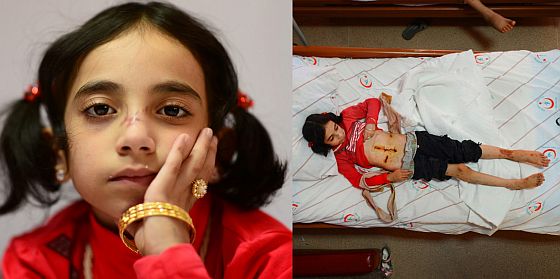
Dania-Amroosh

The Washington Post reports: Dania Amroosh wears a Hello Kitty shirt, tiny heart-shaped earrings and her hair in cute little pigtails. She looks like any other 7-year-old, except for the jagged scars on the bridge of her nose and across her chin.

There is much worse beneath her blanket on the third floor of the Kilis State Hospital in southern Turkey. A huge seeping wound on her stomach is closed with an angry grid of stitches. The casts are finally off her broken right leg and right hand, but her fingers are still black and blue and she can barely walk. Her lower body is covered with shrapnel scars.

Five months ago, Dania and her family were sitting in their home in Aleppo, Syria, about 60 miles south of here, when a bomb dropped from the sky. Her grandmother, aunt, uncle and two cousins were killed instantly. Another cousin lost his legs. Dania was mangled.

Mohammad Amroosh, her father, says that after what Syrian President Bashar al-Assad’s military did to them, he can’t go back. When Dania is ready to leave the hospital, the family will stay in Turkey, joining nearly 700,000 other Syrians who have taken shelter in the country.

“This is our home now,” he says.

One of the world’s largest forced migrations since World War II is transforming the Middle East.

The United Nations and governments in the countries where the refugees have taken shelter estimate that between 2.3 million and 2.8 million Syrians have fled their homeland. The United Nations says that number is rising by nearly 3,000 people a day, with no end in sight for a conflict that has lasted nearly three years. [Continue reading…]

Facebooktwittermail

For Syrian refugees in Lebanon, winter storm brings snow, rain and new misery

The Washington Post reports: The United Nations said Wednesday that it is “extremely concerned” for Syria’s refugees as snow and freezing temperatures descended on the region.

Syria and the countries that border it have been bracing for what is expected to be the worst winter storm in years. Snow hit some areas of Lebanon, Turkey and northern Syria overnight Tuesday as sharp winds and cold, heavy rains battered others, causing misery for hundreds of thousands in camps and shanties.

In Lebanon, despite the wintry conditions, the flow of Syrians fleeing the war is unrelenting. Local officials in the border town of Arsal, where some of the heaviest snow fell overnight, on Wednesday reported the arrival of 200 men, women and children who had risked the treacherous journey across the mountains on foot. Many were from the town of Yabroud in the Qalamoun region, where a Syrian army offensive is underway.

Aid agencies, the Office of the U.N. High Commissioner for Refugees (UNHCR) and the Lebanese army rushed to distribute kits containing plastic sheeting and blankets to the newcomers, but poorly funded humanitarian groups are struggling to meet the overwhelming needs. Authorities remain reluctant to establish permanent refu­gee camps in Lebanon and have opened only one official, 100-tent “transit camp.” [Continue reading…]

Facebooktwittermail

The collapse of the Free Syrian Army brand

Mike Giglio reports: On the afternoon of Nov. 26, near the border in southern Turkey, Mohamed al-Kadi got behind the wheel of a white Isuzu delivery truck and drove into Syria. In the back of the truck sat a shipment of advanced communications equipment, provided by the United States. Kadi’s mission was to bring it to the Free Syrian Army, or FSA, the U.S.-backed rebel coalition whose main base sat just a few miles into Syria.

Kadi, a deeply religious man partial to Muslim prayer beads and oddball humor, was a tech whiz with a degree in computer engineering. He’d been a young lieutenant in Damascus at the war’s outset but defected early to the rebel side, where his computer skills saw him pulled from the front lines. He worked as a senior technician for the FSA’s high command, based mainly inside Syria. But shortly after he crossed into Syria that afternoon, Kadi and the delivery truck disappeared. Days later, his body was found in a farm field, shot at point-blank range in the back of the head, hands tied behind his back.

The FSA blamed Kadi’s death on the Islamic State of Iraq and Syria, or ISIS, which claims to be Al-Qaeda’s Syrian arm, saying the group had captured Kadi’s truck along a critical supply route and stolen the equipment inside.

The incident alarmed the U.S., which had long worried about the possibility of the supplies it sends the FSA falling into the hands of extremists. Some U.S. allies inside the rebellion shared those concerns. “We warned the U.S. government for over a year about ISIS gathering strength and spreading in the North,” said one opposition official involved in channeling U.S. assistance to the FSA.

Now many are questioning how much longer the FSA can survive, following news that fighters from a new, hardline coalition called the Islamic Front, which boasts an estimated 45,000 fighters in Syria, overtook its main bases and warehouses in Atimeh, a town near the Turkish border late last week. The powerful Islamist faction now stands poised to overtake the FSA as the country’s dominant rebel force. [Continue reading…]

Facebooktwittermail

Former CIA chief Hayden hopes Assad will remain in power

AFP reports: The sectarian bloodbath in Syria is such a threat to regional security that a victory for Bashar al-Assad’s regime could be the best outcome to hope for, a former CIA chief said.

Washington condemned Assad’s conduct of the conflict, threatened air strikes after he was accused of targeting civilians with chemical weapons and has demanded he step down.

The United States is also supplying millions of dollars in “non-lethal” aid to some of the rebel groups fighting Assad’s rule.

But Michael Hayden, the retired US Air Force general who until 2009 was head of the Central Intelligence Agency, said a rebel win was not one of the three possible outcomes he foresees for the conflict.

“Option three is Assad wins,” Hayden told the annual Jamestown Foundation conference of terror experts.

“And I must tell you at the moment, as ugly as it sounds, I’m kind of trending toward option three as the best out of three very, very ugly possible outcomes,” he said.

Facebooktwittermail

Top Western-backed rebel in Syria is forced to flee

The Wall Street Journal reports: Islamist fighters ran the top Western-backed rebel commander in Syria out of his headquarters, and he fled the country, U.S. officials said Wednesday.

The Islamists also took over key warehouses holding U.S. military gear for moderate fighters in northern Syria over the weekend. The takeover and flight of Gen. Salim Idris of the Free Syrian Army shocked the U.S., which along with Britain immediately froze delivery of nonlethal military aid to rebels in northern Syria.

The turn of events was the strongest sign yet that the U.S.-allied FSA is collapsing under the pressure of Islamist domination of the rebel side of the war. It also weakened the Obama administration’s hand as it struggles to organize a peace conference next month bringing together rebels and the regime.

The Islamic Front is a recently formed alliance of the largest Islamist rebel groups that excludes the two main al Qaeda-linked rebel groups—the Nusra Front and the Islamic State of Iraq and al Sham—and is considered the more moderate faction among Islamist rebel groups.

Gen. Idris flew to the Qatari capital of Doha on Sunday after fleeing to Turkey, U.S. officials said Wednesday. “He fled as a result of the Islamic Front taking over his headquarters,” a senior U.S. official said.

An Islamic Front spokesman also said Gen. Idris had fled to Turkey.

The Front took over the warehouses and offices controlled by the Supreme Military Council, the moderate opposition umbrella group that includes the FSA and coordinates U.S. aid distribution, officials said. They also seized the Bab al-Hawa border crossing with Turkey, near the warehouses in the town of Atmeh.

The growing strength of the Islamic Front prompted the U.S. and its allies to recently hold direct talks with Islamic Front representatives. The goal, according to Western officials, was to persuade some Islamists to support a Syria peace conference set for Geneva on Jan. 22 for fear that a lasting accord won’t be possible without their backing. The SMC already agreed to participate in the peace talks. [Continue reading…]

Facebooktwittermail