Category Archives: United States

Christian Appy: America’s Hiroshima and Nagasaki 70 years later

So many decades later, it’s hard to remember the kind of nuclear thinking top American officials engaged in during the Cold War. In secret National Security Council documents of the early 1950s, for instance, the country’s top strategists descended willingly into the charnel house of futuristic history, imagining life on this planet as an eternal potential holocaust. They wrote in those documents of the possibility that 100 atomic bombs, landing on targets in the United States, might kill or injure 22 million Americans and of a “blow” that might result in the “complete destruction” of the Soviet Union.

And they weren’t just whistling Dixie. After all, in 1960, the top military brass found themselves arguing about the country’s first Single Integrated Operational Plan for nuclear war. In it, a scenario was laid out for delivering more than 3,200 nuclear weapons to 1,060 targets in the Communist world. Targets included at least 130 cities, which, if all went well, would cease to exist. Classified estimates of possible casualties from such an attack ran to 285 million dead and 40 million injured. That’s what “the complete destruction” of the Soviet Union and Communist China meant then and, until Dr. Strangelove hit the screens in 1964, those figures were simply part of the sort of “rational” war planning that led to perfectly serious debate about launching a “preemptive strike” — what, if another country were considering it, would have been a “war of aggression” — to eradicate that enemy. To give credit where it’s due, Army and Navy officials did worry “about the lethal impact of downwind fallout, with the Army explicitly concerned about limiting exposure of ‘friendly forces and people’ to radioactive fallout. By contrast, the Air Force saw no need for additional constraints [on surface nuclear blasts].”

It’s this world that we “celebrate,” having now reached the 70th anniversary of the atomic bombings of Hiroshima (August 6, 1945) and Nagasaki (August 9, 1945). Today, we know that delivering so many nuclear weapons (or, in fact, many less) would have done a lot more than wipe out the “Communist world.” It would have plunged the planet into nuclear winter and undoubtedly eradicated humanity as definitively as the dinosaurs were wiped out by that asteroid 65 million years ago.

Apocalypse was — and remains — us. After all, despite the recent nuclear agreement that will stop a country without nuclear weapons from building them, this planet is still loaded with a world-ending arsenal that is constantly being expanded, updated, and modernized. Call us lucky, but don’t call us particularly thoughtful. Today, Christian Appy, author of American Reckoning: The Vietnam War and Our National Identity, considers the way in which — except in rare moments when antinuclear movements gained brief strength here — Americans managed to ignore how this country’s leaders ushered us into the nuclear age by annihilating not one but two cities and killing hundreds of thousands of defenseless civilians. Tom Engelhardt

Our “merciful” ending to the “good war”
Or how patriotism means never having to say you’re sorry
By Christian Appy

“Never, never waste a minute on regret. It’s a waste of time.”

— President Harry Truman

Here we are, 70 years after the nuclear obliteration of Hiroshima and Nagasaki, and I’m wondering if we’ve come even one step closer to a moral reckoning with our status as the world’s only country to use atomic weapons to slaughter human beings. Will an American president ever offer a formal apology? Will our country ever regret the dropping of “Little Boy” and “Fat Man,” those two bombs that burned hotter than the sun? Will it absorb the way they instantly vaporized thousands of victims, incinerated tens of thousands more, and created unimaginably powerful shockwaves and firestorms that ravaged everything for miles beyond ground zero? Will it finally come to grips with the “black rain” that spread radiation and killed even more people — slowly and painfully — leading in the end to a death toll for the two cities conservatively estimated at more than 250,000?

Given the last seven decades of perpetual militarization and nuclear “modernization” in this country, the answer may seem like an obvious no. Still, as a historian, I’ve been trying to dig a little deeper into our lack of national contrition. As I have, an odd fragment of Americana kept coming to mind, a line from the popular 1970 tearjerker Love Story: “Love,” says the female lead when her boyfriend begins to apologize, “means never having to say you’re sorry.” It has to be one of the dumbest definitions ever to lodge in American memory, since real love often requires the strength to apologize and make amends.


Continue reading

Facebooktwittermail

In the West, drought, heat and climate change leave the land thirstier than ever

The New York Times reports: Another summer of record-breaking drought and heat has seized the West, setting off costly and destructive wildfires from Southern California, where a single blaze burned more than 30,000 acres of national forest east of Los Angeles, to Montana, where a fast-moving fire in Glacier National Park recently forced tourists to flee hotels, campgrounds and vehicles.

No measurable rain has fallen here in Walla Walla since May. Temperatures have broken decades-old records. And, though known for soaking skies and cool summers, Washington State is well on track to surpass last year’s wildfire season, its busiest on record.

Dozens of homes and thousands of acres have burned over the past few months — in the rain forests of the Olympic Peninsula, in suburban communities on the edge of the wild lands, and in this city of wheat farms and vineyards where hundreds of firefighters are still battling a blaze on the western slopes of the Blue Mountains, digging and scraping the earth, building barriers of dirt to shield the dried-out forests from the approaching flames.

“Our fire season started a month ahead, our crops matured weeks ahead and the dry weather we usually get in August, we’ve had since May,” said Peter J. Goldmark, Washington’s commissioner of public lands. Walking along the edge of the Blue Creek fire, burning near the Oregon-Washington border, he added, “By heavens, if this isn’t a sign of climate change, then what is climate change going to bring?” [Continue reading…]

Facebooktwittermail

Missing: One year’s worth of California rain

Climate Central reports: The amount of rain that California has missed out on since the beginning of its record-setting drought in 2012 is about the same amount it would see, on average, in a single year, a new study has concluded.

The study’s researchers pin the reason for the lack of rains, as others have, on the absence of the intense rainstorms ushered in by so-called atmospheric rivers, the ribbons of very moist air that can funnel water vapor from the tropics to California during its winter rainy season.

Overall, the study, accepted for publication in the Journal of Geophysical Research – Atmospheres, found that California experiences multi-year dry periods, like the current one, and then periods where rains can vary by 30 percent from year to year. Those wet and dry years typically cancel each other out. [Continue reading…]

Facebooktwittermail

Watch out! Millions of angry, impulsive Americans with guns

Another day, another shooting.

While it’s hard to construct a profile of the typical American shooter who engages in random killing, there are a few generalizations that can be made with reasonable confidence:

1. The shooter will be male,
2. his weapon(s) will much more often than not have been acquired legally, and
3. he’ll probably be white.

Whether a demographically disproportionate number of homicidal, gun-wielding Americans are white, I have no idea. But the latest shooting — this time the gunman, at 59-years-old, was probably above average age — illustrates the fundamental problem with the idea that carrying a gun is the best way to defend yourself against another gun owner who’s on the rampage: By the time you’ve figured out who the crazy guy is, it’s too late. Why? Because the crazy guy looks just like the regular guy.

The gun lobby would have everyone believe that guns are really only dangerous if they get in the wrong hands and thus when gun ownership turns deadly we are encouraged to overlook the central fact: guns are designed to kill.

There are lots of things that can be deadly — cars, alcohol, cigarettes, passenger aircraft, and so forth — but when these become instruments of fatality, they are not performing the function for which they were designed.

But when a gun owner goes on the rampage, unless his weapon malfunctions, each time he kills or injures someone, his gun and its ammunition were functioning exactly in accordance with specifications.

Although guns can be used to pop holes in paper targets or shatter bottles, what they’re really meant to do is rip flesh apart and end lives. This is machine tooled, high precision, state of the art, carnage.

Lisa Wade writes:

While it seems that much of the discourse around curbing gun violence focuses on the need to keep guns out of the hands of the mentally ill, these two issues — gun violence and mental illness — “intersect only at their edges.” These are the words of Jeffrey Swanson and his colleagues in their new article examining the personality characteristics of American gun owners.

To think otherwise, they argue, is to fall prey to the narrative of gun rights advocates, who want us to think that “controlling people with serious mental illness instead of controlling firearms is the key policy answer.” Since the majority of people with mental illnesses are never violent, this is unlikely to be an effective strategy while, at the same time, further stigmatizing people with mental illness.

What is a good strategy, then, short of the unlikely event that we take America’s guns away?

Swanson and colleagues argue that a better policy would be to look for signs of impulsive, angry, and aggressive behavior and limit gun rights based on that. Evidence of such behavior, they believe, “conveys inherent risk of aggressive or violent acts” substantial enough to justify limiting gun ownership.

By Wade’s estimate, based on an unspecified national data set, there are several million American gun owners who pose a risk.

Political realism may dictate that America’s gun owners can’t be deprived of their cherished weapons, but civil libertarians would just as surely guarantee that no screening process would ever be put in place (if such a process could even be devised) that would keep guns out of the hands of impulsive, angry, and aggressive Americans.

The remedy, it seems to me, will have to come from the other end by making legally available weapons less deadly and by holding gun manufacturers legally responsible for the effects of their products.

No other industry enjoys impunity from product liability yet in 2005, Congress, under pressure from the NRA, conspired with the gun makers to protect their profits at the expense of American lives.

The authors of the 2005 Protection of Lawful Commerce in Arms Act have blood on their hands. Each time the families of victims of yet another mass shooting attempt to sue the gun makers, this law provides them with protection.

The Washington Post reported in 2013 on those stymied efforts.

Marc Bern, a New York trial lawyer representing family members of Aurora victims, said the gun law severely limited his clients’ options. He is pursuing a case against the movie theater company, although some of his clients had expressed interest in trying to pursue companies that provided guns or ammunition to the shooter.

“We looked at the gun industry, but they were able to insulate themselves with this law,” Bern said. “It is absolutely outrageous that the gun industry is not accountable when virtually every other industry in this country is accountable.”

President Obama bemoans the fact that the U.S. does not have “sufficient, common-sense gun safety laws — even in the face of repeated mass killings,” and the chances of new legislation being crafted during what remains of is term are slim.

He could, however, push for the repeal of the 2005 law.

Facebooktwittermail

Cyber attack on U.S. power grid could cost economy $1 trillion: report

Reuters reports: A cyber attack which shuts down parts of the United States’ power grid could cost as much as $1 trillion to the U.S. economy, according to a report published on Wednesday.

Company executives are worried about security breaches, but recent surveys suggest they are not convinced about the value or effectiveness of cyber insurance.

The report from the University of Cambridge Centre for Risk Studies and the Lloyd’s of London insurance market outlines a scenario of an electricity blackout that leaves 93 million people in New York City and Washington DC without power.

The scenario, developed by Cambridge, is technologically possible and is assessed to be within the once-in-200-year probability for which insurers should be prepared, the report said. [Continue reading…]

Facebooktwittermail

Greg Grandin: How endless war helps Old Dixie stay new

“They finally shot the nigger!” the sparrow-slight soldier whooped. Nicknamed “Georgia” for the obvious reason, that’s what he apparently ran around shouting once word of Martin Luther King, Jr.’s assassination wound its way out into the electric-green paddy fields of South Vietnam. I was told the story more than once by a member of his unit and often imagined what it must have been like, especially for his black brothers-in-arms, to be smacked with that news and that epithet all at once. Yet, on some level, it wasn’t the least bit shocking. Labeled a “total racist” by a fellow member of his unit, Georgia was one of many white soldiers hailing from the former Confederate States of America whose bigotry was on full display during the Vietnam War.

As “soul brothers” and “bloods” across South Vietnam embraced emerging ideas about black consciousness, black pride, and black power, racist white troops responded by donning Ku Klux Klan robes, burning crosses, and embracing other symbols of white supremacy. Reflecting on his decision to join the militant Black Panthers after returning from Vietnam, Reginald Edwards, who served as a rifleman with the Marines, recalled: “We had already fought for the white man in Vietnam. It was clearly his war. If it wasn’t, you wouldn’t have seen as many Confederate flags as you saw.” Dwyte Brown, who served in the Navy, told journalist Wallace Terry that, in the barracks at the U.S. base in Cam Ranh Bay, “there would be nothing but Confederate flags all over the place.”

In the midst of the recent Confederate flag fallout following the massacre in Charleston, TomDispatch regular Greg Grandin revisits this much-neglected history and so much else that came before and after. Tracing the sordid story of the Old South’s battle flag, that symbol of bitter-end racism, from its raising by Marines on Okinawa during the Second World War to more recent appearances in Iraq and Afghanistan, Grandin shines a light on a larger and more troubling military embrace of the Confederacy — something the Pentagon would, no doubt, rather keep hidden from view.

Georgia, the soldier who cheered King’s 1968 murder, seemingly conformed to all the stereotypes you might imagine. “He had a little tape player. And all he had was one tape of every Hank Williams song there ever was and he played them constantly whenever we were in base camp,” I was told. But what he did out in the field — where the stifling heat of the day gave way to dank nights in cool, clammy foxholes — shocked me. “Georgia was this little white racist and Mitchell was this great big black guy, and when it would rain and get cold, they’d get in and sleep together to stay warm,” a fellow unit member told me. Perhaps racists are like atheists and can’t be found in foxholes. Or perhaps Georgia’s and Mitchell’s bunker brotherhood is a reminder that there’s always reason for hope.

The Pentagon now stands where South Carolina did just weeks ago. With a groundswell of grassroots activism, the U.S. military’s long-cherished symbols of racism and Confederacy-veneration might also be brought to the brink of welcome exile, if not banishment to history’s dustbin. If that ever comes to pass, one person we’ll have to thank is Greg Grandin, author of the much-anticipated Kissinger’s Shadow: The Long Reach of America’s Most Controversial Statesman. Nick Turse

The Confederate flag at war
(But not the Civil War)
By Greg Grandin

The Pentagon just can’t let go. In the wake of the Charleston Massacre, Amazon and Walmart have announced that they will no longer sell Confederate flag merchandise. Ebay says it will stop offering Confederate items for electronic auction. The Republican governor of Mississippi calls his state flag, which includes the Stars and Bars in the top left corner, “a point of offense that needs to be removed.” Even Kentucky’s Mitch McConnell, the majority leader of the U.S. Senate, agrees that a statue of Confederate President Jefferson Davis in his state’s capitol building belongs in a museum.

Yet the Department of Defense says it isn’t even “reviewing” the possibility of a ban on the flag, deciding instead to leave any such move to the various service branches, while military bases named after Confederate officers will remain so. One factor in this decision: the South provides more than 40% of all military recruits, many of them white; only 15% are from the Northeast.

Continue reading

Facebooktwittermail

Koch-backed group calls for no more national parks

Claire Moser writes: Just in time for the Fourth of July — when millions of people across the country will visit America’s national parks and other public lands — the Koch brothers are rolling out their latest campaign against these treasured places: pushing for no more national parks.

In an op-ed published in Tuesday’s New York Times, Reed Watson, the executive director at the Koch-backed Property and Environment Research Center (PERC), along with a research associate at the Center, call for no more national parks, citing the backlog in maintenance for existing parks.

“True conservation is taking care of the land and water you already have, not insatiably acquiring more and hoping it manages itself,” the op-ed reads. “Let’s maintain what we’ve already got, so we can protect it properly,” it concludes. [Continue reading…]

Facebooktwittermail

In defense of equality

In a review of Our Declaration: A Reading of the Declaration of Independence in Defense of Equality, by Danielle Allen, Gordon S. Wood writes: This is a strange and remarkable book. There must be dozens of books on the Declaration of Independence written from every conceivable point of view — historical, political, theoretical, philosophical, and textual — but no one has ever written a book on the Declaration quite like this one. If we read the Declaration of Independence slowly and carefully, Danielle Allen believes, then the document can become a basic primer for our democracy. It can be something that all of us — not just scholars and educated elites but common ordinary people — can participate in, and should participate in if we want to be good democratic citizens.

Allen, who is a professor of social science at the Institute for Advanced Study in Princeton, came to this extraordinary conclusion when she was teaching for a decade at the University of Chicago. But it was not the young bright-eyed undergraduates whom she taught by day who inspired her. Instead, it was the much older, life-tested adults whom she taught by night who created “the single most transformative experience” of her teaching career.

As she slowly worked her way through the 1,337 words of the Declaration of Independence with her night students, many of whom had no job or were working two jobs or were stuck in dead-end part-time jobs, Allen discovered that the document had meaning for them and that it was accessible to any reader or hearer of its words. By teaching the document to these adult students in the way that she did, she experienced “a personal metamorphosis.” For the first time in her life she came to realize that the Declaration makes a coherent philosophical argument about equality, an argument that could be made comprehensible to ordinary people who had no special training.

By reading and analyzing the words of the Declaration deliberately and with care, her night students

found themselves suddenly as political beings, with a consciousness that had previously eluded them. They built a foundation from which to assess the state of their political world. They gained a vocabulary and rhetorical techniques for arguing about it.

The entire experience with her students “re-gifted to me a text that should have been mine all along. They gave me again the Declaration’s ideals — equality and freedom — and the power of its language.”

Allen is most interested in the idea of equality, and rightly so. Equality has always been the most radical and potent idea in American history. [Continue reading…]

Facebooktwittermail

Why racists target black churches

Sarah Kaplan and Justin Wm. Moyer write: Since at least 1822, when the first recorded burning of a black church occurred in South Carolina, church arson has been the default response of racists frustrated with progress — or even the faint specter of progress — on civil rights. More than even lynching, burning houses of worship remains a go-to weapon in hate groups’ arsenal. Torching churches such as Mount Zion persisted decades after the passage of the Civil Rights Act and the Voting Rights Act, 100 years after Booker T. Washington dined at the White House and 150 years after the end of the Civil War.

What’s the enduring appeal of this very specific act of terror for those who wish to express hate?

The reason black churches remain a target? Because they have always remained a symbol of hope in the darkness of American racism and a source of leadership, political and religious, in the African American community.

Though it may seem the black church has always been a part of American culture — as essential as the Fourth of July or “The Star-Spangled Banner” — it was not always so. When human beings were held in servitude and meetings among slaves were banned, founding a black church was considered an act of rebellion.

Case No. 1: The founding of the church that would became Emanuel AME, the church targeted allegedly by Dylann Roof last month.

“The formation of the African Church in Charleston was a rebellious act of revolutionary proportions,” historian Bernard Powers wrote in “Black Charlestonians: A Social History.” “… The city authorities recognized the full import of the initiatives taken by this group of slaves and free blacks and responded with harassment.”

Like many black churches, Charleston’s African Church saw a tragic end; it was razed by city authorities in the 1820s after a purported slave plot and was not reborn until Reconstruction. Though such churches remained a constant target, they persisted, weaving themselves not just into the fabric of African American culture but into the social fabric of the United States.

During the early years of the black church in the South, when most congregants were enslaved and the rest still subject to the restrictive racism that was then the law of the land, Christianity offered solace and inspiration to African American worshipers. In the introduction to the award-winning digital library collection “The Church in the Southern Black Community,” professor Laurie F. Maffly-Kipp of the University of North Carolina at Chapel Hill explained how black Americans converted to Methodist and Baptist traditions around the turn of the 19th century.

“Clergy within these denominations actively promoted the idea that all Christians were equal in the sight of God, a message that provided hope and sustenance to the slaves,” she wrote.

Among enslaved people, religious gatherings were called “hush harbors” — a phrase evoked by President Obama during his impassioned eulogy for the slain pastor of Emanuel AME last week. These secret meetings were the birthplace of African American spirituals, which always carried a double meaning of religious salvation and freedom from slavery, and of the inextricable link between black spirituality and black liberation. [Continue reading…]

Facebooktwittermail

Gary Younge reflects on 12 years in America

Gary Younge writes: For the past couple of years the summers, like hurricanes, have had names. Not single names like Katrina or Floyd – but full names like Trayvon Martin or Michael Brown. Like hurricanes, their arrival was both predictable and predicted, and yet somehow, when they landed, the effect was still shocking.

We do not yet know the name that will be attached to this particular season. He is still out there, playing Call of Duty, finding a way to feed his family or working to pay off his student loans. He (and it probably will be a he) has no idea that his days are numbered; and we have no idea what the number of those days will be.

The precise alchemy that makes one particular death politically totemic while others go unmourned beyond their families and communities is not quite clear. Video helps, but is not essential. Some footage of cops rolling up like death squads and effectively executing people who posed no real threat has barely pricked the popular imagination. When the authorities fail to heed community outrage, or substantively investigate, let alone discipline, the police, the situation can become explosive. An underlying, ongoing tension between authorities and those being policed has been a factor in some cases. So, we do not know quite why his death will capture the political imagination in a way that others will not.

But we do know, with gruesome certainty, that his number will come up – that one day he will be slain in cold blood by a policeman (once again it probably will be a man) who is supposed to protect him and his community. We know this because it is statistically inevitable and has historical precedent. We know this because we have seen it happen again and again. We know this because this is not just how America works; it is how America was built. Like a hurricane, we know it is coming – we just do not yet know where or when or how much damage it will do.

Summer is riot season. It’s when Watts, Newark and Detroit erupted in violence in the 1960s, sparked by callous policing. It’s when school is out, pool parties are on and domestic life, particularly in urban centres, is turned inside-out: from the living room to the stoop, from the couch to the street. It’s when tempers get short and resentments bubble up like molten asphalt. It’s when, to paraphrase Langston Hughes, deferred dreams explode. [Continue reading…]

Facebooktwittermail

America’s embattled Christian majority?

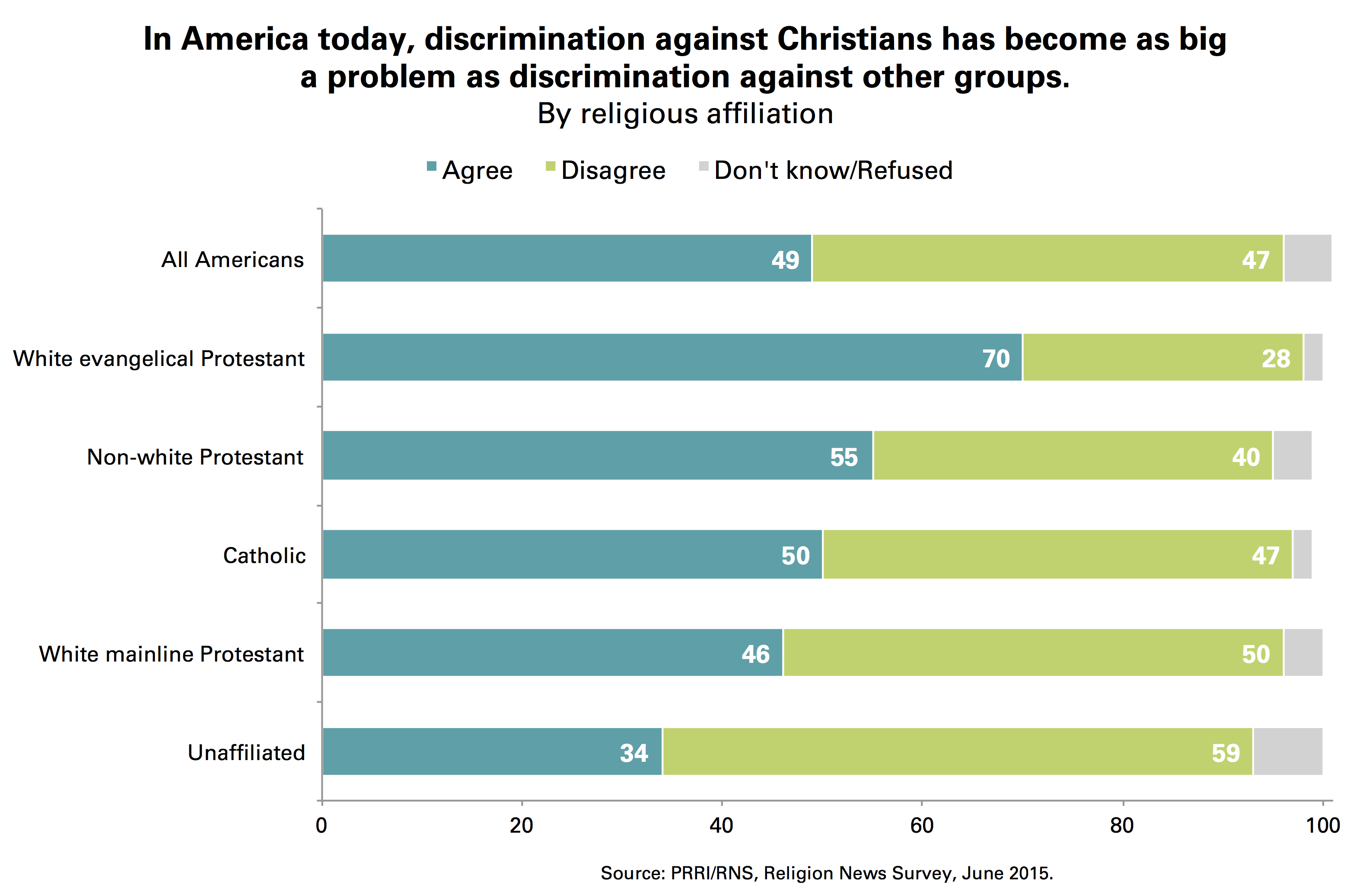
In America, 72% of the adult population identify themselves as Christian.

That, to my mind, makes this demographically (though of course not constitutionally) a Christian country.

And yet, among white evangelical Protestants, 70% believe that discrimination against Christians has become as big of a problem as discrimination against other groups!

The persecuted majority?

Do Christians get harassed by the police? Get discriminated against by landlords or employers? Get harsher jail sentences? Suffer any of the other forms of discrimination experienced by many minorities in this country?

Or, do some Christians simply resent living under a democratic constitution that separates Church and State?

Facebooktwittermail

How many lives will be saved by flag control?

John Cassidy writes: After living in this country for almost thirty years, I confess I find it hard to write about gun massacres. They are just too familiar, and too depressing. An alienated post-adolescent, almost always white, gets a gun, or guns, and exorcises his demons by killing as many people as he can. Then follows an equally predictable media outpouring, with round-the-clock coverage on cable, lengthy accounts in the serious papers, harrowing profiles of the victims, and why-oh-why editorials aplenty. Flags are flown at half-mast. Politicians, especially those who represent the area in which the massacre occurs, say that something needs to be done about gun control.

Nothing much happens, of course, and, after a while, we move onto the next incident. Back in the nineteen-eighties and -nineties, for some reason, fast-food restaurants and post offices were the sites of some of the deadliest incidents. Then came a series of school massacres, including at Columbine, where Eric Harris and Dylan Klebold killed twelve high-school students and a teacher, and at Virginia Tech, where Seung-Hui Cho killed thirty-two people before taking his own life. In Newtown, Connecticut, in December, 2012, a twenty-year-old misfit named Adam Lanza murdered twenty elementary schoolchildren, and six of their teachers, before taking his own life, too. Then there were the 2012 shootings in Aurora, Colorado: twelve people gunned down at a midnight showing of “The Dark Knight Rises.”

Which leads us to Charleston, and the latest atrocity. In this case, of course, we have the complicating and insidious factor of racism to consider. The suspected shooter, Dylann Roof, didn’t choose the Emanuel African Methodist Episcopal Church at random. The evidence suggests that his alienation took the form of embracing white-supremacy claptrap, and that he wanted to kill black people specifically. When Roof reached Emanuel A.M.E., which is one of the oldest and best-known black churches in the country, on Wednesday evening, the members of a prayer group he encountered were so nice to him that he hesitated to go through with his “mission,” he has reportedly told police. Sadly, he managed to overcome his humane impulses.

President Obama, Hillary Clinton, and many others, including my colleagues David Remnick and Jelani Cobb, have pointed out how this tragedy reminds us that, in Obama’s words, “We don’t have to look far to see that racism and bigotry, hate and intolerance, are still all too alive in our world.” Did we really need reminding, though? The United States was partly built on racial cleansing and slavery: racism, and racist violence, have long been a part of its social fabric, as have efforts to root out these evils and eradicate them.

In the wake of last week’s events, attempts to confront racial bigotry need to be renewed and intensified, with particular attention being paid to right-wing groups that propagate hatred on the Internet and elsewhere. But the historic battle against racism and racial subordination shouldn’t distract from the other pressing policy issue at hand. On the death certificates of eighty-seven-year-old Susie Jackson, seventy-year-old Ethel Lance, and the rest of the victims, the cause of death won’t be listed as racism: it will be gunshot wounds. Roof’s despicable views didn’t kill anybody: the weapon he used was a .45 mm Glock handgun, which, according to the police, he bought at a local gun store. [Continue reading…]

Facebooktwittermail

Nomi Prins: Jeb! The money! Dynasty!

Money, they say, makes the world go round. So how’s $10 billion for you? That’s a top-end estimate for the record-breaking spending in this 1% presidential election campaign season. But is “season” even the right word, now that such campaigns are essentially four-year events that seem always to be underway? In a political world stuffed with money, it’s little wonder that the campaign season floats on a sea of donations. In the case of Jeb Bush, he and his advisers have so far had a laser-focus on the electorate they felt mattered most: big donors. They held off the announcement of his candidacy until last week (though he clearly long knew he was running) so that they could blast out of the gates, dollars-wise, leaving the competition in their financial dust, before the exceedingly modest limits to non-super PAC campaign fundraising kicked in.

And give Jeb credit — or rather consider him a credit to his father (the 41st president) and his brother (the 43rd), who had Iraq eternally on their minds. It wasn’t just that Jeb flubbed the Iraq Question when a reporter asked him recently (yes, he would do it all over again; no, he wouldn’t… well, hmmm…), but that Iraq is deeply embedded in the minds of his campaign team, too. His advisers dubbed the pre-announcement campaign they were going to launch to pull in the dollars a “shock-and-awe” operation in the spirit of the invasion of Iraq. Now, having sent in the ground troops, they clearly consider themselves at war. As the New York Times reported recently, the group’s top strategist told donors that his super PAC “hopes to ‘weaponize’ its fund-raising total for the first six months of the year.”

The money being talked about$80-$100 million raised in the first quarter of 2015 and $500 million by June. If reached, these figures would indeed represent shock-and-awe fundraising in the Republican presidential race. As of now, there’s no way of knowing whether they’re fantasy figures or not, but here’s a clue to Jeb’s money-raising powers: according to the Washington Post, his advisers have been asking donors not to give more than a million dollars now; they are, that is, trying to cap donations for the moment. (As the Post’s Chris Cillizza wrote,“The move reflects concerns among Bush advisers that accepting massive sums from a handful of uber-rich supporters could fuel a perception that the former governor is in their debt.”) And having spent just about every pre-announcement day for months doing fundraisers and scouring the country for money, while preserving the fiction that he might not be interested in the presidency, Jeb, according to the New York Times, bragged to a group of donors that “he believed his political action committee had raised more money in 100 days than any other modern Republican political operation.”

Let’s not forget, of course, that we’re not talking about anyone; we’re talking about a Bush. We’re talking about the possibility of becoming number three (or rather Bush 45) in the Oval Office. We’re talking about what is, by now, a fabled money-shaking, money-making, money-raising machine of a family. We’re talking dynasty and when it comes to money and the Bushes (as with money and that other potential dynasty of our moment), no one knows more on the subject than Nomi Prins, former Wall Street exec and author of All the Presidents’ Bankers: The Hidden Alliances That Drive American Power. In her now ongoing TomDispatch series on the political dynasties of our moment, fundraising, and the Big Banks, think of her latest post as an essential backgrounder on the election you have less and less to do with, in which Wall Street, the Koch brothers, Sheldon Adelson, and the rest of the crew do most of the essential voting with their wallets. Tom Engelhardt

All in
The Bush family goes for number three (with the help of its bankers)
By Nomi Prins

[This piece has been adapted and updated by Nomi Prins from her book All the Presidents’ Bankers: The Hidden Alliances That Drive American Powerrecently out in paperback (Nation Books).] 

It’s happening. As expected, dynastic politics is prevailing in campaign 2016. After a tease about as long as Hillary’s, Jeb Bush (aka Jeb!) officially announced his presidential bid last week. Ultimately, the two of them will fight it out for the White House, while the nation’s wealthiest influencers will back their ludicrously expensive gambit.

And here’s a hint: don’t bet on Jeb not to make it through the Republican gauntlet of 12 candidates (so far). After all, the really big money’s behind him. Last December, even though out of public office since 2007, he had captured the support of 73% of the Wall Street Journal’s “richest CEOs.” Though some have as yet sidestepped declarations of fealty, count on one thing: the big guns will fall into line. They know that, given his family connections, Jeb is their best path to the White House and they’re not going to blow that by propping up some Republican lightweight whose father and brother weren’t president, not when Hillary, with all her connections and dynastic power, will be the opponent. That said, in the Bush-Clinton battle to come, no matter who wins, the bankers and billionaires will emerge victorious.

Continue reading

Facebooktwittermail

How the embracing of violence destroyed the American left in the 1970s

Rick Perlstein writes: The terrorists attacked their target in New York on a sunny Tuesday in autumn — but not the sunny Tuesday we now commemorate. The year was 1981 — a year in which, as Bryan Burrough observes in Days of Rage, his sprawling history of America’s post-’60s radical underground, the country had suffered the greatest number of fatalities from terrorism in that era of radical violence. That figure would not be surpassed again until the year the World Trade Center was bombed.

The 1981 attack is one of dozens of acts of cinematic violence narrated in Days of Rage, and it encapsulates some of the book’s key themes. A leader in the group that staged the attack was a man named Sekou Odinga. Born Nathaniel Burns, he had returned from Algeria, where he’d worked as a deputy for Eldridge Cleaver, who had established the Black Panther Party’s “international section” there (and was accorded official diplomatic recognition from Algiers). “We have a solidarity group in China,” Cleaver told a writer visiting his lair, which had a giant electrified map with colored lights that could be flicked on and off to represent revolutionary battlefronts all over the world. “Its chairman is Chairman Mao.” Cleaver also informally directed a new group from Algeria: the Black Liberation Army, a collection of terrorist cells that crisscrossed the United States, ambushing cops in cold blood. Upon its dissolution, Odinga helped start an even more shadowy and brutal organization, so informal that it went nameless, although its members referred to it as “the Family.”

The Family had an advantage over the Black Liberation Army, what its leaders called a “white edge”: a band of worshipful white fellow travelers who provided cover by renting cars and forging IDs. What the disciples didn’t know was that in the New York action, Mutulu Shakur and his comrades were going to carry out a “revolutionary expropriation” in order to buy cocaine. While two white accomplices, Kathy Boudin and David Gilbert, waited in a U-Haul truck, Shakur and two other men leaped out of a nearby van, shot a Brink’s guard to death, loaded $1.6 million in cash into the van, and sped off. Police officers intercepted the U-Haul vehicle and were about to release its white occupants — eyewitnesses had said the criminals were black — when Shakur’s crew sprang out of the rented truck and raked Rockland County’s finest with machine-gun fire, killing two. Boudin and Gilbert ended up holding the bag, which had been the plan all along.

If the attack proved anything, it was the extraordinary resilience of “revolutionary” violence in the United States long after it had any conceivable chance of bringing about social change (assuming that such a chance existed in the first place). It also drew attention to the cultish behavior of the Family, their systematic exploitation of revolution-besotted acolytes, the incompetence of law-enforcement agencies in tracking them down, the underground network that assisted them, and the blood — barrels of it.

No less noteworthy is that even in our terror-obsessed era, the scale of this decadelong florescence of revolutionary domestic terrorism has been all but forgotten. [Continue reading…]

Facebooktwittermail

In America, infamy is as easy to acquire as a gun

In post 9/11 America, terrorism has been used to justify wars, drone strikes, torture, secret detention, kidnapping, extrajudicial killing, mass surveillance, and the unfettered expansion of the national security state.

In recent days, numerous commentators, many of whom have surely previously been disturbed by the way the fear of terrorism has been used to manipulate this country’s political system and global outlook, are nevertheless now arguing that in America today the term “terrorist” is not being used broadly enough.

Since the white male Charleston killer, Dylann Roof, is unlikely to be branded a terrorist by public officials or in most of the media, Anthea Butler suggests:

the go-to explanation for his alleged actions will be mental illness. He will be humanized and called sick, a victim of mistreatment or inadequate mental health resources.

Nevertheless, Butler writes:

The Charleston shooting is a result of an ingrained culture of racism and a history of terrorism in America. It should be covered as such. On Friday, Department of Justice spokeswoman Emily Pierce acknowledged that the Charleston shooting “was undoubtedly designed to strike fear and terror into this community” (though terrorism is not among the nine murder charges brought against Roof, so far). And now that Roof has admitted to killing those people to start a “race war,” we should be calling him what he is: a terrorist.

Then what?

Ship him off to Guantánamo?

Terrorist is a politically charged and legally dubious term precisely because it gets used to shut down debate and curtail analysis. It is used to justify sidestepping due process and ignoring human rights.

The terrorist is the ghoul of modern America — the term functions more as an instrument of exorcism rather than illumination.

In America and elsewhere in the West, fear of terrorism dovetails with the inclinations to treat skin color as a mark of foreignness, and the tendency to view the foreign as threatening.

Calling Dylann Roof a white American terrorist, isn’t going to diminish the levels of racism, Islamophobia, and xenophobia across this country.

Calling Roof a terrorist, merely elevates his infamy, grants him the attention he obviously craves and turns attention away from the flawed legal system that allowed a worm of hatred inside his mind to be transformed into an act of deadly violence.

In America, infamy is no harder to obtain than a gun.

I recognize that there is a common sentiment which justifiably perceives an undercurrent of racism in the way in which people get labelled terrorists — that it’s a term that sticks much more easily to non-whites and especially to Muslims — but I don’t think this indicates we lack a sufficiently expansive definition and application of the term.

On the contrary, we would be better off not using the term at all, rather than trying to make its application more racially inclusive.

Jared Keller argues:

by not calling Roof’s atrocity terrorism, we gloss over the past — and present — of white America’s war of terror against its black citizens.

To my mind, that assertion, much as it contains an element of truth, is also indicative of the cultural stranglehold with which the war-on-terrorism narrative continues to grip America, fourteen years after 9/11.

The only way in which we can sense the gravity of a mass killing is by calling it terrorism, because it goes without saying — supposedly — that nothing is more serious than terrorism.

The real problem here is not the failure to call Roof a terrorist, but rather a failure to acknowledge that America faces many issues that are actually much more serious than terrorism:

Racism, inequality, environmental degradation, an unsustainable economic system, and foundationally a societal breakdown that results from individual interests being placed above collective welfare.

In a mind-your-own-business society, the mass murderers always seemingly come out of nowhere. No one sees them coming, because no one was paying enough attention. A live-and-let-live philosophy easily shifts into a live-and-let-kill reality.

In a word, we live in a country where people do not care for each other enough.

We do not live in a country where the number of terrorists is being undercounted.

After the shooting, President Obama said: “At some point, we as a country will have to reckon with the fact that this type of mass violence does not happen in other advanced countries.”

But why wasn’t that point reached long ago? The signs of this ugly form of American exceptionalism has been evident for decades.

Most Americans don’t own a gun and yet gun owners are more likely to think of themselves as “a typical American” (72% vs. 62%). Indeed, gun owners are more likely to say they “often feel proud to be American” (64% vs. 51%).

The most vocal among the 24% of Americans who own a gun are using their weapons to intimidate the whole population. Through their arrogance, ignorance and selfishness, they seem to imagine they have a stronger claim on what it means to be an American than everyone else.

After the Charleston shootings, National Rifle Association board member Charles Cotton blamed the deaths on one of the dead, Clementa Pinckney, who as a state senator had voted against a law allowing gun owners to carry concealed weapons without permits.

“Eight of his church members who might be alive if he had expressly allowed members to carry handguns in church are dead,” Cotton wrote. “Innocent people died because of his position on a political issue.”

Gun owners like Cotton, regard guns as the protectors of freedom, and see gun control laws as threats to their own freedom. In practice, they prize their weapons more highly that the lives of the tens of thousands of Americans who get killed each year by firearms.

As Gary Younge writes:

America does not have a monopoly on racism. But what makes its racism so lethal is the ease with which people can acquire guns. While the new conversation around race will mean the political response to the fact of this attack will be different, the stale conversation around gun control means the legislative response to the nature of this attack will remain the same. Nothing will happen.

After Adam Lanza shot 20 primary school children and six adults in Sandy Hook, Connecticut, in 2012 before turning his gun on himself, nothing happened. Seven children and teens are shot dead every day in America and nothing happens.

So these nine victims will join those who perished before them – a sacrifice to the blood-soaked pedestal erected around the constitution’s second amendment that gun lobbyists say guarantees the right of individuals to bear arms.

At some point, America as a nation needs to challenge its superstitious reverence for a piece of paper, and demonstrate that it is no longer willing to see the lives of so many of its citizen’s needlessly wasted.

Facebooktwittermail

Before Charleston’s church shooting, a long history of attacks

Douglas R. Egerton writes: In 1868, three men assassinated the Rev. Benjamin Randolph in broad daylight as he was boarding a train in Abbeville County, South Carolina. Randolph, a black man, had recently won a seat in the State Senate and was then campaigning for the Republican slate. Having served as an Army chaplain with the 26th Regiment United States Colored Troops, Randolph asked the Freedmen’s Bureau to send him “where he can be most useful to his race.” He settled in South Carolina in time to take part in the 1865 rededication of the Emanuel African Methodist Episcopal Church in Charleston. It was that church’s long history of spiritual autonomy and political activism that caught the attention of the white vigilantes who gunned him down and rode away. Randolph’s fate was repeated yesterday with the murder of nine people, including the pastor of the church, the Rev. Clementa Pinckney, who, like Randolph, also served as a state senator.

Reports of yesterday’s tragedy have invariably noted that an earlier incarnation of the Emanuel Church was home to Denmark Vesey, a lay minister who was one of the church’s founders, but the connections between Vesey, the congregation’s long history of activism and the events of June 17 run far deeper than that.

South Carolina was unique in early America for its black majority. No other Southern colony or state had a white minority until 1855, when Mississippi also earned that particular status. In 1822, Charleston housed 24,780 people, only 10,653 of whom were white. Free people of color were a tiny percentage, at 623, and most of them were the mixed-race offspring of white fathers and black mothers. One of the few free blacks in the city was a former slave turned carpenter, Denmark Vesey.

Vesey’s early life was so unusual that if it were the plot of a novel or film, most would regard the saga as an absurd fiction. (The fact that his story has not attracted modern filmmakers is in itself curious, and perhaps a commentary on Hollywood’s disinclination to wrestle seriously with the American past.) Born around 1767 on what was then the Danish island of St. Thomas, he was purchased in 1781 by Capt. Joseph Vesey, who shipped slaves around the Caribbean. Vesey briefly kept the child as a cabin boy, but upon reaching the French sugar colony of St. Domingue — modern Haiti — he sold the child, whom he had rechristened Telemaque, to French planters. Even by the standards of slave societies, St. Domingue was hell on earth. Telemaque pretended to have epileptic fits, rendering him unfit for the fields. When the captain returned with another cargo of humans, he had to take the child back, at which time the fits stopped. Captain Vesey, who settled in Charleston after the British evacuation in 1783, kept Telemaque — whose name had evolved into Denmark — as a domestic servant and assistant.

Denmark’s life took yet another turn in the fall of 1799, when he won $1,500 in the city lottery. The captain might simply have confiscated the earnings of his human property, but instead he agreed to sell Denmark his freedom for $600. The bargain was completed on New Year’s Eve, and Denmark Vesey woke up in the new century as a free man. But his wife, and therefore his two sons, Robert and Sandy, remained enslaved by a man named James Evans. At length, with his wife in bondage, Vesey married another woman, named Susan, and Vesey was able to buy her freedom. Their children grew up free in their rented house on Bull Street.

A practicing Presbyterian, Vesey was outraged by the pro-slavery brand of Christianity preached from the city’s pulpits. White ministers were advised to lecture their black congregants on “their duties and obligations” and avoid troublesome stories, like the exodus out of Egypt, or Christ’s sermons on human brotherhood. When 4,376 black Methodists quit their white-controlled church in protest over the elders’ decision to construct a hearse house — a garage — over a black cemetery, Vesey was an early convert. As a carpenter, he may even have assisted in constructing the first Emanuel Church, which stood not far from the present building.

The African Church, as black Charlestonians called it, promptly attracted the animosity of the authorities. As a lay minister, Vesey, in his off hours, taught congregants to read and write — a violation of the state’s ban on black literacy. State and city ordinances allowed for blacks to worship only in daylight hours and only with a majority of white congregants. City authorities raided the church in 1818, arresting and whipping 140 “free Negroes and Slaves,” one of them presumably Vesey. In 1819 they again shuttered the church, and in 1820 the City Council warned the Rev. Morris Brown not to allow his church to become “a school for slaves.”

Had the city not declared war on Emanuel, Vesey might not have participated in the plot that got him killed in 1822. Enslaved Carolinians were never content with their lot, of course, but every slave in the state knew the odds of a successful rebellion. To protect the region’s white minority, the city militia was ever active, and Secretary of War John C. Calhoun always stood ready to ship soldiers to his native state. But the assaults on the church, which the Old Testament taught was a capital offense, reminded blacks that authorities would never allow them even the smallest spiritual freedom.

President Jean-Pierre Boyer of Haiti had recently placed advertisements in American newspapers, urging free blacks to bring their tools and skills and start life anew in his black republic. So, meeting in Vesey’s Bull Street home and within the walls of the Emanuel, Vesey and his lieutenants called for domestic slaves to kill their masters in their beds and fight their way to the docks, where they would seize ships and sail south. Originally, the plan was set for July 14, 1822 — Bastille Day — but the plot began to unravel, and Vesey moved the plans forward to the night of June 16. The uprising would begin when the city’s churches tolled midnight, meaning that the actual black exodus out of Charleston would take place on June 17. Either the shooter in Charleston yesterday knew the importance of this date, or the selection of June 17 was a ghastly coincidence. [Continue reading…]

Facebooktwittermail

Factory farm nation

Food & Water Watch recently published its report Factory Farm Nation based on an analysis of U.S. Department of Agriculture (USDA) Census of Agriculture data from 1997, 2002, 2007 and 2012 for beef cattle, hogs, dairy cattle, broiler meat chickens and egg-laying operations. These are the report’s key findings:

  • The total number of livestock on the largest factory farms rose by 20 percent between 2002 and 2012. The number of livestock units on factory farms increased from 23.7 million in 2002 to 28.5 million in 2012. “Livestock units” is a way to measure different kinds of animals on the same scale based on their weight — one beef cattle is the equivalent of approximately two-thirds of a dairy cow, eight hogs or four hundred chickens.
  • These factory-farmed livestock produced 369 million tons of manure in 2012, about 13 times as much as the sewage produced by the entire U.S. population. This 13.8 billion cubic feet of manure is enough to fill the Dallas Cowboys stadium 133 times. Unlike sewage produced in cities, manure on factory farms does not undergo any wastewater treatment.
  • The number of dairy cows on factory farms doubled, and the average-sized dairy factory farm increased by half, between 1997 and 2012. The number of dairy cows on factory farms rose 120.9 percent in 2012, the equivalent of adding 550 factory-farmed dairy cows every day for 15 years. The average size of dairy factory farms grew by half (49.1 percent) from 1,114 cows in 1997 to 1,661 in 2012. In nine states — Kansas, Oklahoma, New Mexico, Arizona, Idaho, Texas, Indiana, Missouri and Nevada — the average size was more than 2,000 cows in 2012.
  • The number of beef cattle on feedlots rose 5 percent from 2002 to 2012. Feedlot size grew even as the 2012 drought reduced total cattle numbers. The number of beef cattle on operations with at least 500 head grew from 11.6 million in 2002 to 12.1 million in 2012 — adding about 157 beef cattle every day for 10 years. Texas, Nebraska and Kansas all had more than 2 million beef cattle on feedlots in 2012. The 2012 drought reduced the total number of beef cattle on feedlots nationwide, but the average feedlot size increased by 12.7 percent over five years, from 3,800 in 2007 to more than 4,300 in 2012.
  • The number of hogs on factory farms increased by more than one-third, and the average farm size swelled nearly 70 percent from 1997 to 2012. The number of hogs on factory farms grew by 37.1 percent — from 46.1 million in 1997 to 63.2 million 2012 — the equivalent of adding 3,100 hogs to factory farms every day for the past 15 years. The average size of a hog factory farm increased 68.4 percent, from 3,600 hogs in 1997 to nearly 6,100 in 2012.
  • The number of broiler chickens on factory farms rose nearly 80 percent from 1997 to 2012, to more than 1 billion. The number of broiler chickens raised on factory farms rose 79.9 percent from 583.3 million in 1997 to 1.05 billion in 2012 — about three birds for every person in the United States. The growth in industrial broiler production added 85,000 chickens to factory farms every day over the past 15 years. The average size of U.S. broiler chicken operations rose by 5.9 percent, from 157,000 in 1997 to 166,000 birds in 2012. The average size in California and Nebraska exceeded 500,000 birds in 2012.
  • The number of egg-laying hens on factory farms increased by nearly one quarter from 1997 to 2012, to 269 million. The number of egg-producing layer hens increased 24.8 percent from 215.7 million in 1997 to 269.3 million in 2012. Nearly half (49.3 percent) of the egg-laying hens in 2012 were in the top-five-egg producing states: Iowa, Ohio, Indiana, California and Texas. The average size of egg operations has grown by 74.2 percent over 15 years, rising from 399,000 in 1997 to more than 695,000 in 2012.
Facebooktwittermail