Category Archives: United States

Inequality in America is even worse than you thought

Justin Elliot reports: There has been no shortage of headlines this week about the growing income and wealth inequality in the United States. A new study from the Congressional Budget Office, for example, found that income of the top 1 percent of households increased by 275 percent in the 30-year period ending in 2007. American households at the bottom and in the middle, meanwhile, saw income growth of just 18 to 40 percent over the same period

But less attention has been paid to the fact that not only are the numbers bad in America, they’re particularly bad when compared to other developed nations.

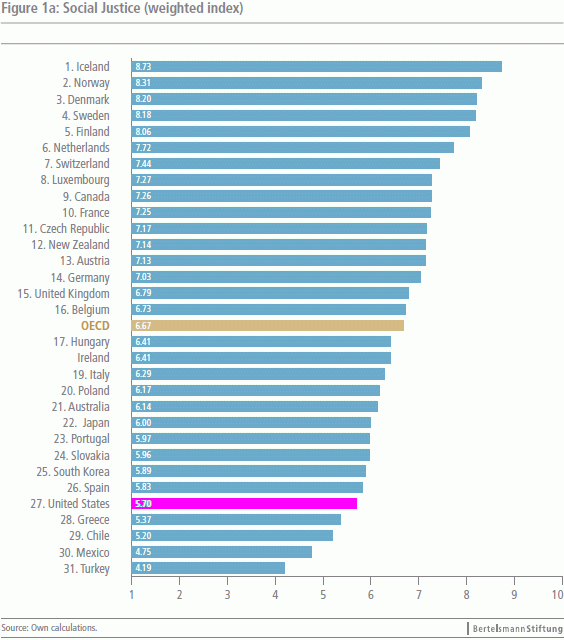
A new report (.pdf) by the Bertelsmann Foundation drives this point home. The German think tank used a set of policy analyses to create a Social Justice Index of 31 developed nations in the Organisation for Economic Co-operation and Development (OECD). The United States came in a dismal 27th in the rankings.

Facebooktwittermail

American and Israeli exceptionalism

Foreign Policy‘s latest issue looks at American exceptionalism and Stephen Walt writes:

Over the last two centuries, prominent Americans have described the United States as an “empire of liberty,” a “shining city on a hill,” the “last best hope of Earth,” the “leader of the free world,” and the “indispensable nation.” These enduring tropes explain why all presidential candidates feel compelled to offer ritualistic paeans to America’s greatness and why President Barack Obama landed in hot water — most recently, from Mitt Romney — for saying that while he believed in “American exceptionalism,” it was no different from “British exceptionalism,” “Greek exceptionalism,” or any other country’s brand of patriotic chest-thumping.

Most statements of “American exceptionalism” presume that America’s values, political system, and history are unique and worthy of universal admiration. They also imply that the United States is both destined and entitled to play a distinct and positive role on the world stage.

The only thing wrong with this self-congratulatory portrait of America’s global role is that it is mostly a myth. Although the United States possesses certain unique qualities — from high levels of religiosity to a political culture that privileges individual freedom — the conduct of U.S. foreign policy has been determined primarily by its relative power and by the inherently competitive nature of international politics. By focusing on their supposedly exceptional qualities, Americans blind themselves to the ways that they are a lot like everyone else.

No doubt it behooves Americans to recognize the things that tie this country to the rest of the world, but there is an aspect of exceptionalism Walt does not touch upon — one that sets apart American and Israeli exceptionalism from most others: the exceptionalism of colonizers.

Nations that come into existence by dispossessing, imprisoning and slaughtering the indigenous population have two problems with history:

1. Its ugliness makes it hard to glorify.
2. Its shortness exposes the tenuousness of any claim that this is “our land”.

Others look back at their national history and can trace a rich tapestry of events, places, and people in which the contours of their nation have over the preceding centuries been carved by culture and inscribed in geography. All around are stepping stones that lead into the near, middling, distant, and sometimes ancient past. The punctuations of history rest on a continuum.

If without sentiment we look back into our ancestry as Americans or Israelis, we see migrants and murderers fast preceded by a void. Our actual roots in abandoned lands take us far away from the very thing that supposedly makes us exceptional.

With histories much harder to glorify, we find the need to make our pasts less linear and more mythically grandiose. We ignore the catastrophes that we imposed on others. We didn’t steal the land; it was a gift from God.

Facebooktwittermail

Occupy Wall Street ends capitalism’s alibi

Richard Wolff writes:

Occupy Wall Street has already weathered the usual early storms. The kept media ignored the protest, but that failed to end it. The partisans of inequality mocked it, but that failed to end it. The police servants of the status quo over-reacted and that failed to end it – indeed, it fueled the fire. And millions looking on said, “Wow!” And now, ever more people are organising local, parallel demonstrations – from Boston to San Francisco and many places between.

Let me urge the occupiers to ignore the usual carping that besets powerful social movements in their earliest phases. Yes, you could be better organised, your demands more focused, your priorities clearer. All true, but in this moment, mostly irrelevant. Here is the key: if we want a mass and deep-rooted social movement of the left to re-emerge and transform the United States, we must welcome the many different streams, needs, desires, goals, energies and enthusiasms that inspire and sustain social movements. Now is the time to invite, welcome and gather them, in all their profusion and confusion.

The next step – and we are not there yet – will be to fashion the program and the organisation to realise it. It’s fine to talk about that now, to propose, debate and argue. But it is foolish and self-defeating to compromise achieving inclusive growth – now within our reach – for the sake of program and organisation. The history of the US left is littered with such programs and organisations without a mass movement behind them or at their core.

So permit me, in the spirit of honoring and contributing something to this historic movement, to propose yet another dimension, another item to add to your agenda for social change. To achieve the goals of this renewed movement, we must finally change the organisation of production that sustains and reproduces inequality and injustice. We need to replace the failed structure of our corporate enterprises that now deliver profits to so few, pollute the environment we all depend on, and corrupt our political system.

We need to end stock markets and boards of directors. The capacity to produce the goods and services we need should belong to everyone – just like the air, water, healthcare, education and security on which we likewise depend. We need to bring democracy to our enterprises. The workers within and the communities around enterprises can and should collectively shape how work is organised, what gets produced, and how we make use of the fruits of our collective efforts.

If we believe democracy is the best way to govern our residential communities, then it likewise deserves to govern our workplaces. Democracy at work is a goal that can help build this movement.

Facebooktwittermail

Israel has hit brick wall, and it’s called isolation

Larry Derfner writes:

Whenever things take a turn for the worse in Israel, whenever I think the country has become too filled with fear and aggression to ever be ready to make peace, I remind myself: The way we’re going leads to a brick wall, and one day we’re going to run into it. After the pain subsides and we dust ourselves off, we will see that the brick wall is still standing. And at that point, we will have no choice but to change direction.

The brick wall up the road is international isolation to the point of pariah status, together with a continual escalation in severe security threats and no reasonable hope of overcoming them by military force.

Two weeks ago at the United Nations, Israel took another giant step toward that wall. At the same time, by enforcing Israel’s opposition to the Palestinian statehood bid, the United States appears to have dealt itself out of influence in the Israeli-Palestinian conflict, and maybe even in the Middle East as a whole.

Backed by the Republican Party, the American Christian right and the American Jewish right, the Israeli government bent U.S. President Barack Obama too far this time. By blocking the Palestinian drive for statehood, he’s no good to Israel anymore. He’s lost the trust of even a moderate Palestinian leader like Mahmoud Abbas. So he can’t pressure the Palestinians to be more conciliatory, like he could before.

It’s questionable whether he has much sway left with Egypt, Turkey and Jordan, either, whom Israel used to count on as bulwarks against its radical enemies.

This is not good for Israel. And if Prime Minister Benjamin Netanyahu thinks a Republican in the White House will come riding to his rescue, I doubt that any of the Republican candidates will be able to win any more friends or influence people for this Israeli government than Obama currently can – and I am, of course, understating matters.

Facebooktwittermail

Why fewer young American Jews share their parents’ view of Israel

Dana Goldstein writes:

“I’m trembling,” my mother says, when I tell her I’m working on an article about how younger and older American Jews are reacting differently to the Palestinians’ bid for statehood at the United Nations. I understand the frustrations of the Palestinians dealing with ongoing settlements construction and sympathize with their decision to approach the U.N., but my mom supports President Obama’s promise to wield the U.S. veto, sharing his view that a two-state solution can be achieved only through negotiations with Israel.

“This is so emotional,” she says as we cautiously discuss our difference of opinion. “It makes me feel absolutely terrible when you stridently voice criticisms of Israel.”

A lump of guilt and sadness rises in my throat. I’ve written harshly of Israel’s invasion of Lebanon in 2006 and its assault on Gaza in 2009, and on civil rights issues in Israel. But speaking my mind on these topics — a very Jewish thing to do — has never been easy. During my childhood in the New York suburbs, support for Israel was as fundamental a family tradition as voting Democratic or lighting the Shabbos candles on Friday night.

My mom has a masters degree in Jewish history and is the program director of a large synagogue. Her youthful Israel experiences, volunteering on a kibbutz and meeting descendants of great-grandmother’s siblings, were part of my own mythology. Raised within the Conservative movement, I learned at Hebrew school that Israel was the “land of milk and honey” where Holocaust survivors had irrigated the deserts and made flowers bloom.

What I didn’t hear much about was the lives of Palestinians. It was only after I went to college, met Muslim friends, and enrolled in a Middle Eastern history and politics course that I was challenged to reconcile my liberal, humanist worldview with the fact that the Jewish state of which I was so proud was occupying the land of 4.4 million stateless Palestinians, many of them refugees displaced by Israel’s creation.

Facebooktwittermail

Wall Street protests reveal slice of America’s barely tamed brutality

Ed Pilkington writes:

One of the hardships of life as a reporter in New York City is that you so rarely get credited with the kind of heroism shown by colleagues in Helmand, say, or Baghdad. The assumption is that you’re spending time drinking gin martinis on the roof of Soho House (I prefer vodka) or dining at the Grand Central oyster bar (try the Rhode Island Cuttyhunks, they’re sumptuous), rather than dodging bullets in Tripoli.

I’d like to think that over the past few days perception of my job as a soft landing has started to change, and that its true nature as a tough, dangerous and – yes – heroic posting has begun to emerge. Take the events over the weekend in Wall Street. Admittedly, I wasn’t there, but that’s not the point. I could have been.

The protests were a lament for a nation in which, despite the 2008 meltdown, the financial system remains largely unregulated, where 46 million Americans live below the official poverty line, and where inequality is greater now than at any time since 1929. That’s hardly the stuff of revolutions: you can read Paul Krugman make a similar point every week in the New York Times. And in the land of the first amendment you’d think it was OK to shout it out in the street, even if that street is Wall Street.

Not according to the two white-shirted senior NYPD officers captured on video. The film shows a small group of women protesters, who are doing nothing menacing at all, having been kettled by police. As they stand there fenced in and defenceless, the two white shirts walk up to them, hold out a pepper-spray canister and zap them straight in the face.

It’s the officers’ insouciance that is most shocking. They engage the pepper spray as calmly as if they were handing out parking tickets, then turn and just as calmly walk away.

The video reminded me of another recent event at which I was present: last week’s execution in Georgia of Troy Davis. The case drew international attention because there was no forensic evidence and seven out of nine key witnesses had recanted their testimony.

But it was the incidental details outside the prison that caught my eye. An impassioned but entirely peaceful crowd of protesters had gathered to make the pretty reasonable argument that states should not go around killing innocent people. Georgia’s response was to line up a Swat team in black riot gear like extras in a Batman movie and fly police helicopters with spotlights overhead. Add to that the balmy night and the loud buzzing of the crickets and it was like stepping back in time into a pastiche of the old Deep South.

It would be tempting to blame the extraordinary cruelty of that night on residual southern racism. But the most gruesome element of the proceedings had nothing to do with Georgia. Rather it came from the highest court in the land, the bastion of American justice, the US supreme court in Washington. It was the supreme court that kept Davis waiting for four full hours, not knowing whether he was about to live or die, and then announced the execution could go ahead. Calmly, insouciantly, just like those New York cops.

The combination of pepper spray, Swat teams and judicial torture – for that is what it was – underlined for me a strain of American life that is forever present but rarely makes itself so boldly visible as it has this week. You find it nostalgically glamorised in westerns and Coen brothers films – rough justice, primordial morality, the cold hard logic of the gun. It’s a barely tamed brutality that sits oddly with America’s claim to be the standard-bearer of civilisation in the world.

Facebooktwittermail

The decline of American client states

Max Fisher writes:

America’s love affair with client states began not long after it and the Soviet Union — another master in the art of client-building — pressured the UK and France to leave Egypt, which they had invaded in 1956 to reclaim control of the Suez canal. European colonialism, the U.S. and USSR argued at the United Nations that year, was outdated, destabilizing, and had to end. British and French forces withdrew from Egypt, and within about a decade most of the British and French empires collapsed. Meanwhile, the U.S. and Soviet Union had begun a different great geopolitical game — the search for client states — one that Washington is still playing today.

The ’56 Suez Crisis was a final act of the imperial age and one of the first in a new era, where the major powers don’t have colonies — they have clients. American and Soviet diplomats, spies, and generals spent the next four decades racing from one capital to another, trying to buy, cajole, or enforce the allegiance of smaller nations. Often, that meant tin-pot dictators that would do the master state’s bidding, either accelerating or stopping the spread of communism, depending on who was paying better that year. Egypt was one of dozens of countries that, not long after ending its centuries under colonial rule, became an often willing pawn in the Cold War’s client game, first aligning itself with the Soviet Union and then with the U.S., which offered it lots of money and military equipment as part of the 1979 Camp David Peace accords. The U.S. found less use for client states after the Soviet Union fell, but still maintains the practice today, developing (mostly) subservient allies in hot spots across the world.

If Egypt’s 1956 liberation from colonialism helped end the colonial era, the country may now once again be signalling a change in the global system. When protesters toppled Egyptian president and reliable U.S. client Hosni Mubarak this February, they changed the terms of the U.S.-Egypt relationship. Washington can send all the money and tanks it wants — it won’t be able to dictate to a democratic Cairo any more than it can to, say, Ankara or Paris. The fall of easily controlled dictators across the region (the U.S. has already given up on its man in Yemen) comes at the same time as U.S.-allied democracies and autocracies alike seem increasingly willing to buck Washington’s wishes. Last week alone, the U.S. clashed with some of its most important client states. Maybe that’s because of America’s habit of picking the most troubled states in the most troubled regions as clients (where they’re perceived as the most needed), maybe it’s because democratic movements are pressuring client states to follow popular domestic will rather than foreign guidance, and maybe it’s because the idea of clientalism was doomed from the start. Democracy is on the march, and democratic governments make bad clients: they’re fickle; prone to change foreign policy as their domestic policy shifts; and subject to the needs, desires, and whims of their voters.

Facebooktwittermail

Robert Gates sees American political scene as dysfunctional and dangerous

The Washington Post reports:

Add former Defense Secretary Robert M. Gates to the list of retired top officials who see the current American political scene as dysfunctional and dangerous.

“As a result of several long-building, polarizing trends in American politics and culture, we have lost the ability to execute even the basic functions of government, much less solve the most difficult and divisive problems facing the country,” Gates said last week at the National Constitution Center in Philadelphia where he received that group’s Liberty Medal.

He cited two causes worth considering.

The first was redistricting of congressional seats which, he said, created safe Republican and Democratic seats but led to party primaries “where candidates must cater to the most hard-core ideological elements of their base.” He wondered how this could be changed to “ensure that more candidates for Congress are forced to appeal to independents, centrists, and at least some members of the other political party to win election, just as presidential candidates must do?”

He also cited the role of an evolving news media. He looked longingly to decades past when three television networks and a handful of major newspapers dominated national coverage and “to a considerable degree, filtered extreme or vitriolic points of view.”

Today, he said, “hundreds of cable channels, blogs and other electronic media” have given wide dissemination to “every point of view, including the most extreme.” The result, according to Gates, though more democratic, “has fueled the coarsening and, I believe, the dumbing down of the national political dialogue.”

He described these two trends, along with some other factors, as polarizing the country at a time when the need is for “more bipartisanship, and more compromise to deal with our most serious problems.”

Citing his time working for eight presidents of both parties over more than 40 years, Gates said, none “had a monopoly on revealed truth.”

And without naming any of today’s leaders or presidential candidates, he warned: “Those who think that they alone have the right answers, those who demonize those who think differently, and those who refuse to listen and take other points of view into account—these leaders, in my view, are a danger to the American people and to the future of our republic.”

Facebooktwittermail

Don’t fear Islamic law in America

Eliyahu Stern writes:

More than a dozen American states are considering outlawing aspects of Shariah law. Some of these efforts would curtail Muslims from settling disputes over dietary laws and marriage through religious arbitration, while others would go even further in stigmatizing Islamic life: a bill recently passed by the Tennessee General Assembly equates Shariah with a set of rules that promote “the destruction of the national existence of the United States.”

Supporters of these bills contend that such measures are needed to protect the country against homegrown terrorism and safeguard its Judeo-Christian values. The Republican presidential candidate Newt Gingrich has said that “Shariah is a mortal threat to the survival of freedom in the United States and in the world as we know it.”

This is exactly wrong. The crusade against Shariah undermines American democracy, ignores our country’s successful history of religious tolerance and assimilation, and creates a dangerous divide between America and its fastest-growing religious minority.

The suggestion that Shariah threatens American security is disturbingly reminiscent of the accusation, in 19th-century Europe, that Jewish religious law was seditious. In 1807, Napoleon convened an assembly of rabbinic authorities to address the question of whether Jewish law prevented Jews from being loyal citizens of the republic. (They said that it did not.)

Fear that Jewish law bred disloyalty was not limited to political elites; leading European philosophers also entertained the idea. Kant argued that the particularistic nature of “Jewish legislation” made Jews “hostile to all other peoples.” And Hegel contended that Jewish dietary rules and other Mosaic laws barred Jews from identifying with their fellow Prussians and called into question their ability to be civil servants.

The German philosopher Bruno Bauer offered Jews a bargain: renounce Jewish law and be granted full legal rights. He insisted that, otherwise, laws prohibiting work on the Sabbath made it impossible for Jews to be true citizens. (Bauer conveniently ignored the fact that many fully observant Jews violated the Sabbath to fight in the Prussian wars against Napoleon.)

During that era, Christianity was seen as either a universally valid basis of the state or a faith that harmoniously coexisted with the secular law of the land. Conversely, Judaism was seen as a competing legal system — making Jews at best an unassimilable minority, at worst a fifth column. It was not until the late 19th century that all Jews were granted full citizenship in Western Europe (and even then it was short lived).

Most Americans today would be appalled if Muslims suffered from legally sanctioned discrimination as Jews once did in Europe. Still, there are signs that many Americans view Muslims in this country as disloyal. A recent Gallup poll found that only 56 percent of Protestants think that Muslims are loyal Americans.

Facebooktwittermail

How the NYPD, with the CIA’s help, became one of the country’s most aggressive domestic intelligence agencies

Mark LeVine writes:

Only two weeks before the 10th anniversary of the September 11, 2001 attacks, the Associated Press has broken a story that reminds us of just how much America has changed during the last decade, and how the government – and as important, some of the country’s most powerful corporations – routinely intrude into the lives of communities and individuals in a manner that would few would have thought imaginable the day before the planes struck the World Trade Center.

After a lengthy investigation, the Associated Press has published a story detailing a highly secretive decade-long relationship between the CIA and the New York Police Department (NYPD), in which the two agencies have worked together in “a massive covert programme to monitor the Muslim communities” living in the New York metropolitan area and surrounding regions.

The program is troubling for a host of reasons. It involves potentially serious violations of federal law, including First Amendment protections. Morever, it bears a strong resemblance to programs launched during the Civil Rights and Vietnam era, which saw techniques, technologies and even personnel from the US military and intelligence communities deployed against citizens within the United States.

When military tactics and strategies drawn from the front lines of war are applied to radically different contexts, the results are rarely beneficial to the health of a democracy.

According to the AP report, “The [NYPD] has dispatched teams of undercover officers, known as ‘rakers,’ into minority neighborhoods as part of a human mapping program, according to officials directly involved in the program. They’ve monitored daily life in bookstores, bars, cafes and nightclubs. Police have also used informants, known as ‘mosque crawlers,’ to monitor sermons, even when there’s no evidence of wrongdoing. NYPD officials have scrutinized imams and gathered intelligence on cab drivers and food cart vendors, jobs often done by Muslims. Many of these operations were built with help from the CIA, which is prohibited from spying on Americans but was instrumental in transforming the NYPD’s intelligence unit.”

Despite such prohibitions on spying on Americans, the NYPD and CIA have built a “partnership that has blurred the bright line between foreign and domestic spying.” The relationship has included a senior, active-duty CIA officer being hired by the NYPD to set up its intelligence programmes and another senior officer working as a “clandestine operative” inside police headquarters, and the CIA training of at least one police detective at the agency’s spy school.

Having watched the World Trade Center fall with my own eyes and then had to cope with a newborn son breathing in the soot and toxin-tainted air for weeks after, it’s hard not to sympathize with the NYPD’s willingness to “push the envelope” of police procedures in order to protect New Yorkers from a similar attack. It’s also hard not to agree with the assessment by NY cops that they can never again rely on the federal government to protect New York and therefore must become an active player in gathering and acting on intelligence that might affect the city’s eight million citizens.

Indeed, the NYPD’s “success” in these operations points out the weakness that still hampers effective intelligence work by the American intelligence community: Most CIA officers are white men who could never blend into a Muslim community; but the NYPD’s 34,000 officers reflect the ethnic and religious mosaic of New York, providing it with a host of Arab and South Asian officers who speak the languages and intimately know the cultures, making it much easier for them, effectively, to spy on their communities.

And it’s clear that this is what the NYPD is doing, having become, in the AP‘s words, “one of the country’s most aggressive domestic intelligence agencies.” Intelligence-read, spy-agencies spy; they aren’t set up primarily to look for evidence of crimes, but to gather intelligence, knowledge that might later be useful do shape policies or influence the behaviour of the groups or communities being surveilled.

Police are supposed to monitor citizens only to the extent there is evidence or sufficient suspicion of criminal activity or its planning. But the AP reports that in many cases members of the unit go out of their way not to have their information, or even their existence, brought to a court of law.

Simply put, if the intelligence that the NYPD intelligence unit is gathering is not useful to the judicial process, then it’s not police work, it’s spying. If Americans think being spied on by their government isn’t such a big deal, they can talk to the millions of Arabs who’ve rebelled in good measures because of decades of such practices, or the citizens of former Communist countries in Eastern Europe. All of these governments also justified spying with the need to “protect” the state and citizens from potentially dangerous people. But it always ends the same way.

Facebooktwittermail

The empire at dusk

In State vs. Defense: The Battle to Define America’s Empire, Stephen Glain writes:

In its scramble to avoid another legislative gang war over the nation’s debt ceiling, Washington is preparing to shake down the Defense Department in the name of deficit reduction. While budget cutters preoccupy themselves with line-item expenditures, they overlook the Pentagon’s biggest cost center: empire. The burden of global hegemony, the commitment to project force across every strategic waterway, air corridor, and land bridge, has exhausted the U.S. military and will be even harder to sustain as budget cuts force strategists and logisticians to do more with less. A national discussion about the logic of maintaining huge forward bases, to say nothing of their financial and human costs, is long overdue.

American relations with the world, and increasingly America’s security policy at home, have become thoroughly and all but irreparably militarized. The culprits are not the nation’s military leaders, though they can be aggressive and cunning interagency operators, but civilian elites who have seen to it that the nation is engaged in a self-perpetuating cycle of low-grade conflict. They have been hiding in plain sight, hyping threats and exaggerating the capabilities and resources of adversaries. They have convinced a plurality of citizens that their best guarantee of security is not peace but war, and they did so with the help of a supine or complicit Congress. Since the collapse of the Soviet Union, U.S. presidents have ordered troops into battle 22 times, compared with 14 times during the Cold War. Not once did they appeal to lawmakers for a declaration of war.

The legacy of American militarism is a national security complex that thrives on fraud, falsehood, and deception. In the 1950s, Americans were told the Soviets had not only the means to destroy the United States but the desire to do so. In reality, Moscow lacked the former and so gave little thought to the latter, while Washington squandered billions of dollars on needless weaponry. Time and again, U.S. presidents weaponized their response to challenges overseas to protect them from charges of appeasement from the right. Habitually, their administrations misinterpreted events — from Russia’s Bolshevik revolution to the September 11 attacks — to disastrous effect. In each case, expert advice was overlooked, ignored, or concealed, while in others, threats were manufactured as chips in petty political wagers. The fraudulent bomber and missile gaps and the Gulf of Tonkin incident did as much to injure U.S. interests overseas as did the notion that Saddam Hussein possessed weapons of mass destruction and intended to use them preemptively.

Facebooktwittermail

Shaping a new world order

Andrew Bacevich writes:

Chief among the problems facing the United States today is this: too many obligations piled high without the wherewithal to meet them. Among those obligations are the varied and sundry commitments implied by the phrase “American global leadership.” If ever there were an opportune moment for reassessing the assumptions embedded in that phrase, it’s now.

With too few Americans taking notice, history has entered a new era. The “unipolar moment” created by the collapse of the Soviet Union in 1991 has passed. To refer to the United States today as the world’s “sole superpower” makes about as much sense as General Motors bragging that it’s the world’s No.1 car company: Nostalgia ill-befits an enterprise beset with competitors breathing down its neck. Similarly, to call Barack Obama the “most powerful man in the world” is akin to curtsying before Elizabeth II as “Queen of Great Britain, Ireland and British Dominions beyond the Seas”: Although a nice title, it confers little by way of actual authority.

A new global order is rapidly emerging. In that order, the United States will no doubt remain a very important player. Yet alongside the U.S. will be several others: China preeminently among them, but with Russia, India, Turkey, Japan, South Korea and Brazil also demanding to be reckoned with. (Whether Europe, currently wallowing in disarray, can muster the will and wallet to play in this company qualifies as an unknown.)

Nothing Washington can do will prevent this geopolitical transformation. Politicians may insist that the United States still stands apart — always and forever a “triple-A nation” — but their declarations will have as much effect as King Canute ordering the waves to stop. Indeed, to indulge further in the fiction of American omnipotence — persisting in our penchant for fighting distant wars of dubious purpose, for example — will accelerate the process, with relative decline becoming absolute decline. For Americans, husbanding power rather than squandering it is the order of the day.

Facebooktwittermail

My Fellow American

About My Fellow American:

My Fellow American is an online film and social media project that calls upon concerned Americans to pledge and spread a message that Muslims are our fellow Americans. It asks people of other backgrounds to pledge, and share a real life story about a Muslim friend, neighbor, or colleague that they admire. Using the power of social media, My Fellow American seeks to change the narrative – from Muslims as the other, to Muslims as our fellow Americans.

Most Americans have never met an American Muslim. Many only know Muslims through the way they are portrayed in the media. American Muslims are so often vilified as “the other” that it is possible not to recognize that most were born in the U.S. Or that those who immigrated here came seeking the same freedoms and opportunities that have always attracted people to America.

Muslims are our fellow Americans, who today face threats to their civil rights and even their personal safety because of the fearful and often hateful rhetoric that would not be tolerated were it uttered about any other minority group.

Facebooktwittermail

Patriotic American Muslims viewed with suspicion by many fellow citizens

Which religious group of Americans has the most positive view of their fellow American Muslims? American Jews.

Which religious group of Americans has the greatest appreciation for religious pluralism in America? American Muslims.

American Muslims and American Jews have almost exactly the same level of support — about 80% — for a two-state solution to the Palestinian-Israeli conflict. The least level of support comes from Protestants — 69%.

Only 56% of Protestants believe that Muslims living in America have no sympathy for al Qaeda.

48% of Muslim Americans say that they have personally experienced racial or religious discrimination in the last year.

These are some of the findings from a new Gallop poll on Muslim Americans.

Christian Science Monitor reports:

A poll released Thursday revealed curious contradictions in the Muslim-American community, which is more enthused about its country and president than any other religious group, yet is the least politically active and faces the greatest discrimination.

The Gallup poll on American religious groups offers a counterpoint to the stereotype that Muslims in the US lead isolated lives because they do not feel comfortable fitting in or associating with mainstream American culture. Moreover, it also offers insights into the Muslim-American experience – from how dramatically the election of President Obama affected them to how little they trust the activists who work on their behalf.

In total, the poll paints a picture of a community characterized by optimism but still seeking acceptance among its fellow citizens.

Facebooktwittermail

Seeds of terror in Norway

Andrew Gumbel writes:

America’s violent far right would have no difficulty recognizing the tell-tale signatures of Friday’s killing spree in Norway — and not just because they would see the confessed perpetrator, Anders Behring Breivik, as an ideological soul mate who, like their own heroes, thought he could trigger a white-supremacist revolution with bombs and bullets.

Breivik appears to have been more than simply inspired by American predecessors such as Timothy McVeigh, the Oklahoma City bomber: The materials he used, the way he planned and carried out his attacks, and his own writings all suggest he was deeply familiar with the actions of some notorious political killers on this side of the Atlantic.

Breivik possessed a Glock semiautomatic, the same weapon McVeigh was carrying when he was arrested by a hawk-eyed Highway Patrol officer 90 minutes after the April 1995 bombing in Oklahoma. Breivik also possessed a .223-caliber Ruger assault rifle, just like McVeigh.

The Ruger, in fact, has a long history of use by violent extremists because it is dependable, easy to load and fire, and cheaper than an AR-15 or M-16. It is also convertible, without much difficulty, to a fully automatic weapon.

Gordon Kahl, an iconic white-supremacist tax protester, was armed with a Ruger Mini-14 — the same model as Breivik’s — when he led the FBI on a multi-state shooting spree from North Dakota to Arkansas in 1983. Richard Wayne Snell, a protege of Kahl’s, was carrying a Mini-14 when he killed the only black trooper in southwestern Arkansas in 1984 and then battled it out with police across the state line in Oklahoma.

Meanwhile, the Irish Times reports:

Breivik played the online role-playing war game World of Warcraft with a Dutch enthusiast – who won the Norwegian gunman’s approval because he’d voted for far-right leader Geert Wilders.

In his 1,500-page manifesto, Breivik describes how he used Blizzard Entertainment’s World of Warcraft and Activision’s Call of Duty: Modern Warfare 2 to prepare for last Friday’s twin attacks which left a total of 76 people dead.

“I just bought Modern Warfare 2, the game,” he wrote in the document, entitled 2083: A European Declaration of Independence . “It is probably the best military simulator out there and it’s one of the hottest games this year. I see MW2 more as part of my training-simulation than anything else.”

It emerged yesterday that one of Breivik’s regular opponents in the multi-player computer game – known as WoW – was Dutch video games enthusiast, Jeroen Rink, who had no idea of Breivik’s real political views or of the double massacre he was allegedly planning.

Facebooktwittermail

Murdoch’s Watergate

Carl Bernstein writes:

The hacking scandal currently shaking Rupert Murdoch’s empire will surprise only those who have willfully blinded themselves to that empire’s pernicious influence on journalism in the English-speaking world. Too many of us have winked in amusement at the salaciousness without considering the larger corruption of journalism and politics promulgated by Murdoch Culture on both sides of the Atlantic.

The facts of the case are astonishing in their scope. Thousands of private phone messages hacked, presumably by people affiliated with the Murdoch-owned News of the World newspaper, with the violated parties ranging from Prince William and actor Hugh Grant to murder victims and families of soldiers killed in Iraq and Afghanistan. The arrest of Andy Coulson, former press chief to Prime Minister David Cameron, for his role in the scandal during his tenure as the paper’s editor. The arrest (for the second time) of Clive Goodman, the paper’s former royals editor. The shocking July 7 announcement that the paper would cease publication three days later, putting hundreds of employees out of work. Murdoch’s bid to acquire full control of cable-news company BSkyB placed in jeopardy. Allegations of bribery, wiretapping, and other forms of lawbreaking—not to mention the charge that emails were deleted by the millions in order to thwart Scotland Yard’s investigation.

All of this surrounding a man and a media empire with no serious rivals for political influence in Britain—especially, but not exclusively, among the conservative Tories who currently run the country. Almost every prime minister since the Harold Wilson era of the 1960s and ’70s has paid obeisance to Murdoch and his unmatched power. When Murdoch threw his annual London summer party for the United Kingdom’s political, journalistic, and social elite at the Orangery in Kensington Gardens on June 16, Prime Minister Cameron and his wife, Sam, were there, as were Labour leader Ed Miliband and assorted other cabinet ministers.

Murdoch associates, present and former—and his biographers—have said that one of his greatest long-term ambitions has been to replicate that political and cultural power in the United States.

Alan Rusbridger, editor of The Guardian, on the phone-hacking scandal

Marina Hyde writes:

Say what you like, this does finally give meaning to David Cameron’s “we’re all in this together” catchphrase. Whether the members of Britain’s necrotic establishment are wading in it, or are up to their necks in it, will be a matter for you to call. But what an irony that Murdoch tabloids, infrequently righteous in their crusades, have finally been shown what major corruption looks like. It’s not a couple of swingers daring to live an unconventional lifestyle in a Wilmslow terrace – it was in the mirror all along.

Yet the solemn announcement that the News of the World is dead (long live the Sun on Sunday!) does not indicate the Murdoch-controlled culture that has debased this septic isle for decades has been dismantled. This week, people have beheld MPs saying what they actually think about Britain’s most obscenely powerful unelected foreign tax exile, and marvelled as if they had seen unicorns. That gives you some idea of the scale of the clean-up, and unless all manner of establishment drones get brave and stay brave, revulsion over the corruption of public life by Murdoch and his soldiers will go the same way as that pertaining to bankers or MPs’ expenses.

People are right to be revolted. It is revolting. Indeed, there are so many threads that we should don rubber gloves and follow merely one of them for a flavour of the whole. So, do open your textbooks at “war”.

Rupert Murdoch was the only figure powerful enough to be able to state explicitly, without consequence, that he was backing war on Iraq to bring down the price of oil. So his “free press” all cheer-led for said war, and began commodifying their version of it, even confecting their own military award ceremonies as though the medal system were inadequate.

The whitewashing report into the death of a scientist who questioned the basis for that war was mysteriously leaked to Murdoch’s papers – another WORLD EXCLUSIVE – while others in his pay hacked the phones and emails of those casualties of war being repatriated in bodybags, to be monetised as stories all over again. Any complaint about this must be taken before an industry court presided over not by the kangaroo of Rupert’s native Australia, but an even less engaged selection of backscratching editors, including his own.

Polly Toynbee writes:

David Cameron’s press conference was nearly a masterclass in damage limitation. How firm he sounded with his three-point actions, announcing two inquiries and the demise of the “failed” Press Complaints Commission. Yes, he would have accepted Rebekah Brooks’s resignation. How shocked he was. It was “simply disgusting”. Here was a wake-up call on the “culture, practice and ethics of the press” and, for now, the crucial BSkyB deal would be delayed. He strove with every sinew to show he gets it, he really does get the public outrage at the hacked phones of a murdered child and dead soldiers. But as the questions rained down, you could see the crisis slipping from his control. This was too little, too late, not quite grasping the changed rules of the old politico-media game.

He said “frankly” once too often, a word that rings alarm bells from politicians on the ropes. “We’ve all been in this together,” he confessed. All the parties, “yes, including me”, had cosied up to Murdoch, turning a blind eye to court political support. But paddling hard to stay afloat, he could not say the Murdoch bid should be stopped. He could not apologise for hiring a man who had already resigned over phone hacking. Every time he said he gave Andy Coulson “a second chance”, that soundbite sounded weaker. What may some day do for him was his denial that he ever received private warnings, one from the Guardian, not to take Coulson into Downing Street, as further revelations were imminent. “I wasn’t given any specific information … I don’t recall being given any information.” Denials about who knew what often turn embarrassments into serious political danger.

Facebooktwittermail