Category Archives: United States

A July Fourth shame on America’s founders

Ray McGovern writes:

Yes, that was I standing before the U.S. Embassy in Athens on the eve of the July Fourth weekend holding the American flag in the distress mode — upside down.

Indignities experienced by me and my co-guests on “The Audacity of Hope,” the American boat to Gaza, over the past ten days in Athens leave no doubt in my mind that Barack Obama’s administration has forfeited the right to claim any lineage to the brave Americans who declared independence from the king of England 235 years ago.

In the Declaration of Independence, they pledged their lives, fortunes and sacred honor to a new enterprise of freedom, democracy and the human spirit. The outcome was far from assured; likely as not, the hangman’s noose awaited them. They knew that all too well.

But they had a genuine audacity to hope that the majority of their countrymen and women, persuaded by Thomas Paine’s Common Sense and the elegant words of Thomas Jefferson, would conclude that the goal of liberty and freedom was worth the risk, that it was worth whatever the cost.

These days we have been seduced into thinking that such principles have become “quaint” or “obsolete” – words used by President George W. Bush’s White House counsel Alberto Gonzales to make light of important international agreements like the Geneva Conventions.

As every American should know, and remember, the principles enshrined in the Declaration of Independence were based on the firm belief that ALL men are created equal, that they have UNALIENABLE rights — among them life, liberty and the pursuit of happiness.

Not just “all Americans,” mind you, but all people. The Declaration of Independence was meant to be a statement expressing the “self-evident” rights of all mankind. Those principles had a universality that was a beacon to the world.

Facebooktwittermail

Clashes ease in Cairo, but underline Egypts fragile condition

The New York Times reports:

Clashes between the police and protesters that began Tuesday night and carried into Wednesday morning left more than 1,000 people injured in the worst violence to grip the capital since President Hosni Mubarak was forced from power in February.

The turmoil, which seemed to take almost everyone by surprise, demonstrated the fragile state of Egyptian society since the revolution, where almost any spark can ignite simmering tensions.

As the sun rose Wednesday over Tahrir Square, a now familiar tableau was revealed: sidewalks smashed to bits by protesters who hurled the pieces at the police, metal barricades dragged into the street, rubber bullets scattered around, and clusters of protesters declaring a sit-in in opposition to the heavy-handed tactics of the police.

“I am here today because I am appalled at how the police have treated protesters,” said Salma Samer, a 23-year-old student. “This is not what we called for when we took to the streets on January 25th. This is not the revolution we imagined.”

Meanwhile, McClatchy reports:

Egyptians largely reject U.S. involvement in Egypt and appear split on whether to extend the longstanding peace treaty with neighboring Israel. They overwhelmingly support the revolution and are eager to vote without delay, but haven’t yet identified a trusted party or politician to steer the nation toward their vision of an Islam-compatible democracy.

That’s the portrait emerging of Egypt’s millions-strong electorate as the country prepares for the first vote since the fall of President Hosni Mubarak, according to survey results released in recent weeks by U.S. polling firms. With no single group garnering more than 15 percent of public support and the majority of voters still undecided, the poll results augur a closely contested parliamentary election this fall.

Until this year, such detailed polling was unheard of here — the government strictly controlled what questions outside pollsters could ask. Anything that might have exposed Mubarak’s deep unpopularity and Egyptians’ pent-up rage over rampant corruption, police brutality and poverty was strictly off limits.

Now, however, polling firms have a mostly free hand to ask what they will — though they apparently still aren’t allowed to probe whether the Egyptian military, which runs the country, should continue receiving billions of dollars in aid from the United States. Surveyors have rushed in to take advantage, some even setting up permanent offices in Cairo. Poll workers are crisscrossing the country, popping up in urban slums and rural villages with questions on once-taboo topics.

Facebooktwittermail

Poll: Majority says US military involved in too many places

The Hill reports:

An overwhelming number of voters believe the United States is involved in too many foreign conflicts and should pull back its troops, according to a new poll conducted for The Hill.

Seventy-two percent of those polled said the United States is fighting in too many places, with only 16 percent saying the current level of engagement represented an appropriate level. Twelve percent said they weren’t sure.

Voters also do not think having U.S. soldiers fighting in Afghanistan and Iraq has made the country safer, according to the poll.

Thirty-seven percent said the continued presence of U.S. troops in Afghanistan makes no impact on national security, while another 17 percent said it makes the United States less safe. By contrast, 36 percent said the United States is safer because forces are in Afghanistan.

Facebooktwittermail

Most American Jews have starry-eyed view of Israel, poll finds

JTA reports:

American Jews strongly believe in Israel’s commitmitment to peace, and largely think the Palestinian leadership and people are opposed to it, according to a new poll.

Eighty-four percent of respondents in the survey released last week said the Israeli government is committed to a lasting peace, compared to just 20 percent who said the same about the Palestinian Authority. More than half think the Palestinian people are opposed to peace with Israel.

Sponsored by the Committee for Accuracy in Middle East Reporting in America, the poll sampled more than 1,000 American Jews several days before President Obama called for the 1967 borders to be used as the basis for negotiations for a future Palestinian state.

More than 75 percent of those polled said the biggest obstacle to peace in the region is the Palestinians’ “culture of hatred” and promotion of anti-Israel sentiment.

Seventy-eight percent said it was essential for the Palestinian Authority to recognize Israel as a Jewish state and 62 percent did not believe that Israelis would be free from Palestinian terror attacks even if a Palestinian state were created in the West Bank and Gaza.

Facebooktwittermail

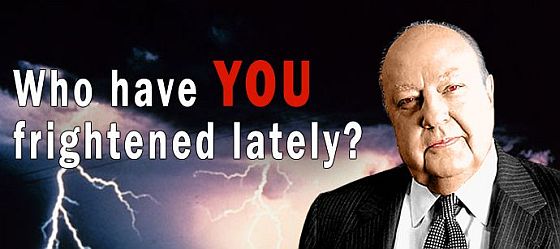
How Roger Ailes built the Fox News fear factory

For Rolling Stone, Tim Dickinson writes:

At the Fox News holiday party the year the network overtook archrival CNN in the cable ratings, tipsy employees were herded down to the basement of a Midtown bar in New York. As they gathered around a television mounted high on the wall, an image flashed to life, glowing bright in the darkened tavern: the MSNBC logo. A chorus of boos erupted among the Fox faithful. The CNN logo followed, and the catcalls multiplied. Then a third slide appeared, with a telling twist. In place of the logo for Fox News was a beneficent visage: the face of the network’s founder. The man known to his fiercest loyalists simply as “the Chairman” – Roger Ailes.

“It was as though we were looking at Mao,” recalls Charlie Reina, a former Fox News producer. The Foxistas went wild. They let the dogs out. Woof! Woof! Woof! Even those who disliked the way Ailes runs his network joined in the display of fealty, given the culture of intimidation at Fox News. “It’s like the Soviet Union or China: People are always looking over their shoulders,” says a former executive with the network’s parent, News Corp. “There are people who turn people in.”

The key to decoding Fox News isn’t Bill O’Reilly or Sean Hannity. It isn’t even News Corp. chief Rupert Murdoch. To understand what drives Fox News, and what its true purpose is, you must first understand Chairman Ailes. “He is Fox News,” says Jane Hall, a decade-long Fox commentator who defected over Ailes’ embrace of the fear-mongering Glenn Beck. “It’s his vision. It’s a reflection of him.”

Ailes runs the most profitable – and therefore least accountable – head of the News Corp. hydra. Fox News reaped an estimated profit of $816 million last year – nearly a fifth of Murdoch’s global haul. The cable channel’s earnings rivaled those of News Corp.’s entire film division, which includes 20th Century Fox, and helped offset a slump at Murdoch’s beloved newspapers unit, which took a $3 billion write-down after acquiring The Wall Street Journal. With its bare-bones news­gathering operation – Fox News has one-third the staff and 30 fewer bureaus than CNN – Ailes generates profit margins above 50 percent. Nearly half comes from advertising, and the rest is dues from cable companies. Fox News now reaches 100 million households, attracting more viewers than all other cable-news outlets combined, and Ailes aims for his network to “throw off a billion in profits.”

The outsize success of Fox News gives Ailes a free hand to shape the network in his own image. “Murdoch has almost no involvement with it at all,” says Michael Wolff, who spent nine months embedded at News Corp. researching a biography of the Australian media giant. “People are afraid of Roger. Murdoch is, himself, afraid of Roger. He has amassed enormous power within the company – and within the country – from the success of Fox News.”

Fear, in fact, is precisely what Ailes is selling: His network has relentlessly hyped phantom menaces like the planned “terror mosque” near Ground Zero, inspiring Florida pastor Terry Jones to torch the Koran. Privately, Murdoch is as impressed by Ailes’ business savvy as he is dismissive of his extremist politics. “You know Roger is crazy,” Murdoch recently told a colleague, shaking his head in disbelief. “He really believes that stuff.”

Facebooktwittermail

How America screws its soldiers

Andrew J. Bacevich writes:

Riders on Boston subways and trolleys are accustomed to seeing placards that advertise research being conducted at the city’s many teaching hospitals. One that recently caught my eye, announcing an experimental “behavioral treatment,” posed this question to potential subjects: “Are you in the U.S. military or a veteran disturbed by terrible things you have experienced?”

Just below the question, someone had scrawled this riposte in blue ink: “Thank God for these Men and Women. USA all the way.”

Here on a 30 x 36 inch piece of cardboard was the distilled essence of the present-day relationship between the American people and their military. In the eyes of citizens, the American soldier has a dual identity: as hero but also as victim. As victims—Wounded Warriors —soldiers deserve the best care money can buy; hence, the emphasis being paid to issues like PTSD. As heroes, those who serve and sacrifice embody the virtues that underwrite American greatness. They therefore merit unstinting admiration.

Whatever practical meaning the slogan “support the troops” may possess, it lays here: in praise expressed for those choosing to wear the uniform, and in assistance made available to those who suffer as a consequence of that choice.

From the perspective of the American people, the principal attribute of this relationship is that it entails no real obligations or responsibilities. Face it: It costs us nothing yet enables us to feel good about ourselves. In an unmerited act of self-forgiveness, we thereby expunge the sin of the Vietnam era when opposition to an unpopular war found at least some Americans venting their unhappiness on the soldiers sent to fight it. The homeward-bound G.I. spat upon by spoiled and impudent student activists may be an urban legend, but the fiction persists and has long since trumped reality.

Facebooktwittermail

Koch brother buys professors at public university to spread free market propaganda — is public education the Kochs’ next front?

Sarah Seltzer writes:

Usually, when billionaires or millionaires give a large sum of money to a university, even a private one, they can specify where that gift will go — which department or function, facilities, new hires, dorms, or what have you. And it’s no secret that some of those big donations may lead to a little bit of wink-and-nudge affirmative action when it comes time for the little billionaires Jr. to apply to college.

But what these monied donors cannot do, what remains taboo in the academic world, is leverage that kind of gift to influence who gets hired and fired by the faculty and what they teach–until now, thanks to Charles G. Koch.

A recent op-ed in a Florida newspaper brought to light a shady deal by billionaire Koch, one of the Koch brothers, who donated a hefty million-dollar plus pledge to Florida State University, with some very big and ethically compromised strings attached.

According to the St. Petersburg Times‘ Kris Hundley’s thorough report:

A foundation bankrolled by Libertarian businessman Charles G. Koch has pledged $1.5 million for positions in Florida State University’s economics department. In return, his representatives get to screen and sign off on any hires for a new program promoting “political economy and free enterprise.”

Traditionally, university donors have little official input into choosing the person who fills a chair they’ve funded. The power of university faculty and officials to choose professors without outside interference is considered a hallmark of academic freedom.

Under the agreement with the Charles G. Koch Charitable Foundation, however, faculty only retain the illusion of control. The contract specifies that an advisory committee appointed by Koch decides which candidates should be considered. The foundation can also withdraw its funding if it’s not happy with the faculty’s choice or if the hires don’t meet “objectives” set by Koch during annual evaluations.

Again, to be clear, such conditional donations have been rejected by universities in the past, even when they were not political in nature.

Facebooktwittermail

Of the 1%, by the 1%, for the 1%

Joseph E. Stiglitz writes:

It’s no use pretending that what has obviously happened has not in fact happened. The upper 1 percent of Americans are now taking in nearly a quarter of the nation’s income every year. In terms of wealth rather than income, the top 1 percent control 40 percent. Their lot in life has improved considerably. Twenty-five years ago, the corresponding figures were 12 percent and 33 percent. One response might be to celebrate the ingenuity and drive that brought good fortune to these people, and to contend that a rising tide lifts all boats. That response would be misguided. While the top 1 percent have seen their incomes rise 18 percent over the past decade, those in the middle have actually seen their incomes fall. For men with only high-school degrees, the decline has been precipitous—12 percent in the last quarter-century alone. All the growth in recent decades—and more—has gone to those at the top. In terms of income equality, America lags behind any country in the old, ossified Europe that President George W. Bush used to deride. Among our closest counterparts are Russia with its oligarchs and Iran. While many of the old centers of inequality in Latin America, such as Brazil, have been striving in recent years, rather successfully, to improve the plight of the poor and reduce gaps in income, America has allowed inequality to grow.

Economists long ago tried to justify the vast inequalities that seemed so troubling in the mid-19th century—inequalities that are but a pale shadow of what we are seeing in America today. The justification they came up with was called “marginal-productivity theory.” In a nutshell, this theory associated higher incomes with higher productivity and a greater contribution to society. It is a theory that has always been cherished by the rich. Evidence for its validity, however, remains thin. The corporate executives who helped bring on the recession of the past three years—whose contribution to our society, and to their own companies, has been massively negative—went on to receive large bonuses. In some cases, companies were so embarrassed about calling such rewards “performance bonuses” that they felt compelled to change the name to “retention bonuses” (even if the only thing being retained was bad performance). Those who have contributed great positive innovations to our society, from the pioneers of genetic understanding to the pioneers of the Information Age, have received a pittance compared with those responsible for the financial innovations that brought our global economy to the brink of ruin.

Facebooktwittermail

You thought the Koch brothers were bad? Turns out they’re even worse than you thought

Adele M. Stan writes:

You knew they were big. You knew they were evil. From the union-busting actions of their minions in Wisconsin and Ohio to their war on health-care reform, to their assault on the environment and their attacks on the science of climatology, Charles and David Koch have earned their place as the focus of progressives’ scrutiny in the age of the Tea Party — the destructive and regressive movement they bankroll. But a new report from the Center for American Progress Action Fund shows that, as bad as you thought the Kochs were, they’re actually worse. And their reach into virtually every aspect of political, economic and physical life on the planet is probably greater than you thought possible.

In The Koch Brothers: What You Need to Know About the Financiers of the Radical Right, author Tony Carrk, policy director of the CAP Action War Room, lays out a case that is breathtaking in its scope, showing how the Koch brothers are using their billions with the aim of reshaping the global economic system in such a way as to enrich themselves and their heirs at the expense of most other inhabitants of the planet.

Facebooktwittermail

It’s the plutocracy, stupid

M J Rosenberg writes:

I received an email from a Capitol Hill aide who thinks my criticism of AIPAC, the powerful pro-Israel lobby, is overly simplistic. He doesn’t dispute the fact that AIPAC has a disproportionate influence on our Middle East foreign policy. He argues, however, that AIPAC is no different than other powerful special interest lobbies.

I think his whole email is worth a read:

I work on Capitol Hill and I disagree with you about AIPAC. You make it seem as if AIPAC is the only lobby that gets what it wants through threats of cutting off campaign contributions, as if only AIPAC dictates legislation through intimidation.

WRONG! My colleague who handles the Israel issue confirms your analysis. But it’s no different on the domestic issues I cover. The issues of jobs, health, taxes, the environment, regulation to protect kids’ health, oil drilling, workers’ safety, education, guns…they are all dictated by lobbies just as overbearing as AIPAC. All we do up here is cater to rich, selfish people and their special interests. And their interest is cutting all social programs so we can keep cutting taxes to make them even richer.

True, most of them don’t brag as much as AIPAC but that doesn’t make them any better or worse, just smarter (AIPAC gets more negative attention because of its swagger). Big deal. The public is getting screwed eight ways to Sunday by special interests and AIPAC is just one of them. Don’t mislead your readers into thinking it is unique. Not only is it not unique, it’s insignificant in the sense that it’s not the guys robbing the poor to put money in their own pockets. They own US Middle East policy. But the real fat cats own everything else.

I agree with everything my correspondent writes. The American democracy we learned about in school no longer exists. It’s been sold to the highest bidders. And the highest bidder is not, as the Tea Partiers like to say, “We The People.”

Facebooktwittermail

War in Libya — mission under construction

Associated Press reports:

U.S. Defense Secretary Robert Gates said Sunday that the U.S. expects to turn control of the Libya military mission over to a coalition — probably headed either by the French and British or by NATO — “in a matter of days.”

In his first public remarks since the start of the bombings, Gates said President Barack Obama felt very strongly about limiting America’s role in the operation, adding that the president is “more aware than almost anybody of the stress on the military.”

“We agreed to use our unique capabilities and the breadth of those capabilities at the front of this process, and then we expected in a matter of days to be able to turn over the primary responsibility to others,” Gates told reporters traveling with him to Russia. “We will continue to support the coalition, we will be a member of the coalition, we will have a military role in the coalition, but we will not have the preeminent role.”

The two key possibilities, he said, are a combined British-French command or the use of a NATO command. He acknowledged there is “some sensitivity on the part of the Arab League to being seen to be operating under a NATO umbrella.”

The Guardian reports:

America, France and Britain – the leaders of the coalition’s air attacks on Libya – were struggling to maintain international support for their actions, as they faced stinging criticism about mission creep from the leader of the Arab League, as well as from China and Russia.

Critics claimed that the coalition of the willing may have been acting disproportionately and had come perilously close to making Gaddafi’s departure an explicit goal of UN policy.

Russia, which abstained on the UN vote last week, called for “an end to indiscriminate force”.

Despite denials from coalition forces, Alexander Lukashevich, Russia’s foreign ministry spokesman, said that the coalition had hit non-military targets.

He suggested that 48 civilians had been killed. “We believe a mandate given by the UN security council resolution – a controversial move in itself – should not be used to achieve goals outside its provisions, which only see measures necessary to protect civilian population,” he said.

The Arab League secretary general, Amr Moussa, also startled western governments when he denounced the air attacks only a week after the league had called for creation of a no-fly zone.

Moussa, who is a candidate for the Egyptian presidency, said: “What has happened in Libya differs from the goal of imposing a no-fly zone and what we want is the protection of civilians and not bombing other civilians.”

The Foreign Office later said Moussa claimed he had been misquoted, or had put his criticism more strongly in Arabic than in English. “We will continue to work with our Arab partners to enforce the resolution for the good of the Libyan people,” the FO said.

The Arab League had, though, been called to an emergency session to discuss the scale of the attacks.

The British defence secretary, Liam Fox, said the scale was in line with UN resolutions that had been “essential in terms of the Gaddafi regime’s ability to prosecute attacks on their own people”. He also said it was possible that Gaddafi himself could become a target of air attacks if the safety of civilians could be guaranteed.

Ahead of a Commons debate and vote tomorrow, leading figures in David Cameron’s cabinet were under pressure to clarify whether the explicit purpose of the attacks was to render Gaddafi’s regime so powerless that it collapses.

Speaking on the Politics Show, Fox said: “Mission accomplished would mean the Libyan people free to control their own destiny. This is very clear – the international community wants his regime to end and wants the Libyan people to control for themselves their own country.”

He then added: “Regime change is not an objective, but it may come about as a result of what is happening amongst the people of Libya.”

He said: “When the dynamic shifts and the equilibrium shifts, we will get a better idea just how much support the Gaddafi regime has and how much the people of Libya genuinely long to be able to control their own country.

“If Colonel Gaddafi went, not every eye would be wet.”

Fox said it was possible that allied forces might treat Gaddafi himself as a legitimate target for air strikes.

The New York Times reported:

Around 10 p.m. Sunday, a column of white smoke rose near Colonel Qaddafi’s compound in Tripoli, accompanied by a loud explosion, suggesting that either his residence or the barracks of his personal guard had become a target for the allied barrage. The compound already contains a damaged building known as the “House of Resistance” that was preserved along with a statue as a monument to a failed American bombing attack on the compound more than 20 years ago. The sounds of sirens and sporadic gunfire followed.

Asked about the explosion, Vice Adm. William Gortney told a news conference in Washington that the United States was not on a mission to kill the Libyan leader. “At this particular point, I can guarantee that he’s not on a targeting list,” he said. But he added: “If he happens to be in a place, if he’s inspecting a surface-to-air missile site, and we don’t have any idea if he’s there or not, then —” He was interrupted by another question, and then said, “No, we’re not targeting his residence.”

The key phrase being: “at this particular point…”

Meanwhile, Chris McGreal describes the fate of some of the first victims of allied attacks on Gaddafi’s forces near Benghazi:

The dozen or so men clustered behind the last smouldering tank looked as if they had died while they slept.

Their blankets bore no burn marks so perhaps it was the force of blasts – powerful enough to rip the turrets off the Russian-made tanks and toss them 20 metres or more across the open field near Benghazi – that killed Muammar Gaddafi’s soldiers.

The air attack came at 4am , after the tanks pulled back from a day-long assault on the rebel stronghold of Benghazi. The crews chose to rest in a field about 10 miles from the de facto capital of the anti-Gaddafi revolutionaries.

It must have seemed safe to the soldiers. The rebels were far away and the tank crews would have seen any threat approaching by road. They gathered to eat and sleep behind the tank furthest into the field.

But it was no protection from the threat in the sky. The tanks and their operators were sitting ducks in the open and probably never heard the planes. The French pilots did not even have to be concerned about the risk of harming civilians.

Within moments, three of the four tanks in the field were shells.

What was not immediately incinerated was mangled, thrown into the sky and dumped in bits on the earth. Machine guns twisted into grotesque shapes, broken engine parts and flattened shells lay among the wreckage.

Four hours later, two of the tanks were still smouldering. A flatbed lorry used to haul them to the edge of Benghazi was on fire. A handful of pickup trucks, one carrying tins of food for the troops, had been burned out. Scavengers were picking over the corpses of Gaddafi’s dead soldiers.

Wreckage was strewn in similar scenes along nearly 15 miles of road beyond Benghazi, the result of air strikes on targets across the country that turned the struggle between Gaddafi and Libya’s revolutionaries on its head in a moment.

The barrage of attacks led by France, Britain and the US on Libya’s army, air bases and other military targets drew threats of a prolonged war from Gaddafi himself. But on the ground many of his forces were in disarray and fleeing in fear of further attacks from a new and unseen enemy.

The air assault halted and then reversed the advances by Gaddafi’s army on Benghazi and other rebel-held towns. But the revolutionary leadership wanted more. On Sunday it appealed for an intensification of the air assault to destroy the Libyan ruler’s forces and open the way for the rebels to drive him from power.

Issandr El Amrani has a shot at looking further down the road and poses five questions few are asking about Libya:

Not to rain on anyone’s parade, but while I’m glad that the multinational intervention is giving cover to Libyan insurgents, I’m rather shocked at the desultory coverage of what might come out of the military intervention. A tragedy has been taking place in Libya, whose people deserve help, but that doesn’t mean not thinking through consequences. Here’s a shot at it:

1. UNSC Resolution 1973 isn’t really about getting a ceasefire, is it?

Not really. Even if Qadhafi were to produce a real ceasefire, which is unlikely, the rebels would not observe it: they would keep trying to topple the regime. This resolution, under the guise of obtaining a ceasefire, seeks to carry out regime change. It would get even more complicated as the Libyan government headed by Qadhafi remains legitimate under international law, and thus can be argued to have law enforcement duties to implement against armed insurgents. This resolution is not just about preventing a massacre of civilians, it’s about taking sides. The Qadhafi regime is over as far as the international community is concerned, and mission creep will ensure that things will swiftly move from imposing a no-fly zone to more direct efforts, including ground missions. This might be good for the insurgents, might split them, and might not be so good for the countries leading the intervention. Time will tell.

2. But what if Qadhafi hangs in there, and there’s a stalemate?

Well, prolonged civil war happens. But it’s not clear whether this is a likely outcome, particularly if there are such stringent sanctions and travel restrictions on regime officials. There could a “liberated zone” and a Qadhafi-controlled zone for a while, with ongoing skirmishes. Western and Arab supplies of weapons to the insurgents would likely increase (Egypt is already supplying them). Although the insurgents have insisted on a united Libya, the fact is that historically there is strong regionalism in the country. A split could perdure, backed by both the regime’s control through force and genuine tribal support in its favor. The international community could be moved to escalate the mission to make it officially regime change, or push other actors (some would like that to be Egypt) to intervene directly. Some openly advocate for Egypt to invade Libya. I liked the idea of regional powers acting as regional policemen, but no one has asked Egypt whether it wants that role. It also has to think about thousands of Egyptians the regime might hold hostage there.

Facebooktwittermail

Leaving Gaddafi a way out

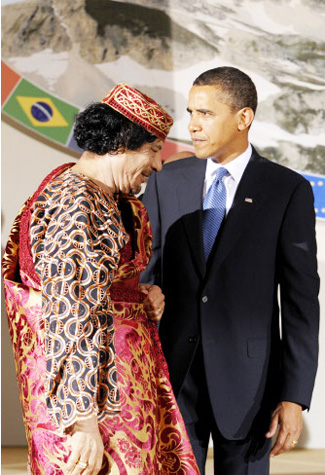
If Sarkozy, Cameron and Obama believe that Gaddafi’s demonization makes the war legitimate in the eyes of domestic audiences which might otherwise lack interest in the fate of Libya, the West will have needlessly restricted the range of acceptable outcomes to this war.
Even at this point, there should be some effort to open up as many exit methods possible both for the Libyan leader and those around him. If Gaddafi’s only options are to cling to power or be killed, he will without doubt fight to the finish. If he can be convinced he won’t win he also needs to be enticed by the credible possibility that there remains a way out — one that’s more appealing than facing trial in The Hague.

Gaddafi is too vain to be serious about martyrdom. I don’t believe he is ready to die, and if that is indeed the case then his desire to live should be seen as an advantage that his adversaries should exploit.

Simon Tisdall focuses on the implications of the expressions of personal animosity that the war’s Western leaders are directing at Muammar Gaddafi.

Now the missiles and B52s have begun their dreadful work, Gaddafi knows, if he didn’t already, that he’s in a fight to the finish – and for him, there may be no escape. His course of action in the coming days will be influenced by this realisation, and may be consequently more extreme and more aggressive than otherwise.

His defiant overnight statement, when he condemned the “crusader colonialism” afflicting his country, was clearly aimed at Arab and Muslim world opinion in particular, and the non-western world in general (major countries such as China, India, Brazil and Germany have not supported the intervention). Regime claims about mounting civilian deaths will play big there, Iraq-style. Gaddafi will press his propaganda advantage for all its worth.

The demonisation of Gaddafi has made it impossible for western leaders to countenance his continuation in power. But without the ground invasion they have pledged not to undertake, he could well survive as the overlord of western and southern Libya following a de facto partition, hostile, vengeful and highly dangerous.

This seems to be his plan. Far from giving up or drawing back, Gaddafi escalated the fighting around Benghazi at the weekend. Rather than abandon cities such as Zawiya, as Obama demanded, he is reportedly moving his troops into urban areas where they can less easily be targeted from the air. Meanwhile, his apparent willingness to use “human shields”, his threats of retaliation across the Mediterranean area, and his designation of the whole of north Africa as a “war zone” raises the spectre of possible terrorist attacks and an alarming regression to his old ways.

Gaddafi has personalised this war, too. And he is not going to go quietly. Military superiority in the air will count for nothing if pro-regime army and air force units, militia and security forces, and civilian and tribal supporters who have remained loyal refuse to turn on him or kick him out of Tripoli. By its determination to “get Gaddafi”, the west has made this a fight to the death – and death may be a long time in coming.

Chris McGreal reports:

Benghazi woke on Saturday morning to discover that its wild celebrations over the UN security council’s declaration and Gaddafi’s calling of a ceasefire on Friday were premature. Residents had imagined the city was saved by the west’s threat of air strikes unless Gaddafi halted his attacks on Libya’s rebellious towns.

But at dawn the dictator’s army was fighting its way into the country’s second-largest city of about 700,000 people using rockets and tanks.

As the shells fell, rattling nerves and buildings, a single question emerged time and again. On occasions it was delivered as a baffled plea by middle-aged men gathered on Benghazi’s seafront as they anxiously awaited the latest word on the fighting. At other times, the question was shouted in anger by young men manning the barricades and facing the threatened onslaught with Kalashnikovs and petrol bombs.

“Where are the air strikes? Why is the west waiting until it is too late?” asked Khalid el-Samad, a 27-year-old chemical engineer, who shook his finger in fury. “Sarkozy said it. Obama said it. Gaddafi must stop. So why do they do nothing? Is it just talk while we die?”

Benghazi reeled in shock as the rebels initially fell back and then fought hard to contain the assault while artillery fire rocked parts of the city for much of the day.

Dozens of people were killed, among them the civilians the UN resolution was pledged to protect, and hospitals treated an even larger number wounded. As the fighting intensified, thousands fled east towards the Egyptian border in cars, pick-up trucks and buses crammed with people and what was most precious or essential – bedding and cooking pots.

Alongside the angry questions over the lack of air strikes was bafflement that the western powers had apparently been duped into believing Gaddafi’s false promise of a ceasefire that bought him time to launch the assault on Benghazi by delaying military action French officials had suggested was imminent.

“In 42 years we learned never to trust Gaddafi,” said Hassan Khalafa, an accountant carrying a Kalashnikov at a checkpoint near the former court that serves as the revolutionary government’s headquarters. “He always lies. The only time he told the truth is when he said he will kill all of us in Benghazi. France and America and the UN have been fooled by him.”

As dusk settled, Gaddafi’s gamble appeared to have failed. In the face of rebel resistance, his army pulled back only to be hit a few hours later by the air strikes. But by then, it was clear that the people of Benghazi will not feel safe until the man who has controlled their country for 42 years is overthrown.

Gaddafi’s prophetic declaration? “All tryants fall under the feet of the people.”

Facebooktwittermail

Arabs say Gaddafi must go, wary of Western action

Reuters reports:

Muammar Gaddafi’s appeal for Arab solidarity in the face of foreign air strikes fell on deaf ears across the Middle East on Sunday, but support for his opponents was mixed with deep suspicion of Western motives.

Western forces have unleashed their biggest military attack in the Arab world since the 2003 U.S. invasion of Iraq, targeting Gaddafi’s air defences and armoured vehicles near the rebel stronghold of Benghazi in the east of the country.

A few hours after the first missiles struck, Gaddafi called on “citizens of the Arab and Islamic nations” and other developing countries to “stand by the heroic Libyan people to confront this aggression”.

But Arabs from North Africa to the Gulf, many demanding political rights for the first time, dismissed the appeal from a leader whose four decades of authoritarian and capricious rule have exhausted any reserves of sympathy.

“It is now clear and understandable that Arab people want to get rid of their leaders, so leaders should simply leave and not fight their people and force foreign nations to interfere,” said Mohamed Abdel Motaleb, a bank employee in Cairo, where mass protests toppled veteran president Hosni Mubarak last month.

“I am very much against foreign troops fighting in Libya, but Arab leaders should not let that happen through their stubbornness and refusal to quit power”.

A Libyan government official said 64 people died in the Western air strikes and the head of the Arab League, which supported Libyan no-fly zone, said the organisation had not endorsed attacks on ordinary Libyans.

“What is happening in Libya differs from the aim of imposing a no-fly zone, and what we want is the protection of civilians and not the bombardment of more civilians,” Amr Moussa said, announcing an emergency Arab League meeting to discuss Libya.

The overthrow of Mubarak in Egypt and Tunisia’s Zine al Abidine bin Ali — as well as mass protests against leaders in Yemen and Bahrain — have restored a dormant Arab pride which was crushed by decades of autocracy and foreign intervention.

But many people in the Arab world, while anxious to see the end of Gaddafi’s rule, felt that the resort to Western military action has tarnished Libya’s revolution.

“Who will accept that foreign countries attack an Arab country? This is something shameful,” said Yemeni rights activist Bashir Othman.

OIL OR DEMOCRACY?

Support for military action was also muted by deep-seated suspicions that the West is more concerned with securing access to Arab oil supplies than supporting Arab aspirations.

“They are hitting Libya because of the oil, not to protect the Libyans,” said Ali al-Jassem, 53, in the village of Sitra in Bahrain, where protests by the Shi’ite Muslim majority against the Sunni ruling Al-Khalifa family have triggered military reinforcement by neighbouring Gulf Arab forces.

A spokesman for Bahrain’s largest Shi’ite opposition party Wefaq questioned why the West was intervening against Gaddafi while it allowed oil-producing allies to support a crackdown on protesters in Bahrain in which 11 people have been killed.

“We think what is happening in Bahrain is no different to what was happening in Libya,” Ibrahim Mattar said. “Bahrain is very small so the deaths are significant for a country where Bahrainis are only 600,000.”

In Iraq, where U.S.-led forces invaded eight years ago to topple Saddam Hussein, opposition to Gaddafi was tempered by the years of violence which Iraq endured after Saddam’s downfall, as well as anger at perceived double standards.

“Bombing Gaddafi’s forces is a step in the right direction but turning blind eyes to the slaughter of innocent protesters in Bahrain is a step in the wrong direction,” said Amir Ahmed, owner of a home appliance shop in Baghdad’s Karrada district.

The leader of Lebanon’s Shi’ite group Hezbollah, Sayyed Hassan Nasrallah, said many people had spelt out their support for the protests in Egypt and Libya, “but when Bahrain is involved… their ink dries up”.

“What is the difference between the Al-Khalifa regime and the regimes of (Hosni) Mubarak and Gaddafi?” he said in a televised speech on Saturday night.

But criticism of the West has not translated into support for Gaddafi, who has bemused or infuriated leaders across the Arab world during his four decades in power.

Facebooktwittermail

A marriage made in hell

Hossein Askari writes:

While there may be truth to the adage that “opposites attract,” a happy and long lasting relationship must be based on common values, respect and shared interests. Do America and the absolute rulers of Saudi Arabia share such a basis for a long-lasting relationship? How will Muslims judge our marriage to the Al-Sauds in the current climate of protests against autocratic rule in the Middle East and North Africa?

There is certainly little to be put in the win column when it comes to shared values.

Political Freedom: Saudi Arabia has no constitution, no representative government, no freedom of the press and no freedom of assembly. The Saudi foreign minister recently said that Saudi Arabia will “cut off any finger” raised in protest. Who are the rulers of Saudi Arabia? In 1932, Abdul-Aziz Al-Saud used his sword, deception and treachery to unite a number of warring tribes. So the Al-Saud family sees Saudi Arabia as their ranch; as one Saudi prince said, “my grandfather took it with the sword. Others could have done it. But they didn’t. It is ours.”

Religious Freedom: Churches and synagogues are banned in Saudi Arabia, only mosques are allowed; in fact, foreigners have gone to jail for holding Christmas services in their home. With about 85 percent of Saudis professing the Sunni sect, Shia Muslims are subjugated, economically deprived and treated as apostates. It is Saudi fundamentalists who have financed madrassasto spread radical Islam with a hatred for all things American. None of this bothers the Al-Sauds because the U.S. and the Vatican don’t publicize this religious discrimination for fear of ruffling Al-Saud feathers. In the face of such discrimination, it is ironic that Al-Saud kings, beginning with Fahd and now Abdullah, refer to themselves as “The Custodian of the Two Holy Mosques,” while the Koran says, “Let there be no compunction in religion.” They claim legitimacy from Islam, while the unity of humankind and social and economic justice, the core of Islamic teachings, has been supplanted by its antithesis.

Economic Equality and Freedom: Contrary to everything in the Koran and from the example of the Prophet Mohammad, the Al-Sauds are the masters and have no equals. While the oil under the ground belongs to all Saudis of this and future generations, the Al-Sauds behave as if it was theirs and theirs alone. The king and senior princes take what they want from the treasury. All major government contracts have a Saudi prince as an agent, taking commissions that are at times obscene. In the case of at least one military contract that ran into the billions, the “add-ons” over a short span of time exceeded the original contract, something that dismayed the U.S. government military attaché in Saudi Arabia. As usual when senior Al-Sauds are involved, it was hushed up by the U.S. embassy. Are the Al-Sauds the best businessmen in the world or are they simply corrupt? While the Al-Sauds wallow in unbelievable opulence, some Shia don’t have running water and around 25 percent of the youth cannot find jobs. The Al-Sauds are wasting the heritage of all Saudis. What happened to the Islamic precept that rulers should live in the same manner as the poorest in their realm?

Facebooktwittermail

Libya’s armed protest movement at the edge of an abyss

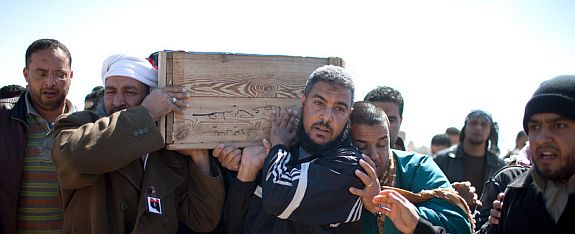
The coffin of Emad al-Giryani, a former petroleum engineer who fought for the opposition in Ras Lanuf. Some Obama administration officials have said privately that the level of violence in Libya would have to approach the scale of that in Rwanda or Bosnia in the 1990s before the United States would engage militarily. (New York Times)

As some commentators solemnly warn about the dangers of a backlash if the Arab democratic revolution was to become poisoned by American involvement in a no-fly zone over Libya, they fail to note a rising chorus inside Libya: anger towards the United States because of its reluctance to become involved.

There’s stunning paradox here. Three decades ago, America’s support of the Mujahadeen in Afghanistan sowed the seeds for a jihad against America. And now, America’s lack of support for a revolution in Libya may eventually have the same effect.

There are those who would on this basis jump to the conclusion that this demonstrates a visceral hatred of America across the Muslim world, but I would argue the exact opposite: that it demonstrates that attitudes towards America in a region in which it exerts so much influence are predominantly pragmatic and rooted in the present tense: they are a response to whatever the United States is doing or is not doing at any particular time.

Anthony Shadid in one of the finest pieces of reporting to come out of Libya since the fighting started, writes from Ras Lanuf:

Everyone here seems to have a gun these days, in a lawlessness tempered only by revolutionary ebullience. Young men at the front parade with the swagger that a rocket-propelled grenade launcher grants but hint privately that they will try to emigrate if they fail. Anti-American sentiments build, as rebels complain of Western inaction. And the hint of radicalization — religious or something more nihilist — gathers as the momentum in the three-week conflict clearly shifts to the forces of one of the world’s most bizarre leaders.

“This better not go on any longer,” said Dr. Salem Langhi, a surgeon who was working around the clock at a hospital that was abandoned as Colonel Qaddafi’s forces rushed in. “It will only bring misery and hard feelings among people. Losing lives and limbs doesn’t make anyone optimistic.”

No one seems to know what to call this conflict — a revolution, a civil war or, in a translation of what some call it in Arabic, “the events,” a shorthand for confusing violence. It certainly looks like a war — the thud of shelling in the distance offers a cadence to occasional airstrikes, their targets smoking like oil fires that turn afternoon to dusk. The dead and dismembered are ferried in ambulances driven by medical students.

But especially for the rebels, there is an amateurishness to the fighting that began as a protest and became an armed uprising.

“We’re here because we want to be,” said one of the fighters, Mohammed Fawzi.

His sense of a spontaneous gathering offers a prism through which to understand the war: the front at Ras Lanuf is the most militarized version of Tahrir Square in Cairo, where hundreds of thousands wrote a script of opposition and street theater that brought down a strongman everyone thought would die in office. The fighting here feels less like combat in the conventional sense and more like another form of frustrated protest.

Some vehicles bear the inscription Joint Security Committee, but nothing is all that coordinated across a landscape that seems anarchic and lacking in leadership. Fighters don leather jackets from Turkey, Desert Fox-style goggles, ski masks, cowboy hats and World War II-era British waistcoats.

Slogans are scrawled in the street just miles from the fighting. “Muammar is a dog,” one reads. A man who bicycled for three days from Darnah, far to the east, became a local celebrity at the front. Free food is offered, as it was in the canteens in Tahrir, and fighters rummaged through donated clothes. “These are American jeans!” one shouted.

Young men revel in the novelty of having no one to tell them not to play with guns. “God is great!” rings out whenever a volley of bullets is fired into the air.

“Some guys consider this a lot of fun, and they’re hoping the war lasts a lot longer,” said Marwan Buhidma, a 21-year-old computer student who credited video games with helping him figure out how to operate a 14.5-millimeter antiaircraft battery.

An hour or so before Friday’s headlong retreat, a gaggle of young men in aviator sunglasses and knit caps danced on military hardware, thrusting weapons into the air.

“Where is the house of the guy with really bad hair?” they chanted, referring to Colonel Qaddafi, jumping on spent cartridges and empty milk cartons. “Let’s go down the road and see it!”

The protests across the Arab world have disparate demands — from power-sharing in Bahrain to the dismantling of the regime in Egypt. But the demographic shift they represent as a generation comes of age is their constant. It is no different in Libya, where the young look at their parents’ lives in disgust and vow that they will not live without dignity, a say in their future and a constitution — a catchall term for the rule of law.

Nearly 70 percent of Libya’s population is under the age of 34, virtually identical to Egypt’s, and a refrain at the front or faraway in the mountain town of Bayda is that a country blessed with the largest oil reserves in Africa should have better schools, hospitals, roads and housing across a land dominated by Soviet-era monotony.

“People here didn’t revolt because they were hungry, because they wanted power or for religious reasons or something,” said Abdel-Rahman al-Dihami, a young man from Benghazi who had spent days at the front. “They revolted because they deserve better.”

The seeming justice of that revolt has prompted moments of naïveté — time and again, young people express amazement that Colonel Qaddafi’s forces would deploy tanks and warplanes against them — with an incipient and unpredictable frustration over demands unmet.

The revolt remains amorphous, but already, religion has emerged as an axis around which to focus opposition to Colonel Qaddafi’s government, especially across a terrain where little unites it otherwise. The sermon at the front on Friday framed the revolt as a crusade against an infidel leader. “This guy is not a Muslim,” said Jawdeh al-Fakri, the prayer leader. “He has no faith.”

Deserting officers have offered what leadership there is, along with some men who call themselves veterans of fighting in Afghanistan or an Islamist insurgency in eastern Libya in the 1990s. The shift remains tentative — and far short of the accusations made by Colonel Qaddafi that he faces an insurgency led by Al Qaeda — but even the opposition acknowledges the threat of radicalization in a drawn-out conflict.

Dr. Langhi, the surgeon, said he scolded rebels who called themselves mujahedeen — a religious term for pious fighters. “This isn’t our situation,” he pleaded. “This is a revolution.”

Sitting on ammunition boxes, four young men from Benghazi debated the war, as they watched occasional volleys of antiaircraft guns fired at nothing. They promised victory but echoed the anger heard often these days at the United States and the West for failing to impose a no-flight zone, swelling a sense of abandonment.

Facebooktwittermail