Category Archives: News

Obama’s (still) unanswered question on phone spying

National Journal reports: Ending bulk data collection, which the NSA claims is authorized under Section 215 of the Patriot Act, has been the top priority for civil liberties groups.

Obama announced on Friday that he will end the program “as it currently exists.”

Starting immediately, NSA analysts will need approval from the Foreign Intelligence Surveillance Court every time they want to access the phone database. Obama also said he plans to eventually move the database out of the government’s hands. The president directed Attorney General Eric Holder and top intelligence officials to come up with a plan by March 28 for turning over control of the database.

But no matter who stores the data, the NSA will want to ensure that its analysts can still access it when they want to map the connections of a potential terrorist group. That could mean the administration will ask Congress to enact a mandate requiring phone companies to store their customers’ data on behalf of the NSA.

Privacy advocates warn that a data retention mandate would turn phone companies into agents of the NSA.

“To the contrary, companies should be working on ways to store less user data for less time—decreasing the risks from data breaches and intrusions like the one that just happened to Target,” wrote Cindy Cohn and Rainey Reitman of the Electronic Frontier Foundation. “Data retention heads in the wrong direction for our security regardless of whether the government or private parties store the information.”

Kevin Bankston, a policy director for the New American Foundation, said that if the alternative to government storage is mandatory data retention or a requirement for phone companies to turn the data over to some other third party, “the President should be prepared for a major legislative battle with key members of Congress, the technology industry and the privacy community arrayed against him.” [Continue reading…]

Facebooktwittermail

U.S. officials dream of murdering Edward Snowden

Buzzfeed reports: Edward Snowden has made some dangerous enemies. As the American intelligence community struggles to contain the public damage done by the former National Security Agency contractor’s revelations of mass domestic spying, intelligence operators have continued to seethe in very personal terms against the 30-year-old whistle-blower.

“In a world where I would not be restricted from killing an American, I personally would go and kill him myself,” a current NSA analyst told BuzzFeed. “A lot of people share this sentiment.”

“I would love to put a bullet in his head,” one Pentagon official, a former special forces officer, said bluntly. “I do not take pleasure in taking another human beings life, having to do it in uniform, but he is single-handedly the greatest traitor in American history.”

That violent hostility lies just beneath the surface of the domestic debate over NSA spying is still ongoing. Some members of Congress have hailed Snowden as a whistle-blower, the New York Times has called for clemency, and pundits regularly defend his actions on Sunday talk shows. In intelligence community circles, Snowden is considered a nothing short of a traitor in wartime.

“His name is cursed every day over here,” a defense contractor told BuzzFeed, speaking from an overseas intelligence collections base. “Most everyone I talk to says he needs to be tried and hung, forget the trial and just hang him.” [Continue reading…]

Facebooktwittermail

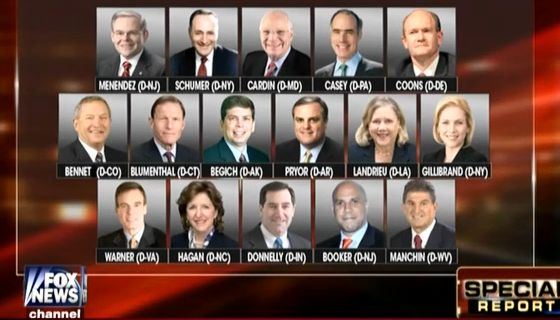
What happened to AIPAC’s seventy senators?

AIPAC-senators

In 2005, AIPAC’s Steven Rosen when prompted by Jeffrey Goldberg to assess the level of the lobby’s influence famously said: “In twenty-four hours, we could have the signatures of seventy senators on this napkin.”

The “Nuclear Weapon Free Iran Act of 2013” sponsored by Democratic Senator Robert Menedez has the support of fifty-nine senators. That’s a dangerously large majority but just short of a veto-proof sixty-seven votes and well short of Rosen’s seventy.

Does that mean that AIPAC is refraining from pulling its weight or is it just not as powerful as Rosen declared?

I called my Democratic Senator Kay Hagan, one of the co-sponsors of the bill, to tell her that if she follows through and casts a vote in favor, she won’t have my vote in November. Interestingly, her staffer was at pains to underline the fact that this is still in process and hasn’t gone to a vote. I got a strong sense that Hagan, perhaps like many other senators both Democratic and Republican, would be content demonstrating her loyalty to AIPAC without actually casting a vote.

In the report below, Republican Senator Roy Blunt essentially says that every senator’s hands have been tied by Senate leader Harry Reid and far from striking a defiant tone, Blunt seems content to be rendered powerless.

If the bill got just one more supporter, would Reid bow to pressure and let it go to a vote? And can’t AIPAC with all its influence turn just one more senator in its favor?

I get the sense that for everyone involved — including AIPAC — this is all political theater. They want to act tough, but at the end of the day, they probably don’t want to be held responsible for sabotaging the most significant diplomatic opening in a decade.

National Journal reports: Senate Iran hawks have lots of votes to back their sanctions legislation. What they lack is a plan to get the bill to the floor.

Fifty-nine senators — including 16 Democrats — have signed onto sanctions legislation from Democratic Sen. Robert Menendez and Republican Sen. Mark Kirk. The measure would punish Iran with sanctions if it reneges on an interim nuclear agreement or if that agreement does not ultimately abolish any nuclear-weapons capabilities for Iran.

That count has climbed rapidly since the bipartisan pair introduced their legislation in late December. But now it’s unclear whether that support will be enough to clear the bill’s next major hurdle: Senate Majority Leader Harry Reid.

Reid is siding with the White House, which has put intense pressure on lawmakers not to act on sanctions, arguing it could result in both a nuclear-armed and hostile Iranian state. And without Reid’s backing, supporters of the Menendez-Kirk bill are unsure how to move the measure to the floor.

“I assume that if the Democrat senators put enough pressure on Senator Reid he might bring it to the floor,” said Missouri Republican Sen. Roy Blunt. “But, you know, we are at a moment in the Senate where nothing happens that Senator Reid doesn’t want to happen; and this is something at this moment that Senator Reid doesn’t want to happen.”

And for now, sanctions supporters are still mulling their strategy.

“We are talking amongst ourselves. There is a very active debate and discussion ongoing about how best to move forward,” said Democratic Sen. Richard Blumenthal of Connecticut, a cosponsor of the bill. “There are a number of alternative strategies, but we’re deliberating them.”

While Reid has, at least for now, foiled their policy plans, sanctions supporters are still scoring the desired political points on the issue. They can report their efforts to their constituents while blaming Reid for the inaction.

Jon Stewart, comparing these senators to egg-throwing Justin Bieber, is perfectly clear about which “constituents” they are trying to represent: AIPAC and Israel. (It’s a shame that Daily Show writers, having crafted a strong piece then felt compelled to add some “balance” by treating Rouhani’s tweet with scorn: “World powers surrendered to Iran’s national will.” If he can placate his hawkish critics just with a tweet, I’m sure Obama is envious.)

Facebooktwittermail

9/11 mastermind says Quran ‘forbids’ violence to spread Islam

Huffington Post reports: The mastermind of the Sept. 11, 2001, terrorist attacks now says that the use of violence to spread Islam is forbidden by the Quran, a major shift away from the more militaristic view he had put forward previously.

Khalid Sheikh Mohammed’s thinking is detailed in a first-of-its-kind 36-page manifesto obtained by The Huffington Post. In a departure from his previous stance, which led the Guantanamo Bay prisoner to tell a military commission, “it would have been the greatest religious duty to fight you over your infidelity,” KSM, as he’s known in intelligence circles, instead seeks to convert the court to Islam through persuasion and theological reflection, going so far as to argue that “The Holy Quran forbids us to use force as a means of converting” and that reaching “truth and reality never comes by muscles and force but by using the mind and wisdom.”

“Don’t believe the media that the Mujahedeen believe that Islam spread in the past and will prevail in the future with the sword,” writes KSM, who has previously admitted to his role in the 9/11 attacks that killed thousands of Americans. He uses the bulk of the manifesto to put his newfound principle into practice, attempting to persuade his captors, prosecutors and lawyers that the path to true happiness lies in Islam. [Continue reading…]

Facebooktwittermail

U.N. warns inaction on climate change will be costly

The New York Times reports: Nations have dragged their feet in battling climate change so much that the situation has grown critical and the risk of severe economic disruption is rising, according to a UN draft report. Another 15 years of failure to limit carbon emissions could make the problem virtually impossible to solve with current technologies, the experts found.

Delay would probably force future generations to develop the capability to suck greenhouse gases out of the atmosphere and store them underground to preserve the livability of the planet, the report found. But it is not clear whether such technologies will ever exist at the necessary scale, and even if they do, the approach would probably be wildly expensive compared with taking steps now to slow emissions.

The report said that governments of the world were still spending far more money to subsidize fossil fuels than to accelerate the shift to cleaner energy, thus encouraging continued investment in projects like coal-burning power plants that pose a long-term climate risk.

While the spread of technologies like solar power and wind farms might give the impression of progress, the report said, such developments are being overtaken by rising emissions from fossil fuels over the past decade, especially in fast-growing countries like China. And one of the most important sources of low-carbon energy, nuclear power, is actually declining over time as a percentage of the global energy mix, the report said.

“The fundamental drivers of emissions growth are expected to persist despite major improvements in energy supply” and in the efficiency with which energy is used, the report declared.

The new warnings come in a draft report from the Intergovernmental Panel on Climate Change, a panel of climate experts that won the Nobel Peace Prize in 2007 for its efforts to analyze and communicate the risks of climate change. The report is not final, but a draft dated Dec. 17 leaked this week and was first reported by Reuters. The New York Times obtained a copy independently. [Continue reading…]

Facebooktwittermail

NSA collects millions of text messages daily in ‘untargeted’ global sweep

The Guardian reports: The National Security Agency has collected almost 200 million text messages a day from across the globe, using them to extract data including location, contact networks and credit card details, according to top-secret documents.

The untargeted collection and storage of SMS messages – including their contacts – is revealed in a joint investigation between the Guardian and the UK’s Channel 4 News based on material provided by NSA whistleblower Edward Snowden.

The documents also reveal the UK spy agency GCHQ has made use of the NSA database to search the metadata of “untargeted and unwarranted” communications belonging to people in the UK.

The NSA program, codenamed Dishfire, collects “pretty much everything it can”, according to GCHQ documents, rather than merely storing the communications of existing surveillance targets.

The NSA has made extensive use of its vast text message database to extract information on people’s travel plans, contact books, financial transactions and more – including of individuals under no suspicion of illegal activity. [Continue reading…]

Facebooktwittermail

Egypt’s security state is triumphant once again

Jared Malsin reports from Cairo: Dozens of men lined the sidewalk outside a school in Cairo’s upper-class Mohandessin neighborhood on Tuesday morning, the first day of voting on Egypt’s new constitution. Soldiers in tan fatigues armed with AK-47s motioned for the men to enter, four or five at a time. Inside the gates, one group of mostly elderly men argued with the army officer in charge. “We can’t find our names on the list!” shouted one man. The officer dialed his cell phone, assuring the man he would find his polling station.

The proposed constitution, drafted under a military-backed government in the months since the ouster of President Mohamed Morsi in July, further insulates the police and armed forces from civilian control and could enshrine the military’s power within the Egyptian state for decades. Nearly three years after a popular uprising forced autocrat Hosni Mubarak from power, Egypt’s security state is triumphant once again. Since Morsi’s removal, more than a thousand people have been killed in a government crackdown on supporters of Morsi’s Muslim Brotherhood and its allies. Hundreds of others have been jailed, including journalists and leading activists who opposed Mubarak and Morsi. With most of the media backing the current regime, and much of the public either voicing support for the military or simply resigned to the reality of the current political arrangement, the forces of the 2011 revolution are struggling to be heard.

At three separate polling stations on Tuesday, every voter interviewed backed the constitution. “I believe that this constitution is a very good constitution, and this is just to give a message that we don’t want the Muslim Brotherhood. We want a new regime of freedom and democracy,” says Inas Mazen, a 60-year-old doctor, at a women’s polling station in Mohandessin. Egypt’s Elections Committee on Monday reported that 15% of voters had turned out so far, according to the leading news site Ahram Online. Nine people were killed in violence at polling stations as security forces clashed with protesters, and an explosion hit a courthouse in Cairo’s Imbaba district, causing no reported injuries.

In spite of criticism from rights groups and political dissidents about both the content of the constitution and the integrity of the voting process, the document is expected to be approved by a majority of voters. Recent history suggests voters will choose a concrete constitutional option and the prospect of political stability over the chaos of a no vote. Majorities also voted yes in constitutional referendums in Egypt in 2011 and 2012.

This week’s referendum is also taking place amid government harassment of those opposed to the document. One of the only groups actively urging a no vote, the Strong Egypt Party, suspended its campaign on Sunday after 11 activists were arrested in three separate incidents hanging posters and distributing campaign materials. “It’s a referendum with one choice only, and it’s yes. No is not allowed,” says Strong Egypt Party representative Fekry Nabil. “This process is not free and not fair, and we cannot join it.” [Continue reading…]

Facebooktwittermail

NSA devises radio pathway into computers

The New York Times reports: The National Security Agency has implanted software in nearly 100,000 computers around the world that allows the United States to conduct surveillance on those machines and can also create a digital highway for launching cyberattacks.

While most of the software is inserted by gaining access to computer networks, the N.S.A. has increasingly made use of a secret technology that enables it to enter and alter data in computers even if they are not connected to the Internet, according to N.S.A. documents, computer experts and American officials.

The technology, which the agency has used since at least 2008, relies on a covert channel of radio waves that can be transmitted from tiny circuit boards and USB cards inserted surreptitiously into the computers. In some cases, they are sent to a briefcase-size relay station that intelligence agencies can set up miles away from the target.

The radio frequency technology has helped solve one of the biggest problems facing American intelligence agencies for years: getting into computers that adversaries, and some American partners, have tried to make impervious to spying or cyberattack. In most cases, the radio frequency hardware must be physically inserted by a spy, a manufacturer or an unwitting user.

The N.S.A. calls its efforts more an act of “active defense” against foreign cyberattacks than a tool to go on the offensive. But when Chinese attackers place similar software on the computer systems of American companies or government agencies, American officials have protested, often at the presidential level. [Continue reading…]

Facebooktwittermail

The net neutrality battle has been lost. Now we can win the war

Marvin Ammori writes: The D.C. Circuit Court of Appeals just issued its long-awaited decision striking down the FCC’s network neutrality rule. This is the second time in four years that this court struck down the FCC’s attempt to adopt a network neutrality rule. It is now legal for AT&T or Verizon to block Slate, your blog, or any other site.

Even though the Internet touches every part of our lives, one person is to blame for potentially destroying its potential for innovation and freedom of expression: former FCC Chairman Julius Genachowski.

The court loss was even more emphatic and disastrous than anyone expected. But this defeat comes with a silver lining: It may force the new FCC chairman to act.

“Network neutrality” is sometimes called “Internet freedom” or “Internet openness” and is a legal principle that would forbid cable and phone companies like AT&T, Verizon, and Comcast from blocking some websites or providing special priority to others. It would forbid Comcast from blocking Facebook or Bing. It would forbid Verizon from, say, charging the Huffington Post for special service to load more quickly than Slate.

Without network neutrality, cable and phone companies could stifle innovation. Imagine if, years ago, MySpace or AltaVista had cut deals with cable companies to block Facebook and Google. Without network neutrality, telecom and cable companies could also stifle free expression. They’d have the legal right to block articles like this one. [Continue reading…]

Facebooktwittermail

Egypt’s military rulers plot to provoke uprising in Gaza

Reuters reports: After crushing the Muslim Brotherhood at home, Egypt’s military rulers plan to undermine the Palestinian militant group Hamas, which runs the neighboring Gaza Strip, senior Egyptian security officials told Reuters.

The aim, which the officials say could take years to pull off, includes working with Hamas’s political rivals Fatah and supporting popular anti-Hamas activities in Gaza, four security and diplomatic officials said.

Since it seized power in Egypt last summer, Egypt’s military has squeezed Gaza’s economy by destroying most of the 1,200 tunnels used to smuggle food, cars and weapons to the coastal enclave, which is under an Israeli blockade.

Now Cairo is becoming even more ambitious in its drive to eradicate what it says are militant organizations that threaten its national security.

Intelligence operatives, with help from Hamas’s political rivals and activists, plan to undermine the credibility of Hamas, which seized control of Gaza in 2007 after a brief civil war against the Fatah movement led by Western-backed Palestinian President Mahmoud Abbas.

According to the Egyptian officials, Hamas will face growing resistance by activists who will launch protests similar to those in Egypt that have led to the downfall of two presidents since the Arab Spring in 2011. Cairo plans to support such protests in an effort to cripple Hamas.

“Gaza is next,” said one senior security official, who requested anonymity because of the sensitivity of the issue. “We cannot get liberated from the terrorism of the Brotherhood in Egypt without ending it in Gaza, which lies on our borders.” [Continue reading…]

Facebooktwittermail

Washington ready to send $1.5 billion aid to Egypt’s military rulers

The Daily Beast reports: Congress is preparing to allow the Obama administration to give more than $1 billion dollars to the Egyptian government and military, despite the fact the generals perpetrated a coup last summer and are suppressing opposition ahead of a nation-wide constitutional referendum.

The House and Senate are set to unveil a year-long spending bill that will loosen restrictions on U.S. aid to Egypt and negate the law that prevents the U.S. from funding a foreign military that has conducted a coup against a democratically elected government. The Obama administration has been lobbying Congress for permission to give the aid to the Egyptian government. Several senior senators had been working to make sure that aid was conditioned on the Egyptian government pursing a path toward democracy and respect for the rule of law.

But now, with the Egyptians speeding toward a Constitutional referendum that will cement the rule of the military-led regime and with the Egyptian government’s crackdown on the opposition ongoing, most of those conditions could be lifted by Congress or waived by the Obama administration.

For experts and congressional officials who have followed the Obama administration’s clumsy and often incoherent policy on Egypt, the potential easing of restrictions on aid represents only the latest unfortunate twist in a failed effort to preserve U.S. influence in the Arab world’s most populous country.

“When the omnibus bill is passed, there’s going to be legislation in it that in effect is going to give the administration a waiver from the coup provisions and allow them to restore aid to Egypt,” said Michele Dunne, senior associate at the Carnegie Endowment for International Peace.

Ever since the Egyptian military ousted and jailed ex-president Mohamed Morsi last July and began its campaign of arresting opposition leaders and protesters, the Obama administration and Congress have been withholding most of the $1.5 billion in annual aid the U.S. gives Egypt, most of which goes directly to the country’s army.

“I think there’s a sense of giving up on Egypt [inside of the Obama administration], on the Hill as well,” said Dunne. “There’s a sense that ‘Oh well they tried a democratic transition, it didn’t work, but we don’t want to cut ourselves off from Egypt as a security ally, so let’s just forget about the whole democracy and human rights thing except for giving it some lip service from time to time.’” [Continue reading…]

Facebooktwittermail

Russia expels American journalist without explanation

For the first time since the end of the Cold War, Russia has expelled an American journalist. David Satter, a former correspondent for the Financial Times, spoke to The Guardian:

He said the manner of his expulsion – without any explanation – suggested the security services regarded him as a risk. “This is a formula used for spies,” he said. “To apply it to a journalist is something I have not seen in nearly four decades of writing and reporting on Russia. It is indicative that they consider me, for whatever crazy reasons, to be a security threat.”

Satter first visited Moscow in 1969 as an Oxford graduate student. Between 1976-82 he was the FT’s correspondent in the city. In 1979, the authorities threatened to expel him for “hooliganism”, only to back down later. He returned to post-communist Russia in the early 1990s and went back to Moscow from the US for another stint last autumn.

Satter’s new role was an adviser to the broadcaster Radio Europe/Radio Free Liberty, which is funded by the US Congress. He was also working on a book on Russia’s post-communist history. Satter said he had been unable to collect his notes, clothes and other belongings, which remain in his flat in central Moscow.

Asked why Russia had kicked him out, Satter said he did not know the answer. But he speculated that the FSB’s decision may be linked to his writings on Russia’s 1999 apartment bombings – one of the murkiest episodes in the country’s post-Soviet history.

More than 300 people were killed in a series of unprovoked explosions in Moscow and two other cities. Putin blamed the bombings on Chechen terrorists. He immediately seized on the blasts to justify a second, punitive and devastating war in Chechnya.

Satter, and others, believe the bombings may have been an undercover FSB operation, designed to boost Putin’s popularity and to secure his election as president. In his 2003 book, Darkness at Dawn: The Rise of the Russian Criminal State, Satter concluded that the evidence of the FSB being behind the blasts was “overwhelming”.

Facebooktwittermail

Why Russia might be crazy enough to buy Iranian oil and undermine nuclear talks

Quartz: Moscow privately denies a report that it is conducting barter negotiations that would increase Iranian crude oil exports by up to 50%, a source privy to US State Department communications has told Quartz. But if Russian president Vladimir Putin has in fact sanctioned such discussions, it is because of the attractions of a sweet deal and a chance yet again to flaunt his foreign policy independence.

The report — a Jan. 10 exclusive by Reuters — is taken seriously enough in Washington that US secretary of state John Kerry raised it with Russian foreign minister Sergei Lavrov. The idea is that Iran would ship as many as 500,000 barrels of oil a day to Russia, which would pay in the form of goods. The volume is eye-popping since Iran currently exports just 1 million barrels a day, one-third of its 2011 shipments, because of sanctions.

The Russian side denied the Reuters report to US officials, the source told Quartz. But the reason Kerry reacted so sharply was that it coincided almost precisely with a Jan. 12 final agreement by Iran and US-led negotiators to scale back Tehran’s nuclear enrichment program in exchange for some sanctions relief. The two sides agreed to activate that deal Jan. 20. If Iran could hike its oil shipments significantly, with Russia’s help, it would weaken other countries’ leverage for getting it to agree to a planned final and much more stringent agreement in six months. [Continue reading…]

Facebooktwittermail

Mozilla calls on world to protect Firefox browser from the NSA

Wired reports: Brendan Eich is the chief technology officer of the Mozilla Foundation, the non-profit behind the Firefox web browser. Among many other things, he oversees the Firefox security team — the software engineers who work to steel the browser against online attacks from hackers, phishers, and other miscreants — and that team is about to get bigger. Much, much bigger.

In a recent blog post, Eich calls for security researchers across the globe to regularly audit the Firefox source code and create automated systems that can ensure the same code is used to update 18 million machines that run the browser. That’s not an option for other browsers, but it is for Firefox. The code behind the browser is completely open source, meaning anyone can look at it, at any time.

The move is one more way that the giants of the web are responding to revelations that the National Security Agency is snooping on web traffic via popular services and software. After NSA whistleblower Edward Snowden revealed that the U.S. government is tapping into data collected by private companies like Google and Facebook and then private email outfit Lavabit revealed a gag order that forbade the company from the telling customers the government was requesting information about them, Eich is worried that the feds could force Mozilla into adding a backdoor into its browser. [Continue reading…]

Facebooktwittermail

Phone firms balk at proposal that would force them to store surveillance data

The Associated Press reports: Telephone companies are quietly balking at the idea of changing how they collect and store Americans’ phone records to help the National Security Agency’s surveillance programs. They’re worried about their exposure to lawsuits and the price tag if the U.S. government asks them to hold information about customers for longer than they already do.

President Barack Obama is expected to announce Friday what changes he is willing to make to satisfy privacy, legal and civil liberties concerns over the NSA’s surveillance practices. One of the most important questions is whether the government will continue to collect millions of Americans’ phone records every day so that the government can identify anyone it believes might be communicating with known terrorists.

The president’s hand-picked review committee has recommended ending the phone records program as it exists. It suggested shifting the storage of the phone records from the NSA to phone companies or an unspecified third party, and it recommended new legal requirements before the government could search anyone’s phone records.

The phone companies don’t want the job. Executives and their lawyers have complained about the plan in confidential meetings with administration officials and key congressional intelligence and other committees, according to interviews by The Associated Press. Two phone executives familiar with the discussions said the cellular industry told the government that it prefers the NSA keep control over the surveillance program and would only accept changes if they were legally required. The executives spoke on condition of anonymity because they were not authorized to disclose the private discussions. But there have been public complaints, too. [Continue reading…]

Facebooktwittermail

EU must open doors to avoid Syrian refugee catastrophe, says UN

The Guardian reports: The crisis posed by millions of refugees from Syria’s civil war flooding into neighbouring countries is becoming a humanitarian and political catastrophe that can only be eased if Europe opens its doors, the UN and European commission have warned.

More than 2.1 million refugees have been registered by the UN high commissioner for refugees (UNHCR) in Syria’s four neighbouring states; hundreds of thousands more are known to be living outside Syria’s borders without access to aid.

The scale of the crisis is perhaps the most acute since the end of the second world war. David Miliband, president of the International Rescue Committee (IRC), described the ever-deteriorating situation in Syria as “the defining humanitarian crisis of our time”.

The UNHCR, European commission and British Refugee Council have urged EU leaders to acknowledge the exceptional crisis posed by the Syrian civil war and accept the temporary settlement of Syrian refugees inside their borders – relaxing “fortress” policies designed to keep migrants out of Europe.

The UN has issued an urgent call to resettle 30,000 of the most vulnerable Syrians worldwide – a call that remains unmet as the exodus from Syria into Turkey, Lebanon, Jordan and Iraq fast outpaces the capacity to provide for them. The UK government has refused to take part in the resettlement scheme, calling the idea tokenistic and stressing the importance of the £500m of aid it has sent to the region. [Continue reading…]

Facebooktwittermail

Devastating dossier on ‘abuse’ by UK forces in Iraq goes to International Criminal Court

The Independent reports: A devastating 250-page dossier, detailing allegations of beatings, electrocution, mock executions and sexual assault, has been presented to the International Criminal Court, and could result in some of Britain’s leading defence figures facing prosecution for “systematic” war crimes.

General Sir Peter Wall, the head of the British Army; former defence secretary Geoff Hoon; and former defence minister Adam Ingram are among those named in the report, entitled “The Responsibility of UK Officials for War Crimes Involving Systematic Detainee Abuse in Iraq from 2003-2008”.

The damning dossier draws on cases of more than 400 Iraqis, representing “thousands of allegations of mistreatment amounting to war crimes of torture or cruel, inhuman or degrading treatment”.

They range from “hooding” prisoners to burning, electric shocks, threats to kill and “cultural and religious humiliation”. Other forms of alleged abuse include sexual assault, mock executions, threats of rape, death, and torture.

The formal complaint to the ICC, lodged yesterday, is the cumulation of several years’ work by Public Interest Lawyers (PIL) and the European Centre for Constitutional and Human Rights (ECCHR). It calls for an investigation into the alleged war crimes, under Article 15 of the Rome Statute.

The dossier, seen by The Independent on Sunday, is the most detailed ever submitted to the ICC’s Office of the Prosecutor on war crimes allegedly committed by British forces in Iraq. The court has already acknowledged that there was little doubt that war crimes were committed. [Continue reading…]

Facebooktwittermail
