Wade Davis challenges Jared Diamond’s perspective on traditional societies

In a review of The World Until Yesterday: What Can We Learn from Traditional Societies?, Wade Davis says that Jared Diamond’s approach to anthropology is rooted in many of the prejudices of the nineteenth century which saw societies from traditional to modern as stages in a linear progression of advancement.

The other peoples of the world are not failed attempts at modernity, let alone failed attempts to be us. They are unique expressions of the human imagination and heart, unique answers to a fundamental question: what does it mean to be human and alive? When asked this question, the cultures of the world respond in 7000 different voices, and these answers collectively comprise our human repertoire for dealing with all the challenges that will confront us as a species as we continue this never-ending journey.It is against this backdrop that one must consider the popular but controversial writings of Jared Diamond, a wide-ranging scholar variously described as biogeographer, evolutionary biologist, psychologist, ornithologist and physiologist. In Guns, Germs and Steel, Diamond set out to solve what was for him a conundrum. Why was it that some cultures such as our own rose to technological, economic and political predominance, while others such as the Aborigines of Australia did not? Rejecting notions of race, intelligence, innate biological differences of any kind, he finds his explanation in the environment and geography. Advanced civilisations arose where the environment allowed for plant domestication, leading to the generation of surplus and population growth, which in turn led to political centralisation and social stratification. No surprises there.

In Collapse, Diamond returned to the theme of environmental determinism as he pondered why and how great civilisations come to an end. Evoking the ecological fable of Easter Island, he suggests that cultures fall as people fail to meet the challenges imposed by nature, as they misuse natural resources, and ultimately drift blindly beyond a point of no return.

Again nothing to suggest controversy, save for the shallowness of the arguments, and it is this characteristic of Diamond’s writings that drives anthropologists to distraction. The very premise of Guns, Germs and Steel is that a hierarchy of progress exists in the realm of culture, with measures of success that are exclusively material and technological; the fascinating intellectual challenge is to determine just why the west ended up on top. In the posing of this question, Diamond evokes 19th-century thinking that modern anthropology fundamentally rejects. The triumph of secular materialism may be the conceit of modernity, but it does very little to unveil the essence of culture or to account for its diversity and complexity.

Consider Diamond’s discussion of the Australian Aborigines in Guns, Germs and Steel. In accounting for their simple material culture, their failure to develop writing or agriculture, he laudably rejects notions of race, noting that there is no correlation between intelligence and technological prowess. Yet in seeking ecological and climatic explanations for the development of their way of life, he is as certain of their essential primitiveness as were the early European settlers who remained unconvinced that Aborigines were human beings. The thought that the hundreds of distinct tribes of Australia might simply represent different ways of being, embodying the consequences of unique sets of intellectual and spiritual choices, does not seem to have occurred to him.

In truth, as the anthropologist WEH Stanner long appreciated, the visionary realm of the Aborigines represents one of the great experiments in human thought. In place of technological wizardry, they invented a matrix of connectivity, an intricate web of social relations based on more than 100 named kin relationships. If they failed to embrace European notions of progress, it was not because they were savages, as the settlers assumed, but rather because in their intellectual universe, distilled in a devotional philosophy known as the Dreaming, there was no notion of linear progression whatsoever, no idealisation of the possibility or promise of change. There was no concept of past, present, or future. In not one of the hundreds of Aboriginal dialects and languages was there a word for time. The entire purpose of humanity was not to improve anything; it was to engage in the ritual and ceremonial activities deemed to be essential for the maintenance of the world precisely as it was at the moment of creation. Imagine if all of Western intellectual and scientific passion had focused from the beginning of time on keeping the Garden of Eden precisely as it was when Adam and Eve had their fateful conversation. [Continue reading…]


Facebooktwittermail

There’s more to life than being happy

Emily Esfahani Smith writes: In September 1942, Viktor Frankl, a prominent Jewish psychiatrist and neurologist in Vienna, was arrested and transported to a Nazi concentration camp with his wife and parents. Three years later, when his camp was liberated, most of his family, including his pregnant wife, had perished — but he, prisoner number 119104, had lived. In his bestselling 1946 book, Man’s Search for Meaning, which he wrote in nine days about his experiences in the camps, Frankl concluded that the difference between those who had lived and those who had died came down to one thing: Meaning, an insight he came to early in life. When he was a high school student, one of his science teachers declared to the class, “Life is nothing more than a combustion process, a process of oxidation.” Frankl jumped out of his chair and responded, “Sir, if this is so, then what can be the meaning of life?”

As he saw in the camps, those who found meaning even in the most horrendous circumstances were far more resilient to suffering than those who did not. “Everything can be taken from a man but one thing,” Frankl wrote in Man’s Search for Meaning, “the last of the human freedoms — to choose one’s attitude in any given set of circumstances, to choose one’s own way.”

Frankl worked as a therapist in the camps, and in his book, he gives the example of two suicidal inmates he encountered there. Like many others in the camps, these two men were hopeless and thought that there was nothing more to expect from life, nothing to live for. “In both cases,” Frankl writes, “it was a question of getting them to realize that life was still expecting something from them; something in the future was expected of them.” For one man, it was his young child, who was then living in a foreign country. For the other, a scientist, it was a series of books that he needed to finish. Frankl writes:

This uniqueness and singleness which distinguishes each individual and gives a meaning to his existence has a bearing on creative work as much as it does on human love. When the impossibility of replacing a person is realized, it allows the responsibility which a man has for his existence and its continuance to appear in all its magnitude. A man who becomes conscious of the responsibility he bears toward a human being who affectionately waits for him, or to an unfinished work, will never be able to throw away his life. He knows the “why” for his existence, and will be able to bear almost any “how.”

In 1991, the Library of Congress and Book-of-the-Month Club listed Man’s Search for Meaning as one of the 10 most influential books in the United States. It has sold millions of copies worldwide. Now, over twenty years later, the book’s ethos — its emphasis on meaning, the value of suffering, and responsibility to something greater than the self — seems to be at odds with our culture, which is more interested in the pursuit of individual happiness than in the search for meaning. “To the European,” Frankl wrote, “it is a characteristic of the American culture that, again and again, one is commanded and ordered to ‘be happy.’ But happiness cannot be pursued; it must ensue. One must have a reason to ‘be happy.'”

According to Gallup, the happiness levels of Americans are at a four-year high — as is, it seems, the number of best-selling books with the word “happiness” in their titles. At this writing, Gallup also reports that nearly 60 percent all Americans today feel happy without a lot of stress or worry. On the other hand, according to the Center for Disease Control, about 4 out of 10 Americans have not discovered a satisfying life purpose. Forty percent either do not think their lives have a clear sense of purpose or are neutral about whether their lives have purpose. Nearly a quarter of Americans feel neutral or do not have a strong sense of what makes their lives meaningful. Research has shown that having purpose and meaning in life increases overall well-being and life satisfaction, improves mental and physical health, enhances resiliency, enhances self-esteem, and decreases the chances of depression. On top of that, the single-minded pursuit of happiness is ironically leaving people less happy, according to recent research. “It is the very pursuit of happiness,” Frankl knew, “that thwarts happiness.” [Continue reading…]

Facebooktwittermail

Pull back the curtain on drones

Micah Zenko writes: This week, President Obama nominated his homeland security adviser and deputy national security adviser for counterterrorism, John Brennan, to become the next director of the Central Intelligence Agency.

In the coming weeks, a Senate committee will hold hearings, followed by a full Senate vote, that will likely confirm the appointment. The Senate must seize this narrow window of opportunity to publicly discuss, for the first time, the Obama administration’s policy of targeted killings by drones.

Though many ordinary Americans are understandably uneasy with these secret attacks, the politicians we elect have so far subjected the program to almost no official scrutiny.

There have been more than 400 drone strikes killing more than 3,000 people in Pakistan, Yemen and Somalia over the past decade. Yet Congress has refused to assess or even question the effectiveness, legality and sustainability of this lethal tactic, which has increasingly come to define U.S. foreign policy.

Brennan, more than any other single official, represents the program. [Continue reading…]

Facebooktwittermail

The CIA’s double standards

Ted Gup writes: In the last week, the American public has been reminded of the Central Intelligence Agency’s contradictory attitude toward secrecy. In a critique of “Zero Dark Thirty,” published last Thursday in The Washington Post, a former deputy director of the C.I.A., Jose A. Rodriguez Jr., defended the use of waterboarding and said that operatives used small plastic bottles, not buckets as depicted in the film, to carry out this interrogation method on three notable terrorists. On Sunday, The New York Times reported on the Justice Department’s case against a former C.I.A. officer, John C. Kiriakou, a critic of waterboarding who faces 30 months in prison for sharing the name of a covert operative with a reporter, who never used the name in print.

The contrast points to the real threat to secrecy, which comes not from the likes of Mr. Kiriakou but from the agency itself. The C.I.A. invokes secrecy to serve its interests but abandons it to burnish its image and discredit critics.

Over the years, I have interviewed many active and retired C.I.A. personnel who were not authorized to speak with me; they included heads of the agency’s clandestine service, analysts and well over 100 case officers, including station chiefs. Five former directors of central intelligence have spoken to me, mostly “on background.” Not one of these interviewees, to my knowledge, was taken to the woodshed, though our discussions invariably touched on classified territory.

Somewhere along the way, the agency that clung to “neither confirm nor deny” had morphed into one that selectively enforces its edicts on secrecy, using different standards depending on rank, message, internal politics and whim. [Continue reading…]

Facebooktwittermail

Maliki’s dangerous game is increasing sectarian dangers

Ranj Alaaldin writes: In 1964, the Shia population of Iraq’s south gathered in the holy city of Karbala to protest against the sectarian, predominantly Sunni, government of Abdul Salam Al Arif.

Witness accounts, as well as US and UK diplomatic cables, say that tens of thousands, perhaps over 100,000, rallied against the regime, which had come to power in Iraq through a military coup the previous year.

Through the rest of the 1960s tensions continued to increase between the authoritarian, Sunni-dominated government and the Shia community, marginalised by a range of government policies that made life harder for them.

In the decades that followed, the Shia were increasingly and violently oppressed under Iraq’s Baath regime and its dictatorial leader, Saddam Hussein.

Now, almost 50 years later, the tables have turned, and Iraq’s Sunni population is complaining – peacefully and violently – of being excluded and discriminated against.

About 60,000 were in the streets of the Anbar city of Fallujah on Friday. Recent weeks have seen many such protests, in Anbar and across the primarily Sunni provinces of the north, the region that formed the heart of the Sunni insurgency after Hussein was deposed.

These people are protesting against a lack of political recognition, failure of basic services and alleged indiscriminate anti-terror raids and arrests.

The demonstrations started after the controversial arrest of the bodyguards of the country’s finance minister Rafi Issawi, a Sunni.

Those arrests came just a year after the equally controversial arrest warrant for the country’s vice-president, Tariq Al Hashimi, who is now living in Turkey.

All of this reflects the dysfunctional politics in Baghdad. Prime Minister Nouri Al Maliki has failed to lead anything even remotely resembling a serious, efficient and effective government. [Continue reading…]

Facebooktwittermail

Cairo’s new normal: Protests spawn a world of walls and barricades

Jared Malsin reports: Ramadan Romih, the heavyset manager of the White House Net, an Internet café up the street from the U.S. embassy in Cairo, sat on a chair on the sidewalk outside his shop, smoking a large tobacco water pipe. He hasn’t had many customers recently, he says, because of the high concrete wall blocking the street next to his shop. The wall was built by the Egyptian government this past November to ward off demonstrators from nearby Tahrir Square away from the embassy.

Romih, 41, commutes downtown from a working-class neighborhood near the pyramids. His shop ordinarily depends on foot traffic from the bustling business districts surrounding Tahrir Square, but now because of an elaborate system of walls and barbed-wire roadblocks built by the authorities, the area near the embassy has been cut off from the core of the downtown.

As a result, he said, his business is “at zero.” By late afternoon that day his revenue was only 20 Egyptian pounds, or a little over $3. “People should dig tunnels like they do in Gaza,” he said, waving his water-pipe hose at the unsightly wall.

Two of the storefronts adjacent to White House Net were gutted, Romih said, during recent clashes between demonstrators and police. The burned-out shell of a car still lies upside down in the road in front of the shop. Across the street, men in business suits were hoisting themselves over a tall iron fence in order to get home from work, handing briefcases to one another over the top of the barrier. Armed security men stationed at a checkpoint leading to the embassy looked on.

Because of the government’s walls, scenes like this one are the new normal in the upscale neighborhood of Garden City and other areas south of Tahrir Square, the epicenter of the winter 2011 uprising that ended the 30-year dictatorship of Hosni Mubarak. [Continue reading…]

Facebooktwittermail

Can a collapse of global civilization be avoided?

On the Midway Islands, near the heart of the Pacific Trash Gyre, thousands of birds die after consuming the detritus of modern civilization. Photo: Chris Jordan

Paul R. Ehrlich and Anne H. Ehrlich write: Virtually every past civilization has eventually undergone collapse, a loss of socio-political-economic complexity usually accompanied by a dramatic decline in population size. Some, such as those of Egypt and China, have recovered from collapses at various stages; others, such as that of Easter Island or the Classic Maya, were apparently permanent. All those previous collapses were local or regional; elsewhere, other societies and civilizations persisted unaffected. Sometimes, as in the Tigris and Euphrates valleys, new civilizations rose in succession. In many, if not most, cases, overexploitation of the environment was one proximate or an ultimate cause.

But today, for the first time, humanity’s global civilization – the worldwide, increasingly interconnected, highly technological society in which we all are to one degree or another, embedded — is threatened with collapse by an array of environmental problems. Humankind finds itself engaged in what Prince Charles described as ‘an act of suicide on a grand scale’, facing what the UK’s Chief Scientific Advisor John Beddington called a ‘perfect storm’ of environmental problems. The most serious of these problems show signs of rapidly escalating severity, especially climate disruption. But other elements could potentially also contribute to a collapse: an accelerating extinction of animal and plant populations and species, which could lead to a loss of ecosystem services essential for human survival; land degradation and land-use change; a pole-to-pole spread of toxic compounds; ocean acidification and eutrophication (dead zones); worsening of some aspects of the epidemiological environment (factors that make human populations susceptible to infectious diseases); depletion of increasingly scarce resources, including especially groundwater, which is being overexploited in many key agricultural areas; and resource wars. These are not separate problems; rather they interact in two gigantic complex adaptive systems: the biosphere system and the human socio-economic system. The negative manifestations of these interactions are often referred to as ‘the human predicament’, and determining how to prevent it from generating a global collapse is perhaps the foremost challenge confronting humanity.

The human predicament is driven by overpopulation, overconsumption of natural resources and the use of unnecessarily environmentally damaging technologies and socio-economic-political arrangements to service Homo sapiens’ aggregate consumption. How far the human population size now is above the planet’s long-term carrying capacity is suggested (conservatively) by ecological footprint analysis. It shows that to support today’s population of seven billion sustainably (i.e. with business as usual, including current technologies and standards of living) would require roughly half an additional planet; to do so, if all citizens of Earth consumed resources at the US level would take four to five more Earths. Adding the projected 2.5 billion more people by 2050 would make the human assault on civilization’s life-support systems disproportionately worse, because almost everywhere people face systems with nonlinear responses, in which environmental damage increases at a rate that becomes faster with each additional person. Of course, the claim is often made that humanity will expand Earth’s carrying capacity dramatically with technological innovation, but it is widely recognized that technologies can both add and subtract from carrying capacity. The plough evidently first expanded it and now appears to be reducing it. Overall, careful analysis of the prospects does not provide much confidence that technology will save us or that gross domestic product can be disengaged from resource use. [Continue reading…]

Facebooktwittermail

Obama’s ‘light footprint’ masks a war fueling deep hatred of the U.S.

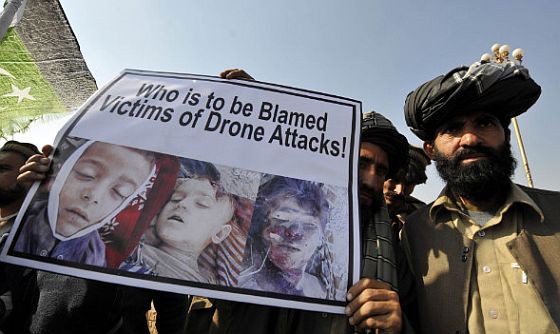
Since President Obama was re-elected on November 6, there have been 15 drone strikes in Pakistan and Yemen, including five strikes since New Year’s Day. This is the White House’s definition of a “light footprint” — a euphemism designed to imply that if the United States refrains from sending armies of occupation to foreign lands, then its military impact on the rest of the world is fundamentally benign.

Neoconservatives who seem to prefer the blunt force of American power and have a nostalgia for “shock and awe” are not impressed with light footprints. The idea that Obama employs a light touch seems designed to appeal to mainstream Democrats who like to believe that if America’s military actions pose no risk to American troops, then America is not at war. Drone strikes can continue, largely ignored by the press, and a public happy to remain ignorant can delude itself that the only people getting killed are “bad guys” and that Obama has a smarter approach to national security than his predecessor.

Assuming their nominations are confirmed, the two new pillars of Obama’s national security policy, John Brennan and Chuck Hagel, will likely further reinforce Obama’s approach which has much more to do with method than doctrine. Hagel will ensure that the troops stay at home while Brennan sends the drones overseas, effectively placing a light footprint on American consciousness and fostering an illusion of peace.

In an interview with Reuters, retired General Stanley McChrystal, who devised the U.S. counterinsurgency strategy in Afghanistan, voiced his concerns about the Obama administration’s practice of remote warfare.

“What scares me about drone strikes is how they are perceived around the world,” he said in an interview. “The resentment created by American use of unmanned strikes … is much greater than the average American appreciates. They are hated on a visceral level, even by people who’ve never seen one or seen the effects of one.”

McChrystal said the use of drones exacerbates a “perception of American arrogance that says, ‘Well we can fly where we want, we can shoot where we want, because we can.'”

Drones should be used in the context of an overall strategy, he said, and if their use threatens the broader goals or creates more problems than it solves, then you have to ask whether they are the right tool.

The Bureau of Investigative Journalism reports: CIA drones killed up to 12 people near Mir Ali, North Waziristan, hours after President Obama announced his nominee for Director of the Agency was John Brennan, his chief counterterrorism advisor and a leading proponent of the drone programme. It was the fourth CIA drone attack in 2013 and the fifth in 12 days. If reports are correct it is the third consecutive attack on a TTP compound. However there were conflicting accounts of the strike. Several agencies said a single target was hit, with Associated Press reporting several missiles ‘slammed into a compound near the Afghan border’ killing eight. However multiple sources said targets in different villages were hit in quick succession. The first strike hit Khasso Khel shortly after midnight, according to Xinhua. Five were killed when eight missiles ‘completely levelled’ a building that subsequently caught fire. Witnesses said the casualty count could rise as they feared people were trapped in the rubble.

Facebooktwittermail

New questions over CIA nominee Brennan’s denial of civilian drone deaths

The Bureau of Investigative Journalism reports: Claims by the Central Intelligence Agency’s new director-designate that the US intelligence services received ‘no information’ about any civilians killed by US drones in the year prior to June 2011 do not appear to bear scrutiny.

John Brennan, President Obama’s nominee to take over the CIA, had claimed in a major speech in summer 2011 that there had not been ‘a single collateral death’ in a covert US strike in the past year due to the precision of drones. He later qualified his statement, saying that at the time of his comments he had ‘no information’ to the contrary.

Yet just three months beforehand, a major US drone strike had killed 42 Pakistanis, most of them civilians. As well as being widely reported by the media at the time, Islamabad’s concerns regarding those deaths were also directly conveyed to the ‘highest levels of the Administration’ by Washington’s then-ambassador to Pakistan, it has been confirmed to the Bureau.

This confirmation suggests that senior US officials were aware of dozens of civilian deaths just weeks before Brennan’s claims to the contrary.

The CIA drone strike in Pakistan on March 17, which bombed the town of Datta Khel in North Waziristan and killed an estimated 42 people, has always seemed a contradiction of Brennan’s official statement.

The attack was later justified by an anonymous US official as a so-called ‘signature strike’ where the identities of those killed was unknown. They insisted that ‘a large group of heavily armed men, some of whom were clearly connected to al Qaeda and all of whom acted in a manner consistent with AQ-linked militants, were killed.’

In fact the gathering was a jirga, or tribal meeting, called to resolve a local mining dispute. Dozens of tribal elders and local policemen died, along with a small number of Taliban. [Continue reading…]

Facebooktwittermail

Japan and China step up drone race as tension builds over disputed islands

The Guardian reports: Drones have taken centre stage in an escalating arms race between China and Japan as they struggle to assert their dominance over disputed islands in the East China Sea.

China is rapidly expanding its nascent drone programme, while Japan has begun preparations to purchase an advanced model from the US. Both sides claim the drones will be used for surveillance, but experts warn the possibility of future drone skirmishes in the region’s airspace is “very high”.

Tensions over the islands – called the Diaoyu by China and the Senkaku by Japan – have ratcheted up in past weeks. Chinese surveillance planes flew near the islands four times in the second half of December, according to Chinese state media, but were chased away each time by Japanese F-15 fighter jets. Neither side has shown any signs of backing down.

Japan’s new conservative administration of Shinzo Abe has placed a priority on countering the perceived Chinese threat to the Senkakus since it won a landslide victory in last month’s general election. Soon after becoming prime minister, Abe ordered a review of Japan’s 2011-16 mid-term defence programme, apparently to speed up the acquisition of between one and three US drones.

Under Abe, a nationalist who wants a bigger international role for the armed forces, Japan is expected to increase defence spending for the first time in 11 years in 2013. The extra cash will be used to increase the number of military personnel and upgrade equipment. The country’s deputy foreign minister, Akitaka Saiki, summoned the Chinese ambassador to Japan on Tuesday to discuss recent “incursions” of Chinese ships into the disputed territory.

Facebooktwittermail

Hagel and the neo-McCarthyite Israel lobby

The Emergency Committee for Israel launched a website to attack Hagel's nomination.

Bernard Avishai writes: I think it is time to acknowledge, bluntly, that certain major Jewish organizations, indeed, the Conference of Presidents of Major Jewish Organizations — also, the ADL, AIPAC, the American Jewish Committee, political groups like the Republican Jewish Coalition, along with their various columnists, pundits, and list-serves — are among the most consistent purveyors of McCarthyite-style outrages in America today. Are there greater serial defamers of public officials in fake campaigns against defamation? Starting with Andrew Young and the late Charles Percy, and on to Chas Freeman and (now) Chuck Hagel, the game has been to keep Congresspeople and civil servants who might be skeptical of Israel’s occupation and apologetics in a posture that can only be called exaggerated tact.

Fault Israel and you are accused of faulting Jews in our collective state, or, the same thing, overlooking the venality of our enemies — things only an anti-Semite would do and, of all times, in the wake of the Holocaust. This is not a charge anyone in public life wants to suffer or try to deny. My Israeli friends love that old Borsch-belt joke, that anti-Semitism means disliking Jews more than necessary. For American Jewish organizations, the very idea that dislike is ever warranted is proof of bigotry, like Philip Roth’s early novels were proof of “self-hatred.”

AIPAC et al know that if American politicians — and especially those fighting routinely for Florida, Pennsylvania and Ohio — are not cowed by the fear of being branded as anti-Semitic they may not be embarrassed into backing Israeli actions ritualistically. Where is the shame and who is our Murrow?

I won’t presume to go through the credentials that make Chuck Hagel fit for appointment as Defense Secretary; I saw and heard him in person only once. I also won’t repeat, or defend him against, all the fatuous charges leveled against him. Others have done this better than I could. (If you want a comprehensive list of the AIPAC-inspired letters Hagel refused to sign, you can find it here.)

Suffice it to say that Hagel is a man of independent judgment whose views on the Israeli-Palestinian conflict track pretty much exactly with those of Haaretz. He was distinguished guest at J Street’s first national conference. Nothing he’s said has not been said by leaders like Ehud Olmert and intelligence chief Ephraim Halevy. Hagel is also a man, like George McGovern, who having served with distinction in the military knows the unknown dangers of resorting to military force without a clear diplomatic strategy and except as a last resort. So he refuses to speak glibly about using force against Iran the same way he refused to endorse war with Iraq. A Vietnam purple heart, he would in retrospect have engaged with the Viet Cong. Should he not now endorse engagement with the Taliban or Hamas, for that matter?

Why should this stance be thought anathema to Jewish organizations? Let’s get real. The latter throw their weight around, presumably on behalf of us Israelis, but really on behalf of the Israeli right, whose orthodoxy and pathos they relate to more readily than to Israeli peace advocates. The weight they have derives from their being able to hold American politicians to endorsing a “special relationship” with Israel, where special means unconditional, so that (as James Baker and Howard Dean discovered) even the desire for “even-handedness” is treachery. [Continue reading…]

Yousef Munayyer notes: What the debate on Hagel is sorely missing is a loud public voice akin to Colin Powell’s on Obama’s faith in 2008, who would respond to allegations that Hagel isn’t pro-Israel by simple stating, So what if he’s not? Hagel is, after all, an American nominated for the role of U.S. Defense Secretary and shouldn’t be pro-Israel or pro-any-country-other-than-the-United-States. If he was, that should lead to controversy.

This debate, however, has it the other way around because it is grounded in the notion that American support for Israel is as American as our Constitution. It isn’t, and it can’t and should never be.

Yet, this type of debate, framed around “pro-Israel” interests, dominates mainstream discussions about U.S. foreign policy in the Middle East and specifically as it relates to Israel/Palestine. For as long as that is the case, Washington is only kidding itself if it thinks it can ever successfully mediate Israeli-Palestinian peace.

Facebooktwittermail

Jewish groups showed cavalier disregard for the welfare of American troops

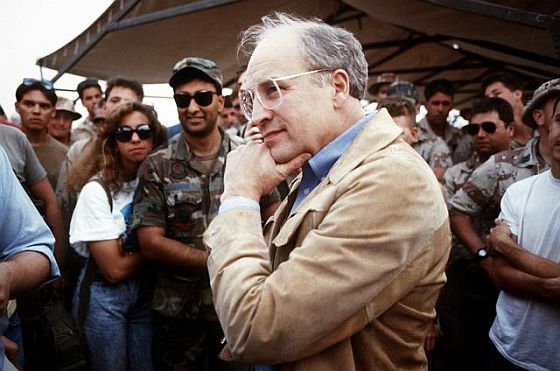
Advice from Defense Secretary Dick Cheney to American troops stationed in Saudi Arabia in 1990: keep quiet about the "Jewish lobby."

In 1990, American troops deployed to Saudi Arabia in advance of the Gulf War against Iraq, were advised by the Pentagon — then under Dick Cheney’s control — that they should not make pro-Israel, anti-Arab remarks while stationed in the Islamic kingdom.

That might sound like a no-brainer — clearly it was advise crafted for the purpose of making sure that young American soldiers lacking knowledge about the Middle East might avoid getting themselves in trouble or alienating themselves from their hosts.

But that’s not how organizations such as the American Jewish Committee, the World Jewish Congress, and the Simon Wiesenthal Center responded to the advice laid out in the Defense Department’s “Troop Information Handbook.”

In a letter to Cheney, Sholom Comay, AJ Committee president, and David Harris, its executive vice president, made it clear that they regarded the presence of American troops in the Gulf as being primarily to serve the interests of Israel.

The Jewish Telegraph Agency reported:

“No one can be under the illusion that our presence in Saudi Arabia is intended to protect a fellow democracy,” Comay and Harris wrote, dismissing the kingdom and its neighbors as “current allies” of the United States.

Perhaps the most egregious element in the Pentagon handbook — the part that most offended these Jewish organizations — was that they were included as one of the taboo topics of conversation and referred to as the “Jewish lobby.” Troops were advised not to discuss the “Jewish lobby” or “U.S. intelligence given to Israel.”

The Associated Press reported:

Writing to Secretary of Defense Dick Cheney, the World Jewish Congress said it wishes to convey “our sense of distress at what appears to be a capitulation to bigotry and a surrender of our democratic values…”

The letter, from WJC Vice President Kalman Sultanik, urges that the material be withdrawn from circulation.

The American Jewish Committee, expressing to Cheney its “deep sense of hurt and anger,” says U.S. troops should not be asked to “submerge entirely those values of tolerance, pluralism, and open-mindedness that have made the U.S. a unique democratic society.”

Cheney neither withdrew the handbook nor apologized for its contents.

During the current hullabaloo over Chuck Hagel’s use of the term “Jewish lobby“, it’s reasonable to ask: given the level of loyalty to Israel which so many members of the Senate seem to expect from America’s top civilian defense official, would Dick Cheney also face strong opposition from his own party if he was once again nominated as defense secretary?

Facebooktwittermail

Hagel’s independence will serve Obama as the Israel lobby pushes for war on Iran

Politics rewards creeps — individuals whose desire to please others makes them willing to sacrifice any principal in the pursuit of power. The more pliable the politician, the more useful he is to the lobbies he serves.

This is why Chuck Hagel has made enemies in Washington — not because of any specific views he holds, but because he lacks the servile disposition that has become the norm. As former deputy secretary of state Richard Armitage puts it: Hagel “doesn’t care if people like him or not.”

Bloomberg reports: If Hagel wins confirmation, he will face challenges such as the increasing threat of cyber warfare, readying military contingency plans for the volatile Middle East and jockeying with China for naval influence in the Asia-Pacific region.

The former enlisted combat veteran is uniquely equipped to take on four-star generals over how fast to withdraw troops from Afghanistan and how to cut forces and weapons in a time of restricted defense spending, according to friends such as Richard Armitage.

“He’s got proven guts,” Armitage, who was deputy secretary of state in the Bush administration, said in an interview before the appointment. “He doesn’t care if people like him or not. He knows who he is.”

Hagel, whose father died when he was 16, dropped out of college and worked as a radio disc jockey before going to serve in Vietnam with his brother Tom. When their armored personnel carrier hit a mine in 1968, Chuck, suffering burns to his body, dragged his brother from the vehicle to safety.

He came back from that war with two Purple Hearts and a conviction that, as he put it in a 2002 interview, “War is the last resort that we, a nation, a people, call upon to settle a dispute.”

“The horror of it, the pain of it, the suffering of it — people just don’t understand it unless they’ve been through it,” Hagel said in the interview for the Veterans History Project of the American Folklife Center. “There’s no glory, only suffering in war.”

Facebooktwittermail

Hagel’s uncommon honesty

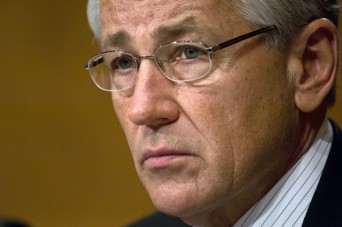
It is widely reported that President Obama will nominate former Nebraska senator Chuck Hagel as secretary of defense today.

Peter Beinart writes: Hagel says in public what others only say in private. In his 2005 book, The Much Too Promised Land, former Clinton administration Middle East hand Aaron Miller notes that “of all my conversations [about the Israel debate in Congress], the one with Hagel stands apart for its honesty and clarity.” That’s because when Hagel told Miller that “the Jewish lobby intimidates a lot of people up here,” he was saying the same thing that people who work in Congress and the executive branch say all the time. As Thomas Friedman has noted, “I am certain that the vast majority of U.S. senators and policy makers quietly believe exactly what Hagel believes on Israel.” But the operative word is quietly. I’ve also heard many government officials, some of them Jewish, say things similar to what Hagel is now being flayed for having told Miller. The difference is that those other officials first confirmed that they were speaking off the record. One even lowered his voice and closed the door.

Hagel’s uncommon honesty isn’t restricted to Israel. Among the statements that critics now decry is Hagel’s 2007 declaration that “People say we’re not fighting for oil [in Iraq]. Of course we are.” In The Weekly Standard, Bill Kristol calls Hagel’s statement “vulgar and disgusting.” What Kristol doesn’t note is that the same article that quotes Hagel also quotes noted radical Alan Greenspan saying virtually the same thing. The difference: Greenspan said it in his memoir, published once he was safely retired from government service.

As John Judis notes, Hagel was considered a plausible Republican presidential candidate in 2008 until his blunt criticism of the Bush administration’s Iraq policies ended his career in the GOP. He is, therefore, one of the very few public figures in recent memory — Joe Lieberman, whose blunt support for the Bush administration’s Iraq policies ended his career in the Democratic Party, is another — to have forfeited a national role in his political party because of his policy views. In the process, Hagel has incurred the wrath of the same hawkish “pro-Israel” forces whose influence he was rash enough to acknowledge. He has done, in short, exactly what people who aspire to jobs like secretary of defense in Democratic administrations learn not to do.

Facebooktwittermail

Brennan to become Central Assassination Agency chief

It looks like the CIA’s decade-long shift from being an intelligence agency to becoming an assassination agency is soon to become irreversible as President Obama’s chief assassin takes over.

The New York Times reports: President Obama will announce on Monday that John O. Brennan, his counterterrorism adviser and a career Central Intelligence Agency officer, is his choice to head the agency, two months after David H. Petraeus stepped down after admitting an extramarital affair, a spokesman for the National Security Council said.

Mr. Brennan’s nomination will be announced at 1 p.m. along with that of Chuck Hagel, the former maverick Republican senator from Nebraska, whom the president has chosen for secretary of defense, said the spokesman, Thomas Vietor.

In Mr. Obama’s first term, Mr. Brennan, 57, has played a central role in the oversight of Mr. Obama’s use of targeted killing of suspected terrorists using drones in Pakistan, Yemen and Somalia. He has become one of the president’s most trusted advisers, and administration officials had said that the C.I.A. job was his for the asking.

Facebooktwittermail

Assad offers only more of the same — mukhabarat brutality

Hassan Hassan writes: The world still blinks every time that Bashar Al Assad speaks, as if it has not learnt anything from 21 months of violence.

In his speech yesterday – his ninth since the uprising began – the dictator offered a plan that would include a lengthy, complicated process of gradual change and “truth and reconciliation”. That would, in theory, lead to a new coalition government and a new constitution.

The speech was preceded by an aggressive two-week diplomatic campaign by the regime’s allies and the UN envoy Lakhdar Brahimi. That renewed push for diplomacy followed 140 countries’ recognition of the National Coalition as the sole representative of the Syrian people, Nato Patriot missiles and military personnel that were dispatched to Turkey’s border, and pledges of increased support for the opposition.

The diplomatic overture by the regime is part of a Russian-backed plan that would keep Al Assad in power until presidential elections in the summer of 2014. And the diplomacy appears to have succeeded in slowing down aid to the rebels, with reports that arms supplies are drying up. But the speech yesterday should remind the world that this dictator has no place in a future Syria and that support for the rebels is the only way forward.

Russia probably pressured on Al Assad to announce a plan of reconciliation. But the speech sounded more vindictive, dismissive and exclusivist than even his previous bombast. For example, he said the plan was directed at only segments of the opposition, and that “those who reject the offer, I say to them: why would you reject an offer that was not meant for you in the first place?” In other points, he emphasised vengeance rather than reconciliation. He also blamed the rebels for the destruction of infrastructure and for cutting off electricity and communications.

“Syria accepts advice but never accepts orders,” he said. “All of what you heard in the past in terms of plans and initiatives were soap bubbles, just like the [Arab] Spring.” [Continue reading…]

Facebooktwittermail

Are the Arab monarchies next?

Hicham Ben Abdallah El Alaoui writes: The Arab Spring is not an outcome, it is a process. For those countries at the forefront of regional transformation, the fundamental question is can democracy become institutionalised? Though progress has been uneven and the outcomes of many state-society struggles have yet to be resolved, the answer is a cautious yes. In at least a few countries, we are witnessing the onset of democratic institutionalisation: whether the process of reform and transformation spreads to other parts of the Middle East depends on many factors — religious tensions, political mobilisation, regime adaptations, geopolitics. Meanwhile North Africa provides the most promising preview of the future.

Democratic institutionalisation means the healthy convergence of politics around three arenas of competition: elections, parliaments and constitutions. When these institutions are robust and durable, then the democratic governments they engender are relatively safe from radical groups, reactionary forces and authoritarian backsliding (due to alternation: democracies that uphold the rule of law and hold regular elections require that power alternates between competing parties).

In Tunisia, Libya and Egypt, this process is unfolding, if at an unsteady pace. All three have had founding legislative elections that were far more competitive and pluralistic than those held in their authoritarian past. In Tunisia, the project to re-craft the national constitution nears completion by the Constituent Assembly, which itself was the product of electoral competition. The crisis there has two dimensions: the new government’s passivity in response to Salafist violence (which came to an end after the attack on the US embassy in Tunis) and the delay in getting economic reform under way, especially in the poorest regions. In spite of often acute tensions and conflicts between different political interest groups, all but the tiniest minority have accepted that democracy is now the name of the game. [Continue reading…]

Facebooktwittermail