Adam Weinstein reports: With time fast running out for the so-called deficit supercommittee, the mammoth amount of government money spent on the military has become a prime target in Washington. But the main focus isn’t on big-ticket weapons projects or expensive wars—it’s on retirement benefits for the roughly 17 percent of soldiers, Marines, sailors, and airmen who have served 20 years or more in uniform. Currently the total cost of their benefits is about $50 billion a year.
Cuts to military pensions are “the kind of thing you have to consider,” Defense Secretary Leon Panetta said in September. When President Obama unveiled his $3 trillion debt reduction plan the same month, it called GIs’ benefits “out of line” with private employee retirement plans, saying the system was “designed for a different era of work.” When Congress held a hearing on military retirements in October, Rep. Austin Scott (R-Ga.) promoted a cheaper 401(k)-style plan that would slash existing benefits for many troops. “I see nothing wrong with them being able to choose a different retirement plan,” he said.
These ideas may sound like a bold new approach in an urgent moment—but in fact, the push for pension cuts and other corporate “reforms” at the Pentagon originates from an obscure advisory panel that has existed for a decade: the Defense Business Board. Its 21 members know little about military affairs, but they are rich in Wall Street experience, including with some of the biggest companies implicated in the 2008 financial meltdown. They are investment bank CEOs and CFOs, outsourcing experts, and layoff specialists who promote a corporate agenda of “behavior change” and “business solutions” [PDF] in the military bureaucracy. The board proposes not only to slash and privatize military pensions, but also to have the Pentagon invest in oil futures, boost pay for its executives and political appointees, and make it easier for them to fire rank-and-file employees while scaling back those workers’ collective-bargaining rights.
Indeed, “this sounds like what’s being done now around the country with the public unions,” affirms Charles Tiefer, a University of Baltimore law professor and defense contracting watchdog who’s testified to Congress about the board’s recommendations. The board was launched in 2001 by then Defense Secretary Donald Rumsfeld, who famously wanted to downsize the military and corporatize its management system. The essential reason it exists, Tiefer says, is so that “a pro-business attitude—especially on personnel issues—remains intact” inside the Pentagon.
Socialism for the rich, capitalism for the poor
George Monbiot writes: In the documentary series which finished on Friday evening, the heiress Tamara Ecclestone set out to prove that she isn’t “a pointless, quite spoilt, really stupid, vacuous, empty human being”. This endeavour was not wholly successful. Channel 5 showed her supervising the refurbishment of her £45m home in London, in which she commissioned a £1m bathtub carved from Mexican crystal, an underground swimming pool complex, her own nightclub, a lift for her Ferrari, a bowling alley with crystal-studded balls and a spa and massage parlour for her five dogs, to save her the trouble of taking them to Harrods to have their hair sprayed and their nails painted. But there was something the series didn’t tell us: how much of this you helped to pay for.
In court a fortnight ago, her father, the Formula One boss Bernie Ecclestone, revealed that the fact his family’s offshore trust, Bambino Holdings, was controlled by his ex-wife rather than himself could have saved him “in excess of £2bn” in tax. The name suggests that the trust could have something to do with supporting his daughter’s attempt to follow the teachings of St Francis of Assisi.
Ecclestone has also been adept at making use of the corporate welfare state: the transfer by the government of wealth and power from the rest of us to the 1%. After the mogul made a donation to Labour’s election fund, Tony Blair demanded that F1 be exempted from the European Union’s ban on tobacco sponsorship. The government built a new dual carriageway to the F1 racetrack at Silverstone.
In other countries his business has received massive state subsidies. Russia, for example, has recently agreed to build a circuit for Ecclestone to race his cars, and then charge itself $280m for the privilege of letting him use it. Working in India in 2004, I came across the leaked minutes of a cabinet meeting in which the consultancy McKinsey insisted that the desperately poor state of Andhra Pradesh – where millions die of preventable diseases – cough up between £50m and £75m a year to support F1. The minutes also revealed that the state’s chief minister had lobbied the prime minister of India to exempt Ecclestone’s business from the national ban on tobacco advertising.
Socialism for the rich, capitalism for the poor: that is how our economies work. Those at the bottom are subject to the rigours of the free market. Those at the top are as pampered and protected as Tamara Ecclestone’s dogs.
Bill McKibben, Keystone XL, and Barack Obama
Jane Mayer writes: Last spring, months before Wall Street was Occupied, civil disobedience of the kind sweeping the Arab world was hard to imagine happening here. But at Middlebury College, in Vermont, Bill McKibben, a scholar-in-residence, was leading a class discussion about Taylor Branch’s trilogy on Martin Luther King, Jr., and he began to wonder if the tactics that had won the civil-rights battle could work in this country again. McKibben, who is an author and an environmental activist (and a former New Yorker staff writer), had been alarmed by a conversation he had had about the proposed Keystone XL oil pipeline with James Hansen, the head of NASA’s Goddard Institute for Space Studies, and one of the country’s foremost climate scientists. If the pipeline was built, it would hasten the extraction of exceptionally dirty crude oil, using huge amounts of water and heat, from the tar sands of Alberta, Canada, which would then be piped across the United States, where it would be refined and burned as fuel, releasing a vast new volume of greenhouse gas into the atmosphere. “What would the effect be on the climate?” McKibben asked. Hansen replied, “Essentially, it’s game over for the planet.”
It seemed a moment when, literally, a line had to be drawn in the sand. Crossing it, environmentalists believed, meant entering a more perilous phase of “extreme energy.” The tar sands’ oil deposits may be a treasure trove second in value only to Saudi Arabia’s, and the pipeline, as McKibben saw it, posed a powerful test of America’s resolve to develop cleaner sources of energy, as Barack Obama had promised to do in the 2008 campaign.
But TransCanada, the Canadian company proposing the project, was already two years into the process of applying for the necessary U.S. permit. The decision, which was expected by the end of this year, would ultimately be made by Obama, but, because the pipeline would cross an international border, the State Department had the lead role in evaluating the project, and Secretary of State Hillary Clinton had already indicated that she was “inclined” to approve it. Both TransCanada and the Laborers’ International Union of North America touted the construction jobs that the pipeline would create and the national-security bonus that it would confer by replacing Middle Eastern oil with Canadian.
The lineup promoting TransCanada’s interests was a textbook study in modern, bipartisan corporate influence peddling. Lobbyists ranged from the arch-conservative Grover Norquist’s Americans for Tax Reform to TransCanada’s in-house lobbyist Paul Elliott, who worked on both Hillary and Bill Clinton’s Presidential campaigns. President Clinton’s former Ambassador to Canada, Gordon Giffin, a major contributor to Hillary Clinton’s Presidential and Senate campaigns, was on TransCanada’s payroll, too. (Giffin says that he has never spoken to Secretary Clinton about the pipeline.) Most of the big oil companies also had a stake in the project. In a recent National Journal poll of “energy insiders,” opinion was virtually unanimous that the project would be approved.
Egyptians challenge military rule
The New York Times reports: Huge crowds of protesters filled Tahrir Square in central Cairo on Tuesday and battled with the police in nearby streets for the fourth straight day, braving an increasingly lethal crackdown to demand an end to military rule.
Each day the crowds have grown; on Tuesday, a day after the civilian cabinet offered its resignation to Egypt’s transitional military government, the protesters massed at the epicenter of Egyptian resistance — first to the former president, Hosni Mubarak, ousted in February and now to the military commanders who replaced him — appeared to number well over 100,000.
Such was the nervousness about the test of wills that trading was briefly suspended on the Cairo stock exchange after its main index slumped for a third successive day, deepening the sense of crisis that has built since street fighting began on Saturday. The first parliamentary elections since Mr. Mubarak was forced from power are scheduled to begin next week, and there is widespread concern that they will be postponed.
Intense skirmishes continued for a fourth day on the main avenue leading to the Interior Ministry. For the protesters, the outburst still seemed to represent a leaderless expression of rage.
Issandr El Amrani writes: The situation in Alexandria appears to have really escalated. This is no longer just about Tahrir. The loss of Egyptian Current Party (offshoot of Muslim Brotherhood) member Bahei Eddin al-Senoussi, a major activist in Alexandria, has galvanized people there. Follow Rawya Ragei’s reporting for al-Jazeera English on this.
The resignation of Essam Sharaf’s cabinet does not seem to have moved the protest movement. The SCAF is said to be negotiating its replacement with political forces, but here they must be treading carefully: if they join in a national unity cabinet, can they be assured that the protestors in Tahrir will accept? They now risk discrediting themselves in doing so. They have to be sure they can sell it to the public, and that means a hard sell. Meanwhile, the best presidential candidates (ElBaradei and Aboul Fotouh) are scathing about SCAF but offer different ways to get to a national unity government. And the most populist one, Hazem Saleh Abu Ismail, has called for more protestors to come down onto the streets. But he still wants elections, and his criticism of SCAF is partly put as a threat.
The Washington Post reports: Three Americans studying at the American University in Cairo have been arrested and accused of participating in the violent demonstrations that are posing the greatest threat to Egypt’s military leaders since the ouster of President Hosni Mubarak last February.
As angry crowds gathered in the capital’s Tahrir Square for a fourth consecutive day, Egypt’s military leaders held a meeting with political leaders in hopes of diffusing the deepening political crisis.
But major figures refused to attend, including Mohamed ElBaradei, the Nobel Peace Prize winner who has emerged as a possibility to head a national unity government, and Shady Ghazali Harb, a leading member of the Revolutionary Youth Coalition, and a close ally of ElBaradei’s.
“I refused to go because of the violence still going on in Tahrir Square,” Harb said. “We can not negotiate with anyone still doing such violence. The legitimacy comes from the square, not the military council.”
Al-Masry Al-Youm reports: Egyptian diplomats on Tuesday signed a statement urging the ruling Supreme Council of the Armed Forces (SCAF) to pledge to conduct presidential elections and hand over power to civilians by mid-2012 at the latest.
The statement, which was signed by 245 diplomats, called on the governing military council to “stop systematic assaults by security on protesters.”
Among those who signed the statement were ambassadors and advisers at the Foreign Ministry, including Ambassor to Russia Alaa al-Hadidy and ministry spokesperson Amr Roshdy.
Al-Masry Al-Youm obtained a copy of the statement, which emphasizes the SCAF’s responsibility to preserve security and safeguard the right of peaceful protest, as is outlined in international charters and agreements.
Israel’s slide towards fascism
David Newman, dean of the Faculty of Humanities and Social Sciences at Ben-Gurion University, writes: It has become almost second nature for Israelis to view the Arab and Palestinian residents of the country as citizens with lesser rights than those of the Jewish majority. But the ease with which those rights have been denied, is now spreading to the Jewish majority.
These may sound like strong words and I will no doubt be strongly criticized for making such a comparison, but we would do well to paraphrase the famous words of Pastor Niemoller, writing in 1946 about Germany of the 1930s and 1940s: “When the government denied the sovereign rights of the Palestinians, I remained silent; I was not a Palestinian.
When they discriminated against the Arab citizens of the country, I remained silent; I was not an Arab. When they expelled the hapless refugees, I remained at home; I was no longer a refugee. When they came for the human rights activists, I did not speak out; I was not an activist. When they came for me, there was no one left to speak out.”
For all of us who likewise believe in the need to preserve the country’s democracy, it is our responsibility to speak out now before it is too late.
Glenn Beck receives ‘Defender of Israel Award’
The Zionist Organization of America gave its first “Defender of Israel Award” to Glenn Beck on Sunday. The award was presented by American billionaire casino magnate and backer of Benjamin Netanyahu, Sheldon Adelson.
Beck, in his acceptance speech, said, “I am a proud Zionist and an obvious defender of Israel. I speak the truth and have been awarded the Defender of Israel Award, which only reveals the kind of trouble we are in.”
He also added, “The current U.S. government is not a friend of Israel.” Beck has been one of the most outspoken and vocal critics of U.S. President Barack Obama.
Beck, who left Fox News several months ago, strongly hinted of political aspirations as he wrapped up his speech. “There is a vacuum [in American politics] that I intend to fill. I am not asking you to join me. I would rather join you,” he said.
Several American politicians were on hand at the ceremony as well. Republican presidential hopeful Congresswoman Michele Bachmann spoke at the event saying, “The Pentagon must prepare a plan for war against Iran, as a last resort.” The congresswoman called for crushing economic sanctions on Iran, and promised that on the day she is sworn in as president, she would move the U.S. embassy in Israel from Tel Aviv to Jerusalem.
Chairwoman of the House Foreign Affairs Committee Ileana Ros-Lehtinen (R-FL), who also received an honorary ZOA award, pledged that the House of Representatives would work to increase sanctions against Iran. (Source)
Jordan starts to shake
Nicolas Pelham writes: To measure the sturdiness of King Abdullah of Jordan against the tide of upheaval sweeping the Arab world, go to Tafila, an impoverished town tucked into a sandy bowl encircled by the Moabite Mountains 110 miles south of the royal seat of Amman. Outside the courthouse where four youths recently awaited trial on charges of cursing the king, a crime punishable in this hitherto deferential kingdom by up to three years in jail, one hundred protesters continue cussing the king, until the order comes from on high to let the four go.
Such protests are growing in intensity and geographic reach, degrading the royal stature with every chant. Last season’s innuendo against his courtiers and queen has become this season’s naked repudiation of the King. In September, demonstrators chanted S-S-S, a deliberately ambiguous call for both the regime’s islah, Arabic for reform, and isqat, overthrow. The protesters outside Tafila’s courthouse dispense with such niceties, spicing the crude one-liners with which Egypt’s revolutionaries toppled Hosni Mubarak with cheeky Bedouin rhyming couplets: “O Abdullah son of Hussein/Qadaffi’s a goner, whither your reign?”
Among the flashy young men who staff the royal court, it is common to dismiss the protests as coming from unruly poor peasants after money and jobs. But in the more sober milieux of their parents where much of Jordan’s business is conducted, the King’s inability to impose his will on the south is a cause of greater unease. For though peripheral and small in number, comprising 10 percent of the kingdom’s six million subjects, the tribesmen dominate the ranks of his security apparatus. If their dissatisfaction grows, some might be tempted, as in Egypt, to jettison their leader in order to preserve their power. Doomsday may yet be far off, but, a former senior Jordanian intelligence official tells me, each month seems worse than the last. By way of comparison he cites Black September of 1970, when an armed force rose up against the King, only this time the forces challenging his rule are those already running the country, not Palestinians opposing it.
Libya’s toughest test may be building an army
The New York Times reports: The marching can hardly be called crisp as the new Libyan National Army takes form in daily drills at an abandoned air force base here.
The soldiers do not yet march in step or even keep their formations straight. Some answer their cellphones when they should be taking orders. Some smoke in the middle of exercises. Others push and shove as personal disputes break out over one thing or another.
“You are not going to see a good, really good military,” Gen. Abdul Majid Fakih, an instructor at the military academy under Col. Muammar el-Qaddafi who later defected, said as he supervised the training. “We are just beginning to build.”
Libya has never had a truly professional national army — a cornerstone in the building of a modern state — one that was not the personal tool of a king or dictator and purposely kept weak and divided to avert coups. And the effort at building one by the struggling new interim government may be its most difficult and important task.
Only a respected army will be able to persuade or force the various competing and heavily armed militias around the country to disarm and join together under a unified leadership. The challenge was underscored over the weekend when a militia from the town of Zintan captured Seif al-Islam el-Qaddafi, Colonel Qaddafi’s son and onetime heir apparent, without any help from the army, and then refused to turn him over to the central government.
The army is trying to build respect by holding parades around the country, complete with parachute jumps and fly-bys by Soviet-era MIG fighter jets and Mi-8 helicopters. But even the officers of the new force say they face challenges in building national veneration around the military, as well as in breaking old habits of officer cronyism and allegiance to one strongman or another.
The new army, which numbers a few thousand and includes many soldiers who deserted Colonel Qaddafi’s military, needs barracks, uniforms, vehicles, boots, radios, even flashlights, officers say. Rather than having a central unified command, it is being formed by distinct committees in different cities, following the model of the diverse bunch of militias that fought the war against the dictatorship. And perhaps most troubling, the militias across the country are already refusing to take its orders.
Life after occupation
Arun Gupta visits Mobile, Alabama and Chicago, and asks: Can an occupation movement survive if it no longer occupies a space?
Emily Schuler, a Mobile native and college student, says the Occupy movement made her rethink her place in society, calling it “one of the best things that has ever happened to me.” Schuler says, “I love Mobile, but it’s ultra-conservative.” She explains, “I always felt like the black sheep because I sensed that the way the world was working was not good … There is a lot of pain and suffering. I think it has a lot to do with the way the system works. Because right now it’s profit over people. And it should be people over profit.”
To the world-weary in New York, a silent protest and proposition that the American system values “profit over people” may seem prosaic. And it would be prosaic were it not happening in a place like Mobile, Ala., and all over the United States. Dozens of occupiers have told us this movement is an “awakening” for them or for others.
One eye-opening aspect of our evening with Occupy Mobile was that none of these people knew each other a month before. The movement has created a new political community virtually overnight.
“We all felt alone,” Chelsy Wilson says. “Now we know that’s not the case. We’re going to try to reach out to other people who feel this wa … People say they have a new hope for Mobile. A lot of us were looking for jobs outside the city, we wanted to move away as fast as we could, and a lot of us have changed our minds. We want to stay here now.”
In smaller, conservative cities, the creation of a new community may be success enough for the movement, enabling a new network to consolidate and spread its message without a public encampment. But for larger cities that already have a strong progressive presence, the experience of Occupy Chicago is more relevant — and more sobering.
Occupy Chicago is forging ahead with maintaining a public presence despite never having established an occupation in the first place. It’s not for lack of trying. On two consecutive Saturdays in mid-October, Occupy Chicago tried to take Grant Park, known for Chicago’s head-bashing police plying their trade during the 1968 Democratic National Convention.
On the day of the second action, Oct. 22, we caught up with the protest as it was marching to the horse, a statue that provided the rally cry, “Take the horse.” It was impressive compared to New York. A march some 3,000 strong, bullhorns, banners, resounding chants and marshals providing a buffer from the police. Occupy Chicago felt like any of hundreds of demonstrations I’ve been on in the last 20 years. To be fair, the energy and stakes were higher, but it seemed like protest as usual. It was far better organized than Occupy Wall Street’s chaotic peregrinations — and that was the problem.
In New York, Occupy Wall Street actions surge with electricity. No one quite seems in control because everyone is in control. Amoebic blobs of protesters break off and take the streets. Chants are thrown out, and the hive mind picks a winner. It is atavistic, often lacking signs, denied sound systems and shunning permits, but powered by hearts, lungs and passion. Exciting and unpredictable, it attracted greenhorns, drove the cops nuts, paralyzed Bloomberg for weeks and captured the world’s attention. That was why it worked and why the boot came down in the end.
In Chicago, the first time protesters tried to take the space on Oct. 15, 175 people were arrested. We were there for the second round of arrests of about 130 people. I talked to Jan Rodolfo, a 36-year-old oncology nurse and National Nurses United staff member. While preparing to be arrested along with other union members and scores of others, Rodolfo said Occupy Chicago needed “a permanent encampment because it allows the movement to grow by creating a central place for people to come. ”
Another activist said, “It would have been a big victory for the students, unions and other groups putting their efforts into the movement.”
It wouldn’t have just been a victory; it would have created a different movement. What made occupations in New York City and other cities so successful is that they brought new people into the movement in droves. Chicago has strong networks of activists, unionists and community groups, which are all involved in the Occupy movement. What they were missing was crucial: the people who were previously non-political.
How the Pepper Spray Cop could change the trajectory of Occupy Wall Street

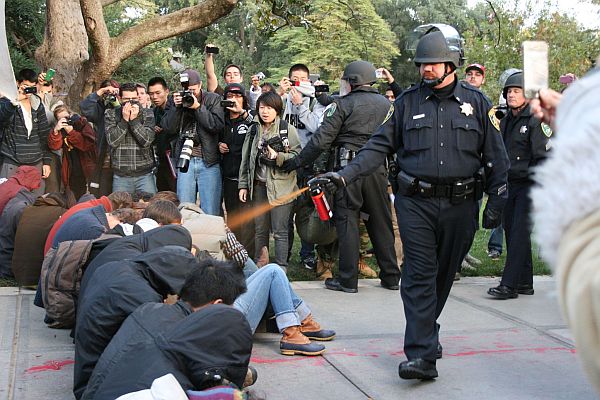
Megan Garber writes: This weekend, a series of photographs — images of a riot-gear-wearing cop shooting a group of students in the face with pepper spray — made their transition from journalistic documents to sources of outrage to, soon enough, Official Internet Meme. Perhaps the most iconic image (taken by UC Davis student Brian Nguyen, and shown above) isn’t explicitly political; instead, it captures a moment of violence and resistance in almost allegoric dimensions: the solidarity of the students versus the singularity of the cop in question, Lt. Pike; their steely resolve versus his sauntering nonchalance; the panic of the observers, gathered chorus-like and open-mouthed at the edges of the frame. The human figures here are layered, classified, distant from each other: cops, protestors, observers, each occupying distinct spaces — physical, psychical, moral — within the image’s landscape.
As James Fallows put it, “You don’t have to idealize everything about them or the Occupy movement to recognize this as a moral drama that the protestors clearly won.”
Exactly. The image — and its subsequent meme-ification — marked the moment when the Occupy movement expanded its purview: It moved beyond its concern with economic justice to espouse, simply, justice. It became as much about inequality as a kind of Platonic concern as it is about income inequality as a practical one. It became, in other words, something more than a political movement.
The image itself, I think — as a singular artifact that took different shapes — contributed to that transition, in large part because the photo’s narrative is built into its imagery. It depicts not just a scene, but a story. It requires of viewers very little background knowledge; even more significantly, it requires of them very few political convictions, save for the blanket assumption that justice, somehow, means fairness. The human drama the photo lays bare — the powerless being exploited by the powerful — has a universality that makes its particularities (geographical location, political context) all but irrelevant.
The Serpent’s Egg hatchlings in Greece’s postmodern Great Depression
The Greek economist, Yanis Varoufakis, writes: It will prove George Papandreou’s ugliest legacy: that his last-minute childish maneuvering to maximise his waning hold on power (while negotiating his eviction from the PM’s job), has brought into the new ‘national unity’ government four self-declared racists (some of whom are neo-Fascists and one a neo-Nazi of some renown). It is also wildly ironic: for Mr Papandreou’s best quality has traditionally been his ardent cosmopolitanism, his demonstrated anti-nationalism, a genuine commitment to minorities and a deep seated intolerance of racism. Alas, such is the lure of power, it seems, that the entry into the new government of one minister and three junior ministers representing LAOS (a small ultra-right wing party) was cynically judged as a smaller price to pay than handing more control of the new regime to Mr Papandreou’s political opponents in the two major parties – his own PASOK and New Democracy, the conservative opposition.
To non-Greeks watching breathlessly the swearing into government of the serpent’s egg latest hatchlings, these news from Greece will surely resonate terribly. As they should! For yet again a Great Depression has given fascism another twirl. And while Greece is small and ought to be irrelevant, its past has spawned great perils for the world at large. Lest we forget, the Cold War did not begin in the streets of Berlin but in the alleys of Athens back in December 1944. Greece was also one of the first countries to have established a fully fledged fascist regime after the Crash of 1929: the Metaxas dictatorship in 1936. More recently, a CIA-backed coup brought Greek fascists in power six years before General Pinochet rolled his tanks against the Presidential palace in Santiago, quite obviously inspired by the ‘success’ of his Greek brethren. Nowadays, with Greece leading the chorus of Europe’s headlong dive into a new recession, and a renewed disintegration complete with racial overtones (Germans loathing the Greeks and vice versa), it is time for the world to take note. Feeling the irony of Papandreou’s tragic end will simply not do. Progressives around the world must remain vigilant. [Continue reading…]
Israel shuts liberal radio station in attempt to silence criticism of right
The Independent reports: Israel has closed down a dovish Israeli-Palestinian radio station in what its backers say is a politically-motivated decision to silence criticism of the Jewish state.
The Communications Ministry ordered the Kol Hashalom station, or All for Peace, to shut down earlier this month for broadcasting into Israel illegally. But Danny Danon, a member of Benjamin Netanyahu’s hawkish Likud party, boasted that he had instigated an investigation into the station for alleged incitement against Israel.
The attack on the radio station, which has broadcast for seven years, raises fresh concerns about press freedoms at a time when many of Israel’s liberals view the country’s democracy as under threat from the right wing.
Israel claims that All for Peace, established by Palestinian and Israeli activists, is a pirate radio station operating without a licence, but the station has countered that it has a licence from the Palestinian Authority, and does not require permission from Israel. The station has offices in East Jerusalem, but broadcasts from Ramallah in the West Bank.
Managers of the station, unique for its willingness to talk to far-right Israelis as much as to militant Palestinians, have been in regular contact with the Communications Ministry over the past seven years, said the Jewish co-director Mossi Raz, who insists that he has never in that time been told to seek an Israeli licence.
“It is a political decision,” said Mr Raz, a former politician with the left-wing party Meretz. “I am very concerned. There is no democracy here. People think that democracy is only the right to vote, but it’s not only that. You cannot have democracy without freedom of the press.” He added that he is preparing to challenge the decision in court.
Lobbyists plan to defend Wall Street and attack the Occupy movement
Visit msnbc.com for breaking news, world news, and news about the economy
MSNBC reports: A well-known Washington lobbying firm with links to the financial industry has proposed an $850,000 plan to take on Occupy Wall Street and politicians who might express sympathy for the protests, according to a memo obtained by the MSNBC program “Up w/ Chris Hayes.”
The proposal was written on the letterhead of the lobbying firm Clark Lytle Geduldig & Cranford and addressed to one of CLGC’s clients, the American Bankers Association.
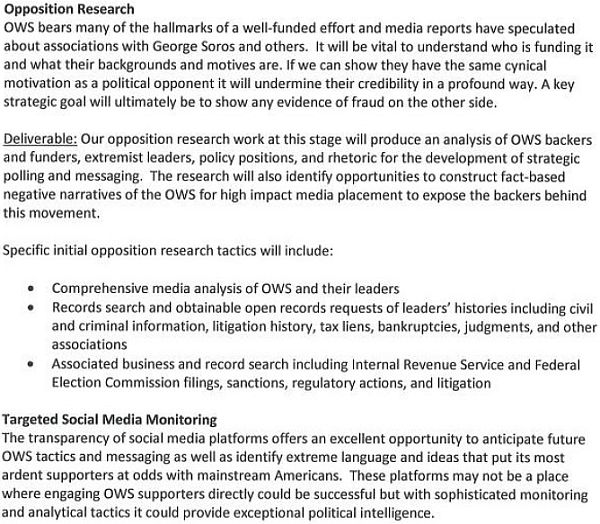
CLGC’s memo [PDF] proposes that the ABA pay CLGC $850,000 to conduct “opposition research” on Occupy Wall Street in order to construct “negative narratives” about the protests and allied politicians. The memo also asserts that Democratic victories in 2012 would be detrimental for Wall Street and targets specific races in which it says Wall Street would benefit by electing Republicans instead.
According to the memo, if Democrats embrace OWS, “This would mean more than just short-term political discomfort for Wall Street. … It has the potential to have very long-lasting political, policy and financial impacts on the companies in the center of the bullseye.”
Here’s an extract from the memo:

Don’t let them destroy the revolution
An anonymous #OWS activist urges President Obama to break his silence on the bloodshed in Cairo where 24 people have already been killed. But let’s not forget that this is a man who in 2006 supported the carpet-bombing of Beirut, in 2008 remained mute while Israelis slaughtered Palestinians in Gaza, and in 2009 was slow to condemn the Iranian government as it crushed the Green Revolution. Obama is consistent in this respect: he displays an unswerving loyalty to power.
President Obama, where are you? Are you not watching the same images that the world is watching of the massacres in Tahrir? Are you too busy preparing for Thanksgiving to take a minute to make a strong statement about what’s happening in a country in which your government has invested so much money and support?
Are you not outraged at the brutal suppression of pro-democracy protesters by the military junta in Egypt? If so, why have you offered no meaningful condemnation of the attempt to crush a revolution that has so inspired millions of Americans? After all, their encouragement to Occupy Wall Street might actually wind up saving your presidency.
During the fateful 18 days in January and February when Egyptians took to the streets by the millions to topple Hosni Mubarak, you remained largely silent, refusing to call directly for democracy until it was clear that young Egyptians would not be denied their wish to be free of his three-decade-long rule.
In the months since then, as thousands of Egyptians have been attacked, imprisoned, sexually assaulted and murdered by their government, the United States has not merely remained silent, but has continued to provide crucial diplomatic, economic and military aid to the regime responsible for these crimes.
Now that the facade of a democratic transition has been ripped away and Egyptians are once again battling the military government in Tahrir Square for the future of the country, your administration remains as quiet as it was in the early days of the revolution. Such silence is both morally indefensible, and politically and strategically disastrous for the US. The march for freedom in Egypt cannot be stopped, and when Egyptians finally rid themselves of the military government and establish a democratic system, the US will have few friends in Egypt, or the Arab world more broadly, if it is seen as having supported the military rather than the people at this pivotal moment.
The tear gas being fired at demonstrators in Cairo is manufactured by the US company, Combined Systems.
UC Davis: The power of silence
After the UC Davis pepper spraying, a string of lies and vacuous declarations:
“The students had encircled the officers,” UC Davis Police Chief Annette Spicuzza said. “They needed to exit. They were looking to leave but were unable to get out.”
As the video above shows, police officers were able with perfect ease to step over the peacefully sitting demonstrators whenever they chose to do so.
“I spoke with students this weekend, and I feel their outrage. I have also heard from an overwhelming number of students, faculty, staff and alumni from around the country. I am deeply saddened that this happened on our campus, and as chancellor, I take full responsibility for the incident,” Linda P.B. Katehi.
I take full responsibility has been turned into a phrase whose meaning extends no further than its utterance.
There was a day these words would preface a tangible demonstration of their meaning: “I take full responsibility and have therefore tendered my resignation.”
Then comes Katehi’s boss’s declaration of deep concern:
“I am appalled by images of University of California students being doused with pepper spray and jabbed with police batons on our campuses.
“I intend to do everything in my power as president of this university to protect the rights of our students, faculty and staff to engage in non-violent protest.
“Chancellors at the UC Davis and UC Berkeley campuses already have initiated reviews of incidents that occurred on their campuses. I applaud this rapid response and eagerly await the results,” said University of California President Mark G. Yudof today.
Nothing is more predictable in the practice of damage control than the promise of an inquiry — bury the story in the mud of time and deadening bureaucratic detail.
“I will be asking the chancellors to forward to me at once all relevant protocols and policies already in place on their individual campuses, as well as those that apply to the engagement of non-campus police agencies through mutual aid agreements.
“Further, I already have taken steps to assemble experts and stakeholders to conduct a thorough, far-reaching and urgent assessment of campus police procedures involving use of force, including post-incident review processes.
“My intention is not to micromanage our campus police forces. The sworn officers who serve on our campuses are professionals dedicated to the protection of the UC community.
“Nor do I wish to micromanage the chancellors. They are the leaders of our campuses and they have my full trust and confidence.”
Yudof might trust Katehi but the students in her university do not.
After a news conference on Saturday she was presented with an instant report on the conduct of her administration. The text was scornful silence — a message from hundreds of students who sat and watched as Katehi retreated to her car..
“Corporate America is using our own police departments as hired thugs, and that’s a disgrace,” says Retired Captain Ray Lewis from the Philadelphia PD.
And if we need any further reminders that the police in the US have indeed become hired thugs, here’s another view of their assault on peaceful protesters in Berkeley.
10 killed, 1700 injured in Cairo clashes
Al-Masry Al-Youm reports: Presidential hopefuls Abdel Moneim Abouel Fotouh and Mohamed ElBaradei are speaking to Dream TV, a private satellite channel, criticizing both the Supreme Council of the Armed Forces (SCAF) and the government for mishandling the situation in Tahrir.
ElBaradei said the prime responsibility for the situation in the country is the SCAF, which he says has admitted it cannot run the country. ElBaradei asked who is responsible for starting this barbaric use of force that left over 1000 injured, 10 dead and 10 more blind; he answered: the Interior Ministry.
Abouel Fotouh said that, once again, protesters are being subjected to the same oppressive tactics used during the era of ex-president Hosni Mubarak. He added that until today, the blood of Egyptians is being shed only because the pure youth are trying to save their homeland. He said that the youth in Tahrir now are the same revolutionaries we all know.
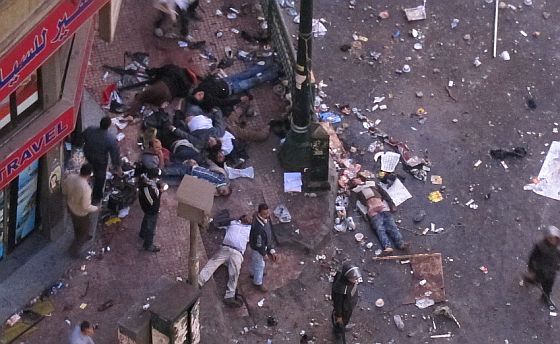
Anjali Kamat, an independent journalist and correspondent for Democracy Now! posted a photo of “8 unmoving bodies” in Tahrir. There have been multiple reports of Egyptian security services firing live rounds during the protest.
A podcast from The Arabist puts today and yesterday’s violence in context.
Egyptian blogger, Hossam El-Hamalawy interviewed by Al Jazeera:
A fight for control of Tahrir Square
Al Jazeera reports: Egyptian security forces are engaged in back-and-froth street battles in downtown Cairo’s Tahrir Square with thousands of defiant activists who filled the square for the second day of protests against the country’s interim military leaders.
Thick clouds of tear gas filled the air on Sunday as military police armed with batons and shields charged into the square, firing rubber bullets and forcibly clearing the area of protesters. The assault sparked panic among the estimated 5,000 protesters, many of whom had remained in Tahrir since early on Saturday.
A short time affter the offensive, however, a surge of protesters returned to the square, overwhelming security forces and retaking the area.
“This is what the Egyptian army calls protecting the revolution,” Salma Said, a democracy activist, told Al Jazeera. “We’ve lost so many people in the last nine months. We want Field Marshall Tantawi gone. We’re going to keep fighting, we don’t have any other options.”
At 5.50pm local time, Al-Masry Al-Youm reported: Protesters marching through Tahrir Square are chanting, “Tantawi is the enemy of God.” Another group is chanting Ultra football fan anti-security songs.
Meanwhile, EgyNews, an official state website, just announced that military police and security forces have completely cleared Tahrir Square of demonstrators. However, according to Al-Masry Al-Youm correspondents in the square, thousands of protesters remain.
The roots of the UC-Davis pepper-spraying
Glenn Greenwald writes: The now-viral video of police officers in their Robocop costumes sadistically pepper-spraying peaceful, sitting protesters at UC-Davis (details here) shows a police state in its pure form. It’s easy to be outraged by this incident as though it’s some sort of shocking aberration, but that is exactly what it is not. The Atlantic‘s Garance Franke-Ruta adeptly demonstrates with an assemblage of video how common such excessive police force has been in response to the Occupy protests. Along those lines, there are several points to note about this incident and what it reflects:
(1) Despite all the rights of free speech and assembly flamboyantly guaranteed by the U.S. Constitution, the reality is that punishing the exercise of those rights with police force and state violence has been the reflexive response in America for quite some time. As Franke-Ruta put it, “America has a very long history of protests that meet with excessive or violent response, most vividly recorded in the second half of the 20th century.” Digby yesterday recounted a similar though even worse incident aimed at environmental protesters.
The intent and effect of such abuse is that it renders those guaranteed freedoms meaningless. If a population becomes bullied or intimidated out of exercising rights offered on paper, those rights effectively cease to exist. Every time the citizenry watches peaceful protesters getting pepper-sprayed — or hears that an Occupy protester suffered brain damage and almost died after being shot in the skull with a rubber bullet — many become increasingly fearful of participating in this citizen movement, and also become fearful in general of exercising their rights in a way that is bothersome or threatening to those in power. That’s a natural response, and it’s exactly what the climate of fear imposed by all abusive police state actions is intended to achieve: to coerce citizens to “decide” on their own to be passive and compliant — to refrain from exercising their rights — out of fear of what will happen if they don’t.
The genius of this approach is how insidious its effects are: because the rights continue to be offered on paper, the citizenry continues to believe it is free. They believe that they are free to do everything they choose to do, because they have been “persuaded” — through fear and intimidation — to passively accept the status quo. As Rosa Luxemburg so perfectly put it: “Those who do not move, do not notice their chains.” Someone who sits at home and never protests or effectively challenges power factions will not realize that their rights of speech and assembly have been effectively eroded because they never seek to exercise those rights; it’s only when we see steadfast, courageous resistance from the likes of these UC-Davis students is this erosion of rights manifest.