Whatever happened to that war with Iran?

Justin Elliot writes:

Last August, the Atlantic published a splashy cover story by Jeffrey Goldberg that led with a startling prediction: Israel would more likely than not launch bombing raids on Iran’s nuclear sites by July 2011, according to Goldberg’s mostly Israeli (and unnamed) sources.

Today is July 1, and there has, of course, been no attack. It’s worth looking back at the influential piece and considering what happened. Wrote Goldberg:

[A] consensus emerged that there is a better than 50 percent chance that Israel will launch a strike by next July. (Of course, it is in the Israeli interest to let it be known that the country is considering military action, if for no other reason than to concentrate the attention of the Obama administration. But I tested the consensus by speaking to multiple sources both in and out of government, and of different political parties. Citing the extraordinary sensitivity of the subject, most spoke only reluctantly, and on condition of anonymity. They were not part of some public-relations campaign.)

The piece, packaged with a provocative cover image and headline (“ISRAEL IS GETTING READY TO BOMB IRAN”) was the subject of intense debate when it came out. Glenn Greenwald here at Salon accused Goldberg of feigning “‘ambivalence’ about whether Iran should be bombed … while infecting the discourse with the kinds of factual falsehoods documented here, all in service of skewing the debate towards ensuring an attack happens.” Others like Clive Crook hailed the piece as “an amazing intellectual coup.”

A common critique of the piece was precisely what Goldberg tried to preemptively address in the excerpt above: that his Israeli sources, with the protection of anonymity, were overstating the possibility and imminence of an Israeli strike in order to persuade Washington to more aggressively pressure Iran, or even launch its own attack. As Ben Smith wrote at the time, the “unstated logic here [is] that, if Israel is going to bomb Iran, the U.S. might as well do it itself.” That critique seems to have been strengthened by the fact that the central prediction of the article didn’t pan out.

Facebooktwittermail

Tens of thousands of Syrians protest in central city of Hama

The New York Times reports:

Tens of thousands of protesters poured Friday into the streets of Hama, a Syrian city abandoned by the military and security forces, gathering in the country’s biggest demonstration in nearly four months of unrest and staking a festive claim to a region that bore the brunt of a ferocious government crackdown a generation ago.

The scenes of residents rallying in a central square there, captured by activists on video and circulated on the Internet, seemed to signal a new stage in an uprising that has so far only aspired to rival the mass protests in Egypt and Tunisia, where authoritarian leaders were eventually forced to step down. Protesters exploited at least a temporary vacuum in the official security presence in Hama to stage a panorama of dissent as celebratory as it was angry.

“Leave! Leave!” protesters chanted to a hip-hop beat.

The military and security forces withdrew last month from Hama for reasons that remain unclear. But the move seemed to reflect a compelling, if ambiguous, turn in an uprising that until recently was marked by repeated clashes between protesters and armed troops.

After weeks of stalemate, a new dynamic has emerged recently in Syria. The opposition gathered Monday in a rare meeting in Damascus, government officials are promising reform in coming weeks and protesters have shown a resilience that seems more and more difficult for the government to suppress.

The most visible shift has occurred in Hama, where a government crackdown in 1982 made the city synonymous with the brutality of Syria’s leadership. Since the withdrawal last month, protests have gathered momentum. Each night, youths have converged on Aasi Square, which they have renamed Freedom Square. On successive Fridays, crowds have grown bigger, surpassing 10,000 last week, diplomats say.

Facebooktwittermail

Gaza flotilla aims to leave Greece next week

The Jerusalem Post reports:

The fate of the flotilla to the Gaza Strip was in jeopardy on Saturday after Greek authorities prevented an American vessel from leaving Athens and issued a blanket order forbidding ships from sailing to the Gaza Strip.

Despite the order and additional setbacks, Adam Shapiro, an American co-founder of the International Solidarity Movement, and one of the organizers of the flotilla, told The Jerusalem Post on Saturday night that the group still planned to sail to the Gaza Strip in the coming days.

He said that the Greek- Swedish ship Juliano, which was allegedly sabotaged last week, was expected to be repaired by Sunday morning and that an Irish ship, also allegedly sabotaged in Turkey, was set to begin repairs soon.

“We are still arranging to go and are working on different fronts to get permission to leave,” Shapiro said by phone from Athens.

He also denied reports that organizers were considering canceling the flotilla since they had already achieved their goal by raising awareness regarding the sea blockade on the Gaza Strip.

“Gaza is still blockaded and there is still a need to sail there,” he said.

Al Jazeera adds:

Members of the Dutch-Italian boat issued an open letter to the Greek Prime Minister Georgios Papandreou on Sunday, expressing outrage over his “government’s decision to close the ports of Greece to our humanitarian initiative, even by force if needed”.

The letter demanded that they be allowed to sail and said, “It is totally incomprehensible to us and fills us with just wrath that the Greek government closes the ports to our ships…

“You and your government acting as an ally of Israel in the Palestinian question means you also seem to have forgotten the struggle against the military dictatorship in your own country.”

Joe Meadors, a US Navy veteran [and survivor of Israel’s attack on the USS Liberty], is one of the roughly 100 passengers on board a flotilla vessel that finds itself standed. Meadors, however, still expects to sail.

“We are waiting for the Greek government to release us,” he told Al Jazeera, “We are here for the long haul, and we’re ready to go just as soon as the Greeks say we can go. We’re pleased we can do something for the Palestinians and remain excited to go.”

Khalid Tuhraani, an American Palestinian activist whose ship is stuck in the port of Corfu, is also frustrated and feels that it perhaps would have been better if the flotilla had orginated from a port in an Arab country such as Tunisia or Egypt.

“However, many of the Arab countries have, like Greece now, become hostages of the political will of the United States and Israel,” he said.

Tuhraani said he remained committed to doing what was necessary to end the Israeli blockade against Gaza, but he expressed disappointment at the Greek government.

“We chose Greece because this country has a history of support for the Palestinian struggle for freedom,” he said.

“Unfortunately we did not expect the Greek government to just roll over and die. But the Middle East Quartet issued a statement against our flotilla, so I think the pressure on the Greek government just might have been too enormous for it to bear.”

Facebooktwittermail

Why every flotilla succeeds and the siege of Gaza will end

Is it possible to break the siege of Gaza if no one notices?

As an exercise in directing global attention to the plight of a population subject to collective punishment, the first flotilla in August 2008 was a bit of a flop — even though it reached Gaza.

In the Jerusalem Post, Herb Keinon cynically wrote at the time:

Ever since the Free Gaza Movement made known its intent a few weeks ago to set sail for the Gaza Strip to “break” the Israeli blockade, it was clear that the two boatfuls of professional left-wing demonstrators and tag-along journalists were after one thing: a huge media event.

Nothing, therefore, would have given them a greater media buzz than if a couple of Israel Navy boats stopped them on the high seas, arrested the protesters (hopefully, from the point of view of the organizers of the protest, with some gratuitous brutality), and dragged the Greek-registered vessels into the Ashdod port.

Imagine the footage, imagine the images, and imagine the public relations bonanza for those few “brave souls” on the sea-weary vessels. Israel would, undoubtedly, have faced a public relations drubbing. So by deciding to let the boats through, the government deprived the protesters of the huge media event they so obviously wanted.

Indeed, instead of footage of heavyhanded Israelis stopping boats carrying an 81-year-old American nun and the sister-in-law of former British prime minister Tony Blair leading the nightly news broadcasts in the West on Saturday night, the story of the boats’ arrival in Gaza barely made a blip on the CNN, Fox, or Sky news broadcasts. With the world’s eyes still glued to the Olympics in Beijing, and the media focusing on US presidential candidate Barack Obama’s choice of Joe Biden as his vice presidential nominee, the Gaza blockade-running story didn’t register in the electronic media.

And in the written press, the protesters didn’t fare that much better. The New York Times ran a small piece on page 16 on Sunday; The Washington Post on page 12; and The St. Louis Post-Dispatch relegated it to a three-paragraph brief. As media events go, this one was not particularly successful.

But — as Keinon also noted — the story was not over. Indeed.

What the flotilla organizers understood was that whatever the outcome, each challenge to the siege could in fact never fail. Ships could succeed by reaching Gaza, or succeed without reaching Gaza by exposing Israel to the eyes of the world as a cowardly bone-headed bully.

The only solution to Israel’s problem was and remains the one that it refuses to entertain: backing itself out of a dead-end policy that by any metric one wants to use, has been a demonstrable failure — a policy which hasn’t weakened Hamas; hasn’t turned Gaza’s population against its rulers; hasn’t made Israel safer; and above all has brought Israel’s global image to an all-time low while callously inflicting yet more suffering on the Palestinian people.

The Israeli columnist, Asaf Gefen, suggested this week:

If the Marmara that took part in the previous sail sought to present Israel’s brutality to the world (and managed to do so, thanks to our kind assistance,) it appears that the current flotilla was meant to present Israel’s stupidity.

At this time already, when it’s still unclear whether and when the ships shall arrive, it appears that this objective had also been fully achieved.

But now that the flotilla appears stuck in Greece, can’t Netanyahu claim victory? Some Israeli reporters seem to think so:

Prime Minister Benjamin Netanyahu sometimes seems almost too arrogant and self assured for his own good. However, unlike in most instances, this weekend he actually has justification for his haughtiness.

Really?

Look at The Audacity of Hope as it chugged out of a Greek harbor yesterday and ask yourself: what kind of prime minister and what kind of nation could feel threatened by this kind of challenge?

The need to subjugate others; the obsession with existential threats; the insatiable hunger for loving affirmations; and the fear of equality between Jews and non-Jews — all of this exposes Israel’s intrinsic weakness, a weakness that cannot be overcome by belligerence, isolation or warfare.

In truth, nothing threatens Israel more than its own fear of the world.

It’s time not just for Israel to end the siege of Gaza but for Zionists to break out of their own self-made prison.

Facebooktwittermail

Defiant Gaddafi threatens Europe

Al Jazeera reports:

Muammar Gaddafi, the Libyan leader, has delivered a telephone address through loudspeakers to thousands of supporters gathered in Tripoli’s Green Square, warning the NATO-led alliance to stop its war support or face “catastrophe”.

In the Friday speech, 100 days after NATO first entered the country, Gaddafi gave multiple warnings to foreign forces that have been militarily supporting anti-regime rebels for months, to a crowd of supporters who waved green flags and posters of the head of state.

“We advise you to retreat before you face a catastrophe… If we decide to, we are able to move to Europe like locusts, like bees,” Gaddafi said.

Addressing the West, Gaddafi warned that Libyans could take revenge on Europe for supporting of rebel forces.

Facebooktwittermail

Anonymous declares cyberwar against Orlando

The New York Times reports:

The hacker group Anonymous has declared a cyberwar against the City of Orlando, disabling Web sites for the city’s leading redevelopment organization, the local Fraternal Order of Police and the mayor’s re-election campaign.

Anonymous, a large yet loosely formed group of hackers that claimed responsibility for crashing the Web sites of MasterCard and the Church of Scientology, began attacking the Orlando-based Web sites earlier this week.

The group described its attacks as punishment for the city’s recent practice of arresting members of Orlando Food Not Bombs, an antipoverty group that provides vegan and vegetarian meals twice a week to homeless people in one of the city’s largest parks.

“Anonymous believes that people have the right to organize, that people have the right to give to the less fortunate and that people have the right to commit acts of kindness and compassion,” the group’s members said in a news release and video posted on YouTube on Thursday. “However, it appears the police and your lawmakers of Orlando do not.”

Facebooktwittermail

Syria: U.S. presses for opposition dialogue with Assad

The Guardian reports:

The US is pushing the Syrian opposition to maintain dialogue with Bashar al-Assad’s regime as details emerge of a controversial “roadmap” for reforms that would leave him in power for now despite demands for his overthrow during the country’s bloody three-month uprising.

Syrian opposition sources say US state department officials have been discreetly encouraging discussion of the unpublished draft document, which circulated at an unprecedented opposition conference held on Monday in Damascus. But Washington denies backing it.

Assad would oversee what the roadmap calls “a secure and peaceful transition to civil democracy”. It calls for tighter control over the security forces, the disbanding of “shabiha” gangs accused of atrocities, the legal right to peaceful demonstrations, extensive media freedoms, and the appointment of a transitional assembly.

The carefully phrased 3,000-word document demands a “clear and frank apology” and accountability for organisations and individuals who “failed to accommodate legitimate protests”, and compensation for the families of victims. The opposition says 1,400 people have been killed since mid-March. The government says 500 members of the security forces have died.

It calls for the ruling Ba’ath party to be subject to a new law on political parties – though the party would still provide 30 of 100 members for a proposed transitional national assembly. Seventy others would be appointed by the president in consultation with opposition nominees.

Several of the proposed measures have already been mentioned in public by Assad, fuelling speculation that he is at least partially following through on some of the document’s recommendations.

The roadmap is signed by Louay Hussein and Maan Abdelsalam, leading secular intellectuals in a group called the National Action Committee. Both men met the vice-president, Farouk al-Sharaa, before Assad’s most recent speech, diplomats said. On Monday they chaired the Damascus conference, which had official permission, was attended by 150 people – and was publicly welcomed by the US.

Facebooktwittermail

Greek police face investigation after protest violence

The Guardian reports:

A public prosecutor has ordered an investigation into alleged police brutality against Greeks protesting against austerity measures amid an outcry over the excessive use of force and teargas to control crowds in Athens this week.

As municipal employees worked furiously to clean up the capital in the wake of street battles that left its central square resembling a war zone, the socialist government faced growing criticism of the controversial methods employed by riot police to disperse demonstrators.

“What took place in the centre of Athens these past few days is a complete violation of democratic law,” said Alexis Tsipras, leader of the leftist Syriza party, emerging from the supreme court where he filed a suit against the Greek police.

Fierce fighting erupted outside the Greek parliament on Wednesday as MPs inside voted on the hard-hitting policies demanded by the EU and IMF in exchange for the debt-choked country receiving further aid.

The release of video footage depicting police beating protesters, and in one instance seemingly colluding with rock-throwing extremists before firing off rounds of tear gas, has shocked Greeks.

Facebooktwittermail

‘Netanyahu has become Greece’s lobbyist to the European Union’

Haaretz reports:

Prime Minister Benjamin Netanyahu sometimes seems almost too arrogant and self assured for his own good. However, unlike in most instances, this weekend he actually has justification for his haughtiness.

Netanyahu’s personal investment in his relationship over the past year-and-a-half with Greek Prime Minister George Papandreou in which he increased diplomatic ties with the floundering European nation seems to have put the final nail in the Gaza flotilla’s coffin.

In his speech Thursday night for the Israeli Air Force Flight School graduation ceremony, Netanyahu discussed diplomatic efforts being made to prevent the Gaza flotilla from setting sail. The only leader that Netanyahu mentioned by name in his address was Greece’s George Papandreou.

Just a day before, the prime minister spoke with his Greek counterpart, imploring him to issue an order preventing ships from disembarking from Greece toward the Gaza Strip. Unlike in the past, Papandreou responded positively, and a top Israeli official involved in the talks between the Greek prime minister and Netanyahu said that Israel knew as early as Thursday afternoon that Greece was planning to block ships from leaving its ports toward the strip.

Facebooktwittermail

The battle over the Gaza Flotilla

Joseph Dana reports:

On Thursday, the passengers of the Audacity of Hope, the US boat in the “Freedom Flotilla 2” to Gaza—a convoy of ten boats, two cargo ships and some 300 civilians—emerged from their hotel on the edge of an Athens turned upside down. The air was heavy from the stench of garbage and tear gas, after two days of a general strike and fighting between police and demonstrators protesting the latest austerity measures. But the dramatic urban landscape barely caught the passengers’ attention as they boarded a chartered bus to a distant Athenian port, kept secret until then due to security concerns.

Standing in front of more than seventy journalists from around the world, the thirty-five passengers called on the Greek government to allow their boat to sail. The idea was that if the government were to continue its efforts—coming after intense Israeli lobbying—to prevent the boat from sailing, it would be forced to do so in front of the world media, and thus might back down. But just one hour before the press conference was set to begin, the captain of the US boat announced that he was abandoning the mission, saying that he risked losing his maritime license and could face jail time if he didn’t. But this was only the latest setback for the flotilla.

Facebooktwittermail

Israelis seem to have moved the blockade from Gaza to Greece

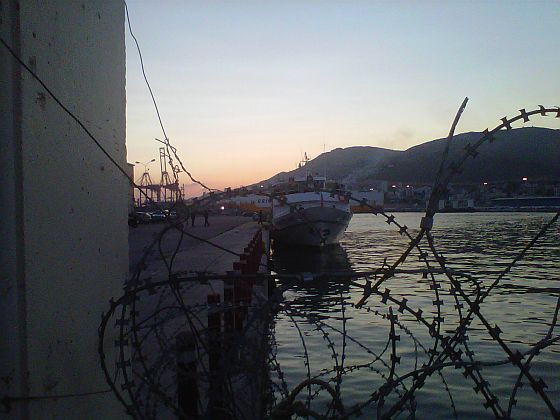
'We were forced to go back to a Greek port surrounded with bars and barbwire.' -- The Audacity of Hope

The New York Times reports:

With the propeller shafts of two ships mysteriously damaged, Greek authorities holding other vessels in port on government orders and an American boat turned back by the Greek Coast Guard just 20 minutes off the coast Friday, the international flotilla to Gaza has stalled.

Organizers say they see the long arm of Israel behind their improbable woes, and while Israeli officials have dismissed such accusations as so much conspiracy mongering, they have declined to deny them outright.

One year after Israeli commandos killed nine Turkish activists aboard the Mavi Marmara during an earlier flotilla, organizers had hoped to once again challenge the naval blockade of the Gaza Strip on the open seas, off the Gaza coast. It appears decreasingly likely, however, that the eight boats now preparing to sail will ever be able or allowed to leave port.

Echoing a majority view among participants here, Johnny Leo Johansen, a ponytailed Norwegian photographer and activist, put it this way: “It’s like they’ve moved the blockade from Gaza to Greece.”

The coast guard stopped the American boat, “The Audacity of Hope,” about one mile out to sea, quashing the initial excitement of the passengers, who were surprised to have been allowed to leave the harbor at all.

“We could see the handwriting on the wall, that they were going to try to shut down all the ports across the Mediterranean,” said Ann Wright, the lead organizer of the American boat.

After a complaint about improper documentation filed by an Israeli advocacy group, the boat had been held in port outside Athens on police orders. Inspectors visited it a week ago Friday, but the results of their inspection had yet to be provided. Without them, the ship could not legally set sail.

On Friday, the Greek Ministry of Citizen Protection decreed that all vessels in Greek ports were prohibited from sailing toward “the maritime area of Gaza.” No explanation was given, and ministry officials could not be reached for further comment.

The Americans decided to leave just the same. After chasing them down, a smiling, youthful coast guard captain leaned out his window and requested the ship’s inspection papers. Passengers leaned over the upper-deck railing of the American boat, chanting, “Let us sail to Gaza!” Others held a cardboard sign asking, “Is it Poseidon or Netanyahu?” (That is, a passenger explained, “Who is the king of the Aegean?”)

“The probability that the Greek government has already made a decision to not let us out of the port is probably quite high, I would think,” Ms. Wright said earlier this week. “It’s not surprising, in a way, that the Greek government has succumbed to the pressure.” She further suggested that Greece, in the throes of a protracted sovereign debt crisis, might be acceding to an Israeli “diplomatic offensive.”

The Israeli government, she noted, had held cabinet meetings on the subject of the flotilla, and several rounds of military exercises have been conducted in preparation for a confrontation. “I’m shocked that they would be spending so much time, money, energy,” Ms. Wright added, but in some ways, she has been pleased by the Israeli attention. “We couldn’t have dreamed for a better thing. Usually, governments don’t cooperate with us this way!”

On Thursday, Irish organizers announced they had pulled their Turkish-docked ship from the flotilla after the crew discovered damage to the propeller shaft, the result of what they assume to have been sabotage by underwater divers. Organizers said that the damage was discovered on a trial run, but that otherwise the vessel would have sunk at sea, endangering the passenger and crew.

Activists discovered nearly identical damage to a Greek-Swedish-Norwegian passenger boat earlier this week. That boat is now grounded for repairs, which are not expected to be completed before next week, organizers say.

Three boats with passengers principally hailing from Canada, Spain and the Netherlands were awaiting clearance to sail on Friday, and a cargo vessel was hoping to be permitted to load its cargo. All of the ships have ostensibly met the requirements of Greek authorities, according to Adam Shapiro, a flotilla organizer and spokesman.

But on Thursday, harbor officials barred a French boat from refueling, he said, an indication that Greek officials might find other justifications for retaining the other ships in port.

As of Friday morning, after more than a week in ports across Greece, no single ship appeared to have explicit clearance from the Greek authorities to set sail; like the American boat, a Greek-Swedish-Norwegian cargo ship was under police order to remain in port.

Organizers said the delays were not completely unanticipated, though they had hoped to meet less resistance. Should the vessels be permitted to sail, or if they depart unauthorized, organizers hope to rendezvous next week at a fixed location in the Mediterranean. But it remains unclear when more ships might set sail, or what an eventual flotilla might resemble.

“We’re going to do something,” Mr. Shapiro vowed. Still, he added, “It seems we’re already doing something, given the kind of response we’ve gotten.”

Asked about activists’ allegations that Israel was behind the apparent sabotage, Mark Regev, a spokesman for Israeli prime minister Benjamin Netanyahu, said: “These activists are not renowned for being an objective source of information.”

“These people have a tendency to blame Israel, to see Israel’s hand behind every calamity,” he went on. “And of course that cannot be true.” But when asked to deny their claims more categorically, he declined.

On Thursday, Prime Minister Netanyahu said in a speech that “sometimes, we not only need to deflect our enemies’ physical attacks, but also deflect the attack on our right to protect ourselves.” Speaking at the Israeli Air Force flight school graduation ceremony, Mr. Netanyahu thanked world leaders who in recent days had spoken out and acted “against the provocation flotilla,” and specifically commended the Greek prime minister George Papandreou, who he said has been closely cooperating with Israel in coordinating the moves related to the flotilla.

On Democracy Now! the Consul General of Israel in New York, refuses to deny Israeli role in the sabotage of flotilla boats:

Facebooktwittermail

Criminalising Palestinian solidarity

Maureen Murphy writes:

The United States government has criminalised the Palestinian people, and now it is increasingly treating US citizens who stand in solidarity with Palestine as criminals as well – including those courageously putting their lives on the line to break the siege on Gaza.

I am a Palestine solidarity activist in the US, and one of 23 US citizens who have been issued with a subpoena to appear before a federal grand jury as part of what the government has said is an investigation into violations of the laws banning material support to foreign “terrorist organisations”.

None of us have given money or weapons to any group on the State Department’s foreign terrorist organisation list. But what many of us have done is participate in or help organise educational trips to meet with Palestinians and Colombians resisting the US-funded military regimes they live under.

The goal of these trips is to learn about the human rights violations happening in these places and to bring those stories back home to the US, to educate people and to organise to change US foreign policy for the better.

Travel for such purposes should be protected by the First Amendment of the US Constitution. But a year ago the US Supreme Court decided in Holder vs. Humanitarian Law Project to dramatically expand the government’s definition of what constitutes material support for a foreign terrorist organisation.

Now the government considers travel to places like the West Bank and Colombia to be a predicate or justification for opening up an investigation and issuing search warrants to raid activists’ homes and seize their belongings. Political speech if made in a “coordinated way” can be construed as material support.

Facebooktwittermail

The blockade on Gaza began long before Hamas came to power

Mya Guarnieri writes:

The second Freedom Flotilla is slated to set sail by the end of the month in an attempt to challenge the Israeli blockade of the Gaza Strip. The act will call attention to the closure that the United Nations and human rights organizations have decried as a violation of the Fourth Geneva Convention, which prohibits the collective punishment of civilians.

According to the Israeli government — and most of the mainstream media — the blockade began in 2007, following the Hamas takeover of the Gaza Strip. The aim of this “economic warfare” was to weaken Hamas, a group that the Israeli government had once supported. Israel also sought to stop rocket fire and to free Gilad Shalit, the Israeli soldier who has been held in Gaza since 2006.

Four years on, none of these goals have been achieved.

Israel has achieved a minor victory on one front, however. Even critics use 2007 as the start-date of the blockade, unintentionally legitimizing Israel’s cause-and-effect explanation that pegs the closure to political events.

But the blockade did not begin in 2007, following the Hamas takeover of the Strip. Nor did it start in 2006, with Israel’s economic sanctions against Gaza. The hermetic closure of Gaza is the culmination of a process that began twenty years ago.

Facebooktwittermail