Toward a strategy for the new Middle East

Paul R. Pillar writes:

The wave of popular unrest in the Middle East has stimulated armchair strategists to offer over-arching advice on how the United States should deal with what may be a substantially changed region. As with any other fast-moving foreign policy challenges (or opportunities), policymakers will necessarily be focused more on what is here and now than on what is over-arching. They are properly concentrating on not making damaging mistakes this week or this month rather than sitting back and thinking deep thoughts about their rendezvous with history. Nonetheless, something of historical significance has indeed been playing out in the Middle East for these last three months and shows little sign of dying out any time soon. So some deep thinking may be useful in providing a context for dealing with the here-and-now problems that turbulence in the region has been putting on the policymakers’ agenda.

Grand strategizing on this subject needs to proceed with several cautions. One is that there is an awful lot about where the Middle East is headed in the months and years ahead that we do not and cannot know. A second caution is that although the United States can influence some of that history in the making, it cannot mold it or determine the main lines of the story. It would be hubristic to believe the United States can shape what happens in the Middle East more than it has to adapt to what happens there. A third caution is to resist the tendency to overgeneralize and oversimplify. That tendency is an almost unavoidable side-effect of the over-arching stuff. But we need to remember that despite the region-wide sweep of much of what we are witnessing (and despite the contagion effect that I admit I underestimated when unrest first broke out in Tunisia), country-to-country differences may be as significant as what characterizes the Middle East as a whole.

Amid all that can be said about what is new in the Middle East, we need to think first about what has not changed, which in many respects is as important as what has. The economic and social structures in the region are not being transformed overnight, however rapid are some of the political changes at the top and on the surface. Political culture also is not changing overnight, although it can slowly evolve in response to new distributions of power and the creation of new institutions. These aspects of the political, economic, and social fabric of the Middle East—including political habits developed in an authoritarian environment, economic structures that discourage entrepreneurship and dynamic growth, and social structures in which religious identity in particular plays a significant role—limit the possibilities or at least the pace of fundamental change, however exuberant may be the demands voiced in the street.

Facebooktwittermail

A marriage made in hell

Hossein Askari writes:

While there may be truth to the adage that “opposites attract,” a happy and long lasting relationship must be based on common values, respect and shared interests. Do America and the absolute rulers of Saudi Arabia share such a basis for a long-lasting relationship? How will Muslims judge our marriage to the Al-Sauds in the current climate of protests against autocratic rule in the Middle East and North Africa?

There is certainly little to be put in the win column when it comes to shared values.

Political Freedom: Saudi Arabia has no constitution, no representative government, no freedom of the press and no freedom of assembly. The Saudi foreign minister recently said that Saudi Arabia will “cut off any finger” raised in protest. Who are the rulers of Saudi Arabia? In 1932, Abdul-Aziz Al-Saud used his sword, deception and treachery to unite a number of warring tribes. So the Al-Saud family sees Saudi Arabia as their ranch; as one Saudi prince said, “my grandfather took it with the sword. Others could have done it. But they didn’t. It is ours.”

Religious Freedom: Churches and synagogues are banned in Saudi Arabia, only mosques are allowed; in fact, foreigners have gone to jail for holding Christmas services in their home. With about 85 percent of Saudis professing the Sunni sect, Shia Muslims are subjugated, economically deprived and treated as apostates. It is Saudi fundamentalists who have financed madrassasto spread radical Islam with a hatred for all things American. None of this bothers the Al-Sauds because the U.S. and the Vatican don’t publicize this religious discrimination for fear of ruffling Al-Saud feathers. In the face of such discrimination, it is ironic that Al-Saud kings, beginning with Fahd and now Abdullah, refer to themselves as “The Custodian of the Two Holy Mosques,” while the Koran says, “Let there be no compunction in religion.” They claim legitimacy from Islam, while the unity of humankind and social and economic justice, the core of Islamic teachings, has been supplanted by its antithesis.

Economic Equality and Freedom: Contrary to everything in the Koran and from the example of the Prophet Mohammad, the Al-Sauds are the masters and have no equals. While the oil under the ground belongs to all Saudis of this and future generations, the Al-Sauds behave as if it was theirs and theirs alone. The king and senior princes take what they want from the treasury. All major government contracts have a Saudi prince as an agent, taking commissions that are at times obscene. In the case of at least one military contract that ran into the billions, the “add-ons” over a short span of time exceeded the original contract, something that dismayed the U.S. government military attaché in Saudi Arabia. As usual when senior Al-Sauds are involved, it was hushed up by the U.S. embassy. Are the Al-Sauds the best businessmen in the world or are they simply corrupt? While the Al-Sauds wallow in unbelievable opulence, some Shia don’t have running water and around 25 percent of the youth cannot find jobs. The Al-Sauds are wasting the heritage of all Saudis. What happened to the Islamic precept that rulers should live in the same manner as the poorest in their realm?

Facebooktwittermail

Obama weighs talking to the Taliban, Hezbollah

David Ignatius writes:

In a rapidly changing Islamic world, the Obama administration is weighing how best to talk with adversaries such as the Taliban and, perhaps, Hezbollah.

One model for the administration, as it thinks about engagement of enemies, is the British process of dialogue during the 1990s with Sinn Fein, the legal political wing of the terrorist Irish Republican Army. That outreach led to breakthrough peace talks and settlement of a conflict that had been raging for more than a century.

In the case of the Taliban, the administration has repeatedly stated that it is seeking a political settlement of the war in Afghanistan rather than a military one. That formula sometimes seems hollow when more than 100,000 U.S. troops are in combat. But it got more definition last month from Secretary of State Hillary Rodham Clinton, who opened the doors wider for dialogue.

Clinton, in a Feb. 18 speech to the Asia Society, subtly altered the terms for Taliban participation in peace talks. She repeated the administration’s “red lines for reconciliation” — that Taliban representatives must renounce violence, reject al-Qaeda and abide by the Afghan constitution. But rather than making these preconditions for talks, as before, she said they were “necessary outcomes of any negotiation.”

Facebooktwittermail

The fight for Libya

Hana El-Gallal, a law professor from Benghazi, writes:

The global community must act to stop Gaddafi and his forces reaching Benghazi. If he gets here, he will kill everyone. We in Benghazi, in what is left of Free Libya, have a very simple message for the Security Council. Please, do something. We are desperate for your help and you must do it now. It is the time to act and if you don’t there will be genocide. We are called rebels, but we are not rebels. We are a people that simply wants the same freedoms and liberties enjoyed by the people in the West. For 42 years, one man and his family have denied the people of Libya their dignity.

Whenever he gets to Benghazi, he will deny us our lives too.

Days ago, a no-fly zone could have been imposed and that would have helped. It would still help, but now it may be too late. Even so, it is not too late to help to stop him reaching us.

There are soldiers here, willing to fight for us, but we have no weapons. We are walking around gathering up what we can use to defend ourselves. I am a mother, not a member of al-Qa’ida; not a mujahideen. But when Gaddafi gets to Benghazi, I will have to be a fighter, not only to defend myself and my family, but also to defend the dignity of a people who have told the tyrant that has raped our country to go.

The world needs to know this will not happen unless we get help. We are a brave people and we will fight. But we will also lose without the help of the rest of the world. And if the international community does not act, it will remain of the conscience of the people that did nothing. China, with your riches; America, with your power; Europe, with your history – you will all be guilty of standing aside and letting Gaddafi massacre his innocent people. We did not want to fight, but we were forced to, and now, in our moment of need, we are calling for the world to come together and defend us from this evil man. It has been said the Libyan people do not want foreign troops on our soil, but which country does? Now it is too late for these arguments. Libya is not Iraq: it is full of desperate people and if the international community decides to send its armies, they will be greeted with joy; a joy that will replace what is now a growing sense of hopelessness.

We pray that our brothers and sisters can hold Ajdabiya. Gaddafi says that he has taken the town, but we know that our friends are still fighting for their lives, even if we know in our hearts that they won’t be able to hold on forever without assistance. And when Ajdabiya falls, there is then nothing to stop Gaddafi and his thugs reaching us here in Benghazi. We are all so frightened of what he will do when he gets here. We are all going to die.

We are all desperately waiting for the UN, or Nato, or the EU or anyone to act. Even the Arab League has called for action – what more of an invitation do people want? It the first time that the Arab League has called for action against one of its members: we have heard the call, but God knows that we have to see the action. We all know intervening in the affairs of another state is a controversial act. The world was sick when it released that inaction led to the deaths of thousands in Rwanda; the world said “never again”. That was only 15 years ago and, without urgent action, what happened in Rwanda will be repeated on the streets of Benghazi, maybe as soon as tomorrow.

We have all heard the speeches of Gaddafi and his sons: does the international community really believe that we are al-Qa’ida and on drugs? It will know that answer soon enough when, after Gaddafi reaches Benghazi, the pictures of our murdered children are shown around the world.

The Wall Street Journal reports:

Egypt’s military has begun shipping arms over the border to Libyan rebels with Washington’s knowledge, U.S. and Libyan rebel officials said.

The shipments—mostly small arms such as assault rifles and ammunition—appear to be the first confirmed case of an outside government arming the rebel fighters. Those fighters have been losing ground for days in the face of a steady westward advance by forces loyal to Libyan leader Moammar Gadhafi.

The Egyptian shipments are the strongest indication to date that some Arab countries are heeding Western calls to take a lead in efforts to intervene on behalf of pro-democracy rebels in their fight against Mr. Gadhafi in Libya. Washington and other Western countries have long voiced frustration with Arab states’ unwillingness to help resolve crises in their own region, even as they criticized Western powers for attempting to do so.

The Independent reports:

Even as the votes to take on the Libyan regime were cast last night, the battle for Benghazi had begun. Col Gaddafi’s warplanes carried out several strikes on the city as artillery volleys started to come in from units approaching from several directions.

The skies above were lit up by constant streams of anti-aircraft fire. Rebel fighters, buoyed by reports that the vote in New York had gone for military action, began to stream towards the western gates of the city.

Even as the violence flared they believed that, at last – a month to the day after Libya’s revolution began – their only realistic hope of avoiding defeat at the hands of the regime had finally come true. But there is a fierce battle ahead. The firefights took place with the constant background sound of mosques in the city playing chants of “Allah hu Akhbar” at high decibel through loudspeakers. The chant was taken up by the rebel fighters, the Shabbab, as they traded fire. Many of the exchanges were chaotic with heavy calibre guns used at random. Flames appeared in parts of the city with black smoke blending into the night sky.

Down below, however, Benghazi was a bright target for the warplanes. No attempt had been made to dim the lights in any of the public buildings in the centre and residential areas also lit up as people came out to windows and balconies to watch the action with some women ululating. The mood of the rebel fighters, who had suffered repeated defeats in recent weeks and had been forced to withdraw from town after town was buoyant. As he manned his anti-aircraft gun, Selim Astersi shouted: “The devil Gaddafi wants to come into Benghazi, we shall throw him back. Tonight we shall prove ourselves. We shall avenge all those he killed.”

Khalid Ibrahimi stopped his truck, carrying five fighters in the back, to ask: “Is it true that they have voted [at the UN] yes ? That is what we needed my brothers, we have got help at last.” At just after 1am local time, two explosions echoed through the waterfront followed by machine-gun fire. Shabaab fighters claimed infiltrators had come into the city but it seemed more likely that some ammunition had detonated.

Facebooktwittermail

Intifada update

Opposition leaders arrested in Bahrain as crackdown grows
Bahrain arrested six opposition leaders on Thursday, kept the main hospital surrounded by troops and tanks and imposed a nighttime curfew on the center of its capital as it moved to the next stage of its crackdown on reform-seeking protesters, sending the political opposition into crisis.

A day after troops drove demonstrators from the main square and destroyed a month-old tent city there, popular unrest had been reduced to a few minor skirmishes in villages known as opposition strongholds.

There was much defiant talk of keeping the struggle going, but also deep distress.

“We feel cornered and are trying to find our way out,” said Jalal Fairooz, a leader of the Wefaq opposition party in an interview at party headquarters.

A group of Bahraini human rights groups appealed to the United Nations for help. (New York Times)

Bahrain pulls a Qaddafi
It is heartbreaking to see a renegade country like Libya shoot pro-democracy protesters. But it’s even more wrenching to watch America’s ally, Bahrain, pull a Qaddafi and use American tanks, guns and tear gas as well as foreign mercenaries to crush a pro-democracy movement — as we stay mostly silent.

In Bahrain in recent weeks, I’ve seen corpses of protesters who were shot at close range, seen a teenage girl writhing in pain after being clubbed, seen ambulance workers beaten for trying to rescue protesters — and in the last few days it has gotten much worse. Saudi Arabia, in a slap at American efforts to defuse the crisis, dispatched troops to Bahrain to help crush the protesters. The result is five more deaths, by the count of The Associated Press.

One video from Bahrain appears to show security forces shooting an unarmed middle-aged man in the chest with a tear gas canister at a range of a few feet. The man collapses and struggles to get up. And then they shoot him with a canister in the head. Amazingly, he survived.

Today the United States is in a vise — caught between our allies and our values. And the problem with our pal Bahrain is not just that it is shooting protesters but also that it is something like an apartheid state. Sunni Muslims rule the country, and now they are systematically trying to crush an overwhelmingly Shiite protest movement. (Nicholas Kristof)

Brotherhood sticks to ban on Christians and women for presidency
A leading figure in the Muslim Brotherhood (MB), Egypt’s largest opposition group, said on Monday that the MB’s new “Freedom and Justice Party” would continue to stick by its view that Christians and women are unsuitable for the presidency.

Saad al-Husseini, a member of MB’s Guidance Bureau, the highest executive authority within the group, said the new party program will be announced late March after it is approved by the MB’s Guidance Office and Shura Council. Al-Husseini said that although they stick by this view, they “respect all opinions”.

“Our adherence to the jurisprudential opinion refusing the appointment of women or Christians as president does not mean we impose this opinion on the people, who have inherent jurisdiction in this regard,” he said.

“I personally accept for Copts to be appointed in hundreds of positions, including sensitive leadership positions in the country in accordance with the criterion of efficiency and competence, regardless of their proportion in society.”

Meanwhile, MB spokesman Mohamed Morsi said the group is pushing for a civil state, without the tutelage of the clergy. Morsi said the group does not call for a religious state. (almasryalyoum)

Facebooktwittermail

US spy operation that manipulates social media

The Guardian reports:

The US military is developing software that will let it secretly manipulate social media sites such as Facebook and Twitter by using fake online personas to influence internet conversations and spread pro-American propaganda.

A Californian corporation has been awarded a contract with United States Central Command (Centcom), which oversees US armed operations in the Middle East and Central Asia, to develop what is described as an “online persona management service” that will allow one US serviceman or woman to control up to 10 separate identities based all over the world.

The project has been likened by web experts to China’s attempts to control and restrict free speech on the internet. Critics are likely to complain that it will allow the US military to create a false consensus in online conversations, crowd out unwelcome opinions and smother commentaries or reports that do not correspond with its own objectives.

The discovery that the US military is developing false online personalities – known to users of social media as “sock puppets” – could also encourage other governments, private companies and non-government organisations to do the same.

The Centcom contract stipulates that each fake online persona must have a convincing background, history and supporting details, and that up to 50 US-based controllers should be able to operate false identities from their workstations “without fear of being discovered by sophisticated adversaries”.

Facebooktwittermail

Bradley Manning’s military doctors accused over treatment

The Guardian reports:

A leading group of doctors in the US concerned with the ethical treatment of patients has questioned the role of military psychiatrists in Quantico, Virginia, where the suspected WikiLeaks source Bradley Manning is being subjected to harsh treatment that some call torture.

The advocacy body Physicians for Human Rights has sounded the alarm over the role of psychiatrists at the brig in the marine base where Manning has been in custody since last July.

The group sees the psychiatrists as trapped in a situation of “dual loyalty”, where their obligations to the military chain of command may conflict with their medical duty to protect their patient.

Christy Fujio, author of a forthcoming report on the issue, said the main concern was that psychiatrists were allowing Manning’s continuing solitary confinement.

“Even if they do not officially approve it, by continuing to examine him and report back to the government on his condition, they are effectively taking part in security operations. Their failure to call it what it is, cruel and inhumane treatment, constitutes a violation of their ethical duties as doctors.”

Facebooktwittermail

UN Resolution 1973/2011 adopted

UN Security Council Resolution 1973/2011 on Libya – full text

10 in favour, zero against, five abstentions.

Voting for the resolution:
Permanent members: United States, Britain, France
Non-permanent members:: Bosnia and Herzegovina, Colombia, Gabon, Lebanon, Nigeria, Portugal, South Africa

Abstentions:
Permanent members: Russia, China
Non-permanent members: Germany, Brazil, India

The Resolution authorizes member states “to take all necessary measures… to protect civilians and civilian populated areas under threat of attack in the Libyan Arab Jamhariya, including Benghazi, while excluding an occupation force.”

Simon Tisdall writes:

With a boldness that the world had begun to believe he lacked, Barack Obama has gone for broke. The US wants Muammar Gaddafi’s head. It will not rest until he is deposed and there is regime change in Libya. And it will fight to get it.

Obama spent weeks pondering, prevaricating and posturing, infuriating Britain and France, arch advocates of military intervention. He used public appearances to prate professorially about plans, contingencies and downsides. He allowed senior administration officials such as Pentagon chief Robert Gates to give full vent to their doubts and misgivings about a possible Libyan quagmire.

Obama is already fighting two wars in Muslim countries he did not start – in Iraq, now all but finished, and Afghanistan. He did not want to author another. He did not want another foreign distraction ahead of his presidential re-election bid next year. He did not want the cost, the corpses or the inevitable collateral damage – political and human.

But gradually the pressure from hawkish Democrats such as John Kerry and Republicans such as John McCain began to tell. The escalating rhetoric from Downing Street and the Elysee Palace will have had an impact, too.

Obama finally made his mind up. The US would intervene to stop him. And there would be no half measures. All steps short of boots on the ground, as the US under-secretary of state William Burns put it are now urgently contemplated, with a view to immediate implementation.

That means possible, imminent air strikes as well as an air exclusion zone. It means direct head-on combat with Libya’s air force, if it chooses to fight. It means, potentially, western casualties, if pilots are shot down or bail out or are taken hostage. It could mean innocent civilian deaths as the EU’s foreign policy chief Lady Ashton warned last week. And if things do not go well, it may mean escalation beyond all that is envisaged now. Who knows when it will stop.

The immediate impact may be to stop Gaddafi’s advance on Benghazi in its tracks. If that happens, the revolution will have been salvaged, albeit at the very last moment. Whether it can endure is another matter entirely.

The US and its European and Arab allies will hope that Gaddafi, facing the prospect of overwhelming, punitive force, will quickly back down, observe the UN demand for a ceasefire, even agree to negotiations. But to be sure of saving Benghazi, a no-fly zone will not be enough. To drive home the point the game is up, it is likely allied air strikes on Gaddafi’s heavy armour and artillery will be required, and possibly also attacks directed at him personally, as Ronald Reagan tried in 1986.

Gaddafi acts like a bully and a coward. But he is full of bluster. Only a sudden, bloody nose will convince him to desist. This is he is probably about to receive. And the betting must be that, once the revised odds become clear, those remnants of the Libyan army and security forces that have so far remained loyal will desert him, too.

The longer term impact of the intervention is immeasurable – but disaster is certainly one possible outcome. Like the first Gulf war, the involvement and support of Arab countries means the Libyan war will not be defined, except by hardline jihadis and al-Qaida, as another western assault on Muslim lands. But if the fighting is prolonged, if Gaddafi does not quit and run, if his more able sons take up his cause, if the intervention makes things worse not better for ordinary people (as in Iraq), if there is no clear-cut win but ongoing low level conflict and resistance (as in Afghanistan), then Arab opinion will turn against the westerners once more. The post-9/11 nightmare of the Pentagon’s long war without end will reproduce on the shores of the Mediterranean.

But there is a reasonable prospect of success, too. If the rebels, rescued from annihilation, prove capable of creating a government able to take over the running of all of Libya, and not just the rebellious east, then Obama’s gamble could pay off.

If Gaddafi, no longer able to deploy superior firepower and mercenaries, is overthrown by his own people, it will be hailed as an improbable triumph for, among others, David Cameron, who took a harder line than most, earlier than most. Britain (and not Germany, which opposed intervention) may profit from the gratitude of a grateful people. If Libya falls to democracy, then like-minded reformers in Bahrain and elsewhere will be greatly heartened.

Obama and Cameron are looking for another Kosovo or Kuwait, not another Iraq. It’s a story, as they would prefer to write it, with a happy ending, producing a newly independent country, and another friend for the west. But they cannot control the outcome. Now they can only wait and hope they were right.

The New York Times reports:

In the most strident verbal attack on Colonel Qaddafi to date by an American official, Secretary of State Hillary Rodham Clinton said Thursday that the Western powers had little choice but to provide critical military backing for the rebels. “We want to support the opposition who are standing against the dictator,” she told an applauding audience in Tunisia on Thursday. “This is a man who has no conscience and will threaten anyone in his way.”

She added that Colonel Qaddafi would do “terrible things” to Libya and its neighbors. “It’s just in his nature. There are some creatures that are like that.”

The Qaddafi government responded to the potential United Nations action with threats.

“Any foreign military act against Libya will expose all air and maritime traffic in the Mediterranean Sea to danger and civilian and military facilities will become targets of Libya’s counter-attack,” it said in a statement carried on Libyan television and the official news agency, JANA, Reuters reported. “The Mediterranean basin will face danger not just in the short-term, but also in the long-term.”

There were reports on Thursday that warplanes were already bombarding the outskirts of Benghazi for a second day, opening shots, perhaps, in the battle. And after days of batterings at the hands of Qaddafi loyalists, the opposition forces welcomed the promise of Western assistance.

Rebel leaders doubted that the loyalist forces could mount an assault on Benghazi tonight, in that they were still contesting Ajdabiya, 100 miles to the south, on Thursday morning. But witnesses said there were skirmishes on the road to Benghazi in the afternoon, about 30 miles from Ajdabiya.

Mohamed, a rebel spokesman in the embattled, rebel held city of Misurata — the last major rebel foothold in the west — welcomed the new American tone. “We are very heartened yesterday by the moves in the United Nations Security Council and the urgency of the American stand,” he said, speaking over a satellite phone.

Facebooktwittermail

Obama’s indecision on Libya has pushed Clinton over the edge

The Daily reports:

Fed up with a president “who can’t make his mind up” as Libyan rebels are on the brink of defeat, Secretary of State Hillary Clinton is looking to the exits.

At the tail end of her mission to bolster the Libyan opposition, which has suffered days of losses to Col. Moammar Gadhafi’s forces, Clinton announced that she’s done with Obama after 2012 — even if he wins again.

“Obviously, she’s not happy with dealing with a president who can’t decide if today is Tuesday or Wednesday, who can’t make his mind up,” a Clinton insider told The Daily. “She’s exhausted, tired.”

He went on, “If you take a look at what’s on her plate as compared with what’s on the plates of previous Secretaries of State — there’s more going on now at this particular moment, and it’s like playing sports with a bunch of amateurs. And she doesn’t have any power. She’s trying to do what she can to keep things from imploding.”

Clinton is said to be especially peeved with the president’s waffling over how to encourage the kinds of Arab uprisings that have recently toppled regimes in Egypt and Tunisia, and in particular his refusal to back a no-fly zone over Libya.

In the past week, former President Bill Clinton and Hillary Clinton’s former top adviser Anne-Marie Slaughter lashed out at Obama for the same reason.

The tension has even spilled over into her dealings with European diplomats, with whom she met early this week.

When French president Nicolas Sarkozy urged her to press the White House to take more aggressive action in Libya, Clinton repeatedly replied only, “There are difficulties,” according to Foreign Policy magazine.

“Frankly we are just completely puzzled,” one of the diplomats told Foreign Policy magazine. “We are wondering if this is a priority for the United States.”

Or as the insider described Obama’s foreign policy shop: “It’s amateur night.”

Facebooktwittermail

International alliance forming to stop Gaddafi

Libya’s Deputy Permanent UN Representative warns that a convoy of 400 military vehicles are headed to destroy Ajdabiya and that the UN must intervene in the coming hours.

The New York Times reports:

The prospect of a deadly siege of the rebel stronghold in Benghazi, Libya, has produced a striking shift in tone from the Obama administration, which is now pushing for the United Nations to authorize aerial bombing of Libyan tanks and heavy artillery to try to halt the advance of forces loyal to Col. Muammar el-Qaddafi.

The administration, which remains deeply reluctant to be drawn into an armed conflict in yet another Muslim country, is nevertheless backing a resolution in the Security Council that would give countries a broad range of options for aiding the Libyan rebels, including military steps that go well beyond a no-flight zone.

Administration officials — who have been debating a no-flight zone for weeks — concluded that such a step now would be “too little, too late” for rebels who have been pushed back to Benghazi. That suggests more aggressive measures, which some military analysts have called a no-drive zone, to prevent Colonel Qaddafi from moving tanks and artillery into Benghazi.

The United States is insisting that any military action would have to be carried out by an international coalition, including Libya’s Arab neighbors.

The rapid advance of forces loyal to Colonel Qaddafi, combined with rising calls from the Arab world to prevent a rout of the opposition, has changed the calculations of the administration, which had clung to a belief that interfering in a Middle East uprising could provoke an anti-American backlash.

“The turning point was really the Arab League statement on Saturday,” Secretary of State Hillary Rodham Clinton said Wednesday to reporters traveling with her in Cairo. “That was an extraordinary statement in which the Arab League asked for Security Council action against one of its own members.”

Mrs. Clinton said she was hopeful that the Security Council would vote no later than Thursday. The American ambassador to the United Nations, Susan E. Rice, is in intensive negotiations over the language of a resolution, sponsored by Lebanon, another Arab state, and backed by France and Britain.

This about-turn in the Obama administration’s position is being viewed with a measure of skepticism in some quarters. “Privately, some European officials expressed frustration with the Obama administration, with one saying he believed it was supporting strong measures in an attempt to draw a veto.”

What is particularly noteworthy is that the resolution is sponsored by Lebanon. Even while the country is still in the process of forming a new government, this UN initiative can most likely be attributed to Hezbollah, now the dominant political force in Lebanon.

Soon after the Feb 17 Revolution began, Hezbollah issued a strong condemnation of Gaddafi. On Feb 22, the Ahlul Bayt News Agency reported:

Hezbollah lashed out Monday at the “crimes committed by the Gaddafi regime” in Libya:
“Anyone with honor and consciousness in this world cannot, and should not, keep silent on the massacres that the Gaddafi regime is committing across the country on a daily basis, namely in Benghazi.

Terror and violence do not protect a regime that was founded on corruption and crime, from the will and determination of a people that has taken its decisive decision,” a Hezbollah statement read.

“Hezbollah firmly condemns crimes committed by the Gaddafi regime against the oppressed Libyan people. We also offer our sincere condolences to the families of those who were unjustly killed, just for demanding their rights. Hezbollah expresses support to the revolutionists in Libya and we pray that they will triumph over this arrogant tyrant,” the statement added.

“The criminality of this tyrant had first struck us deeply as Lebanese, when he kidnapped the Imam of the resistance Sayyed Moussa Sadr with his two dear companions. We ask Almighty Allah that the honorable revolutionists in Libya would be able to liberate Imam Sadr and his companions, just as they would be able to free Libya from all of its chains,” the statement concluded.

Facebooktwittermail

We in the Middle East have replaced humiliation with dignity

Turkey’s foreign minister, Ahmet Davutoglu, writes:

The wave of revolutions in the Arab world was spontaneous. But it also had to happen. They were necessary in order to restore the natural flow of history. In our region – west Asia and the south Mediterranean – there were two abnormalities in the last century: first, colonialism in the 1930s, 40s and 50s that divided the region into colonial entities, and severed the natural links between peoples and communities. For example, Syria was a French colony and Iraq a British one, so the historical and economic links between Damascus and Baghdad were cut.

The second abnormality was the cold war, which added a further division: countries that had lived together for centuries became enemies, like Turkey and Syria. We were in Nato; Syria was pro-Soviet. Our border became not a border between two nation states, but the border between two blocs. Yemen was likewise divided.

Now it is time to naturalise the flow of history. I see all these revolutions as a delayed process that should have happened in the late 80s and 90s as in eastern Europe. It did not because some argued that Arab societies didn’t deserve democracy, and needed authoritarian regimes to preserve the status quo and prevent Islamist radicalism. Some countries and leaders who were proud of their own democracy, insisted that democracy in the Middle East would threaten security in our region.

Now we are saying all together: no. An ordinary Turk, an ordinary Arab, an ordinary Tunisian can change history. We believe that democracy is good, and that our people deserve it. This is a natural flow of history. Everybody must respect this will of the people.

If we fail to understand that there is a need to reconnect societies, communities, tribes and ethnicities in our region, we will lose the momentum of history. Our future is our sense of common destiny. All of us in the region have a common destiny. [Continue reading…]

Facebooktwittermail

Bahrain regime promoting sectarian division

Marc Lynch writes:

While the American and international debate over Libya continues, the situation in Bahrain has just taken a sharp turn for the worse. A brutal crackdown on the protestors followed the controversial entry of security forces from Saudi Arabia and three other GCC states. Media access has been curtailed, with journalists finding it difficult to gain entry to the Kingdom (I was supposed to be in Bahrain right now myself, but elected not to try after several journalists let me know that they were being denied entry and several Embassies in Doha warned me off). The road to political compromise and meaningful reform now appears to be blocked, which places the long-term viability of the Bahraini regime in serious question.

The response of the Bahraini regime has implications far beyond the borders of the tiny island Kingdom — not only because along with Libya it has turned the hopeful Arab uprisings into something uglier, but because it is unleashing a regionwide resurgence of sectarian Sunni-Shi’a animosity. Regional actors have enthusiastically bought in to the sectarian framing, with Saudi Arabia fanning the flames of sectarian hostility in defense of the Bahraini regime and leading Shia figures rising to the defense of the protestors. The tenor of Sunni-Shi’a relations across the region is suddenly worse than at any time since the frightening days following the spread of the viral video of Sadrists celebrating the execution of Saddam Hussein.

The sectarian framing in Bahrain is a deliberate regime strategy, not an obvious “reality.” The Bahraini protest movement, which emerged out of years of online and offline activism and campaigns, explicitly rejected sectarianism and sought to emphasize instead calls for democratic reform and national unity. While a majority of the protestors were Shi’a, like the population of the Kingdom itself, they insisted firmly that they represented the discontent of both Sunnis and Shi’ites, and framed the events as part of the Arab uprisings seen from Tunisia to Libya. Their slogans were about democracy and human rights, not Shi’a particularism, and there is virtually no evidence to support the oft-repeated claim that their efforts were inspired or led by Iran.

Mohammed Ayoob writes:

The real reason for the establishment of the GCC in 1981 was not defense against external enemies threatening the security of GCC states but cooperation against domestic challenges to authoritarian regimes. Its main task was and continues to be coordination of internal security measures, including sharing of intelligence, aimed at controlling and suppressing the populations of member states in order to provide security to the autocratic monarchies of the Persian Gulf. The establishment of the GCC was in large measure a reaction on the part of the Gulf monarchies to the Iranian revolution of 1979 in which people’s power toppled the strongest autocracy in the neighborhood. The Arab autocracies of the Gulf did not want to share the Shah’s fate.

That ensuring the security of autocratic regimes was the principal reason for the existence of GCC has become crystal clear with the military intervention by Saudi-led forces in Bahrain to put down the democracy movement and prevent the freedom contagion from spreading to other parts of the Gulf. It is true that the Saudis are apprehensive of the Shia majority coming to power in Bahrain because of the impact it could have on its own restive Shia minority in the oil-rich east of the country. Riyadh is also worried about the impact of a change in regime in Bahrain on the balance of power between Saudi Arabia and Iran in the region. (One can, however, argue that Saudi military intervention in Bahrain’s affairs will in fact redound to Iran’s benefit in the long run by further de-legitimizing the al-Khalifa rule in Bahrain).

But these are secondary explanations. The primary concern of the Arab autocracies in the Gulf is the suppression of democratic movements regardless of the sectarian character of the populations engaging in democratic struggles. They are worried that if any of the autocracies fall or even reach a substantial compromise with democratic movements it will have a domino effect in the entire Gulf region consigning all of them to the dustbin of history. The GCC was established as an instrument to protect and prolong autocratic rule on the Arabian littoral of the Gulf. Its military operation in Bahrain has clearly shown this true colors.

Facebooktwittermail

Egypt’s army cracks down

Rania Abouzeid reports:

The bare-chested 20-year-old Egyptian turns slowly to reveal a broad back that resembles a work of sadistic abstract art — a bloody, bruised composition of pink, red and purple. Long, deep gashes had been sliced through his skin; welts, pinker and more superficial, crisscross his body. His upper left arm is a mix of purples, a cufflike bruise that wraps all the way around his bicep. His right hand is bandaged, one of his fingers sprained. He runs his good hand over his closely shorn hair. His wavy locks, he says, were shaved off with glass shards by the same people who beat him.

On Wednesday, March 9, Khalid, who does not want his last name published, went down to Cairo’s Tahrir Square, concerned about reports that thugs were attacking protesters in the iconic site where he had previously joined hundreds of thousands of his compatriots in the protests that brought down President Hosni Mubarak. He wanted to check on several friends among the hundreds of activists still camped out in the square to press the military government to meet the revolution’s demands.

That afternoon, without warning, soldiers surged into the square behind what several witnesses said were lines of plainclothes thugs armed with metal pipes, electric cables and long, thick wooden rods. The uniformed and nonuniformed men reportedly worked in tandem, just like in Mubarak’s days, rounding up hundreds of young men and women in an attack that lasted several hours, according to multiple accounts.

ABC News reports:

A coalition of six youth groups that emerged from Egypt’s revolution last month has refused to meet with Secretary of State Hillary Clinton, who arrived in Cairo earlier today, in protest of the United States’ strong support for former Egyptian President Hosni Mubarak who was ousted by the uprising.

“There was an invitation for members of the coalition to meet Secretary of State Hillary Clinton but based on her negative position from the beginning of the revolution and the position of the US administration in the Middle East, we reject this invitation,” the January 25 Revolution Youth Coalition said in a statement posted on its Facebook page.

A spokesman for Clinton had no immediate response to the snub. Another State Department official, who would not speak for attribution, confirmed such a meeting had been slated for Tuesday and noted that she still plans to meet with members of civil society and transitional government officials during her visit, during which she will urge Egyptians to continue on the path towards democracy.

Facebooktwittermail

CIA killer gets “pardoned” in exchange for $2 million blood money

In order to make sure Hillary Clinton can enjoy cordial exchanges with her counterparts in Pakistan during her upcoming visit, CIA contractor Raymond Davis just got “pardoned” by the families of the men he killed in late January.

Dawn reports:

The US government did not pay any compensation to the families of two Pakistanis killed by Raymond Davis, US Secretary of State Hillary Clinton said on Wednesday.

She said the US did not pay to win Davis’s release, but she didn’t dispute that the men’s families were compensated.

The News reports:

The families of the murdered men, Fahim and Faizan, accepted the blood money of 2.34 million dollars (equal to Rs200 million) while, according to sources, four US visas were also part of the deal.
[…]
The counsel of the bereaved families, Manzoor Butt alleged that the families of Faizan and Fahim were forcibly brought from their homes to the court.

Lawyers for the families said they had been held on gun-point for four hours at the jail court where Davis was being tried on Wednesday, but had not been allowed to witness proceedings. They were also warned against uttering a word before the media, sources said.

Facebooktwittermail

How the West empowered Gaddafi and undermined the Arab democratic revolution

“I am very worried about #Libya. I do not want #Gaddafi to win this, and the complicity of the international community is allowing him to.” @Sandmonkey (Mahmoud Salem), Cairo, March 16.

“The fierce urgency of now” is a concept that Obama abandoned the day he got elected. The Decider got replaced with The Deliberator.

For this president, no decision has ever been so urgent that it couldn’t be mulled over for weeks or months. Meanwhile, what for Obama was empty campaign rhetoric, has for Muammer Gaddafi become his means of survival. As the US and Europe have dawdled and deliberated, the Libyan uprising has effectively been crushed.

The New York Times now reports:

With the advances made by loyalists, there is growing consensus in the Obama administration that imposing a no-flight zone over Libya would no longer make much of a difference, a senior official said. Just moving the ships and planes into place to impose an effective no-flight zone, the official said, would take until April, too late to help rebels hunkered down in Benghazi. While administration officials said the United States would not obstruct efforts by other countries to build support for a no-flight zone in the United Nations, President Obama met with his National Security Council on Tuesday to consider a variety of other options to respond to the deteriorating situation. Among those options are jamming Libyan government radio signals and financing the rebel forces with $32 billion in Libyan government and Qaddafi family funds frozen by the United States. That money could be used either for weapons or relief. The meeting broke without a decision, the official said.

“This is another indication of the constant exploration of different options that we have to increase the pressure on the Qaddafi regime as we go forward,” the White House press secretary, Jay Carney, said Tuesday.

But in fact, the administration’s options have narrowed with the dwindling viability of a no-flight zone. The White House is considering more aggressive airstrikes, which would make targets of Colonel Qaddafi’s tanks and heavy artillery — an option sometimes referred to as a “no-drive zone.” The United States or its allies could also send military personnel to advise and train the rebels, an official said.

But given the lack of consensus behind a no-flight zone, these options are viewed as even less likely.

Simon Tisdall writes:

Disagreement between European countries over Libya has moved from the merely embarrassing to the wholly humiliating, after Germany again blocked Anglo-French no-fly zone proposals at a G8 meeting in Paris. The EU’s Libya debacle is now the foreign policy equivalent of last year’s eurozone meltdown, and similarly damaging to its global credibility and influence. Once again, Europe is being forced to confront an unpalatable truth: unless the US takes the lead, nothing gets done. Europe has not been entirely passive in the face of Muammar Gaddafi’s accelerating counter-attack on rebel forces. The EU has imposed sanctions, frozen the assets of leading figures and backed an arms embargo. It has also loudly proclaimed that Gaddafi must go. But these measures have made no appreciable difference on the ground.

On the question of military intervention, there are almost as many opinions as there are EU members. Britain and France are the most outspoken advocates of a no-fly zone. Germany has been the most vocal opponent. Italy – Libya’s former colonial power – havers and trims like a Berlusconi defence lawyer. Last week’s EU summit refused to back a no-fly zone. So did Nato. Today’s G8 communique does not even mention it.

Alain Juppé, France’s foreign minister, suggested Europe had left it too late to stop Gaddafi winning. “If we had used military force last week to neutralise some airstrips and the several dozen planes that they have, perhaps the reversal taking place to the detriment of the opposition wouldn’t have happened,” Juppé told Europe-1 radio. “But that’s the past. What is happening today shows us that we may have let slip by a chance.”

With outright victory now close at hand, Saif al-Islam Gaddafi, in an interview on Euronews, said that a UN decision on a no-fly zone would be of no consequence: “Military operations are over. Within 48 hours everything will be finished. Our forces are almost in Benghazi. Whatever the decision, it will be too late.”

Since France was the first country to recognize the Transitional National Council in Benghazi, he was asked his opinion of the French president, Nicolas Sarkozy:

Sarkozy must first give back the money he took from Libya to finance his electoral campaign. We funded it and we have all the details and are ready to reveal everything. The first thing we want this clown to do is to give the money back to the Libyan people. He was given assistance so that he could help them. But he’s disappointed us: give us back our money. We have all the bank details and documents for the transfer operations and we will make everything public soon.

Al Jazeera reports:

Members of the European Parliament have blasted the European Union for a weak response to the crisis.

Guy Verhofstadt, a former Belgian prime minister, said, to repeated rounds of applause: “This makes me sick!”

In Libya we can change the course of events. There are thousands of heroes. We know who they are but Gaddafi knows as well. He knows their names and their families. If he takes Benghazi it will be nothing more than a massacre, a new Srbrenica, a new Rwanda, a new Darfur.

This makes me sick of the EU. We have learnt nothing at all of history. When Gaddafi is back shall we say business as usual? Are we going to close our eyes again? Will we add one black page more to European history?

Rebecca Harms, a German MEP, said the EU was “refusing to line up on the right side, on the side of the just, and the Arab world will not forget or pardon this weakness from Europe”.

One piece of commentary effectively sums up the Obama administration’s role in what is becoming a disaster for the people of Libya:

New administrations anticipate foreign policy as if it will be baseball or football—a complicated team sport, bound by rules, at which they will succeed by dint of individual skill, clever plays and their all-knowing coach. They suit up, only to discover that their sport will be rafting on a uncharted river in full flood, filled with rocks and whirlpools, through which the frantic crew paddles in opposite directions.

Thus too the Obama administration. It came into office planning resets, nuclear zeroes and Israeli-Palestinian peace. It finds itself instead coping with a vast revolution of politics, society and thought in the Arab world—unforeseen and unforeseeable, fraught with opportunity and danger.

For the moment, the administration has survived several rapids—ditching Egypt’s President Hosni Mubarak in some confusion and with embarrassing but not indecent haste; nudging the ruler of Bahrain into reform without quite pitching him overboard; and, thus far, avoiding a complete capsizing of the boat in Yemen.

But with regard to Libya it has made mistakes that could haunt this country for years to come. The administration prides itself on the president’s unhurried deliberation, his reluctance to act before considering all the angles, his strategic silences and extended consultations. But steer a raft on a wild river that way, and you end up in the water.

From the outset there were three possible outcomes in Libya: Moammar Gadhafi could go quickly, he could go slowly, or he could stay. The best chance of helping him go quickly would have been an unambiguous declaration of intent to see him off, and the willingness to lead a military effort—most likely a no-fly zone—to help Libyan rebels overthrow his regime.

There was momentum a few weeks ago as one town after another fell to enemies of the regime. A stream of defections, betrayals and surrenders seemed to spell Gadhafi’s doom. The time to intervene is when a small push can have the greatest psychological effect, even if military planners would prefer to do it only after orchestrating a three-week air-defense suppression campaign.

Instead of seizing the opportunity, the administration made cumulative mistakes. It was slow in insisting that Gadhafi had to go—but is now committed to that end, exposing itself to humiliation if he does not. It allowed the Pentagon to publicly disparage military measures, reassuring Gadhafi and dispiriting the rebels, when a discreet and menacing silence would have done far less harm. It called for an international effort when the lesson of decades is that NATO and the United Nations find it impossible to act without American leadership. And when the French government showed strategic initiative and pluck, it undercut a major ally.

The moment has passed. The only question now is whether Gadhafi goes slowly, over months, or not at all. Senior American intelligence officials inconveniently observed the other day in front of Congress that the latter seems the likely outcome. What will happen if they are right?

The administration will have put itself in the position of willing the ends, but not the means—a humiliating position for a great power. Gadhafi will need to recover access to European resources to rebuild his oil industry and regain access to his country’s plundered wealth. He can do that in any of a number of ways. He could threaten to open up the spigot of massive African emigration through Libya, to resume work on weapons of mass destruction, or to sponsor terror—all of which he has done in the past. A divided Europe, which includes a timorous Germany and an Italy preoccupied with the prime minister’s bunga bunga parties, will yield.

The administration is teaching dictators, and the populations they oppress, that you can get away with large-scale mayhem if you avoid YouTube. Instead, let the hard men do their work with assault rifles in alleys and soldering irons in lonely cellars. The thuggish leaders will be emboldened, the populations either despairing or desperate. If one hopes to aid the Arab awakening in the direction of more open and just societies, rather than to empower Islamist terror, this policy is perverse. And, finally, the U. S. has provided cover and reassurance for other unsavory actors—a deafening silence, for example, as Iran arrests leaders of the opposition.

This is a disaster for the people of Libya. It is a moral and political calamity for a generation of Western leaders whose reactions to Rwanda and Srebrenica consisted of ineffectual squeaks of dismay. It may deflect the Arab awakening into directions that will horrify us. And it says dangerous things about American foreign policy. Unless it is reversed, the administration’s Libya policy will convince the world that the U.S. is a feeble friend and an ineffectual foe, paralyzed by its own ambivalence.

That this analysis would come from, Elliot Cohen — a neoconservative proponent of military intervention — is hardly surprising. But to those who have warned about the dire implications of Western involvement in a no-fly zone, I would simply ask: who has been well-served by the West’s non-involvement in what will soon be declared a failed revolution?

Facebooktwittermail

Libyan uprising close to collapse as Gaddafi’s troops near Benghazi

The Guardian reports:

Muammar Gaddafi’s effort to defeat the rebels before international support can come seems to be paying off, with the uprising close to collapse as the US ended weeks of stalling to join Britain and France in supporting a United Nations resolution to impose a no-fly zone over Libya.

A vote is expected this week, but is likely to come too late to support the rebellion. Gaddafi’s troops, backed by air power, moved into the town of Ajdabiya, clearing the way to the rebel stronghold of Benghazi, 90 miles away. Residents of the city were fleeing towards the border with Egypt.

Washington is facing accusations, particularly from the rebels, that delay had given the Libyan leader the space he needed. “They have betrayed us,” Ahmed Malen, one of the revolutionary volunteers pasting anti-Gaddafi posters on walls in Benghazi. “If they kill us all, the west will have blood on its hands. They do not believe in freedom. They are cowards.”

President Barack Obama will face criticism from Democrats as well as Republicans if the rebellion collapses.

France’s foreign minister, Alain Juppé, admitted that a no-fly zone might now be too late. “If we had used military force last week to neutralise some airstrips and the several dozen planes that they have, perhaps the reversal taking place to the detriment of the opposition wouldn’t have happened,” Juppé told Europe-1 radio.

The Obama administration, already fighting two wars, was reluctant to join a third and challenged the value of a no-fly zone. But, after the Arab League countries met and agreed a request on Saturday for a no-fly zone, the US along with Britain, France and Lebanon supported a draft UN resolution to be presented to the UN security council.

Although victory by Gaddafi would make a no-fly zone redundant, the draft resolution also includes measures that would remain in some degree relevant, mainly expanding sanctions, such as stricter enforcement of the arms embargo, freezing the assets of more members of the Gaddafi regime and extending a travel ban, and ordering countries to stop mercenaries flying from their airports to Libya.

A security council source, noting Gaddafi’s advances, said: “Time is of the essence.” But he acknowledged that the security council was slow moving and that while a vote could be held this week, it could spill over into next week. “The negotiations will be tough,” he added.

France’s UN ambassador, Gerard Araud, told reporters: “We are deeply distressed by the fact that things are worsening on the ground, that the Gaddafi forces are moving forward and the council has not yet reacted.”

The US shift comes after securing a promise that Arab countries would contribute forces to policing the no-fly zone. Countries such as Saudi Arabia, the United Arab Emirates and Jordan would be asked to provide planes. Washington is worried that a purely western force would be counter-productive, alienating Arab opinion and damaging the changes elsewhere in the Arab world.

But the rate of advance by Gaddafi may make a no-fly zone academic. The street-by-street fighting promised by rebel’s military leader, Abdel Fattah Younis, failed to materialise. Younis was Gaddafi’s interior minister until recently and now has a $4m (£2.48m) bounty on his head.

In an interview with the Italian newspaper Il Giornale, he derided international discussionof a no-fly zone. The Libyan leader told the rebels: “There are only two possibilities: surrender or run away.”

Gaddafi’s seizure of the coastal road at Ajdabiya opens the way not only to Benghazi but to Tobruk and control of Libya’s border with Egypt. The coastal road divides at Ajdabiya, offering Gaddafi’s forces the opportunity to bypass Benghazi to seize towns to the east and then besiege the rebels’ de facto capital from both sides.

Akram Ramadan, a British-born Libyan broadcaster who returned to the UK from Bengazhi this week, said: “Everything is already too late. Whatever they decide, it is a month too late. Libyans are disappointed with the response of the west.”

Facebooktwittermail

Smile sweetly and say peace for the cameras — and bring in the big guns

Tahiyya Lulu writes:

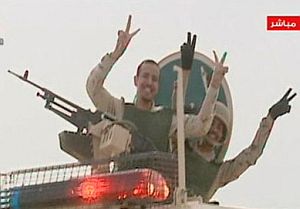
The international community is taking weeks to decide whether to impose a no-fly zone over Libya. Meanwhile, in the eerie quiet of a Bahraini afternoon a deployment of 1,000 soldiers from the Saudi Arabia who are part of the Pensinsula Shield Force entered the country.

Bahrain TV proudly aired clips showing cheering Saudi soldiers in their tanks and armoured personnel carriers as they rolled across the 16-mile causeway between the two countries. Tellingly, a man at the parapet of a tank sits behind his machine gun waving a peace sign at the camera. This is a snapshot of the regime’s current strategy, smile sweetly and say peace for the cameras – and bring in the big guns.

While pro-government commentators allege Iranian support of the current uprising, US defence secretary Robert Gates, who visited Bahrain on March 12, said there is no evidence of interference from Tehran. Unsurprisingly though, the White House issued a statement on Monday saying it does not consider the entry of Saudi troops on to Bahraini land an invasion.

Since the beginning of this uprising – which calls for constitutional reform, an investigation into theft of public land worth billions of dollars, and an end to systematic discrimination, among other things – the regime has implemented a soft-talk big-stick strategy. Its security personnel killed two protesters, and the king appeared on national television to speak of his regret, promising an independent investigation to hold those responsible accountable. Two days later, government security personnel stormed the encampment of protesters at the now-famous Pearl roundabout, killing four more. Later the same day, the crown prince appeared on TV urging calm, while the Bahraini army opened fire on unarmed demonstrators, killing another two.

The government then said it was open to dialogue with protesters (who are understandably sceptical). Distrust of the government emerges from a history of state oppression and reneged promises much longer than this long month of protest in Bahrain.

Our mothers and fathers, teachers, lawyers, activists and unionists were among the people of Bahrain who expressed their social and political grievances and desires for change in 1954, 1965, 1972, 1994, and 2002. The response of the government has always been the same: unleashing violence against calls for meaningful change, exaggerating the superficial self-imposed changes which include little concession towards sharing of power, and turning to its powerful friends for backing.

Associated Press reports:

Frenzied clashes swept Bahrain Tuesday, a day after a Saudi-led military force entered the country to defend its Sunni monarchy from a Shiite-led protest movement. Hundreds of demonstrators were injured by shotgun blasts and clubs, a doctor said.

As the government’s crackdown intensified, the Bahraini king declared a three-month state of emergency Tuesday that gave his military chief wide authority to battle protesters demanding political reforms and equal rights for Shiites. One demonstrator was shot in the head and killed, and a Saudi official said one of his country’s soldiers was shot dead by a protester.

The force of more than 1,000 Saudi-led troops from several Gulf nations saw its first day of action to help prop up the U.S.-backed regime in Bahrain. Its intervention was the first major cross-border military action to challenge one of the revolts sweeping across the Arab world.

Not surprisingly, the claim by the Saudi official cited in the AP report turned out to be false.

Reuters reports:

A member of Bahrain’s security forces was killed on Tuesday in clashes with thousands of protesters, state television and the information ministry said, denying earlier reports that a Saudi policeman had also died.

“A member of the security forces passed away in Maameer this evening when he was deliberately run over by one of the rioters,” Bahrain’s Ministry of Information said.

And maybe the story will change yet again and we’ll learn that the vehicle involved was one of the security services’ own.

Yesterday, Amnesty accused the government of using excessive force:

Amnesty International has called on the Bahrain authorities to hold security forces accountable over the use of excessive force after police fired rubber bullets at close range at demonstrators in the capital Manama.

Hundreds of protesters are reported to have been injured over the weekend. On Friday, anti-government protesters sought to march to the royal palace in Riffa but were blocked by security forces and armed government supporters.

On Sunday, police used batons and fired tear gas and rubber bullets at protesters who sought to block Manama’s financial district and demonstrated at Bahrain University.

The disturbances were the first major violence since Crown Prince Salman bin Hamad al-Khalifa ordered the military off the streets nearly three weeks ago.

“This further resort to excessive force by Bahrain’s security forces is alarming and unacceptable,” said Malcolm Smart, Amnesty International’s Director for the Middle East and North Africa. “The government must now rein in its forces. Those responsible for attacking peaceful protestors and using excessive force must be held to account.”

Meanwhile, the Committee to Protect Journalists reported that Bahraini security forces and plainclothes officers are obstructing news coverage of ongoing political unrest by attacking journalists.

Facebooktwittermail