Egypt opposition arrive late to the revolution

There’s a thin line between well-organized and over-organized. On the one hand, the fact that the Muslim Brotherhood will be joining tomorrow’s regime-crushing demonstrations in Egypt looks likely to bring mass mobilization to a level that even an authoritarian government lacks the power to stop. At the same time, the fact that the Islamist movement has waited this long to join the action calls into question its capacity to lead the revolution and dominate a new government.

The Financial Times reports:

After decades of political apathy in this society of 80m people where few bothered to vote and protests usually drew tiny numbers, the explosion of anger has also taken the country’s opposition politicians by surprise.

Although the demonstrations are essentially leaderless, organised by youth activists on the internet, the opposition is now scrambling to use the opportunity to press for an end to the Mubarak era.

Politicians in Cairo say the National Association for Change headed by Mohamed ElBaradei, the Nobel laureate and former chief of the International Atomic Energy Agency who was due to land in Cairo last night, will emerge from the Egyptian “intifada”, or uprising, with enhanced credibility. But whether the regime will allow Mr ElBaradei to assume a leadership role remains to be seen.

The national association comprises several leading political figures and intellectuals, youth groups like April 6 which has been instrumental in mobilising demonstrations through the internet and a few political parties, including representatives from the Muslim Brotherhood.

The Islamist group is considered the movement with the largest grassroots support in the country but has always been reluctant to provoke the regime. It gave only timid support to the youth activists’ call for a “day of wrath” on Tuesday, though it is calling for participation in the rallies that are planned on Friday.

Opposition leaders say Mr ElBaradei, in particular, has played a crucial role in encouraging young Egyptians in their activism. He returned to Egypt a year ago, after living abroad for three decades, amid activists’ calls on him to run against Mr Mubarak in the September presidential elections.

His response was that he would heed the calls if the constitution was changed to allow independent candidates. Recent amendments to the constitution, as it stands today, give the ruling National Democratic party of Mr Mubarak control over the presidential election process.

Mr ElBaradei’s contribution, say opposition leaders, was to articulate the calls for reform and demonstrate that there are alternatives to Mr Mubarak. “No one can claim this wave . . . but what ElBaradei said and did helped light the flame,” said Osama el-Ghazali Harb of the Democratic Front party, which is part of Mr ElBaradei’s National Association. “He put forward the demands of the opposition and he gave them international attention.”

Issam el-Erian, a brotherhood leader, concurs. “El Baradei had a big role in starting this wave,” he says. “The system was always saying there is no alternative and the only one is the Ikhwan (Brotherhood), but he offered an alternative, and he has a Nobel prize, so he’s a respectable alternative.”


Facebooktwittermail

Obama supports reform not democracy in Egypt

“The United States of America stands with the people of Tunisia, and supports the democratic aspirations of all people,” President Obama said on Tuesday, but he could not say the US stands with the people of Egypt, even though they are currently making their democratic aspirations crystal clear.

What the people of Egypt know, as do the citizens living under every US-backed autocratic ruler in the Middle East, is that if they are to win the prize of democratic freedom, they must surmount the obstacles that the US government throws in their way.

The Obama administration has made it perfectly evident that in spite of the pro-democracy platitudes it reluctantly espouses, it’s preeminent loyalties are with its undemocratic allies — thus Obama and Secretary of State Hillary Clinton’s reluctance to even utter the word “democracy.”

Instead of backing democracy in Egypt, the administration supports reform and it claims that Hosni Mubarak is capable of bringing about the necessary changes.

At the State Department yesterday, a Middle Eastern reporter challenged Clinton, saying:

[Y]ou seem to imply that the Egyptian Government is capable of reforming itself and meeting the expectation of the people. Yet the mood in the streets of Cairo today contrasts that, and people are demanding for radical change, removal of the government and President Mubarak not to nominate himself for another term. Are you unsure of what’s happening in Cairo?

Clinton responded:

I do think it’s possible for there to be reforms, and that is what we are urging and calling for. And it is something that I think everyone knows must be on the agenda of the government as they not just respond to the protest, but as they look beyond as to what needs to be done economically, socially, politically. And there are a lot of very well informed, active civil society leaders in Egypt who have put forward specific ideas for reform, and we are encouraging and urging the Egyptian Government to be responsive to that.

The message from Egypt is simple: the Egyptian people want democratic freedom and an end to dictatorship. They want an end to a brutal regime that still retains Washington’s support. The demonstrators are not calling on Mubarak to implement reforms; they are demanding that he go — and that is a demand that, so far, the Obama administration refuses to acknowledge.

When the status quo becomes untenable, people take to the streets in order to force political change. But Mubarak’s friends in Washington and Jerusalem are not ready to see him go — their preeminent interest is in stability.

As the Jerusalem Post reports:

Prime Minister Binyamin Netanyahu has met repeatedly since coming to power in March 2009 with Egyptian President Hosni Mubarak, and has said on a number of occasions that he has great respect for Mubarak as a statesman, and as a leader with vast experience and knowledge. Earlier this month he characterized the Egyptian-Israeli peace agreement as a “foundation for regional stability.”

There is not a prevalent sense among Egypt watchers in Jerusalem that the disturbances pose a threat to Mubarak’s regime. Rather, the concern is what comes after the 82-year-old Mubarak, and whether his successor – whether his son or someone else – will have the same authority and command the same degree of allegiance.

The sense in Jerusalem is that it would be a mistake to look at the events in Egypt and see an extension of what happened in Tunisia.

“This is not a Tunisian domino effect,” one official said.

Egypt, it was pointed out, is not as closed as Tunisia was under ousted president Zine al-Abidine Ben Ali – it has a different political culture, with more organized opposition and more outlets for letting off steam than existed in Tunisia.

Most importantly, the army is considered loyal to the government, whereas the commander of the Tunisian army determined that it would not face down the protestors there.

Labor MK Binyamin Ben-Eliezer, who is close to Mubarak and met on Tuesday with a senior Egyptian official, said Mubarak’s regime was strong and stable. He said there was no Egyptian who was serious enough competition for Mubarak to lead an effort against him.

“I don’t think it is possible [for there to be a revolution in Egypt],” Ben-Eliezer told Army Radio. “I see things calming down soon.

“Israel cannot do anything about what is happening there. All we can do is express our support for Mubarak and hope the riots pass quietly.”

Likewise, in an interview with Al Jazeera‘s Shihab Rattansi [see video below], State Department spokesman PJ Crowley said:

We want to see restraint on both sides. We want to see the Egyptian people have the opportunity to engage their government, to make clear what their aspirations of [sic], and we want to see that government respond in a meaningful way to meet those aspirations. That is our goal. That is the advice we are giving Egypt. We hope that Egypt will allow its people to protest peacefully but also open up the door for meaningful reforms.

Al Jazeera: Right, but we’re not talking in general terms here. Egypt is not letting its people protest peacefully. It’s deploying the full ranks of its US-backed $1.3 billion-backed security forces to beat up those protesters. Isn’t it time perhaps to be a little firmer with President Mubarak?

Crowley: We are giving Egypt advice publicly and privately. We have concerns about what is happening on the street. We are watching the situation carefully. We are in touch with the Egyptian government and we’re making clear that Egypt should allow its citizens to peacefully protest.

AJ: And if it doesn’t, is that funding — is that US support in jeopardy?

Crowley: We don’t see this as an either/or proposition. Egypt is an ally and friend of the United States. It’s an anchor of stability in the Middle East. It is helping us to pursue comprehensive peace in the Middle East.

But what every Egyptian knows today is that the United States government is not a friend of Egypt, it is a friend and ally of the Mubarak regime — a regime that does not represent the Egyptian people, nor should even be afforded the political shorthand of being referred to as “Egypt.”

Democracy is not the United State’s gift to the world and it will not be acquired under American tutelage. Real democrats don’t bankroll dictatorships.

Facebooktwittermail

‘Down, Down Mubarak!’

Mohamed ElBaradei is heading back to Egypt despite direct threats against his life. He said this to Newsweek:

When Egypt had parliamentary elections only two months ago, they were completely rigged. The party of President Hosni Mubarak left the opposition with only 3 percent of the seats. Imagine that. And the American government said that it was “dismayed.” Well, frankly, I was dismayed that all it could say is that it was dismayed. The word was hardly adequate to express the way the Egyptian people felt.

Then, as protests built in the streets of Egypt following the overthrow of Tunisia’s dictator, I heard Secretary of State Hillary Clinton’s assessment that the government in Egypt is “stable” and “looking for ways to respond to the legitimate needs and interests of the Egyptian people”. I was flabbergasted—and I was puzzled. What did she mean by stable, and at what price? Is it the stability of 29 years of “emergency” laws, a president with imperial power for 30 years, a parliament that is almost a mockery, a judiciary that is not independent? Is that what you call stability? I am sure not. And I am positive that it is not the standard you apply to other countries. What we see in Egypt is pseudo-stability, because real stability only comes with a democratically elected government.

If you would like to know why the United States does not have credibility in the Middle East, that is precisely the answer. People were absolutely disappointed in the way you reacted to Egypt’s last election. You reaffirmed their belief that you are applying a double standard for your friends, and siding with an authoritarian regime just because you think it represents your interests. We are staring at social disintegration, economic stagnation, political repression, and we do not hear anything from you, the Americans, or for that matter from the Europeans.

So when you say the Egyptian government is looking for ways to respond to the needs of the Egyptian people, I feel like saying, “Well, it’s too late!” This isn’t even good realpolitik. We have seen what happened in Tunisia, and before that in Iran. That should teach people there is no stability except when you have government freely chosen by its own people.

Al Ahram reports:

Downtown Cairo looked like a war zone Wednesday.

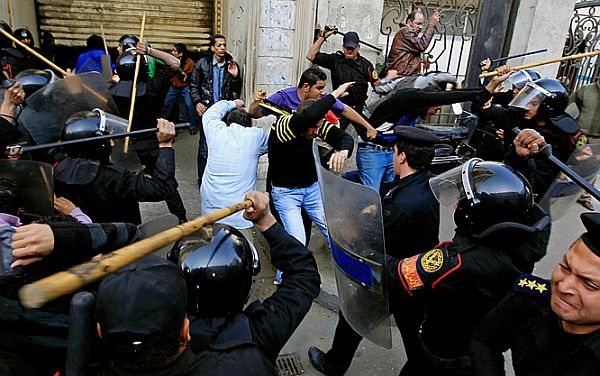
Police in both plain clothes and formal security uniforms were present by the thousands. Riot police were seen sleeping on, and manning, the 6 October and 15 May bridges – the main ones connecting main streets of the city — since last night. Hundreds of people gathered in several streets downtown chanting “People want the government down”, “Copts and Muslims don’t want this system”, and, “Bread, freedom, human integrity.” They were chased and beaten fiercely, many of them also dragged off by force – by thugs and state security agents.

Reporting on today’s demonstrations, Time noted:

Everywhere, the message was the same: “The people want the fall of the regime,” the protesters chanted as they marched over broken glass. On the Corniche, Cairo’s busy road along the Nile, protesters stopped traffic, setting a dumpster on fire and chanting “Down, Down Mubarak!” Moments later, they scattered after a charge by over a dozen plainclothes thugs, armed with sticks and knives, who chased them in between cars and onto a nearby bridge.

Throughout the evening, TIME’s Cairo reporter continued to hear reports of an impeding rally in the center of the city. And at around 11 p.m., a group of protesters attacked the Foreign Ministry, ransacking an outside office, before being pushed back.

The government released statements on Tuesday and Wednesday that sought to place much of the blame for Tuesday’s protest on Egypt’s largest opposition group, the banned Muslim Brotherhood. Activists who actually participated in the demonstrations say the allegation is bogus. “They’re trying to play the same old cards — by threatening the West and the United States that when this regime leaves power, the Muslim Brotherhood will take over. This is absolutely not true,” says Shadi Taha, a member of the liberal Tomorrow Party, whose leader Ayman Nour — a darling of the Bush administration — was on the street on Tuesday. “What we witnessed yesterday was that more than 90% of those people who took to the streets… it was probably their first time to demonstrate. We used to call them the silent majority — the majority that is not involved in politics, who have never been involved in politics, and who definitely are not involved in the Muslim Brotherhood.”

Facebooktwittermail

Palestine Papers: PA stonewalled the Goldstone vote

The Palestine Papers reveal:

On October 2, 2009, the UN Human Rights Council was widely expected to pass a resolution supporting the Goldstone Report, the UN’s probe of war crimes committed during Israel’s war in Gaza in December 2008 and January 2009.

The Council instead agreed to delay a vote on the report until March 2010, following major reservations expressed by the Palestinian Authority, the United States and Israel.

A UNHRC endorsement of the report would have brought Israeli officials one step closer to prosecution before a war crimes tribunal, an event many Palestinians were anxious to see.

But, as The Palestine Papers reveal, the Palestinian Authority apparently sacrificed a potential victory for Palestinian victims in exchange for favorable assurances on negotiations from the United States and, they hoped, from Israel.

Facebooktwittermail

Is honesty the best foreign policy?

We live — as politicians frequently repeat — under the rule of law and there is nothing the legal system frowns on more earnestly than perjury. Hence during trials the solemn ritual that witnesses must swear to tell the truth, the whole truth and nothing but the truth.

And then there is government, where the conduct of the people’s business apparently requires the economical expression of truth, the guarding of secrecy and a subtle contempt for honesty — as though only those who are ignorant about the way the world works would attach great value to truthfulness.

Tom Malinowski, the Washington director of Human Rights Watch, asked HRW staff to canvass sources in Tunisia to gauge the impact of the revelations from WikiLeaks and how they influenced the revolution.

The candid appraisal of Ben Ali by U.S. diplomats showed Tunisians that the rottenness of the regime was obvious not just to them but to the whole world — and that it was a source of shame for Tunisia on an international stage. The cables also contradicted the prevailing view among Tunisians that Washington would back Ben Ali to the bloody end, giving them added impetus to take to the streets. They further delegitimized the Tunisian leader and boosted the morale of his opponents at a pivotal moment in the drama that unfolded over the last few weeks.

This point might not be worth dwelling on, except that it suggests something interesting about how the United States, and the State Department in particular, approaches the challenge of promoting human rights and democracy in countries like Tunisia. Consider the following proposition: None of the decent, principled, conscientious, but behind the scenes efforts the State Department made in recent years to persuade the Tunisian government to relax its authoritarian grip — mostly through diplomatic démarches and meetings with top Tunisian officials — had any significant impact on the Ben Ali regime’s behavior or increased the likelihood of democratic change. Nor did the many quiet U.S. programs of outreach to Tunisian society, cultural exchanges and the like, even if Tunisians appreciated them and they will bear fruit as the country democratizes.

Instead, the one thing that did seem to have some impact was a public statement exposing what the United States really thought about the Ben Ali regime: a statement that was vivid, honest, raw, undiplomatic, extremely well-timed — and completely inadvertent.

Had anyone at the State Department proposed deliberately making a statement along the lines of what appears in the cables, they would have been booted out of Foggy Bottom as quickly as you can say “we value our multifaceted relationship with the GOT.” [Continue reading…]

Facebooktwittermail

Most of South America now recognizes Palestine

The latest announcement of diplomatic recognition of Palestine means that governments representing 304 million out of South America’s 386 million people have joined the international movement pressing for the creation of a fully sovereign Palestinian state.

The Guardian reports:

Peru last night announced it recognises Palestine as a state, becoming the seventh South American country to do so in a rapid diplomatic domino effect which has alarmed Israel.

The declaration came on the eve of a Latin American-Arab summit to be hosted in the Peruvian capital, Lima, reflecting growing political and economic ties between the two regions.

“Palestine is recognised as a free and sovereign state,” Peru’s foreign minister, José Antonio García Belaúnde, told RPP radio. “There was no pressure from any side. We have acted with freedom and independence.” He expressed Peru’s continued support for peace talks.

The announcement followed similar decisions by Argentina, Bolivia, Brazil, Chile, Ecuador and Guyana in recent weeks, bolstering Palestinian hopes of momentum towards global recognition.

It came as a chink of good news for Palestinians amid controversy and despair over leaked peace talks documents showing negotiators’ apparent weakness in dealings with Israel and the US.

Facebooktwittermail

How to resist the will of the people

How can you placate the frustrations of a disenfranchised population without giving them real political power?

The answers to this question describe the common ground that unites Western leaders with their authoritarian counterparts in the Middle East. The game is to come up with political formulae that will make a potentially rebellious population feel heard just enough so that the fire of revolution can be dampened.*

Egyptian Armed Forces Chief-of-Staff Sami Annan, along with a delegation from the Egyptian Army, happen to be visiting Washington this week. I doubt that their counterparts in the Pentagon will be advising them on the fastest way to prepare Egypt for democracy.

Issandr El Amrani comments on al-Sayed Badawi, the president of the Wafd party (the most established of Egypt’s legal opposition parties) who appeared on Al Jazeera, demanding the formation of a new national unity government, the dissolution of parliament, and new elections under a proportional representation system.

My gut reaction: this is either a significant break with the Wafd’s behavior for over 30 years, or he is making this announcement on behalf of the regime. Why the conspiracy theory? Because he doesn’t mention the question of the presidency, a chief demand of the protestors. Perhaps he should be given the benefit of the doubt.

Meanwhile, the National Association for Change has made its own demands, including asking Mubarak to step down and [his son] Gamal to be disqualified from the presidency, as well as the dissolution of the parliament. Other groups have other demands, including a new minimum wage and the firing of the interior minister.

These people should be coordinating — and remember they are not the ones who protested tonight.

The cautiousness of some of the Egyptian opposition leaders demonstrates exactly why an authoritarian regime provides space for an opposition to operate: so that at a moment such as this, opposition leaders will not place themselves at the vanguard of revolutionary change and that by holding back, they will undermine the popular will.

*Am I implying that any Western countries harbor the seeds of revolution? Far from it. The “success” of Western democracy has been to depoliticize populations through the anesthetizing power of consumerism. People don’t care too much if government by the people is a fiction, so long as they can get their hands on the latest iPhone. Once the anesthetic is applied sufficiently widely and sufficiently frequently, there ceases to be such a thing as the will of the people.

Facebooktwittermail

In Egypt a barrier of fear has been transcended

Issandr El Amrani writes:

The most significant thing about today’s protests across Egypt is that their scale was totally unexpected. Yes, there has been a wave of protests since late 2004. But none have been nationwide to this extent, and none have been as big. We still do not have a clear picture of what transpired in much of the country, and media focus tended to be on the main protest in Cairo’s Midan Tahrir. But that is enough to know that these may be the biggest protest movement since at least the 1977 bread riots and perhaps even the biggest since the 1950s.

It was not predictable, just like Tunisia, because it was an unknown unknown — we did not know that the threshold for such an event had been reached, partly because previous protests had fizzled out or were effectively contained by the regime . While we (here I mean the press, analysts, and activists) knew many Egyptians were tired of the current state of affairs, we did not know that an external change (what happened in Tunisia) could have this kind of impact on a country that, after all, has been protesting for years and that is nowhere as repressive and controlled as Tunisia was under Ben Ali. I suspect the staggering effrontery of the regime during December’s parliamentary elections and the moment of national unity after the New Year’s Eve January bombing also played a role. A significant number of Egyptians simply do not find the regime credible anymore, and hold it responsible for much of the deterioration of the country — in terms of the socio-economic situation, sectarian relations, and political accountability. Today, a red line has been irrevocably crossed, a barrier of fear transcended.

Facebooktwittermail

After Egypt’s ‘Day of Wrath’ protesters say ‘there’s a revolution coming’

“I’ve never seen men so angry, yet so happy to be expressing their anger,” Courtney Graves, an American living in Giza told the BBC, describing what she witnessed in Tahrir square in Cairo today. “I walked next to girls in hijabs screaming for the downfall of Hosni Mubarak. I walked behind men begging God for freedom.” At least three people died in clashes between police and demonstrators.

In Hillary Clinton’s assessment, “the Egyptian Government is stable,” although Gamal Mubarak, Egyptian president Hosni Mubarak’s son who is widely tipped as his successor, has fled to London with his family, Arabic website Akhbar al-Arab said on Tuesday.

The Mubarak regime is clearly rattled and has blocked Twitter.

Christian Science Monitor reports:

A popular uprising in Tunisia may have just pushed out President Zine El Abidine Ben Ali, but Egypt — the Arab world’s largest country with a vast security establishment — is something else again.

But activists, political analysts and average people in Egypt insist that something crucial shifted for Egypt today. Egyptian political scientist Mustapha Kamel Al Sayyid predicts that now the dam has broken, protests will continue. “the reservoir of discontent is huge,” he says. He adds it is much too soon to talk about a revolution in Egypt, where several factors would make a Tunisia-style toppling of Mubarak much more difficult.

Though both nations suffer from high unemployment and a have a large youth population, Egypt has a much smaller middle class than Tunisia. The regime’s power is not only concentrated in the security forces, as Tunisia’s was, but also in the Army. Tunisia’s military is credited with helping to bring about Ben Ali’s demise, while Egypt’s military is loyal to Mubarak, he says.

And while the corruption of Tunisia’s ruling family was a rallying point for protesters, corruption in Egypt extends further, meaning a widespread base of people who would have much to lose from the fall of the regime. Yet Egyptians have hope.

“All this is happening because we are not afraid,” said Shaimaa Morsy Awad, a young woman who held aloft an Egyptian flag during the protest. “Every day more people will join us. We are still weak, and there’s a lot of work we have to do. But there’s a revolution coming.”

Facebooktwittermail

Palestine Papers: With US support, Palestinian Authority engaged in torture

Mark Perry writes:

The Palestine Papers provide unprecedented access into the internal workings of the U.S.-brokered Israeli-Palestinian negotiating process. But the leaked documents and meetings also touch on other key issues surrounding U.S. intervention in the conflict – including dozens of documents on Palestinian security issues. At the heart of these is the work of the Office of the U.S. Security Coordinator (USSC), what many refer to as “The Dayton Mission,” – a designation derived from the USSC’s chief, Lt. General Keith Dayton, who retired last October. Among other things they confirm – from Dayton’s own mouth – that Palestinian Authority forces supported by the United States engaged in torture.

The establishment of the USSC – its mandate and purpose — is fraught with misunderstandings. The first is that U.S. military officers are training Palestinian security personnel. That’s not true. Palestinian security personnel were initially trained by American contractors (in this case, Dyncorp) – the same kind of contractors who have given the U.S such problems in Iraq. Later, these private contractors were joined by trainers provided by the Jordanian Public Security Directorate. While the facilities for the training (located outside of Amman) are provided by the United States, the Palestinian trainees were (and are) equipped by the Egyptians.

While the now-retired Dayton was a senior three-star military officer (he was preceded by General William Ward and has been succeeded General Michael Moeller), he never reported through a military chain of command. Rather, he reported directly to the Secretary of State – first to Condoleezza Rice, under the Bush administration and, later, to Hillary Clinton, under President Barack Obama. There are a number of reasons for this, not the least of which is that his mission is controversial among senior Pentagon officers, who argue that a U.S. training mission (whose goal is to create a military force that cooperates with Israel), will raise serious objections among Arabs. As a U.S. Army colonel told me in 2009: “This is just a stupid idea – it makes us look like we’re an extension of the Israeli occupation.” This of course is a view that many Palestinians, including Hamas, also take.

Facebooktwittermail

Palestine Papers: MI6 drew up plan for crackdown on Hamas

The Guardian reports:

British intelligence helped draw up a secret plan for a wide-ranging crackdown on the Islamist movement Hamas which became a security blueprint for the Palestinian Authority, leaked documents reveal. The plan asked for the internment of leaders and activists, the closure of radio stations and the replacement of imams in mosques.

The disclosure of the British plan, drawn up by the intelligence service in conjunction with Whitehall officials in 2004, and passed by a Jerusalem-based MI6 officer to the senior PA security official at the time, Jibril Rajoub, is contained in the cache of confidential documents obtained by al-Jazeera TV and shared with the Guardian. The documents also highlight the intimate level of military and security cooperation between Palestinian and Israeli forces.

The bulk of the British plan has since been carried out by the West Bank-based PA security apparatus which is increasingly criticised for authoritarian rule and human rights abuses, including detention without trial and torture.

The British documents, which have been independently authenticated by the Guardian, included detailed proposals for a security taskforce based on the UK’s “trusted” Palestinian Authority contacts, outside the control of “traditional security chiefs”, with “direct lines” to Israel intelligence.

Alastair Crooke writes:

Many have questioned why the European Union failed to provide an independent view to that of the United States on Middle East policy during the last decade. It is not a simple question to answer. Partly the EU failed to assert its voice because, at the beginning of the decade, it was scrambling to contain the impact of inflating US hubris, fuelled by the defeat of Saddam Hussein. Partly it was also a simple reflection of most European politicians’ dependency on Washington. But the release of The Palestine Papers provides another answer.

They show how Tony Blair in particular had so undercut the political space, that there was effectively no room for it. In a secret policy switch in 2003, he tied the UK and EU security policy into a major American counter-insurgency (COIN) ‘surge’ in Palestine.

It was an initiative that would bear a heavy political cost for the EU in 2006, and for years to come, when Hamas won parliamentary elections by a large majority. The EU’s claims for democracy have rung hollow ever since. Blair’s ‘surge’ also left the EU exposed as hypocrites: On a political level, for example, the EU might talk about its policy of fostering reconciliation between Palestinian factions, but at the security plane, and in other ways, the EU was pursuing the polar opposite objectives.

In 2003, US efforts to marginalize President Arafat by leeching away his presidential powers into the embrace of Prime Minister Mahmoud Abbas, collapsed. Arafat dismissed Abbas as PM. This was a blow to the US policy which – even then – was focused on creating a ‘de-Fatah-ised’ Palestinian Authority. Bush complained to Blair bitterly about Abbas’ dismissal: the Europeans still were ‘dancing around Arafat’ – leaving the US to ‘do the heavy lifting’ with the Israelis. Europeans were not pulling their weight in the ‘war on terror’, Bush concluded.

Blair’s COIN surge was his response to Bush: The Palestine Papers reveal ‘a security drive’ with the objective of “degrading the capabilities of the rejectionists: Hamas, PIJ [Palestinian Islamic Jihad], and the Al Aqsa Brigades – through the disruption of their leaderships’ communications and command and control capabilities; the detention of key middle-ranking officers; and the confiscation of their arsenals and financial resources held within the Occupied Territories. US and – informally – UK monitors would report both to Israel and to the Quartet. We could also explore the temporary internment of leading Hamas and PIJ figures”.

Facebooktwittermail

US can’t link Manning to Assange, while Arab youth voice strong support for WikiLeaks

NBC News reports:

U.S. military officials tell NBC News that investigators have been unable to make any direct connection between a jailed army private suspected with leaking secret documents and Julian Assange, founder of the whistleblowing website WikiLeaks.

The officials say that while investigators have determined that Manning had allegedly unlawfully downloaded tens of thousands of documents onto his own computer and passed them to an unauthorized person, there is apparently no evidence he passed the files directly to Assange, or had any direct contact with the controversial WikiLeaks figure.

Meanwhile, the latest of the Doha Debates revealed overwhelming support for WikiLeaks among young Arabs:

Arab youth have overwhelmingly embraced the WikiLeaks phenomenon and told their governments to stop lying to them.

In the latest Doha Debate an audience of mostly Arab and Muslim students supported the motion: This House believes the world is better off with Wikileaks, by a margin of 74 to 26 percent.

The highly-charged debate was held weeks after the whistle-blowing website published confidential US diplomatic cables, exposing official corruption in several Middle East states and a yawning gap between the private and public positions of Arab rulers on Iran.

A student won instant applause when he said: “I would rather live in a world where I am told the truth than in a world where I am told lies”. Another female student from Qatar asked: “Is it really that wrong to know the truth?”

Facebooktwittermail

Protests against government escalate in Egypt

Al Jazeera reports:

Two Egyptians have died after a wave of unusually large anti-government demonstrations swept across the country.

The two died in the eastern city of Suez, according to the Reuters news agency. The report did not detail how or when they died.

Thousands of Egyptians have taken to the streets in demonstrations, reportedly the largest in years, that they have explicitly tied to the successful uprising in nearby Tunisia.

On Tuesday night, hours after the countrywide protests began, the interior ministry issued a statement blaming the Muslim Brotherhood, Egypt’s technically banned but largest opposition party, for fomenting the unrest.

Inspired by events in Tunisia, thousands of protesters gathered in Cairo and elsewhere, calling for reforms and demanding an end to the presidency of Hosni Mubarak, which has now lasted for nearly three decades.

The demonstrations prompted US secretary of state Hillary Clinton to assert during a press conference that “Egypt’s government is stable.”


(Video by Mondoweiss contributor Ahmed Moor.)

Facebooktwittermail

Palestine Papers can’t slow down a stationary peace process

Jerusalem Post:

The US State Department acknowledged Monday that the “Palestine Papers,” released by Al-Jazeera, complicated American efforts to forge an Israeli-Palestinian peace agreement. But it said it wouldn’t slow the Obama administration’s work toward that goal.

George Mitchell can be as busy as a hamster in a treadmill without actually getting anywhere. Still, the key rhetorical marker that the administration’s efforts have reached their termination point will be transparent when State Department spokesman PJ Crowley starts responding to questions about Israel with what has become Obama’s signature expression: “We’re monitoring the situation.”

Facebooktwittermail

Hezbollah backs billionaire Najib Mikati as Lebanese prime minister

Bloomberg reports:

Mikati “is seen as a genuinely neutral figure,” said Amal Saad-Ghorayeb, a research adviser at the Doha Institute in Qatar. He “is balanced and enjoys good relations with Syria and Saudi Arabia,” the two main powerbrokers in Lebanon, she said.

Syria, Hezbollah’s backer, was initially blamed for Hariri’s killing by many Lebanese, and withdrew its troops from the country following a wave of protests. Both Syria and Hezbollah have denied responsibility for the murder.

Hassan Nasrallah, Hezbollah’s leader, said in a televised speech yesterday that his group and its allies will seek to form a national unity government if their candidate wins the nomination.

Hezbollah backed Mikati when he was premier for three months in a caretaker government before the 2005 parliamentary elections. The group’s initial choice for the premiership this time was Omar Karami, 76, a pro-Syrian politician. Karami declined to be nominated citing his age and health, Hamdan said.

Mikati, from the northern city of Tripoli, is worth $2.5 billion according to Forbes magazine. He founded Investcom, which runs phone networks in emerging markets, with his brother, Taha, in 1982. MTN Group Ltd., Africa’s largest mobile-phone operator, bought the company in 2006 for $5.5 billion.

Mikati called for “solidarity to bring the country out of this severe crisis,” and said his candidacy isn’t “a challenge to anyone,” according to a statement on his website.

Facebooktwittermail

Israel sees threat from “delegitimizers”

Reuters reports:

Foreign protests, boycotts, embargoes and sanctions, along with internal resistance, helped bring about the isolation and eventually the end of apartheid in South Africa in the 1990s.

Now Israelis fear pro-Palestinian, or anti-Israeli, activists are using the same tactics against their country, with increasing effect.

Carlos Santana, Gil Scott Heron, Elvis Costello, Gorillaz Sound System, the Klaxons, the Pixies, Faithless, Leftfield, Tindersticks, Meg Ryan and film director Mike Leigh have all decided not to go to Israel in recent months.

Some older, established acts — Paul McCartney, Elton John and Rod Stewart among them — have ignored boycott pressure.

The activist website boycottisrael.info keeps count.

Israeli analysts say pressure is brought to bear on artists by a global “delegitimisation network.”

White South Africa was ostracized in a campaign lasting years. Today, Facebook and Twitter can flash protest messages globally in seconds, putting pressure on entertainers to stay away from Israel, and drawing the attention of millions of fans.

Meanwhile, the Los Angeles Times reports:

The intent of the anonymous Internet video was unambiguous: “This person should be killed — and soon,” read a message underneath a photo of Israel’s deputy state prosecutor, Shai Nitzan.

His alleged offense? “Betraying” his Jewish roots by opening a criminal inquiry into racist threats and hate speech expressed on two Israel-based Facebook pages with statements in Hebrew such as “Death to Arabs.”

It was the latest, and most overtly violent, sign of what many here are calling a wave of intolerance toward people of different races, religions, orientations and viewpoints.

From rabbinical prohibitions against renting homes to “non-Jews” to government crackdowns on left-wing activists, Israelis are grappling with their nation’s identity and character.

Across the political spectrum, some see the struggle as a threat to Israel’s democratic ideals. Opposition leader Tzipi Livni, of the centrist Kadima party, warned that “an evil spirit has been sweeping over the country.” Defense Minister Ehud Barak said a “wave of racism is threatening to pull Israeli society into dark and dangerous places.”

Facebooktwittermail

Tunisian army ‘will protect the revolution’

Reuters reports:

The Tunisian army general who refused to back president Zine al-Abdine Ben Ali’s crackdown on protesters warned on Monday that a political vacuum could bring back dictatorship and vowed to protect the revolution.

“Our revolution is your revolution. The revolution of the youth could be lost and could be exploited by those who call for a vacuum,” General Rashid Ammar told crowds outside the prime minister’s office, where protesters have demanded the fall of the interim government. “The army will protect the revolution.”

Facebooktwittermail