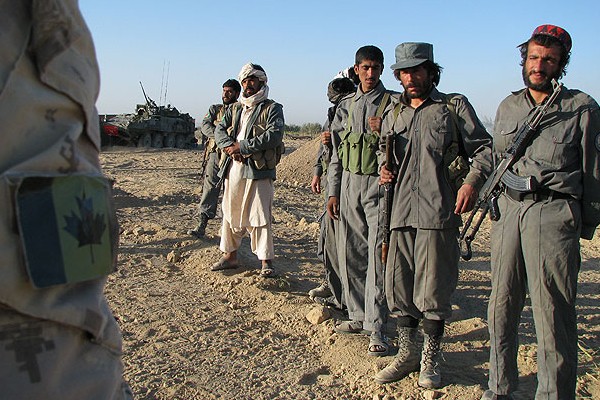
‘It’s better to join the Taliban; they pay more money.’


When President Obama announced his 30,000-strong troop surge in December he said: “these additional American and international troops will allow us to accelerate handing over responsibility to Afghan forces and allow us to begin the transfer of our forces out of Afghanistan in July of 2011.”

It was another example of what has become all too familiar: Obama’s ability to govern like Bush without sounding exactly like Bush. He might as well have simply reused Bush’s line and said: “As Afghan forces stand up, we will stand down.” The difference in language is trivial. The real difference between now and 2005 when Bush said that in reference to Iraqi forces is that it turns out Bush’s objective was a bit more realistic.

Consider Rod Nordland’s portrayal or the way the Afghan National Police force is shaping up:

The NATO general in charge of training the Afghan police has some tongue-in-cheek career advice for the country’s recruits.

“It’s better to join the Taliban; they pay more money,” said Brig. Gen. Carmelo Burgio, from Italy’s paramilitary Carabinieri force.

That sardonic view reflects a sobering reality. The attempts to build a credible Afghan police force are faltering badly even as officials acknowledge that the force will be a crucial piece of the effort to have Afghans manage their own security so American forces can begin leaving next year.

Though they have revamped the program recently and put it under new leadership, Afghan, NATO and American officials involved in the training effort list a daunting array of challenges, as familiar as they are intractable.

One in five recruits tests positive for drugs, while fewer than one in 10 can read and write — a rate even lower than the Afghan norm of 15 percent literacy. Many cannot even read a license plate number. Taliban infiltration is a constant worry; incompetence an even bigger one.

Now consider this description of the resistance that US Marines are facing in Helmand Province:

In areas where they have built bases, the Marines have undermined the Taliban’s position. But the insurgents have consolidated and adapted, and remain a persistent and cunning presence.

On the morning of the sweep, made by Weapons Company, Third Battalion, First Marines, a large communications antenna that rose from one compound vanished before the Marines could reach it. The man inside insisted that he had seen nothing. And when the Marines moved within the compounds’ walls, people in nearby houses released white pigeons, revealing the Americans’ locations to anyone watching from afar.

The Taliban and their supporters use other signals besides car horns and pigeons, including kites flown near American movements and dense puffs of smoke released from chimneys near where a unit patrols.

“You’ll go to one place, and for some reason there will be a big plume of smoke ahead of you,” said Capt. Paul D. Stubbs, the Weapons Company commander. “As you go to the next place, there will be another.”

“Our impression,” he added, “is the people are doing it because they are getting paid to do it.”

The people are getting paid… right.

You don’t have to be a Holywood screenwriter to see this description — the smoke signals, pigeon alerts and so forth — as a classic image of resistance. The foreign fighters are better armed, but the resistance fighters have the home-turf advantage — they’re being protected by the civilian population. Do the civilians have to get paid for their services? Conceivably, but I kind of doubt it. More likely it simply comes down to knowing who are “our boys”.


Facebooktwittermail

Israeli commander: ‘We rewrote the rules of war for Gaza’

From The Independent:

A high-ranking officer has acknowledged for the first time that the Israeli army went beyond its previous rules of engagement on the protection of civilian lives in order to minimise military casualties during last year’s Gaza war, The Independent can reveal.

The officer, who served as a commander during Operation Cast Lead, made it clear that he did not regard the longstanding principle of military conduct known as “means and intentions” – whereby a targeted suspect must have a weapon and show signs of intending to use it before being fired upon – as being applicable before calling in fire from drones and helicopters in Gaza last winter. A more junior officer who served at a brigade headquarters during the operation described the new policy – devised in part to avoid the heavy military casualties of the 2006 Lebanon war – as one of “literally zero risk to the soldiers”.

The officers’ revelations will pile more pressure on Israeli Prime Minister Benjamin Netanyahu to set up an independent inquiry into the war, as demanded in the UN-commissioned Goldstone Report, which harshly criticised the conduct of both Israel and Hamas. One of Israel’s most prominent human rights lawyers, Michael Sfard, said last night that the senior commander’s acknowledgement – if accurate – was “a smoking gun”.

A policy of “zero risk to the soldiers” — think about that. Isn’t that exactly what the infamous Rabbi Yitzhak Shapira believes in — a rabbi, it should be noted, who has been portrayed as being a fanatic and an extremist.

This is how the views of Shapira, head of the Od Yosef Chai Yeshiva, were described in the Jerusalem Post a few days ago:

In sharp contrast to the Goldstone Report, which criticizes the IDF for purportedly committing “war crimes” against Palestinians during Operation Cast Lead, Od Yosef Chai’s criticism of the IDF is totally different.

IDF battlefield ethics are seen as immoral not because they allow for the killing of innocent bystanders but because they force Jewish soldiers to needlessly endanger themselves to protect gentiles.

The measures taken by the IDF to protect non-combatants, such as using ground forces to weed out terrorists embedded in highly populated civilian areas so as to minimize collateral damage, are viewed by Shapira as downright evil, because they lead to the needless injury or death of Jewish soldiers.

So, Shapira should be relieved to hear that Jewish soldiers were not put at unnecessary risk — though he’d hardly need to have waited a year to figure that out, since the war’s casualty figures (six soldiers killed, not including four killed by friendly fire) make it transparent that Israel minimized its risks. Indeed, as the Independent report reveals, one of the principal ways the operation kept soldiers out of harms way was through heavy reliance on drone attacks.

“Most of the guys taken down were taken down by order of headquarters. The number of enemy killed by HQ-operated remote … compared to enemy killed by soldiers on the ground had absolutely inverted,” an Israeli soldier told Yedhiot Ahronot.

Since the Independent has, at least in part, run Yedhiot Ahronot‘s own story, hopefully the Israeli newspaper can muster the courage to print the rest of it.

Facebooktwittermail

Avi Shlaim – Blair: Gaza’s great betrayer

From The Guardian:

The savage attack Israel ­unleashed against Gaza on 27 December 2008 was both immoral and unjustified. Immoral in the use of force against civilians for political purposes. Unjustified because Israel had a political alternative to the use of force. The home-made Qassam rockets fired by Hamas militants from Gaza on Israeli towns were only the ­excuse, not the reason for Operation Cast Lead. In June 2008, Egypt had ­brokered a ceasefire between Israel and Hamas, the Islamic resistance movement. ­Contrary to Israeli propaganda, this was a success: the average number of rockets fired monthly from Gaza dropped from 179 to three. Yet on 4 November Israel violated the ceasefire by launching a raid into Gaza, killing six Hamas fighters. When Hamas ­retaliated, Israel seized the renewed rocket attacks as the ­excuse for launching its insane offensive. If all Israel wanted was to protect its citizens from Qassam rockets, it only needed to ­observe the ceasefire.

While the war failed in its primary aim of regime change in Gaza, it left ­behind a trail of death, devastation, ­destruction and indescribable human suffering. Israel lost 13 people, three in so-called friendly fire. The Palestinian death toll was 1,387, including 773 civilians (115 women and 300 children), and more than 5,300 people were injured. The ­entire population of 1.5 million was left traumatised. Across the Gaza Strip, 3,530 homes were completely ­destroyed, 2,850 severely damaged and 11,000 suffered structural damage.

The UN Relief and Works Agency for Palestinian Refugees, tending to the needs of four million Palestinian ­refugees, stated that Gaza had been “bombed back, not to the Stone Age, but to the mud age”; its inhabitants ­reduced to building homes from mud after the fierce 22-day offensive.

War crimes were committed and possibly even crimes against humanity, documented in horrific detail in Judge Richard Goldstone’s report for the UN human rights council. The report ­condemned both Israel and Hamas, but reserved its strongest criticism for Israel, accusing it of deliberately targeting and terrorising civilians in Gaza. The British government did not take part in the vote on the report, sending a signal to the hawks in Israel that they can continue to disregard the laws of war. Gordon Brown’s 2007 appointment as a patron of the Jewish National Fund UK presumably played a part in the adoption of this ­pusillanimous position.

One year on, the Gaza Strip, one of the most densely populated areas on earth, continues to teeter on the verge of a humanitarian disaster. Israel’s ­illegal blockade of Gaza, in force since June 2007, restricts the flow not only of arms but also food, fuel and medical supplies to well below the minimum necessary for normal, everyday life. Reconstruction work has hardly begun because of the Israeli ban on bringing in cement and other building materials to Gaza. Thousands of families still live in the ruins of their former homes. Hospitals, health facilities, schools, government buildings and mosques cannot be rebuilt. Nor can the basic ­infrastructure of the Gaza Strip, including Gaza City’s sewage disposal plant. Today, 80% of Gaza’s population ­remain dependent on food aid, 43% are unemployed, and 70% live on less than $1 a day.

Facebooktwittermail

Blair lied in build-up to Iraq invasion, claims Clare Short

From The Times:

The former development secretary was scathing about Mr Blair’s failure to ask Washington to delay the invasion despite warnings that the military and aid officials were not ready.

“I think he was so frantic to be with America that all that was thrown away. If he had done that, his place in history and the UK’s role in the world would have been so much more honourable,” she said.

She told that inquiry that she believed Mr Blair genuinely believed he was right to overthrow Saddam. “I am not saying he was insincere. I think he was willing to be deceitful because he thought it was right.”

(Note: The Sky News clip appearing above is different from the one appearing at the top of the Times article – the latter includes interesting comments from Short on Britain’s need to re-conceive what it means to have a “special relationship” with the United States.)

Facebooktwittermail

Riz Khan – Iraq: Reopening sectarian wounds?

Al Jazeera English’s Riz Khan: Now, of course, in 2005 when the Sunni community generally boycotted the elections taking place then, there was violence on the street. And I wonder, because there’s, you know, if there’s a sense of being sidelined and excluded and being left out of any kind of voice in Iraqi politics? Whether there’s a chance of people taking to the streets again this time? What do you expect?

Dr. Saleh al-Mutlaq, a leading Sunni Iraqi politician: Well, it is really a very dangerous and worrying situation because although we told people when we heard this news about excluding us from the election, we told them they should not worry about this. They should go to the election. They should vote. Whether we are in or we are out and we will struggle against dictatorship, against the oppressing government whether we are inside the political process or outside the political process, whether we are inside the election process or outside the election process.

But we could not convince people. People, now, are depressed, pessimistic about what’s going on. They say to us, they still saying, that if you are in the political process and you are a leader in this process that you cannot protect yourself. So how could we protect ourself when we go to the election? So they cannot guarantee their lives and their family lives if they go to the election. Plus they do not guarantee that the results will not be fixed from now.

If the IHEC [Iraq’s Accountability and Justice Commission], the, I mean, the election committee and the government is capable of cheating the people and fixing the situation as they want in a very obvious way. So aren’t they able to cheat the people and to make the fraud in the coming election? These are the arguments the people argue and most of the people, we talk to them, they said we will not go to the election. And this is very dangerous because then they will lose hope. And if they lose hope, then they will go to the violence again.

Facebooktwittermail

The Iraqi oil conundrum

At TomDispatch, Michael Schwartz writes:

How the mighty have fallen. Just a few years ago, an overconfident Bush administration expected to oust Iraqi dictator Saddam Hussein, pacify the country, install a compliant client government, privatize the economy, and establish Iraq as the political and military headquarters for a dominating U.S. presence in the Middle East. These successes were, in turn, expected to pave the way for ambitious goals, enshrined in the 2001 report of Vice President Dick Cheney’s secretive task force on energy. That report focused on exploiting Iraq’s monstrous, largely untapped energy reserves — more than any country other than Saudi Arabia and Iran — including the quadrupling of Iraq’s capacity to pump oil and the privatization of the production process.

The dream in those distant days was to strip OPEC — the cartel consisting of the planet’s main petroleum exporters — of the power to control the oil supply and its price on the world market. As a reward for vastly expanding Iraqi production and freeing its distribution from OPEC’s control, key figures in the Bush administration imagined that the U.S. could skim off a small proportion of that increased oil production to offset the projected $40 billion cost of the invasion and occupation of the country.

All in a year or two.

Almost seven years later, it will come as little surprise that things turned out to cost a bit more than expected in Iraq and didn’t work out exactly as imagined. Though the March 2003 invasion quickly ousted Saddam Hussein, the rest of the Bush administration’s ambitious agenda remains largely unfulfilled.

Facebooktwittermail

Iraq’s coming civil war?

Steve Clemons at The Washington Note writes:

As Iraq tilts towards March 7th elections, there are disconcerting trends unfolding inside the Maliki-run government that portend serious problems and potentially civil war in the not distant future.

Iraq expert and military affairs specialist Tom Ricks recently commented on Wolf Blitzer’s Situation Room on CNN that he believed that there was a 50-50 chance Iraq would erupt in civil war, and a 10-15% chance that the growing tensions in and around Iraq could become a regional war involving several of the other major states around Iraq.

maliki.jpgPart of the growing trouble inside Iraq stems from the growing sense that politically empowered Shiites in the Iraq Government led by Prime Minister Nouri al-Maliki are still carrying on campaigns against Sunni political interests.

Facebooktwittermail

Iran says ready to send uranium abroad as UN wants

From the Associated Press:

Iran said on Tuesday it was ready to send its uranium abroad for further enrichment as requested by the U.N.

President Mahmoud Ahmadinejad announced the decision in an interview with state Iranian television.

He said Iran will have “no problem” giving the West its low-enriched uranium and taking it back several months later when it is enriched by 20 percent.

The decision could signal a major shift in the Iranian position on the issue.

Facebooktwittermail

US missile test mimicking Iran strike fails

From Reuters:

A U.S. attempt to shoot down a ballistic missile mimicking an attack from Iran failed after a malfunction in a radar built by Raytheon Co (RTN.N), the Defense Department said.

The abortive test over the Pacific Ocean coincided with a Pentagon report that Iran had expanded its ballistic missile capabilities and posed a “significant” threat to U.S. and allied forces in the Middle East region.

The Missile Defense Agency said that in Sunday’s test both the target missile, fired from Kwajalein in the Marshall Islands, and the interceptor, from Vandenberg Air Force Base in California, had performed normally.

“However, the Sea-Based X-band radar did not perform as expected,” the agency said on its web site. Officials will investigate the cause of the failure to intercept, it said.

Facebooktwittermail

Reconsidering America’s place in the world

In Nader Mousavizadeh‘s interesting analysis on America’s failure to deal effectively with so-called “rogue states”, he begins by pointing out that the world that created such states is gone:

Obama came into office thinking that a more responsive diplomacy could rally global support for the old Western agenda, but that’s not enough. What’s needed, more than a change in tone or a U.S. policy review, is a new set of baseline global interests—neither purely Western nor Eastern—defined in concert with rising powers who have real influence in capitals like Rangoon, Pyongyang, and Tehran. This requires a painful reconsideration of America’s place in the world. But it promises real help from rising powers in shouldering the financial and military burden of addressing global threats.

Today countries large and small, well behaved and not, are looking for partners, not patrons. Where Washington looks to punish rogues, seeking immediate changes in behavior, rival powers are stepping in with investment and defense contracts, and offering a relationship based on dignity and respect. This is the story of China in Burma, Russia in Iran, Brazil in Cuba, and so on down the line. And given that the core institutions of global governance—the U.N. Security Council, the World Bank, and the IMF—are unwilling to grant the new powers a seat at the decision-making table, it’s not surprising that they feel no obligation to back sanctions they’ve had no say in formulating.

Far from being coy about their newfound independence, the rising powers are asserting their status with increasing strength. During a recent state visit, Brazilian President Luiz Inácio Lula da Silva stood beside President Mahmoud Ahmadinejad of Iran and declared bluntly: “We don’t have the right to think other people should think like us.” These words resonate more deeply outside the Western world than new calls for unity against the rogues. Days earlier, Ahmadinejad had been hosted by Turkey’s Prime Minister Recep Tayyip Erdogan, who had embraced his neighbor at a summit of Islamic nations and insisted that Iran’s nuclear program was “peaceful.” Predictably, the Western press attacked both Lula and Erdogan for betraying democratic values and solidarity, missing the point entirely. Established democrats like Lula and Erdogan are not siding with Ahmadinejad, supporting his government’s violent crackdown on protesters or its covert nuclear programs. Rather, they are demonstrating their intention—and, more important, their ability—to have a say in who the rogues are and how they should be dealt with.

Facebooktwittermail

Israeli officers get ‘slap on wrist’ for white phosphorus use in Gaza

From The Times:

Israel has reprimanded two senior army officers who were responsible for firing white phosphorus artillery shells at a UN compound during last year’s offensive in Gaza.

In the first admission of any wrongdoing the Israeli military found that Brigadier-General Eyal Eisenberg and Colonel Ilan Malka were guilty “of exceeding their authority in a manner that jeopardised the lives of others”.

The Israeli report was in response to a damning UN investigation into the Gaza war, which concluded that both Israel and Hamas, the Palestinian group, had committed war crimes and possible crimes against humanity and which called on both sides to investigate the conduct of their forces.

An Israeli defence official said that its internal investigation could lead to further disciplinary action against soldiers involved in the 22-day offensive. The two officers disciplined yesterday were served a mild reprimand and had a “note” placed in their personal files noting their involvement. One defence official described the punishment as a “slap on the wrist.”

Facebooktwittermail

The New Intifada

As one pompous ass said to another on Monday: “I can think of few peoples who have contributed more to Western civilization than our two peoples. In both Rome and in Jerusalem, the foundations of Western culture were laid.”

Italian Prime Minister Silvio Berlusconi, at the beginning of a three-day tour of Israel, responded to this self-flattering compliment from Israel’s Prime Minister Benjamin Netanyahu by saying: “We are here to show our recognition and our pride in the fact that we are part of a Judeo-Christian culture that is the basis for European culture.”

Many Israelis might express political contempt for Europe — a reputed well-pool of rising anti-Semitism — yet they still cling to European culture. To be told by a European, as an Israeli diplomat recently was, “we have nothing in common with you,” cuts right to the bone. Without its cherished European and Western identity, Israel has nothing.

This doesn’t say much about European virtues, yet the fact that with increasing frequency prominent Israelis struggle to maintain even a superficially civil bearing, is pushing them outside Europe’s cultural embrace. Israelis are becoming the new barbarians.

Aluf Benn writes:

In a speech at a conference not long ago, an Israeli diplomat serving in a European capital touted Israel’s hoary PR line, distinguishing between “the only democracy in the Middle East” and its autocratic Arab neighbors. “We share common values,” the Israeli told the Europeans. To his surprise, a member of the audience stood up and replied to him: “What common values? We have nothing in common with you.”

In diplomatic conversations, Europeans are critical of Israel because of the Gaza blockade, the construction in the Jewish settlements, the home demolitions in East Jerusalem, the pervasive loathing of the right-wing government and even the social gaps and the way Israel is moving away from the European welfare-state model.

The Netanyahu-Lieberman government is nearly always described as “hard-line” in the foreign media. This is not entirely fair: The government of Ehud Olmert and Tzipi Livni went to war in Lebanon and Gaza and built thousands of apartments for Jews in East Jerusalem and the West Bank settlement blocs – many more than did Netanyahu, who has refrained from employing military force and has declared a 10-month freeze on settlement construction. But they liked the Kadima government because Olmert and Livni made the right noises about their desire for peace and a final status agreement, whereas they don’t believe Netanyahu when he talks about “two states for two peoples.” The fact that Olmert and Livni achieved nothing in the negotiations makes no difference. It’s the intentions that count.

Netanyahu and his aides have answers to the accusations against Israel. The blame for the Gaza blockade lies squarely with the Palestinians, who chose Hamas to reign over them and kidnapped soldier Gilad Shalit. “You are worrying about the humanitarian rights of 1.5 million Palestinians in Gaza. You should be worrying about one Israeli who is being held there,” Netanyahu’s people tell UN representatives.

In East Jerusalem, the government is hiding behind Mayor Nir Barkat and the planning and construction institutions, which are approving building plans for Jews and home demolitions for Palestinians. And for the diplomatic stagnation, it is blaming Palestinian Authority President Mahmoud Abbas, who is refusing to renew the talks.

There is one little problem: The world isn’t buying Israel’s explanations and it isn’t prepared to condemn Palestinian obduracy.

Political scientists Shaul Mishal and Doron Mazza warn of a “white intifada” — apparently they didn’t notice: the West isn’t white anymore — but even if their warning is misnamed, their fear is not misplaced.

The threats to Israel’s legitimacy emanating from the West, may well turn out to be much potent than loudly heralded threats to Israel’s existence coming from the East.

Facebooktwittermail

Greedy bastards

Michael Kinsley, smart as always:

[Rush Limbaugh] said on his radio show that President Obama may be appealing to anti-Semitism with his recent populist criticism of banks and bankers. “There are a lot of people,” Limbaugh said, “when you say banker, people think Jewish.” He didn’t mention Goldman Sachs. Abe Foxman, longtime head of the B’nai Brith Anti-Defamation League, declared that Limbaugh’s remark was “offensive and inappropriate” and “borderline anti-Semitic.” Limbaugh and his defenders protest that Limbaugh clearly was referring to other people, “people who have–what’s the best way to say–a little prejudice about them,” and not endorsing such views himself. And the transcript bears him out.

By Foxman’s standard, even to mention that many bankers are Jewish is anti-Semitic (even though it’s true), and attributing this view to others (while professing to be worried about it) is no excuse This may be over-the top. We live in a culture of umbrage, in which everybody seems to be taking offense at something somebody else says. Foxman is one of the nation’s foremost umbragists.

However, Limbaugh’s supporters make too much of the fact that, read literally, his remarks took the form of defending Jews against unfair maligning. There can be something creepy about “philo-semitism,” or a professed special fondness for Jews. Even when it is sincere (as it may well be in Limbaugh’s case), it rests on an acute feeling of “otherness” about Jews that makes many Jewish Americans rightly uncomfortable.

Sometimes the stereotype about Jews and money takes a harsher form: Jews are greedy, they lie, cheat and steal for money, they have undue influence with the government, which they cultivate and exploit ruthlessly, and so on. In recent weeks, many have said this sort of thing about Goldman Sachs, but with no reference to Jews. Are they all anti-Semites? No. It ought to be possible to criticize Goldman in the harshest possible terms–if you think that’s warranted–without being tarred as an anti-Semite. (Many of Goldman’s harshest critics, unsurprisingly, are Jewish. Jews can be anti-Semites, too.)

Yesterday, I made the pointed observation that Goldman Sach’s CEO, Lloyd Blankfein, appears to meet the CIA’s requirements for becoming the target of a Predator attack: that such an individual poses “a continuing threat to US persons or interests.”

That observation deserves three points of clarification:

1. No, I am not suggesting that the CIA or anyone else “take out” Blankfein. I neither support extrajudicial killing nor even the death penalty.

2. I freely confess that I harbor a prejudice – but it’s not against Jews; it’s against greedy bastards. I don’t give a fig whether any particular greedy bastard happens to be a Jew or a Gentile.

3. My loathing for greedy bastards does not rest on a simple Marxist belief in a need for the equitable distribution of material wealth. Rather, it springs from seeing the corrosive effect on human culture that derives from attaching excessive value to material things.

Yes, we have been fleeced by men like Blankfein, but much worse we have been led to believe that they are models of success – that they and their values deserve the power to shape the society in which we live and the culture that we create. We have been led to forget that the things of real value are things we can certainly lose, but never buy or own.

Facebooktwittermail

Rabbi Yitzhak Shapira’s Jewish supremacism

Rabbi Yitzhak Shapira, was detained for questioning by the Shin Bet (Israel Security Agency) in connection with the burning of a mosque in Yasuf, a village near Nablus, in December. He is head of the Od Yosef Chai Yeshiva in Yitzhar, and is a disciple of Rabbi Yitzhak Ginsberg. The Jerusalem Post reports:

While religious Zionists are primarily concerned with the issue of evacuating settlements, the students at Od Yosef Chai also see IDF ethics as problematic because they are based on “western” or “Christian” morality that equates Jewish lives with those of non-Jews.

In sharp contrast to the Goldstone Report, which criticizes the IDF for purportedly committing “war crimes” against Palestinians during Operation Cast Lead, Od Yosef Chai’s criticism of the IDF is totally different.

IDF battlefield ethics are seen as immoral not because they allow for the killing of innocent bystanders but because they force Jewish soldiers to needlessly endanger themselves to protect gentiles.

The measures taken by the IDF to protect non-combatants, such as using ground forces to weed out terrorists embedded in highly populated civilian areas so as to minimize collateral damage, are viewed by Shapira as downright evil, because they lead to the needless injury or death of Jewish soldiers.

In his preface to the controversial book Torat Hamelech [The King’s Torah], authored by Shapira and Rabbi Yosef Elitzur, Ginsberg points out the tremendous need to illuminate the fundamental differences between Jew and gentile “at a time when we are obligated to conquer [the land of Israel] from our enemies so that we can act as we need to in the spirit of Torah and so that we can strengthen the spirit of the nation and its soldiers.”

Some of the guidelines mentioned at the back of the book in a section entitled “Conclusions – Chapter Five: The Killing of Gentiles in War,” include the following: “There is a reason to kill babies [on the enemy side] even if they have not transgressed the seven Noahide Laws [to believe in God, not to commit idolatry, murder, theft or adultery, to set up a legal system, and not to tear a limb from a live animal] because of the future danger they may present, since it is assumed that they will grow up to be evil like their parents….”

Facebooktwittermail

Turkey’s Prime Minister Erdogan interviewed on Euronews

Euronews, Ali Ishan Aydin: How do you see the future of Turkey-Israel relations? After all that has happened, do you still think Turkey can mediate between Israel and Syria, and other Arab states?

Prime Minister, Recep Tayyip Erdoğan: Israel should give some thought to what it would be like to lose a friend like Turkey in the future. The way they recently treated our ambassador has no place in international politics. We have done our best for Israel-Syria relations. But now we see Benjamin Netanyahu saying ‘I do not trust Erdoğan, but I trust Sarkozy’. Do you have to give a name? This is diplomatic inexperience, too. Because when you say this… How can I trust you if you say you don’t trust me? We have important ongoing agreements between us. How can these agreements be kept going in this climate of mistrust? I think Israel had better take another look at its relations with its neighbours if it believes it is a world power.

Euronews Nial O’Reilly: In recent days the Israeli foreign ministry has accused you of being a cause of the rising tension between your two countries. In fact, it has accused you of anti-semitism. When you review how you handled this incident, do you feel YOU could have handled it more diplomatically?

Prime Minister, Recep Tayyip Erdoğan: I am telling the truth…And I will keep telling the truth. Turkey has an age-old history as a state. When you talk to such a state you must be careful. When innocent civilians are ruthlessly killed, struck by phosphorus bombs, infrastructure is demolished in bombing and people are forced to live in an open-air prison… we can not see this as compatible with the Universal Declaration of Human Rights, simply human rights, and we can not close our eyes to all this happening. 1-30-10

Facebooktwittermail

Which is more dangerous: reckless or clueless?

When Obama took office, many citizens of this nation (including me) let out a sigh of relief, comforted by the thought that a reckless fool had been replaced a calm and sometimes inspiring realist.

How can a year seem like such a long time ago?

Engagement turned out to a piece of campaign pap that fizzled out when the administration discovered that face-to-face contact with Americans does not in the eyes of America’s adversaries have the irresistible appeal it was supposed to have. When you come to the table a smile and a handshake turns out not to be enough.

So what’s Obama’s fallback plan when it comes to confronting Iran?

First we should note that Obama never really challenged the Bush/neocon paradigm in the first place: confrontation with Iran.

Now, since talks went nowhere we’re into the phase escalation: Obama ditched the European missile defense plans (which might have been a smart way of placating the Russians) but now he’s sending in Patriot missiles to be positioned right on Iran’s doorstep. The New York Times reports:

“Our first goal is to deter the Iranians,” said one senior administration official. “A second is to reassure the Arab states, so they don’t feel they have to go nuclear themselves. But there is certainly an element of calming the Israelis as well.”

Adhmadinejad, on the other hand, promises a February 11 “telling blow to global powers.” What kind of blow? I predict it’ll be something symbolic and not quite as dramatic as his language suggests, but who knows.

Meanwhile, Gen James Jones, Obama’s national security adviser, has warned that Iran might lash out at Israel through its surrogates, Hezbollah and Hamas.

Sorry, but this is exactly the kind of regurgitated conventional wisdom we should expect from a man who gives every appearance of functioning on autopilot.

Did Jones happen to hear Lebanon’s Prime Minister Saad Hariri warn last week that an attack on Hezbollah by Israel would be viewed as an attack on Lebanon? This from the poster-boy of the Cedar Revolution which five years ago was taken by the Bush administration as the herald of democracy spreading across the Middle East.

What’s my point? Hariri, who might view Hezbollah warily nevertheless recognizes that it is not an Iranian surrogate waiting to be unleashed on Israel. The Islamist party’s primary focus is on its own domestic constituency and the wider interests of Lebanon.

If a war with Iran was to erupt, would Hezbollah and Hamas have a role? Quite likely, but that doesn’t mean that these groups are sitting around awaiting their commands from masters in Tehran. They have their own political agendas that are not subordinate to the interests of the Iranians.

And if my comments about Jones sound harsh, just watch his keynote address at the J Street conference in October last year where he said: “Of all the problems the administration faces globally, that if there was one problem that I would recommend to the president that if he could do anything he wanted, he could solve one problem, this [the Israeli-Palestinian conflict] would be it.”

Ah, if only he was in a position to make such a recommendation. If only he had the president’s ear…

If only Obama’s push for Middle East peace hadn’t turned out to epitomize a wasted year in office.

General Jim Jones, President Obama’s National Security Advisor, addresses J Street’s first national conference from Isaac Luria on Vimeo.

Facebooktwittermail

Covering up homicide

In his State of the Union speech, President Obama said: “… in the last year, hundreds of al Qaeda’s fighters and affiliates, including many senior leaders, have been captured or killed — far more than in 2008.”

He could have said “we have killed…” just to make it clear that he includes himself as an actor, not an observer, in the killing process. And he could also have said “and we killed a bunch of innocent bystanders as well.” But maybe when it comes to al Qaeda, there is in Obama’s mind no such person as an innocent bystander. Maybe the children, wives and grandparents are “affiliates”.

In Pakistan the concept of an innocent bystander has not been abandoned and what Obama touts as great success is perceived as an ongoing unrelenting massacre.

Here are some of the latest damning numbers – numbers that no doubt many an American journalist will hesitate to report because they haven’t been confirmed by the holiest of sources, the Pentagon:

Afghanistan-based US predators carried out a record number of 12 deadly missile strikes in the tribal areas of Pakistan in January 2010, of which 10 went wrong and failed to hit their targets, killing 123 innocent Pakistanis. The remaining two successful drone strikes killed three al-Qaeda leaders, wanted by the Americans.

The rapid increase in the US drone attacks in the Pakistani tribal areas bordering Afghanistan can be gauged from the fact that only two such strikes were carried out in January 2009, which killed 36 people. The highest number of drone attacks carried out in a single month in 2009 was six, which were conducted in December last year. But the dawn of the New Year has already seen a dozen such attacks.

Note that all of these Predator attacks came after the CIA team widely reported as having been responsible for Predator targeting had been killed in the Khost bombing.

Now if it became known that the US government was responsible for sending gunmen into restaurants where mafia-style they left their targets riddled with bullets in front of horrified onlookers, even if there were no innocent bystanders killed, there would be public outrage. The government would be accused of having stooped to using the methods of gangsters.

Instead, we fire missiles, destroy the restaurant and kill everyone in it and even if it turns out the target had already left, somehow it’s OK. It was an innocent mistake. It happened in a distant country. We’ll never hear the names of the dead.

Facebooktwittermail

The immutable connection between greed and talent

From Politico:

In the midst of two wars and the fight against Al Qaeda, the CIA is offering operatives a chance to peddle their expertise to private companies on the side — a policy that gives financial firms and hedge funds access to the nation’s top-level intelligence talent, POLITICO has learned.

In one case, these active-duty officers moonlighted at a hedge-fund consulting firm that wanted to tap their expertise in “deception detection,” the highly specialized art of telling when executives may be lying based on clues in a conversation.

The never-before-revealed policy comes to light as the CIA and other intelligence agencies are once again under fire for failing to “connect the dots,” this time in the Christmas Day bombing plot on Northwest Flight 253.

But sources familiar with the CIA’s moonlighting policy defend it as a vital tool to prevent brain-drain at Langley, which has seen an exodus of highly trained, badly needed intelligence officers to the private sector, where they can easily double or even triple their government salaries. The policy gives agents a chance to earn more while still staying on the government payroll.

OK, I know it’s supposed to be a fundamental law in free-market economics that the only way of finding and holding on to talent is through high “compensation” but whatever else we might have learned from the Wall Street debacle, isn’t it that the bright minds there turned out not to have wisdom commensurate with their pay checks.

Isn’t this the only sure thing that can be said: that those who seek the highest paying jobs are the people who want to make the most money and their talent, such as it is, consists most reliably in this: their ability to enrich themselves.

For the last eight years we’ve been told that the CIA is staffed by heroic patriots who’ve dedicated their careers to protecting America. Mistakes, they’ve made a few, but they did it their way.

Are we now supposed to add the caveat – so long as they can make as money as possible in the process.

Facebooktwittermail