ISIS’s Islamic credentials still in dispute

The latest chapter in the backlash provoked by the Atlantic’s controversial article, “What ISIS really wants,” comes from Mehdi Hasan in a 5,000-word piece for the New Statesman.

The rise of Isis in Iraq and Syria has been a disaster for the public image of Islam – and a boon for the Islamophobia industry. Here, after all, is a group that calls itself Islamic State; that claims the support of Islamic texts to justify its medieval punishments, from the stoning of adulterers to the amputation of the hands of thieves; and that has a leader with a PhD in Islamic studies who declares himself to be a “caliph”, or ruler over all Muslims, and has even renamed himself in honour of the first Muslim caliph, Abu Bakr.

The consequences are, perhaps, as expected. In September 2014, a Zogby poll found that only 27 per cent of Americans had a favourable view of Islam – down from 35 per cent in 2010. By February 2015, more than a quarter of Americans (27 per cent) were telling the pollsters LifeWay Research that they believed that life under Isis rule “gives a true indication of what an Islamic society looks like”.

Yet what is much more worrying is that it isn’t just ill-informed, ignorant or bigoted members of the public who take such a view. “The reality is that the Islamic State is Islamic. Very Islamic,” wrote Wood in his widely read 10,000-word cover report (“What Isis really wants”) in the March issue of Atlantic, in which he argued, “The religion preached by its most ardent followers derives from coherent and even learned interpretations of Islam.”

Hasan responds by saying we need to ask: “is Isis a recognisably ‘Islamic’ movement? Are Isis recruits motivated by religious fervour and faith?”

The answers he provides to these questions come in a form reminiscent of nineteenth century ethnography.

There is no need for us to understand the natives (those being the members of ISIS) by their own accounts — given the notorious duplicity of this murderous tribe, such accounts could hardly be relied upon. It is instead sufficient and wholly appropriate to look at ISIS through the eyes of observers — even observers who profess no direct knowledge of the organization.

Thus, the first piece of evidence of the lack of religiosity of ISIS comes from a former hostage, Didier François, who noted that hostages were not provided with a Quran.

Which demonstrates what? If, on the contrary, ISIS had been schooling its hostages in Islam, would this, for Hasan, buttress the assertion that the group is indeed very Islam? I doubt it.

Another field account Hasan offers comes from an American journalist:

In a recent despatch from Zarqa in Jordan, birthplace of the late AQI leader Abu Musab al-Zarqawi and “one of the country’s most notorious hotbeds of Islamic radicalism”, Foreign Policy magazine’s David Kenner sat down with a group of young, male Isis supporters.

“None of them appeared to be particularly religious,” Kenner noted. “Not once did the conversation turn to matters of faith, and none budged from their seats when the call to prayer sounded. They appeared driven by anger at humiliations big and small – from the police officers who treated them like criminals outside their homes to the massacres of Sunnis in Syria and Iraq – rather than by a detailed exegesis of religious texts.”

As Hasan and others frequently note, there are 1.6 billion Muslims in the world. If one was to randomly listen in on conversations between groups of Muslims and also observe how often they pray, would this be a reliable way of determining who should or should not be described as very Islamic?

For good reasons, most non-Muslims would avoid referring to Muslims as people who call themselves Muslim, because in the religiously diverse world in which we live, the business of determining who does or does not authentically represent their own faith is an intra-faith issue.

Are Jehovah’s Witnesses genuinely Christian? Are Hasidic Jews more Jewish than secular Jewish Zionists?

These are questions best left to be argued about and between those who ascribe themselves these identities, because they are inherently subjective issues.

To call ISIS very Islamic seems to me much less a statement about Islam than it is a retort to those who assert that ISIS’s Islamic trappings are simply a facade.

*

Paradoxically there is often a secular slant to arguments about who does or does not legitimately represent any particular faith and this comes through the concept of religious fanaticism.

In societies where religion is generally viewed as a private matter, the religious fanatic is the person who is seen as taking their religion too seriously. This is a secular perception.

Mainstream religions tend to have greater tolerance for non-believers, those of weak faith, and the less devout. Indeed, the capacity for any religion to enlarge itself depends to some degree on its ability to be inclusive by lowering the bars to membership.

Those groups that get marginalized and dubbed fanatical, tend to be the ones who are also preoccupied with questions about religious purity, strict adherence to scripture and narrowly defined authenticity.

As understandable as it is that the vast majority of Muslims want to disavow ISIS and assert that it does not in any way represent Islam, denunciations of the literal application of Sharia law by others are heard much less frequently.

When an Iranian court implemented an order that a convict have one of his eyes gouged out last week, it would be very hard to argue that this was an un-Islamic implementation of law. On the contrary, it could reasonably be described as very Islamic — even if this approach to Sharia disturbs many Muslims.

Saudi Arabia’s delegation to the UN Human Rights Council in Geneva last week defended the state’s escalating use of the death penalty by saying it is authorized under Sharia law. Saudi Arabia is frequently criticized for its appalling human rights record, but rarely is it accused of being un-Islamic.

Inside every religion there are power struggles and contested claims about who holds the most legitimate authority. But just as is the case in so many other facets of life, these are ultimately mundane expressions of egotism.

Flag-wavers of all descriptions see their flags (be they national or religious) as emblems of power a portion of which they are claiming as their own.

Hasan concludes:

To claim that Isis is Islamic is egregiously inaccurate and empirically unsustainable, not to mention insulting to the 1.6 billion non-violent adherents of Islam across the planet. Above all else, it is dangerous and self-defeating, as it provides Baghdadi and his minions with the propaganda prize and recruiting tool that they most crave.

He started out by asking whether ISIS recruits are motivated by religious fervour and faith and proceeded to demonstrate that they are not.

But if that’s really the case, how could claiming ISIS is Islamic actually serve as a recruiting tool?

Religious veneration always invokes a separation between the sacred and the adherent. The pristine religion is somehow imagined to exist independent from its followers, yet the fact is that religions are their adherents.

Islam is Muslims. Judaism is Jews. Christianity is Christians. Buddhism is Buddhists.

Religions come into existence and also die and it’s easy to tell when a religion has died. Its temples and sacred texts might survive and yet it has no human form.

ISIS is Islamic by a measure that probably isn’t worth disputing, but those who argue that it is not Islamic seem as deluded as those who view it as the epitome of Islam.


Facebooktwittermail

The great acts of vandalism by ISIS are by no means unique

George Monbiot writes: Journalists are meant to be able to watch and read dispassionately: to face horror with equanimity. I have never acquired this skill, and I know I’m not the only one. It’s true that we seek out bad news, but there is some news that many of us find hard to confront.

This is why I write about extinction less often than I should: most of the time I just don’t want to know. It’s one of the reasons why I have turned my gaze away from the Middle East. I’ve been unable to watch, or even to think very much about the bombing of Gaza, the war in Syria or the slaughter of hostages by Isis. But, reluctantly, I’ve forced myself to read about the destruction of the ancient wonders at Nimrud and Hatra.

The war Isis is waging against difference has many fronts. Just as this rebarbative movement is engaged in the ethnic cleansing of the peoples whose lands it has occupied, it is also involved in the cultural cleansing of the pre-Islamic past. Anything that deviates from its narrow strictures must be destroyed.

The magnificent buildings at Nimrud and Hatra and the precious sculptures and friezes they held were, to Isis, nothing more than deviance. Marvels that have persisted for thousands of years were leveled in hours with explosives and bulldozers. These people have inflicted a great wound upon the world.

But while this destruction, as Isis doubtless intends, is shocking, for me it is also familiar. Almost every day, I find in my inbox similar stories of the razing of priceless treasures. But they tend to involve natural marvels, rather than manmade ones.

The clearing of forests and savannas, the trawling or dredging of coral reefs and seamounts and other such daily acts of vandalism deprive the world of the wonders that enhance our lives. A great global polishing is taking place, eliminating difference, leaving behind grey monotonies of the kind that Isis appears to love. But while the destruction of those ancient citadels in northern Iraq has been widely and rightly denounced as a war crime, the levelling of our natural wonders is treated as if it were a sad but necessary fact of life. [Continue reading…]

Facebooktwittermail

U.S.-trained Iraqi forces investigated for war crimes

ABC News reports: U.S.-trained and armed Iraqi military units, the key to the American strategy against ISIS, are under investigation for committing some of the same atrocities as the terror group, American and Iraqi officials told ABC News. Some Iraqi units have already been cut off from U.S. assistance over “credible” human rights violations, according to a senior military official on the Pentagon’s Joint Staff.

The investigation, being conducted by the Iraqi government, was launched after officials were confronted with numerous allegations of “war crimes,” based in part on dozens of ghastly videos and still photos that appear to show uniformed soldiers from some of Iraq’s most elite units and militia members massacring civilians, torturing and executing prisoners, and displaying severed heads.

The videos and photos are part of a trove of disturbing images that ABC News discovered has been circulating within the dark corners of Iraqi social media since last summer. In some U.S. military and Iraqi circles, the Iraqi units and militias under scrutiny are referred to as the “dirty brigades.”

“As the ISF [Iraqi Security Forces] and militias reclaim territory, their behavior must be above reproach or they risk being painted with the same brush as ISIL [ISIS] fighters,” said a statement to ABC News from the U.S. government. “If these allegations are confirmed, those found responsible must be held accountable.” [Continue reading…]

Facebooktwittermail

IRGC official: Iran indoctrinating Syria youth

NOW reports: A top Iranian Revolutionary Guards officer boasted about Tehran’s role in Syria and revealed that his country has been indoctrinating youths in the war-torn country to fight under the IRGC.

“The IRGC has begun to establish new religious groups in Syria called ‘Kashab’ among young Alawites, Sunnis, Christians and Ismailis,” Al-Arabiya on Tuesday cited Hussein Hamdani as saying.

These groups aim to carry out what Hamdani called “ideological education” for the “recruitment of teenagers in Syria to fight in militias under [the command] of the IRGC.”

The advisor to the Revolutionary Guards commander-general did not elaborate further on the youth groups, but did boast that Iran had formed 42 brigades and 138 battalions fighting for the Bashar al-Assad regime in Syria.

Hamdani added that the “establishment of the Basij in Syria was one of Iran’s most important achievements in recent years.” [Continue reading…]

Facebooktwittermail

Syrians describe the impact of four years of war

Faris Shihab, 35, former Free Syrian Army officer, now in Turkey, tells The Guardian: I was an officer in a huge FSA brigade in Damascus. I fought in the Mouadamiya district of west Ghouta for a year with more than 3,500 armed fighters. We were only three kilometres away from the presidential palace in July 2012. The regime was on the verge of collapse.

But when the planes struck the centre of Damascus, we had to flee to Daraya, south-west of the capital, where we hid among the groves, laboriously digging trenches, waiting for the soldiers to advance forward.

My friend Ahmed Nadeem was with me in the trench when he got a bullet in his head from a sniper. He died in my arms, aged 22 years old. For nine hours, I was in the trench with his body during airstrikes and tank shelling. I kept looking at him while he was dead: the same guy who had been sharing food with me a few minutes earlier. We had been together since first demo in Damascus. The last words he said to me were: “Please remember me as a Syrian man who died for his country.” Only after midnight, when the shelling eased, could we bury him near an olive tree.

Later, the Syrian people began to turn against the FSA. When Isis began decapitations, people started to curse those who had revolted against the regime. They thought we were the reason that these radical fighters had come to our country. But we wanted to freedom, not Isis.

Some people now think that life was better before the revolution – but these are people who did not lose a sibling, or whose car was not blown up, or whose house was not levelled. When my relatives and friends sit together or watch the news, they say: “What a pity, we were really having a great life. It is true that we did not have dignity but we had enough food.”

Now, should I keep the revolution going for the sake of the martyrs and allow more people to die from starvation under the regime’s bombing? Should I compound the number of the dead? Or conciliate with the regime in hope that one day a child among these people will lead another Syrian revolution, because our revolution is cursed by God. [Continue reading…]

Facebooktwittermail

Why a ‘bad’ deal with Iran is better than no deal at all

Jeffrey Lewis writes: I am old enough to remember when, back in 2006, I argued that the United States should let Iran keep 164 centrifuges in standby mode during talks. Do you know what people said? “164 centrifuges? Are you mad? You are giving away the store to the Iranians!” Well, now Iran has more than 15,000 centrifuges (that we know about) in at least two sites.

One of the most frustrating things about following the past decade of negotiations is watching the West make one concession after another — but only after the Iranians had moved so far forward that the concession had no value. The people arguing now for a “better” deal at some later date are the same people who in 2006 said 164 centrifuges was way too many and, that if we just held out long enough, we’d haggle the Iranians down to zero. Look what that got us.

This is a fantasy, a unicorn, the futile pursuit of which ends with a half-assed airstrike against Iran, a region in flames, and eventually an Iranian nuclear weapon. And let’s be clear: If negotiations collapse, the United States will take the blame from Europe and the sanctions regime will unravel. And here’s the best-case scenario:

Any military action against Iran will set its nuclear program back, at best, a couple of years. But the anger will last generations. [Continue reading…]

Facebooktwittermail

Saudi Arabia: Three more executions add to unprecedented spike in death penalty

Amnesty: Saudi Arabia is well on track to far surpass its previous annual execution records, Amnesty International warned after three more men were put to death this morning, bringing the total number of executions in the country to 44 so far this year.

That is fully four times the number of people executed in the Gulf Kingdom during the same period last year – 11. Public beheading is the most common method of execution.

“This unprecedented spike in executions constitutes a chilling race to the bottom for a country that is already among the most prolific executioners on the planet,” said Said Boumedouha, Deputy Director of Amnesty International’s Middle East and North Africa Programme.

“If this alarming execution rate continues, Saudi Arabia is well on track to surpass its previous records, putting it out of step with the vast majority of countries around the world that have now rejected the death penalty in law or practice.”

The three men executed this morning include a Saudi Arabian, a Yemeni and a Syrian national, all for drug-related offences.

“The fact that around half of the executions carried out so far this year were for drug-related offences contradicts the Saudi Arabian authorities’ claims at the United Nations Human Rights Council that the death penalty is imposed for only the most serious crimes and because it is sanctioned by Shari’a law. In the case of drug-related offences, both of these claims are far from the truth,” said Said Boumedouha. [Continue reading…]

Facebooktwittermail

B’Tselem’s battle to be Israel’s conscience

Eve Fairbanks writes: On 15 August last year, five weeks into the war between Israel and Hamas in Gaza, Hagai El-Ad, the director of B’Tselem, an Israeli human rights organisation, appeared on a morning radio show to discuss the conflict. Throughout the fighting, B’Tselem did what it has done for 25 years since it was founded during the first Palestinian intifada: document human rights violations by Israel in the West Bank and Gaza. It compiled film and testimony gathered by volunteer field researchers on the ground, tallied daily casualty figures that were used by the local and international press, and released names of individual Palestinians killed by the Israel Defence Forces (IDF).

B’Tselem’s founders intended it to serve a purpose unlike any other organisation in Israel’s fractious political atmosphere: to provide pure information about the Israeli military’s treatment of Palestinians, without commentary or political agenda. But by last summer, this stance had become a source of controversy. For many Israelis, identifying human-rights violations by the Israeli military, but not its enemies, was tantamount to treason. When B’Tselem tried to run radio ads listing the names and ages of 20 Palestinian children killed in Gaza, Israel’s national broadcasting authority banned them on the grounds that they constituted a political message masquerading as neutral information. A group called Mothers of Soldiers Against B’Tselem was formed; Avigdor Lieberman, Israel’s foreign minister, endorsed one of their protests.

That morning on the radio, the host, a journalist named Sharon Gal, pressed El-Ad over and over to agree that he believed Hamas is a “terrorist organisation”. El-Ad reminded Gal that B’Tselem, by its very core principles, declined to make that kind of characterisation because it believed doing so would be a political act. “We’re talking about armed Palestinian organisations; that is the professional term, and we criticise their activities when they are illegal,” he said. Gal responded that Israel was locked in a battle for its survival; at such a moment, he argued, refusing to call Hamas a terrorist group was a political – and disloyal – act. Newspaper columnists were still talking about it a month later. “Hagai El-Ad has essentially become a Hamas apologist,” one declared.

Three and a half months after the end of the Gaza war, in early December, I met El-Ad at Talbia, a wine bar beneath the Jerusalem Theatre. Forty-five years old, he looks barely over 30. He has a soft, almost hushed voice, glasses that press down on the tops of his ears, making them flop over like wings, and a frequent, mirthful smile. “Don’t sneeze,” he laughed, as a waitress propped a cork under a wobbly leg of our table, creating a fragile balance. El-Ad arrived at B’Tselem last May after spells as the director of Jerusalem Open House, Jerusalem’s premier gay-advocacy group, and the Association for Civil Rights in Israel.

B’Tselem, in Hebrew, means “in His image,” from the line in the Book of Genesis: “And God made man in His image.” El-Ad possesses a fierce belief in Israelis’ ability – and duty – to live up to their human godliness by being just and manifesting an expansive empathy. “I self-identify as a Jew who cares deeply about the Jewish future and the Jewish identity,” he told me. “To be Jewish is to treat people with dignity.” He grew up in Haifa, on the Israeli coast, and takes as the basis for his personal creed an anecdote from a visit Golda Meir paid to the city during the 1948 Israeli war for independence, when she noted that scenes of Palestinians fleeing their homes reminded her of images of Jews fleeing Poland before the second world war. “If Golda Meir could notice the similarities,” he said, smiling, “then anybody can recognise Palestinians as human beings who ought to be treated with equal rights.” [Continue reading…]

Facebooktwittermail

Second ex-Mossad chief joins chorus criticizing Netanyahu

Times of Israel: In a widening offensive against the six-year rule of Benjamin Netanyahu, a group of former security commanders criticized the prime minister Wednesday for allegedly ruining ties with the US, mishandling the summer’s war against Hamas, and bungling the country’s approach to the international negotiations with Iran over its nuclear program.

“You and only you turned the United States from an ally to an enemy,” former Mossad head Shabtai Shavit said of Netanyahu at a Tel Aviv press conference organized by Commanders for Israel’s Security, a group of former officers campaigning against the prime minister.

Shavit was the second former Mossad chief to express strong opposition to Netanyahu’s policies in recent days, coming close on the heels of Meir Dagan’s scathing media campaign this past week against the Likud prime minister. The pair joined a growing chorus of former defense officials who have criticized the prime minister’s policies, particularly on Iran.

Facebooktwittermail

Michael Klare: Is Big Oil finally entering a climate change world?

Welcome to the asylum! I’m talking, of course, about this country, or rather the world Big Oil spent big bucks creating.You know, the one in which the obvious — climate change — is doubted and denied, and in which the new Republican Congress is actively opposed to doing anything about it. Just the other day, for instance, Senate Majority Leader Mitch McConnell wrote a column in his home state paper, the Lexington Herald-Leader, adopting the old Nancy Reagan slogan “just say no” to climate change. The senator from Coalville, smarting over the Obama administration’s attempts to reduce carbon emissions from coal-fired power plants, is urging state governors to simply ignore the Environmental Protection Agency’s proposed “landmark limits” on those plants — to hell with the law and to hell, above all, with climate change. But it’s probably no news to you that the inmates are now running the asylum.

Just weeks ago, an example of Big Energy’s largess when it comes to sowing doubt about climate change surfaced.  A rare scientific researcher, Wei-Hock Soon, who has published work denying the reality of climate change — the warming of the planet, he claims, is a result of “variations in the sun’s energy” — turned out to have received $1.2 million from various fossil fuel outfits, according to recently released documents; nor did he bother to disclose such support to any of the publications using his work.  “The documents,” reported the New York Times, “show that Dr. Soon, in correspondence with his corporate funders, described many of his scientific papers as ‘deliverables’ that he completed in exchange for their money. He used the same term to describe testimony he prepared for Congress.”

There’s nothing new in this.  Big Energy (like Big Tobacco before it) has for years been using a tiny cadre of scientists to sow uncertainty about the reality of climate change.  Naomi Oreskes and Erik Conway wrote a now-classic investigative book, Merchants of Doubt, about just how the fossil fuel companies pulled this off, creating a public sense of doubt where a scientific one didn’t exist.  Now, the book has been made into a striking documentary film, which has just opened nationally.  Someday, perhaps, all of this will enter a court of law where those who knowingly perpetrated fraud on the American and global publics and in the process threatened humanity with a disaster of potentially apocalyptic proportions will get their just desserts.  On that distant day when those who ran the planet into the ground for corporate profits have to pay for their criminal acts, Merchants of Doubt will undoubtedly be exhibit one for the prosecution.

In the meantime, TomDispatch regular Michael Klare continues his invaluable chronicling at this site of the depredations of Big Oil on this fragile planet of ours. Tom Engelhardt

Big Oil’s broken business model
The real story behind the oil price collapse
By Michael T. Klare

Many reasons have been provided for the dramatic plunge in the price of oil to about $60 per barrel (nearly half of what it was a year ago): slowing demand due to global economic stagnation; overproduction at shale fields in the United States; the decision of the Saudis and other Middle Eastern OPEC producers to maintain output at current levels (presumably to punish higher-cost producers in the U.S. and elsewhere); and the increased value of the dollar relative to other currencies. There is, however, one reason that’s not being discussed, and yet it could be the most important of all: the complete collapse of Big Oil’s production-maximizing business model.

Continue reading

Facebooktwittermail

Politics intrude as cybersecurity firms hunt foreign spies

Reuters reports: The $71 billion cybersecurity industry is fragmenting along geopolitical lines as firms chase after government contracts, share information with spy agencies, and market themselves as protectors against attacks by other nations.

Moscow-based cybersecurity firm Kaspersky Lab has become a leading authority on American computer espionage campaigns, but sources within the company say it has hesitated at least twice before exposing hacking activities attributed to mother Russia.

Meanwhile, U.S. cybersecurity firms CrowdStrike Inc and FireEye Inc (FEYE.O) have won fame by uncovering sophisticated spying by Russia and China – but have yet to point a finger at any American espionage.

The balkanization of the security industry reflects broader rifts in the technology markets that have been exacerbated by disclosures about government-sponsored cyberattacks and surveillance programs, especially those leaked by former U.S. intelligence agency contractor Edward Snowden.

“Some companies think we should be stopping all hackers. Others think we should stop only the other guy’s hackers – they think we can win the war,” said Dan Kaminsky, chief scientist at security firm White Ops Inc, putting himself in the former camp.

Kaspersky Lab has faced questions about its connections to Russian intelligence before: Chief Executive Eugene Kaspersky had attended a KGB school, Chief Operating Officer Andrey Tikhonov was a lieutenant colonel in the military, and Chief Legal Officer Igor Chekunov had served in the KGB’s border service.

Eugene Kaspersky said the firm has never been asked by a government agency to back away from investigating a cyberattack, and said that its international team of researchers would not be swayed by any one country’s national interests.

Still, several current and former Kaspersky Lab employees said the firm has dithered over whether to publish research on at least two Russian hacking strikes.

Last year, Kaspersky Lab officials privately gave some paying customers a report about a sophisticated computer spying campaign that it had uncovered. But the company did not publish the report more widely until five months after British defense contractor BAE Systems Plc (BAES.L) exposed the campaign, linking it to another suspected Russian government operation and noting that most infected computers were found were in Ukraine. [Continue reading…]

Facebooktwittermail

Substance used to poison Litvinenko could only have come from Russia — inquiry

The Guardian reports: The rare radioactive substance used to poison Alexander Litvinenko in London could only have come from Russia, a world-leading expert has told the inquiry into the former spy’s murder.

Norman Dombey, emeritus professor of theoretical physics at the University of Sussex, said the polonium was produced at a closed nuclear facility in the city of Sarov, 450 miles south-east of Moscow. Its Soviet-era Avangard plant was the only place in the world with a polonium “production line”, he said.

“In my opinion, the Russian state, or its agents, was responsible for the poisoning,” Dombey said.

Litvinenko died after drinking a cup of tea laced with radioactive polonium-210, during a meeting in November 2006 at a Mayfair hotel. Two Russians – Andrei Lugovoi and Dmitry Kovtun – have been charged with his murder. The Kremlin has insisted that the polonium involved did not come from Russia. [Continue reading…]

Facebooktwittermail

Celebrity status of General Soleimani coincides with rise in Iranian nationalism

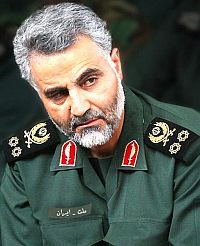
Qassem-SuleimaniMahan Abedin writes: His photos are everywhere in the Iranian media and his name is mentioned on a daily basis by the national broadcaster. Major General Qasem Soleimani, the commander of the Quds force of the Islamic Revolutionary Guards Corps (IRGC), is officially a national hero.

This extreme publicity is all the more surprising in view of Soleimai’s command of the most secretive and sensitive branch of the IRGC. The Quds force is the expeditionary wing of the Revolutionary Guards and spearheads Iran’s engagement with pro-Iranian armies, militias and political factions across the region.

To the outside world, in particular to Iran’s enemies and opponents in the region and beyond, Soleimani is the potent face of Iran’s political and ideological offensive in the Middle East.

This portrait of Soleimani is being increasingly adopted at home as well, fed by a daily diet of the Quds force commander’s exploits on the Iraqi battlefield, most recently in the offensive to re-take Tirkrit from the so-called Islamic State.

Whilst Soleimani’s leading role in Iran’s counter-insurgency efforts in Iraq and Syria is undoubtedly pivotal to the Islamic Republic’s regional policy, there are huge questions marks regarding the extreme publicity that now surrounds him.

One plausible explanation is that Soleimani’s adoption as a national hero heralds a change of political culture in Iran with significant long-term ramifications for the country’s domestic and foreign policy.

Qasem Soleimani’s transformation from a secretive commander to national celebrity is unprecedented in modern Iranian culture, and his enormous popularity notwithstanding, it is not entirely without controversy. [Continue reading…]

Facebooktwittermail

Hardliner wins key post to influence choice of Iran’s next leader

Reuters reports: A prominent hardliner was elected on Tuesday to head the influential body that will pick Iran’s next Supreme Leader.

The surprise choice of Ayatollah Mohammad Yazdi as head of the Assembly of Experts took place at a highly sensitive time, as Iran and six world powers face a March 31 deadline to reach the outline of an agreement over Tehran’s disputed nuclear program.

Supreme Leader Ayatollah Ali Khamenei, 75, underwent prostate surgery last year and rumors have recently resurfaced about his health, although he was shown on television last Sunday meeting a group of environmental activists.

In the internal election, Yazdi, a hardline cleric who headed the judiciary through much of the 1990s, defeated former president Ayatollah Ali Akbar Hashemi Rafsanjani by 47 votes to 24, according to Fars news agency.

“This was unexpected,” said Mashallah Shamsolvaezin, an Iranian journalist and political analyst based in Tehran. “I was genuinely surprised that Yazdi won.”

The result suggested that hardliners within the Assembly had closed ranks at a sensitive time when a new Supreme Leader could soon be chosen – a decision in which the Islamic Revolutionary Guard Corps, the most powerful military force in the country, could also play a role. [Continue reading…]

Facebooktwittermail

Iraq’s Sunnis: Between the ISIS and a hard place

Myriam Benraad writes: More than ever, Iraq’s Sunnis remain ground zero in the struggle that is being waged against the so-called Islamic State (IS). Recent military successes by the international coalition formed by the United States last summer to counter the jihadis through the intercession of local fighters—particularly Iraqi and Syrian Kurdish militias—make it clear that the war’s outcome will in large part be determined on the battlefield. But any defeat of IS, which arose and has been fed principally by the failure of political powers to grasp the scale of the problem in time, must include a political component addressing Sunni grievances in Iraq if it is to be sustainable.

This will be complicated by Iran’s prominent role in the battle against IS. Tehran is now often presented as a stabilizing force in Iraq. However, Iran continues to play into the hands of IS, by remaining silent on the anti-Sunni exactions carried out by Iraqi Shiite militias that are funded, armed and trained by Tehran. Sunni-majority Diyala province was taken back from the jihadis in January by Iraqi security forces backed by these militias as well as Iranian troops, but at the price of more killings and forced displacement of Sunni populations. Iraq’s Shiite prime minister, Haidar al-Abadi, has also done little to rein in these militias, which he needs to compensate for the weakness of the Iraqi army. Meanwhile, the position of outside Sunni powers, Saudi Arabia and Turkey in particular, remains mutable and ambiguous in the fight against IS. Yet defeating IS will require that Sunnis across the region arrive at a coherent strategy, rather than working at cross-purposes, as is currently the case.

The challenge is first and foremost a domestic one for Iraq: How to mobilize Sunnis against IS and bring them back to institutions from which they have been excluded for a decade? From de-Baathification, which became synonymous with “de-Sunnification,” after the U.S.-led invasion of Iraq in 2003, to the 2010 parliamentary elections, in which Iyad Allawi’s largely secular Sunni-backed coalition won a narrow electoral victory but lost out to then-Prime Minister Nouri al-Maliki in the post-election wrangling, Iraq’s Sunnis had no good reason in 2014 to oppose a group that promised them liberation, revenge and political existence. It was the cooperation or non-interference of the Sunni tribes, formerly allied with the Americans against al-Qaida in Iraq between 2006 and 2008 but whose resentment toward Baghdad had since grown, that facilitated IS’ rise. The question now is whether Sunni aversion to Iraq’s political institutions can be reversed. [Continue reading…]

Facebooktwittermail

New ISIS video claims to show child killing Palestinian captive

CNN reports: A newly released ISIS video shows a child shooting a man the group claims is an Israeli spy.

The video identifies the man as 19-year-old Mohamed Said Ismail Musallam, an Israeli citizen of Palestinian descent.

In the video, ISIS shows Musallam’s Israeli passport and claims he’s an agent sent to infiltrate the group. The 19-year-old’s family told CNN Tuesday that he had no ties with the Mossad, Israel’s spy agency, and had, in fact, been recruited by ISIS.

“Mohamed told me and his brother that ISIS took him,” according to Said Musallam, his father. “They sent him money through the Western Union. They said you will have girls, money, cars, villas, paradise, but afterwords he discovered that there is nothing.”

It wasn’t long before Musallam’s family members didn’t recognize him when they talked to him on Skype. The man they knew as a kind and funny brother and son who was once a volunteer firefighter had grown a long beard and was carrying a rifle.

His father tried to help him get home, sending him money and even enlisting the Red Cross. But his son never made it back to Israel. About a month ago, Said Musallam said, he was told his son was taken by ISIS when he was on his way back and trying to cross the border. [Continue reading…]

Facebooktwittermail

Thugs wanted — bring your own boots: How ISIS attracts foreign fighters to its twisted utopia

Jessica Stern and JM Berger write: In August 2014, Isis marked Eid al-Fitr, the end of Ramadan, with a 20-minute HD video offering its greetings to the Muslim world. Gauzy images of smiling worshippers embracing at a mosque cut to children passing out sweets to break the Ramadan fast. This was interspersed with scenes of the muhajireen (emigrants) – British, Finnish, Indonesian, Moroccan, Belgian, American and South African – each repeating a variation on the same message.

“I’m calling on all the Muslims living in the west, America, Europe, and everywhere else, to come, to make hijra with your families to the land of Khilafah,” said a Finnish fighter of Somali descent. “Here, you go for fighting and afterwards you come back to your families. And if you get killed, then … you’ll enter heaven, God willing, and Allah will take care of those you’ve left behind.”

Hijra is an Arabic word meaning “emigration”, evoking the prophet Muhammad’s historic escape from Mecca, where assassins were plotting to kill him, to Medina. Abdullah Azzam, co-founder of al-Qaida and the father of the modern jihadist movement, defined hijra as departing from a land of fear to a land of safety, a definition he later amplified to include the act of leaving one’s land and family to take up jihad in the name of establishing an Islamic state. For most Islamic extremists today, the concepts of hijra and jihad are intimately linked. [Continue reading…]

Facebooktwittermail