Apple and Google’s wage-fixing cartel involved dozens more companies, over one million employees

n13-iconMark Ames writes: Back in January, I wrote about “The Techtopus” — an illegal agreement between seven tech giants, including Apple, Google, and Intel, to suppress wages for tens of thousands of tech employees. The agreement prompted a Department of Justice investigation, resulting in a settlement in which the companies agreed to curb their restricting hiring deals. The same companies were then hit with a civil suit by employees affected by the agreements.

This week, as the final summary judgement for the resulting class action suit looms, and several of the companies mentioned (Intuit, Pixar and Lucasfilm) scramble to settle out of court, Pando has obtained court documents (embedded below) which show shocking evidence of a much larger conspiracy, reaching far beyond Silicon Valley.

Confidential internal Google and Apple memos, buried within piles of court dockets and reviewed by PandoDaily, clearly show that what began as a secret cartel agreement between Apple’s Steve Jobs and Google’s Eric Schmidt to illegally fix the labor market for hi-tech workers, expanded within a few years to include companies ranging from Dell, IBM, eBay and Microsoft, to Comcast, Clear Channel, Dreamworks, and London-based public relations behemoth WPP. All told, the combined workforces of the companies involved totals well over a million employees. [Continue reading…]

Facebooktwittermail

Silicon Valley’s refusal to grow up

f13-iconNoam Scheiber writes: “I have more botox in me than any ten people,” Dr. Seth Matarasso told me in an exam room this February.

He is a reality-show producer’s idea of a cosmetic surgeon—his demeanor brash, his bone structure preposterous. Over the course of our hour-long conversation, he would periodically fire questions at me, apropos of nothing, in the manner of my young daughter. “What gym do you go to?” “What’s your back look like?” “Who did your nose?” In lieu of bidding me goodbye, he called out, “Love me, mean it,” as he walked away.

Twenty years ago, when Matarasso first opened shop in San Francisco, he found that he was mostly helping patients in late middle age: former homecoming queens, spouses who’d been cheated on, spouses looking to cheat. Today, his practice is far larger and more lucrative than he could have ever imagined. He sees clients across a range of ages. He says he’s the world’s second-biggest dispenser of Botox. But this growth has nothing to do with his endearingly nebbishy mien. It is, rather, the result of a cultural revolution that has taken place all around him in the Bay Area.

Silicon Valley has become one of the most ageist places in America. Tech luminaries who otherwise pride themselves on their dedication to meritocracy don’t think twice about deriding the not-actually-old. “Young people are just smarter,” Facebook CEO Mark Zuckerberg told an audience at Stanford back in 2007. As I write, the website of ServiceNow, a large Santa Clara–based I.T. services company, features the following advisory in large letters atop its “careers” page: “We Want People Who Have Their Best Work Ahead of Them, Not Behind Them.”

And that’s just what gets said in public. An engineer in his forties recently told me about meeting a tech CEO who was trying to acquire his company. “You must be the token graybeard,” said the CEO, who was in his late twenties or early thirties. “I looked at him and said, ‘No, I’m the token grown-up.’ ”

In talking to dozens of people around Silicon Valley over the past eight months — engineers, entrepreneurs, moneymen, uncomfortably inquisitive cosmetic surgeons — I got the distinct sense that it’s better to be perceived as naïve and immature than to have voted in the 1980s. [Continue reading…]

Facebooktwittermail

Devasting consequences of losing ‘knowledgeable elders’ in non-human cultures

bluefin-tuna

Culture — something we generally associate with its expressions through art, music, literature and so forth — is commonly viewed as one of the defining attributes of humanity. We supposedly rose above animal instinct when we started creating bodies of knowledge, held collectively and passed down from generation to generation.

But it increasingly appears that this perspective has less to do with an appreciation of what makes us human than it has with our ignorance about non-human cultures.

Although non-human cultures don’t produce the kind of artifacts we create, the role of knowledge-sharing seems to be just as vital to the success of these societies as it is to ours. In other words, what makes these creatures what they are cannot be reduced to the structure of their DNA — it also involves a dynamic and learned element: the transmission of collective knowledge.

The survival of some species doesn’t simply depend on their capacity to replicate their DNA; it depends on their ability to pass on what they know.

Scuola Internazionale Superiore di Studi Avanzati: Small changes in a population may lead to dramatic consequences, like the disappearance of the migratory route of a species. A study carried out in collaboration with the SISSA has created a model of the behaviour of a group of individuals on the move (like a school of fish, a herd of sheep or a flock of birds, etc.) which, by changing a few simple parameters, reproduces the collective behaviour patterns observed in the wild. The model shows that small quantitative changes in the number of knowledgeable individuals and availability of food can lead to radical qualitative changes in the group’s behaviour.

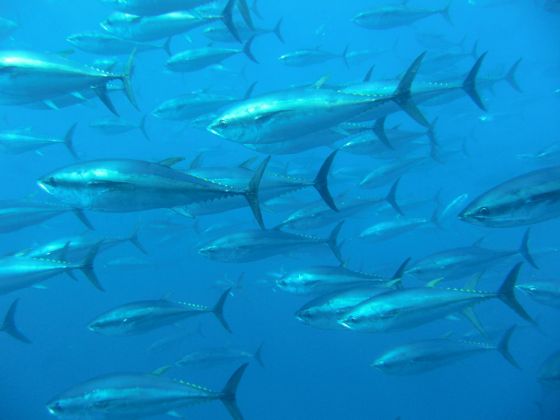
Until the ’50s, bluefin tuna fishing was a thriving industry in Norway, second only to sardine fishing. Every year, bluefin tuna used to migrate from the eastern Mediterranean up to the Norwegian coasts. Suddenly, however, over no more than 4-5 years, the tuna never went back to Norway. In an attempt to solve this problem, Giancarlo De Luca from SISSA (the International School for Advanced Studies of Trieste) together with an international team of researchers (from the Centre for Theoretical Physics — ICTP — of Trieste and the Technical University of Denmark) started to devise a model based on an “adaptive stochastic network.” The physicists wanted to simulate, simplifying it, the collective behaviour of animal groups. Their findings, published in the journal Interface, show that the number of “informed individuals” in a group, sociality and the strength of the decision of the informed individuals are “critical” variables, such that even minimal fluctuations in these variables can result in catastrophic changes to the system.

“We started out by taking inspiration from the phenomenon that affected the bluefin tuna, but in actual fact we then developed a general model that can be applied to many situations of groups “on the move,” explains De Luca.

The collective behaviour of a group can be treated as an “emerging property,” that is, the result of the self-organization of each individual’s behaviour. “The majority of individuals in a group may not possess adequate knowledge, for example, about where to find rich feeding grounds” explains De Luca. “However, for the group to function, it is enough that only a minority of individuals possess that information. The others, the ones who don’t, will obey simple social rules, for example by following their neighbours.”

The tendency to comply with the norm, the number of knowledgeable individuals and the determination with which they follow their preferred route (which the researchers interpreted as being directly related to the appeal, or abundance, of the resource) are critical variables. “When the number of informed individuals falls below a certain level, or the strength of their determination to go in a certain direction falls below a certain threshold, the migratory pathway disappears abruptly.”

“In our networks the individuals are “points,” with interconnections that form and disappear in the course of the process, following some established rules. It’s a simple and general way to model the system which has the advantage of being able to be solved analytically,” comments De Luca.

So what ever happened to the Norwegian tuna? “Based on our results we formulated some hypotheses which will, however, have to be tested experimentally,” says De Luca. In the’50s Norway experienced a reduction in biomass and in the quantity of herrings, the main prey of tuna, which might have played a role in their disappearance. “This is consistent with our model, but there’s more to the story. In a short time the herring population returned to normal levels, whereas the tuna never came back. Why?”

One hypothesis is that, although the overall number of Mediterranean tuna has not changed, what has changed is the composition of the population: “The most desirable tuna specimens for the fishing industry are the larger, older individuals, which are presumably also those with the greater amount of knowledge, in other words the knowledgeable elders.” concludes De Luca.

Another curious fact: what happens if there are too many knowledgeable elders? “Too many know-alls are useless,” jokes De Luca. “In fact, above a certain number of informed individuals, the group performance does not improve so much as to justify the “cost” of their training. The best cost-benefit ratio is obtained by keeping the number of informed individuals above a certain level, provided they remain a minority of the whole population.”

Facebooktwittermail

Climate change deniers: The growing strength of the opponents of science

o13-iconNick Cohen writes: The American Association for the Advancement of Science came as close as such a respectable institution can to screaming an alarm last week. “As scientists, it is not our role to tell people what they should do,” it said as it began one of those sentences that you know will build to a “but”. “But human-caused climate risks abrupt, unpredictable and potentially irreversible changes.”

In other words, the most distinguished scientists from the country with the world’s pre-eminent educational institutions were trying to shake humanity out of its complacency. Why weren’t their warnings leading the news?

In one sense, the association’s appeal was not new. The Royal Society, the Royal Institution, Nasa, the US National Academy of Sciences, the US Geological Survey, the IPCC and the national science bodies of 30 or so other countries have said that man-made climate change is on the march. A survey of 2,000 peer-reviewed papers on global warming published in the last 20 years found that 97% said that humans were causing it.

When the glib talk about the “scientific debate on global warming”, they either don’t know or will not accept that there is no scientific debate. The suggestion first made by Eugene F Stoermer that the planet has moved from the Holocene, which began at the end of the last ice age, to the manmade Anthropocene, in which we now live, is everywhere gaining support. Man-made global warming and the man-made mass extinction of species define this hot, bloody and (let us hope) brief epoch in the world’s history.

If global warming is not new, it is urgent: a subject that should never be far from our thoughts. Yet within 24 hours of the American association’s warning the British government’s budget confirmed that it no longer wanted to fight it. [Continue reading…]

Facebooktwittermail

Wall Street’s ties to Putin threatened as sanctions bite

a13-iconBloomberg reports: Wall Street leaders including Lloyd Blankfein and James Gorman, who have courted business in Vladimir Putin’s Russia, are facing a dilemma as tensions over Ukraine escalate.

Their scheduled attendance at Putin’s annual investor showcase in St. Petersburg in May is in doubt as sanctions imposed by the U.S. in response to Russia’s annexation of Crimea — and retaliatory moves by Putin — threaten the ties between Russia’s leader and businesses including Goldman Sachs Group Inc. and Morgan Stanley. Spokesmen for the New York-based banks declined to comment on whether the executives will attend.

Wall Street firms that have pursued deals in Russia for years are being forced by the dispute over Ukraine to reexamine their bet on friendlier relations between Putin and the West. U.S. President Barack Obama yesterday added to the list of Russians targeted by financial sanctions and a June Group of Eight meeting in Russia was scrapped. Russia banned entry by U.S. leaders including House Speaker John Boehner.

“If you’re a head of a major U.S. financial institution, you say, ‘President Obama’s not going to the G-8 meeting, should I go to St. Petersburg?’” said Edwin Truman, a senior fellow with the Peterson Institute for International Economics who was an assistant Treasury secretary for international affairs in the Clinton administration. “If they don’t ask themselves that question, they’re not doing their job.”

Obama yesterday ordered financial sanctions on OAO Bank Rossiya, a St. Petersburg-based lender owned by Putin associates, and on an increasing number of Russian officials, saying the incursion into Ukraine and continuing military movements carry “dangerous risks of escalation” and must be met by unified global opposition. Russia responded by barring entry by nine U.S. officials, including Boehner.

At stake are investments made over years and sometimes decades by global companies in Russia, where economic growth had until recently outstripped the U.S.

Goldman Sachs has made at least $1 billion in investments in Russian companies and won a three-year contract last year to advise the Kremlin on improving the nation’s image overseas and to help the country attract more investors. [Continue reading…]

Facebooktwittermail

Crimea leader urges Ukraine’s Russians to fight Kiev

n13-iconAFP reports: Crimea’s rebel leader urged Russians across Ukraine on Sunday to rise up against Kiev’s rule and welcome Kremlin forces whose unrelenting march against his flash point peninsula has defied Western outrage.

The call came amid growing anxiety among Kiev’s Western-backed rulers that Russian President Vladimir Putin — flushed with expansionist fervor — will imminently order an all-out attack on his ex-Soviet neighbor after being hit by only limited EU and U.S. sanctions for taking the Black Sea cape.

“The aim of Putin is not Crimea but all of Ukraine,” Ukraine’s National Security and Defence Council chief Andriy Parubiy told a mass unity rally in Kiev.

“His troops massed at the border are ready to attack at any moment,” he said a day after Russian forces used armored personnel carriers and stun grenades to capture Ukraine’s main Crimean air base. [Continue reading…]

Facebooktwittermail

NATO says Russia has big force at Ukraine’s border, worries over Transdniestria

n13-iconReuters reports: NATO’s top military commander said on Sunday that Russia had a large force on Ukraine’s eastern border and said he was worried it could pose a threat to Moldova’s mainly Russian-speaking separatist Transdniestria region.

NATO’s Supreme Allied Commander Europe, U.S. Air Force General Philip Breedlove, voiced concern about Moscow using a tactic of snap military exercises to prepare its forces for possible rapid incursions into a neighboring state, as it had done in the case of Ukraine’s Crimea region.

Russia launched a new military exercise, involving 8,500 artillery men, near Ukraine’s border 10 days ago.

“The (Russian) force that is at the Ukrainian border now to the east is very, very sizeable and very, very ready,” Breedlove told an event held by the German Marshall Fund think-tank.

The president of ex-Soviet Moldova warned Russia last Tuesday against considering any move to annex Transdniestria, which lies on Ukraine’s western border, in the same way that it has taken control of Crimea. [Continue reading…]

Daniel Berman argues: Transnistria may well wish for annexation for Russia, but the likelihood of Russia acting on that request depends on a calculation of its future relationship with Kiev, and portents bode ill. The Russian annexation of Crimea has alienated Ukrainian opinion while removing one of the major reserves of Pro-Russian votes in Ukrainian elections. Any further annexations in the East will only exacerbate that problem and reinforce that lack of influence in Kiev. Moscow may be able to extract concessions, geopolitical neutrality, and Finlandization from Kiev, but those will be extracted by force, either economic or military. It is unlikely the Ukraine will see a genuinely Pro-Russian government for a generation.

Mike Giglio reports from eastern Ukraine: Uncertainty about Russia’s intentions looms in Kharkiv, and several residents put the chances of invasion at “50-50.” Fears that an invasion is imminent, though, have gradually eased since last week’s referendum in Crimea. And activists on both sides stressed that support for Russian intervention in eastern Ukraine is considerably less than it was in Crimea, where Russian troops faced little resistance. Many expected locals and Ukrainian troops alike to fight back if Russia tried to move in. “You can’t compare this to Crimea,” said Andrei Borodavka, a Kharkiv journalist and pro-Russia activist. “The Russians don’t want to kill Ukrainians or Ukrainian soldiers.”

Borodavka said he thought Russia would intervene only in the case of persistent violence — and on a far larger scale than the shootings that took place in Kharkiv on March 14, however much they may have jarred residents here.

Yet on the highways around Kharkiv, military vehicles could be seen making their way to the border, as the Kiev government moved to shore up its forces there. They would be little match for the Russians — in one glaring sign of the Ukrainian army’s weakness, Kharkiv activists were regularly delivering food and blankets to the under-supplied troops. Yet the army seemed determined at least not to be caught off guard.

Facebooktwittermail

Ukraine and Crimea: What is Putin thinking?

f13-iconThe Guardian reports: When Vladimir Putin summoned the entirety of Russia’s political elite to the St George’s Hall of the Kremlin to announce that Russia would “welcome back” the territory of Crimea last week, the atmosphere was one almost of a country united in military victory.

In people’s hearts and minds, Crimea has always been an inseparable part of Russia,” said Putin, making it sound like it had always been just a matter of time before Moscow made its move to recover the territory. “This firm conviction is based on truth and justice.”

Some have seen Putin’s actions in the context of a post-imperial complex and a leader longing to reconstitute some form of the Soviet Union by gathering up lost territories. There may be a flicker of truth in this, but the reality is more complex, according to those familiar with the Kremlin’s decision-making over Crimea in recent weeks.

The evidence about how decisions were made over the past month points to reactive, ad-hoc and impulsive moves, rather than the implementation of a strategic gambit long in the planning. [Continue reading…]

Facebooktwittermail

What Pakistan knew about Bin Laden

f13-iconIn a long extract from her upcoming book, The Wrong Enemy: America in Afghanistan, 2001-2014, Carlotta Gall writes: Shortly after the Sept. 11 attacks, I went to live and report for The New York Times in Afghanistan. I would spend most of the next 12 years there, following the overthrow of the Taliban, feeling the excitement of the freedom and prosperity that was promised in its wake and then watching the gradual dissolution of that hope. A new Constitution and two rounds of elections did not improve the lives of ordinary Afghans; the Taliban regrouped and found increasing numbers of supporters for their guerrilla actions; by 2006, as they mounted an ambitious offensive to retake southern Afghanistan and unleashed more than a hundred suicide bombers, it was clear that a deadly and determined opponent was growing in strength, not losing it. As I toured the bomb sites and battlegrounds of the Taliban resurgence, Afghans kept telling me the same thing: The organizers of the insurgency were in Pakistan, specifically in the western district of Quetta. Police investigators were finding that many of the bombers, too, were coming from Pakistan.

In December 2006, I flew to Quetta, where I met with several Pakistani reporters and a photographer. Together we found families who were grappling with the realization that their sons had blown themselves up in Afghanistan. Some were not even sure whether to believe the news, relayed in anonymous phone calls or secondhand through someone in the community. All of them were scared to say how their sons died and who recruited them, fearing trouble from members of the ISI, Pakistan’s main intelligence service.

After our first day of reporting in Quetta, we noticed that an intelligence agent on a motorbike was following us, and everyone we interviewed was visited afterward by ISI agents. We visited a neighborhood called Pashtunabad, “town of the Pashtuns,” a close-knit community of narrow alleys inhabited largely by Afghan refugees who over the years spread up the hillside, building one-story houses from mud and straw. The people are working class: laborers, bus drivers and shopkeepers. The neighborhood is also home to several members of the Taliban, who live in larger houses behind high walls, often next to the mosques and madrasas they run. [Continue reading…]

This article appeared in most of the international editions of the New York Times with the exception of the Express Tribune in Pakistan. There, the paper’s printer removed the article.

Facebooktwittermail

Palestinians forced to demolish own homes

f13-iconAl Jazeera reports: For the past two months, Hamzah Abu Terr has slept on the floor of his home. He gave his bed to his three small children whose room he was forced to destroy earlier this year, to avoid large demolition fines issued by the Israeli municipality.

“I had no choice,” said Hamzah, sitting on the couch at his home in East Jerusalem next to his eldest daughter. “It was either my hands or their bulldozers.”

The single father received a demolition order in 2001, after the extension – a kitchen and bedroom – to his one-room house was deemed illegal by the Jerusalem municipality. He spent the next 12 years fighting the order in Israeli courts, paying more than 100,000 shekels ($28,775) in fees and fines. He even had to sell his now ex-wife’s jewellery.

“I could not fight it anymore. I had to destroy it myself,” Hamzah told Al Jazeera. “The kids can’t understand this: Their father destroyed their room. They were angry, sad… confused.”

This pattern of illegal construction and demolition is common throughout East Jerusalem. According to the United Nations, a set of discriminatory laws, polices and practices applied to Palestinian residents makes building “legally” next to impossible. [Continue reading…]

Facebooktwittermail

Industrial espionage: NSA hacked servers of China telecom giant Huawei

n13-iconThe New York Times reports: American officials have long considered Huawei, the Chinese telecommunications giant, a security threat, blocking it from business deals in the United States for fear that the company would create “back doors” in its equipment that could allow the Chinese military or Beijing-backed hackers to steal corporate and government secrets.

But even as the United States made a public case about the dangers of buying from Huawei, classified documents show that the National Security Agency was creating its own back doors — directly into Huawei’s networks.

The agency pried its way into the servers in Huawei’s sealed headquarters in Shenzhen, China’s industrial heart, according to N.S.A. documents provided by the former contractor Edward J. Snowden. It obtained information about the workings of the giant routers and complex digital switches that Huawei boasts connect a third of the world’s population, and monitored communications of the company’s top executives.

One of the goals of the operation, code-named “Shotgiant,” was to find any links between Huawai and the People’s Liberation Army, one 2010 document made clear. But the plans went further: to exploit Huawai’s technology so that when the company sold equipment to other countries — including both allies and nations that avoid buying American products — the N.S.A. could roam through their computer and telephone networks to conduct surveillance and, if ordered by the president, offensive cyberoperations. [Continue reading…]

MIT Technology Review: How’s this for a tough sales job? The American sales reps of Huawei offer top-notch telecom gear at a 35 percent discount. But anytime they get near to closing a sale, their customers get a visit from the FBI or the U.S. Department of Commerce.

The message from the feds isn’t subtle: buy something else.

Huawei, based in Shenzhen, China, is the world’s largest seller of telecom equipment, commanding 20 percent of the market. Yet it is barely a factor in North America. Here its market share in optical equipment is just 1.4 percent, and in switches and routers it’s just 0.1 percent.

Just as Huawei has been shut out of the American market, leaks about the pervasiveness of spying by the NSA and other U.S. intelligence agencies might now hurt American companies abroad. Businesses are starting to talk of a “Snowden effect” of lost sales, dimmed prospects, and growing uncertainty, as they too come under a cloud of mistrust.

Huawei (pronounced wah-way) was founded in 1987 by Ren Zhengfei, a former military officer who splits the CEO job with executives who rotate every six months. As Huawei expanded overseas, suspicions began to swirl around the company, particularly in the United States. Its effort to buy 3Com, a networking company, was blocked by a trade panel that assesses national security risks. In 2011, Cisco Systems, a competitor, developed talking-point slides that laid out reasons for “Fear of Huawei.”

In 2012, partly at the Chinese company’s request, the U.S. House Intelligence Committee investigated and released a report. It offered no real proof of spying, yet it still concluded that the United States must “view with suspicion” progress by Chinese companies in the North America telecommunications market.

The concern was that somehow, with Huawei’s knowledge or without it, the Chinese government could use equipment sold by the company to eavesdrop or even to gain an advantage in a cyberwar. Huawei loudly denied the charges; it cried “discrimination.”

The irony now is that leaked National Security Agency documents suggest the U.S. was doing everything it suspected China of. The documents indicate that the U.S. may have compromised routers from Cisco, Juniper, and Huawei. It’s also believed to have weakened encryption products so the ciphers used by commercial software could be broken. [Continue reading…]

Facebooktwittermail

The NSA, flight MH370, and the unknown

A few days ago I saw this headline: “Why don’t we just ask the NSA where the plane is?”

I expected a piece of pointed commentary or even that it came from The Onion. I assumed someone thought the international search for a missing plane should serve as a reminder that the NSA is not actually able to monitor everything happening on this planet.

It turned out, unfortunately, that the question came from a conspiracy theorist who was convinced that the only possible explanation for the NSA’s lack of helpfulness during the ongoing search for Malaysia Airlines Flight 370 was that the agency must be guarding some dirty secret.

For the rest of us — which is to say, people not inclined to believe that this plane was either shot down by the U.S. or that its passengers were abducted by aliens — the link to the NSA should provide a reality check.

However advanced the NSA’s capabilities are for globally tracking the movement of millions of microscopic electronic packets of information moving at close to the speed of light, it turns out that the movement of a great big hulk of metal carrying 239 people at less than 600MPH took place outside the NSA’s line of sight. (Neither is there any reason to assume that the US National Reconnaissance Office, through its satellite imagery, has secretly been the guardian of the truth about MH370.)

Those of us who spend too much time on the internet can easily succumb to a worldview within which the movement of information forms a global matrix to which seemingly everything is tied. We lose sight of the fact that what is known is dwarfed by an infinitely larger unknown.

We forget that most of what is forgotten is lost forever, and most of what is happening everywhere is never known.

I live in a region clad by vast tracts of forest where every day, trees fall unheard, unseen. Societies whose laws we may never learn govern the undergrowth. And beneath the forest, the skeletal remains of mountains whose height could never be measured have been ground into clay.

Earthquakes and volcanoes show the magnitude of events that can catch people by surprise, telling us that we don’t even know what is happening under our own feet. We don’t know what’s happening inside each cell in our body. We don’t know which neural networks are firing inside our brains right now or what these interior firework displays signify. We can’t remember everything we’ve ever said or heard. The events that form the fabric of our lives, turn out to be like glistening dew drops on a spider’s web. They disappear under the glare of a rising sun, never to be seen again.

* * *

The NSA and Google are co-conspirators, not in a formal sense, but in as much as they are jointly invested in the prevailing delusion of this age: that it is possible to know everything.

For the NSA, this fantasy is a tool for manipulating Congress — it implies that the only real obstacle to perfect security is adequate funding.

For Google, its mission to “organize the world’s information and make it universally accessible and useful” implies we live in a world governed by information (and Google’s beneficent hand) and that this information truly encompasses the world — and that its uncharted territories will soon be mapped.

This worldview not only fails to recognize the incomprehensible vastness of the unknown, but it also reinforces a view of human agency that makes us imagine we have the power to control all things.

Instead of seeing an issue like climate change as a consequence of our reckless behavior, which is to say, seeing it as an industrially triggered planetary convulsion, we risk seeing it as a technical problem which sooner or later is bound to yield to a technical solution.

But to see the true relationship between the known and the unknown is not only a vital form of realism; it’s also the only way of holding human grandiosity in check.

We do not live in a world that calls to be mastered; it demands to be met with humility. The Earth can survive without us, but we can’t survive without this planet. Only by recognizing that we are not on the brink of becoming all-seeing gods can we see our real place in the scheme of things.

Facebooktwittermail

Revelations of NSA spying cost U.S. tech companies

a13-iconThe New York Times reports: Microsoft has lost customers, including the government of Brazil.

IBM is spending more than a billion dollars to build data centers overseas to reassure foreign customers that their information is safe from prying eyes in the United States government.

And tech companies abroad, from Europe to South America, say they are gaining customers that are shunning United States providers, suspicious because of the revelations by Edward J. Snowden that tied these providers to the National Security Agency’s vast surveillance program.

Even as Washington grapples with the diplomatic and political fallout of Mr. Snowden’s leaks, the more urgent issue, companies and analysts say, is economic. Technology executives, including Mark Zuckerberg of Facebook, raised the issue when they went to the White House on Friday for a meeting with President Obama.

It is impossible to see now the full economic ramifications of the spying disclosures — in part because most companies are locked in multiyear contracts — but the pieces are beginning to add up as businesses question the trustworthiness of American technology products. [Continue reading…]

Facebooktwittermail

Crimea first ‘ethnic Russian republic’ within Russian Federation

a13-iconPaul Goble writes: By annexing Crimea, Vladimir Putin has created “the only ethnic Russian republic” within the Russian Federation, an ethnicization of political life there that will begin by threatening the Crimean Tatars with a new round of repression and end by threatening more of Russia’s neighbors and Russia itself, according to Renat Akhmetov.

In a lead article in the new issue of “Zvezda Povolzhya,” Akhmetov calls attention to an aspect of the Crimean crisis that few have underlined. By the actions he has taken, Putin has set up “the only ethnic Russian republic” [“yedinstvennaya russkaya revolyutsiya”] within the Russian Federation (“Zvezda Povolzhya, no. 10 (690), 20-26 March 2014, p. 1).

“Today,” the Kazan editor writes, “the Crimean Tatars face a difficult choice.” They can either decide to take Russian Federation citizenship or refuse to do so and become, within 30 days, foreigners on their own land, a status that he points out could allow Moscow to deal with them as it can with any other “migrants.”

The Milli Mejlis, “did not participate in the referendum, boycotted it, consider it illegal, and consequently it is more probable that the Crimean Tatars” will choose the latter status, Akhmetov says. If they do, then that will vitiate the meaning of Moscow’s offer of a reservation of 20 percent of the seats in the new Crimean parliament for the Crimean Tatars and of its declaration that Crimean Tatar will be the third official language on the peninsula.

Already, he notes, “certain leaders of Crimea have begun to say that the lands which the Crimean Tatars had obtained by unilateral action will be returned to their owners at the time of the re-registration of such acts on the basis of Russian legislation.” How the Crimean Tatars would react to that is not difficult to predict.

Moscow thus faces a choice of two options concerning what to do. Either it can make maximum concessions to the Crimean Tatars in the hopes of winning them over or at least dissuading them from resistance – concessions Russian nationalists would not like – or it can begin “a policy of ‘soft’ deportation,” one that would involve sending the Crimean Tatars to neighboring Kherson oblast.

If it chooses the latter course, Akhmetov argues, that will contribute to yet another stage in the international isolation of the Russian Federation because then what Putin would be doing would recall for too many “a rebirth of Stalin’s deportation policy.” And to sustain that would require the rebirth of Stalinism in Russia itself. [Continue reading…]

Facebooktwittermail

In Ukraine, few think Crimea marks the end of Putin’s expansion

a13-iconMcClatchy reports: With the Russian takeover of Crimea all but complete — Russia’s Senate is expected to give final approval to the Black Sea peninsula’s annexation on Friday — Ukrainians are waiting for the other shoe to drop. And expecting that it certainly will.

Indeed, many people here believe Russian President Vladimir Putin is playing a game that goes far beyond reclaiming a piece of land that first became part of the Russian Empire during the rule of Catherine the Great. What they see adds up to what in Kiev is now jokingly referred to as a “Russian Spring,” a term usually meaning an uncomfortably cold season.

But while in the United States it’s fashionable to cast Putin as playing chess, his approach seems closer to the American board game “Risk” — a game of maps.

“All options remain on the table,” said Bobo Lo, a Russia expert at the British think tank Chatham House.

What are those options? For those who wonder if Putin, who famously has said the collapse of the Soviet Union 23 years ago was the greatest tragedy of the 20th century, might be intent on reassembling at least part of it, the next conquest could be southeastern Ukraine.

“Crimea is definitely not the end,” said leading Ukrainian military analyst Oleksiy Melnyk, co-director of Razumkov Centre, a research center in Kiev. “He will not be satisfied.”

Experts then wonder about Transnistria in Moldova, a breakaway region that has requested Russian annexation. That’s just west of Ukraine. And just north is Belarus, also discussed by Putin as historically important to Russia. [Continue reading…]

Facebooktwittermail

Russia’s shifting of border force stirs U.S. worry

n13-iconThe New York Times reports: The White House cast doubt Friday on the Kremlin’s claims that thousands of troops massing on the border of southeastern Ukraine are merely involved in training exercises, deepening fears that Russian aggression will not end in Crimea.

“It’s not clear what that signals,” the national security adviser, Susan E. Rice, said to reporters in a briefing at the White House. But she added, “Obviously given their past practice and the gap between what they have said and what they have done, we are watching it with skepticism.”

At the Pentagon, senior officers and analysts said they were monitoring the Russian infantry, airborne, air defense and other reinforcements with growing alarm, uncertain of President Vladimir V. Putin’s ambitions.

Pentagon officials do not believe that a new Russian move into Ukraine is imminent. But one of their big worries is that American and NATO officials would have virtually no time to react if it did happen. All told, officials said, there are more than 20,000 troops near the border. [Continue reading…]

Facebooktwittermail