Israel advances plans for 2,269 West Bank homes

n13-iconAFP reports: Israel has progressed with plans for more than 2,000 new homes in six West Bank settlements, an official said Thursday, in a move likely to further endanger peace talks.


Guy Inbar, a spokesman for the defence ministry unit responsible for civilian affairs in the Palestinian territories, said a ministry committee had furthered existing plans for 2,269 homes at a meeting last month.

He confirmed claims by anti-settlements Israeli group Peace Now about decisions on two sets of projects, which the watchdog said the committee had examined on February 19.

In the first case, the committee approved for validation 1,015 units in Leshem, Beit El and Almog, meaning the only remaining formality for their final approval is the okay of Defence Minister Moshe Yaalon.

The same committee approved for deposit 1,254 units in Ariel, Shvut Rachel and Shavei Shomron, meaning those projects will now be published in the media for public comment before returning to the committee for further discussion. [Continue reading…]

Facebooktwittermail

Ukrainian nationalists hand Russians propaganda coup with video of assault

n13-iconRobert Mackey reports: Since a coalition of Ukrainian opposition groups took control of Independence Square in Kiev and held it long enough to undermine the authority of President Viktor Yanukovych, the Russian government and news media outlets under Kremlin control have consistently focused on the part played by far-right, nationalist demonstrators who manned the barricades there during deadly clashes with the police.

To counter the perception fostered in Moscow that the interim government in Kiev, which took power after Mr. Yanukovych fled the country, is led by neo-Nazis and fascist thugs, pro-Western Ukrainian activists have drawn attention to voices of moderation and tolerance in their coalition. One part of that effort was a YouTube video letter to the Russian people from prominent Ukrainian musicians and artists who appealed, in Russian, for peace, love and understanding from their neighbors. “There are no ‘Nazis’ here; your brothers are here,” the singer Valeriy Kharchyshyn said in the video. “We love you and we don’t want war.”

In that context, a highly discordant note was struck by video posted on YouTube this week that showed three men who represent the Ukrainian nationalist party Svoboda in Parliament berating the head of Ukraine’s state broadcaster over his decision to cover the Kremlin ceremony marking the annexation of Crimea. [Continue reading…]

Facebooktwittermail

Tom Engelhardt: The inimitable Colonel Manners

Col. Manners answers your questions on CIA practices, proper cyberwar behavior, and invasion etiquette
By Tom Engelhardt

[Editor’s note: Our old friend Colonel Manners (ret.) made his first appearance at TomDispatch last October.  Today, he’s back for the third time.  We have yet to run into anyone more knowledgeable in the mores, manners, and linguistic habits of the national security state.  His CV (unfortunately redacted) would blow you away.  At a time of heightened tension among the U.S. Intelligence Community, the White House, Congress, and the American people, who better to explain the workings and thought patterns of the inner world of official Washington than the Colonel?  Once again, he answers the questions of ordinary citizens about how their secret government actually works.  Among advice columnists, he’s a nonpareil.  Here’s just a sampling of his answers to recent correspondence.]

Dear Col. Manners,

When Barack Obama entered the Oval Office, he insisted that we “look forward,” not backward.  While he rejected the widespread use of torture and abuse by the CIA in the Bush years, his Department of Justice refused to prosecute a single torture case, even when death was the result.  (The only CIA agent to go to jail during the Obama presidency was the guy who blew the whistle on the CIA torture program!) 

Jump ahead five years, and instead of looking forward, it seems that we’re again looking backward big time.  The head of the Senate Intelligence Committee, Sen. Dianne Feinstein, usually the staunchest backer of U.S. intelligence, seems to have sworn a vendetta against the CIA on the Senate floor for spying on her oversight committee as it prepared its still-unreleased report on the Agency’s torture program.  The CIA denies it all and claims committee staffers spied on them.  Once again, the Justice Department faces the issue of charges over the Agency’s torture program!  It seems like little short of a constitutional catfight.

What gives, Colonel?  Shouldn’t President Obama have prosecuted CIA torturers in the first place and isn’t it time that he and his Justice Department finally take all this to court?

Tortured in Tacoma

Dear Tortured,

You’ve hit the nail on the head!  When Senator Feinstein turns on the CIA, the situation couldn’t be more disturbing — or out of hand.  But believe me, the answer is not to call on the Justice Department (of all places!) to sort this out.  After all, as you indicate, it was incapable of prosecuting the killing of tortured prisoners, so it’s hardly likely to adopt a take-no-prisoners attitude toward either the CIA or the Senate Intelligence Committee over possible computer spying. 

Instead, as the president long ago suggested, we need to look forward, not backward.  And with that in mind, Senator John McCain has, I believe, made the most useful suggestion: that an independent investigative body be empaneled to get to the bottom of the dispute between Feinstein and the CIA.  As you know, over the last five years, the Senate Intelligence Committee has managed to write a still-incomplete report on the CIA’s black sites and torture campaign.  Though unreleased to the public even in redacted or summary form, it is reportedly 6,300 pages long.  By comparison, the first novel in history, the Tale of Genji, is only 1,200 pages, and War and Peace only 1,800 pages.  (And yes, Tortured, we in the secret world do have a certain attraction to fiction.)

Continue reading

Facebooktwittermail

When it’s hard to catch terrorists or crooks, it’s easier to create them

Mike Masnick writes: For years now, we’ve been writing about the FBI’s now popular practice of devising its own totally bogus “terrorist plots” and then convincing some hapless individual to join the “plot” only to later arrest them to great fanfare, despite the fact that everyone (other than the arrested person) involved was actually an FBI agent, and there was no actual danger or real plot (or real terrorists) involved. In fact, we just had yet another such story. We’ve written about similar occurances over and over and over and over and over and over and over and over and over and over and over again — and, depressingly, it seems that courts repeatedly uphold this practice as not being entrapment. Many have been questioning why the FBI is spending so much time and money creating fake terrorist plots that don’t seem to protect anyone (but do give the FBI/DOJ lots of big headlines about “stopping terrorism!”), but the courts have basically let it go.

However, it finally appears that one judge thinks these kinds of things go too far — and it happens to be Judge Otis Wright, whose name you may recall from being the first judge to really slap down Prenda law for its obnoxious copyright trolling practices. Reader Frankz alerts us to the news Wright has dismissed a case involving the Bureau of Alcohol Tobacco and Firearms (ATF) for a similar “made up crime” and completely trashed the government for doing these kinds of things. As with his order in the Prenda case, I urge you to read his full dismissal which is granted for “outrageous government conduct.” Judge Wright, it appears, is not one to hide his opinions about those who abuse the legal system. The ruling kicks off with a hint of where this is heading:

“‘Lead us not into temptation,’” Judge Noonan warned. United States v. Black,
733 F.3d 294, 313 (Noonan, J., dissenting). But into temptation the Government has gone, ensnaring chronically unemployed individuals from poverty-ridden areas in its fake drug stash-house robberies. While undoubtedly a valid law-enforcement tool when employed to target or prevent demonstrated criminal enterprises, reverse stings offend the United States Constitution when used solely to obtain convictions.

This case didn’t involve “terrorism” like the FBI cases, but rather a similar “reverse sting” in which an ATF agent pretends to be a cocaine courier, tells some dupes about a “stash house” he knows about and then pushes them to rob the house. [Continue reading…]

Facebooktwittermail

America’s regime of institutionalized torture

o13-iconSadhbh Walshe writes: Sarah Shourd still has nightmares about the 13 months she spent in solitary confinement in Iran. “It reduces you to an animal-like state,” she tells me. Shourd recalled the hours she spent crouched down at the food slot of her cell door, listening for any sign of life. Or pounding on the walls until her knuckles bled. Or covering her ears to drown out the screams – the screams she could no longer distinguish as her own – until she felt the hands of a prison guard on her face, trying to calm her.

Shourd was captured by the Iranian government in 2009, along with her now husband Shane Bauer and their friend Josh Fattal, when they accidentally crossed over the border during a long vacation hike. The three have just released a book called A Sliver of Light about their subsequent incarceration. Shourd spent less time in Evin prison than Bauer and Fattal, but she was held in solitary confinement for her entire stay. Her devastating account of how this isolation almost caused her to unravel will, no doubt, shock many American readers. They should be even more shocked, however, to know that there are tens of thousands of prisoners held in isolation in American prisons every day – and the conditions to which they’re subjected are not much better than Shourd’s in Iran.

Indeed, ‘the hole’ in the US is sometimes even worse than the worst public horror stories.

Scientific studies have shown that it can take less than two days in solitary confinement for brainwaves to shift towards delirium or stupor (pdf). For this reason, the United Nations has called on all countries to ban solitary confinement – except in exceptional circumstances, and even then to impose a limit of no longer than 15 days so that any permanent psychological damage can be averted. Shourd spent a total of 410 days in solitary and was diagnosed with post-traumatic stress disorder after her release. She still has trouble sleeping. But since returning home, she has spent much of her time trying to draw attention to the plight of more than 80,000 Americans who are held in isolation on any given day, some of whom do not count their stay in days or months, but in years and even decades. [Continue reading…]

Facebooktwittermail

How long before Palestinian nationalism gives way to the pursuit of equal rights inside a single state?

A Palestinian nationalist movement that has endured decades of failure is probably not about to expire. Indeed, the one thing that can be reliably inferred about the lesson of continuing failure is that failure, far from necessitating change, seems to inspire persistence.

If we have failed for this long, that’s no reason to give up now, since last year, the year before that, and the year before that, and on and on, dedication to this heroic fight has meant the willingness to enjoy no rewards.

Some might call that resistance; others might see it as an exercise in futility.

It’s perhaps worth remembering Thomas Kuhn’s succinct analysis (reiterating Max Planck) of the most common cause of a paradigm shift: the proponents of the old paradigm drop dead.

[A] new scientific truth does not triumph by convincing its opponents and making them see the light, but rather because its opponents eventually die, and a new generation grows up that is familiar with it.

The New York Times reports: When President Mahmoud Abbas of the Palestinian Authority visited the White House this week, he again heard dire warnings that the current moment could be the last chance for a two-state solution through negotiations with Israel.

Back home in Ramallah, Mr. Abbas’s own son has been telling him that last chance is already long gone, the negotiations futile. The son, Tareq Abbas, a businessman who has long shied away from politics and spotlights, is part of a swelling cadre of prominent Palestinians advocating instead the creation of a single state stretching from the Jordan River to the Mediterranean Sea in which Jews and Arabs would all be citizens with equal rights.

“If you don’t want to give me independence, at least give me civil rights,” Mr. Abbas, 48, said in a rare interview at his well-appointed apartment here as his father headed to Washington. “That’s an easier way, peaceful way. I don’t want to throw anything, I don’t want to hate anybody, I don’t want to shoot anybody. I want to be under the law.”

President Abbas, in a separate interview last month, said Israel’s continued construction in West Bank settlements made it impossible to convince Tareq that the two-state solution was still viable.

“I said, ‘Look, my son, we are looking for two-state solution and this is the only one.’ He said, ‘Oh, my father, where is your state? I wander everywhere and I see blocks everywhere, I see houses everywhere,’ ” the elder Mr. Abbas, 78, recalled. “I say, ‘Please, my son, this is our position, we will not go for one state.’ He says, ‘This is your right to say this, and this is my right to say that.’ Because he is desperate. He doesn’t find any sign for the future that we will get a two-state solution, because on the ground he doesn’t see any different.”

Such intergenerational arguments have become commonplace in the salons of Palestinian civil society and at kitchen tables across the West Bank as the children and grandchildren of the founders of the Palestinian national movement increasingly question its goals and tactics. [Continue reading…]

Facebooktwittermail

Xenophobia in Russia at an all-time high, experts say

a13-iconPaul Goble writes: Xenophobia and hate crimes against members of other ethnic groups, after having declined in Russia between 2009 and 2012, have now risen to unprecedented levels, the result of what many see as the Putin regime’s backing for ethnic Russian pride, according to experts in Moscow.

In yesterday’s Yezhednevny Zhurnal, Vera Alperovich says that “the outburst of ethnic violence” in Russia “is visible even to the uninterested observer” and that the main victims are migrants from Central Asia and the Caucasus who suffer both from organized attacks and individual violence.

Two other trends are especially worrisome, she writes: the growth in the number of attacks by organized groups and increases in the number of attacks against anyone with a dark skin, Jews, ethnic Chinese and Roma (gypsies), the latest confirmation that xenophobia tends to spread from new targets to old ones, especially if officials do not counter it.

2013 was a record year in terms of the number of attacks against immigrants, she says, and she recounts some of the most notorious cases, including the July violence in Pugachev in Saratov oblast. What made that clash stand out is that ultra-right groups were not involved; instead, the population appears to have acted more or less spontaneously. [Continue reading…]

Facebooktwittermail

Facebook’s DeepFace will soon be analyzing your face

n13-iconPolicyMic: Facebook is officially one step closer to becoming Big Brother. Last week, the company announced a new, startlingly accurate photo recognition program, ominously called DeepFace.

The program can compare two photos and determine whether they are of the same person with 97.25% accuracy — just a hair below the 97.53% facial recognition rate of actual human beings.

DeepFace goes way beyond Facebook’s current facial recognition that suggests tags for images. [Continue reading…]

Facebooktwittermail

Intelligence Community rethinking its approach to transparency and secrecy

a13-iconSteven Aftergood writes: By leaking classified intelligence documents, Edward Snowden transformed public awareness of the scale and scope of U.S. intelligence surveillance programs. But his actions are proving to be no less consequential for national security secrecy policy.

“These leaks have forced the Intelligence Community to rethink our approach to transparency and secrecy,” said Robert S. Litt, General Counsel at the Office of the Director of National Intelligence. He spoke at a March 18 Freedom of Information Day program sponsored by the Collaboration on Government Secrecy at American University Washington College of Law.

Mr. Litt made it clear that he did not approve of the Snowden leaks, which he said were unlawful and had “seriously damaged our national security.” Yet he stressed that the leaks have also prompted a reconsideration of previously accepted patterns of secrecy.

“We have had to reassess how we strike the balance between the need to keep secret the sensitive sources, methods and targets of our intelligence activities, and the goal of transparency with the American people about the rules and policies governing those activities.” [Continue reading…]

Facebooktwittermail

Earth will cross threshold into environmental ruin by 2036

a13-iconMichael E. Mann writes: “Temperatures have been flat for 15 years — nobody can properly explain it,” the Wall Street Journal says. “Global warming ‘pause’ may last for 20 more years, and Arctic sea ice has already started to recover,” the Daily Mail says. Such reassuring claims about climate abound in the popular media, but they are misleading at best. Global warming continues unabated, and it remains an urgent problem.

The misunderstanding stems from data showing that during the past decade there was a slowing in the rate at which the earth’s average surface temperature had been increasing. The event is commonly referred to as “the pause,” but that is a misnomer: temperatures still rose, just not as fast as during the prior decade. The important question is, What does the short-term slowdown portend for how the world may warm in the future?

The Intergovernmental Panel on Climate Change (IPCC) is charged with answering such questions. In response to the data, the IPCC in its September 2013 report lowered one aspect of its prediction for future warming. Its forecasts, released every five to seven years, drive climate policy worldwide, so even the small change raised debate over how fast the planet is warming and how much time we have to stop it. The IPCC has not yet weighed in on the impacts of the warming or how to mitigate it, which it will do in reports that were due this March and April. Yet I have done some calculations that I think can answer those questions now: If the world keeps burning fossil fuels at the current rate, it will cross a threshold into environmental ruin by 2036. The “faux pause” could buy the planet a few extra years beyond that date to reduce greenhouse gas emissions and avoid the crossover — but only a few. [Continue reading…]

Facebooktwittermail

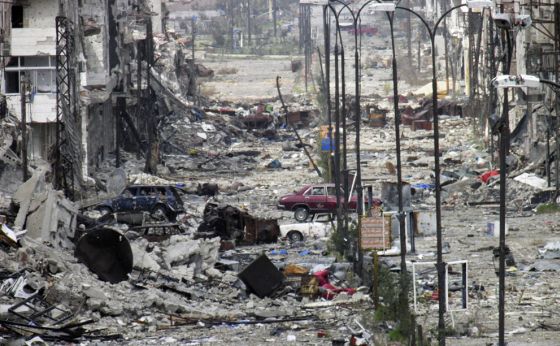
Syria: A country in ruins after three years of war

homs

Click the photo above to see 36 more grim reminders of the devastation caused, above all, by the Assad regime’s unwillingness to accede to the legitimate demands of the Syrian people for freedom and democracy.

From the outset of what was initially a peaceful uprising, Assad made it clear that had no reservations about using violence to crush political dissent, and yet for many Western observers who had just been cheering on an ostensibly peaceful revolution in Egypt, Syria’s revolution became unpalatable as soon as the opposition picked up weapons.

Yet remember these words: “Where choice is set between cowardice and violence, I would advise violence. I prefer to use arms in defense of honor rather than remain the vile witness of dishonor.”

That was the choice most Syrians faced: to either cower in response to ruthless authoritarian rule, or to fight back.

And who offered this advice to use arms? Mahatma Gandhi.

The cost of fighting has been higher than any country should ever bear, but the power to choose a different course has rested in Bashar al Assad’s hands from day one. This catastrophe did not have to happen.

Facebooktwittermail

Nearly half of Syria’s chemical arms supply removed

n13-iconThe New York Times reports: Nearly half of Syria’s chemical stockpile for weapons use has now been removed from the war-ravaged country, the organization helping to oversee the elimination of the deadly arsenal reported on Wednesday.

The organization said in a statement that two shipments, including some of the most lethal chemicals from the stockpile, were delivered on March 14 and 17 to the Syrian port of Latakia, where they were transferred to cargo ships, making a total of 10 exported shipments so far.

“The latest movements increased the portion of chemicals that have now been removed from Syria for destruction outside the country to more than 45 percent,” said the statement, issued by the Organization for the Prohibition of Chemical Weapons, the Hague-based group that is collaborating with the United Nations to ensure the arsenal’s destruction.

The statement was the first progress report on the Syrian government’s commitment to getting rid of the chemicals since the Syrians proposed a revised timetable for exporting them early this month. The timetable’s revision, which calls for the job to be finished by the end of April instead of Feb. 6 as originally planned, came after Syria missed deadlines in the destruction effort and was widely criticized internationally.

The statement also appeared to suggest that Russia and the United States were continuing to cooperate in pressuring Syria to comply with its pledges on chemical weapons, despite the crisis in Ukraine, which has deeply chilled relations between Moscow and Washington. [Continue reading…]

Facebooktwittermail

Sen. Ron Wyden scorches senior CIA and NSA officials and their ‘pattern of deception’

n13-iconThe Oregonian reports: U.S. Sen. Ron Wyden scorched senior CIA and NSA officials, the secret doings inside the Foreign Intelligence Surveillance Court, and a controversial section of the USA Patriot ACT on Tuesday night during a lecture in downtown Portland.

The senior senator from Oregon performed perhaps the most skillful dodge yet – by any politician – of a question nagging many Americans: is former National Security Agency contractor Edward Snowden a hero, a traitor, or something in between?

Wyden declined to comment about a case now before a criminal court (Snowden faces spy charges). But he said senior intelligence officials should have told the public that the National Security Agency had collected the phone records of millions of ordinary Americans, rather than having them learn about it through Snowden’s leaks of classified files to journalists.

“This is a debate that shouldn’t have been started this way,” said Wyden, a member of the Senate Intelligence Committee who sits in on classified briefings of national security operations.

Wyden called for more vigorous oversight of U.S. spy agencies. He called on senior intelligence officials to end what he described variously as their “pattern of deception,” “incredibly misleading statements,” and “culture of misinformation.” [Continue reading…]

Facebooktwittermail

U.S. listed as enemy of the internet

a13-iconReporters Without Borders: Natalia Radzina of Charter97, a Belarusian news website whose criticism of the government is often censored, was attending an OSCE-organized conference in Vienna on the Internet and media freedom in February 2013 when she ran into someone she would rather not have seen: a member of the Operations and Analysis Centre, a Belarusian government unit that coordinates Internet surveillance and censorship. It is entities like this, little known but often at the heart of surveillance and censorship systems in many countries, that Reporters Without Borders is spotlighting in this year’s Enemies of the Internet report, which it is releasing, as usual, on World Day Against Cyber-Censorship (12 March).

Identifying government units or agencies rather than entire governments as Enemies of the Internet allows us to draw attention to the schizophrenic attitude towards online freedoms that prevails in in some countries. Three of the government bodies designated by Reporters Without Borders as Enemies of the Internet are located in democracies that have traditionally claimed to respect fundamental freedoms: the Centre for Development of Telematics in India, the Government Communications Headquarters (GCHQ) in the United Kingdom, and the National Security Agency (NSA) in the United States.

The NSA and GCHQ have spied on the communications of millions of citizens including many journalists. They have knowingly introduced security flaws into devices and software used to transmit requests on the Internet. And they have hacked into the very heart of the Internet using programmes such as the NSA’s Quantam Insert and GCHQ’s Tempora. The Internet was a collective resource that the NSA and GCHQ turned into a weapon in the service of special interests, in the process flouting freedom of information, freedom of expression and the right to privacy.

The mass surveillance methods employed in these three countries, many of them exposed by NSA whistleblower Edward Snowden, are all the more intolerable because they will be used and indeed are already being used by authoritarians countries such as Iran, China, Turkmenistan, Saudi Arabia and Bahrain to justify their own violations of freedom of information. How will so-called democratic countries will able to press for the protection of journalists if they adopt the very practices they are criticizing authoritarian regimes for? [Continue reading…]

Facebooktwittermail

Inside the Senate report on CIA interrogations

f13-iconJason Leopold reports: A still-classified report on the CIA’s interrogation program established in the wake of 9/11 sparked a furious row last week between the agency and Senate Intelligence Committee chairwoman Dianne Feinstein. Al Jazeera has learned from sources familiar with its contents that the committee’s report alleges that at least one high-value detainee was subjected to torture techniques that went beyond those authorized by George W. Bush’s Justice Department.

Two Senate staffers and a U.S. official, who spoke on the condition of anonymity because the information they disclosed remains classified, told Al Jazeera that the committee’s analysis of 6 million pages of classified records also found that some of the harsh measures authorized by the Department of Justice had been applied to at least one detainee before such legal authorization was received. They said the report suggests that the CIA knowingly misled the White House, Congress and the Justice Department about the intelligence value of detainee Zain Abidin Mohammed Husain Abu Zubaydah when using his case to argue in favor of harsher interrogation techniques.

The committee’s report, completed in 2012, must go through a declassification review before any part of it may be released, but conflicts between the CIA — the original classification authority for the documents on which the report is based — and the Senate Intelligence Committee have complicated the process. Even if the report was declassified, releasing it would require Senate approval, and it’s not clear that Feinstein, a California Democrat, could muster enough votes to do so. President Barack Obama last week expressed support for releasing the report “so that the American people can understand what happened in the past … That can help guide us as we move forward.”

CIA Director John Brennan delivered a rebuttal to the report last June, more than four months after a deadline imposed by the Intelligence Committee. The 120-page CIA response, which addresses what the agency says are flaws in the Senate report, also remains classified. [Continue reading…]

Facebooktwittermail

Putin becomes a Russian ethnic nationalist

a13-iconKimberly Marten writes: There are two ways to talk about a Russian person or thing in the Russian language. One way, “Rossisskii,” refers to Russian citizens and the Russian state. Someone who is ethnically Chechen, Tatar, or Ukrainian can be “Rossisskii” if they carry a Russian passport and live on Russian territory.

Up until now that is how Russian President Vladimir Putin has always referred to the Russian people. Even the rather aggressive pro-Putin Russian youth movement of a few years back, Nashi (or “ours”) — with its summer camps, mass calisthenics rallies, and ugly jeering at opposition politicians — was always careful to use the word “Rossisskii.” While some critics like Valeria Novodvorskaya portrayed Nashi as if it were some kind of updated version of the Hitler youth, the group in fact never took on an ethnic slant.

That all changed on Tuesday. In his Kremlin speech to the two houses of the Russian parliament, Putin made a fateful choice. Instead of sticking to the word “Rossisskii,” he slipped into using “Russkii,” the way to refer in the Russian language to someone who is ethnically Russian. Putin said, “Crimea is primordial “Russkaya” land, and Sevastapol is a “Russkii” city.” He went on to say, “Kiev is the mother of “Russkie” cities,” in a reference to the ancient city of Kievan Rus’. (This reference must have grated on the ears of Ukrainian nationalists; as scholar Andrew Wilson points out, the historiography of Rus’ is fraught with the question of contested national origins.)

When speaking of the collapse of the Soviet Union, Putin added, “Millions of ‘Russkii’ went to sleep in one country and woke up in another, instantly finding themselves ethnic minorities in former Soviet republics, and the ‘Russkii’ people became one of the largest, if not the largest, divided nation in the world.”

Putin thereby signaled a crucial turning point in his regime. He is no longer simply a Russian statist, an old KGB man who wants to recapture Soviet glory, as Brookings analysts Fiona Hill and Clifford Gaddy argued in their fascinating 2013 biography. Instead Putin has become a Russian ethnic nationalist. [Continue reading…]

Facebooktwittermail

Dependence on Russia is likely to leave Crimea’s economy in a precarious state

a13-iconThe New York Times reports: Many A.T.M.s in this sun-dappled seaside resort city in Crimea, and across the region, have been empty in recent days, with little white “transaction denied” slips piling up around them. Banks that do have cash have been imposing severe restrictions on withdrawals.

All flights, other than those to or from Moscow, remain canceled in what could become the norm if the dispute over Crimea’s political status drags on, a chilling prospect just a month before tourist season begins in a place beloved as a vacation playground since czarist times.

Even with the West imposing sanctions to punish Russia’s invasion of Crimea, President Vladimir V. Putin faces a far steeper financial liability as he pushes to annex the peninsula, which lacks a self-sustaining economy and depends heavily on mainland Ukraine for vital services, including electricity and fresh water.

“Ukraine can quite easily cut off Crimea,” said Oleksandr Zholud, an economist with the International Center for Policy Studies in Kiev, the Ukrainian capital. “From an economic point of view it looks like a sinkhole.” [Continue reading…]

Facebooktwittermail