James Meek writes: The Russians and Ukrainians of the 1990s were able to temper regret at the collapse of the USSR with their own knowledge of the dismembered country’s shortcomings. A generation later, this is less and less the case. Many of the most articulate and thoughtful Russians and Ukrainians, those of middle age who knew the realities of Soviet life and later prospered in the post-Soviet world, have moved abroad, gone into a small business or been intimidated: in any case they have been taken out of the political arena. In Russia and Russophone Ukraine the stage is left to neo-Soviet populists who propagate the false notion of the USSR as a paradisiac Russian-speaking commonwealth, benignly ruled from Moscow, a natural continuum of the tsarist empire, disturbed only by Nazi invaders to whom ‘the west’ are heirs and the only obstacle to its re-creation. If you were born after 1985 you have no remembered reality to measure against this false vision, just as you have no way to situate those charming Soviet musical comedies of the 1960s and 1970s, idyllic portrayals of an idealised Russophone socialism, brightly coloured and fun, propaganda now in a way they weren’t when they were made. This is the context that has made it possible for Vladimir Putin and his government to sell Russia’s opportunistic invasion of Ukraine to his own people and to Ukrainian neo-Soviets: the idea that it undoes what should never have been done, an artificial division of Russian-speaking Eurasia by fascists/the West/America/rabid Ukrainian nationalists – in neo-Soviet discourse, avatars of a single anti-Russian monster.
The truth is that Russia and Ukraine have been reunited for a long time, in a corrupt mosaic dominated by Moscow. Putin didn’t begin invading Ukraine to bring it back into the fold but to stop it escaping. He established a patriarchal-oligarchic police state in Russia; the now universally despised Ukrainian president-in-exile, Viktor Yanukovich, was well on his way to establishing one in Ukraine; the leaders of Belarus and the Central Asian republics have established similar repressive polities. Russophone Ukrainians have real fears about Ukraine’s new leaders. Putin’s great fear is that the people of a future better Ukraine might inspire an entirely different unification with their East Slav brethren on his side of the border – a common cause of popular revolt against him and other leaders like him. The revolution on Maidan Nezalezhnosti – Independence Square in Ukrainian – is the closest yet to a script for his own downfall. In that sense the invasion is a counter-revolution by Putin and his government against Russians and Ukrainians alike – against East Slav resistance as a whole.
The Maidan revolution wasn’t a purely ethnic Ukrainian uprising, although ethnic Ukrainians seem to have taken the lead in storming police lines. In the week I spent in Kiev in the immediate aftermath of the revolt I met no one who objected to my speaking Russian. On Maidan there are ethnic Russians speaking Ukrainian and ethnic Ukrainians speaking Russian. In one of the sagging khaki tents pitched on the square I met Vladimir Malyshev, a 44-year-old from St Petersburg, who came to the city to join the demonstrations late last year after a period spent in the anti-Putin movement in Russia. ‘It’s the one form of struggle that seems possible against the particular kind of power that’s appeared in the post-Soviet space: these gangs of criminals and bandits – they can be fought by gathering a large enough group of people to defy them. You can’t bribe or destroy this force. My experience here confirmed that this was possible. It happened.’ [Continue reading…]
Putin’s dystopian vision of a united, patriotic Russia
Maxim Trudolyubov writes: President Vladimir Putin’s decision to slip soldiers in unmarked uniforms into Crimea this month and escalate the race for control over other Russian-speaking parts of Ukraine shows that former assumptions about Moscow’s political behavior no longer apply. The United States and the European Union may still consider sanctions as a tool to check Moscow’s foreign policy, but to Mr. Putin, the threat of such sanctions means little: He has already factored them into his plans.
The chain of events the Kremlin has set in motion contains a message not only for Western policy makers, but also for the Russian plutocrats and corrupt officials who keep much of their wealth in the West. Mr. Putin is letting his Western adversaries know that he is telling his Russian enemies and financially corrupt friends: “If you won’t straighten up and behave as patriots, I am ready to throw you under the bus. If the laws prohibiting you to feather your nests abroad or to serve as ‘foreign agents’ do not persuade you, Western sanctions will do the job.”
After the Russia-supported president of Ukraine, Viktor F. Yanukovych, fled his country on Feb. 22, the Kremlin went into emergency mode. Since then, key decisions have been made by a group of Russia’s top security officials. The diplomatic, military and business establishments have been pushed to the side. [Continue reading…]
How the Russia Today propaganda apparatus operates
BuzzFeed reports: Staci Bivens knew something was seriously wrong when her bosses at Russia Today asked her to put together a story alleging that Germany — Europe’s economic powerhouse — was a failed state.
“It was me and two managers and they had already discussed what they wanted,” Bivens, an American who worked in RT’s Moscow headquarters from 2009 through 2011, said of a meeting she’d had to discuss the segment before a planned reporting trip to Germany. “They called me in and it was really surreal. One of the managers said, ‘The story is that the West is failing, Germany is a failed state.’”
Bivens, who had spent time in Germany, told the managers the story wasn’t true — the term “failed state” is reserved for countries that fail to provide basic government services, like Somalia or Congo, not for economically advanced, industrialized nations like Germany. They insisted. Bivens refused. RT flew a crew to Germany ahead of Bivens, who was flown in later to do a few standups and interviews about racism in Germany. It was the beginning of the end of her RT career.
“At that point I’d been there for a little bit and I’d had enough of the insanity,” Bivens said. She stayed until the end of her contract in 2011 and didn’t make an effort to renew it.
Judging by interviews with seven former and current employees, Bivens’ story is typical. [Continue reading…]
Three grim statistics from three years of war in Syria
Every minute: Three Syrians become refugees abroad.
Every two minutes: Eight children inside Syria are forced to flee their homes.
Every 10 minutes: One person dies.
Former Egyptian general calls promise of free elections a ‘farce’
The New York Times reports: Critics of the military takeover here often say the generals’ promise of free elections is little more than a bad joke. Now a prominent former military man who cheered the takeover seems to agree: Ahmed Shafik, a former general and prime minister and the runner-up in the last presidential election, has called it a “farce.”
Mr. Shafik had not planned on making his opinion quite so public. But these days in Egypt, conversations are often not as private as they seem.
“I know very well they will fix all the ballot boxes,” Mr. Shafik said in a leaked recording of a private conversation that he authenticated Thursday. He said in the recording that he would not run because the new government was rigging the race in favor of Field Marshal Abdul-Fattah el-Sisi, who led the ouster of President Mohamed Morsi of the Muslim Brotherhood last summer and is expected to enter and win the election to succeed him.
“I have taken myself out of this loop because the election is going to be a farce,” Mr. Shafik said, adding that “they will fix everything for him” and “this is going to be a comedy show.”
His comments stunned Egypt because Mr. Shafik comes from the same military elite as Field Marshal Sisi. Questioning the field marshal’s candidacy is almost heretical in the pro-military and anti-Islamist circles both officers represent, and Mr. Shafik’s comments were a rare hint of possible dissent among the business and military elite. [Continue reading…]
Remembering Tony Benn (1925-2014)
Tony Benn interviewed by Anthony Clare in 1995.
Yarmouk and a contagion of doubt
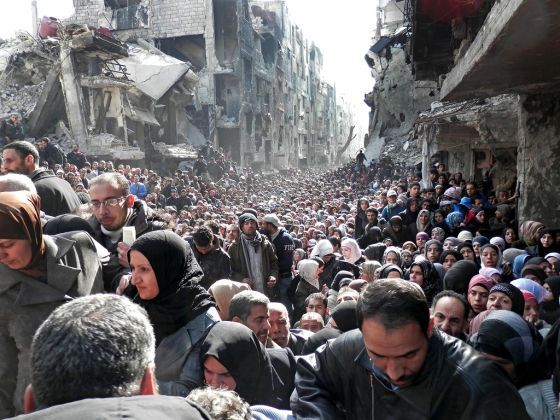
“U.N. Denies That Syria Image Was Faked” and “U.N. Denies Altering Image of Palestinian Refugees in Damascus” — both headlines appeared in the New York Times on Tuesday and referred to doubts that have been expressed about the authenticity of what has become an iconic representation of suffering in Syria.

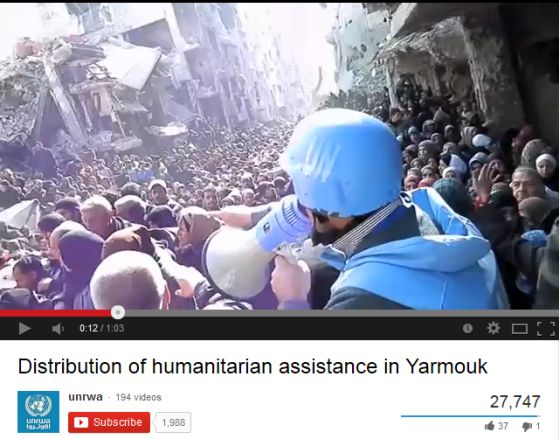
As the following screenshot taken from a video that the United Nations Relief and Works Agency (UNRWA) posted on YouTube and filmed at the same time as the photo above makes clear, the photograph’s authenticity is beyond doubt.

Paradoxically, the fact that UN officials were put in a position where they needed to refute accusations that the photograph had been faked, and the New York Times’ own headlines, will quite likely have had the opposite of the intended effect. Where doubts may have previously been few, they are now just as likely to continue growing.
We live in an age of doubt and the internet is its engine — the very notion that something can be “beyond doubt” has itself become an object of doubt.
As someone who from a very early age was taught to question — I was lucky enough to have parents and teachers who recognized that questioning is a vital instrument of intelligence — the proliferation of doubt might to my eye look like a positive development. It might seem like a sign that people are less susceptible to manipulation by the political and corporate forces which shape popular thought. But I see little evidence that this is indeed the case.
On the contrary, the doubt that spreads so easily has less to do with critical intelligence and much more to do with suspicion and fear. The “fake” meme is much more contagious than any sober analysis.
Doubt and cynicism are held onto because they offer psychic armor for shielding ourselves from the dark forces controlling the world. The price, however, for those who employ this form of protection, is that it tends to render them immobile.
Yet clearly, the image of Yarmouk’s starving residents that got retweeted more than eight million times was not being passed around primarily by those who had doubts about what the photograph depicted.
As Chris Gunness, the spokesman for UNRWA said: “I saw that image and said, ‘This has the wow factor.’”
It is an image that resonates and does so for multiple reasons. Strange as it may sound, this is not only a news image but also a work of art.
In accordance with the principle of the “golden ratio” (or divine proportion), it is a perfectly balanced composition. It is a photograph that could just as easily be a painting.
More than simply capturing a moment of one day for one particular group of people, it seems to represent something timeless about the vulnerability of all people throughout history in times of war.
Within the skeletal remains of a city shattered by human brutality, we see that reinforced concrete is easier to destroy than the will to live.
Hope and desperation come together.
U.N. refugee chief warns world powers not to forget Syria conflict
Reuters reports: The head of the United Nation’s refugee agency said on Tuesday it must be ready in case Ukraine’s crisis causes refugees to flee Crimea, but his biggest worry is that “a total disaster” could occur if the international community diverts its attention away from Syria’s conflict.
Antonio Guterres, the head of the U.N.’s High Commission for Refugees (UNHCR), said in an interview that little progress was being made in efforts by the United States and Russia, now at loggerheads over Ukraine, to bring Syria’s warring sides together after the collapse of talks in Geneva last month.
“In the moment in which we need the most relevant countries in the world to be able to come together to narrow their differences and to try to find a way to move into peace for Syria, this tension around Ukraine will obviously not help,” Guterres told Reuters while visiting Washington to discuss Syria’s refugee crisis.
“I hope that those that have the most important responsibility in world affairs will be able to understand that forgetting Syria will be a total disaster,” he said. [Continue reading…]
Ukraine crisis: Six reasons why U.S. use of military forces is unthinkable
Loren Thompson writes: The interim prime minister of Ukraine was in Washington this week, and according to the New York Times, he was asking just one thing of U.S. leaders. He said as a signatory to a 1994 treaty guaranteeing the security of Ukraine, America “must defend our independent, sovereign state.” Some members of Congress sound like they agree, especially Republicans who are using Washington’s slow response to Russian occupation of the Crimea as the latest evidence that President Obama is weak when it comes to dealing with America’s enemies.
If Obama looks weak, it is mainly because he sees the danger of decisive action in a place that matters far more to Russia than America. Over the last two decades, the United States has gotten used to fighting enemies with modest military capabilities and crackpot leaders, but Russia is a much more imposing player. If Washington somehow stumbled into a military confrontation with Moscow, the U.S. would probably lose and in the process run huge risks to its larger interests.
Most Americans seem to understand this — a CNN poll this week found three-quarters of respondents opposed to even giving military aid to Kiev, with far fewer backing use of U.S. forces. Nonetheless, some hardliners seem to think America’s military might play a role in forcing Russian leader Vladimir Putin to back away from what they see as a return to the expansionist foreign policies of the Cold War era. Here are six reasons why using U.S. military power in the current crisis would be a strategic miscalculation of epic proportions. [Continue reading…]
Editor of independent Russian news site replaced with pro-Kremlin figure
The Guardian reports: In what appears to be part of a growing state crackdown on liberal media, the editor of a major independent Russian news website has been replaced by a Kremlin-friendly editor after running an interview with a controversial Ukrainian nationalist.
Lenta.ru announced on its site on Wednesday that Galina Timchenko, who had worked there since its founding in 1999, would immediately be replaced by Alexei Goreslavsky, the former editor of the pro-Kremlin internet publication Vzglyad. Goreslavsky is currently deputy general director for external communications at the Afisha-Rambler-SUP media holding that owns Lenta.ru.
The news came only hours after the state communications watchdog issued a warning to Lenta.ru over a recent interview with Dmytro Yarosh, leader of the Ukrainian ultranationalist paramilitary group Right Sector, which played a key role in the protests that ousted President Viktor Yanukovych. The Investigative Committee of Russia, the country’s main federal investigator, has charged Yarosh, who recently announced he would run for president in Ukraine’s May elections, with inciting terrorism over a post on a Right Sector social network page that called on Russia’s most-wanted terrorist, Doku Umarov, to “activate his struggle.”
But a letter posted on Lenta.ru and signed by 69 employees and correspondents said Goreslavsky’s appointment amounted to “direct pressure on the Lenta.ru editorial staff” and a violation of censorship laws. Lenta.ru’s editorial policy, which embraced controversial topics and was often critical of the Kremlin, won the site a wide readership, including 13.6 million unique visitors last month, according to Rambler.ru rankings.
“This is absolutely a political situation,” said Lenta.ru’s night editor, Pavel Borisov. “Galina Timchenko was the best editor-in-chief I ever had. I don’t plan to work with Goreslavsky.” The change in editor came with no warning, he added. [Continue reading…]
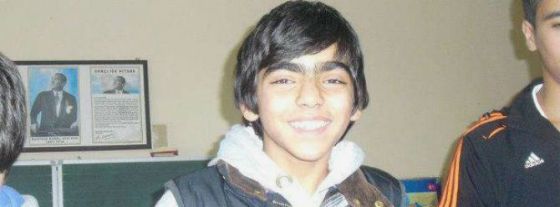
Across Turkey, new unrest as Berkin Elvan is buried

The New York Times reports: An enormous outpouring of grief and antigovernment rage during the funeral procession for a teenage boy felled by a police tear-gas canister turned into another mass confrontation with the Turkish authorities on Wednesday as mourners clashed with antiriot squads in Istanbul, Ankara and Izmir. At least one person was killed.
The new unrest came a day after protesters battled with police officers in at least 15 cities over news that the boy, Berkin Elvan, 15, had died. He had been comatose with head trauma since June, when Turkey was first engulfed with antigovernment protests against the decade-old tenure of Prime Minister Recep Tayyip Erdogan, who is seen as increasingly authoritarian.
The boy, who was struck by a tear-gas canister while buying bread, has become the newest symbol of simmering anger at Mr. Erdogan and his Justice and Development Party, known as AKP, and over the tough police repression of political dissent and a recent corruption scandal that has entangled the top echelons of the ruling party.
“Here’s a thief! Here’s a murderer!” and “Mothers’ anger will strangle murderers!” funeral marchers screamed as they walked, blowing whistles. “Berkin’s murderer is AKP’s police!”
More than 100,000 people converged in Istanbul to participate in the boy’s funeral procession to a cemetery. The burial itself was peaceful as hundreds of riot police were deployed nearby.
“He was our hope, he was our miracle, he was our son, brother, everything. We were waiting for him to wake up but we unfortunately lost him,” said Damla Atalay, 32, a lawyer, who marched in a convoy behind the coffin. “We are here because this little boy is part of us, it could happen to any of us, to our son, brother.” [Continue reading…]
Abbas accuses Dahlan of involvement in six murders
Reuters reports: Palestinian President Mahmoud Abbas has accused one of his main rivals, Mohammed Dahlan, of involvement in six murders, hinting that he might also be behind the death of former leader Yasser Arafat.
Dahlan, who lives in exile in the Gulf, denied the allegations of his arch foe Abbas, their bitter row now playing out publicly across the Palestinian media and on social media.
Once a prominent official in Abbas’s Western-backed Fatah movement, Dahlan was ousted from the group in 2011 following accusations of corruption. He denied the charges and remains a powerful figure on the sidelines, forging ties with numerous Arab leaders and maintaining links with the splintered Fatah.
Abbas lashed out at Dahlan, who is regularly cited as a possible future president, during a Fatah meeting earlier this week, with his comments later released to the press. [Continue reading…]
Nick Turse: American proxy wars in Africa
Our major post-9/11 wars are goners and the imagery of American war-making is heading downhill. The Iraq War was long ago left in the trash heap of history, while in Afghanistan the talk is now about “the zero option” — that is, about an irritated Obama administration making a lock, stock, and drone departure from that country as 2014 ends. Meanwhile, back in America, headlines indicate that the U.S. military stands trembling at the brink of evisceration, with the U.S. Army soon to return to pre-World War II levels of troop strength and all the services about to go on a diet in an era of belt-tightening. The only new arms being promoted are the ones Republicans are “up in” when it comes to the potential destruction of U.S. military might.
As it happens, the impression this leaves bears only the most minimal relationship to the actual U.S. global military posture of this moment. The Middle Eastern and Persian Gulf buildup around Iran remains massive, even as talks on that country’s nuclear program are underway. Despite the “zero option” media focus on Afghanistan, Obama administration officials seem determined that a residual force of trainers, mentors, and special operations types will remain in that country to anchor a rump war after combat troops leave this year. They clearly expect the successor to the recalcitrant President Hamid Karzai to sign the necessary bilateral security pact — even if at the last moment. As for the axe being taken to the Pentagon budget, it turns out, at worst, to be a penknife.
In the meantime, hardly noticed amid all the hoopla about future cuts to Army strength (which do indicate a genuine no-invasions-no-occupations-on-the-Eurasian-landmass change of strategy initiated in the late Bush years), there has been next to no attention paid to a striking piece of budgetary news: despite speculations about cuts to its fleet of aircraft carriers, the U.S. Navy is expected to keep its full contingent of 11 aircraft carrier strike groups — essentially 11 giant floating bases off the world’s coasts. This fits well with the Obama administration’s much ballyhooed “pivot” to Asia. As Michael Klare recently explained, that pivot is, at heart, a naval strategy (consonant with those 11 carriers) of ensuring ongoing control over the crucial energy sea lanes in the Persian Gulf, the Indian Ocean, and the East and South China Seas through which China is going to have to import staggering amounts of liquid energy in the coming decades.
Finally, on a planet still impressively heavily garrisoned by Washington, hardly noticed by anyone and rarely written about, the U.S. military has for years been quietly moving into Africa in a distinctly below-the-radar fashion. This represents a major new commitment of American power in a world of supposed cutbacks, but you would never know it. If you’re a news jockey, every now and then you can catch a report, like David Cloud’s recently in the Los Angeles Times, which offers a brief snapshot of that process with, for instance, a head’s-up that 50 U.S. Special Operations troops have just been put on the ground at a “remote outpost” in Tunisia. However, only at TomDispatch, thanks to the reporting of Nick Turse, can you find an ongoing account of the U.S. military move into Africa, its planning, its implementation, and the destabilization and blowback that seem to accompany it. The Pentagon’s newest tactic for Africa, as he documents today: refight the colonial wars in partnership with the French. Just tell me: What could possibly go wrong? Tom Engelhardt
Washington’s back-to-the-future military policies in Africa
America’s new model for expeditionary warfare
By Nick TurseLion Forward Teams? Echo Casemate? Juniper Micron?
You could be forgiven if this jumble of words looks like nonsense to you. It isn’t. It’s the language of the U.S. military’s simmering African interventions; the patois that goes with a set of missions carried out in countries most Americans couldn’t locate on a map; the argot of conflicts now primarily fought by proxies and a former colonial power on a continent that the U.S. military views as a hotbed of instability and that hawkish pundits increasingly see as a growth area for future armed interventions.
Since 9/11, the U.S. military has been making inroads in Africa, building alliances, facilities, and a sophisticated logistics network. Despite repeated assurances by U.S. Africa Command (AFRICOM) that military activities on the continent were minuscule, a 2013 investigation by TomDispatch exposed surprisingly large and expanding U.S. operations — including recent military involvement with no fewer than 49 of 54 nations on the continent. Washington’s goal continues to be building these nations into stable partners with robust, capable militaries, as well as creating regional bulwarks favorable to its strategic interests in Africa. Yet over the last years, the results have often confounded the planning — with American operations serving as a catalyst for blowback (to use a term of CIA tradecraft).
Blackwater in Ukraine? No, it was Alpha
Has Blackwater been deployed to Ukraine? http://t.co/6MMI0rzhnJ
— Paul Joseph Watson (@PrisonPlanet) March 9, 2014
Nobody can identify who these troops in Ukraine are http://t.co/70KAvaEBlB makes it hard for me to choose whether to hate or worship them
— David Swanson (@davidcnswanson) March 11, 2014
'#Blackwater in #Ukraine'? Despite rumors, @AcademiElite tells @WSJ it has no people in Ukraine. http://t.co/CvMxCJ21RR
— Dion Nissenbaum (@DionNissenbaum) March 10, 2014
Yesterday I laid out a timeline suggesting how the Blackwater-in-Ukraine story may have evolved. I did not, however, attempt to identify the armed men in the video that has kept this rumor alive in social media.
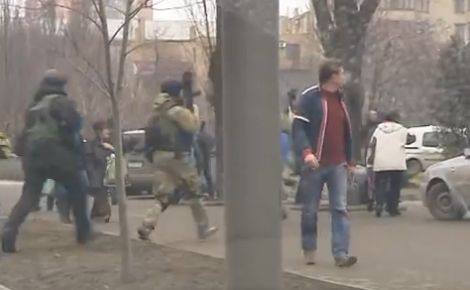
Thanks to a reader who said that the Ukrainian press identified the armed men as “Спецназ (Alpha) СБУ,” I have been able to piece together the story.
The elite Alpha special operations unit is attached to the Security Service of Ukraine.
The reason for their appearance outside the regional administrative building in Donetsk was given in the following local press report, Преступности.Нет (English version):
In Donetsk day 3 March during the seizure of the regional state administration of protesters attacked the ex-Governor of area Andrey shishatskiy.
It is reported by channel «Donbass» on his Youtube page.
So, the footage shows a group of people, among them people with the Russian flag in his hands, and beat former Governor of Donetsk region Shishatskiy.
According to the TV company, beat it from the attackers, interferes with the police and the special forces of the security service of Ukraine covers of his departure.
As is known, today the building of the Donetsk regional Council were captured by a group of Pro-Russian activists, who declared about the illegitimacy of Kyiv and declared himself the new authorities in Donetsk region.
This is the video showing former Governor Shishatskiy being attacked. Although the Alpha unit is not shown, they can be seen in another news report on the same incident.

Before any of the dozens of copies of the video labelled “USA military mercenary BlackWater in Ukraine (Donetsk)” appeared on YouTube, the same video had been posted with this title: “Alpha” – Donetsk. 03/03/2014. The video’s description says: “After the Russian provocations, Special Forces of Alpha security appeared in Donetsk.”
No mention of Blackwater.
Ukraine, Russia, and the differing conceptions of fascism
Jeremy Hicks writes: All parties have been drawing historical analogies to interpret the Ukraine crisis: Hillary Clinton and western commentators have compared Putin to Hitler, the annexation of Crimea to the Sudetenland, and referred to appeasement. The Russians insist that the pro-European Ukrainians are fascists.
While the presence of the genuine neo-Nazis of the Svoboda party in Ukraine’s interim government is undeniable, it seems paradoxical that both the West and Russia legitimise their positions by reference to World War II, and opposition to the Nazis. To understand this situation better, it helps to examine quite how different Russian and Western memories of the war really are.
As the West recalls it, World War II saw democracy take a stand against tyranny – but only after prevaricating through appeasement, at the immediate cost of Czechoslovakia and the ultimate price of the Holocaust. The war’s main lesson is the importance of universal human rights, and the need to oppose expansionist dictators intent on small annexations or lesser crimes before they invade at will and commit mass murder.
From the Russian perspective, when it is discussed at all, appeasement is seen as confirmation of Western hypocrisy, and as the factor that drove the Soviets to sign a non-aggression pact with Hitler in self-defence. But in Russia, the real story of World War II begins with the Nazi invasion of the USSR in June 1941. The victims of the unchecked rise of Nazism are not so much the Jewish population of occupied Europe, but rather Russia and Russians. They were both the Nazis’ primary victims and the principal heroes of their defeat. Fascism is therefore not seen in terms of its anti-Semitic and anti-democratic dimensions, but as an anti-Russian phenomenon springing from Western Europe. [Continue reading…]
Air links between Crimea and Kiev are severed
The New York Times reports: The airport in the regional capital of Simferopol was closed on Tuesday to all flights except those heading to and from Moscow, in the boldest display yet of Russia’s tightening control over Crimea.
The announcement that air links had been severed between Crimea and the Ukrainian capital of Kiev raised the possibility that the peninsula might be closed off indefinitely from the rest of Ukraine, and it immediately prompted a sellout of tickets for connecting flights on Aeroflot, the Russian national carrier.
Even as Russia consolidated its grip on the embattled peninsula, diplomatic efforts between the Obama administration and the Kremlin appeared stalled, with the two sides continuing to engage in menacing military exercises and trade threats of economic retaliation. [Continue reading…]
How the NSA plans to infect ‘millions’ of computers with malware
Ryan Gallagher and Glenn Greenwald report: Top-secret documents reveal that the National Security Agency is dramatically expanding its ability to covertly hack into computers on a mass scale by using automated systems that reduce the level of human oversight in the process.
The classified files – provided previously by NSA whistleblower Edward Snowden – contain new details about groundbreaking surveillance technology the agency has developed to infect potentially millions of computers worldwide with malware “implants.” The clandestine initiative enables the NSA to break into targeted computers and to siphon out data from foreign Internet and phone networks.
The covert infrastructure that supports the hacking efforts operates from the agency’s headquarters in Fort Meade, Maryland, and from eavesdropping bases in the United Kingdom and Japan. GCHQ, the British intelligence agency, appears to have played an integral role in helping to develop the implants tactic.
In some cases the NSA has masqueraded as a fake Facebook server, using the social media site as a launching pad to infect a target’s computer and exfiltrate files from a hard drive. In others, it has sent out spam emails laced with the malware, which can be tailored to covertly record audio from a computer’s microphone and take snapshots with its webcam. The hacking systems have also enabled the NSA to launch cyberattacks by corrupting and disrupting file downloads or denying access to websites.
The implants being deployed were once reserved for a few hundred hard-to-reach targets, whose communications could not be monitored through traditional wiretaps. But the documents analyzed by The Intercept show how the NSA has aggressively accelerated its hacking initiatives in the past decade by computerizing some processes previously handled by humans. The automated system – codenamed TURBINE – is designed to “allow the current implant network to scale to large size (millions of implants) by creating a system that does automated control implants by groups instead of individually.” [Continue reading…]
‘What does ISP mean?’ — how government officials are flunking security challenges
The Guardian reports: One of the world’s leading cyberwarfare experts has warned of the damaging lack of government literacy in cybersecurity issues, pointing out that some senior officials don’t know how to use email, and that one US representative about to negotiate cybersecurity with China asked him what an “ISP” was.
Speaking at the SXSW festival, Dr Peter W Singer, director of the Center for 21st Century Security & Intelligence, cited a 2014 poll by the Pew research institute that found Americans are more afraid of cyberattack than attack by Iran or North Korea, climate change, the rise of China or authoritarian Russia.
Sketching out the scale of technology in our lives, Singer said that 40 trillion emails are sent a year, that 30 trillion websites now exist and that 9 new pieces of malware are discovered every second. He claimed that 97% of Fortune 500 companies have admitted they’ve been hacked – the other 3% just aren’t ready to admit it yet.
The consequent rise in cybercrime and state-sponsored attacks has not gone unnoticed. 100 nations now have cyber command, and the Pentagon’s own briefings, which contained the word ‘cyber’ 12 times during 2012, have already mentioned it 147 times so far this year.
Yet former head of US homeland security Janet Napolitano once told Singer. “Don’t laugh, but I just don’t use email at all,” Singer recalled. “It wasn’t a fear of privacy or security – it’s because she just didn’t think it was useful. A supreme court justice also told me ‘I haven’t got round to email yet’ – and this is someone who will get to vote on everything from net neutrality to the NSA negotiations.” [Continue reading…]