The Wall Street Journal reports: The National Security Agency and the Department of Homeland Security acknowledged in a settlement made public Tuesday that they were wrong to ban a leading custom-merchandise retailer from selling t-shirts, mugs, and posters that poked fun at the agencies.
The agreement puts to rest a First Amendment lawsuit against the federal government brought last year by a t-shirt designer, Dan McCall, who hawked merchandise on Zazzle.com that parodied the official seal of the NSA with jokes referencing the spy program disclosures. Another design imprinted on mugs featured a look-alike Homeland Security logo for a “Department of Homeland Stupidity.”
Mr. McCall’s lawsuit, which Law Blog wrote about earlier, came in response to cease-and-desist letters that the NSA and Homeland Security sent to Zazzle in 2011, ordering the retailer to remove the parody products from its site or face legal action.
Music: Bill Evans — ‘A Child Is Born’
![]()
A spate of banker suicides or a spate of reports on banker suicides?
Trends are easy to spot when you go looking for them and conspiracy theorists are trend-spotters par excellence. The trouble is, a lot of these trends only exist in the eye of the beholder.
Following a “spate” of recent suicides among investment bankers — a possible early warning sign of another financial crisis — John Aziz asks:
[I]s it really abnormal for the finance industry to experience seven possible suicides in the space of a month?
Let’s do a back-of-an-envelope calculation. The U.S. has a suicide rate of about 12 people per 100,000 per year. Roughly 5.9 million people are employed in the American financial sector. Assuming the industry has the same suicide rate as the rest of the population — even with higher-than-average stress levels — one would expect 708 suicides in any given year, or nearly 60 per month in the U.S. alone.
Given that just three of the seven incidents (some of which may not have been suicides) occurred in the U.S., this suggests that the number is not excessive or unusual. Seven hundred suicides perhaps would be cause for raising eyebrows. Not seven.
So this “trend” is more of a case of bloggers and writers conspiracy-mongering without looking properly at the evidence.
The idea that suicides on Wall Street provide a metric for accessing the health of the economy can be traced back to the 1920s, but then as now, it turned out to be an urban legend:
Tall tales about panicked speculators leaping to their deaths have become part of the popular lore about the Great Crash. But although jumping from bridges or buildings was the second-most-popular form of suicide in New York between 1921 and 1931, the “crash-related jumping epidemic” is just a myth. Between Black Thursday and the end of 1929, only four of the 100 suicides and suicide attempts reported in the New York Times were plunges linked to the crash, and only two took place on Wall Street.
Obama plays water-guzzling desert golf courses amid California drought
Time reports: President Barack Obama traveled to California on Friday to highlight the state’s drought emergency at two events near Fresno, calling for shared sacrifice to help manage the state’s worst water shortage in decades. He then spent the rest of the weekend enjoying the hospitality of some of the state’s top water hogs: desert golf courses.
Vacationing with DVDs of his favorite television shows and multiple golf outings with his buddies, the duffer in chief played at two of the most exclusive courses in the Palm Springs area. On Saturday, Obama played at the Sunnylands estate, built by the late billionaire Walter Annenberg, which features a nine-hole course that is played like 18 holes. The following day he golfed at billionaire Oracle founder Larry Ellison’s 19-hole Porcupine Creek. On Presidents’ Day, Obama hit the links at Sunnylands once again.
The 124 golf courses in the Coachella Valley consume roughly 17% of all water there, and one-quarter of the water pumped out of the region’s at-risk groundwater aquifer, according to the Coachella Valley Water District. [Continue reading…]
Climate change is threatening the entire marine food chain
Peter Brannen writes: At the Woods Hole Oceanographic Institution on Cape Cod, Massachusetts, snowdrifts piled up outside shuttered T-shirt shops, and wind and whitecaps lashed vessels tethered to empty piers in the harbour. The flood of sun-tanned tourists and research students that descends on this place in summer was still months away. The only visitor was a winter storm that hung over the coast, making travel in and out of the cedar-shingled town impossible. In a research building downtown, at the end of a dimly lit hallway, Peter Wiebe sat with a stack of yellowed composition notebooks, reliving a lifetime spent on the ocean. Wiebe, a grizzled scientist emeritus, is transcribing his research cruise logs, which go back to 1962. His handwritten notes archive a half-century of twilit cruises in the Antarctic and languorous equatorial days surrounded by marine life.
‘It’s quite clear to me things are changing,’ he told me, after I asked him to think back on his decades on the ocean. ‘As a graduate student on one cruise, my logs talk about a hammerhead and two whitetips following the ship the whole time. On other cruises, we would fish for mahimahi and tuna, and occasionally catch a shark. Now we hardly ever see any big fish or sharks at all.’
Indeed, in oceanography, the big story over the past half century – the span of Wiebe’s career – has been the wholesale removal of the seas’ top predators through overfishing. But the story of the oceans for the coming century may be a revolution that starts from the bottom of the food chain, not the top.
‘I won’t be around to see it,’ Wiebe told me. ‘I wish I were.’
Plankton (taken from the Greek word for wanderer) are the plants, animals and microbes that are unable to overcome the influence of ocean currents, either because they’re too small, like bacteria, or because, as in the case of the indifferent jellyfish, they can’t be bothered. Wiebe’s speciality is zooplankton, the kaleidoscopic, translucent animal world in miniature, much of which feeds on even smaller photosynthetic life called phytoplankton. To make the jump from photosynthesis to fish, birds and whales, you have to go through zooplankton first.
Wiebe is part of a body of researchers worldwide working feverishly to find out how these grazers will be affected by an increasingly unfamiliar ocean, an ocean that absorbs 300,000 Hiroshimas of excess heat every day, and whose surface waters have already become 30 per cent more acidic since the dawn of the Industrial Revolution.
‘When I first started, the idea that you could actually change the pH of the ocean just wasn’t there – no one expected us to be able to do it,’ Wiebe told me. ‘Certainly, no one expected us to be able to do it at the pace we’re doing it, at a pace that far surpasses anything natural that has ever happened.’ [Continue reading…]
We must give the land back: America’s brutality toward Native Americans continues today
Steven Salaita: I write often about liberating Palestine from Israeli occupation, a habit that evokes passionate response. I have yet to encounter a response that persuades me to abandon the commitment to Palestinian liberation.
I have, however, encountered responses that I consider worthy of close assessment, particularly those that transport questions of colonization to the North American continent. You see, there is a particular defense of Zionism that precedes the existence of Israel by hundreds of years.
Here is a rough sketch of that defense: Allowing a Palestinian right of return or redressing the ethnic cleansing of Palestinians in 1947-49 is ludicrous. Look what happened to the Native Americans. Is the United States supposed to return the country to them?
Israeli historian Benny Morris puts it this way: “Even the great American democracy couldn’t come to be without the forced extinction of Native Americans. There are times the overall, final good justifies terrible, cruel deeds.”
This reasoning suggests a finality to the past, an affirmation of tragedy trapped in the immutability of linear time. Its logic is terribly cliché, a peculiar form of common sense always taken up, everywhere, by the beneficiaries of colonial power.
The problems with invoking Native American genocide to rationalize Palestinian dispossession are legion. The most noteworthy problem speaks to the unresolved detritus of American history: Natives aren’t objects of the past; they are living communities whose numbers are growing.
It’s rarely a good idea to ask rhetorical questions that have literal answers. Yes, the United States absolutely should return stolen land to the Indians. That’s precisely what its treaty obligations require it to do. [Continue reading…]
How the north ended up on top of the map
Nick Danforth writes: Why do maps always show the north as up? For those who don’t just take it for granted, the common answer is that Europeans made the maps and they wanted to be on top. But there’s really no good reason for the north to claim top-notch cartographic real estate over any other bearing, as an examination of old maps from different places and periods can confirm.
The profound arbitrariness of our current cartographic conventions was made evident by McArthur’s Universal Corrective Map of the World, an iconic “upside down” view of the world that recently celebrated its 35th anniversary. Launched by Australian Stuart McArthur on Jan. 26, 1979 (Australia Day, naturally), this map is supposed to challenge our casual acceptance of European perspectives as global norms. But seen today with the title “Australia: No Longer Down Under,” it’s hard not to wonder why the upside-down map, for all its subversiveness, wasn’t called “Botswana: Back Where It Belongs” or perhaps “Paraguay Paramount!”
The McArthur map also makes us wonder why we are so quick to assume that Northern Europeans were the ones who invented the modern map — and decided which way to hold it — in the first place. As is so often the case, our eagerness to invoke Eurocentrism displays a certain bias of its own, since in fact, the north’s elite cartographic status owes more to Byzantine monks and Majorcan Jews than it does to any Englishman. [Continue reading…]
Don’y worry about the millions of Syrian refugees — it turns out Marwan had not lost his parents
The Guardian reports: A heart-rending picture of a four-year-old Syrian boy apparently alone in the desert, separated from his family and clutching a tattered plastic bag of possessions, seemed to epitomise the refugee crisis caused by the civil war.
The image went viral after it was tweeted by United Nations staff who helped the child find his family, with the caption: “Here 4 year old Marwan, who was temporarily separated from his family …”, and then retweeted to a wider audience by a CNN International anchor with the caption “UN staff found 4 year-old Marwan crossing desert alone after being separated from family fleeing #Syria”.
But it was not quite what it seemed at first glance. A second photograph, posted by UN staff on Tuesday, showed that the boy was straggling behind a larger group of refugees. “He is separated – he is not alone,” Andrew Harper, head of the refugee agency UNHCR in Jordan, who took the first picture, clarified. Marwan had been reunited with his mother within 10 minutes.
The picture triggered a wave of sympathy on social media, swiftly followed by scepticism and anger at the perceived misrepresentation of Marwan’s plight.
I posted Hala Gorani’s first tweet yesterday and also included a link to her second tweet which said Marwan had been reunited with his family. Her two tweets were separated by a whopping six minutes!
A Storify analysis in which both tweets are embedded, each showing the time they were posted — the first at 9.54AM and the second at 10.02AM — nevertheless claims “Gorani followed up, 30 minutes later”.
It seems like the sticklers for accuracy aren’t too hot about ensuring the accuracy of their own reporting.
To the extent that clarifications about the Marwan story then provoked a “backlash” (though I can’t say I’ve been able to find an abundance of backlash tweets), this would seem to represent one of the pathologies of Twitter: that it empowers cantankerous nitpickers.
The Pulizer-prize winning photograph of Phan Thị Kim Phúc — a naked girl who was a victim of a napalm attack during the Vietnam War — was selective in highlighting one of the most heart-rending moments of her distress. There were other photos that showed her running but not crying. Did the choice of one moment of anguish make a photo that became one of the most famous icons of the whole war in some way a misrepresentation?
To focus on ostensible discrepancies of this nature is to some extent simply the product of pettiness — an unwillingness or inability to look at the big picture.
But it also seems to represent a deficit in the very ability to recognize and use icons — a consequence of an overly literal way of thinking that narrowly circumscribes meaning.
Marwan may not have trudged across the desert alone, but the image of a lost child in the desert remains emblematic of a people who have been largely forgotten by the world.
A literary scholar’s fight against American complacency about nuclear arms
Elaine Scarry is professor of aesthetics and general theory of value at Harvard University. Nathan Schneider reviews her new 640-page book, Thermonuclear Monarchy: Choosing Between Democracy and Doom: The seed of the book lies in Scarry’s first and best-known work, The Body in Pain, a literary, philosophical, and political analysis that since its publication, in 1985, has been a favorite source for those seeking the prohibition of torture.
“I realized that nuclear war much more closely approximates the model of torture than the model of war because there’s zero consent from the many millions of people affected by it,” Scarry recalls, nearly repeating a sentence that appears in the 1985 text. She began working on Thermonuclear Monarchy in earnest the year after The Body in Pain came out — 28 years ago, with the Cold War still well under way.
The monarchy in her title denotes the assertion that “out-of-ratio” weapons such as nuclear warheads, like the perversions of torture, are inherently undemocratic. It is the nature of nuclear weapons to place the lives of billions of people in the hands of the minutely few individuals with access to the launch codes. Regarding U.S. presidents since 1945, she writes, “Louis XIV was powerless compared to each of these men”; future generations, as she put it in The Body in Pain, “may look back upon our present situation the way we now look back upon the slaves building the pyramids of Egypt.” The new book, published by W.W. Norton, implores its readers to undo this condition, to “reacquire our powers of self-government and dismantle the nuclear arsenal simultaneously.”
Those who have been following Scarry’s work the past few decades will find much that is familiar, even redundant. Several of Thermonuclear Monarchy’s arguments appeared in a 1991 University of Pennsylvania Law Review article, while other parts mirror her polemics against George W. Bush-era policies of torture and surveillance. A version of a chunk of it has already come out as a much shorter book with the same publisher. The fastidiousness of her research also resulted in a several-years-long detour more than a decade ago, expressed in a series of New York Review of Books articles, when she proposed electromagnetic interference from military vessels as a possible explanation for the crashes of several civilian airliners, including TWA Flight 800. Though investigators ultimately dismissed it, her theory prompted a federal study and was cited in a NASA report.
Scarry’s assault on the reigning complacency about nuclear weapons rests on her belief in the capacity of an interpretation to reconfigure the world.
To an unusual degree for an English professor, Scarry has gotten into the habit of seeking to have an impact beyond the realm of pure discourse. While [anti-nuclear protester] John Dear keeps his decade-long vigil and Megan Rice lives out the consequences of her [Oak Ridge] break-in, Scarry’s assault on the reigning complacency about nuclear weapons rests on her belief in the capacity of an interpretation to reconfigure the world. [Continue reading…]
How a careerist culture leads to military scandals
Kelley Vlahos writes: Popular culture reveres the U.S. military as an institution of pride and strength, as keeper of the American moral center. But a recent series of scandals suggests that, instead, ethical corrosion may be eating away at its very core.
Sarah Palin was in top rhetorical form when she told an assembled crowd of thousands on the National Mall in 2010 that soldiers were “a force for good in this country, and that is nothing to apologize for … for these men and women, honor was never lost.” But behind the partisan politics in which Democrats and Republicans have used the military as props, padded its budgets, and publicly deferred to its leadership in myriad ways over 12 years of war, there lies a complicated breakdown in its culture, military experts tell TAC. Without reform, they believe institution is headed for more embarrassment and transgression.
“I’m not surprised at all—one [scandal] relates to the other,” charges Donald Vandergriff, a retired Army officer who often lectures on leadership and reform, including in the service academies. A West Point grad and former deputy director of Army ROTC at Georgetown University, he wrote The Path to Victory: America’s Army and the Revolution in Human Affairs, in 2002.
“The [military] system that’s evolved over the last 100 years does not test moral courage, it does not test strength of character, or the ability to tell the truth regardless of harm to one’s career,” Vandergriff added. “We don’t do things like that. We are looking at people who follow the process, fall in line, don’t cause waves, aren’t open to innovation, and these personality traits leave them open to scandal.” [Continue reading…]
Why it’s a good time to be a dictator like Kim Jong-un
Jonathan Freedland writes: In the early 1990s, when I was in my infancy as a reporter, the dominant international story was the war in the Balkans. Several of my peers made their names covering that war and were deeply affected by it. What motivated at least a few of them was not the desire simply to be on the front page or lead the evening news, but a passionate urge to let the world know what was happening. Several believed that, if only the world could see what they could see in Bosnia, then it would act.
Perhaps the authors of the latest UN report into human rights in North Korea felt a similar motivation. They can be satisfied that, thanks to their 372-page study, no one now can claim to be ignorant of the horrors committed in that place. They are laid out in stomach-turning detail: the torture, the deliberate starvation, the executions committed in a network of secret prison camps. The individual cases break the heart: the seven-year-old girl beaten to death over a few extra grains of food; the boy whose finger was chopped off for accidentally dropping a sewing machine in the factory where he was forced to work; and, most shocking of all, the mother forced to drown her just-born baby in a bowl of water.
The report’s lead author, like those old journalistic colleagues of mine, clearly hopes that now that the evidence is laid out, action will follow. “Now the international community does know,” says retired Australian judge Michael Kirby. “There will be no excusing a failure of action because we didn’t know. It’s too long now. The suffering and the tears of the people of North Korea demand action.”
But how confident can Kirby be that action will follow? Any UN plan – even a referral of North Korea to the International Criminal Court – would hit the immediate obstacle of a Chinese veto in the security council. (China, after all, is implicated in North Korea’s horrors: when people somehow manage to escape across the border, China’s policy is to hand them straight back.)
It’s a similar story in Syria. Less than a month has passed since a report laid out comprehensive evidence of the suffering of detainees at the hands of the Assad regime. That report, like the latest one on North Korea, detailed murder through starvation, beatings and torture – complete with photographs of emaciated bodies. Then, as now, the authors noted chilling echoes of the Nazi crimes of the 1940s. Yet did that report spark a worldwide demand for action, with demonstrations outside parliaments and presidential palaces? It did not. Perhaps mindful that any call for UN action would be blocked by a Russian veto, the chief response was a global shrug. [Continue reading…]
A global shrug, or more specifically a Western shrug?
The intervention in the Balkans had perhaps more to do with the fact that the atrocities were taking place inside Europe, than it was a product of the “responsibility to protect”. There was an enormous reluctance to intervene but the tipping point came when Europe appeared to be witnessing what it had pledged it would never witness again: scenes reminiscent of the Holocaust. And even at such a juncture, Europe wasn’t willing to act without the U.S. taking the lead.
Snowden documents reveal covert surveillance and pressure tactics aimed at WikiLeaks and its supporters
Glenn Greenwald and Ryan Gallagher write: Top-secret documents from the National Security Agency and its British counterpart reveal for the first time how the governments of the United States and the United Kingdom targeted WikiLeaks and other activist groups with tactics ranging from covert surveillance to prosecution.
The efforts – detailed in documents provided previously by NSA whistleblower Edward Snowden – included a broad campaign of international pressure aimed not only at WikiLeaks founder Julian Assange, but at what the U.S. government calls “the human network that supports WikiLeaks.” The documents also contain internal discussions about targeting the file-sharing site Pirate Bay and hacktivist collectives such as Anonymous.
One classified document from Government Communications Headquarters, Britain’s top spy agency, shows that GCHQ used its surveillance system to secretly monitor visitors to a WikiLeaks site. By exploiting its ability to tap into the fiber-optic cables that make up the backbone of the Internet, the agency confided to allies in 2012, it was able to collect the IP addresses of visitors in real time, as well as the search terms that visitors used to reach the site from search engines like Google.
Another classified document from the U.S. intelligence community, dated August 2010, recounts how the Obama administration urged foreign allies to file criminal charges against Assange over the group’s publication of the Afghanistan war logs. [Continue reading…]
John Kerry’s Mideast peace deal is a disaster
Gideon Levy writes: If United States Secretary of State John Kerry fails in his efforts, it will be a disaster; if he succeeds, it will be an even greater disaster. Failure is liable to herald what New York Times analyst Thomas Friedman has called “the Brussels intifada,” a third intifada that won’t involve bombings and violence but sanctions and international boycotts of Israel. Failure will push the Palestinians back to the United Nations, where even the U.S. may remove its automatic and blind veto umbrella that has always protected Israel there. In the end, failure is also liable to reignite the fire of rebellion in the territories.
But success would be even more ominous. Kerry is not an honest broker, because the U.S. cannot be one − not even the U.S. of President Barack Obama, as disappointing as that is. The absolute ally of one side can never be a fair intermediary, not in business and not in diplomacy. An ally that cannot exploit the dependence of its protectorate to advance a fair agreement can’t achieve anything that will resolve the ultimate problems.
Instead, the name of the game now is exploiting the weakness of the Palestinian Authority. With the Arab world fighting its own regimes and the Western world tired of this endless conflict, the Palestinians are left alone to their fate. America is trying to bring them to their knees and subdue them. If it succeeds, it will be a disaster. [Continue reading…]
Nick Turse: The Pentagon makes history the first casualty
Call me human. It turns out that I’m no better at predicting the future than the rest of humanity. If as a species we were any good at it, right now I would undoubtedly be zipping through the gloriously spired skies over my hometown, New York City, my jet pack strapped to my back, just as I was promised by those imagining the future in my youth. I’ve been an editor in the book business for almost four decades and I still wouldn’t put a buck at decent odds on my predictions about which books will make it. When it came to Kill Anything That Moves: The Real American War in Vietnam, whose focus is American war crimes in Vietnam, I spent years assuring its author, Nick Turse, that in the America we both knew, the odds were it would promptly fall into the abyss where unnoticed books go to die. Mind you, I never had a second’s doubt that it would be a great book — but a great, ignored book was my best guess. Of course, as most readers of TomDispatch know, it hit the New York Times bestseller list.
It was published in January 2013 and it’s fair to say that my predictive inadequacies have been brought home to me in the most literal way every single day since. I’ve never had an experience like it. Because Nick is the managing editor of TomDispatch.com and, as today, often publishes his work at this site, it’s natural that people would often write him about his book care of TomDispatch. Nonetheless, in the last year plus I doubt a single day has passed without at least one such email, and often a slew of them, arriving at the site. Thirteen months and still going.
Sometimes book editors work their whole lives on manuscripts they think the universe needs to read and never quite see how the books they’ve shepherded into existence settle into our world, how reading them touches, affects, changes lives. It’s been a rare honor to be a sideline witness to exactly that through those emails. My role since publication has fallen somewhere between messenger boy and peeping Tom. I always at least glance at them, since from the subject lines it’s seldom initially clear what they are, and I have to say that they have been eye-opening. Many come from Vietnam vets, who want to thank Nick for documenting their war, for confirming their own experiences or those of their buddies. Some want to tell him stories — horrors, really — they witnessed, experienced, or committed more than 40 years ago as exceedingly young men in “Nam” and have been living with ever since. Often, by their own accounts, until writing Nick they have been incapable of confiding in a soul, including their own wives and children. There were also letters from those children, letting Nick know that, thanks to his book, they finally understood what their silent, unnerved, disturbed dads had gone through in lives shadowed by, or even cut short by, the pain of memories that remained unbearable and acts, witnessed or committed, that were worse.
If I didn’t admit that these have been moving private accounts to read, I’d be a liar. I’ve never quite seen anything like them, nor while working on the book did it ever cross my mind that such a thing might happen. The new afterword to the just published paperback of Kill Anything That Moves focuses on the emails, letters, and encounters that followed publication of the hardcover. Nick writes: “I had spent years painstakingly tracking down witnesses, victims, and perpetrators. Now, people with stories to tell were finding me.”
In his book, Nick has created a one-man Grand Guignol of the real American war in Vietnam. Admittedly, it’s not the sort of thing that countries like to commemorate when they hand out medals, pump up their populaces, or “remember” their wars. A series of visits Nick paid to a website billed by the Pentagon as a 50th anniversary commemoration of Vietnam makes the point well. (And by the way, 1962, the year chosen for the beginning of that commemoration, ludicrously enough, was the anniversary of nothing, neither of the end of the war and a staggering defeat nor of its beginning and the sad path ahead.) Tom Engelhardt
Misremembering America’s wars, 2003-2053
The Pentagon’s latest “mission accomplished” moment
By Nick TurseIt’s 2053 — 20 years since you needed a computer, tablet, or smart phone to go online. At least, that’s true in the developed world: you know, China, India, Brazil, and even some parts of the United States. Cybernetic eye implants allow you to see everything with a digital overlay. And once facial recognition software was linked to high-speed records searches, you had the lowdown on every person standing around you. Of course, in polite society you still introduce yourself as if you don’t instantly know another person’s net worth, arrest record, and Amazooglebook search history. (Yes, the fading old-tech firms Amazon, Google, and Facebook merged in 2033.) You also get a tax break these days if you log into one of the government’s immersive propaganda portals. (Nope, “propaganda” doesn’t have negative connotations anymore.) So you choose the Iraq War 50th Anniversary Commemoration Experience and take a stroll through the virtual interactive timeline.
Look to your right, and you see happy Iraqis pulling down Saddam’s statue and showering U.S. Marines with flowers and candy. Was that exactly how it happened? Who really remembers? Now, you’re walking on the flight deck of what they used to call an aircraft carrier behind a flight-suit-clad President George W. Bush. He turns and shoots you a thumbs-up under a “mission accomplished” banner. A voice beamed into your head says that Bush proclaimed victory that day, but that for years afterward, valiant U.S. troops would have to re-win the war again and again. Sounds a little strange, but okay.
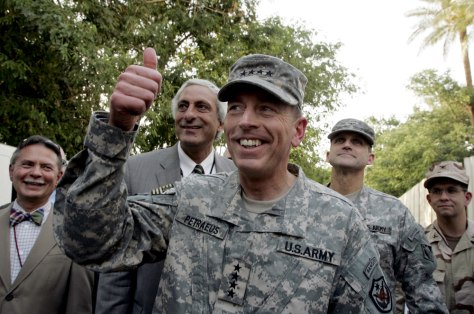
A few more paces down the digital road and you encounter a sullen looking woman holding a dog leash, the collar attached to a man lying nude on the floor of a prison. Your digital tour guide explains: “An unfortunate picture was taken. Luckily, the bad apple was punished and military honor was restored.” Fair enough. Soon, a digital General David Petraeus strides forward and shoots you another thumbs-up. (It looks as if they just put a new cyber-skin over the President Bush avatar to save money.) “He surged his way to victory and the mission was accomplished again,” you hear over strains of the National Anthem and a chorus of “hooahs.”
Music: Bugge Wesseltoft — ‘Existence’
![]()
Syria and the parable of the poisoned arrow
A Buddhist scripture recounts a parable in which the Buddha said:
Suppose a man is struck by a poisoned arrow and the doctor wishes to take out the arrow immediately. Suppose the man does not want the arrow removed until he knows who shot it, his age, his parents, and why he shot it. What would happen? If he were to wait until all these questions have been answered, the man might die first.
Translate this to Syria and this parable takes an ugly twist:
Suppose a man is struck by a poisoned arrow and he asks a doctor to take out the arrow immediately. Suppose the doctor does not want the arrow removed until he knows who shot it, his age, his parents, and why he shot it. What would happen? If the doctor were to wait until all these questions have been answered, the man might die first.
The principle, do no harm, applies just as well to politics as it does to medicine, yet it’s a mistake to view this as a choice between action and inaction. If conceived in those terms, the balance will always incline towards inaction because we can’t know the future. We can never say with certainty that our actions will cause no harm.
Yet if we endeavor to do no harm, we have to recognize that inaction has effects. A passive bystander who actually possesses a significant amount of power yet declines to wield it in any meaningful way, is not lacking in agency. More often, he is simply climbing through the moral escape-hatch which every day affords people across the globe some fragile peace of mind: it’s not my problem. I don’t need to worry about it.
In an op-ed for the Washington Post last week, Stephen Hawking wrote:
What’s happening in Syria is an abomination, one that the world is watching coldly from a distance. Where is our emotional intelligence, our sense of collective justice?
When I discuss intelligent life in the universe, I take this to include the human race, even though much of its behavior throughout history appears not to have been calculated to aid the survival of the species. And while it is not clear that, unlike aggression, intelligence has any long-term survival value, our very human brand of intelligence denotes an ability to reason and plan for not only our own but also our collective futures.
We must work together to end this war and to protect the children of Syria. The international community has watched from the sidelines for three years as this conflict rages, engulfing all hope. As a father and grandfather, I watch the suffering of Syria’s children and must now say: No more.
Hawking is clearly frustrated with global inaction, he sees the suffering of the Syrian population as an affront to any conception of universal justice, and he is appealing for the war to end. What he fails to do is propose any course of action which might lead to that outcome.
A theoretical physicist can reasonably claim he is unqualified to outline such a plan. Nicholas Burns, on the other hand, was a career diplomat and was the U.S. Under Secretary of State for Political Affairs in the Bush administration. We might expect that while appealing for action he would go further than offer a McCainish something must be done.
Burns writes:
There are no easy answers to the Syria crisis. A US-led ground invasion would require something on the scale of the 1991 Gulf War — hundreds of thousands of troops. That’s not in the cards for a president, Congress, and public emerging from two major wars since 9/11. Russia and China continue to shield Syrian President Bashar Assad from international pressure at the UN, going so far as to object to proposals to facilitate the delivery of humanitarian aid. For now, the main, and mainly vain, hope is UN-led talks for a ceasefire and transition from Bashar Assad’s rule. At its current languid pace, that could take years to materialize.
Washington finds itself in an uncharacteristically weak position to drive events in Syria. President Obama has taken force off the table, refusing to strike last September following Assad’s use of chemical weapons against civilians. Obama has still not provided effective, lethal support to moderate rebels or threatened strikes on Assad’s air force if the brutal killings continue. As a result, the United States lacks the leverage and credibility to intimidate Assad. The administration plods along the diplomatic path, remaining a responsible contributor of humanitarian aid but lacking the strength to produce a solution on its own.
The one country that could make a decisive difference to stop the fighting is Vladimir Putin’s Russia. But Putin, aligned with Iran’s Revolutionary Guard and Hezbollah, prefers to run arms to the Syrian government and serve as Assad’s de facto lawyer in Geneva.
[…]
Putin will never reach a “Srebrenica moment” on Syria. That leaves the rest of us to consider once more — how many more lives will be claimed by Syria’s ceaseless civil war before we are finally shamed to stop the killings?
The question is: how?
Opponents of war, who nowadays seem to be much more concerned about avoiding involvement in other people’s wars than in ending wars — let’s call them the Not-Our-War-ists — seem to commonly have a kind of organic perspective on Syria.
If allowed to, the war will follow its natural course — though no one’s particularly clear about where that leads. In one breath the conflict in Syria involves no “good guys” and thus there is no basis for taking sides. Yet in the next breath, the conflict is driven by external powers and the Assad regime is resisting Western imperialism.
While it’s impossible to construct a coherent picture from these elements, the unifying theme is that Syria must not become another Iraq.
On those terms, since there has been no invasion, no bombs dropped nor cruise missiles launched from American warships, I guess — at least for now — Syria counts as one success story in the campaign to end U.S.-led wars in the Middle East.
While 140,000 have been killed and 6 million Syrians have lost their homes, this hasn’t become America’s war.
If this is mission accomplished, this is the kind of victory that leads to ruin.
So what’s the alternative?
One of the many reasons Americans tend to have a twisted view of war is because the continuation or end of a war has often had so little impact on life in America. Ending a war is a political choice here, but the physical implications play out elsewhere. America and American civilians collectively, face no existential threats.
The day the war ends is not the day the bombs stop dropping because for most Americans during wartime the bombs were always dropping somewhere else. War thus appears to be nothing more than the product of the callous calculations of governments — governments which might just as easily choose to end such wars as they chose to start them.
In Syria, on the other hand, both sides see themselves as facing an existential threat. There can be no return to a status quo ante bellum.
But as much as this is true for the Assad regime, it is not true for its principal supporters. Iran’s future does not depend on its alliance with Syria and neither does Russia’s. And while Hezbollah’s dependence may be the greatest, its involvement in Syria is actually serving to postpone its greatest existential challenge: whether it can ever fully evolve into a political entity, or whether it will always need weapons to compensate for a deficit in its popularity.
Without these three pillars of support, Assad is finished, and everyone knows that all four will not all rise or fall together.
Burns is right that Putin will never reach a “Srebrenica moment” on Syria — but neither will the U.S. and its allies. That moment came and went last August.
So what’s left?
Assad rules Syria from the air and now more than ever through barrel bombs which plummet aimlessly from helicopters. This crude use of power utterly depends on the weakness of his opponent, but that may soon change.
Last week, the Wall Street Journal, quoting Western and Arab diplomatic sources, reported that Saudi Arabia is about to supply Syrian rebel forces with “Chinese man-portable air defense systems, or Manpads, and antitank guided missiles from Russia”.
[I]f the Manpads are supplied in the quantities needed, rebels said it could tip the balance in the stalemated war in favor of the opposition. The antiaircraft and Russian Konkurs antitank weapons would help them chip away at the regime’s two big advantages on the battlefield—air power and heavy armor.
“New stuff is arriving imminently,” said a Western diplomat with knowledge of the weapons deliveries.
Rebel commanders and leaders of the Syrian political opposition said they don’t know yet how many of the Manpads and antiaircraft missiles they will get. But they have been told it is a significant amount. The weapons are already waiting in warehouses in Jordan and Turkey.
Earlier in the conflict, rebels managed to seize a limited number of Manpads from regime forces. But they quickly ran out of the missiles to arm them, the Western diplomat said.
Following the logic that more weapons means more violence, the supply of Manpads would have to be viewed as an unwelcome development. Moreover, no one can plausibly claim that Saudi Arabia has an interest in promoting democracy in the region. Yet assuming that the Manpads do in fact materialize, the most immediate and likely effect they will have is to bring a sudden end to the regime’s use of barrel bombs. Perhaps a broader shift in the balance of power will follow.
An end to this war depends less on finding enough people willing to give peace a chance than it does on changing the status quo.
And while some observers will always be inclined to see nefarious motives in all Saudi actions, their decision at this time, along with Washington’s quiet acquiescence, provides yet another telltale sign of AIPAC’s dwindling power.
The most vociferous opposition to Manpads circulating in Syria comes from Israel — which also happens to be the power that appears most content with a continuing stalemate.

Separation from Syria
UN staff found 4 year-old Marwan crossing desert alone after being separated from family fleeing #Syria. pic.twitter.com/YdCt7gZrcN
— Hala Gorani (@HalaGorani) February 17, 2014
Marwan, found today, was later reported to have been reunited with his family, yet this image of a child alone in the desert seems like an icon representing the connection between Syria and the rest of the world.
Going ‘green’ is more than shopping at Whole Foods and driving a Prius
Marc Bamuthi Joseph writes: As environmentalism goes mainstream, corporations are marketing the word “green” as a panacea for the world’s climate crisis. Today the word describes a set of prescribed, mostly consumerist actions: buy local, organic and fresh; go vegan; eat in season; skip the elevator, take the stairs. “Green” has come to mean shopping at Whole Foods and possessing a Prius. Meanwhile, leading corporate polluters like BP and ExxonMobil place commercials on CNN advertising their “green” practices.
It should come as no surprise, then, that “green” lifestyles don’t resonate with low-income communities; being “green” involves a set of behaviors that are financially or culturally inaccessible to millions of Americans. This presents a major problem for the environmental movement. If it is going to be successful, environmentalism simply cannot afford to be demographically segregated or isolated from the pathos of economic disparity.
The environmental movement needs to do a better job of connecting issues of race, class, poverty and sustainability; in short, it has to become a broader social movement. And people of color need visibility in the movement. By that, I don’t mean Barack Obama presiding over environmental policy from the White House or Lisa Jackson heading the Environmental Protection Agency during Obama’s first term. I mean the recognition that sustainable survival practices in poor communities are just as significant as solar panels and LED lights. Ultimately this is where the citizenry of the planet can and must come together in order to move forward. [Continue reading…]