The most arrogant creatures on Earth

Dominique Mosbergen writes: Researchers from the University of Adelaide in Australia argue in an upcoming book, The Dynamic Human, that humans really aren’t much smarter than other creatures — and that some animals may actually be brighter than we are.

“For millennia, all kinds of authorities — from religion to eminent scholars — have been repeating the same idea ad nauseam, that humans are exceptional by virtue that they are the smartest in the animal kingdom,” the book’s co-author Dr. Arthur Saniotis, a visiting research fellow with the university’s School of Medical Sciences, said in a written statement. “However, science tells us that animals can have cognitive faculties that are superior to human beings.”

Not to mention, ongoing research on intelligence and primate brain evolution backs the idea that humans aren’t the cleverest creatures on Earth, co-author Dr. Maciej Henneberg, a professor also at the School of Medical Sciences, told The Huffington Post in an email.

The researchers said the belief in the superiority of that human intelligence can be traced back around 10,000 years to the Agricultural Revolution, when humans began domesticating animals. The idea was reinforced with the advent of organized religion, which emphasized human beings’ superiority over other creatures. [Continue reading…]

At various times in my life, I’ve crossed paths with people possessing immense wealth and power, providing me with glimpses of the mindset of those who regard themselves as the most important people on this planet.

From what I can tell, the concentration of great power does not coincide with the expression of great intelligence. What is far more evident is a great sense of entitlement, which is to say a self-validating sense that power rests where power belongs and that the inequality in its distribution is a reflection of some kind of natural order.

Since this self-serving perception of hierarchical order operates among humans and since humans as a species wield so much more power than any other, it’s perhaps not surprising that we exhibit the same kind of hubris collectively that we see individually in the most dominant among us.

Nevertheless, it is becoming increasingly clear that our sense of superiority is rooted in ignorance.

Amit Majmudar writes: There may come a time when we cease to regard animals as inferior, preliminary iterations of the human—with the human thought of as the pinnacle of evolution so far—and instead regard all forms of life as fugue-like elaborations of a single musical theme.

Animals are routinely superhuman in one way or another. They outstrip us in this or that perceptual or physical ability, and we think nothing of it. It is only our kind of superiority (in the use of tools, basically) that we select as the marker of “real” superiority. A human being with an elephant’s hippocampus would end up like Funes the Memorious in the story by Borges; a human being with a dog’s olfactory bulb would become a Vermeer of scent, but his art would be lost on the rest of us, with our visually dominated brains. The poetry of the orcas is yet to be translated; I suspect that the whale sagas will have much more interesting things in them than the tablets and inscriptions of Sumer and Akkad.

If science should ever persuade people of this biological unity, it would be of far greater benefit to the species than penicillin or cardiopulmonary bypass; of far greater benefit to the planet than the piecemeal successes of environmental activism. We will have arrived, by study and reasoning, at the intuitive, mystical insights of poets.

Facebooktwittermail

By cracking cellphone code, NSA has capacity for decoding private conversations

The Washington Post reports: The cellphone encryption technology used most widely across the world can be easily defeated by the National Security Agency, an internal document shows, giving the agency the means to decode most of the billions of calls and texts that travel over public airwaves every day.

While the military and law enforcement agencies long have been able to hack into individual cellphones, the NSA’s capability appears to be far more sweeping because of the agency’s global signals collection operation. The agency’s ability to crack encryption used by the majority of cellphones in the world offers it wide-ranging powers to listen in on private conversations.

U.S. law prohibits the NSA from collecting the content of conversations between Americans without a court order. But experts say that if the NSA has developed the capacity to easily decode encrypted cellphone conversations, then other nations likely can do the same through their own intelligence services, potentially to Americans’ calls, as well.

Encryption experts have complained for years that the most commonly used technology, known as A5/1, is vulnerable and have urged providers to upgrade to newer systems that are much harder to crack. Most companies worldwide have not done so, even as controversy has intensified in recent months over NSA collection of cellphone traffic, including of such world leaders as German Chancellor Angela Merkel. [Continue reading…]

Facebooktwittermail

For Syrian refugees in Lebanon, winter storm brings snow, rain and new misery

The Washington Post reports: The United Nations said Wednesday that it is “extremely concerned” for Syria’s refugees as snow and freezing temperatures descended on the region.

Syria and the countries that border it have been bracing for what is expected to be the worst winter storm in years. Snow hit some areas of Lebanon, Turkey and northern Syria overnight Tuesday as sharp winds and cold, heavy rains battered others, causing misery for hundreds of thousands in camps and shanties.

In Lebanon, despite the wintry conditions, the flow of Syrians fleeing the war is unrelenting. Local officials in the border town of Arsal, where some of the heaviest snow fell overnight, on Wednesday reported the arrival of 200 men, women and children who had risked the treacherous journey across the mountains on foot. Many were from the town of Yabroud in the Qalamoun region, where a Syrian army offensive is underway.

Aid agencies, the Office of the U.N. High Commissioner for Refugees (UNHCR) and the Lebanese army rushed to distribute kits containing plastic sheeting and blankets to the newcomers, but poorly funded humanitarian groups are struggling to meet the overwhelming needs. Authorities remain reluctant to establish permanent refu­gee camps in Lebanon and have opened only one official, 100-tent “transit camp.” [Continue reading…]

Facebooktwittermail

The collapse of the Free Syrian Army brand

Mike Giglio reports: On the afternoon of Nov. 26, near the border in southern Turkey, Mohamed al-Kadi got behind the wheel of a white Isuzu delivery truck and drove into Syria. In the back of the truck sat a shipment of advanced communications equipment, provided by the United States. Kadi’s mission was to bring it to the Free Syrian Army, or FSA, the U.S.-backed rebel coalition whose main base sat just a few miles into Syria.

Kadi, a deeply religious man partial to Muslim prayer beads and oddball humor, was a tech whiz with a degree in computer engineering. He’d been a young lieutenant in Damascus at the war’s outset but defected early to the rebel side, where his computer skills saw him pulled from the front lines. He worked as a senior technician for the FSA’s high command, based mainly inside Syria. But shortly after he crossed into Syria that afternoon, Kadi and the delivery truck disappeared. Days later, his body was found in a farm field, shot at point-blank range in the back of the head, hands tied behind his back.

The FSA blamed Kadi’s death on the Islamic State of Iraq and Syria, or ISIS, which claims to be Al-Qaeda’s Syrian arm, saying the group had captured Kadi’s truck along a critical supply route and stolen the equipment inside.

The incident alarmed the U.S., which had long worried about the possibility of the supplies it sends the FSA falling into the hands of extremists. Some U.S. allies inside the rebellion shared those concerns. “We warned the U.S. government for over a year about ISIS gathering strength and spreading in the North,” said one opposition official involved in channeling U.S. assistance to the FSA.

Now many are questioning how much longer the FSA can survive, following news that fighters from a new, hardline coalition called the Islamic Front, which boasts an estimated 45,000 fighters in Syria, overtook its main bases and warehouses in Atimeh, a town near the Turkish border late last week. The powerful Islamist faction now stands poised to overtake the FSA as the country’s dominant rebel force. [Continue reading…]

Facebooktwittermail

Former CIA chief Hayden hopes Assad will remain in power

AFP reports: The sectarian bloodbath in Syria is such a threat to regional security that a victory for Bashar al-Assad’s regime could be the best outcome to hope for, a former CIA chief said.

Washington condemned Assad’s conduct of the conflict, threatened air strikes after he was accused of targeting civilians with chemical weapons and has demanded he step down.

The United States is also supplying millions of dollars in “non-lethal” aid to some of the rebel groups fighting Assad’s rule.

But Michael Hayden, the retired US Air Force general who until 2009 was head of the Central Intelligence Agency, said a rebel win was not one of the three possible outcomes he foresees for the conflict.

“Option three is Assad wins,” Hayden told the annual Jamestown Foundation conference of terror experts.

“And I must tell you at the moment, as ugly as it sounds, I’m kind of trending toward option three as the best out of three very, very ugly possible outcomes,” he said.

Facebooktwittermail

NSA review to leave spying programs largely unchanged, reports say

The Guardian reports: A participant in a White House-sponsored review of surveillance activities described as “shameful” an apparent decision to leave most of the National Security Agency’s controversial bulk spying intact.

Sascha Meinrath, director of the Open Technology Institute, said Friday that the review panel he advised is at risk of missing an opportunity to restore confidence in US surveillance practices.

“The review group was searching for ways to make the most modest pivot necessary to continue business as usual,” Meinrath said.

Headed by the CIA’s former deputy director, Michael Morrell, the review is expected to deliver its report to President Barack Obama on Sunday, the White House confirmed, although it is less clear when and how substantially its report will be available to the public.

National security council spokeswoman Caitlin Hayden said she would have no further comment “on a report that is not yet final and hasn’t yet been submitted to the White House”.

Should the review group’s report resemble descriptions that leaked late Thursday, the report “does nothing to alter the lack of trust the global populace has for what the US is doing, and nothing to restore our reputation as an ethical internet steward,” said Meinrath, who met with the advisory panel and White House officials twice to discuss the bulk surveillance programs that have sparked international outrage.

Leaks about the review group’s expected recommendations to the New York Times and Wall Street Journal strengthened Meinrath and other participants’ long-standing suspicions that much of the NSA’s sweeping spy powers would survive. [Continue reading…]

Facebooktwittermail

Iran nuclear talks hit snag after U.S. expands commercial ‘blacklists’

Reuters reports: A breakthrough agreement to end a standoff over Iran’s nuclear program appeared to face its first major difficulty on Friday with Russia warning that a U.S. sanctions move could “seriously” complicate its implementation.

Russia, which along with the United States is among the six world powers which negotiated the November 24 interim accord with Tehran, echoed Iran’s criticism by saying Washington’s sanctions decision violated the spirit of the deal.

Moscow’s statement came after diplomats said Iran had interrupted technical talks with the six nations in Vienna over how to implement the agreement, under which Tehran is to cap its nuclear program in return for limited sanctions easing.

The developments highlighted potential obstacles negotiators face in pressing ahead with efforts to resolve a decade-old dispute between the Islamic Republic and the West that has stirred fears of a new Middle East war.

Several Western diplomats insisted the inconclusive outcome of the December 9-12 expert-level discussions in Vienna should not be seen as a sign that the political deal hammered out nearly three weeks ago was in serious trouble.

But Russia made its concerns clear a day after the United States blacklisted additional companies and people under existing sanctions intended to prevent Iran from obtaining the capability to make nuclear weapons. Iran denies any such aims.

“The U.S. administration’s decision goes against the spirit of this document,” said Foreign Ministry spokeswoman Maria Zakharova, referring to the Geneva agreement between Iran and the United States, Russia, China, France, Britain and Germany.

“Widening American ‘blacklists’ could seriously complicate the fulfillment of the Geneva agreement, which proposes easing sanctions pressure.” [Continue reading…]

Facebooktwittermail

The disappearance of CIA contractor Robert Levinson: A rogue operation or a rogue intelligence agency? Updated

An Associated Press investigation has revealed that Robert Levinson, a former FBI agent who went missing in Iran in 2007 and who was at that time described by the State Department as “a private citizen involved in private business in Iran,” was in fact working for the CIA. He had been hired by a team of analysts who were running a rogue intelligence operation.

A 28-year veteran of the Drug Enforcement Administration and the FBI, Robert Levinson had a natural ability to cultivate informants. Former colleagues say he was an easy conversationalist who had the patience to draw out people and win their confidence. He’d talk to anyone.

“Bob, in that sense, was fearless,” said retired FBI Assistant Director Mark Mershon, who worked with Levinson in Miami in the 1980s. “He wasn’t concerned about being turned down or turned away.”

As the Soviet Union collapsed, Levinson turned his attention away from Mafia bosses and cocaine cartels and began watching the Russian gangsters who made their homes in Florida. Russian organized crime was a niche then and Levinson made a name as one of the few investigators who understood it.

At a Justice Department organized crime conference in Santa Fe, N.M., in the early 1990s, Levinson listened to a presentation by a CIA analyst named Anne Jablonski and spotted a kindred spirit.

Jablonski was perhaps the government’s foremost expert on Russian organized crime. Former colleagues say she had an encyclopedic memory and could, at the mere mention of a crime figure, quickly explain his place in the hierarchy and his method of moving money. When White House officials had questions about Russian organized crime, they often called Jablonski directly.

In the relatively staid world of CIA analysts, Jablonski was also a quirky character, a yoga devotee who made her own cat food, a woman who skipped off to Las Vegas to renew her vows in an Elvis-themed chapel.

After the Santa Fe conference, Levinson left a note for Jablonski at her hotel and the two began exchanging thoughts on organized crime. Jablonski invited Levinson to CIA headquarters in Langley, Va., to speak to her colleagues in the Office of Russian and European Analysis.

By the time Levinson retired from the FBI in 1998, he and Jablonski were close friends. She attended his going-away party in Florida, met his family and harvested his knowledge of organized crime.

In retirement, Levinson worked as a private investigator, traveling the world and gathering information for corporate clients. Jablonski, meanwhile, thrived at the CIA. After the Sept. 11 attacks, former colleagues say, she was assigned to brief Attorney General John Ashcroft and FBI Director Robert Mueller about terrorist threats every morning.

In 2005, Jablonski moved to the Office of Transnational Issues, the CIA team that tracks threats across borders. Right away, she arranged for Levinson to speak to the money-laundering experts in the office’s Illicit Finance Group.

In a sixth-floor CIA conference room, Levinson explained how to track dirty money. Unlike the analysts in the audience, Levinson came from the field. He generated his own information.

In June 2006, the head of Illicit Finance, Tim Sampson, hired Levinson on a contract with the CIA, former officials said. Like most CIA contracts, it was not a matter of public record. But it also wasn’t classified. [Continue reading…]

Following an internal investigation into the events leading up to Levinson’s disappearance, Jablonski and Sampson were forced to resign. [The New York Times reports that Jablonski says she refused to resign and was fired. See update below.]

Jablonski later became chief data officer for Regulatory DataCorp, Inc. (RDC), a private intelligence company serving major banks. Yesterday evening the company’s website leadership page included this description of her:
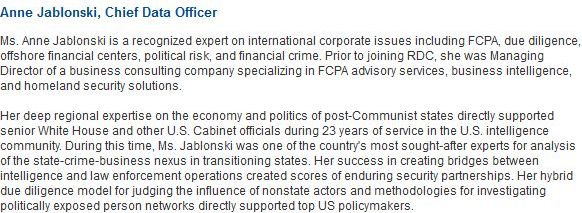
jablonski

Today a company representative I spoke to said that she no longer works there but couldn’t tell me when she left. Presumably it was within hours of the publication of the Associated Press report.

USA Today reports that the White House strongly urged AP not to run the story:

“Without commenting on any purported affiliation between Mr. Levinson and the U.S. government, the White House and others in the U.S. Government strongly urged the AP not to run this story out of concern for Mr. Levinson’s life,” said a statement from Caitlin Hayden, a spokesperson for the National Security Council.

NBC News, however, reports that Levinson’s family believe the disclosure may be helpful:

Friends and relatives of Robert Levinson, a retired FBI agent who disappeared in Iran more than six years ago, say they hope new disclosures that he was working for the CIA will lead to more action to get him home.

“Bob is a courageous man who has dedicated himself, including risking his own life, in service to the U.S. government,” Levinson’s family said in a statement provided to NBC News. “But the U.S. government has failed to make saving this good man’s life the priority it should be.”

While the account told by the AP places emphasis on the role of Anne Jablonski, characterizing her as “quirky” (like 20 million other Americans she practices yoga) and implies that as “kindred spirits” she and Levinson perhaps carry equal responsibility for conducting a rogue operation, the story says nothing about the prevailing culture in the CIA after Vice President Dick Cheney had said that it would need to operate on “the dark side.”

The idea of a group of analysts contracting an American to conduct a clandestine mission inside Iran might sound reckless, but the fact is, they were working inside an agency that was engaged in targeted killing, torture, kidnapping, and the operation of secret prisons.

Governments, their agencies, and companies, all expect unswerving loyalty from their employees, but the obligations of loyalty invariably seem to flow in only one direction.

Update: Following the publication of the AP report, the New York Times has also released a report which it has published after receiving the Levinson family’s permission. The report contains a great deal of additional information about the fruitless efforts to find Levinson. It also contains details that raise questions about whether Jablonski was turned into a scapegoat by the CIA. It should be noted that the agency’s own investigation was triggered by the intervention of Levinson’s senator, who had himself be informed about the case by the Levinson family’s lawyer.

In March 2008, a year after Mr. Levinson’s disappearance, his wife was called to a meeting at F.B.I. headquarters. There C.I.A. officials acknowledged for the first time that he had worked for them. Had it been left up to the C.I.A., it is unlikely that meeting would have occurred.

Mr. McGee [the family lawyer] and Mr. Silverman [a retired NBC investigative producer who had arranged Levinson’s meeting in Iran] had given records from Mr. Levinson’s files that documented his C.I.A. work to the Senate Select Committee on Intelligence. Senator Bill Nelson, Democrat of Florida, called in top agency officials and demanded an explanation. Those officials said they had never been alerted that an agency contractor was missing and promised to investigate.

Not long afterward, two C.I.A. officials met with Ms. Levinson and Mr. McGee at his office in Pensacola, Fla. They started by delivering a message. “They wanted to officially apologize on behalf of the C.I.A. to the Levinson family,” Mr. McGee recalled.

According to Mr. McGee, the C.I.A. officials said that while an inquiry had not found a “smoking gun” proving that the agency knew in advance about Mr. Levinson’s trip, it did conclude that Ms. Jablonski and her boss, Mr. Sampson, had misled officials about his work.

The agency gave Ms. Jablonski, Mr. Sampson and another top C.I.A. analytical official a choice: They could resign from the agency or be fired, according to several people familiar with the matter. Mr. Sampson and the other official resigned. Ms. Jablonski said she had refused and had been fired. In 2008, when Mr. McGee made it clear he was prepared to sue the C.I.A., the agency agreed to pay $2.25 million to Christine Levinson, whether or not her husband returned.

Ms. Jablonski later said in an interview that the C.I.A.’s suggestion she had abandoned a friend to protect her career was a lie. She said she had never imagined Mr. Levinson would go to Kish and insisted that she would have stopped him had she known.

She described herself as a convenient scapegoat for the C.I.A. She said that during the agency’s internal inquiry she had been repeatedly interrogated inside a windowless room by two former operatives. The men belittled Mr. Levinson’s intelligence reports as useless and suggested she might have been complicit in his disappearance.

“For all we know, you were angry with your friend and sent him to Iran to be killed,” she said one of them told her.

Facebooktwittermail

How computers are making people stupid

The pursuit of artificial intelligence has been driven by the assumption that if human intelligence can be replicated or advanced upon by machines then this accomplishment will in various ways serve the human good. At the same time, thanks to the technophobia promoted in some dystopian science fiction, there is a popular fear that if machines become smarter than people we will end up becoming their slaves.

It turns out that even if there are some irrational fears wrapped up in technophobia, there are good reasons to regard computing devices as a threat to human intelligence.

It’s not that we are creating machines that harbor evil designs to take over the world, but simply that each time we delegate a function of the brain to an external piece of circuitry, our mental faculties inevitably atrophy.

Use it or lose it applies just as much to the brain as it does to any other part of the body.

Carolyn Gregoire writes: Take a moment to think about the last time you memorized someone’s phone number. Was it way back when, perhaps circa 2001? And when was the last time you were at a dinner party or having a conversation with friends, when you whipped out your smartphone to Google the answer to someone’s question? Probably last week.

Technology changes the way we live our daily lives, the way we learn, and the way we use our faculties of attention — and a growing body of research has suggested that it may have profound effects on our memories (particularly the short-term, or working, memory), altering and in some cases impairing its function.

The implications of a poor working memory on our brain functioning and overall intelligence levels are difficult to over-estimate.

“The depth of our intelligence hinges on our ability to transfer information from working memory, the scratch pad of consciousness, to long-term memory, the mind’s filing system,” Nicholas Carr, author of The Shallows: What The Internet Is Doing To Our Brains, wrote in Wired in 2010. “When facts and experiences enter our long-term memory, we are able to weave them into the complex ideas that give richness to our thought.”

While our long-term memory has a nearly unlimited capacity, the short-term memory has more limited storage, and that storage is very fragile. “A break in our attention can sweep its contents from our mind,” Carr explains.

Meanwhile, new research has found that taking photos — an increasingly ubiquitous practice in our smartphone-obsessed culture — actually hinders our ability to remember that which we’re capturing on camera.

Concerned about premature memory loss? You probably should be. Here are five things you should know about the way technology is affecting your memory.

1. Information overload makes it harder to retain information.

Even a single session of Internet usage can make it more difficult to file away information in your memory, says Erik Fransén, computer science professor at Sweden’s KTH Royal Institute of Technology. And according to Tony Schwartz, productivity expert and author of The Way We’re Working Isn’t Working, most of us aren’t able to effectively manage the overload of information we’re constantly bombarded with. [Continue reading…]

As I pointed out in a recent post, the externalization of intelligence long preceded the creation of smart phones and personal computers. Indeed, it goes all the way back to the beginning of civilization when we first learned how to transform language into a material form as the written word, thereby creating a substitute for memory.

Plato foresaw the consequences of writing.

In Phaedrus, he describes an exchange between the god Thamus, king and ruler of all Egypt, and the god Theuth, who has invented writing. Theuth, who is very proud of what he has created says: “This invention, O king, will make the Egyptians wiser and will improve their memories; for it is an elixir of memory and wisdom that I have discovered.” But Thamus points out that while one man has the ability to invent, the ability to judge an invention’s usefulness or harmfulness belongs to another.

If men learn this, it will implant forgetfulness in their souls; they will cease to exercise memory because they rely on that which is written, calling things to remembrance no longer from within themselves, but by means of external marks. What you have discovered is a recipe not for memory, but for reminder. And it is no true wisdom that you offer your disciples, but only its semblance, for by telling them of many things without teaching them you will make them seem to know much, while for the most part they know nothing, and as men filled, not with wisdom, but with the conceit of wisdom, they will be a burden to their fellows.

Bedazzled by our ingenuity and its creations, we are fast forgetting the value of this quality that can never be implanted in a machine (or a text): wisdom.

Facebooktwittermail

Pope attacks mega-salaries and wealth gap in peace message

Reuters reports: Pope Francis said in the first peace message of his pontificate that huge salaries and bonuses are symptoms of an economy based on greed and inequality and called again for nations to narrow the wealth gap.

In his message for the Roman Catholic Church’s World Day of Peace, marked around the world on January 1, he also called for sharing of wealth and for nations to shrink the gap between rich and poor, more of whom are getting only “crumbs”.

“The grave financial and economic crises of the present time … have pushed man to seek satisfaction, happiness and security in consumption and earnings out of all proportion to the principles of a sound economy,” he said.

“The succession of economic crises should lead to a timely rethinking of our models of economic development and to a change in lifestyles,” he said.

Francis, who was named Time magazine’s Person of the Year on Wednesday, has urged his own Church to be more fair, frugal and less pompous and to be closer to the poor and suffering.

His message will be sent to national leaders, international organizations such as the United Nations, and NGO’s.

Titled “Fraternity, the Foundation and Pathway to Peace“, the message also attacked injustice, human trafficking, organized crime and the weapons trade as obstacles to peace.

Facebooktwittermail

Pope Francis — a whistleblower for the poor

Chris Arnade writes: Edward Snowden was not chosen as Time magazine’s Person of the Year, and for this many in the media are outraged.

Instead Time chose Pope Francis, a man who in the last year has been transforming the Catholic church by focusing on the searing inequalities brought about by poverty. In one of his many poignant quotes recently, he asks:

How can it be that it is not a news item when an elderly homeless person dies of exposure, but it is news when the stock market loses two points?

His stunning 224-page “Apostolic Exhortation” is a treatise on the corrosive effects of capitalism and a call for empathy. It is a must read, whether you are Catholic or not:

Some people continue to defend trickle-down theories which assume that economic growth, encouraged by a free market, will inevitably succeed in bringing about greater justice and inclusiveness in the world. This opinion, which has never been confirmed by the facts, expresses a crude and naïve trust in the goodness of those wielding economic power and in the sacralized workings of the prevailing economic system. Meanwhile, the excluded are still waiting.

I keep going back to the line “those wielding economic power”. They are the ones who have come to dominate our society, a society that over the last 40 years has slowly ceded to the ideology of free markets.

When I worked on Wall Street in the 90s, I traveled for business to Pope Francis’s home country of Argentina. I was one of many foreigners there to tell them how they needed to reform their country, open it up to the free markets. They did embrace the free markets. That worked well until it didn’t, ending in a massive crash in 2001. Poverty rates climbed during that period.

We bankers would travel in taxis, past the slums that ringed the city center of Buenos Aires. No banker went in there. It was said to be too dangerous. Instead we moved around numbers on a spreadsheet, numbers that represented people. Pope Francis did go into the slums. Regularly. He saw what we didn’t. As he wrote in his Apostolic Exhortation: “Human beings are themselves considered consumer goods to be used and then discarded.” [Continue reading…]

Facebooktwittermail

AT&T accused of violating privacy law with sale of phone records to CIA

Ars Technica: Consumer advocates have asked the Federal Communications Commission (FCC) to declare that AT&T violated a privacy rule in the Communications Act by selling phone records to the Central Intelligence Agency (CIA).

A report last month said that “AT&T has turned over international calling records to the CIA. The telecom charges the CIA more than $10 million per year in exchange for access to metadata about calls by suspected terrorists overseas.”

In response, a group of consumer advocacy groups led by Public Knowledge filed a petition today with the FCC.

Appealing to the FCC is a new tactic against government collection of calling records. Previously, privacy advocates have tried to shut down the phone collection by filing lawsuits, including one in the Supreme Court. [Continue reading…]

Meanwhile, Reuters reports: Verizon Communications Inc told activist investors on Wednesday that it might skip a vote on a shareholder proposal that seeks details on the company’s cooperation with government surveillance efforts.

Verizon’s law firm Jones Day said in a November 25 letter that the company would exclude the measure from its 2014 proxy statement unless the activists did more to verify their eligibility to file the proposal.

The company’s response appears to be more aggressive than the stance AT&T Inc took against a similar proposal, said Jonas Kron, senior vice president for Trillium Asset Management, a co-filer of the measures at both telecommunications companies.

Facebooktwittermail

Top Western-backed rebel in Syria is forced to flee

The Wall Street Journal reports: Islamist fighters ran the top Western-backed rebel commander in Syria out of his headquarters, and he fled the country, U.S. officials said Wednesday.

The Islamists also took over key warehouses holding U.S. military gear for moderate fighters in northern Syria over the weekend. The takeover and flight of Gen. Salim Idris of the Free Syrian Army shocked the U.S., which along with Britain immediately froze delivery of nonlethal military aid to rebels in northern Syria.

The turn of events was the strongest sign yet that the U.S.-allied FSA is collapsing under the pressure of Islamist domination of the rebel side of the war. It also weakened the Obama administration’s hand as it struggles to organize a peace conference next month bringing together rebels and the regime.

The Islamic Front is a recently formed alliance of the largest Islamist rebel groups that excludes the two main al Qaeda-linked rebel groups—the Nusra Front and the Islamic State of Iraq and al Sham—and is considered the more moderate faction among Islamist rebel groups.

Gen. Idris flew to the Qatari capital of Doha on Sunday after fleeing to Turkey, U.S. officials said Wednesday. “He fled as a result of the Islamic Front taking over his headquarters,” a senior U.S. official said.

An Islamic Front spokesman also said Gen. Idris had fled to Turkey.

The Front took over the warehouses and offices controlled by the Supreme Military Council, the moderate opposition umbrella group that includes the FSA and coordinates U.S. aid distribution, officials said. They also seized the Bab al-Hawa border crossing with Turkey, near the warehouses in the town of Atmeh.

The growing strength of the Islamic Front prompted the U.S. and its allies to recently hold direct talks with Islamic Front representatives. The goal, according to Western officials, was to persuade some Islamists to support a Syria peace conference set for Geneva on Jan. 22 for fear that a lasting accord won’t be possible without their backing. The SMC already agreed to participate in the peace talks. [Continue reading…]

Facebooktwittermail

Al Qaeda and America’s deep battle

In a review, Owen Bennett-Jones writes: In Decoding al-Qaida’s Strategy Michael Ryan draws a useful distinction between the drawn-out or ‘deep’ battle of ideas and the ‘close’ battle of combat. The recent al-Qaida advances can be seen as close-battle victories of relatively little importance, but al-Qaida and the West are also engaged in a broad ideological struggle and it is here, significantly, that the West’s inability to put up a decent counterargument to al-Qaida is more worrying. In the last three years bin Laden and now al-Zawahiri have convinced millions of people that, for all their excesses, they have a point. Their key messages relate to Western double standards now so widely discussed as to require only the briefest rehearsal: the West’s creation and subsequent abandonment of a mujahedin fighting force to confront the Soviets; the neglect of the hallowed principle of habeas corpus implicit in extraordinary rendition; detentions without trial in Guantánamo; the humiliation and torture of prisoners in Iraq; the CIA’s use of drones in Pakistan, Somalia and Yemen; and, most recently, the NSA’s disregard for privacy. This litany of human rights abuses, al-Qaida argues, is explained by the West’s hatred of Islam. The actions of a few fringe figures such as Pastor Terry Jones who do indeed seem to hate Islam are then cited as supporting evidence.

One aspect of the US’s use of torture, incidentally, has received too little attention. Khalid Sheikh Mohammed was waterboarded no fewer than 183 times. At some point he worked out his interrogator’s protocols, including the length of time (40 seconds) he could have water poured down his throat. By the end he was seen counting down the seconds with his fingers. It’s said by people who have read the transcripts of his confessions that some of his information led to the arrests of leading jihadis. But Khalid Sheikh Mohammed later told the Red Cross that he also gave false information so as to confuse the Americans. Crucially, he failed to answer questions about the location of either al-Zawahiri (despite having met him the day before his capture) or bin Laden’s courier, Abu Ahmed al-Kuwaiti, the man who led the Americans to Abbotabad. Other detainees told the Americans that al-Kuwaiti had been well known to Khalid Sheikh Mohammed for years. So the waterboarding not only fed al-Qaida’s narrative, it was also ineffective.

Other examples of counterproductive Western policies abound. Take the 2013 drone strike on the Taliban leader Hakimullah Mehsud. Mehsud was known to have deployed suicide bombers all over Pakistan, yet his death evoked a wave of sympathy in the country. It was simultaneously a close-battle victory for the US and a deep-battle defeat. Although many Pakistanis were happy that Mehsud was no long threatening them, their relief was outweighed by the thought that the US’s use of drones in Pakistan was an unacceptable breach of sovereignty and a national humiliation. Sympathy for Mehsud was punctured only when a journalist revealed that his house in the tribal areas was worth $120,000 (a huge sum in that part of Pakistan) and included extensive gardens with orchards.

At a stroke the news dented the Taliban’s carefully burnished image as selfless holy warriors renouncing worldly comforts for their faith. Some jihadis evoke the kind of admiration that Western socialists feel for the volunteers who fought in Spain. YouTube videos of fit young men, brave, idealistic and pious, washing themselves in mountain streams, give jihadism a romantic air. Bin Laden was perfectly placed to take advantage of this appeal, having given up his riches for a life of hardship and struggle. You can’t help thinking that the US would have been well advised to use the drones not to kill Mehsud but to leaflet his admirers with images of his luxurious lifestyle.

The carefully honed Robin Hood image is only part of the story. Ryan’s stated purpose in Decoding al-Qaida’s Strategy is to identify other aspects of radical Islam’s support base, the better to equip US strategists for the deep battle. The book consists of summaries, translations and analysis of important al-Qaida texts including al-Zawahiri’s Knights under the Prophet’s Banner; The Administration of Savagery by Abu Bakr Naji; A Practical Course for Guerrilla Warfare (actually not an ideological text but a description of military tactics) by Abd al-Aziz al-Muqrin; various articles by Abu Ubayd al-Qurashi including Fourth Generation Warfare, which argues that al-Qaida should conceive of itself as a revolutionary vanguard; and finally a perennial favourite on many jihadi websites, The Call to Global Islamic Resistance by Abu Musab al-Suri.

Ryan’s survey pins down crucial elements of al-Qaida’s appeal. Even many of its detractors in the Middle East would accept that the organisation is trying to respond to the humiliations meted out to the Arab people by colonial European powers, the US, Israel and, according to al-Zawahiri, the United Nations, the multinationals, internet providers, the global news media and international aid agencies. All these stand accused of using puppet regimes in the Middle East to continue the colonial project by other means. As I travelled around the Middle East during the Arab Spring, the word that most often cropped up in the slogans in various capitals was not ‘freedom’ – the one the Western media recognised and highlighted – but ‘dignity’. The failure of the Arab Spring has reinforced al-Qaida’s case. For a moment it looked as if people power rather than jihadi violence would topple the authoritarian regimes bin Laden railed against. Today those hopes have been dashed. Indeed, the Egyptian army’s successful assault on the democratically elected Muslim Brotherhood government may turn out to be as useful to al-Qaida as the US invasion of Iraq. It’s already a familiar argument that only the jihadis have the resolve and drive to sweep away entrenched dictatorial regimes. [Continue reading…]

Facebooktwittermail

How easy is it to make sarin?

“It’s not hard to make sarin. You could mix it in the backyard. Two chemicals melded together.”Seymour Hersh interviewed on CNN, December 9, 2013.

The idea that the chemical warfare agent, sarin, is easy to make is central to Seymour Hersh’s claim that the August 21 attacks killing hundreds of Syrians could have been carried out by the rebel group, the Al Nusra Front. (With unquestioning confidence in the reliability of his source(s), Hersh rests this claim on classified intelligence reports none of which he claims to have seen.)

Hersh’s backyard sarin production appears to be concocted from fiction. The only non-state actor known to have engaged in large-scale sarin production was the Japanese cult, Aum Shinrikyo. They invested $30 million in this endeavor which included the creation of a production facility.

The plant was a free-standing three-story building, staffed by workers with chemistry and chemical-engineering expertise who designed and built proper process controls. It was a complex, expensive operation, and its production capacity was approximately 2 gallons of sarin per batch.

Dan Kaszeta, a former officer in the U.S. Army Chemical Corps and former member of the U.S. Secret Service, estimates that the August attack would have required one ton of sarin — far more than Aum Shinrikyo was able to produce even with their dedicated facility.

Hersh says “there’s two inert substances” used for producing sarin. But Kaszeta points out that the precursors are neither easy to obtain nor inert. Methylphosphonyl difluoride is both reactive and corrosive and as a Schedule 1 substance under the Chemical Weapons Convention, is tightly controlled.

Even if the precursors are obtainable, anyone trying to make sarin in an at-home lab would face a challenge because, in many ways, the ingredients are more dangerous than the final product. An intermediate step in the production, for example, requires the use of hydrogen fluoride gas at a high temperature. Hydrogen fluoride is nasty stuff, and a lot of it is needed to make sarin. Even in its more stable liquid form, the smallest leak would destroy all the chemistry equipment and almost everything else in a modern kitchen. Anyone trying to combine these ingredients may kill or seriously harm himself and anyone nearby.

Amy E. Smithson, a researcher on chemical and biological weapons at the Henry L. Stimson Center in Washington, who investigated the Aum Shinrikyo attacks in Japan emphasized that in assessing the capacity of non-state actors to use chemical weapons there is a huge gulf between the “theoretical possibility” and the “operational reality.” And keep in mind that Aum Shinrikyo was operating in the tranquility of peacetime Japan — it’s obstacles were all technical with none from the battlefield.

“By almost any standard, Aum was a terrorist nightmare – a cult flush with money and technical skills led by a con-man guru with an apocalyptic vision, an obsession with chemical and biological weaponry, and no qualms about killing,” Smithson writes.

But by almost any standard, Aum Shinrikyo’s chemical weapons program, and an earlier attempt to develop biological agents, failed to produce anything close to the killing power the group desired.

The cult started off by trying to simply acquire chemical weapons from a rogue U.S. operation peddling nerve gas on the black market – but found itself dealing with a front for the U.S. Customs Service.

For terrorists, the lesson here is plain: Worldwide law enforcement and intelligence agencies represent no small obstacle.

When Aum Shinrikyo then turned to producing its own stockpiles of chemicals in 1993, it soon ran into complex problems involved in dispersing nerve gas in ways that kill lots of people.

“Weaponizing” chemical agents requires munitions that disperse the substances in droplets, which can kill on skin contact, or vapor, which can be lethal if inhaled. But most explosive devices within the technological reach of terrorists would either destroy most of the chemical agents upon detonation or fail to effectively disperse them.

Spraying also can effectively disperse chemical agents. But most experts believe that 90 percent of any agent sprayed outdoors will not reach its intended targets in lethal form, given the vagaries of temperature, sunlight, wind and rain. Pumping chemical or biological agents into a building’s indoor ventilation system is no easy task either, requiring detailed knowledge of how air is distributed from floor to floor.

In Aum Shinrikyo’s first attempt to attack a rival group by spraying sarin gas from a moving van, Smithson notes, “the sprayer completely malfunctioned and sprayed backwards.” The second attempt ended up exposing the group’s security chief to the toxic nerve agent.

When the cult finally executed its climactic subway attack, its dispersal method of choice was poking holes in plastic bags with sharpened umbrella points. Noxious fumes then seeped from the bags into the subway cars.

The resulting chaos and death shocked the world. “Rescue crews found pandemonium, with scores of commuters stumbling about, vision-impaired and struggling to breathe,” Smithson writes. “Casualties littered the sidewalks and subway station exits. Some foaming at the mouth, some vomiting and others prone and convulsing.”

But in the final analysis, she notes, 85 percent of the 5,510 people treated at Tokyo hospitals and clinics were simply worried, not harmed. Twelve ultimately died from sarin exposure, about 40 others were seriously injured, and slightly less than 1,000 were “moderately ill.”

I recently launched my new website, Attention to the Unseen.

If you find it interesting, please sign up for email updates (via Feedburner).

Facebooktwittermail

Investigating chemical weapons in Syria

Brian Whitaker writes: In the blue corner, Seymour Hersh, one of America’s most famous and highly paid investigative reporters. In the red corner, Eliot Higgins, who sits at home in an English provincial town trawling the internet and tweets and blogs about his findings under the screen name Brown Moses.

On Sunday, in a 5,000-word article for the London Review of Books, Hersh suggested Syrian rebels, rather than the regime, could have been responsible for the chemical weapons attacks near Damascus on August 21.

On Monday, Higgins responded on the Foreign Policy website, demolishing the core of Hersh’s argument in a mere 1,700 words.

While seeking to re-ignite the “whodunnit” debate about chemical weapons, Hersh’s article unwittingly revealed a lot about the changing nature of investigative journalism. Hersh is old-school. He operates in a world of hush-hush contacts – often-anonymous well-placed sources passing snippets of information around which he constructs an article that challenges received wisdom.

The Hersh style of journalism certainly has a place, but in the age of the internet it’s a diminishing one – as the web-based work of Higgins and others continually shows.

The main problem with Hersh’s article is that he seems to have spent so much time listening to his secretive sources, and perhaps became so enthralled with them, that he never got round to looking at a wealth of information about the chemical attacks which is freely available on the internet. The result was that his article posed a number of once-important questions which others had already answered. [Continue reading…]

Facebooktwittermail

