Israel suspected of conducting terrorist attack inside Iran

Suppose that an Israeli commander from the IDF’s Electronic Warfare (EW) Section was assassinated outside Tel Aviv. However terrorism might be defined legally, there’s little doubt that the press inside and outside Israel would describe such an event as an act of terrorism and likewise any country suspected of directing the attack would be described as a state-sponsor of terrorism.

At a time when Israel clearly feels threatened by an unprecedented diplomatic opening between the United States and Iran, there are strong grounds to suspect that the killing of an Iranian cyber warfare commander outside Tehran in the last few days should be viewed in the context of an ongoing secret war that Israel has been conducting against Iran for several years. Given the timing of the killing, it’s purpose appears quite transparent: to place President Rouhani in a more difficult negotiating position. Given, however, that the interests of the Israelis and the hardliners inside Iran are so closely aligned right now, it’s premature to conclude who was responsible.

The Telegraph reports: Mojtaba Ahmadi, who served as commander of the Cyber War Headquarters, was found dead in a wooded area near the town of Karaj, north-west of the capital, Tehran. Five Iranian nuclear scientists and the head of the country’s ballistic missile programme have been killed since 2007. The regime has accused Israel’s external intelligence agency, the Mossad, of carrying out these assassinations.

Ahmadi was last seen leaving his home for work on Saturday. He was later found with two bullets in the heart, according to Alborz, a website linked to the Revolutionary Guard Corps. “I could see two bullet wounds on his body and the extent of his injuries indicated that he had been assassinated from a close range with a pistol,” an eyewitness told the website.

The commander of the local police said that two people on a motorbike had been involved in the assassination. [Continue reading…]

Facebooktwittermail

Israel hopes to strengthen ties with Gulf rulers in anti-Iran alliance

The Times of Israel reports: Israel has held a series of meetings with prominent figures from a number of Gulf and other Arab states in recent weeks in an attempt to muster a new alliance capable of blocking Iran’s drive toward nuclear weapons, Israel’s Channel 2 reported Wednesday.

According to the report, Prime Minister Benjamin Netanyahu has been supervising a series of “intensive meetings” with representatives of these other countries. One “high ranking official” even came on a secret visit to Israel, the report said.

The report came a day after Netanyahu, in an overlooked passage of his UN speech, noted that shared concerns over Iran’s nuclear program “have led many of our Arab neighbors to recognize… that Israel is not their enemy” and created an opportunity to “build new relationships.”

The Arab and Gulf states involved in the new talks have no diplomatic ties with Jerusalem, the report noted. What they share with Israel, it said, is the concern that President Hasan Rouhani’s new diplomatic outreach will fool the US and lead to a US-Iran diplomatic agreement which provides for “less than the dismantling of the Iranian nuclear program.” [Continue reading…]

Facebooktwittermail

Egypt draws up plans to bomb Gaza

Ma’an News Agency reports: The Egyptian army has established a precautionary plan for military intervention in the Gaza Strip if attacks on Egyptian troops in the Sinai Peninsula intensify, Egyptian security officials said Wednesday.

Officials told Ma’an that Egyptian reconnaissance planes had entered the Gaza Strip’s airspace and examined a number of locations in Rafah and Khan Younis to be targeted if military attacks against Egyptian troops intensify in Sinai.

Egyptian aircraft could also target vehicles which travel across the border area delivering smuggled goods, sources added. More smuggling tunnels could also be destroyed, and sources highlighted that “all options are open.”

According to Egyptian military sources, the ongoing attacks in Sinai are carried out by organizations based both in Sinai Peninsula and in the Gaza Strip.

Certain militant groups in the Gaza Strip, according to Egyptian officials, are “behind the violence” in Sinai, including Ansar al-Sunna, which has ties to Hamas, as well as Ansar Beit al-Maqdis, among others.

As a result, sources argue that in order to maintain control over the Sinai, the Egyptian army has no choice but to shut down all smuggling tunnels and strike targets in Gaza if further red lines are crossed.

“The Egyptian army does not believe the population of Gaza is involved in the violence in Sinai, but certain factions strongly support Sinai groups. The tunnels play a major role in the communication between both sides,” a senior Egyptian official told Ma’an.

“In addition, Hamas, although its involvement is limited, is responsible for maintaining control of the smuggling tunnels as well as the factions operating in the coastal enclave,” he added.

Facebooktwittermail

NSA admits grossly exaggerating effectiveness of mass surveillance in thwarting terrorism

The Washington Times reports: The Obama administration’s credibility on intelligence suffered another blow Wednesday as the chief of the National Security Agency admitted that officials put out numbers that vastly overstated the counterterrorism successes of the government’s warrantless bulk collection of all Americans’ phone records.

Pressed by the Democratic chairman of the Senate Judiciary Committee at an oversight hearing, Gen. Keith B. Alexander admitted that the number of terrorist plots foiled by the NSA’s huge database of every phone call made in or to America was only one or perhaps two — far smaller than the 54 originally claimed by the administration.

Gen. Alexander and other intelligence chiefs have pleaded with lawmakers not to shut down the bulk collection of U.S. phone records despite growing unease about government overreach in the program, which was revealed in documents leaked by former NSA contractor Edward Snowden.

“There is no evidence that [bulk] phone records collection helped to thwart dozens or even several terrorist plots,” Sen. Patrick J. Leahy, Vermont Democrat and committee chairman, told Gen. Alexander of the 54 cases that administration officials — including the general himself — have cited as the fruit of the NSA’s domestic snooping.

“These weren’t all plots and they weren’t all foiled,” he said.

Mr. Leahy and Rep. F. James Sensenbrenner Jr., Wisconsin Republican and author of the USA Patriot Act, which the government says allows bulk data collection, are working on a bill to roll back that authority.

In a summary they floated to colleagues Wednesday, the men said they would end bulk collection and require the NSA to show that the data it is seeking are relevant to an authorized investigation and involve a foreign agent.

The two lawmakers also proposed a special advocacy office with appellate powers to be part of the proceedings in the secret Foreign Intelligence Surveillance Court, and requiring the court to release secret opinions that lay out major interpretations of law.

Mr. Leahy, who has been a chief critic of the NSA, asked Gen. Alexander to admit that only 13 of the 54 cases had any connection at all to the U.S., “Would you agree with that, yes or no?”

“Yes,” Gen. Alexander replied in a departure from normal practice.

Administration officials giving testimony to Congress, even when asked to confine themselves to a simple yes or no, rarely do.

In response to a follow-up question, Gen. Alexander also acknowledged that only one or perhaps two of even those 13 cases had been foiled with help from the NSA’s vast phone records database. [Continue reading…]

Facebooktwittermail

NSA had test project to collect data on Americans’ cellphone locations, director says

The Washington Post reports: The National Security Agency began a test project in 2010 to collect data on ordinary Americans’ cellphone locations, but later discontinued it because it had no “operational value,” the agency’s director said Wednesday.

In response to questioning at a Senate hearing, Gen. Keith Alexander said that the secret effort ended in 2011 and that the data collected were never available for intelligence analysis purposes.

“This may be something that is a future requirement for the country, but it is not right now,” given that the FBI is able to gather the location of suspects’ cellphones by obtaining warrants from a court, Alexander told the Senate Judiciary Committee.

The disclosure came just a week after Alexander declined to answer whether the NSA had ever sought the authority to obtain such data. But Sen. Ron Wyden (D-Ore.), an Intelligence Committee member who has been pressing this issue for at least two years, suggested Wednesday that officials were still withholding significant information.

“After years of stonewalling on whether the government has ever tracked or planned to track the location of law abiding Americans through their cell phones, once again, the intelligence leadership has decided to leave most of the real story secret — even when the truth would not compromise national security,” Wyden said in a statement. [Continue reading…]

Facebooktwittermail

Germany asks U.S. why NSA critic was denied entry

The Associated Press reports: Germany’s Foreign Ministry says it has contacted U.S. authorities over their decision to deny a German author entry to the United States.

Ilija Trojanow says he was refused permission to board a flight from Salvador da Bahia, Brazil, to Miami on Monday without explanation. He told the Spiegel Online website that the denial of entry might be linked to his criticism of the U.S. National Security Agency.

Trojanow was one of several prominent German authors who signed an open letter to Chancellor Angela Merkel urging her to take a firm stance against the mass online surveillance allegedly conducted by the NSA.

Facebooktwittermail

Edward Snowden’s e-mail provider defied FBI demands to turn over crypto keys, documents show

Wired reports: The U.S. government in July obtained a search warrant demanding that Edward Snowden’s e-mail provider, Lavabit, turn over the private SSL keys that protected all web traffic to the site, according to to newly unsealed documents.

The July 16 order came after Texas-based Lavabit refused to circumvent its own security systems to comply with earlier orders intended to monitor a particular Lavabit user’s metadata, defined as “information about each communication sent or received by the account, including the date and time of the communication, the method of communication, and the source and destination of the communication.”

The name of the target is redacted from the unsealed records, but the offenses under investigation are listed as violations of the Espionage Act and theft of government property — the exact charges that have been filed against NSA whistleblower Snowden in the same Virginia court.

The records in the case, which is now being argued at the 4th U.S. Circuit Court of Appeals, were unsealed today by a federal judge in Alexandria, Virginia. They confirm much of what had been suspected about the conflict between the pro-privacy e-mail company and the federal government, which led to Lavabit voluntarily closing in August rather than compromise the security it promised users. [Continue reading…]

Facebooktwittermail

Afghans baulk at U.S. push for operations after 2014

Reuters reports: A U.S. bid to run unilateral counter-terrorism operations in Afghanistan after 2014 is threatening to derail a security pact between the two countries, an Afghan spokesman said, underlining Afghanistan’s tenuous ties with its main backer.

Most foreign combat troops are due to leave by the end of 2014, and the United States has been putting pressure on Afghanistan to finalize a bilateral security agreement by the end of this month.

The pact will set out the terms of a U.S. presence after 2014 and will be followed by similar deals with other countries such as Germany and Italy.

But two issues have emerged as potential “deal breakers”, President Hamid Karzai’s spokesman, Aimal Faizi, told reporters late on Tuesday. [Continue reading…]

Facebooktwittermail

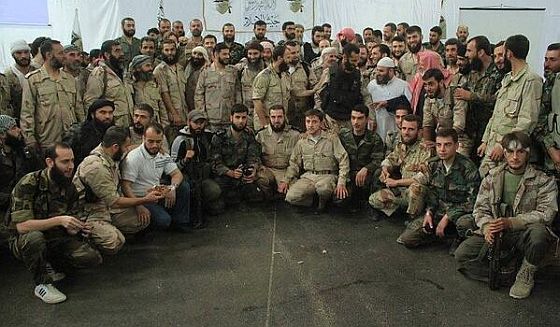
Syria beyond the binaries

Jaish al-Islam commanders from  50 insurgent groups who merged on Sunday.

Jaish al-Islam commanders from 50 insurgent groups who merged on Sunday.

I suspect that for quite a few observers there’s something vaguely comforting about the spectacle of the rise of extremism in Syria. Why comforting? Because it reinforces the idea that however bad the Assad regime might be, the alternative seems destined to be worse. On that basis one can take comfort in the belief that the best course of action for those outside Syria is no action at all.

Indeed, the Assad regime itself seems willing to cater to those who want to balance both humanitarian and non-interventionist concerns through facilitating a symbolic intervention by destroying Syria’s chemical weapons arsenal. If the Syrian government is sufficiently cooperative in this undertaking it will no doubt earn qualified praise for doing so.

Which brings me to a headline in yesterday’s Washington Post: “Foreign extremists dominate Syria fight“. As if carried away by the sentiment in those words, the security analyst Matthew Aid then reposted the article on Tumblr with an even more sensational headline: “Most Fighting in Syria Being Done by AQ-Linked Militants, Not Free Syrian Army“.

The problem is, neither headline actually reflected the details of the report. No doubt Liz Sly, reporting from Beirut, wanted to convey some sense of Syria being taken over by foreign jihadists, yet the second sentence in her report acknowledges: “The number of Syrians battling to overthrow the regime led by President Bashar al-Assad outstrips by a large margin the thousands of Arabs and other non-Syrian Muslims who have streamed into Syria over the past two years to join in the fight.”

Further in to the report she says that conservative estimates put the number of foreign fighters at between 6,000 to 10,000 — though she fails to put that in context by referring to the estimated size of the fighting opposition: 100,000.

Supposedly, what is happening in Syria can only be comprehended in binary terms: Syrian vs foreign; moderate vs extremist; secular vs Islamist; Sunni vs Allawite. But the overarching effect of the imposition of these simplistic labels is to reinforce the sentiment that Syria is bad news and the less we hear about it the better.

On the other hand, for those who retain an interest in being provided with a more nuanced picture of what’s happening on the ground, there are commentators like Hassan Hassan who are capable of explaining some of the complexity in an ever-changing landscape while underlining the fact that whatever fissures do indeed exist inside the opposition, this remains a fight to topple the Assad regime.

Hassan notes that in the liberated areas of Syria, Salafi-leaning fighters are now dominant and among these the newly formed Jaish al-Islam (“the Army of Islam”) composed of at least 50 groups operating mainly around Damascus, has now displaced the FSA as the strongest rebel force.

The emerging trend, far from that of Syria being taken over by foreign fighters, may actually be going in the opposite direction:

Significant grassroots hostility is building in liberated Syrian areas against foreign-funded extremists and al Qaeda affiliates. These tensions do not always develop into sustained clashes — for almost all rebel groups, toppling the regime is the priority, not fighting extremist forces, which have proved indispensable in the battlefield.

According to an activist based in the northern city of Raqqa, when clashes erupted between the al Qaeda-affiliated ISIS and Ahfad al-Rasoul in August, local residents threw their support behind one or the other side — but the strongest condemnation was for the infighting itself. “When they see the regime’s warplanes shelling the city without a single shot in their direction, they get angry at the fighters who could do something,” the activist explained.

The size of extremist groups is not an accurate indicator of the support for their ideology within Syrian society. Fighting groups are also not ideologically homogenous, as many fighters join groups for their effectiveness on the battlefield and disciple — not their religious beliefs. Ahrar al-Sham members in Daraa, for example, can be remarkably different in terms of religiosity from members in more conservative northern areas such as Idlib or the Aleppo countryside.

The situation inside the country is more fluid and nuanced than many groups’ hard-line slogans would suggest. Moderates can be members of hard-line groups and vice versa. Some groups, such as Suqour al-Sham, include both secular members and Islamist veterans of the insurgency against the U.S. occupation of Iraq. For example, a former judge at Aleppo’s cassation court, a secular Syrian who does not pray, nevertheless supports an Islamic identity to the state.

For this reason, many moderate fighters are more concerned with the foreign networks and leaders than the rank-and-file members of hard-line groups. “We are not too worried about Jabhat al-Nusra,” said one FSA-affiliated officer in the eastern governorate of Deir Ezzor who said he worked in intelligence operations. “Once the fighting ends, we’ll bring them back. We know them. They’re our brothers, cousins, and neighbors — they’re the sons of our tribes. Our true struggle will be against [ISIS] and the Nusra leaders.”

Facebooktwittermail

Israel’s increasing sense of isolation

Joanna Paraszczuk reports: A sense of isolation prevails in Israel’s media on Wednesday — reflected in both news reporting and opinion pieces — following Prime Minister Binyamin Netanyahu’s Tuesday speech to the UN General Assembly.

Populist outlet Ynet and Channel 2 focus on comments made by Defense Minister Moshe Ya’alon on Wednesday morning. Ya’alon spoke out in support of Netanyahu’s stance on Iran, saying that the Prime Minister had “drawn an accurate picture” of Israel’s stance on Iran and President Hassan Rouhani.

“In the UN, the Prime Minister described an accurate reality about how we see the Iranian threat, which is ongoing, even though President Rouhani spoke sweetly and Western officials prefer not to face reality with open eyes,” Ya’alon told reporters during a tour of the Golan Heights.

The Defense Minister echoed Netanyahu’s words, saying that Iran posed a terror threat in the region and beyond, “Iran carries out terror in Afghanistan, it trains and arms Hezbollah, it tries to smuggle weapons into Gaza, it is investing in infrastructure of terrorism in South America and Asia and its centrifuges continue to turn. That is why we say you have to stop the Iranian nuclear program by all means.”

Channel 2 also carries comments from Security Cabinet member and Minister Silvan Shalom, who warned that Israel stands alone.

“We are quite alone in facing the Iranian threat to destroy us,” Shalom said, adding that Rouhani is no different from his predecessor, Mahmoud Ahmadinejad:

“Israel is trying to remove the mask from Rouhani’s face, he speaks sweetly and in a different way from Ahmadinejad, but he did not really no different from him. His aim is to gain more time to build a nuclear bomb, which would be an eternal insurance certificate for the ayatollahs’ regime,” Shalom added. [Continue reading…]

Setting aside for now the fact that Iran’s leaders persist in denying that the Islamic republic’s nuclear program is geared towards weapons production, Shalom’s characterization of the implications of a nuclear-armed Iran is quite revealing.

Having referred to “the Iranian threat to destroy us,” he then suggests that nuclear weapons would serve as an “eternal insurance certificate for the ayatollahs’ regime” — acknowledging that such weapons would serve Iran in exactly the same way that they serve all other nuclear powers: as the ultimate deterrent. Shalom clearly doesn’t share the view promoted by Alan Dershowitz and other members of the rabid wing of the Israel lobby: that Iran is a “suicide nation” willing to see itself destroyed by a retaliatory nuclear strike from Israel.

Moreover, to suggest that Iran’s rulers would want or need nuclear insurance is to acknowledge that an ad hoc coalition of regional powers — preeminently Israel and Saudi Arabia — remain reluctant to abandon their dreams of bringing about regime change in Tehran.

At the same time as engaging in last week’s whirlwind of diplomatic outreach, Hassan Rouhani made it very clear that he has a relatively small window of opportunity to make real progress as he faces pressure from a new axis of extremism revealing the common interests of Israel, Saudi Arabia, Iran’s Revolutionary Guard, and the Assad regime, all of whom for their own reasons feel deeply threatened by the possibility of Iranian-U.S. rapprochement.

Facebooktwittermail

Iran president’s phone call with Obama stirs hardline suspicions

Reuters reports: Iranian President Hassan Rouhani’s historic phone call with U.S. President Barack Obama is likely to provoke resistance from powerful hardliners in the Islamic Republic who have built their support on enmity with the West.

The first thing Rouhani did on his return to Tehran at the weekend was to state that he had acted within guidelines set by Supreme Leader Ayatollah Ali Khamenei when he took part in the highest-level contact between Iran and the United States in three decades.

The brief mobile phone conversation led many to speculate that since the election of the moderate Rouhani relations between Washington and Tehran, in the deep freeze since the U.S. embassy hostage crisis, may be about to improve.

Rouhani’s invocation of Khamenei, the man at the top of Iran’s complex political system, looked like a bid to ward off a backlash from hardline power centres and their supporters, some of whom were already lying in wait to throw eggs at the president’s motorcade.

The demonstrators’ chants of “Death to America” were, however, likely to be only the opening shots of a campaign against Rouhani by a conservative political and military establishment opposed to the West in general and to the United States and Israel in particular.

Such is the mistrust between Iran and the United States that a big sticking point of negotiations over Tehran’s disputed nuclear programme has been who should make the first move. [Continue reading…]

Facebooktwittermail

What happened to Egypt’s liberals after the coup?

Sharif Abdel Kouddous writes: Khaled Dawoud worked hard to remove Mohamed Morsi, Egypt’s first democratically elected president, from office.

As the spokesperson for the National Salvation Front, a loose coalition of non-Islamist parties and groups formed last November, he was a well-recognized voice of opposition to Morsi and the Muslim Brotherhood. In the weeks leading up to June 30, Dawoud traveled across the country, helping to drum up support and organize logistics for the massive anti-Morsi protests.

After the army ousted Morsi on July 3, Dawoud was a regular guest on local and international news channels, vociferously defending the overthrow and arguing that the president’s removal did not constitute a military coup.

“I do not have any regrets over Morsi’s removal because the Muslim Brotherhood were posing a major threat to the future of this country,” he says. “They betrayed every single principle of the Egyptian revolution.”

Yet now, Dawoud finds himself at odds with the group he once represented, and he is vilified by many of his former political allies.

The turning point came on August 14, when the military and security forces brutally cleared the two mass sit-ins in Cairo that formed the epicenter of support for the ousted president. Hundreds of people were killed in what Human Rights Watch describes as “the most serious incident of mass unlawful killings in modern Egyptian history.”

The National Salvation Front leadership, which includes former presidential candidates Hamdeen Sabahi and Amr Moussa, put out a statement applauding the raids. Two days later, Dawoud—who describes himself as a “leftist, not a liberal”—resigned as the group’s spokesperson.

“We wanted a political deal, we wanted Morsi removed, but we didn’t want to suppress [the Muslim Brotherhood] or kill them or consider them an outlawed organization,” he says, sitting on a heavily cracked black leather couch in the offices of Al-Ahram Weekly, the state-owned English-language publication where he has worked as a journalist since 1996. After resigning, he says, “even some close friends called me a Brotherhood sympathizer, a secret cell, a traitor and a US agent.”

Dawoud’s story is emblematic of Egypt’s convoluted political landscape, whose fault lines have shifted and rearranged in the aftermath of Morsi’s overthrow and the subsequent brutal crackdown on the Brotherhood and its allies.

Opposition to Morsi grew throughout his time in office, eventually stretching across nearly every sector of Egyptian society. It also had grassroots support, manifested in more than 9,000 protests and strikes during his year-long rule that culminated in calls for early presidential elections and the unprecedented June 30 mobilization.

His opponents included a broad swath of political and social movements, often characterized by conflicting ideologies and grievances. It included revolutionary activists, labor unions, human rights advocates, the Coptic Church, intransigent state institutions, former Mubarak regime members and sidelined business elites as well as the formal opposition—the flock of non-Islamist political parties and figures routinely lumped together as “liberals,” despite the fact that many of them have rejected any notion of political pluralism, a defining characteristic of liberalism.

The result has been a confusing, and increasingly atomized, political landscape. Of the disparate groups opposed to Morsi, some actively sought military intervention, fewer opposed any military role, while others—like Dawoud—stood by the military as it ousted the president, but eventually broke away in the face of mounting state violence and mass arrests of Islamists under the guise of a “war on terror.”

The military—which formed a coalition of convenience with the Brotherhood for much of 2011 to manage the post-Mubarak landscape and hold revolutionary aspirations and unfettered popular mobilizations in check—successfully co-opted the movement against Morsi and, along with the security establishment, emerged as the clearest winner from his overthrow. [Continue reading…]

Facebooktwittermail

Tunisia’s government falls, Arab democracy is born

Noah Feldman writes: If you blinked, you missed it, but the democratically elected Islamist government of an Arab country just promised to resign peacefully, with no threat of a coup d’etat in sight.

Tunisia is still a long way from political stability. Yet once again, the nation that started the Arab Spring is showing the rest of the region how it’s supposed to be done. Reasonable people facing deep disagreements are negotiating and power-sharing their way to the Holy Grail of legitimate constitutional democracy.

Start with the deal. Ennahda, the Islamic democratic party that formed a government after Tunisia’s free elections in 2011, didn’t agree to step down for nothing. In exchange for agreeing to resign in favor of a caretaker government of nonpartisan technocrats, Ennahda got the opposition to agree to ratify a draft constitution that has been painstakingly drafted and debated over the last year and a half.

Under the rules of the road, adopted after the old regime fell in January 2011, the constituent assembly can approve the constitution if two-thirds of its members vote in favor. That structure put a premium on consensus, the political value most valued by Tunisian political culture. It also put Ennahda in a tough position during the drafting process: Its slight coalition majority in the assembly gave it almost no leverage, because it needed lots of opposition votes to get to two-thirds. The only alternative was to go to the public, which might have approved the constitution by a bare majority. But that would have violated the goal of consensus, and Ennahda consistently refused to treat it as an option. [Continue reading…]

Facebooktwittermail

Iraq sliding towards civil war

Time reports: Early Monday morning, more than a dozen car bombs ripped through mostly Shi‘ite neighborhoods in Baghdad, killing at least 50 people and leaving dozens lying bloodied in the streets. The worst attack that day was in heavily Shi‘ite Sadr City, where a man parked a white car near an area where day laborers gather; a bomb inside erupted, killing seven people and wounding 16.

Such reports have become commonplace over the past few months, as violence in Iraq has escalated to levels unfathomable in almost any other country, and by any metric — death tolls, frequency, geographic distribution — it’s becoming worse. For decades, the Baath Party of toppled dictator Saddam Hussein, composed mostly of secular Sunnis, ruled Iraq’s majority Shi‘ite population and ruthlessly kept a lid on sectarian tensions. After the 2003 U.S.-led invasion overturned the Saddam regime, Shi‘ites controlled the new government. This year, violence in Iraq has been largely the result of a Sunni bombing campaign aimed at the Shi‘ite-dominated political status quo. The civil war in neighboring Syria — itself a volatile, sectarian conflict — has spilled across the border, and Sunni jihadi factions are operating in both countries. Now, four months before the next parliamentary elections, Iraq increasingly appears to be spiraling toward a civil war.

Since 2006, when Iraq then under U.S. occupation convulsed in sectarian bloodshed, violence has been driven mainly by internal divisions, and after the withdrawal of U.S. troops in 2011, the Shi‘ite-dominated government led by Prime Minister Nouri al-Maliki has been unable to stop the killing. “The struggle for power is not conducted along neat Shia versus Sunni or Islamist versus secular dividing lines,” a May report by British think tank Chatham House explained. “However, issues of identity, rights and interests have often found sectarian expression in periods of upheaval and transition.”

It’s spreading as well. Until this weekend, much of the violence has occurred in Baghdad and its environs, largely sparing Iraqi Kurdistan, an autonomous region in the north. For most of the past decade, Iraq’s Kurdish region has been immune to the bloodshed. When American troops occupied Iraq, no American soldiers were killed there. But this weekend, as the results of the region’s parliamentary elections were announced, suicide bombers in the Kurdish capital Erbil attacked a building housing the Kurdish security forces, setting off gunfights in the streets. According to the regional government, six attackers and six members of the security forces were killed.

Iraq’s tumultuous year began when the Shi‘ite-dominated government’s security forces raided the home of Sunni Finance Minister Rafia al-Issawi, touching off antigovernment protests in several provinces. In April, security forces clashed with protesters and Sunni gunmen in the northern city of Hawija, leaving dozens of mostly Sunnis dead. More than 700 people were killed in April alone.

Attacks then picked up in the spring and summer. According to the U.N. Assistance Mission for Iraq, more than 1,000 Iraqis were killed in July, the deadliest month in the country since sectarian violence peaked in 2006 and ’07. More than 800 were killed in August, and the U.N. estimates that nearly 1,000 were killed in September. Since the April protests began, more than 5,000 Iraqis have been killed in the violence. [Continue reading…]

Facebooktwittermail

More than 115,000 killed in Syrian conflict – monitoring group

Reuters reports: More than 115,000 people have been killed in Syria’s two-and-a-half-year-old civil war, including tens of thousands of soldiers, rebels and civilians, the Syrian Observatory for Human Rights said on Tuesday.

The figure suggested that around 5,000 people had died in September alone and that the bloodshed has not been slowed by an international deal for the elimination of Syria’s chemical weapons after an August 21 sarin gas attack in the Damascus area.

The British-based Observatory, which monitors violence through a network of activists, medical and military sources around Syria, said about 47,000 soldiers and militia fighters loyal to President Bashar al-Assad had been killed.

Rebel fighters, including army defectors, accounted for around 23,000 of the dead, the Observatory said.

More than 41,000 civilians have been killed, including 6,000 children and 4,000 women. The toll includes 3,000 unidentified people, according to the Observatory which says it documents deaths by obtaining film and photographs of bodies and seeking to confirm identities through family, medics and activists.

Facebooktwittermail

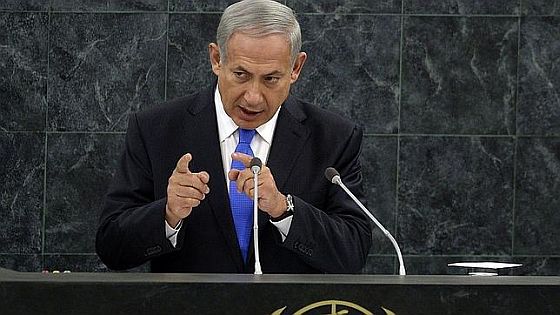
Netanyahu’s ‘The Speech that Never Was’

netanyahu-un

After Benjamin Netanyahu had delivered a speech at the U.N. which surprised no one, Chemi Shalev wrote:

In the streets and avenues leading up to the UN building on the East River, it was already clear the ball has long been over: the barricades were gone, the policemen were relaxed, the satellite trucks had moved elsewhere, the tension and anticipation of the first few days, when Rohani was in town, had all but dissipated. Inside the hall only a fraction of the fatigued foreign diplomats remained to hear Netanyahu, the last head of the state on the agenda, and even they seemed mainly anxious to go home and get back to their normal lives.

The situation in the media, where Netanyahu hopes to make an impact, wasn’t much better. A few hours after the US government had shut down many of its operations, with news networks anxiously breaking to their reporters in the Rose Garden where President Obama was set to make a statement; it was hard to drum up too much interest, not to mention excitement and buzz, over Netanyahu’s strident speech at the UN.

Because in the end, the Israeli prime minister gave the speech that everyone expected him to make, and, much to the media’s disappointment, he didn’t even bother this time to come up with an eye-catching gimmick for visuals.

Barak Ravid writes: One by one, Netanyahu’s donors, associates and supporters flocked in to watch. Casino magnate and owner of the Hebrew daily Yisrael Hayom, Sheldon Adelson, was followed by American-Jewish attorney Alan Dershowitz, former advisor Dore Gold, family friend Zeev Rubinstein and others. Last to enter was Sara Netanyahu, who took her place near the podium. When Netanyahu made his entrance, in front of a half-empty, drowsy hall, his friends, advisors, supporters and entourage all rose to their feet and applauded for several minutes.

Still, the fans the in stands hardly helped. The prime minister’s address resembled a game of the Israeli national soccer team. After weeks of aggressive marketing, spins, headlines and high expectations, the result was disappointing. We hoped to make it to the World Cup, but will have to do with the League Cup.

Netanyahu’s speech was tired, bothersome and boring. In contrast to the Iranian President Hassan Rohani’s sophisticated PR campaign, which led to his taking the UN by storm, Netanyahu sounded like an old, scratchy vinyl record. Not only did he fail to come up with a new effect that would call world attention to the Iranian nuclear threat, such as last year’s cartoon, the prime minister failed to offer any new pertinent information.

The New York Times reported: Mr. Netanyahu dismissed any thought of allowing Iran to enrich uranium to even a low level, insisting that the only way to assure it would never build a nuclear weapon was a complete dismantlement of its capability to enrich nuclear fuel. He exhorted the West to intensify economic sanctions on Iran instead of easing them, as Mr. Rouhani has demanded.

“I wish I could believe Rouhani, but I don’t,” Mr. Netanyahu told the General Assembly, where Iran’s seats were vacant. “Because facts are stubborn things.”

He said the international response to Iran’s entreaties for sanctions relief should be “distrust, dismantle and verify,” and he repeated his warnings that Israel reserved the right to preemptively strike Iran’s nuclear facilities if it deemed the Iranians were close to producing nuclear weapons.

Mohammad Khazaee, Iran’s ambassador to the United Nations, said afterward that his country had found Mr. Netanyahu’s speech inflammatory, rejected the notion that Iran was building a nuclear arsenal, and asserted its right to self-defense.

“The Israeli Prime Minister better not even think about attacking Iran let alone planning for that,” the Iranian ambassador said. He capped his remarks by saying that Iran’s “smile policy” was better than “lying.”

Hours before Mr. Netanyahu spoke, Iranian diplomats sought to make a pre-emptive strike of their own, calling him a persistent liar and warning President Obama not to allow the Israelis to subvert the positive spirit cultivated by Mr. Rouhani in his visit to the United Nations.

Facebooktwittermail

Iranian media splits over diplomatic outreach

Tehran Bureau reports: Hossein Shariatmadari, the chief editor of Iran’s leading hardline newspaper, appears to be in quite a quandary. Long Kayhan’s primary editorial writer, he kept silent for weeks as Iran’s new president, Hassan Rouhani, and his diplomatic team made a series of statements and gestures indicating their willingness to engage in substantive negotiations with the United States and its western allies. Then came the historic telephone exchange last week between Rouhani and Barack Obama, the first direct contact between the presidents of the Islamic republic of Iran and the United States since the 1979 revolution and the takeover of the US embassy in Tehran. On Sunday, Shariatmadari, faced with a choice between continued silence and condemnation, picked the latter.

“The last act of the New York trip, which should be considered most disheartening, and the largest advantage that our nation’s respectful president handed [our] opponent, was the phone conversation of his with the president of the US”, he said of Rouhani’s visit to address the UN General Assembly.

Rather than deal with the content of the conversation, Shariatmadari focused on the announcement by US national security advisor Susan Rice that the Iranian delegation had requested the call. “Based on what analysis and interpretation did his eminence, Mr Rouhani, and the meritorious entourage feel it necessary to trust the Americans and then present the United States’ trust-building efforts in such expansive and loud propaganda as one of the fruits of the New York trip? Furthermore, what kind of a ‘trust-building step’ is this, which neither side is willing to take responsibility for [initiating]?”

“Just take a look at the volume of reviews, analyses, and reports published by the American media, and by American and Zionist officials to see how they reframe the aforementioned telephone conversation in terms of the ‘capitulation of Islamic Iran’ and its weakness and despair due to the strain of the sanctions”, he wrote, without naming any specific media outlets.

Discussing the Kayhan editorial, a senior editor at an Iranian reformist publication told Tehran Bureau, “Shariatmadari is considered an icon in the principlist media realm. For about 20 years, his has been the first and last words among right-wing publications, and his first and last words have always been that under no circumstances should we negotiate with the United States.

“Undoubtedly, Rouhani did not converse with Obama without the consent of [supreme leader Ayatollah Ali] Khamenei. This has put Shariatmadari in a frightful predicament.”

The depth of that predicament was brought into clearer focus when the state-controlled Islamic Republic of Iran Broadcasting, long a source of hardline views essentially identical to Kayhan’s, offered a very different perspective on the presidential phone call to its millions of viewers. In its Channel One news programming on Saturday, IRIB presented wall-to-wall coverage of Rouhani and his youthful entourage’s return to Iran. Even as it censored out any coverage of the protesters, including Basij militia members, who chanted anti-Rouhani slogans at the airport, the network’s reporters roamed the streets of Tehran asking apparently typical citizens for their opinions of the 15-minute conversation between Iran’s president and that of the nation which for years it had called “the Great Satan”.

Every single one of the people whose interviews were aired welcomed the event. [Continue reading…]

Facebooktwittermail

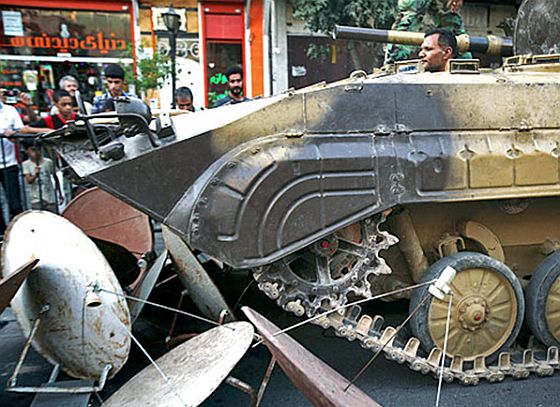
Rouhani promises free media access while the Revolutionary Guard sends in tanks

Satellite dishes in Shiraz being crushed by Iran's Revolutionary Guard tank.

Satellite dishes in Shiraz being crushed by Iran's Revolutionary Guard tank.

IranWire reports: Just two days after President Hassan Rouhani laughed off a question about access to satellite television in Iran during a press conference in New York, the Revolutionary Guards’ Fajr Brigade sent a tank into Shiraz to crush 800 pieces of satellite equipment.

“The Iranian government’s objective is to provide free access to information for the people,” Rouhani said during his Asia Society press conference. “Presently even Iranian villages have access to satellite [television]; all you have to do is to look at their rooftops.”

While period sweeps on satellite dishes and more recently satellite dish workshops are a feature of life in the Islamic Republic, a costly cat and mouse game between the authorities and citizens who seek free access to global culture and information, the Revolutionary Guards’ tank pageant is unprecedented in its violent show of force.

The timing raises questions as to whether powerful regime forces like the Revolutionary Guards will seek to obstruct his reforms and tar the image of moderation he seeks to present to the world. [Continue reading…]

Facebooktwittermail