Yearly Archives: 2010

What America left behind in Iraq

Nir Rosen reports from Iraq:

Hundreds of cars waiting in the heat to slowly pass through one of the dozens of checkpoints and searches they must endure every day. The constant roar of generators. The smell of fuel, of sewage, of kabobs. Automatic weapons pointed at your head out of military vehicles, out of SUVs with tinted windows. Mountains of garbage. Rumors of the latest assassination or explosion. Welcome to the new Iraq, same as the old Iraq — even if Barack Obama has declared George W. Bush’s Operation Iraqi Freedom over and announced the beginning of his own Operation New Dawn, and Iraq’s Prime Minister Nouri al-Maliki has declared Iraq sovereign and independent.

Iraq has had several declarations of sovereignty since the first one in June 2004. As with earlier milestones, it’s not clear what exactly this one means. Since the Americans have declared the end of combat operations, U.S. Stryker and MRAP vehicles can be seen conducting patrols without Iraqi escorts in parts of the country and the Americans continue to conduct unilateral military operations in Mosul and elsewhere, even if under the guise of “force protection” or “countering improvised explosive devices.” American military officers in Iraq told me they were irate with the politically driven announcement from the White House that combat troops had withdrawn. Those remaining still consider themselves combat troops, and commanders say there is little change in their rules of engagement — they will still respond to threats pre-emptively.

Facebooktwittermail

Why burn Qurans when you can move a mosque?

Firebrand Pastor Jones now says he won’t be burning Qurans on Saturday because he claims he extracted a deal to get the Cordoba House project moved to a different site.

“Americans don’t want the mosque there and of course Muslims don’t want us to burn Qurans,” Jones said.

The problem is, Jones appears to have cut his deal with someone who has no say in the location of the mosque: Florida Imam Muhammad al-Masri.

In an interview on CNN on Wednesday, Imam Feisal Abdul Rauf reiterated his commitment to open the Islamic center in Lower Manhattan.

“I am glad that Pastor Jones has decided not to burn any Qurans,” Rauf told ABC News on Thursday. “However, I have not spoken with Pastor Jones or Imam Musri. I am surprised by their announcement.”

The likely political effect of Jones’ Quran burning stunt is that it will strengthen mainstream opposition to Cordoba House. In response to Jones’ antics, many opponents of the Islamic center have taken the opportunity to paint themselves as moderates in tune with popular opinion.

As the Washington Post reports:

Most Americans say the planned Muslim community center and place of worship should not be built in Lower Manhattan, with the sensitive locale being their overwhelming objection, according to a new Washington Post-ABC News poll.

Two-thirds of those polled object to the prospective Cordoba House complex near the site of the former twin towers, including a slim majority who express strongly negative views. Eighty-two percent of those who oppose the construction say it’s because of the location, although 14 percent (9 percent of all Americans) say they would oppose such building anywhere in the country.

The new results come alongside increasingly critical public views of Islam: 49 percent of all Americans say they have generally unfavorable opinions of Islam, compared with 37 percent who say they have favorable ones. That’s the most negative split on the question in Post-ABC polls dating to October 2001.

Furthermore, the poll makes it clear that while America remains at war, economic recovery is nowhere near in sight, and tackling climate change has yet to be treated as a national and global imperative, the focus of the upcoming midterm elections is likely to be a minor construction project in New York.

Regardless of their rationale, most voters who firmly oppose the center’s construction in Lower Manhattan say they feel strongly enough about the issue that it would influence their congressional vote in November. These voters side by a wide margin with Republican over Democratic candidates.

Overall, 83 percent of Republicans oppose the Muslim center, as do 65 percent of independents and 53 percent of Democrats. Among Republicans, generally negative views have spiked higher: 67 percent of those who identify as Republican say they have unfavorable views of Islam, up from 42 percent in the months after the Sept. 11, 2001, attacks.

Big majorities of Protestants and Catholics are against it, with opposition peaking among white evangelical Protestants. By contrast, most people with no professed religion support the construction.

As the issue reveals, rarely is there a discernible difference between piety and pettiness — at least in America.

Facebooktwittermail

Islam and America’s most powerful cult

M. Junaid Levesque-Alam writes:

In their spirited assault on Islam, conservatives have seized upon one notion with particular delight: the Abrahamic faith embraced by a quarter of humanity is a “cult.”

Tennessee Lt. Gov. Ron Ramsey popularized the claim in July when a constituent asked about the “threat that’s invading our country from Muslims”; Ramsey wondered aloud whether Islam “is actually a religion or is it a nationality, way of life or cult” and later asserted that “far too much of Islam has come to resemble a violent political philosophy more than peace-loving religion.” Soon after, some of Ramsey’s constituents set ablaze a planned mosque site near Nashville and fired shots when parishioners tried to inspect the damage.

Farther south, in Florida, Pastor Terry Jones proclaimed that Islam is not just a cult but a Satanic creation — hence his planned bonfire of Qur’ans. He is not alone among Floridians. Congressional candidate and retired Army officer Allen West announced earlier this year that Islam is “not a religion” but a “vicious enemy” intent on “infiltrating” America. Another candidate in the sunshine state, Ron McNeil, described Islam as a malicious plot to “destroy our way of life.”

And in upstate New York this August, teenagers who viewed the local mosque as a “cult house” terrorized mosque-goers by blasting a shotgun and sideswiping a parishioner.

What accounts for this renewed alacrity in attacking Islam?

Muslim paratroopers did not suffuse the skies with crescent-shaped parachutes and descend on America. Nor did Muslim terrorists unfurl prayer rugs camouflaged as conifers and seize the highways. The bleating about the Muslim “cult” was provoked by nothing more than a proposed Muslim YMCA, one which is to be headed by a State Department-sponsored Sufi imam and located no closer to Ground Zero than sundry pubs, food stands, pornography stores, and strip clubs.

To repeat the facts, however, is to miss the point. The “Islam is a cult” mantra is not an epithet: it is the axiom of a belief system that outmatches any religion in America in influence and irrationality.

Within this belief system, facts cannot weaken the pull of the idea that “whole blocks of millions or tens of millions of people can be confidently labeled ‘good’ or ‘bad,’” and reason cannot compete with the coveted “habit of assuming that human beings can be classified like insects.”

This belief system is nationalism (distinct from patriotism), and the quoted descriptions are two symptoms of the disease as identified by George Orwell in his matchless 1945 essay on the subject.

Read the rest of Levesque-Alam’s post here.

Facebooktwittermail

The “insensitive” set-up in the Quran burning stunt

“Republicans are usually eager to trumpet their support for the troops and the war against terror. So why aren’t they condemning the Florida pastor who plans to lead his congregation in a Quran-burning bonfire on Sept. 11?,” wrote Fred Kaplan on Tuesday.

His call has been answered — by Sarah Palin: “Book burning is antithetical to American ideals. People have a constitutional right to burn a Koran if they want to, but doing so is insensitive and an unnecessary provocation — much like building a mosque at Ground Zero.”

Is Pastor Jones ready to obey Palin’s call to “stand down”? Maybe a generous donation to his church will do the trick.

However Palin and other Cordoba House opponents manage to persuade Jones to back down, this is how they must be hoping they can play his Quran burning stunt: turn an eleventh hour display of “sensitivity” by the Florida pastor into leverage against Feisal Abdul Rauf — as though the imam and the pastor are somehow equivalents. Once “Dr” Jones finds it in his heart to act as the “sensitive” Christian, the chorus will rise even louder demanding a reciprocal display from “sensitive” Muslims.

Before the term got hijacked by Islamophobes, it was widely understood that to be insensitive was to show a lack of awareness about the feelings of others. To call Quran burning “insensitive” is to imply that Jones and his followers don’t grasp the offensiveness of their action. But as ignorant as the members of this church might be, no one can be in any doubt that this action is consciously designed as an act of provocation. Islam is the target of this attack and it is absurd to claim — as Jones does — that Muslims collectively are not also the intended victims.

In tying together Jones’ Quran burning with the proposed Islamic center we witness a false equivalence that has become all too familiar. Islamophobes poke Muslims in the eye and then accuse them of being culturally insensitive because of the manner in which they practice their faith — by building mosques, by women wearing head coverings and so forth.

Sarah Palin and others are riding on the sensitivity bandwagon because they think it’s a safe bet. Who can refute that sensitivity is a good thing. Most importantly though, it appears to let them off a constitutional hook. After all, it’s hard to wrap yourself in the flag and also oppose freedom of religion.

In truth though, the most reliable defenders of freedom of religion are not particularly religious — least of all are they evangelical.

When someone comes to my door and tells me I’d have a better life it I gave it to Christ, they are certainly exercising freedom of religion but they are not defending it. On the contrary, they are engaged in a religiously sanctioned act of arrogance that I regard as an insult to my intelligence. Even as I suggest that in a reversal of the current situation, they might not take kindly to my arrival on their doorstep for the purpose of educating them about Darwinism, they busily search for a line of scripture that might point me in the right direction. Lucky for them, I believe in religious tolerance and have yet to slam the door in anyone’s face.

Living religions (as distinct from their doctrinal underpinnings) are by their very nature intolerant and the purpose of religious freedom is to temper this intolerance by promoting a live-and-let-live spirit. (To his credit, President Obama has acknowledged that the freedom of religion also protects each American’s right to practice no religion at all.)

Tolerance does not mean that I bow to anyone’s prejudice; it means that I recognize and respect the autonomy of each individual in forming and articulating his or her own understanding of life.

The evangelical conceit — and it matters to me not a whit whether the evangelist happens to be a Christian, a Muslim or a Darwinist — is that there is no intrinsic value in the utterly unique vantage point from which we each of us engages the world. On that basis, the evangelist treats the spirit of the unconverted as open territory, ready for colonization.

America is a vessel inside which evangelical colonists roam freely, but however loudly they may insist on making themselves heard we must ensure that no ones freedom confers privilege in ownership.

This can only be the land of the free if it belongs to everyone.

Facebooktwittermail

Contested America — dreams and reality

Arguments about the construction of an Islamic center and the destruction of Qurans may have less to do with Islam than they have with who gets to define America and why this nation is grappling with its own identity.

The New York Times reports:

Prominent Christian, Jewish and Muslim leaders held an extraordinary “emergency summit” meeting in the capital on Tuesday to denounce what they called “the derision, misinformation and outright bigotry” aimed at American Muslims during the controversy over the proposed Islamic community center near ground zero.

“This is not America,” said Cardinal Theodore E. McCarrick, the emeritus Roman Catholic archbishop of Washington, flanked by three dozen clergy members and religious leaders at a packed news conference at the National Press Club. “America was not built on hate.”

They said they were alarmed that the “anti-Muslim frenzy” and attacks at several mosques had the potential not only to tear apart the country, but also to undermine the reputation of America as a model of religious freedom and diversity.

The imam behind the plan to build an Islamic center near ground zero, Feisal Abdul Rauf, finally spoke out about the controversy, saying in an opinion piece in The New York Times published Tuesday night that he would proceed with plans to build the center. He wrote that by backing down, “we cede the discourse and, essentially, our future to radicals on both sides.”

The meeting in Washington occurred amid growing concern by the White House, the State Department and the top American military commander in Afghanistan over plans by Terry Jones, the pastor of a small church in Florida, to burn copies of the Koran on the anniversary of the Sept. 11 attacks.

Gen. David H. Petraeus warned on Tuesday that any video of Americans burning the Koran “would undoubtedly be used by extremists in Afghanistan — and around the world — to inflame public opinion and incite violence,” endangering the lives of American soldiers.

A State Department spokesman called Mr. Jones’s plan “un-American.” Robert Gibbs, the White House spokesman, said any activity “that puts our troops in harm’s way would be a concern to this administration.”

Several clergy members in Washington and Florida said that there were efforts to dissuade Mr. Jones from proceeding with the event, but that he appeared unlikely to relent.

The religious leaders in Washington said in their statement, “We are appalled by such disrespect for a sacred text that for centuries has shaped many of the great cultures of our world.”

Interfaith events are not unusual, but this one was extraordinary for the urgency and passion expressed by the participants. Some of the same religious leaders later met with Attorney General Eric H. Holder Jr. to urge him to prosecute religious hate crimes aggressively.

Rabbi David Saperstein, director of the Religious Action Center of Reform Judaism, said: “We know what it is like when people have attacked us physically, have attacked us verbally, and others have remained silent. It cannot happen here in America in 2010.”

The problem with any argument that revolves around contesting views about the true identity of this country is that neither side is attempting to differentiate between the America of their convictions and America as actuality.

Cardinal McCarrick can say, “This is not America,” but in fact it is — it just happens to be uglier than he would like it to be.

As an ideological debate, this is ostensibly an argument between on the one hand those who fully include Muslims in the idea of America, and on the other hand those who demand that Muslims must shed or at least modify their identities if they wish to be accepted in this society.

The problem is that a Muslim voice is barely audible on either side of the debate — evidence that the proponents of inclusion are describing an ideal that is far from having been realized.

Feisal Abdul Rauf, whose Cordoba House project has been at the center of the argument and who has just returned from a two-month overseas trip sponsored by the State Department, said in an op-ed in today’s New York Times: “I felt that it would not be right to comment from abroad.”

Not right? Maybe closer the truth was that he knew that if he spoke from the Middle East, his words would more likely be perceived not as those of an American but as a representative of that region and thus they would reinforce the image of Muslims in America as outsiders.

In the context of rising Islamophobia, American Muslims are in retreat, yet the lower the profile they assume, the more empowered the anti-Muslim voice becomes.

The New York Times reported on Sunday:

Muslims sit in their living rooms, aghast as pundits assert over and over that Islam is not a religion at all but a political cult, that Muslims cannot be good Americans and that mosques are fronts for extremist jihadis. To address what it calls a “growing tide of fear and intolerance,” the Islamic Society of North America plans to convene a summit of Christian, Muslim and Jewish leaders in Washington on Tuesday.

Young American Muslims who are trying to figure out their place and their goals in life are particularly troubled, said Imam Abdullah T. Antepli, the Muslim chaplain at Duke University.

“People are discussing what is the alternative if we don’t belong here,” he said. “There are jokes: When are we moving to Canada, when are we moving to Sydney? Nobody will go anywhere, but there is hopelessness, there is helplessness, there is real grief.”

Mr. Antepli just returned from a trip last month with a rabbi and other American Muslim leaders to Poland and Germany, where they studied the Holocaust and the events that led up to it (the group issued a denunciation of Holocaust denial on its return).

“Some of what people are saying in this mosque controversy is very similar to what German media was saying about Jews in the 1920s and 1930s,” he said. “It’s really scary.”

The Anti-Defamation League has formed an Interfaith Coalition on Mosques (ICOM) which aims to “provide support and stand with Muslims when their rights are being violated,” but the credibility of this initiative is undermined by the ADL’s own opposition to the construction of the Cordoba Islamic center. They might have quickly realized that that was a political blunder but it remains to be seen whether ICOM is more than a PR exercise designed to repair the ADL’s tattered image.

Aside from the question about whether the ADL can be true to its core mission and fight “to secure justice and fair treatment to all,” the proponents of a more libertarian and inclusive vision of American society face a deeper problem. We belong to a minority and there are inherent limits on the extent to which any minority can exert its will. We should thus perhaps more explicitly focus on what we want America to become than profess to represent its current condition.

Facebooktwittermail

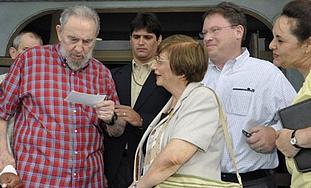
Castro: ‘No one blames the Muslims for anything’

Jeffrey Goldberg just went to visit the father of the Cuban revolution, Fidel Castro, and was surprised and pleased to hear the 84-year-old castigate Iran’s President Ahmadinejad and denounce anti-Semitism:

Over the course of this first, five-hour discussion, Castro repeatedly returned to his excoriation of anti-Semitism. He criticized Ahmadinejad for denying the Holocaust and explained why the Iranian government would better serve the cause of peace by acknowledging the “unique” history of anti-Semitism and trying to understand why Israelis fear for their existence.
[…]
He said the Iranian government should understand the consequences of theological anti-Semitism. “This went on for maybe two thousand years,” he said. “I don’t think anyone has been slandered more than the Jews. I would say much more than the Muslims. They have been slandered much more than the Muslims because they are blamed and slandered for everything. No one blames the Muslims for anything.”

As an elder statesman and revolutionary leader, Castro retains some influence, but to say ‘no one blames the Muslims for anything,’ makes it sound like he’s a man living in a time warp.

Has the post-9/11 Islamophobia now sweeping Europe and rising in America, somehow escaped Castro’s attention? Does he not know that even in Germany, whose national consciousness should have been permanently seared by the memory of the horrific consequences of ethnic hatred, anti-Muslim rhetoric now finds a widening and receptive audience. “Germany is slowly becoming a state that is dominated by exaggerated fears and that exhibits the beginnings of an Islamophobic society,” writes Erich Follath in Der Spiegel.

Facebooktwittermail

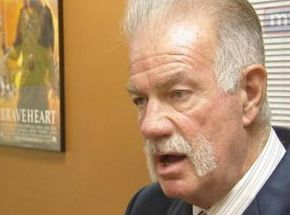
Pastor Jones’ phony Muslim-friendly posture on CNN

In an interview on CNN this morning, Dr Terry Jones, the Florida pastor who has organized “International Burn a Koran Day” for September 11, said:

We want to send a clear message to the peaceful Moslems. We have freedom of speech. We have freedom of religion. They are more than welcome to be here. More than welcome to worship. More than welcome to build mosque[s].

Say what? In July, Jones was asked whether he thought Muslims would turn to Christ as a result of his Quran-burning event:

This is our prayer and desire that they would seriously reexamine their religion. They will then come to the conclusion that Islam is of the devil and Christianity is the only true religion.

Jones now tells CNN that Muslims are welcome to worship in America but in a broadcast of his “Braveheart Show” in May he said:

We must demand that all Moslems that are here, they adapt to our values — they become Americans. If they want to stay Moslems, with their culture, with their Islamic law, then they can stay in Moslem dominated countries.

He now says Muslims are more than welcome to build mosques in America. In May he said:

We should stop immediately, stop right now, the building of all mosque[s] in America…

So, Jones says Muslims are welcome to build mosques in America and that no more mosques should be built. Muslims are welcome to worship here, but if they want to practice their religion they should live in a Muslim-dominated country.

Is that supposed to be a clear message?

Facebooktwittermail

Pastor Jones’ Quran burning stunt

The Wall Street Journal reports:

The top U.S. commander in Afghanistan said the planned burning of Qurans on Sept. 11 by a Florida church could put the lives of American troops in danger and damage the war effort.

Gen. David Petraeus said the Taliban would exploit the demonstration for propaganda purposes, drumming up anger toward the U.S. and making it harder for allied troops to carry out their mission of protecting Afghan civilians.

“It could endanger troops and it could endanger the overall effort,” Gen. Petraeus said in an interview with The Wall Street Journal. “It is precisely the kind of action the Taliban uses and could cause significant problems. Not just here, but everywhere in the world we are engaged with the Islamic community.”

On August 19, an internal warning issued by the FBI’s Jacksonville office stated:

The nature of this event… will likely garner the same, if not a larger, scale of international attention as historically similar events. This attention will most likely have political and national security implications which could involve the boycott of American goods and services, violent demonstrations within the United States and abroad, threats and/or acts of violence from terrorist organizations and/or lone extremist actors, and further segregation between the Muslim and non-Muslim American communities.

Even if the Dove World Outreach Center yields in response to the US government’s security concerns, much of the damage has already been done.
Pastor Terry Jones’ planned Quran burning is like every other act of book burning throughout history — from the actions of the Inquisition to those of the Nazis: a perverse celebration of ignorance.

There are countless books not worth reading but virtually none worth burning. Indeed, the very fact that individuals or groups of people feel driven to burn particular books, generally says less about those books than it does about the impoverished minds of the book burners.

Pastor Jones is presumably reveling in his fifteen minutes of fame, but in his cheap suit he should be seen for what he is: a member of a tawdry class of American religious hucksters who ply their trade by capitalizing on the ignorance in which too many unfortunate souls here pride themselves.

Here he is in action.

Facebooktwittermail

Ground zero church launches with anti-Muslim, anti-Mormon sermon

Justin Elliot reports:

To an audience of about 50 people — fully half of whom were members of the press — Pastor Bill Keller launched his 9-11 Christian Center at ground zero this morning with a fiery sermon targeting Muslims and Mormons as hell-bound followers of false faiths. Keller took aim in particular at Glenn Beck, a Mormon, and Imam Rauf, the organizer of the Park51 Islamic community center.

Keller, an extremist Internet evangelist from Florida, spoke at a drab ballroom of the Marriott hotel two blocks south of ground zero for the launch of his Christian Center, a response to Park51. He told the audience, which included a couple of 9/11 Truther protesters, that he is scouting three possible locations for a permanent church.

Keller regularly assails Muslims as pedophiles and attacks Mormons and gay people. But his church has drawn no objections from opponents of the mosque who have consistently argued that the neighborhood around ground zero is sacred ground. Keller also has a history of trying to profit off of political controversies; last year, for example, he hosted a Birther infomercial.

Facebooktwittermail

Jewish supremacism among Israeli youth

Israel’s Central Bureau of Statistics released numbers today which show that almost a third of the population is under 15 years old.

What can we expect from the next generation?

A new poll reveals how deeply entrenched bigotry is in Israel.

A survey of Israeli teens revealed that most believe that Palestinian Israelis do not currently enjoy equal rights and, according to most of those holding that view, should not be granted equal rights.

Among those 15-18 year old Jewish Israelis polled, 50% said they would object to being placed in a classroom with one or more Palestinian Israelis. 32% do not want to be educated alongside students with special needs and 23% said they would not want gays or lesbians in their class.

96% of the teens want Israel to be a Jewish and democratic state and although almost a quarter of Israelis are not Jewish, 41% of those polled said that Israelis who are opposed to their nation being defined as a Jewish state, should be stripped of their citizenship.

Any glimmers of hope? 24% said they would refuse to perform military service in the West Bank.

Does that reflect significant opposition to the occupation? I suspect not. More likely it is mostly simply another expression of an aversion for Palestinians.

As for reports that Israel’s demographic make-up might be changing due to a surge of new immigrants, it turns out that only 14,572 arrived in 2009, contributing to a modest 1.7% growth in Israel’s Jewish population. At the same time, Zionists who perceive a Palestinian population controlled through occupation as a “demographic threat,” will find no comfort in the fact that Israel’s own Muslim population is growing at 2.8%.

Facebooktwittermail

Anti-Israel economic boycotts are gaining speed

In Haaretz, Nehemia Shtrasler writes:

The world is changing before our eyes. Five years ago the anti-Israel movement may have been marginal. Now it is growing into an economic problem.

Until now boycott organizers had been on the far left. They have a new ally: Islamic organizations that have strengthened greatly throughout Europe in the past two decades. The upshot is a red and green alliance with a significant power base. The red side has a name for championing human rights, while the green side has money. Their union is what led to the success of the Turkish flotilla.

They note that boycott is an especially effective weapon against Israel because Israel is a small country, dependent on exports and imports. They also point to the success of the economic boycott against the apartheid regime in South Africa.

The anti-Israel tide rose right after Operation Cast Lead, as the world watched Israel pound Gaza with bombs on live television. No public-relations machine in the world could explain the deaths of hundreds of children, the destruction of neighborhoods and the grinding poverty afflicting a people under curfew for years. They weren’t even allowed to bring in screws to build school desks. Then came the flotilla, complete with prominent peace activists, which ended in nine deaths, adding fuel to the fire.

But underlying the anger against Israel lies disappointment. Since the establishment of the state, and before, we demanded special terms of the world. We played on their feelings of guilt, for standing idle while six million Jews were murdered.

David Ben-Gurion called us a light unto the nations and we stood tall and said, we, little David, would stand strong and righteous against the great evil Goliath.

The world appreciated that message and even, according to the foreign press, enabled us to develop the atom bomb in order to prevent a second Holocaust.

But then came the occupation, which turned us into the evil Goliath, the cruel oppressor, a darkness on the nations. And now we are paying the price of presenting ourselves as righteous and causing disappointment: boycott.

Meanwhile, the Jerusalem Post reports:

Foreign Minister Avigdor Lieberman on Sunday fiercely attacked the diplomatic process with the Palestinians that Prime Minister Binyamin Netanyahu began in Washington last week, telling Israel Beiteinu activists in the capital that a peace deal is “unachievable.”

In a lengthy address to more than a thousand supporters at the Rimonim (formerly Shalom) Hotel, Lieberman criticized previous governments and his own for not learning the lessons of 17 years of failed diplomatic negotiations.

He said he gets asked all the time why he is against hope, and he responds that he is for hope but against illusions.

“It must be understood that signing a comprehensive agreement in which both sides agree to end the conflict and end all of their claims and recognize Israel as the nation-state of the Jewish people is a goal that is not achievable in the next year or in the next generation, so any historic compromises or painful concessions won’t help,” he said.

The best that could come out of the talks was a long-term interim agreement with the Palestinians, Lieberman said.

He promised that his party would fight against further construction freezes and unilateral concessions.

“Seventeen years should be enough time to realize what is and is not possible. I know there is pressure to continue the freeze, but I don’t know a single reason to do so.

Facebooktwittermail

No nation could preserve its freedom in the midst of continual warfare

Those are the words of James Madison, cited by Fareed Zacharia as the anniversary of 9/11 approaches.

Nine years after 9/11, can anyone doubt that Al Qaeda is simply not that deadly a threat? Since that gruesome day in 2001, once governments everywhere began serious countermeasures, Osama bin Laden’s terror network has been unable to launch a single major attack on high-value targets in the United States and Europe. While it has inspired a few much smaller attacks by local jihadis, it has been unable to execute a single one itself. Today, Al Qaeda’s best hope is to find a troubled young man who has been radicalized over the Internet, and teach him to stuff his underwear with explosives.

I do not minimize Al Qaeda’s intentions, which are barbaric. I question its capabilities. In every recent conflict, the United States has been right about the evil intentions of its adversaries but massively exaggerated their strength. In the 1980s, we thought the Soviet Union was expanding its power and influence when it was on the verge of economic and political bankruptcy. In the 1990s, we were certain that Saddam Hussein had a nuclear arsenal. In fact, his factories could barely make soap.

The error this time is more damaging. September 11 was a shock to the American psyche and the American system. As a result, we overreacted.

An overreaction in response to national shock may reasonably describe what happened, but it doesn’t explain what made America so susceptible to the shock or so ripe for such an overreaction.

America suffers from a cultural deficit that is largely a product of geography. Cultural self-awareness depends significantly on the ability to understand ones own culture as it appears from the outside, yet most Americans swim inside the fishbowl of this culture with only the vaguest sense of what lies beyond. This profound insularity makes America perpetually vulnerable to global shocks of any kind.

The planners of the 9/11 attacks seemed to grasp a core dimension of this culture: that television is the primary medium that shapes a cohesive American identity. The attack of the World Trade Center thus became an attack on America by being televised.

As a culture that understands itself through television, America grasps images more readily than ideas.

The collapsing Twin Towers meant all sorts of things. It meant that the tallest buildings in New York City turned out to lack the structural integrity they might have been expected to have. It meant that security procedures in American airports were wholly inadequate. It meant that successive US governments had operated with a false sense of impunity as their policies bred hostility across the Middle East.

Yet few of these practical or abstract meanings registered as clearly in American consciousness as did the imagery of American power suddenly made impotent.

A crudely simplistic response — they made us look weak so now we’re going to show ’em we’re strong — thus won national support with barely more than a squeak of dissent.

“They” became a category into which all manner of “enemies” could be haphazardly squeezed: al Qaeda, Islamic extremists, the Taliban, Muslims, Arabs, enemies of Israel, anti-Americans, haters of freedom. Understanding who they were, mattered less than being convinced that they were out to get us.

Having signed on to the idea that war was unavoidable, few questioned a concomitant assumption: that a war of supposed necessity would — for the average American — necessitate no personal involvement.

We could watch, cheer, even march against it, or be utterly indifferent, because the function of this war was as much as anything else to perpetuate the anesthetized state of consciousness that sustains the American way of life.

“Go shopping” was not a throwaway remark from a stumbling president. It was a religious injunction to a population that had been trained to value material comfort more than life itself. The shock of 9/11 might have provoked an overreaction but it also proved to be a shock that could quite easily be absorbed; a shock that far from waking up America, barely interrupted its sleep.

Where else could the most massive expansion in government seen in recent decades have so been readily supported by people who profess an abhorrence for big government?

Facebooktwittermail

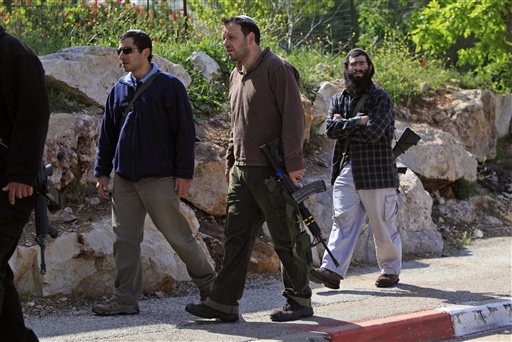
Hamas official: Israeli settlers are a legitimate military target

Haaretz reports:

Israeli settlers in the West Bank are legitimate targets since they are an army in every sense of the word, a senior Hamas official told the London-based Al-Hayat newspaper on Saturday, adding that Palestinians were still committed to an armed struggle against Israel.

The comment by Ezzat al-Rashk, a member of Hamas’s political office, came in the wake of recent attacks against Israeli citizens in the West Bank.

On Tuesday, four Israelis were killed when unknown assailants opened fire at a vehicle they were traveling in near the West Bank city of Hebron. The following night, two Israelis were wounded in a similar shooting attack at the Rimonim Junction near the West Bank city of Ramallah.
[…]
“Attacking settlers is a natural thing,” al-Rashk told Al-Hayat on Saturday, saying the “Zionist settlers are the occupation’s first reserve military force.”
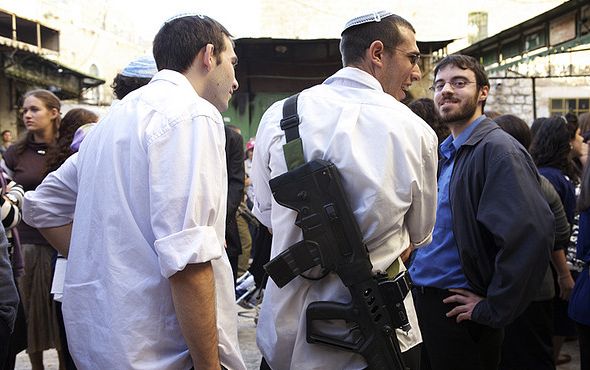
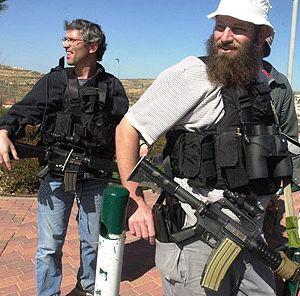
“They are now a real army in every sense of the word, with more than 500,000 automatic weapons at their disposal, on top of the basic protection by the [Israel Defense Forces],” the Hamas official said.

Al-Rashk also referred to the ongoing attempt to relaunch talks between Israel and the PA, saying they were noting more “than a media circus through which the U.S. administration wants to market its policy.”

Another Hamas official, Osama Hamdan, the organization’s Lebanon spokesperson, told the London-based newspaper that Palestinian President Mahmoud Abbas was willing to forfeit “99 percent of the Palestinians’ rights, saying negotiations were over before they even began.

Facebooktwittermail

CIA views Israeli intelligence service as worst US ally

In the Washington Post, Jeff Stein reports:

The CIA took an internal poll not long ago about friendly foreign intelligence agencies.

The question, mostly directed to employees of the clandestine service branch, was: Which are the best allies among friendly spy services, in terms of liaison with the CIA, and which are the worst? In other words, who acts like, well, friends?

“Israel came in dead last,” a recently retired CIA official told me the other day.

Not only that, he added, throwing up his hands and rising from his chair, “the Israelis are number three, with China number one and Russia number two,” in terms of how aggressive they are in their operations on U.S. soil.

Israel’s undercover operations here, including missions to steal U.S. secrets, are hardly a secret at the FBI, CIA and other U.S. intelligence agencies. From time to time, in fact, the FBI has called Israeli officials on the carpet to complain about a particularly brazen effort to collect classified or other sensitive information, in particular U.S. technical and industrial secrets.

Former CIA officer, Philip Giraldi, adds:

FBI sources indicate that the increase in Mossad activity is a major problem, particularly when Israelis are posing as U.S. government officials, but they also note that there is little they can do to stop it as the Justice Department refuses to initiate any punitive action or prosecutions of the Mossad officers who have been identified as involved in the illegal activity.

Giraldi also recounts a recent incident in which a man who identified himself as an Israeli government official, threatened a survivor of the USS Liberty attack, “saying that the people who had been killed on board had gotten what they deserved.”

Israel’s official line has always been that the incident in which 34 US servicemen were killed and 170 wounded during the Israeli attack on the clearly-flagged American naval vessel in 1967, was an accident.

Facebooktwittermail

Israel and Palestine: A true one-state solution

Israel should adapt to the 21st century. Is that really a utopian idea?

As Tony Judt succinctly distilled the issue a few years ago: “The very idea of a ‘Jewish state’ — a state in which Jews and the Jewish religion have exclusive privileges from which non-Jewish citizens are forever excluded — is rooted in another time and place. Israel, in short, is an anachronism.”

President Obama’s “bold” departure from the position of his predecessor is that he has repeatedly asserted — as he did again on Wednesday — that “the status quo is unsustainable — for Israelis, for Palestinians, for the region and for the world.”

An occupation that has continued for 43 years has certainly proved very durable — sufficient reason for half a million Israelis to defy the claim that the status quo is unsustainable as they carry on living in the West Bank.

The focus of skepticism should in fact be focused less on the sustainability of the status quo than on the realistic prospects for a two-state solution. Such a resolution appears no more imminent now than it did when it was first proposed 73 years ago. In that period whole empires have risen and fallen and yet we’re still supposed to imagine that a Palestinian state is lurking just over the horizon?

As the Zionists have understood all along, it is the facts on the ground that shape the future and none of these facts point towards a partition of land upon which two people’s lives are now so deeply intertwined.

One state already exists. The challenge ahead is not how it can be divided, but how all those already living within its borders can enjoy the civil rights that belong to the citizens of all Western states — the part of the world to which Israel’s leaders so often profess their deepest affiliation.

George Bisharat lays out the one-state solution as being far from a utopian vision but, on the contrary, what might turn out to be the path of least resistance.

A de facto one-state reality has emerged, with Israel effectively ruling virtually all of the former Palestine. Yet only Jews enjoy full rights in this functionally unitary political system. In contrast, Palestinian citizens of Israel endure more than 35 laws that explicitly privilege Jews as well as policies that deliberately marginalize them. West Bank Palestinians cannot drive on roads built for Israeli settlers, while Palestinians in Gaza watch as their children’s intellectual and physical growth are stunted by an Israeli siege that has limited educational opportunities and deepened poverty to acute levels.

Palestinian refugees have lived in exile for 62 years, their right to return to their homes denied, while Jews from anywhere can freely immigrate to Israel.

Israeli leaders Ehud Olmert and Ehud Barak have admitted that permanent Israeli rule over disenfranchised Palestinians would be tantamount to apartheid. Other observers, including former U.S. president Jimmy Carter and South African Archbishop Desmond Tutu, have said that apartheid has already taken root in the region.

Clearly, Palestinians and Israeli Jews will continue to live together. The question is: under what terms? Palestinians will no more accept permanent subordination than would any other people.

The answer is for Israelis and Palestinians to formalize their de facto one-state reality but on principles of equal rights rather than ethnic privilege. A carefully crafted multiyear transition including mechanisms for reconciliation would be mandatory. Israel/Palestine should have a secular, bilingual government elected on the basis of one person, one vote as well as strong constitutional guarantees of equality and protection of minorities, bolstered by international guarantees. Immigration should follow nondiscriminatory criteria. Civil marriage between members of different ethnic or religious groups should be permitted. Citizens should be free to reside in any part of the country, and public symbols, education and holidays should reflect the population’s diversity.

Although the one-state option is sometimes dismissed as utopian, it overcomes major obstacles bedeviling the two-state solution. Borders need not be drawn, Jerusalem would remain undivided and Jewish settlers could stay in the West Bank. Moreover, a single state could better accommodate the return of Palestinian refugees. A state based on principles of equality and inclusion would be more morally compelling than two states based on narrow ethnic nationalism. Furthermore, it would be more consistent with antidiscrimination provisions of international law. Israelis would enjoy the international acceptance that has long eluded them and the associated benefits of friendship, commerce and travel in the Arab world.

The main obstacle to a single-state solution is the belief that Israel must be a Jewish state. Jim Crow laws and South African apartheid were similarly entrenched virtually until the eves of their demise. History suggests that no version of ethnic privilege can ultimately persist in a multiethnic society.

Facebooktwittermail

Poll reveals local support for Manhattan Islamic center

“New Yorkers Divided Over Islamic Center, Poll Finds,” says the New York Times in one of its headlines. Another says “New York Poll Finds Wariness About Muslim Center.”

Neither headline suggests a careful reading of the poll results — a poll conducted by the New York Times itself.

This is how the newspaper of record characterizes the results:

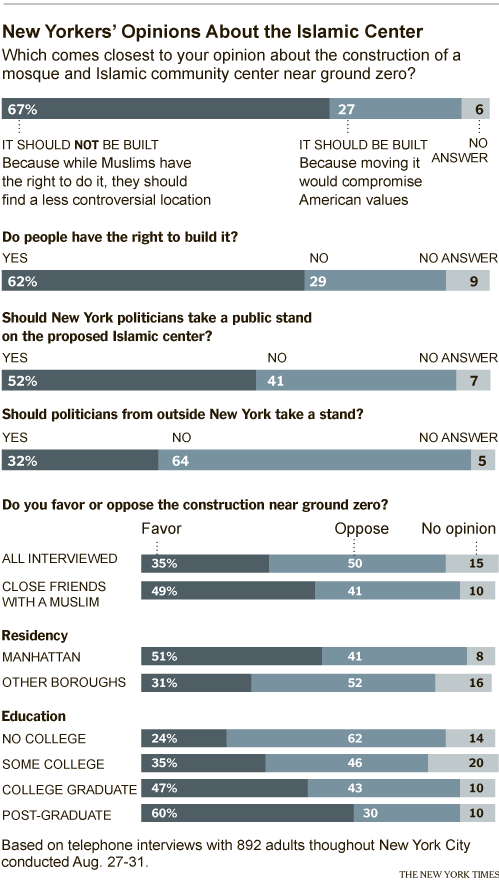
Two-thirds of New York City residents want a planned Muslim community center and mosque to be relocated to a less controversial site farther away from ground zero in Lower Manhattan, including many who describe themselves as supporters of the project, according to a New York Times poll.

The poll indicates that support for the 13-story complex, which organizers said would promote moderate Islam and interfaith dialogue, is tepid in its hometown.

Nearly nine years after the Sept. 11 attacks ignited a wave of anxiety about Muslims, many in the country’s biggest and arguably most cosmopolitan city still have an uneasy relationship with Islam. One-fifth of New Yorkers acknowledged animosity toward Muslims. Thirty-three percent said that compared with other American citizens, Muslims were more sympathetic to terrorists. And nearly 60 percent said people they know had negative feelings toward Muslims because of 9/11.

Over all, 50 percent of those surveyed oppose building the project two blocks north of the World Trade Center site, even though a majority believe that the developers have the right to do so. Thirty-five percent favor it.

Opposition is more intense in the boroughs outside Manhattan — for example, 54 percent in the Bronx — but it is even strong in Manhattan, considered a bastion of religious tolerance, where 41 percent are against it.

OK. Let’s back up. Opposition is “even strong in Manhattan,” or if we take away that particular slant in reading the numbers, we discover that by a 10% margin the majority of Manhattan residents polled favor the construction of the center. This almost exactly mirrors the size of the opposition in the boroughs.

Just as interesting is the fact that whether someone favors or opposes the construction closely correlates with whether they count Muslims among their close friends.

So what’s the conclusion?

Move to Manhattan, make friends with a Muslim and you’ll probably decide Park51 has a place in the neighborhood.

The problem turns out not to be the impending Islamization of America — it’s that not enough Americans have Muslim friends.

Facebooktwittermail

Understanding the Taliban

Jonathan Steele notes that during almost a decade of war with the Taliban, none of their top leaders have been interviewed which leaves many important questions unanswered.

Have the Taliban changed in the decade since they lost office? Is there a neo-Taliban, as some suggest? What of the younger generation of field commanders who lead today’s resistance to the Americans and British? Are they in regular touch with Mullah Omar and do they answer to him in any practical sense, either in military strategy or in their political objectives? Above all, is there room for compromise between the Taliban, President Karzai and the Tajik and Uzbek leaders who surround him in Kabul so that, if the US withdraws in the next few years, a power-sharing government can have a chance of lasting?

Some evidence that the Taliban have moved on since they were in power is provided by Antonio Giustozzi, a scholar at the Crisis States Research Centre at the London School of Economics, who has edited a collection of essays entitled Decoding the New Taliban. For one thing, the technology has changed. Men who used to reject television now put out propaganda DVDs and run a website of news and opinion, complete with pictures. More important, their social attitudes have shifted. Giustozzi argues that the Taliban realise their old position on education was self-defeating and lost them support, and the line is now being reversed. In Lashkar Gah, the capital of Helmand, according to Tom Coghlan, one of Giustozzi’s contributors, people in September 2008 ‘reported a strikingly less repressive interpretation of the Taliban’s social edicts.’ They no longer ban TV, music, dog-fighting and kite-flying; nor do they insist on the old rule that men grow beards long enough to be held in the fist.

Some analysts believe that US air strikes have been so effective in killing senior Taliban that the war is now being run by a new generation of men in their twenties and thirties, with no experience of the anti-Soviet struggle that schooled the mujahidin warlords as well as Mullah Omar and his Taliban colleagues. Whether this means they are more radical than the previous generation is unclear. Coghlan quotes a Taliban cleric near Lashkar Gah in Helmand in March 2008 as saying: ‘These new crazy guys are really emotional. They are war-addicted.’

Recent reports suggest that most Afghans, tired of the all-pervasive insecurity, want negotiations with the Taliban. A survey of 423 men in Helmand and Kandahar, carried out in May by the International Council on Security and Development, found that 74 per cent were in favour of negotiations. In Kabul in March, I interviewed several women professionals, the people who suffered most from the Taliban’s restrictions on girls’ education and women working outside the home. To varying degrees they all supported the idea of dialogue with the Taliban. They felt the top priority was to end what they saw as a civil war – not an insurgency, as Nato calls it. They saw the Taliban as authentic nationalists with legitimate grievances who needed to be brought back into the equation. Otherwise, Afghans would go on being used as proxies in a long battle between al-Qaida and the US. It was time to break free of both sets of foreigners, the global jihadis and the US empire. Shukria Barakzai, an MP and women’s rights campaigner, put it like this: ‘I changed my view three years ago when I realised Afghanistan is on its own. It’s not that the international community doesn’t support us. They just don’t understand us. The Taliban are part of our population. They have different ideas but as democrats we have to accept that.’

Facebooktwittermail