Yearly Archives: 2010

Washington Post comes late to the Stryker ‘kill team’ story

The Washington Post reports:

The U.S. soldiers hatched a plan as simple as it was savage: to randomly target and kill an Afghan civilian, and to get away with it.

For weeks, according to Army charging documents, rogue members of a platoon from the 5th Stryker Combat Brigade, 2nd Infantry Division, floated the idea. Then, one day last winter, a solitary Afghan man approached them in the village of La Mohammed Kalay. The “kill team” activated the plan.

One soldier created a ruse that they were under attack, tossing a fragmentary grenade on the ground. Then others opened fire.

According to charging documents, the unprovoked, fatal attack on Jan. 15 was the start of a months-long shooting spree against Afghan civilians that resulted in some of the grisliest allegations against American soldiers since the U.S. invasion in 2001. Members of the platoon have been charged with dismembering and photographing corpses, as well as hoarding a skull and other human bones.

The subsequent investigation has raised accusations about whether the military ignored warnings that the out-of-control soldiers were committing atrocities. The father of one soldier said he repeatedly tried to alert the Army after his son told him about the first killing, only to be rebuffed.

Two more slayings would follow. Military documents allege that five members of the unit staged a total of three murders in Kandahar province between January and May. Seven other soldiers have been charged with crimes related to the case, including hashish use, attempts to impede the investigation and a retaliatory gang assault on a private who blew the whistle.

Army officials have not disclosed a motive for the killings and macabre behavior. Nor have they explained how the attacks could have persisted without attracting scrutiny. They declined to comment on the case beyond the charges that have been filed, citing the ongoing investigation.

But a review of military court documents and interviews with people familiar with the investigation suggest the killings were committed essentially for sport by soldiers who had a fondness for hashish and alcohol.

The accused soldiers, through attorneys and family members, deny wrongdoing. But the case has already been marked by a cycle of accusations and counter-accusations among the defendants as they seek to pin the blame on each other, according to documents and interviews.

The Army has scheduled pre-trial hearings in the case this fall at Joint Base Lewis-McChord, home of the Stryker brigade. (The unit was renamed the 2nd Stryker Brigade, 2nd Infantry Division, when it returned from Afghanistan in July.) Military officials say privately that they worry the hearings will draw further attention to the case, with photos and other evidence prompting anger among the Afghan civilians whose support is critical to the fight against the Taliban.

Does the Washington Post share the military’s concern about the effects of publicity around this case? It has certainly taken the newspaper a long time to get around to covering this story.

The case was reported by the Seattle Times in early June.

A June 16 report said:

Premeditated murder, the crime that the soldiers are charged with, is the most serious of four murder charges that can be levied under the military code of justice, according to Eugene Fidell, who teaches military law at Yale University. It carries the death penalty.

In cases involving multiple soldiers, military prosecutors, like their civilian counterparts, may sometimes cut deals with some defendants to gain evidence against other defendants.

“The prosecutors’ door is likely to open, and they may have to make some wrenching decisions about whom to make a deal with to gain evidence,” Fidell said.

There are hints that the Washington Post itself may now be part of just such a prosecution process as indicated by the weight its report gives to the testimony of Spc. Adam Winfield, one of the accused soldiers.

Facebooktwittermail

How Israel eavesdrops on the world

At Le Monde diplomatique, Nicky Hager reports:

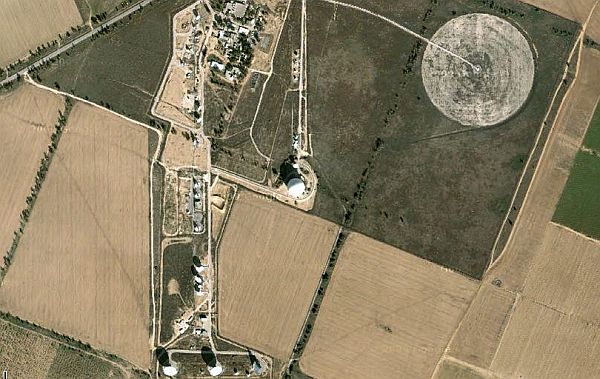
Israel’s most important intelligence-gathering installation is only a 30km drive into the Negev desert from Beersheba prison – where those taking part in the Gaza aid flotilla were briefly detained this June. The base, hidden until now, has rows of satellite dishes that covertly intercept phone calls, emails and other communications from the Middle East, Europe, Africa and Asia. Its antennas monitor shipping and would have spied on the aid ships in the days before they were seized.

Israel’s powerful position in the Middle East is often associated with its armed forces, nuclear weapons arsenal or covert (Mossad) operatives. But just as important is its intelligence gathering – monitoring governments, international organisations, foreign companies, political organisations and individuals. Most of this happens at the installation in the Negev a couple of kilometres to the north of the kibbutz of Urim. Our sources, close to Israeli intelligence, know the base first-hand. They describe lines of satellite dishes of different sizes, and barracks and operations buildings on both sides of the road (the 2333) that leads to the base. High security gates, fences and dogs protect the facility. As you can see on the internet, the satellite images of the base are quite clear. A practised eye easily discerns the signs of an electronic surveillance base. A large circle in the farmland shows the site of a direction-finding antenna (HF/DF) for monitoring shipping.

The Urim base was established decades ago to monitor Intelsat satellites that relay phone calls between countries. It expanded to cover maritime communications (Inmarsat), then rapidly targeted ever more numerous regional satellites. As such, says intelligence specialist Duncan Campbell, it is “akin to the UK-USA pact’s Echelon satellite interception ground stations”. The Echelon system is a network of interception stations around the world, set up in 1996 by the US, Britain, Canada, Australia and New Zealand. Satellite phones used by the Gaza-bound aid ships were easy targets for this hi-tech equipment.


View Larger Map

Facebooktwittermail

Technology fetishes and imaginary revolutions — Haystack and the hype

Just over a year ago, as Iranians took to the streets to protest the disputed presidential election, Andrew Sullivan declared: “The Revolution Will Be Twittered.”

Marveling at the ability of Twitter to empower the people, Sullivan wrote:

That a new information technology could be improvised for this purpose so swiftly is a sign of the times. It reveals in Iran what the Obama campaign revealed in the United States. You cannot stop people any longer. You cannot control them any longer. They can bypass your established media; they can broadcast to one another; they can organize as never before.

One young man, Austin Heap, inspired by the revolutionary potential of new technologies saw at that moment an opportunity to further empower the Green Movement by creating a tool to protect Iranian dissidents for whom internet anonymity had become a life or death imperative.

Thus was born the idea of Haystack.

This is how its creators described their revolutionary tool:

Haystack is a computer program that allows full, uncensored access to the internet even in areas with heavy internet filtering such as Iran. We use a novel approach to obfuscating traffic that is exceptionally difficult to detect, much less block, but which at the same time allows users to security [sic] use normal web browsers and network applications.

To securely use? Perhaps the copy editing on Haystack’s FAQ provided a clue about how carefully they would go about writing computer code.

After wowing the media — and the Obama administration, which provided a rarely granted special license to distribute the software in Iran — it turns out that Haystack has not only failed to live up to expectations, but it may have also placed thousands of Iranian dissidents at risk.

Evgeny Morozov, who blogs at Foreign Policy, was one of the few skeptics.

It all sounded great in theory, until security professionals began asking Austin Heap for a copy of Haystack’s code. (The program was never made available for download.) Every time someone would ask for a copy of Haystack, Heap would demur, explaining that releasing a copy of the program would imperil the project’s security. As the code stayed under wraps, the admiring reviews of Haystack — a program that no one in the media had ever seen — continued to pour in, and the project continued to raise money. While the funding details remain murky, Haystack did get at least one sizable grant — $50,000 from the global advocacy group Avaaz.org.

Heap’s ambitious plans for Haystack went far beyond Iran. In May, he told NPR that he was already working on exporting the program to at least two other countries. As Heap explained to Newsweek in August, “We will systematically take on each repressive country that censors its people. We have a list. Don’t piss off hackers who will have their way with you. A mischievous kid will show you how the Internet works.”

As Heap promised to tear down censorship worldwide, a group of Iranians began to test Haystack inside the country. It didn’t work. On top of the fact that it couldn’t pierce the Iranian firewall, Haystack was extremely insecure. The program’s security holes are so severe, in fact, that describing them here could help the Iranian government retroactively hunt down anyone who ever tested Haystack in Iran. In essence, Heap’s haystack was very, very small and the needle buried within carried GPS coordinates.

In a report for The Register, Dan Goodin wrote:

Members of the Censorship Research Center [the non-profit backing Haystack] said they were withdrawing the Haystack tool and asked that all remaining copies be destroyed. The move came after hacker Jacob Appelbaum called Haystack “the worst piece of software I have ever had the displeasure of ripping apart” and warned it could jeopardize the lives of Iranians who used it.

The project’s lead developer said here he was resigning. Those remaining vowed to have the program reviewed by outside auditors and then released as an open-source package.

It remains unclear how many people ever used Haystack and whether anyone actually depended on it to cloak their online activities from the prying eyes of Iran’s government. What is free from any doubt is the tremendous amount of uninformed adulation the program creators received from mostly mainstream news outlets.

Beyond the overblown expectations about technologically-enabled revolution, the Haystack story also points to the consequences of an inexorable historical trend.

As technological expertise has become progressively more specialized, the gap between user knowledge and producer knowledge becomes increasingly wider — to a point where for the vast majority of people, every piece of technology upon which we depend operates in ways utterly beyond our understanding.

Whereas the ability to understand how things work once formed many strands of common knowledge, we now share common ignorance. We pursue knowledge down much narrower tracks and on this basis repeatedly make naive assumptions about expertise whose quality we are unqualified to assess.

Why did so many journalists believe that Haystack could do what Austin Heap claimed it could? For a good number his credibility was probably based on little more than the fact that he was a geek from Silicon Valley.

As for the immediate impact of Haystack’s failure, the means through which Heap planned to expand its use — by initially sharing it with selected activists and trusted individuals on an invitation-only basis — could have made the software function like a Trojan Horse serving the Iranian regime.

Perhaps the most damning assessment of Haystack comes from the software’s lead developer, Daniel Colascione, who wrote in a letter or resignation:

I regret that we exposed anyone to undue risk, and that we deprived citizens of the effective anti-censorship tool that might have been. I regret standing silently while I listened to empty promises — and I especially regret that this whole ordeal has scarred the anti-censorship landscape so badly that it may be years before anything grows there again.

Facebooktwittermail

Who does Mahmoud Abbas represent?

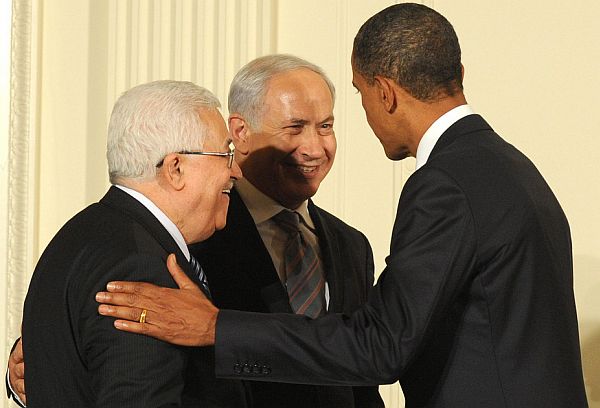
Mark Perry reports on the latest incident in the West Bank which indicates that the Palestinian acting president, Mahmoud Abbas, can now only impose his authority by force.

On Aug. 25, one week prior to the opening of Israeli-Palestinian peace negotiations, a group of Palestinians held a conference in Ramallah to discuss – and protest — President Mahmoud Abbas’s decision to travel to Washington to attend the talks. The Ramallah gathering, to be held at Ramallah’s Protestant Club meeting house, had been meticulously planned by a prominent coalition of political activists that included Palestinian businessmen, acknowledged leaders in Palestinian civil society and respected leaders of Palestinian political parties. “This was to be an open forum, an assembly to debate and discuss,” Munib al-Masri, the founder of the Palestine Forum and one of the meeting’s organizers said in an interview from his home in Nablus. “Our intention was to exercise our right to assemble and debate. Tragically, that’s not what happened.”

As the crowd of attendees (later estimated at between 250-300 people) began to gather at noon on Aug. 25, a group of about 100 non-uniformed officers from the Palestinian General Intelligence Service entered the hall carrying placards featuring Abbas’s picture and shouting pro-Abbas slogans. Across the street, at the headquarters of Al Haq — an independent human rights organization — Shawan Jabarin, the organization’s director (who had been invited to attend the meeting), heard of the commotion and decided to walk to the meeting hall. Jabarin described the scene: “This was going to be a large and important meeting,” he said, “so there were already 200 to 300 people in the hall at noon. But it was clear they wouldn’t be allowed to speak. The security people were shouting slogans, intimidating people. I saw a sign — ‘Stop Supporting Iran.'”

Inside the hall, those disrupting the meeting (Israeli journalist Amira Hess described them in Haaretz as “young men of similar appearance — well-developed muscles, civilian clothes and stern facial expressions”) began to shout down the first speaker, Dr. Mamdouh Al Aker, the director of the Palestinian Independent Commission for Human Rights (PICCR). When Aker asked for a moment of silence “in memory of those who gave their lives for the Palestinian people and the Arab nation” he was whistled down and the crowd of young men began to shout in unison: “With our blood and our souls, we will redeem you, Abu Mazen [Mahmoud Abbas].” The young men, now a phalanx of intimidating muscle and anger, began to push and shove the attendees out of the building. “People were frightened and were pushed outside, shoved out by the security people,” Al Haq’s Jabarin remembers. “It was outrageous, so I directed my staff to take pictures.”

Mustafa Barghouti, the head of the Palestinian National Initiative (a leading and increasingly strong political movement inside Palestine) and one of the most prominent leaders scheduled to speak at the meeting was in the crowd as it was pushed out of the meeting house. He attempted to maintain order and separate the meeting’s attendees from the group disrupting the gathering. “People were pushed into the street,” he remembers, “and that’s when the beatings began. It was very violent. The General Intelligence people were pushing people to the ground.” On the street in front of the Protestant Club, meanwhile, members of the Al Haq staff began to document the incident. “We had a camera, one of my staff members had a camera,” Jabarin says, “and we were trying to take pictures. But my staff member who had the camera was pushed down and the security official attempted to take the camera, to break it. This man was beating him and when one of my other staff members tried to help him, she was pushed to the ground and beaten. They got the camera.”

Standing nearby, Bassam al-Salhi, general secretary of the Palestine Peoples’ Party (and a former candidate for president), also attempted to stop the beatings. “This was mob violence,” he says. “But I thought that if we could somehow move up the street we could stop the confrontations.” Facing continued harassment, the group decided to walk to a nearby park, but were prevented from doing so by the Ramallah police. “They didn’t participate in the violence,” Salhi says of the police, “but they didn’t try to stop it either. Eventually, we had nowhere to go – so people just ran away. They had no choice.” The leaders of the conference, meanwhile, decided to take their protest of the incident to the headquarters of Watan, a local television station. But when they appeared on camera, a vocal group of security officials shouted them down, waving their placards in front of the Watan cameras. Inevitably, perhaps, the continued intimidation of the speakers was successful – and the crowd at Watan dispersed.

Meanwhile a Hamas commander, Iyad As’ad Shelbaya, was killed by the IDF on Thursday after Israeli soldiers claimed he ran towards them in a threatening way and ignored requests to stop. The Ma’an News Agency, however, reports that Shelbaya was shot in bed.

Israeli forces entered the home of a Hamas leader in Tulkarem on Friday morning and shot him three times in the neck and chest before withdrawing, family members said.

Medics at the Thabit Thabit Hospital in Tulkarem confirmed that 38-year-old Iyad As’ad Shelbaya, a known Hamas leader, was dead, killed by three bullets to the neck and chest.

However much these two reports conflict, the one thing about which we can be reasonably sure is that Shelbaya was not carrying a weapon — had he been armed there’s no question that the IDF would have highlighted that detail.

As for their claim that the incident is now being investigated, it’s also reasonable to assume that the investigation won’t reveal anything. As a B’Tselem report revealed this week, the decision by Israeli authorities to regard the West Bank as an area of armed conflict ever since the second intifada began in 2000, “effectively grants immunity to soldiers and officers, with the result that soldiers who kill Palestinians not taking part in hostilities are almost never held accountable for their misdeeds.”

Writing from Gaza, Laila El-Haddad says:

There is very little patience in Gaza for this latest set of talks. They are not only being conducted without a national consensus by what is broadly considered an illegitimate government, but they also completely marginalise the Gaza Strip and overlook the blockade and asphyxiation it has suffered for more than four years.

“When people started to talk about negotiations and going back to the peace process and all, I thought, wait a minute, who took our opinion before going there?” said Ola Anan, 25, a computer engineer from Gaza City. “I mean, Mahmoud Abbas is now a president who’s out of his presidential term. So in whose name is he talking? In the name of Palestinians? I don’t think so.”

Abu el-Abed, a 30-year-old fisherman who sells crabs in the coastal Gaza enclave of Mawasi said: “We hear about the negotiations on television, but we don’t see them reflected on the ground. They’re not feasible. Gaza’s completely marginalised as far as negotiations go. There’s no electricity, there’s no water. There’s no movement. Living expenses are high. And the borders are all closed.”

Ultimately, Gazans know very little or care very little about what is happening in Washington, because what’s happening in Washington cares very little about them, says Nader Nabulsi, a shopkeeper in Gaza City’s Remal neighbourhood: “These negotiations don’t belong to us, and we don’t belong to them.”

Nabulsi, like many others here, feels the negotiations are farcical given the fractured nature of the Palestinian leadership, but also given the fact that most consider Abbas’s government illegitimate and his term expired.

Reza Aslan writes:

As direct talks between the Israelis and Palestinians drag on in Jerusalem, it should not surprise anyone that militants in the Gaza Strip have stepped up their rocket and mortar attacks into southern Israel. Neither should it surprise anyone that the Israeli government is holding Hamas, which has ruled Gaza since seizing control of it in 2007, responsible for the attacks, accusing the group of trying to derail the peace process.

What is surprising, however, is that it may not be Hamas who is responsible for most of the rockets that have recently been launched into Israel. Rather, a group of Palestinian militants connected to al Qaeda has been repeatedly staging attacks against Israeli targets over the last year as a means of challenging Hamas’s rule over Gaza.

A civil war is brewing in the Gaza Strip between Hamas and a new crop of more radical militant groups like Jaish al-Umma, Ansar al-Sunna, and Jund Ansar Allah, who believe Hamas is not fighting the “Jewish enemy” as aggressively as it should be. According to the Economist, these Palestinian militants have been heavily influenced by time spent in Saudi Arabia, where they apparently absorbed the Kingdom’s ultra-orthodox (sometimes called “Salafist”) brand of Islam — a particularly conservative interpretation of Islam that, until recently, had not taken root in the Palestinian territories.

A spokesman for Jaish al-Umma says his group’s purpose is “to awaken the Islamic nation from the backwardness and the ignorance the tyrant regimes in Islamic countries have caused, and to free the Muslims from the despots.”

Although the leaders of this new movement tend to be doctors and university professors, they draw their rank and file membership from Hamas militants who have grown disenchanted with the group’s attempt to moderate its ideology and accommodate Israeli demands. Unlike Hamas, which has diligently kept its distance from al Qaeda and openly rejected its global ideology, many of these so-called “Salafist” groups are fervent supporters of al Qaeda, and some have referred to Osama bin Laden as their “righteous shepherd” (though a few continue to preach loyalty to the president of the Palestinian Authority, Mahmoud Abbas).

Facebooktwittermail

The advance of the anti-Muslim movement across America


(Glenn Beck interviews Frank Gaffney, president of the Center for Security Policy.)

Shariah: The Threat to America, a report released by the Center for Security Policy in Washington DC on Wednesday, is an attempt to provide a veneer of seriousness in support of the hysterical ravings of people like Pamela Geller.

The fact that Washington’s foreign policy establishment won’t take the report seriously is beside the point since Islamophobia needs neither the consent nor the interest of the establishment or the mainstream media in order to continue its advance across America.

The fact that 52% of Republicans believe that President Obama supports the imposition of shariah is sufficient evidence that a new McCarthyism has already gained a firm grip on this country while opposition to this movement has barely begun to solidify.

Under a heading, “The Enemy Within,” the new manifesto for Islamophobes warns: “a massive demographic shift has brought adherents to shariah — a doctrine that, by definition, opposes all others — deep into the non-Islamic world. [p.127]”

Although the report describes shariah as “the crucial fault line of Islam’s internecine struggle,” with moderates on one side and Islamists on the other, the authors decline to express any opinion about which side of this “fault line” most American Muslims reside. Indeed, the focus on shariah merely seems to be a ploy through which Islam as a whole can be attacked by those who profess no hatred for Muslims.

At the very same time, shariah is likened to a disease — a disease spread by Muslims.

The growth of Muslim populations in the West augurs the inexorable spread of shariah into Western societies — less by violence than by dint of natural procreation, unchecked immigration, and the incessant demands of an aggressive minority that refuses to assimilate. Logic should tell us, then, that the growth of shariah in the West threatens Western-style liberty: threatens freedom of expression, freedom of conscience and upends religious and sexual equality. [p.130]

For those willing to shun evil, a path to redemption is laid out: “… every effort should be made to identify and empower Muslims who are willing publicly to denounce shariah…”

But there’s also a call for a Muslims-keep-out sign at the border: “Immigration of those who adhere to shariah must be precluded, as was previously done with adherents to the seditious ideology of communism.”

Is it possible that America could succumb to the folly that the Islamophobes are demanding?

Well, it’s worth considering the fact that two decades after the end of the Cold War and more than fifty years after the passing of McCarthyism, the US Immigration and Naturalization Service still scrutinizes prospective citizens to see if any communists are trying to sneak into this country.

In fact, Sharia presents about the same threat to America as that posed by the Bible. Had America’s founders stuck to the principle “render unto Caesar the things which are Caesar’s,” it seems unlikely that the colonies would ever have sought independence. It wasn’t Christ who objected to taxation without representation.

Thomas Jefferson rightly believed:

…that our civil rights have no dependence on our religious opinions any more than our opinions in physics or geometry, that therefore the proscribing any citizen as unworthy the public confidence, by laying upon him an incapacity of being called to offices of trust and emolument, unless he profess or renounce this or that religious opinion, is depriving him injuriously of those privileges and advantages, to which, in common with his fellow citizens, he has a natural right…

Ironically, the Islamophobes manifesto that Frank Gaffney is now promoting, cites the Virginia Statute for Religious Freedom (in which the passage above appears), even while doing exactly what Jefferson condemned: proscribing American citizens as unworthy of public confidence unless they denounce their religion.

Maybe these fear- and hate-mongers should pay more attention to the principles upon which America was founded and worry less about Islam.

Facebooktwittermail

Corruption isn’t just Karzai’s problem

Fred Kaplan writes:

It’s tempting to skip over the recent news stories about fighting corruption in Afghanistan. (“Of course there’s corruption,” you might have muttered while turning the page.) But resist the urge; go back and read them. They’re just as important as the stories about fighting the Taliban in Kandahar — maybe more so.

In a counterinsurgency war, such as the one we’re waging in Afghanistan, the legitimacy of the host government, in the eyes of its own people, is key to the prospects for success. And legitimacy is nearly unachievable if the government is blatantly corrupt.

Kaplan is right in suggesting that the topic of corruption in Afghanistan is one that does not evoke much intense interest, but I think we look at it from the wrong perspective when considering it as a local problem and a problem that should only concern Americans in as much as it impacts an American war.

The problem of corruption is in many ways, the political problem of this era — the corruption in Afghanistan merely happens to be one of the worst manifestations.

In as much as we think of the issue in terms of ballot rigging, involvement in the drugs trade, the exchange of bribes and so forth, we tend to overlook the fundamental nature of corruption. Whether or not it involves cash in brown paper bags, what political corruption is all about is misrepresentation.

A politician presents himself as serving one set of interests when in reality he serving a different set of interests.

Washington and Kabul are much more alike than we care to see. The difference is in the degree to which the victims of misrepresentation feel aggrieved.

In our obsessive focus on counter-terrorism and counter-insurgency, we give nearly all our attention to the ways in which people react to their grievances and amazingly little to the origins of their grievances.

From Cairo to Kabul, the United States props up corrupt governments and the people ruled by those governments think we bear some of the responsibility for the misery in their lives.

And yet somehow a fiction still has currency — that the source of most of the problems in the Middle East is people who hate freedom.

Facebooktwittermail

Arming the insurgencies of the future

Guns are very durable — ownership tends to be transient.

The New York Times examines a weapons cache which provides a snapshot of the arsenal that the Taliban in Marja — the part of Helmand Province that has seen the most sustained fighting of 2010 — have been using against US marines.

In this collection, a third of the weapons are bolt-actions rifles from World War II or earlier.

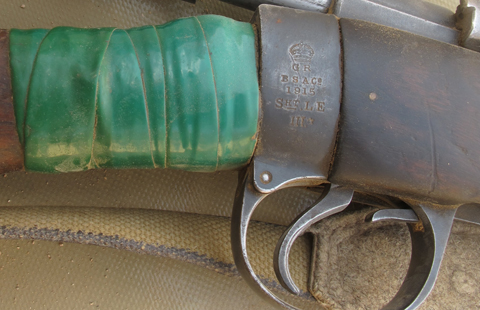
The photograph above shows a 1915 Lee Enfield rifle — a gun that was manufactured in the millions to defend the British Empire.

Did the manufacturers have the slightest idea that they were making weapons that would outlast an empire?

What does the fact that the US military is now locked in a stalemate against an irregular force with vastly inferior weaponry say about the return American taxpayers are getting from a defense budget that dwarfs all others?

Would the Marines be significantly worse off if they too carried Lee Enfields?

But here’s the serious question:

When Britain was amassing an arsenal to defend its empire, it spent a tiny fraction of what the US now spends producing an array of weapons far less potent than those the Pentagon now requires.

If we assume that, just as was the case for the British, the American arsenal far outlasts the American empire, what kind of world will we see a hundred years from now when America is a shadow of its former self and fighters across the planet are wielding M16 rifles instead of Lee Enfields?

The defense of America leads inexorably to the weaponization of the planet.

Facebooktwittermail

What would Cheney say?

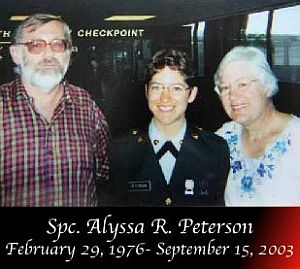
Greg Mitchell reports (parts one and two) on the suicide of Spc. Alyssa Peterson, one of the first women soldiers to die in Iraq. She took her own life exactly seven years ago after being reprimanded for showing empathy for Iraqi prisoners who were undergoing interrogation. All records of the techniques being used have been destroyed but there seems little doubt that the Iraqis were being tortured.

The 27-year-old’s parents didn’t even know their daughter was in Iraq until they were informed of her death. The fact that she committed suicide was concealed by the military for several more years — the most likely reason for the cover-up being that it was Peterson’s unwillingness to participate in torture that drove her to take her own life.
Kayla Williams, a US Army sergeant who served with Peterson, described the impact of participating in interrogations which she could see clearly contravened the Geneva Conventions.

Fellow soldiers, echoing then vice-president Dick Cheney, told the young sergeant that “the old rules no longer applied because this was a different world. This was a new kind of war.” But Williams said: “it really made me feel like we were losing that crucial moral higher ground, and we weren’t behaving in the way that Americans are supposed to behave.”

“It also made me think,” Williams says, “what are we as humans, that we do this to each other? It made me question my humanity and the humanity of all Americans. It was difficult, and to this day I can no longer think I am a really good person and will do the right thing in the right situation.”

As the famous Milgram experiment demonstrated, individuals who choose to do the right thing — especially when that demands defying authority — are usually in a minority. The much more prevalent tendency is a willingness to follow orders and suspend ones own moral judgment — even when that involves participating in torture.

Should Alyssa Peterson have been turned away from the military on the grounds that she was too humane, her conscience too strong, for her to serve in the US Army? She ended up being reprimanded for showing empathy to Iraqi prisoners. As the official investigation of her death revealed: “She said that she did not know how to be two people; she… could not be one person in the cage [where prisoners were apparently tortured] and another outside the wire.”

Suppose before she took her life, Dick Cheney had had an opportunity to council her, what would he have said? Or suppose Cheney was now to speak to her father, what would he say?

Empathy is a liability in wartime? Americans need to set aside their humanity when they put on a uniform?

Peterson’s ability to empathize with Iraqi prisoners was no doubt in large part an expression of her character and her humanity, yet to an extent it must also have resulted from the humanizing effect of understanding and speaking Arabic. In spite of the dehumanizing effect of seeing men stripped of their dignity, she must also have been able to see beyond that and through their words seen not mere “terrorist” suspects, but fathers with daughters and sons with parents.

Recognition of humanity is not something we can pick up or discard whenever it seems expedient — whenever cast aside it henceforth becomes increasingly difficult to rediscover.

The choice to cross over to the “dark side” is a choice that may prove impossible to reverse. At 27 Alyssa Peterson seems to have understood that. As far as we can tell, Dick Cheney has not even attempted to find the way back.

Facebooktwittermail

What really shapes Muslim perceptions of America

As American politicians, administration officials, military leaders and commentators from across the political spectrum denounced a plan to burn Qurans in Florida, preeminent among the reasons given for this condemnation was that such an act would cast the United States in a very unfavorable light and expose American soldiers to greater danger — that it would lend strength to those radical voices who insist that America is hostile to Islam.

The US has spent most of the last decade at war in Muslim countries, as a result of which hundreds of thousands have died and millions been forced to abandon their homes, but it’s as though these facts alone would not have been sufficient to color Muslim perceptions of America.

Occupations in Iraq and Afghanistan, drone attacks in Pakistan, missile strikes in Yemen and Somalia, thinly veiled threats against Iran, Abu Ghraib, Guantanamo, secret prisons, renditions and torture — all of these merely raised doubts about US intentions. It was Pastor Terry Jones who had the power to solidify anti-American hostility across the Muslim world.

I guess if you believed that, then it would also somehow make sense that two recent reports about the actions of American soldiers in Afghanistan and Iraq have been given so little attention in the media.

The Seattle Times reports:

As part of one of the widest-ranging U.S. war-crime cases to emerge from the conflict in Afghanistan, charging documents released Wednesday allege soldiers took finger bones and other body parts cut from Afghan corpses.

The documents provide new public details of the cases against a dozen soldiers who served a year in southern Afghanistan with a Western Washington-based Stryker infantry brigade.

The most serious charges involve the alleged slayings of three Afghans in January, February and May. Five soldiers, all stationed at Joint Base Lewis-McChord, are accused of involvement in one or more of the murders. They face penalties that range up to life imprisonment or death.

Meanwhile, Robert Fisk, in an article on the brutal practice of ‘honor’ killing refers to terrible stories of gang rape by United States personnel in Abu Ghraib.

You hear this repeatedly in Amman, and a very accurate source of mine in Washington — a man who deals with military personnel — tells me they are true. This, he says, is why Barack Obama changed his mind about releasing the photographs which George W Bush refused to make public. The pictures we saw — of the humiliation of men — were outrageous enough. But the ones we haven’t seen show Americans raping Iraqi women.

Lima Nabil, a journalist who now runs a home for on-the-run girls, sips coffee as the boiling Jordanian sun frowns through the window at us. “In Abu Ghraib,” she says, “women were tortured by the Americans much more than the men. One woman said she witnessed five girls being raped. Most of the women in the prison were raped — some of them left prison pregnant. Families killed some of these women — because of the shame.”

Obama’s refrain has been that we need to look forward, not back — that it’s time to turn the page — but the past lingers. Turning away usually simply means that we are choosing to ignore the ways in which the past is still present.

In an interview with Paul Jay from the RealNews Network, David Gardner, foreign affairs editor at the Financial Times talks about the UK’s ongoing investigation into the war in Iraq and some of the ways history may be repeating itself as the West confronts Iran.

Facebooktwittermail

Scapegoating-psychology and rising xenophobia in America

Peter Beinart compares the mood in America with the hysteria that provoked the Palmer Raids in 1919 and the anti-Communist fearmongering of McCarthyism that began in the late 1940s.

Ever since 9/11, according to opinion polls, Republicans have worried more about terrorism than have Democrats. Initially, this fear translated into overwhelming support for military action abroad. But as Republicans (like everyone else) have grown tired and embittered by America’s wars, they have turned their anxiety inward, lured by the same idea that attracted Palmer and the McCarthyites: that America could guarantee its safety on the cheap by ferreting out the real threat, which resides within.

Has, we must fight them over there so we don’t have to fight them here, been turned into, why fight them over there when we can fight them here?

I don’t believe the driving force here is, as Beinart suggests, a desire to guarantee safety on the cheap. Rather, this is about age-old scapegoating-psychology and the political opportunities this crude dynamic opens up.

In a period of economic depression, with high unemployment and a pervasive sense that the nation is heading in the wrong direction, many Americans are experiencing a growing sense of powerlessness. Through scapegoating, they can foster the illusion that they are reclaiming control over our own lives. They can focus their animus on a clearly identifiable enemy — Islam.

In scapegoating, by definition, the enemy must be weaker than those on the attack — which is why even at the height of the financial crisis, popular anger at bankers never became as strong as current Islamophobia. It’s the same as the way a guy who’s treated as a drudge at work then finds his “strength” by abusing his wife.

The more that Muslims can be made to feel like outsiders, the more those who have defined them as other can feel empowered.

Meanwhile, with the emerging visceral sense that American renewal can be delivered by purging this country of its “foreign” elements, a political horizon is opening for conservatives such as Newt Gingrich — a man who has no apparent compunction about harnessing popular power even when delivered from the ugliest source.

Gingrich clearly smells presidential opportunity in rising xenophobia and is channeling this into an attack on President Obama whose “foreignness” derives from his Kenyan ancestry and even the fact that he grew up in Hawaii!

Gingrich claims that Dinesh D’Souza has provided “stunning insight” into Obama, in a Forbes cover story, where the president is characterized as “a Luo tribesman.”

David Frum, a neoconservative and former speech writer for George W Bush, sees Gingrich’s perspective as now providing the foundation for the White Party’s political platform.

With the Forbes story and now the Gingrich endorsement, the argument that Obama is an infiltrating alien, a deceiving foreigner — and not just any kind of alien, but specifically a Third World alien — has been absorbed almost to the very core of the Republican platform for November 2010.

Rush Limbaugh has been claiming for almost 2 years that President Obama is bent upon “redistribution” and “reparations.” Following D’Souza, Gingrich has now stepped up to suggest that this redistribution is motivated by anti-white racial revenge. If Obama wants to expand health coverage, tighten bank regulation, and create government make-work projects it’s not because he shares the same general outlook on the world as Walter Mondale or Ted Kennedy or so many other liberals, living and dead, all of them white and northern European. No, Obama wants to do what he does because he thinks like an African, and not just any kind of African but (in D’Souza’s phrase) “a Luo tribesman.”

It is to vindicate this African tribal dream that Obama wishes to raise the taxes of upper-income taxpayers and redistribute money away from these meritorious individuals. D’Souza contends that Obama is acting to vindicate his father’s supposed dream of overthrowing the global order and ending the global domination of the white race over other peoples.

If only it were true, the anticolonialist in me facetiously says. This global reordering must surely eventually come, but I have my doubts whether Obama will have much if any role in bringing it about.

Much more significant in the current context is the fact that an event which two years ago was seen as a reflection of America’s political maturity — the election of an African-American president — is now serving as a opportunity for America to regress into some of the ugliest recesses of its past.

Facebooktwittermail

The road to fascism in America

In an interview on ABC News which aired yesterday, Imam Feisal Rauf, who leads the Cordoba initiative which plans to open an Islamic center near the site of the World Trade Center, was asked why he does not want to relocate, in spite of strong opposition to the plan.

My major concern with moving it is that the headline in the Muslim world will be Islam is under attack in America, this will strengthen the radicals in the Muslim world, help their recruitment, this will put our people — our soldiers, our troops, our embassies, our citizens — under attack in the Muslim world and we have expanded and given and fueled terrorism.

Even if this genuinely represents the views of the imam, it is also the kind of argument one would expect to be proffered by a political consultant. Shift the debate away from religion towards national security. That’s the most easily defended political ground. Perhaps, but it also sounds lame and can be perceived as disingenuous. Moreover, if national opinion is being offended, potential damage to international opinion is the least persuasive basis on which to appeal to red-blooded Americans.

Whatever the repercussions might be outside the United States in the event that the backers of the Islamic center bow to pressure to relocate, the strongest argument for resisting such pressure should rest on the implications inside America.

Speaking with a surer, more passionate voice, Imam Rauf said:

[T]here’s growing Islamophobia in this country.

How else would you describe the fact that mosques around the country are now being attacked? We are Americans, too. As — we are — we are treated and talked about today as if — as if American Mus — and Muslims are not Americans.

We are Americans. We — we — we are — we are doctors. We are investment bankers. We are taxi drivers. We are store keepers. We are lawyers. We are — we are part of the fabric of America.

This points to the core issue which is not about Islam or Muslims per se — it’s about America’s commitment to advance as a pluralistic society.

In a discussion of the state of Islam in America, Eboo Patel, who serves as an interfaith adviser to President Obama, said: “This is a blip in the broader arc of inclusiveness that is America and the history books will read as they have read before that the forces of inclusiveness will defeat the forces of intolerance.”

Some may share Patel’s faith in America and many more will wish they had his confidence, but his interfaith evangelical fervor contrasts sharply with mounting evidence that America is actually heading in the opposite direction.

In an interview on the John Batchelor Show on Friday, Michael Vlahos, a professor at the US Naval War College, described the parallels between contemporary America and Germany in the 1930s during the period that laid the foundations for the rise of Hitler.

Michael Vlahos interviewed on the John Batchelor Show.

Vlahos says:

Our relationships with the world are taking on a depression era — and by that I mean a 1930s depression era — perspective of nativism… We look at the world as a threatening place and it’s a zero sum game. Everything that they gain, we lose. And therefore we are rejecting the very American universalism that made us great, and part of this is an objectification of threat as the other — as evil people who are trying to hurt and destroy us and hence you have this resonant image of both Muslims and Mexicans as a kind of infection of the American body. So that Americans feeling weak about their identity feel that their body is being infected by this bacterium.

On one hand you have Mexicans, who are penetrating and infecting us, and on the other hand you have Muslims — and the entire crisis over this mosque, the so-called “Ground Zero Mosque,” is really all about this fear that the world is coming after us. And this is a very powerful point of departure in which you have a sense that American identity, if you have the body being infected — now I’m using these metaphors, because these are the exact metaphors that Hitler used in the 20s: the notion that the German body was being infected, and who was it being infected by?… Communists and Jews. And so you see the same kind of dual infection of Muslims and Mexicans. And the fact is, this speaks to an America that is intensely anxious about its future and that is hunkering down and that has essentially thrown off its relationship to the world and is now looking at the world as a source of threat…

[The Bush administration] in its creation of the Department of Homeland Security, in the elaboration of this whole notion that the homeland was the key and the homeland was what it was all about, and that the world was out there to threaten us — this is very much like the deglobalization of the 1930s where we are pulling back from the rest of the world…

This then points to the ultimate irony: that as opponents of the Cordoba initiative hold up signs warning about an Islamic take over and as a staggering 52% of members of the White party (otherwise known as the GOP) believe that President Obama wants to impose Islamic law in America, these very Americans are unwittingly laying the foundations for the advance of fascism.

Facebooktwittermail

This is America

A burned Quran along with excrement-smeared pages from the holy book were found outside the Islamic Center of East Lansing, Michigan yesterday. The FBI have been called in to launch an investigation.

The same day, the Council on American-Islamic Relations (CAIR) called for federal hate crime charges to be brought against three men who allegedly painted the racist slur “sand n**gers” on a mosque in New York.

Earlier this week, CAIR called on the FBI to investigate recent vandalism at a mosque in Phoenix.

In recent months, mosques in California, Florida, Illinois, Kentucky, New York, Tennessee, Texas, and Wisconsin, have faced vocal opposition or have been targeted by hate incidents.

In an effort to sound the alarm during “one of those times that test our values,” Nicholas Kristof notes: “In America, bigoted comments about Islam often seem to come from people who have never visited a mosque and know few if any Muslims.”

He asks: “Is this America?”

Well, most Americans have never visited a mosque and know few if any Muslims.

If liberals such as Kristof and James Fallows are shocked about swelling Islamophobia in America, this may say less about the rise of bigotry than it says about the reluctance of members of America’s liberal elite to acknowledge that they do not represent mainstream America.

Why the reluctance? If one sees oneself as an influential figure — as belonging to that very select class of “opinion makers” (none more prestigious than a New York Times columnist) — yet it turns out that most people do not share your views, it also turns out that you have less influence than your status might suggest.

Kristof lays out some of the numbers that make it clear that Americans, in massive numbers, are delusional. He cites a Newsweek poll that indicates that 52% of Republicans believe President Obama wants to see Sharia law imposed in America and around the world. 24% of those polled believe Obama is a Muslim.

A Washington Post-ABC News poll indicates that 49% of Americans have generally unfavorable opinions about Islam and while these views have no doubt been shaped by the repetitive association made between Islam and terrorism, only 1% of Americans regard terrorism as the most important problem facing this country.

What this suggests is that undiluted Islamphobia has taken hold in the American consciousness over the last nine years. What initially might have simply been a fear of terrorism has gradually shifted into an a more pervasive aversion towards Muslims. Fear has metasticized, becoming a broadly tolerated anti-Muslim bigotry.

One in five Americans believe that most or many Muslims living in America support the goals of al Qaeda and Islamic fundamentalists.

Think about what that means if you’re a Muslim American flying inside this country. The chances are that one or two of the passengers in the same row think you’re a terrorist sympathizer (if not a terrorist).

Or think about it this way:

If you’re a non-Muslim American, the chance that you’ll run into a terrorist sympathizer as you go about your day is so small it can be discounted.

If you’re a Muslim American the chance you’ll run into a bigot every single day is so high it’s almost certain.

Facebooktwittermail

What makes Americans afraid?

9/11 has become the emblem of all our fears not because it represents a national security failure or because it exposed poorly crafted foreign policy.

From our perspective the most terrifying dimension of the threat posed by al Qaeda is not its destructive capacity but its operatives’ casual disregard for life. Like moths drawn towards a flame, death offers for them some irresistible allure.

In contrast, we see our own fear of death as a healthy expression of our love of life. Indeed we see death as signifying more than anything else the termination of life.

There’s a contradiction here which reveals the fundamentally secular nature of contemporary American society — a secularism masked by the ostentatious religious identifications to which so many Americans cling.

Strip away their diverse forms of worship and their often conflicting systems of belief, and each religion has at its core the same function: it provides the individual and society a means to face mortality and render it meaningful.

If you want to determine the degree from which any society has moved away from its historical religious orientation, there is no easier way than to look at how it handles death.

A death-denying society is one that finds little comfort in the promise of an afterlife. It invests most of its faith in this world in the absence of any real confidence about what might follow.

Consider the example of America’s religious fanatic-of-the-week, Pastor Terry Jones. In the face of death threats he professed his willingness to die in defense of his beliefs, yet he did so with a 40-caliber pistol strapped to his waist.

We say “One Nation Under God” as though we are guided by a transcendent perspective, yet more often we seem to worship the nation itself.

The holy book in which so many Americans profess their faith says quite clearly:

Lay not up for yourselves treasures upon earth, where moth and rust doth corrupt, and where thieves break through and steal;
But lay up for yourselves treasures in heaven, where neither moth nor rust doth corrupt, and where thieves do not break through nor steal.

This, like so many others, is a throughly un-American Biblical teaching and where American values and Biblical values conflict, the outcome is predictable.

Our fears reign in this land — the place we have stored all our treasures — which is why, however much we spend on defense, we still struggle to feel safe.

We could instead endeavor to become less afraid.

Facebooktwittermail

In the wake of 9/11, Israel put Iran into “Axis of Evil”

Marsha Cohen writes:

When, on September 11, 2001, two terrorist attacks occurred on U.S. soil, Israeli political figures anticipated that the Americans would now be better able to empathize with Israel’s vulnerability to its own random terror attacks. In the hours immediately following the attacks on the World Trade Center and the Pentagon, Israeli leaders envisioned a massive U.S. retaliation in which Israel was uniquely equipped to be a partner, even a mentor, of the U.S.

“The fight against terror is an international struggle of the free world against the forces of darkness who seek to destroy our liberty and our way of life,” then-Prime Minister Ariel Sharon declared in a televised statement just after midnight on September 12. “I believe that together we can defeat these forces of evil.”

But immediately, a spate of Israeli pronouncements proclaimed Israel’s own priorities. They drew upon a decade of Israeli assertions of Iranian complicity in terrorist attacks, and warnings of an imminent Iranian nuclear threat. A war of civilizations had begun. 9/11 was just the first strike of Islamic fundamentalists. The next might be a nuclear attack by Iran.

The pronouncements constituted the opening salvo in a months-long back-and-forth about how the U.S. would frame its new “global war on terror.” Would the U.S. choose the allegiance of regimes in Muslim majority countries — even enlisting hostile governments like Iran who might sympathize with the dangers of transnational Islamic fundamentalist terror — over Israel, which proclaimed itself a battle-hardened ally? Today, the outcome of those first months after September 11 speak for itself, but a review of the Israeli side of the wrangling may be instructive to how the U.S. arrived at its present positions.

Facebooktwittermail

The real Ground Zero Mosque was destroyed by al Qaeda

In the midst of the heated debate about the construction of an Islamic center two blocks away from the site of the World Trade Center, Samuel Freedman tells a story that should be heard by everyone who has declared their concern about the sensitivity of this issue.

Sometime in 1999, a construction electrician received a new work assignment from his union. The man, Sinclair Hejazi Abdus-Salaam, was told to report to 2 World Trade Center, the southern of the twin towers.

In the union locker room on the 51st floor, Mr. Abdus-Salaam went through a construction worker’s version of due diligence. In the case of an emergency in the building, he asked his foreman and crew, where was he supposed to reassemble? The answer was the corner of Broadway and Vesey.

Over the next few days, noticing some fellow Muslims on the job, Mr. Abdus-Salaam voiced an equally essential question: “So where do you pray at?” And so he learned about the Muslim prayer room on the 17th floor of the south tower.

He went there regularly in the months to come, first doing the ablution known as wudu in a washroom fitted for cleansing hands, face and feet, and then facing toward Mecca to intone the salat prayer.

On any given day, Mr. Abdus-Salaam’s companions in the prayer room might include financial analysts, carpenters, receptionists, secretaries and ironworkers. There were American natives, immigrants who had earned citizenship, visitors conducting international business — the whole Muslim spectrum of nationality and race.

Leaping down the stairs on Sept. 11, 2001, when he had been installing ceiling speakers for a reinsurance company on the 49th floor, Mr. Abdus-Salaam had a brief, panicked thought. He didn’t see any of the Muslims he recognized from the prayer room. Where were they? Had they managed to evacuate?

He staggered out to the gathering place at Broadway and Vesey. From that corner, he watched the south tower collapse, to be followed soon by the north one. Somewhere in the smoking, burning mountain of rubble lay whatever remained of the prayer room, and also of some of the Muslims who had used it.

Given the vitriolic opposition now to the proposal to build a Muslim community center two blocks from ground zero, one might say something else has been destroyed: the realization that Muslim people and the Muslim religion were part of the life of the World Trade Center.

Opponents of the Park51 project say the presence of a Muslim center dishonors the victims of the Islamic extremists who flew two jets into the towers. Yet not only were Muslims peacefully worshiping in the twin towers long before the attacks, but even after the 1993 bombing of one tower by a Muslim radical, Ramzi Yousef, their religious observance generated no opposition

“We weren’t aliens,” Mr. Abdus-Salaam, 60, said in a telephone interview from Florida, where he moved in retirement. “We had a foothold there. You’d walk into the elevator in the morning and say, ‘Salaam aleikum,’ to one construction worker and five more guys in suits would answer, ‘Aleikum salaam.’ ”

One of those men in suits could have been Zafar Sareshwala, a financial executive for the Parsoli Corporation, who went to the prayer room while on business trips from his London office. He was introduced to it, he recently recalled, by a Manhattan investment banker who happened to be Jewish.

“It was so freeing and so calm,” Mr. Sareshwala, 47, said in a phone conversation from Mumbai, where he is now based. “It had the feel of a real mosque. And the best part is that you are in the epicenter of capitalism — New York City, the World Trade Center — and you had this island of spiritualism. I don’t think you could have that combination anywhere in the world.”

Facebooktwittermail

Pastor Jones’ daughter says he’s a megalomaniac

In an interview with Der Spiegel, Pastor Terry Jones’ daughter Emma Jones describes her father as a megalomaniac who she characterizes as a delusional cult leader.

SPIEGEL ONLINE: How did you grow up?

Emma Jones: We were raised in a very Christian household, and it was very strict. But also very social. We received visits from people from all over the world and were open to everything.

SPIEGEL ONLINE: Former members of his church have spoken of psychological cruelty, forced work, financial irregularities and calls to beat ones own children.

Jones: My mother, Lisa Jones, died in 1996 of a heart attack. Shortly thereafter, my father remarried and I left the church at age 17. In 2005, he offered me a job as a bookkeeper in a company belonging to the church, which sold donated furniture on eBay. I gained a new insight, and realized that my father preached things and did things that I didn’t find to be in accordance with the Bible at all. He demanded that people completely obey him and his second wife, Sylvia. Both are extremely obsessed with power. I saw genuine religious delusion. A typical indication of a sect. Both of them wanted to control everything.

SPIEGEL ONLINE: Did you confront your father at the time?

Jones: Yes. I didn’t agree with those things which I saw as exploitation and psychological abuse. I repeatedly brought those things up. In the end, he called me into his office and said he received a message from God for me: God would take my children and then kill me. I stood up and left. Then I contacted members of the church and tried to open their eyes. And I was successful.

SPIEGEL ONLINE: It is true, then, that the church in Cologne ousted your father itself?

Jones: Yes.

SPIEGEL ONLINE: Did he leave Cologne willingly?

Jones: It was a mixture. We confronted him and demanded that he correct his errors. But he didn’t give in. When we brought up the church finances, he disappeared the next day.

SPIEGEL ONLINE: Are you still involved with the church that he left behind?

Jones: No.

SPIEGEL ONLINE: Do you believe your father is serious about burning the Korans?

Jones: I do. My father is not one to give up. As his daughter, I can see the good-natured core deep inside him. But I think he needs help.

SPIEGEL ONLINE: Is your father a megalomaniac?

Jones: I’m afraid he is. As his daughter, it is difficult for me to say that.

ABC News adds:

Shane Butcher, who was expelled from the church for disobeying Jones, told the paper [the Gainesville Sun] that he worked for the pastor’s company for up 72 hours a week without pay and meals were provided from a “food bank.”

Butcher said punishments for disobedience ranged from cleaning the barnacles off Jones’s boat in Tampa, to carrying a life-size wooden cross or writing out all of Psalm 119, the longest chapter in the Bible.

“We carried a card that said ‘obedience is always blessed,’ ” he was quoted as saying.

Indeed, the church has a laundry list of dicta, called the “Academy Rulebook.” Created by his Sylvia Jones in 2007, the rulebook directs students to sever most contact with family members. “Family occasions like wedding, funerals or Birthdays are no exception to this rule,” the rulebook says.

“No phone calls. Exceptions can be made under certain circumstances but only after receiving permission.”

The syntactically-challenged rulebook also barred “Singles” from having “romantic relationships to the opposite sex…Except work things, there is no need to talk at all, or even flirt!”

Sarah Posner sees beyond the drama surrounding Pastor Jones a crisis of much greater proportions — one that has come to permeate American society: the utter ordinariness of demeaning Islam.

That ordinariness, and the ordinariness of accepting it, is why an evangelical like Joel Rosenberg can on the one hand denounce the Qur’an burning but in the same breath write, “I believe those who follow Islam are mistaken and misguided and need to leave Islam and receive Jesus Christ by faith as their personal Savior and Lord.” It’s why Joe Lieberman can say that burning the Qur’an is “inconsistent with American values” yet stand shoulder to shoulder with John Hagee, who has said, “Islam in general — those who live by the Koran have a scriptural mandate to kill Christians and Jews,” and whose entire worldview is predicated on vanquishing Islam. Or why Sarah Palin can say burning the Qur’an is “antithetical to American ideals,” but equate it in provocativeness to “building a mosque at Ground Zero.” Or why she can defend Franklin Graham’s insistence that Islam is an “evil and wicked religion.”

Facebooktwittermail