



As Israeli naval operators engaged in radio communications with the MV Rachel Corrie this morning, they refused to address the ship by its current name — the name linked to its permanent International Maritime Organization identification number, IMO 6715281. Instead, in both communications released by the IDF, the ship is referred to as “Motor Vessel Linda” — the name used by the ship’s previous owner.
The Israeli military apparently not only refuses to accept responsibility for killing unarmed civilians — it refuses to even utter their names.
Free Gaza Movement press release:
Just before 9am GMT this morning, the Israeli military forcibly siezed the Irish-owned humanitarian relief ship, the MV Rachel Corrie, from delivering over 1000 tons of medical and construction supplies to besieged Gaza. For the second time in less then a week, Israeli naval commandos stormed an unarmed aid ship, brutally taking its passengers hostage and towing the ship toward Ashdod port in Southern Israel. It is not yet known whether any of the Rachel Corrie’s passengers were killed or injured during the attack, but they are believed to be unharmed.
The Corrie carried 11 passengers and 9 crew from 5 different countires, mostly Ireland and Malaysia. The passengers included Nobel Peace Prize laureate Mairead Maguire, Parit Member of the Malaysian Parliament Mohd Nizar Zakaria, and former UN Assistant Secretary General, Denis Halliday. Nine international human rights workers were killed on Monday when Israeli commandos violently stormed the Turkish aid ship, Mavi Marmara and five other unarmed boats taking supplies to Gaza. Prior to being taken hostage by Israeli forces, Derek Graham, an Irish coordinator with the Free Gaza Movement, stated that: “Despite what happened on the Mavi Marmara earlier this week, we are not afraid.
The 1200-ton cargo ship was purchased through a special fund set up by former Malaysian Prime Minister and Perdana Global Peace Organisation (PGPO) chairman Tun Dr. Mahathir Mohamad. The ship was named after an American human rights worker, killed in 2003 when she was crushed by an Israeli military bulldozer in the Gaza Strip. Its cargo included hundreds of tons of medical equipment and cement, as well as paper from the people of Norway, donated to UN-run schools in Gaza.
According to Denis Halliday: “We are the only Gaza-bound aid ship left out here. We’re determined to deliver our cargo.” The Rachel Corrie had been part of the Freedom Flotilla, a 40-nation effort to break through Israel’s illegal blockade, before being forced to drop off late last week due to suspicious mechanical problems.
The attack on the Rachel Corrie may spell trouble for Israel’s relationship with Ireland. The Irish government had formally requested Israel allow the ship to reach Gaza. On 1 June, the Irish parliament also passed an all-party motion condemning Israel’s use of military force against civilian aid ships, and demanding “an end to the illegal Israeli blockade of Gaza.”
Nobel Laureate Mairead Maguire summed up the hopes of this joint Irish-Malaysian effort to overcome Israel’s cruel blockade by saying: “We are inspired by the people of Gaza whose courage, love and joy in welcoming us, even in the midst of such suffering gives us all hope. They represent the very best of humanity, and we are all privileged to be given the opportunity to support them in their nonviolent struggle for human dignity, and freedom. This trip will again highlight Israel’s criminal blockade and illegal occupation. In a demonstration of the power of global citizen action, we hope to awaken the conscience of all.”
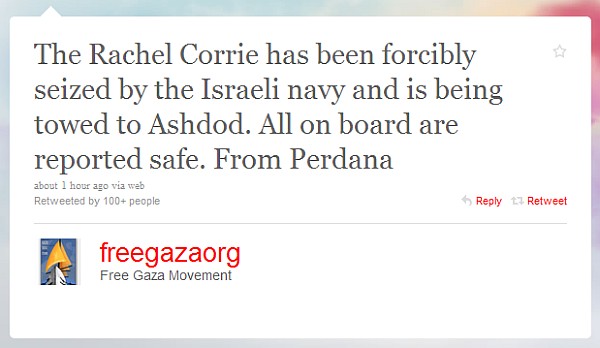
At 5.47AM Eastern:
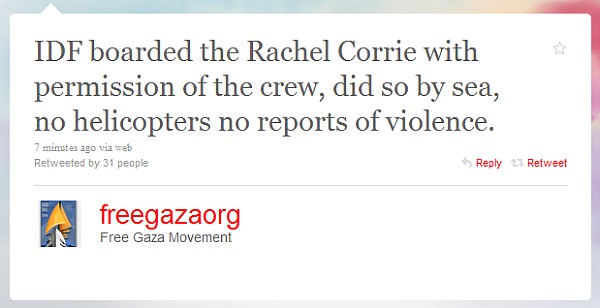
At 5.00AM Eastern:

FreeGaza Tweet – 10 PM Eastern
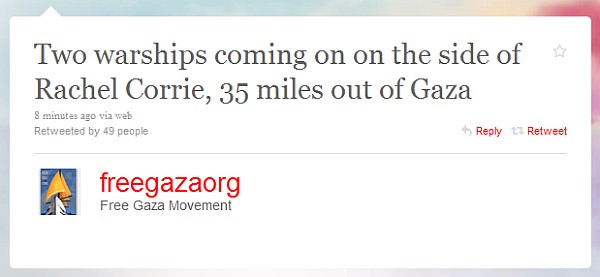
For the latest information on the MV Rachel Corrie, check the FreeGazaOrg Twitter feed.

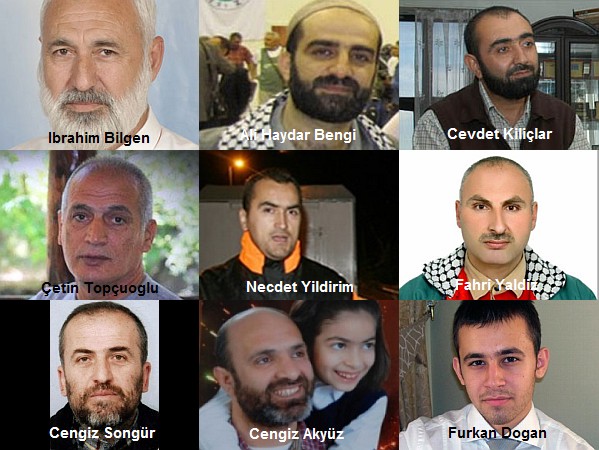
Humanitarian aid workers, a firefighter, a politician, a taekwondo champion, a photojournalist, a student who hoped to become a doctor — nine Turkish men, mostly fathers who leave behind children and wives.
Even while their deaths are at the center of an international crisis that is rocking the state of Israel, these individual lives lost have scarcely gained attention — firstly because the Israeli government resisted revealing any information about who died and in what circumstances, and then, while maintaining a stranglehold on the facts, Israel’s propaganda machine has worked furiously to portray the victims as villains.
The world has largely viewed Israel’s efforts to conceal its brutality with a mixture of skepticism, contempt and outrage. Yet in one regard the hasbara has worked: it has effectively sold the idea that the organizers and participants in the Freedom Flotilla were intent on picking a fight. This was an act of provocation and where opinions differ is on whether the provocation was justified or not.
The first thing you need to know about the Gaza flotilla disaster is that the intention of the activists on board the ships was to break the Israeli blockade. Delivering the embargoed goods was incidental.
In other words, the activists were like the civil rights demonstrators who sat down at segregated lunch counters throughout the South and refused to leave until they were served. Their goal was not really to get breakfast. It was to end segregation.
Yes and no.
The Freedom Flotilla is part of a movement that aims to end the siege of Gaza, but delivering humanitarian aid is not incidental.
Israeli officials and the Israeli public who see themselves as victims of a campaign designed to make Israel look bad, fail to recognize that what cements Muslim solidarity and what has turned Gaza into a global issue, is not a global conspiracy against Israel or against Jews; it is a heartfelt response to human suffering.
The Freedom Flotilla carried thousands of tons of aid, not to poke Israel in the eye, but to help those in need. The many thousands of people who engaged in fundraising, made donations, gathered together supplies and readied the ships — a grass roots effort spread mostly across Europe and the Middle East — believed, naively or not, that the fruits of their efforts would be of real and practical assistance to the population in Gaza.
But, the cynics will ask, how could a few hundred people in a small flotilla of boats hope to successfully defy Israel’s military might? Firstly, simply on the basis that other vessels had completed the same mission. But more importantly, because courageous acts are invariably undertaken in defiance of the odds. The heroic imagination is enticed by what seems impossible.
The Freedom Flotilla as David, is not challenging the Goliath of Israel in order to give the mighty Jewish state some bad headlines. This is about defeating an agent of oppression. It is not about destroying Israel, but about challenging and overcoming the injustices which Israel sustains.
As the MV Rachel Corrie now approaches Gaza, Israel’s Foreign Ministry Director-General Yossi Gal says: “We have no desire for a confrontation. We have no desire to board the ship. If the ship decides to sail the port of Ashdod, then we will ensure its safe arrival and will not board it.”
A conciliatory gesture should receive a similar response, should it not?
Don’t be fooled. Israel and the United States are now working hand in glove to try and “moderate” the oppression of the population in Gaza. While the world calls for the siege to be ended, the Obama administration is calling for it to be “new approach.” Benjamin Netanyahu is reported to be “softening” his position.
This is about moving pressure from the heel to the toe, but it still means the Palestinians remain under an Israeli foot. It’s about taking Gaza out of the spotlight in the hope that global outrage can be replaced by global indifference.
For the Rachel Corrie to sail into the Israeli port of Ashdod under its own steam would be to capitulate to the power that claims it withdrew from Gaza even while it persists in maintaining absolute control over its population, its borders, its airspace and its economy.
The Rachel Corrie must reach Gaza, but if it is thwarted, more ships will come. Israel cannot win.
(Note of thanks to Lawrence of Cyberia for compiling information on those who died in the Flotilla Massacre and creating a page where new information is being added.)

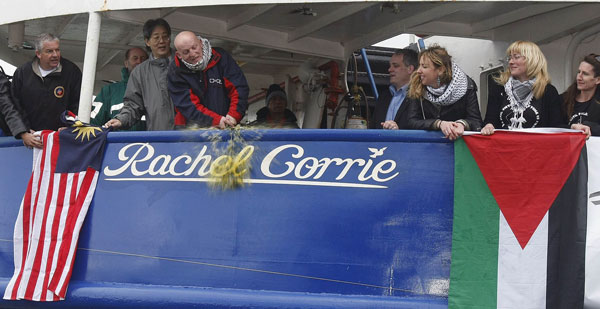
The MV Rachel Corrie, a cargo ship in the Freedom Flotilla whose passage from Ireland was delayed by mechanical difficulties, is now hours away from its destination.
 “I commend this courageous action of brave international civilians who are carrying essential medical, education and construction materials denied by Israeli suffocating and illegal siege on Gaza. It is vital that they have maximum support by the international community!” a Palestinian political leader, Dr Mustafa Barghouthi, told Nobel Peace laureate Mairead Maguire today. She and other activists on board the cargo ship carrying humanitarian aid from the Republic of Ireland to Gaza, said they hope to reach their destination by Saturday morning.
“The world is watching,” said Dr Barghouthi, calling upon the international community to ensure the safe passage of the Rachel Corrie; he urged the EU representatives to take immediate and concrete steps in pressuring Israel to refrain from blocking the ship.
An appeal has gone out calling on Irish Americans to support the effort to end the siege of Gaza. Lorna Siggins, reporting from the Rachel Corrie for the Irish Times, writes:
Former UN assistant secretary general Denis Halliday has called on the [Irish] government to highlight the situation of the Gaza-bound Irish aid ship Rachel Corrie with US president Barack Obama’s administration and the EU.
Speaking by satellite phone on board the Rachel Corrie yesterday several hundred miles from Gaza, Mr Halliday said it was imperative that the Obama administration and the EU supported Ireland’s call on the Israeli authorities to ensure safe passage for the ship, which is carrying aid supplies.
“We feel that, like the UN, the EU has failed the Palestinians and we feel that the EU could exert more pressure in terms of trade links, which the Israelis are very dependent on,” he said.
Mr Halliday, a Connemara resident, confirmed that Minister for Foreign Affairs Micheál Martin had been in phone contact with the ship over the past two days .
“We are very grateful to the Minister, who has been completely supportive, but we need more,” Mr Halliday said.
“We also feel there is a role for the Irish diaspora here, in the US and elsewhere to lobby politicians over this continued illegal blockade of Gaza, which is causing such hardship to the Palestinian people.”
The issue of the Gaza blockade has tremendous resonance in Ireland, partly because of Ireland’s high degree of engagement in international humanitarian causes — John Ging, head of the UN Relief and Works Agency in Gaza, who had called on the international community to break the siege by sending ships loaded with aid, is also Irish — but also, of course, because the Irish people have some experience with the consequences for civilians of a colonial blockade.
Between 1845 and 1850, more than a million Irish people starved to death under British rule while, as Sinead O’Connor famously noted, food was shipped out of Ireland under armed guard. A million more fled Ireland to escape starvation, many to America, including Falmouth Kearney, President Obama’s great-great-great grandfather.
Many Irish people — and Irish-Americans — take the responsibilities of this legacy very seriously.

The feeling of helplessness of a poor lonely victim, confronting the rage of a lynch mob and frantically realizing that these are his last moments, accurately reflect the current psychosis of the majority of the Israeli public, writes Anshel Pfeffer.
“We felt like the Ramallah lynch.” I am certain that the unnamed Israeli naval commando who said these words to a reporter a few hours after the bloodbath on the Mavi Marmara regrets them now. It is quite clear why the image came to his mind at the time. None of us has forgotten the pictures of a baying mob literally hacking to pieces the reservists Yossi Avrahami and Vadim Nurzhitz nine and a half years ago and throwing their bodies out of the window of a Palestinian police station.
But the visual resemblance is where the comparison ends. The two unarmed reservists were on their own, after straying into Ramallah, and were cruelly murdered. They were dead before the army was even fully aware that they were missing. True, the naval commandos on the Turkish ferry were surrounded by club-wielding enemies, intent on killing them – one of them was even thrown off the deck – but they were simply at a very temporary tactical disadvantage. Backing them up was all the firepower and might of a modern navy, and indeed the results were not surprising. After a few minutes of scuffling, in which seven commandos were wounded, the full force was unleashed and nine people on the other side were killed. Hardly a lynch situation.
But it was that remark that was picked up by the entire Israeli media and used as the headline encapsulating the whole bloody event. Why? Because the feeling of helplessness of a poor lonely victim, confronting the rage of a lynch mob and frantically realizing that these are his last moments, accurately reflect the current psychosis of the majority of the Israeli public.
Everything that followed the disastrous raid on the Gaza flotilla – the descriptions in the media, the justifications of the Israel Defense Forces spokesman and the reactions of the politicians – prove how detached we have become from the way that Israel is perceived from outside. One sentence that was repeated over and over to justify the final outcome was: “And what if they had succeeded in killing one of our soldiers?” This is a rhetorical argument that is unanswerable in any discussion held in Israel. No matter how many combatants we have lost in all the wars, operations, accidents and other foul-ups, every time the radio announces the death of yet another an IDF soldier, something dies within every one of us.
That is a noble sentiment, a feeling of a society with a shared responsibility and destiny, but we have lost any other perspectives and are incapable of realizing that it is only we Israelis who feel this. We have hunkered down deep inside our collective bunker and have lost sight of any suffering or loss on the other side.
I don’t want to use this column to discuss the shortcomings of Israeli hasbara, as the implications of this event go well beyond public relations in their significance. But one thing that was very clear to me on Monday, as I watched the Israeli media strategy unfold before the television cameras at the Ashdod port, was how all the professional spokespersons swiftly fell back on the same comforting tropes that appeal only to the Israeli public and a shrinking group of die-hard supporters overseas. Even the experienced professionals, who should know better, could do no more than to convince the already convinced.
Let’s just continue their argument for a moment. Say that two IDF commandos had been killed in the confrontation. It would have been another national tragedy for us, but would anyone outside of Israel have been moved? Not a bit: They would simply have been two heavily armed soldiers carrying out an illegal raid who were killed by brave civilians defending a ship bearing humanitarian aid. None of Israel’s arguments – that the members of the Turkish relief organization IHH were actually murderous jihadis, that there is no humanitarian crisis in Gaza, that Israel was prepared to allow the cargo to go through its own port and that the blockade is justified as the only way to keep more missiles from reaching Hamas – would have been any more persuasive. Not because they were badly presented or inaccurate, but simply because moral people around the world see almost everything that happens in the region as a result of a deeply immoral situation that the Israeli leadership and the great majority of the Israeli public is doing nothing whatsoever to change.
That may be a simplistic perspective, devoid of any nuance, but it is not an anti-Semitic or even anti-Israeli position, as some try to persuade us. It is simply a moral viewpoint. And even most perceptive Israelis can’t seem to see that. Our powers of analysis are impressive, up to a certain level. A few hours after the dust settled it was clear what had gone wrong on a tactical level. On Monday evening, in one of those moments of tired, off-the-record frankness, an IDF colonel said to me, “Come on Anshel, we all know what the problem was here. This was a policing operation, not something for a real army.” He was right, but this is far from an isolated example. Criticizing the IDF is too easy. The real blame lies with successive Israeli governments and the broad public that are not brave enough to end the 42-year-old occupation and prefer instead to throw the army at the problem. As good as our army is, the result will only be more and more bloodshed. So how do we deal with it? By convincing ourselves that we are the moral ones and everyone else just wants to kill us.
If only we had some real friends, friends we could trust implicitly, who could point out the error of our ways. This could be the shining moment of the Jewish Diaspora. They love us, but they also see things from another perspective. We need a strong, unified voice from the Jewish leadership in the United States and Europe telling Israelis enough is enough, you are hurtling down the slippery slope of pariahdom and causing untold damage to yourselves and us. Lift your heads above the ramparts and see that the world has moved on.
Instead, we find the establishment of the Jewish world crouching with us in the bunker.
In his breathtaking analysis of the decline of secular Zionism in America, “The Failure of the American Jewish Establishment,” which appeared in the New York Review of Books last month, Peter Beinart describes how the leaders of America’s major Jewish organizations have succeeded in estranging an entire generation of young Jews from Israel “by defending virtually anything any Israeli government does.” In doing so “they make themselves intellectual bodyguards for Israeli leaders who threaten the very liberal values they profess to admire.”
Beinart persuasively explains how this has convinced many young Jews that they have noting in common with a country whose policies contradict so much of what they have been brought up to believe in. But there is another damaging aspect to this cheerleading. Every Israeli cabinet minister who is greeted by cheering audiences during visits abroad fails to see all those who, disgusted, prefer to stay at home.
They return to Israel convinced that at least the Jewish people are still behind us and that our opponents are simply anti-Semitic. Other voices, such as the new lobbies JStreet and JCall, are ostracized by the establishment instead of being treated as what they really are, authentic voices for many concerned Jews.
When the history of the Jewish people in the early 21st century is written, the conclusion will be unavoidable. In its hour of need Israel was let down by the Diaspora.
Al Jazeera‘s Jamal Elshayyal describes the attack on the Mavi Marmara, witnessing activists being shot, how the injured were left to die, and how he was abused under Israeli detention.
The Turkish president has said that Israel’s military raid on civilian aid ships bound for the Gaza Strip has caused “irreparable” damage to his country’s relations with Israel, and will “never” be forgiven.
“From now on, Turkish-Israeli ties will never be the same. This incident has left an irreparable and deep scar,” Abdullah Gul said in a televised speech on Thursday, as thousands gathered in the streets of Istanbul to pay their respects to the humanitarian activists killed during the raid.
The raid “is not an issue that can be forgotten… or be covered up… Turkey will never forgive this attack,” he said.
Hassan Ghani, a journalist for PressTV describes his experience on board the Mavi Marmara as it came under Israeli attack.
Parts two and three of the interview with Hassan Ghani.
Today’s Zaman adds:
Activists say some people who were initially on the flotilla are missing. They are also telling stories of horror, carnage and pure barbarism at the hands of Israeli officials. In a shocking account, Humanitarian Aid Foundation (İHH) President Bülent Yıldırım, who returned on Thursday, said a photographer, whose first name was Cevdet, was shot in the forehead by a soldier one meter away from him. “Our Cevdet [Kılıçlar], he is a press member. He has become a martyr. All he was doing was taking pictures. They smashed his skull into pieces. We soon made out that these were real bullets they were firing. Rubber bullets also kill because you shoot at very close range, between one-and-a-half and two meters.”
Kevin Ovenden of Britain, an activist on the ship that arrived in İstanbul on Thursday, also said a man who had pointed a camera at the soldiers was shot directly through the forehead with live ammunition, with the exit wound blowing away back of his skull.
There were also claims that Israeli official reports on the number of people killed are untruthful. Yıldırım said, “Until now they have returned nine dead bodies, but our list is bigger. There are people missing.” Speaking to journalists at Atatürk International Airport shortly after his return, Yıldırım said: “We saw 38 injured who were brought back to us by doctors after the attack. Now they are saying there are 21 people who have been injured.” Yıldırım was on the main passenger ship, the Mavi Marmara, which the Israeli navy attacked at the start of its raid.
Another witness, Yücel Köse, who was on the ship Gazze repeated Yıldırım’s allegations of missing people. “The Mavi Marmara was bombed right in front of our eyes. They threw the wounded into the water,” he said. Köse said the soldiers were upset when some of their men were held by activists aboard the Mavi Marmara.
For several days, Israel has been able to contain some of the fallout from the flotilla massacre by withholding information about the dead and injured. The object of this exercise has clearly been to slow the flow of information in the hope that by the time the most damning facts become known, the international media’s attention will have turned elsewhere.
But the dead now have names and faces and one turns out to be a nineteen-year-old American: Furkan Dogan.

Dogan is alleged to have been shot with five bullets, four in the head.
Does the Obama administration intend to investigate the circumstances in which one of its citizens was killed? Protecting the lives of Americans is after all the most fundamental responsibility of our government.
Dogan’s death was presumably instant, but according to Al Jazeera‘s Jamal Elshayyal there were others on board the Mavi Marmara who died because Israeli soldiers refused to treat their injuries.
“After the shooting and the first deaths, people put up white flags and signs in English and Hebrew. An Isreali [on the ship] asked the soldiers to take away the injured, but they did not and the injured died on the ship.”
Crimes have been committed and since the suspects all acted under the direction of the Israeli government and its defense forces and took place on international waters outside Israel’s area of legal jurisdiction, “a prompt, impartial, credible and transparent investigation conforming to international standards” — a demand made by the UN Security Council with the support of the Obama administration — cannot be conducted by the Israeli government or a commission appointed by them. An investigation conforming to international standards must also be an international inquiry.

Carlo Strenger notes in Haaretz:
During the media frenzy of the last days a crucial headline has received close to no attention: Mossad chief Meir Dagan told the Knesset’s Foreign Relations Committee that Israel is gradually turning from a strategic asset into a liability for the United States of America.
As it’s a bit difficult to brush aside Dagan as a softheaded idealist, our policy makers will find another way not to listen. They will say, “this would never have happened under George W. Bush; this is only because the Obama administration is not friendly towards Israel. We simply need to wait for Obama to end this term; he won’t get reelected.”
Nothing could be further from the truth. I have heard warnings that Israel is becoming a strategic liability for the U.S. from Americans, including high ranking members of the George W. Bush administration, for years. The only difference is that during the Bush years, nobody in the administration would say this on record or for attribution.
As if to echo and underline Dagan’s message, Anthony Cordesman, one of the most respected non-partisan national security experts in Washington writes:
[T]he depth of America’s moral commitment [to Israel] does not justify or excuse actions by an Israeli government that unnecessarily make Israel a strategic liability when it should remain an asset. It does not mean that the United States should extend support to an Israeli government when that government fails to credibly pursue peace with its neighbors. It does not mean that the United States has the slightest interest in supporting Israeli settlements in the West Bank, or that the United States should take a hard-line position on Jerusalem that would effectively make it a Jewish rather than a mixed city. It does not mean that the United States should be passive when Israel makes a series of major strategic blunders–such as persisting in the strategic bombing of Lebanon during the Israeli-Hezbollah conflict, escalating its attack on Gaza long after it had achieved its key objectives, embarrassing the U.S. president by announcing the expansion of Israeli building programs in east Jerusalem at a critical moment in U.S. efforts to put Israeli-Palestinian peace talks back on track, or sending commandos to seize a Turkish ship in a horribly mismanaged effort to halt the “peace flotilla” going to Gaza.
It is time Israel realized that it has obligations to the United States, as well as the United States to Israel, and that it become far more careful about the extent to which it test the limits of U.S. patience and exploits the support of American Jews. This does not mean taking a single action that undercuts Israeli security, but it does mean realizing that Israel should show enough discretion to reflect the fact that it is a tertiary U.S. strategic interest in a complex and demanding world.
And then comes word from the Canadian writer, Margaret Atwood, whose impartial observations as a first-time visitor to the Jewish state cut to the core when she says:
[T]he concept of Israel as a humane and democratic state is in serious trouble. Once a country starts refusing entry to the likes of Noam Chomsky, shutting down the rights of its citizens to use words like “Nakba,” and labelling as “anti-Israel” anyone who tries to tell them what they need to know, a police-state clampdown looms. Will it be a betrayal of age-old humane Jewish traditions and the rule of just law, or a turn towards reconciliation and a truly open society?
Time is running out. Opinion in Israel may be hardening, but in the United States things are moving in the opposite direction. Campus activity is increasing; many young Jewish Americans don’t want Israel speaking for them. America, snarled in two chaotic wars and facing increasing international anger over Palestine, may well be starting to see Israel not as an asset but as a liability.
Israelis never tire of declaring with great solemnity that they survive in a dangerous neighborhood — invariably the observation is used as a justification for some form of brutality. Yet behind the faux boldness of this embattled nation is the comforting awareness that little Israel enjoys the protection of its big American friend. But any friendship can eventually be strained beyond repair.
As Israel becomes more and more isolated, that isolation may reinforce the delusions of those convinced that the rest of the world is dangerous yet for others it will make the rest of the world increasingly appealing. Thus will arise the demographic threat that no racist scheme can resolve: the threat that life in a Jewish state is simply no longer appealing to enough Jews.
Today, Israel’s Defense Minister Ehud Barak, praising the Shayetet 13 commandos who slaughtered at least nine humanitarian activists on board the Mavi Marmara, said:
“…we live in the Middle East, in a place where there is no mercy for the weak…”
A year ago President Obama declared in Cairo:
Resistance through violence and killing is wrong and it does not succeed. For centuries, black people in America suffered the lash of the whip as slaves and the humiliation of segregation. But it was not violence that won full and equal rights. It was a peaceful and determined insistence upon the ideals at the center of America’s founding. This same story can be told by people from South Africa to South Asia; from Eastern Europe to Indonesia. It’s a story with a simple truth: that violence is a dead end.
But if the violence is being committed by Israelis then it is all too evident that this particular world leader lacks the courage and moral conviction to speak out.
When the slaves of Zionism are called on to break out of their chains, instead, their own fear of political and financial retribution guarantees that they will maintain their silence.
Obama is not only incapable of condemning Israeli violence; he cannot even acknowledge its existence!
When unarmed and non-violent Americans are the victims — whether killed, maimed or abused by Israeli soldiers — the government of the nation that proudly describes itself as the most powerful nation on earth has nothing to say in defense of its own citizens.
If it wasn’t being used to justify murder, this headline in the Washington Post would be laughably absurd:
Israel says Free Gaza Movement poses threat to Jewish state
Once viewed only as a political nuisance by Israel’s government, the group behind the Gaza aid flotilla has grown since its inception four years ago into a broad international movement that now includes Islamist organizations that Israeli intelligence agencies say pose a security threat to the Jewish state.
The Free Gaza Movement’s evolution is among Israel’s chief reasons for conducting Monday morning’s raid on a ship carrying medicine, construction materials, school paper and parts for Gaza’s defunct water treatment plant. The movement once drew its support almost entirely from activists and donors in Australia, Britain and the United States. But the ship that Israeli forces stormed Monday morning was operated by a Turkish charity that Israeli intelligence agencies and others contend has connections to radical Islamist groups.
Radical Islamist groups — the hobgoblins of the Israeli psyche have also enfeebled the judgement of most Americans. Raise the specter of such a threat and the rational mind freezes.
This is the psychology of cowardice, where fear becomes omnipresent.
Those thus enslaved, cloak their own weakness with fables about the demons they hope to destroy. But their deceit is transparent. This is heroism merely self-declared, visible to no one else.
Arrogance and cowardice are the two faces of the fear of fear. Israel’s might is the mask behind which it conceals its own lack of courage — its terror of looking weak.
Hours after Israeli commandos were out slaying sea monsters, an Israeli soldier in the West Bank faced the threat of an unarmed American 21-year old.
Emily Henochowicz was hit in the face with a tear gas canister fired directly at her by an Israeli soldier during a demonstration at the Qalandiya checkpoint. She is a talented young artist who will now only be able to follow her passion with one eye — the other was removed in surgery yesterday.
Does the soldier who shot her believe Israel is now safer?
When a state blinds or even kills individuals whose “crime” is their willingness to stand up in defense of justice, what is it that national security is securing?
As Robert Fisk duly noted yesterday:
[I]t is a fact that it is ordinary people, activists, call them what you will, who now take decisions to change events. Our politicians are too spineless, too cowardly, to take decisions to save lives. Why is this? Why didn’t we hear courageous words from [Britain’s prime minister and deputy prime minister] Messrs Cameron and Clegg yesterday [after the flotilla massacre]?
For it is a fact, is it not, that had Europeans (and yes, the Turks are Europeans, are they not?) been gunned down by any other Middle Eastern army (which the Israeli army is, is it not?) there would have been waves of outrage.
And what does this say about Israel? Isn’t Turkey a close ally of Israel? Is this what the Turks can expect? Now Israel’s only ally in the Muslim world is saying this is a massacre – and Israel doesn’t seem to care.
But then Israel didn’t care when London and Canberra expelled Israeli diplomats after British and Australian passports were forged and then provided to the assassins of Hamas commander Mahmoud al-Mabhouh. It didn’t care when it announced new Jewish settlements on occupied land in East Jerusalem while Joe Biden, the Vice-President of its erstwhile ally, the United States, was in town. Why should Israel care now?
How did we get to this point? Maybe because we all grew used to seeing the Israelis kill Arabs, maybe the Israelis grew used to killing Arabs. Now they kill Turks. Or Europeans. Something has changed in the Middle East these past 24 hours – and the Israelis (given their extraordinarily stupid political response to the slaughter) don’t seem to have grasped what has happened. The world is tired of these outrages. Only the politicians are silent.
An inspiring video put together by Jewish Voice for Peace during the recent debate on UC Berkeley’s divestment measure. These are the voices of the future.
See commentary by Cecile Surasky and Sidney Levy on the divestment effort.
Ben Saul, who teaches the law of armed conflict at The University of Sydney, writes:
Israel’s response to the Gaza flotilla is another unfortunate example of Israel clothing its conduct in the language of international law while flouting it in practice. If you believe Israeli government spokesmen, Israel is metabolically incapable of violating international law, placing it alongside Saddam Hussein’s Information Minister in self-awareness.
Israel claims that paragraph 67(a) of the San Remo Manual on Armed Conflicts at Sea justified the Israeli operation against the flotilla. (The San Remo Manual is an authoritative statement of international law applicable to armed conflicts at sea.)
Paragraph 67(a) only permits attacks on the merchant vessels of neutral countries where they “are believed on reasonable grounds to be carrying contraband or breaching a blockade, and after prior warning they intentionally and clearly refuse to stop, or intentionally and clearly resist visit, search or capture”.
Israel argues that it gave due warnings, which were not heeded.
What Israel conveniently omits to mention is that the San Remo Manual also contains rules governing the lawfulness of the blockade itself, and there can be no authority under international law to enforce a blockade which is unlawful. Paragraph 102 of the Manual prohibits a blockade if “the damage to the civilian population is, or may be expected to be, excessive in relation to the concrete and direct military advantage anticipated from the blockade”.
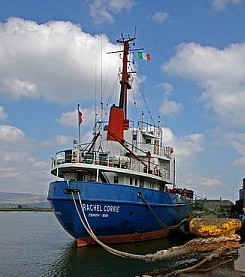 This is a major development. The MV Rachel Corrie cargo ship, whose passage to join the Freedom Flotilla may have been delayed because of sabotage by Israelis, is now heading for Gaza — and it has the full support of the Irish government. This is no longer just a question of how easily Israel can trample on the rights of a humanitarian organization.
The Irish prime minister, Brian Cowen, has warned Israel that it will face “the most serious consequences” in the event that any harm comes to Irish citizens on board the humanitarian relief vessel.
The Irish Times reports:
The cargo vessel is ploughing ahead with its attempt to deliver aid to Gaza despite yesterday’s deadly attack by the Israeli navy on a Gaza-bound flotilla.
Mr Cowen called today called for the immediate establishment of “a full, independent international inquiry into yesterday’s events, preferably under UN auspices”.
He called on Israel to release “unconditionally” Irish citizens who he said had been taken to Gaza by the Israeli authorities and asked to sign papers allowing for their deportation.
Speaking in the Dáil [Ireland’s parliament] during Leaders’ Questions, the Taoiseach [prime minister] said the presence of Irish diplomatic personnel in Israel provided “better prospects” that the citizens would be released “sooner rather than later”
“But I will make this point. If any harm comes to any of our citizens, it will have the most serious consequences.”
Mr Cowen said Ireland’s longstanding position was that the Israeli blockade of Gaza was “immoral and counterproductive” and should be ended.
“Israel must listen and respond to the clear concerns of the international community on this issue. To do otherwise will only serve to reinforce the position of the extremists on both sides and jeopardise the hope of achieving some urgently needed political progress in the region, which the current proximity talks represent,” he said.
The Israeli army has warned that it will be stopped if it attempts to enter Israeli waters.
The Rachel Corrie, which has five Irish nationals and five Malaysians aboard, is due to arrive in Gazan waters over the coming days, a spokeswoman for the Irish Palestine Solidarity Campaign said. It became separated from the main aid flotilla after being delayed for 48 hours in Malta due to logistical reasons, and is currently off the coast of Libya.
Mr Martin, who called Israeli Ambassador Dr Zion Evrony to a meeting yesterday, said the boat should be allowed through peacefully.
Mr Martin said Israel was also obliged to respect its international obligations under the Vienna Convention and ensure Irish citizens have access to full consular support. He also expressed his condolences to the Turkish government and the families of the people killed when Israeli commandos raided the Turkish registered Mavi Marmara aid ship in international waters as it travelled from Cyprus, killing nine people.
Five Irish campaigners – including leading activists Dr Fintan Lane and Fiachra Ó Luain – are being held in the Be’er Sheva detention camp, from where they face deportation. Dr Lane and Mr Ó Luain were on board Free Gaza boat Challenger 1 which was boarded by Israeli forces.
Meanwhile, Haaretz reports that Colonel Itzik Turgeman, a senior Israel Defense Forces officer, speaking before the Knesset’s Foreign Affairs and Defense Committee, hinted that the IDF had sabotaged the engines of all the ships in the Freedom Flotilla other than the Mavi Marmara, saying that “they took care of them.”


The defense of the Mavi Marmara, which Israeli officials have shamelessly been describing as an “ambush” on its elite commandos, is not without historical precedent. Indeed, as Robert Mackey points out at the New York Times, there is a parallel that some Israelis now find impossible to ignore: the resistance to the British naval assault on the SS Exodus in July 1947, as Jewish refugees used every makeshift weapon they could lay their hands on in their effort to repel British soldiers.
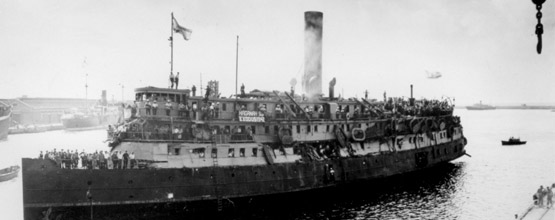
The overcrowded passenger ship carried Jewish refugees fleeing from war-decimated Europe who hoped to become settlers in Palestine — then under British control — but the British were intent on blocking their entry.
In international waters off Palestine the British Royal Navy intercepted the Exodus and British troops attempted to board.
Several hours of fighting followed, with the ship’s passengers spraying fuel oil and throwing smoke bombs, life rafts and whatever else came to hand, down on the British sailors trying to board, The Times reported at the time. Soon the British opened fire. Two immigrants and a crewman on the Exodus were killed; scores more were wounded, many seriously. The ship was towed to Haifa, and from there its passengers were deported, first to France and eventually to Germany, where they were placed in camps near Lübeck.
International outrage at the treatment of the passengers of the Exodus was instrumental in turning the tide of opinion in favor of the creation of a Jewish state. Who on board that ship would have anticipated that decades later it would be Jews themselves who became as callous as the British in their rejection of a humanitarian cause?

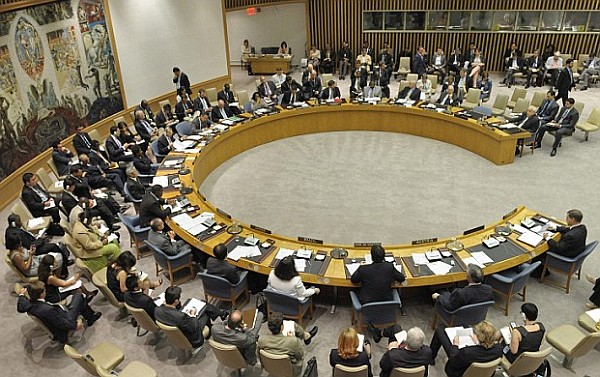
After the flotilla massacre committed by Israeli forces, Turkey’s call for an emergency meeting of the UN Security Council yesterday was to be expected. Turks are assumed to be among the dead — whose names and nationalities have still not been released. There are now hundreds of Turks being held in detention in Israel and Turkish ships were captured illegally in international waters in an action Turkey’s foreign minister described as “tantamount to banditry and piracy.”
What was equally predictable was that the Obama administration would only offer its support if action from the UN was so weak as to be worthless.
Had events of the last two days not disrupted their agendas, President Obama and Prime Minister Netanyahu would today have been servicing their individual political needs with smiles and handshakes on the steps of the White House. Absent that much-anticipated saccharine event, Obama was not about to turn around and support a stern rebuke to Israel.
The key Turkish demand presented to the Security Council was that the “blockade of Gaza must be ended immediately and all humanitarian assistance must be allowed in.”
Turkey was not alone. Britain’s new foreign secretary, William Hague, was equally unequivocal:
There can be no better response from the international community to this tragedy than to achieve urgently a durable resolution to the Gaza crisis.
I call on the Government of Israel to open the crossings to allow unfettered access for aid to Gaza, and address the serious concerns about the deterioration in the humanitarian and economic situation and about the effect on a generation of young Palestinians.
Universally there were calls for an inquiry. But the key to whether such an inquiry would be of any real value would be, minimally, its independence, and ideally that it would be international.
The statement finally issued by the Security Council is riddled with language surely crafted in the White House. It “calls for a prompt, impartial, credible and transparent investigation conforming to international standards.” Impartial, but not independent. International standards, but not international.
It does not call for an end to the siege but says “the situation in Gaza is not sustainable.” And there’s Obama’s lie.
Whether the siege of Gaza is lifted or sustained is up to Washington. If, when Netanyahu finally meets Obama, the US president was to say the embargo must end, Israel would have no choice. The siege of Gaza can only continue with US support and thus far, Obama refuses to withdraw that support. He says the situation is not sustainable, but through his actions Obama has a direct hand in perpetuating the suffering in Gaza.
“Unsustainable” is the signature of Obama’s self-declared impotence. It’s change over which he would like everyone else to believe he has no control. It’s the deceit through which he tells Americans and the world, I would if I could but I can’t.
Before the Security Council issued its statement and before it became clear that Obama was yet again going to throw away an opportunity to demonstrate his commitment to upholding international law, Stephen Walt wrote:
President Obama likes to talk a lot about our wonderful American values, and his shiny new National Security Strategy says “we must always seek to uphold these values not just when it is easy, but when it is hard.” The same document also talks about a “rule-based international order,” and says “America’s commitment to the rule of law is fundamental to our efforts to build an international order that is capable of confronting the emerging challenges of the 21st century.”
Well if that is true, here is an excellent opportunity for Obama to prove that he means what he says. Attacking a humanitarian aid mission certainly isn’t consistent with American values — even when that aid mission is engaged in the provocative act of challenging a blockade — and doing so in international waters is a direct violation of international law. Of course, it would be politically difficult for the administration to take a principled stand with midterm elections looming, but our values and commitment to the rule of law aren’t worth much if a president will sacrifice them just to win votes.
More importantly, this latest act of misguided belligerence poses a broader threat to U.S. national interests. Because the United States provides Israel with so much material aid and diplomatic protection, and because American politicians from the president on down repeatedly refer to the “unbreakable bonds” between the United States and Israel, people all over the world naturally associate us with most, if not all, of Israel’s actions. Thus, Israel doesn’t just tarnish its own image when it does something outlandish like this; it makes the United States look bad, too. This incident will harm our relations with other Middle Eastern countries, lend additional credence to jihadi narratives about the “Zionist-Crusader alliance,” and complicate efforts to deal with Iran. It will also cost us some moral standing with other friends around the world, especially if we downplay it. This is just more evidence, as if we needed any, that the special relationship with Israel has become a net liability.
In short, unless the Obama administration demonstrates just how angry and appalled it is by this foolish act, and unless the U.S. reaction has some real teeth in it, other states will rightly see Washington as irretrievably weak and hypocritical. And Obama’s Cairo speech — which was entitled “A New Beginning” — will be guaranteed a prominent place in the Hall of Fame of Empty Rhetoric.
Irretrievably weak and hypocritical — unfortunately the evidence was there even before Obama took office. His character, commitments, calculations and cynicism were all on open display as he watched in silence Israel’s war on Gaza.

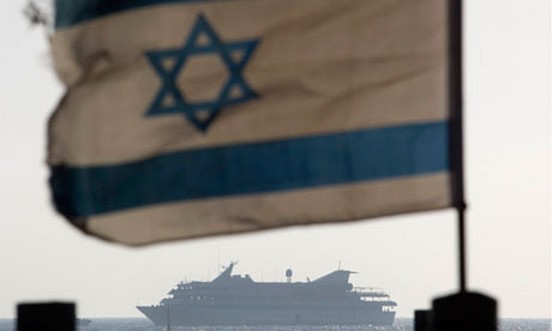
Depending on ones view of Israel, the deaths that occurred on the decks of the Mavi Marmara early today are either reprehensible, tragic, regrettable, or — a cause for celebration.
Someone just wrote to me: “Too bad you weren’t on that ship with the rest of the terror supporters. Anyone touching an IDF soldier deserves what they got.”
I know people in J Street who would find such sentiments deeply offensive; who would assure me that when they say they are pro-Israel it does not in any sense mean that they condone the actions of this Israeli government or the kind of red-blooded xenophobic Zionism that believes the IDF can do no wrong.
Yet the question I would pose to anyone who says they are pro-Israel is this: is the Israel you support the one that exists in 2010, or does it have a firmer foothold somewhere inside your imagination?
Which is the real Israel? The Israel cherished and trumpeted at an AIPAC convention? The Israel struggling to be defined at a J Street gathering? Or the Israel triumphantly being celebrated from the hilltops above Ashdod today?
This is how The Guardian describes the scene there and however representative these particular flag-clad Israelis might actually be, their claim to be pro-Israel has a distinction that many of their American counterparts lack: they are Israelis, they live in Israel and they are not on the political fringe.
If one was to describe a constellation that linked the IDF soldiers to either their flag-waving brethren or their more conflicted American cousins, the closest ties would surely coincide with geographical proximity.
[Above the Israeli port of Ashdod as the ships of the Freedom Flotilla were towed in] Jonah’s Hill itself was heaving. Shirtless Israeli men draped in their national flag waved placards declaring “Well done IDF” in both Hebrew and English, chanting, singing and applauding their support for the military operation.
Thick cables snaked across the ground from thrumming generators, delivering power to dozens of international TV crews, broadcasting across the globe against the backdrop of the shimmering Mediterranean.
Amid the crowd, a sophisticated public relations operation was underway. Spinners and spokesmen from the Israeli military and government departments politely answered questions and offered their own narrative of the day’s events. A barrage of emails and text message alerts firing into inboxes provided a background of electronic muzak.
Shahar Arieli, deputy spokesman for the ministry of foreign affairs, wearing a smart tie despite the heat, said two of the flotilla’s boats had been brought into port.
All activists would be offered the chance of immediate deportation at Israel’s expense “with their passports”, he said. “We want them to leave as soon as possible,” he added.
Those who declined would – “as long as they weren’t involved in attacks on our troops” – be processed through Israel’s justice system.
His patient courtesy was not matched by all those gathered on the hill. Chaim Cohen, a 52-year-old economic consultant from Givatayim, was dripping with both sweat and bile. “We have come to support our soldiers. It is obvious it [the Mavi Marmara] is a terrorist ship. We saw it on TV – they took out knives and put them in the stomachs of the IDF.”
There was nothing to challenge the Israeli version of events. Repeated attempts to reach the cell and satellite phones of activists on board the flotilla were rebuffed; it was unclear whether their phones had been confiscated, jammed or if they were simply out of range.
By late afternoon on Monday, activists with lesser injuries were being brought to hospitals in coastal towns and cities from the smaller passenger ships. At the Barzilai medical centre in Ashkelon, just north of the Gaza Strip, a Greek man in a neck brace told reporters: “They hit me.” Who? “Pirates,” he answered.
A dazed man with a striking black eye was unloaded from an ambulance. There had been “some brutality” on board, he said, but the activists were non-violent. “We are all Palestinian now,” he said as the doors of the ER closed behind him.
