Yearly Archives: 2010

Cornel West points out Obama’s hypocrisy on Israelis and Palestinians

Watch the clip above as Cornel West responds to this question:

The Obama administration talks about a new era of engagement. You spoke earlier about a “friendlier face of empire”. What does that mean? Is that just marketing? Or is there actually a change in US foreign policy these days?

Watch the whole 23-minute interview — if you live outside the U.S. in a location where Al Jazeera does not block access to its own videos.

Facebooktwittermail

The peace-process masquerade falls apart

It turns out that at least when it comes to the Israeli-Palestinian conflict the difference between the Bush administration and the Obama administration is this: team Bush had better choreography.

The Guardian now reports:

The US vice-president, Joe Biden, today attempted to salvage the Middle East peace talks after the Palestinians announced they were pulling out of a new round of indirect negotiations before they had begun.

The Palestinian move was in protest against Israel’s decision to build hundreds of new homes in a Jewish settlement in East Jerusalem.

The withdrawal from negotiations, announced in Cairo by Amr Moussa, the head of the Arab League, represents a major setback to months of diplomacy by the US administration prior to Biden’s visit to the region.

The US vice-president said an agreement would be “profoundly” in Israel’s interests and appealed to the Israeli government to make a serious attempt to reach peace with the Palestinians

Even so, Biden went on to say that in Israel the US has “no better friend”.

Does the vice president, does this administration, have no dignity?

Is it so craven that in the moment of its humiliation it feels driven to ingratiate itself even further?

What Goliaths are these that never fail in turning America’s leaders into gibbering fools?

Gideon Levy offers credit where credit is due:

Here’s someone new to blame for everything: Eli Yishai. After all, Benjamin Netanyahu wanted it so much, Ehud Barak pressed so hard, Shimon Peres wielded so much influence – and along came the interior minister and ruined everything.

There we were, on the brink of another historic upheaval (almost). Proximity talks with the Palestinians were in the air, peace was knocking on the door, the occupation was nearing its end – and then a Shas rogue, who knows nothing about timing and diplomacy, came and shuffled all the proximity and peace cards.

The scoundrel appeared in the midst of the smile- and hug-fest with the vice president of the United States and disrupted the celebration. Joe Biden’s white-toothed smiles froze abruptly, the great friendship was about to disintegrate, and even the dinner with the prime minister and his wife was almost canceled, along with the entire “peace process.” And all because of Yishai.

Well, the interior minister does deserve our modest thanks. The move was perfect. The timing, which everyone is complaining about, was brilliant. It was exactly the time to call a spade a spade. As always, we need Yishai (and occasionally Avigdor Lieberman) to expose our true face, without the mask and lies, and play the enfant terrible who shouts that the emperor has no clothes.

For the emperor indeed has no clothes. Thank you, Yishai, for exposing it. Thank you for ripping the disguise off the revelers in the great ongoing peace-process masquerade in which nobody means anything or believes in anything.

Facebooktwittermail

East Jerusalem in a Jewish stranglehold

Isn’t it time that the “two-state solution” be regarded as an object of the imagination no more real than the Tibetan kingdom of Shambala?

At the heart of this Middle Eastern fable is another Shangri-La: Jerusalem, capital of the Jewish state and a Palestinian state.

In reality, Jews in an unremitting march of expansion are taking over the whole city, making sure that East Jerusalem will never become a Palestinian capital.

As this report reveals:

Some 50,000 new housing units in Jerusalem neighborhoods beyond the Green Line are in various stages of planning and approval, planning officials told Haaretz. They said Jerusalem’s construction plans for the next few years, even decades, are expected to focus on East Jerusalem.

Most of the housing units will be built in predominantly Jewish neighborhoods beyond the Green Line, while a smaller number of them will be built in Arab neighborhoods. The plans for some 20,000 of the apartments are already in advanced stages of approval and implementation, while plans for the remainder have yet to be submitted to the planning committees.

When the Netanyahu government resisted pressure from the Obama administration to impose a settlement freeze, it also made it clear that it regards Jerusalem as indivisible and outside the scope of any agreement on settlements.

As for the “unprecedented” concessions that Secretary Clinton applauded in late October, this is the outcome:

Three and a half months in, the settlement freeze is turning out to be more of a slowing down. With all the exceptions being made, its effect is limited and it appears to be mainly a demonstration of Israel’s willingness to offer concessions to expedite the renewal of negotiations. The total disappearance of the settlers’ protests against the freeze, which they originally described as a disaster, testifies to the actual state of things.

Meanwhile, Jewish extremists occupying Palestinian homes in Sheikh Jarrah in East Jerusalem have gained attention most recently as they sing the praise of the settler and mass murderer Baruch Goldstein:

.

Andrew Sullivan sees “massive Israeli demonstrations” as a sign that the Goldstein supporters are a small minority. Their behavior certainly makes them an easy target for criticism but in a way they seem to serve more as a distraction than to highlight the problem.

The plans to expand the Jewish population in East Jerusalem are unlikely to mean that the putative Palestinian capital will be populated with Goldstein supporters. On the contrary, most of these Israelis are likely to move into East Jerusalem for economic rather than ideological reasons, confident that the neighborhoods in which they live will remain under the authority of the Israeli government.

Even if the majority of Israelis actually thought that the creation of a Palestinian state would be a positive development, all the evidence suggests that most Israelis simply don’t believe that such a state is ever going to exist. Israel has invested too deeply in its claim to Palestinian territory to ever let go. Indeed, the perpetuation of the two-state myth has actually served to make a two-state solution impossible.

The impasse in the peace process is not a failure to implement a two-state solution; it is a failure to confront the realities which must be grappled with once such a proposition is abandoned.

Facebooktwittermail

The wrong kind of green

Johann Hari writes:

Why did America’s leading environmental groups jet to Copenhagen and lobby for policies that will lead to the faster death of the rainforests–and runaway global warming? Why are their lobbyists on Capitol Hill dismissing the only real solutions to climate change as “unworkable” and “unrealistic,” as though they were just another sooty tentacle of Big Coal?

At first glance, these questions will seem bizarre. Groups like Conservation International are among the most trusted “brands” in America, pledged to protect and defend nature. Yet as we confront the biggest ecological crisis in human history, many of the green organizations meant to be leading the fight are busy shoveling up hard cash from the world’s worst polluters–and burying science-based environmentalism in return. Sometimes the corruption is subtle; sometimes it is blatant. In the middle of a swirl of bogus climate scandals trumped up by deniers, here is the real Climategate, waiting to be exposed.

I have spent the past few years reporting on how global warming is remaking the map of the world. I have stood in half-dead villages on the coast of Bangladesh while families point to a distant place in the rising ocean and say, “Do you see that chimney sticking up? That’s where my house was… I had to [abandon it] six months ago.” I have stood on the edges of the Arctic and watched glaciers that have existed for millenniums crash into the sea. I have stood on the borders of dried-out Darfur and heard refugees explain, “The water dried up, and so we started to kill each other for what was left.”

While I witnessed these early stages of ecocide, I imagined that American green groups were on these people’s side in the corridors of Capitol Hill, trying to stop the Weather of Mass Destruction. But it is now clear that many were on a different path–one that began in the 1980s, with a financial donation.

Facebooktwittermail

U.S. changing focus of Iran policy

The Los Angeles Times reports:

After keeping a careful distance for the last year, the Obama administration has concluded that the Iranian opposition movement has staying power and has embraced it as a central element in the U.S.-led campaign to pressure the country’s clerical government.

Administration officials and some allied governments believe that a combination of domestic unrest and international sanctions targeting Iran’s Revolutionary Guard offers the best hope for forcing Tehran to yield on its nuclear program, and could even lead to a change in the government.

The administration has made the shift at a time when it is facing sharp domestic criticism over President Obama’s failed initiative to launch negotiations with Iran and its perceived unwillingness to strongly back the opposition movement. Meanwhile, the protests sparked by June’s disputed presidential election in Iran grew despite a tough crackdown.

This new approach is not a sure thing: It is far from clear that squeezing the Revolutionary Guard, a sprawling military organization that has vast business interests and is close to President Mahmoud Ahmadinejad, would seriously damage it or strengthen the opposition, as the administration hopes. And despite high-profile encouragement by Secretary of State Hillary Rodham Clinton and other U.S. officials, many opposition activists fear that Washington’s embrace will bring more harm than good.

“Just leave us alone, please,” one activist in Tehran pleaded.

Facebooktwittermail

OECD is ushering Israel in too easily

Seth Freedman writes:

Despite all the diplomatic disquiet over Israeli policy towards the Palestinians, actions speak far louder than words when it comes to Israel’s international status. In May, the country seems set to be ushered into the OECD, following years of campaigning from successive Israeli governments. Such a move would be another step in welcoming Israel in from the cold, and demonstrates certain states’ willingness to overlook Israel’s questionable behaviour as an occupier in favour of enhanced fiscal and political ties.

In January the OECD’s incumbent secretary general implied that Israel’s admission is all but guaranteed, and there seems little objection to the decision from the organisation’s 30 member states. For Israel’s part, accession to the OECD is of great advantage, both in terms of global prestige and practical economic benefits. Israel’s credit rating will be upgraded as a result, and Israeli firms will find it much easier to raise capital on the back of the vote of confidence issued by the OECD’s leadership.

The only fly in the ointment is a dispute over information submitted by Israel to the OECD as part of its application for membership. Data provided by Israeli officials included figures related to Israel’s settler population, which contravenes OECD policy not to take account of a state’s economic activity beyond its recognised borders. A leaked report reveals discord among OECD statisticians, who maintain that the data should either include everyone residing in the West Bank – Palestinians as well as settlers – or no one at all.

The row has the potential to derail Israel’s acceptance to the OECD because revamped numbers could leave Israel short of the organisation’s stringent entry criteria. However, according to the report, the proposed solution allows Israel to first gain membership to the OECD, and then be granted a year’s extension to submit new figures – by which point Israel’s status as a fully-fledged member will grant it the power to veto demands for updated statistics.

Facebooktwittermail

Jewish lobbying fails to stop EU support for Goldstone report

On Tuesday, a headline for Haaretz declared:

Jewish lobbying sways EU against support of Goldstone Gaza report

The article said:

Members of the European Parliament have backtracked from their plan to pass a resolution demanding implementation of the Goldstone report, in response to pressure from European Jewish leaders, Haaretz has learned.

After leaders of all the major EP parties had agreed on the wording of a draft demanding implementation of the controversial document – which accused Israel of war crimes in Gaza last year and proposed prosecuting Israeli officials in the International Criminal Court – the European Union’s legislative body was scheduled to vote on the measure Wednesday.

But Tuesday, leaders of the parties backed away from the draft, after the president of the European Jewish Congress, Moshe Kantor, warned them that adopting it would seriously harm EU-Israel ties.

“It appears inconceivable that while the United Nations itself hasn’t yet officially adopted this report, the European Parliament, in this motion for a resolution, calls for and demands its implementation,” he wrote in a letter sent to the heads of major EP parties.

The joint motion for the resolution was removed from the plenary session’s agenda after the European People’s Party (Christian Democrats) blocked it.

“The European Jewish Congress played an important role in blocking the legitimization of the Goldstone report,” an official from the Foreign Ministry said Tuesday.

That was Tuesday, but this is what actually happened on Wednesday:

Despite an intensive lobbying effort on the part of European Jewish groups, the European Parliament has endorsed the Goldstone report, the UN’s official investigation into the bombardment of the Gaza Strip in January 2009, a report that accuses Israel of war crimes and calls for the prosecution of Israeli officials in The Hague.

In a 335-to-287 vote splitting the house between left and right, MEPs backed a joint resolution from the centre left, far left, Greens and Liberals calling on the EU’s foreign policy chief, Catherine Ashton, and the bloc’s member states to “publicly demand the implementation of [the report’s] recommendations and accountability for all violations of international law, including alleged war crimes.”

The report also said:

On Tuesday afternoon, the level of lobbying had reached such an extent that Irish socialist MEP Proinsias de Rossa, the chair of the chamber’s Palestinian Legislative Council liaison delegation, sent around his own email encouraging deputies not to buckle under the pressure.

“You are being bombarded with mails at present seeking to undermine your support for the the Goldstone Report in the vote tomorrow,” he said.

“Tomorrow’s vote is a test of the credibility of this parliament’s commitment to human rights irrespective of political considerations,” he continued. “The joint resolution is a fair and balanced position negotiated by all the main political groups. I appeal to you to support it.”

Imagine a similar turn of events in the US Congress. Just imagine…

(I guess it’s about as easy as imagining Congress including any socialist representatives or a Palestinian liaison group.)

Facebooktwittermail

Biden late for dinner

The Associated Press reports that after the Israeli government humiliated the US Vice President Joe Biden, the minister responsible says he’s sorry:

Israeli Interior Minister Eli Yishai, whose office announced the latest construction plans in east Jerusalem, apologized Wednesday for disrupting Biden’s visit. But he said the problem was merely about timing, not substance.

“We had no intention, no desire, to offend or taunt an important man like the vice president during his visit,” Yishai told Israel Radio. “I am very sorry for the embarrassment … Next time we need to take timing into account.”

Ministry spokeswoman Efrat Orbach said the ministry routinely issues announcements of planning decisions immediately after they are taken. But this is not the first time that such announcements have dovetailed with visits by top U.S. officials. Plans for hundreds of settlement apartments were announced during the peace mission of former Secretary of State Condoleezza Rice.

The Israeli announcement drew an unusually harsh condemnation from Biden late Tuesday. And in an apparent snub Tuesday night, Biden pointedly arrived 90 minutes late to his scheduled dinner with Netanyahu

The Los Angeles Times reports:

Biden, who had come to try to smooth relations with a longtime ally and promote new peace talks, denounced Israel’s plans to build 1,600 housing units in traditionally Arab East Jerusalem as a threat to the search for peace.

“I condemn the decision by the government of Israel to advance planning for new housing units in East Jerusalem,” Biden said, calling it “precisely the kind of step that undermines the trust we need right now.”

“We must build an atmosphere to support negotiations, not complicate them,” Biden said.

The sharp turn of events abruptly changed the tenor of the trip in its second day, coming just hours after the vice president proclaimed his love for Israel and declared enduring U.S. support. Biden’s visit followed a year of tension brought on by Israel’s defiance of the Obama administration’s admonitions on precisely the same issue: housing settlements in disputed areas.

Obama administration cheerleaders like J Street might get a kick out of hearing Biden being harshly critical of the Israeli government, but what’s a denunciation like this really worth?

The administration either needs to threaten to apply real pressure on the Israeli government, or, if it wants to confine itself to diplomatic gestures then it should do so under the tutelage of Recep Tayyip Erdoğan.

In response to Israel’s latest contemptuous behavior, Biden could — he really could — have turned around and said adiós. He does after all belong to an administration that less than a year ago was advising Netanyahu to complete his “homework” on freezing settlements before it would be worth arranging a meeting.

Facebooktwittermail

The price tag for Israeli intransigence

The day before Vice President Joe Biden arrived in Israel — supposedly on a mission to help kick-start peace talks between Israelis and Palestinians — the Netanyahu government made its contempt for the Obama administration clear by approving new settlement construction.

They were quick to take offense — they being the Israelis!

“While we welcome Vice President Biden, a longtime friend and supporter of Israel,” Danny Danon, the deputy speaker of the Knesset, told the Washington Post, “we see it as nothing short of an insult that President Obama himself is not coming.”

Washington on the other hand had no interest in creating a fuss about settlement growth — its impotence on that particular issue has already been amply demonstrated. Pushing for a real settlement freeze is passé. The new game is proximity talks and shuttle diplomacy.

After 17 years of direct talks it’s now time to talk from a distance and have George Mitchell like an Energizer bunny going back and forth between Jerusalem and Ramallah. Irrespective of how much life there might be in his batteries, the Arab League has thankfully imposed a four-month deadline on this charade.

If the latest “initiative” seems like an exercise in atmospherics, an Israeli official was straightforward enough to confirm the fact when he told Ynet that resuming talks with the Palestinians “would create an atmosphere in the Arab world and the international community that would allow the world to focus on the real threat – Iran.”

George Mitchell is going to allow the Israelis to talk to the Palestinians so that the world can focus on Iran.

It’s not a novel idea. It came up three-and-a-half years ago in Washington when Philip Zelikow, Special Counselor to then-Secretary of State Condoleezza Rice, caused a stir by making a similar linkage between the threat from Iran and the Israeli-Palestinian conflict.

The controversy in Zelikow’s suggestion was that it hinted that the Bush administration might defy Tel Aviv and remove the peace process from its preservative, but Zelikow’s concern was the same as that of the Israelis now: how to mount pressure on Iran. This depended, he said, on strengthening an anti-Iran coalition.

What would bind that coalition and help keep them together is a sense that the Arab-Israeli issues are being addressed, that they see a common determination to sustain an active policy that tries to deal with the problems of Israel and the Palestinians. We don’t want this issue … [to] have the real corrosive effects that it has, or the symbolic corrosive effects that it causes in undermining some of the friends we need [as] friends to confront some of the serious dangers we must face together.

Note that Zelikow was not pushing for anything so grand as a resolution to the conflict, merely that an effort be made to create “a sense” that the issues were being addressed.

Initiatives, summits, and dark-suited earnestness with a liberal sprinkling of handshakes — we all know the routine. “What will they ask Israel to do? Meet with Abu Mazen? – so you’ll meet with Abu Mazen,” one Washington hand told Haaretz at the time.

That was 2006. Now in 2010 the Israelis don’t even need to inconvenience themselves by sitting in the same room as the Palestinians, even though Netanyahu would be happy to be granted the photo-op of face-to-face talks — talks that he can be confident will be fruitless.

The anti-Iran coalition might still be rather shaky but there is another coalition that has proved to be durable and near universal: the coalition of states who remain content to pay lip-service to the Palestinian issue; the political leaders who gladly shake hands with Mahmoud Abbas as though having Ramallah’s jaded political leaders received in global capitals was all the Palestinians could ever have aspired for.

But when it comes to dealing with the Israelis no one has a better understanding than the Israelis themselves. Jewish settlers in the West Bank insist that if they are uprooted, others will be forced to pay the “price tag.”

President Obama on the other hand insists that for Israel “the status quo is unsustainable” but neither he nor any of the other political leaders who profess some level of concern for the Palestinians have been willing to exact a price for Israeli intransigence. Until a price tag is applied effectively, Israel can remain confident in the durability of the status quo.

Facebooktwittermail

What the Dubai assassination reveals

Robert Baer considers some of the wider implications of the assassination of the Hamas commander, Mahmoud al-Mabhouh, in Dubai in January:

If Mossad was indeed responsible, it means that blame for Mabhouh’s assassination can be put at the doorstep of Prime Minister Benjamin Netanyahu. Israel’s Prime Minister has historically approved hits staged in countries with which Israel is not at war. Such details are unlikely to be made public any time soon, but it does make you wonder what the deliberations might have been leading up to Mabhouh’s assassination.

More than a few Middle East hands shrugged their shoulders at the question: Netanyahu wouldn’t have cared whether Israel was fingered for the assassination of Mabhouh or not. The whole point, they argue, was to send a reminder to Israel’s enemies that it will eliminate them anywhere it can find them. When Mossad went after the Palestinian Black September movement in retaliation for the 1972 Munich Olympics massacre, it didn’t give a damn about the diplomatic blowback. It was a case of an eye for an eye, and the belief that the best deterrence is to strike fear into your enemies.

But the evidence that the assassins tried to make it look as if Mabhouh died in his sleep belies the deterrence explanation. And it doesn’t answer the question why Mossad would risk exposing 26 operatives. A small intelligence service, Mossad cannot afford to take this many people out of circulation by having their pictures beamed around the world. It also doesn’t explain why the alleged assassins stole the identities of Israeli citizens. Israelis may be proud that their secret service can reach its enemies anywhere, but it serves no national or political interests to expose their own people to retribution.

If Netanyahu authorized the hit, though, the real question is whether he really considered the strategic implications. Look at the map. If Israel goes ahead and bombs Iran’s nuclear facilities, it will need over-flight clearances from the Gulf Arabs. Antagonizing the U.A.E. in this way, leaving almost no doubt Israel was behind Mabhouh’s assassination, does not seem the best way to facilitate such clearances.

Baer makes a good point. If everything had gone as planned not only would there have been no news about the killing, but Hamas’ leaders themselves would have had little reason to doubt that Mabhouh had died of natural causes.

As for Netanyahu’s strategic thinking, there are at least two ways of interpreting his action. Either it was purely opportunistic and a decision made without clearly thinking through the implications. Or, it can be taken as further evidence that despite the Israeli leader’s bellicose posture he does in fact have no intention of asking Arab states for over-flight clearances because — and this would be Israel’s most closely guarded secret — Netanyahu has in truth no intention of attacking Iran and that his thinly veiled threats are hollow.

Facebooktwittermail

The Marjah mirage

Gareth Porter writes:

For weeks, the U.S. public followed the biggest offensive of the Afghanistan War against what it was told was a “city of 80,000 people” as well as the logistical hub of the Taliban in that part of Helmand. That idea was a central element in the overall impression built up in February that Marjah was a major strategic objective, more important than other district centers in Helmand.

It turns out, however, that the picture of Marjah presented by military officials and obediently reported by major news media is one of the clearest and most dramatic pieces of misinformation of the entire war, apparently aimed at hyping the offensive as a historic turning point in the conflict.

Marjah is not a city or even a real town, but either a few clusters of farmers’ homes or a large agricultural area covering much of the southern Helmand River Valley.

“It’s not urban at all,” an official of the International Security Assistance Force (ISAF), who asked not to be identified, admitted to IPS Sunday. He called Marjah a “rural community.”

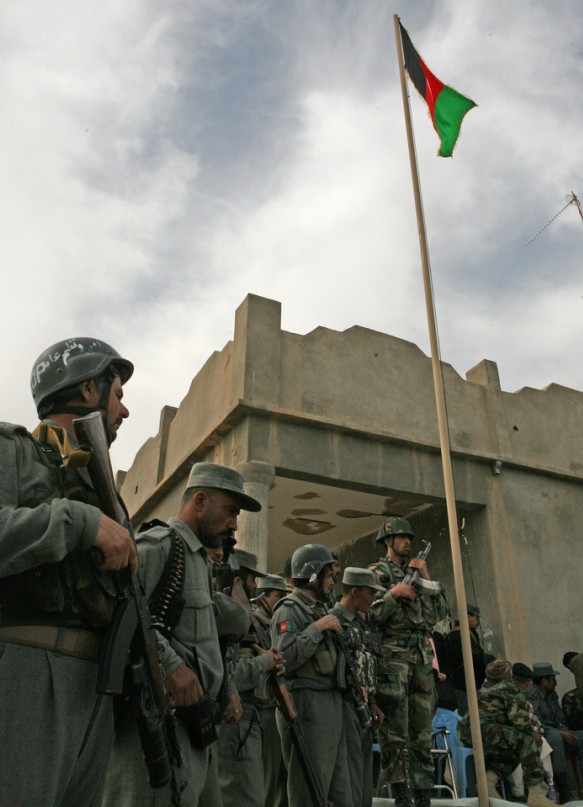
Not surprisingly, it’s hard to find photographs of Marjah’s “city center”. Even so, it’s reasonable to infer that the flag-raising ceremony that took place on February 25 when the Afghan central government reclaimed control of Marjah would have taken place at some sort of center, near some sort of prominent civic building.

This is the occasion:

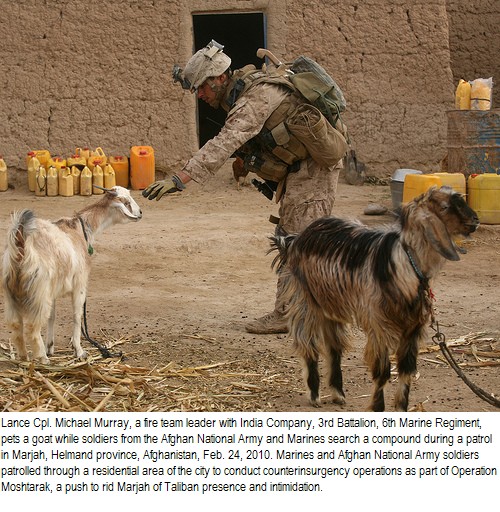
Two days earlier, while US Marines were conducting counterinsurgency operations “through a residential area of the city” one soldier found time to pet goats:

Facebooktwittermail