Yearly Archives: 2010

Netanyahu threatens American interests

Christopher Dickey writes:

Netanyahu summed up his core thinking in his 1993 book, A Place Among the Nations: Israel and the World, when he said it was naive for Israelis to believe that “Arabs loathed war as much as they themselves.” He derided Israelis who thought of peace as “a kind of blissful castle in the clouds, a Jewish never-never land in which the Jews will be able finally to find a respite from struggle and strife.”

In Bibi’s view, the fight will go on and on. “True, continuing struggle does not necessarily mean perpetual war, but it does mean an ongoing national exertion and the possibility of periodic bouts of international confrontation … You cannot end the struggle for survival without ending life itself.” So to protect itself, in Netanyahu’s view, Israel has to be aggressive on all fronts, controlling the land, the sea, the sky, and above all the message—never giving an inch. To paraphrase the late Erich Segal, being Bibi means never having to say you’re sorry.

So it is difficult, to say the least, to be Netanyahu’s friend, and nobody knows that better than the Jordanians, who tried to build a solid peace with Israel during his last term as prime minister in the 1990s. “Today everything is déjà vu,” says Randa Habib, author of the forthcoming Hussein and Abdullah: Inside the Jordanian Royal Family.

Jordan had signed a peace treaty with Israel in 1994 only to see the architect of that accord, Prime Minister Yitzhak Rabin, gunned down by an Israeli terrorist in 1995. When Netanyahu won the elections that followed, Jordan’s late King Hussein had hopes he could work with Bibi. Hussein tried to build confidence by receiving the Israeli prime minister in Amman in August 1996, only to have the Israelis begin digging a tunnel under Muslim holy places in Jerusalem a few days later. In February 1997, Hussein invited Netanyahu to Amman again, hoping to improve the atmosphere, but the next day the Israelis announced approval of a whole new Jewish neighborhood, Har Homa, to be built in East Jerusalem. In both cases the timing seemed planned not only to embarrass King Hussein, but to implicate and weaken him.

Finally, King Hussein wrote bluntly to Netanyahu: “You are destroying peace. I have no trust in you.” In his response to the king, Netanyahu professed to be “amazed by your personal attack.”

A few months later, Israeli agents tried to kill Hamas leader Khaled Meshal, who was then in Amman, by spraying an exotic poison in his ear. Unlike the killers of another Hamas official in Dubai in January this year, the ones in Jordan were caught. Hussein demanded the antidote from Netanyahu, as well as the release of another Hamas leader, and did not turn over the captured Mossad agents until he got them. The Canadian government protested the use of its passports by the assassins, another harbinger of the Dubai case. But in the end, like today, nothing happened. “The Israelis will get away with all this; they always get away with it,” says Habib.

I am not so sure. Even a dozen years ago, the American public was largely passive about Middle East issues. Congressmen proclaimed undying support for Israel, and their constituents asked few questions. Now, with America involved in two wars in the Muslim world, that’s not the case. The 1,000-plus comments on Aluf Benn’s Newsweek column make that clear. But the decisive voices may belong to America’s generals. Are they ready to have Bibi Netanyahu’s vision of war-without-end dictate endless wars for American troops? The answer, almost certainly, is no.

Given the warm embrace that Benjamin Netanyahu is sure to receive at the AIPAC conference in Washington next week — whether he appears in person or opts for a diplomatically safer live video link — it’s time that the pro-Israel lobby within which AIPAC is the central pillar be referred to by a more accurate label: the pro-Israel anti-American lobby.

Those Americans who are the most stalwart defenders of Israel’s interests, try to deflect the charge that they are working against the interests of their own nation by claiming that America’s interests and Israel’s interests are inseparable.

But let’s be honest. Given that there are no two states within the United States whose interests completely overlap, it is an absurd and audacious lie to claim that two nations separated by oceans, continents, cultures and thousands of miles have exactly the same interests.

In truth, the relationship between Israel and the United States is not one of indivisible interests but instead that of a dysfunctional familial tie.

In Yoav Shamir’s brilliant documentary, Defamation, there is a scene in which Abe Foxman, the president of the Anti-Defamation League, and a group of the ADL’s wealthy American supporters are talking about how they feel about Israel and how deep is their bond and commitment to the Jewish state’s survival. The consensus is that their attachment is like that of a parent for his or her own child; that they would sacrifice their own lives if that’s what Israel needed.

It’s hard to be clear about what state of development this Israel-child is in — rebellious teen, nursing infant or still tied by an umbilical chord. Whichever it is, the source of much its sustenance (unlike the ADL) is largely ignorant of the relationship.

When pollsters ask Americans about Israel they pose trite questions and solicit inane responses. But were Americans polled to find out whether they are happy to be providing aid which amounts to $1000 per Israeli citizen year in, year out, the likely responses would range from disbelief, to shock, to outrage. Americans who thought that number sounded “about right” would be in a small minority — especially in this struggling economy.

CNN’s Jack Cafferty poses the question: Is it time for the United States to get tougher with Israel?


Facebooktwittermail

The American backbone deficit

Gideon Levy writes:

Israel has no real intention of quitting the territories or allowing the Palestinian people to exercise their rights. Israel does not truly intend to pursue peace, because life here seems to be good even without it. The continuation of the occupation doesn’t just endanger Israel’s future, it also poses the greatest risk to world peace, serving as a pretext for Israel’s most dangerous enemies.

No change will come to pass in the complacent, belligerent and condescending Israel of today. That’s why this difficult, thankless task has fallen on the shoulders of an ally, as only it has the power to get things started. No agreement will come out of another endless series of futile diplomatic trips or peace plans to which no one intends to adhere. We have tried this enough in the past, and all for naught. This is the time to come up with a rehabilitation program for Israel. The entire world, and ultimately Israel too, will applaud Barack Obama if he succeeds.

Expressing offense at “poor timing” and giving Israel’s prime minister the cold shoulder are not enough. This is the time for action, comprehensive and unwavering. America must now decide where it is heading and where it aims to lead Israel, the Middle East and the world. At issue is not just the future of 1,600 homes in Ramat Shlomo, but that of Israel itself. What is required is not merely extending the settlement construction freeze – whether or not it includes the occupied areas of Jerusalem – but applying pressure on Israel to begin withdrawing to its own borders. The means at Washington’s disposal – including assistance on security and economic issues, the campaign against Iran’s nuclear program and diplomatic support of Israel – can all be conditioned on an end to the occupation.

America must now decide whether it’s for us or against us. Will it make do with easing the sting of the insult to the vice president? Will it continue to give in to its powerful Jewish lobby? Will it keep passing itself off as a friend while acting as a foe? Or are we really playing by different rules now? Yes, it’s likely to hurt Israel, and even many Americans, but this is the opportunity. There will be no other.

I’m not holding my breath.

A few days ago, when Hillary Clinton read the riot act to Benjamin Netanyahu, the word was that she was reading from an Obama-approved script. The image was of an angry president being tough while maintaining his facade of cool.

Almost a week later there are signs that the latest manifestation of Obama toughness was yet another mirage. Obama’s characteristically bland assessment that there is no crisis in US-Israeli relations but merely “a disagreement in terms of how we can move this peace process forward,” will yet again confirm Benjamin Netanyahu’s understanding that he is dealing with a spineless president.

Can Clinton and Mitchell make up for the backbone deficit? If the latter ends up in Israel in a few days without Netanyahu having made any significant concessions and if the former shows up at the AIPAC conference next week and doesn’t manage to make a few of the participants piss in their pants, then we’ll know the answer is no.

Facebooktwittermail

No nation can endure when built on hatred

Writing from Jerusalem on Tuesday as rioting left dozens injured, Bradley Burston said:

Hamas has designated this day, in this place, its Day of Rage. Why, then, the smiles on the faces of Mahmoud Zahar and Mahmoud Ahmadinejad?

Perhaps it’s because after more than 22 years of costly trial and error, Hamas has finally come upon the secret of how to bring down the Jewish state:

Let the ship sink itself.

This month, down here in the engine room of the Titanic, a single coherent order continues to sound from the officers shrouded in fog on the bridge: “More power!”

To the delight of Mahmoud Zahar and Mahmoud Ahmadinejad, Israel’s homemade weapons of mass destruction – pro-settlement bureaucrats with conflicts of financial and ideological interest – have done in one meeting what Israel’s foes have sought for generations: driving a stake through the heart of Israel’s relationship with the White House.

We should have known. But in the swamp of anomaly and impossibility that is Jerusalem, you can easily lose sight of, and belief in, the basics:

One of the curses of endless war, is the tendency to become one’s own worst enemy – in every sense.

A self-conception grounded in the notion that one is an object of enmity, whether this be within the self-identity of an individual or a nation, is no basis upon which a constructive relationship with the world can be formed. The world is seen as otherness and engagement with such a world becomes equated with annihilation. This is indeed the definition of a nihilistic outlook.

Facebooktwittermail

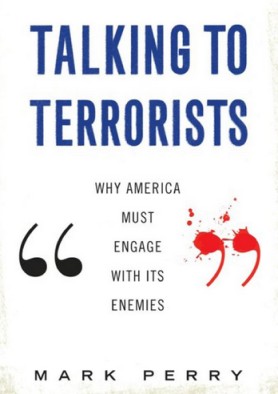
Talking to terrorists

The Washington Post has a passage from Mark Perry’s new book, Talking to Terrorists: Why America Must Engage With Its Enemies. As Perry notes, talking to groups that the US government has labelled as “terrorists” is not only necessary but is a choice that has already been pursued and shown highly effective. As he recounts: “the real gamble in Iraq was not in deploying more troops to kill terrorists; the real gamble in Iraq was in sending marines to talk to them”.

This is how that happened:

On July 23, 2005 Marine Corps Colonel John Coleman was sitting at his desk at Camp Pendleton, Calif. when he received a telephone call from Jerry Jones – an assistant to then-Secretary of Defense Donald Rumsfeld. Jones was frantic, telling Coleman that a group of Iraqi insurgents were battling an al-Qaeda militia at al-Qaim – an Iraqi city on the Syrian border.

“They need help,” Jones said. “It’s night there now, but they’re surrounded and if we don’t do something they’ll be wiped out.” Coleman acted quickly, placing a call to the Marine Corps headquarters at Camp Fallujah in Iraq.

The next morning, at sunrise, a “package” of Cobra helicopters attacked the al-Qaeda fighters, killing dozens and scattering the rest into the desert. “It was pretty nip and tuck there for awhile,” Coleman remembers, “but I had real confidence in the Marines.”

The little-known Marine intervention in al-Qaim is now seen as a turning point in America’s war in Iraq. It was the moment at which al-Anbar tribes – the insurgents — “awakened,” turning their guns on al-Qaeda and siding with the Americans.

But the Anbar Awakening did not happen suddenly.

For eighteen months prior to the Battle of al-Qaim, U.S. Marine Corps officers had been talking to the leaders of the Iraqi insurgency in a series of meetings that began in Amman, Jordan in July of 2004. The meetings were opposed by senior State Department and Pentagon officials, who castigated the Marines for “talking to terrorists.” The Marines vehemently disagreed, quoting an insurgent leader whom they had met in Amman. “We are not your enemy,” this leader said. “Al Qaeda is your enemy. We’re different. We’re not terrorists, we’re the insurgents. There’s a difference.”

Can what the United States did in Iraq serve as a model for a larger strategy – one that will bring stability to the entire region? More specifically, should America recruit the region’s more moderate Islamist parties (like Hamas, Hezbollah and the Muslim Brotherhood) to help in its fight against al Qaeda?

For most Americans, the suggestion seems outrageous; but for increasing numbers of policymakers, there are stark differences between the three groups and al-Qaeda: each of the movements has participated in national elections (Hamas won the parliamentary vote in the Palestinian territories in 2006, while Hezbollah and the Brotherhood hold seats in the Lebanese and Egyptian parliaments), each represents a distinct and growing constituency (and provides services for them), and each has rejected al-Qaeda’s Jacobin revolutionary ideology – and is targeted by bin Laden and his followers for actually endorsing democratic principles.

“Our habit of lumping all of these groups together, of putting Hamas, Hezbollah and the Muslim Brotherhood in the same class as al-Qaeda is a terrible mistake,” former Pentagon official James Clad says. “Hamas, Hezbollah and the Muslim Brotherhood are the three most important movements in the region today – and we don’t talk to any of them. I can understand not talking to al-Qaeda, they’re dead-enders and don’t represent anyone, but refusing to have a dialogue with groups that are respected in their own societies is short-sighted and counter-productive.”

Former Marine John Coleman would agree. In the wake of the Battle of al-Qaim, Coleman points out, the Anbar Awakening united 42 Anbar clans against al-Qaeda and transformed the war in Iraq.

“Our strategy was not simply a shift in American tactics, but in American thinking,” Coleman says. “It meant abandoning the easy language of the war on terrorism for a more sophisticated strategy.” Which is to say: the real gamble in Iraq was not in deploying more troops to kill terrorists; the real gamble in Iraq was in sending marines to talk to them.

Maybe that’s what we should be doing for the entire region.

Facebooktwittermail

A trial for Saddam and a bomb for bin Laden

The Associated Press reports:

Attorney General Eric Holder told Congress on Tuesday that Osama bin Laden will never face trial in the United States because he will not be captured alive.

In testy exchanges with House Republicans, the attorney general compared terrorists to mass murderer Charles Manson and predicted that events would ensure “we will be reading Miranda rights to the corpse of Osama bin Laden” not to the al-Qaida leader as a captive.

Holder sternly rejected criticism from GOP members of a House Appropriations subcommittee, who contend it is too dangerous to put terror suspects on trial in federal civilian courts as Holder has proposed.

Unless my memory fails me, there was no outrage expressed in Congress when Saddam Hussein was captured, rather than given a summary execution. Nor were there howls of protest when he was imprisoned without torture and treated humanely. Nor were there huge objections against him going through a criminal trial. This for a man widely understood to have been responsible for the deaths of tens of thousands of Iraqis.

And let’s not forget, throughout the time Saddam was being hunted down he was presented as a greater threat to the world than Osama bin Laden.

Do American lawmakers have such little faith in the law they make or in the judicial system that applies that law, that they regard the United States legal system as too feeble an entity to justly handle the fate of one man — even a man given mythical proportions of Osama bin Laden?

As John Brennan — Assistant to the President and Deputy National Security Advisor for Homeland Security and Counterterrorism — pointed out last month, “Terrorists are not 100-feet tall. Nor do they deserve the abject fear they seek to instill.”

Facebooktwittermail

Where’s Joe Biden?

Has the vice president gone missing? Or is he hiding in a secure undisclosed location?
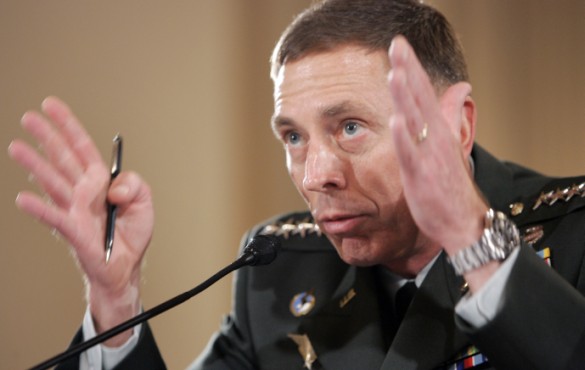
Strong words delivered by Joe Biden during his visit to Israel were widely reported last week.

“This is starting to get dangerous for us,” Biden warned his Israeli hosts. “What you’re doing here undermines the security of our troops who are fighting in Iraq, Afghanistan and Pakistan. That endangers us and it endangers regional peace.”

Many in Washington were apparently so shocked that Biden could have said something like this, they were, for several days, dumb-struck and rendered immobile.

One of the first to regain his senses was Jeffrey Goldberg. It can’t be true, Goldberg thought, and then set about getting to the bottom or at the very least the periphery of the story.

Where would one turn if one wanted to find out what the vice president said? Maybe the Office of the Vice President? Not if you’re Goldberg. He asked some fellow at the White House.

Meanwhile, Eric Re-Cantor had a chat with Rahm Emanuel, and the White House Chief of Staff confirmed that he too had heard from some guy (could have been Biden himself — we don’t know) that Biden was misquoted.

I guess I’m a bit of a stickler because when it comes to establishing what Biden did or did not say, I’d prefer to hear it from the vice president himself — or at least in a written statement from his office. He has a reputation for being blunt. I dearly hope he hasn’t lost it.

Facebooktwittermail

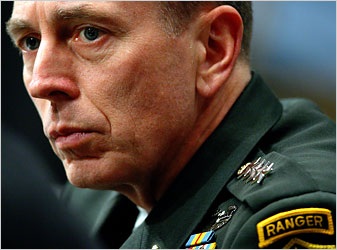
Israel is empowering al Qaeda, Petraeus warns

As erupting violence in Jerusalem suggests a third intifada may soon take hold, the CENTCOM commander Gen David Petraeus, testifying before the US Senate Armed Services Committee today, gave a grave warning about the wider impact of a conflict that has been the epicenter of Middle East hostilities ever since the creation of Israel.

In issuing his warning, Petraeus — arguably the most influential even if not the highest ranking member of the US military — was reiterating a statement he made almost a year ago. The only difference between what he said in April 2009 and what he said today, was that he now acknowledges al Qaeda is being strengthened by the conflict.

He now says:

The enduring hostilities between Israel and some of its neighbors present distinct challenges to our ability to advance our interests in the AOR [CENTCOM’s area of responsibility]. Israeli-Palestinian tensions often flare into violence and large-scale armed confrontations. The conflict foments anti-American sentiment, due to a perception of U.S. favoritism for Israel. Arab anger over the Palestinian question limits the strength and depth of U.S. partnerships with governments and peoples in the AOR and weakens the legitimacy of moderate regimes in the Arab world. Meanwhile, al-Qaeda and other militant groups exploit that anger to mobilize support. The conflict also gives Iran influence in the Arab world through its clients, Lebanese Hizballah and Hamas.

If such a statement was being made outside the American political arena, it could be regarded as a rather bland expression of what has long been utterly obvious. Yet from the lips of a celebrated general, regarded by many as a potential future president, these words come as a bombshell.

Neoconservatives and the Israel lobby have worked hard and long to obscure the deeply corrosive regional impact of a conflict that successive Israeli leaders have either been unwilling or seemingly incapable of resolving. Others, who earlier said what Petraeus now says, have either been dismissed as poorly informed or worse, branded as anti-Israeli or by insinuation, anti-Semitic.

No such charge will stick to Petraeus. Indeed, if the Israel lobby was so foolhardy as to try and go after an American general who sometimes gets treated like a latterday Eisenhower, the lobby will be at dire risk of being visited by its own greatest fear: being branded as anti-American.

Facebooktwittermail

Netanyahu remains defiant

As Bill Clinton famously said about Benjamin Netanyahu in 1998, “Who the fuck does he think he is? Who’s the fucking superpower here?”

Twelve years later there is no sign that Bibi’s hubris has been tempered. In the midst of what Israel’s ambassador to the United States, Michael Oren, has told the country’s diplomats is the worst crisis in U.S.-Israeli relations in 35 years, what does Israel’s prime minister do? He declares that “building in Jerusalem – and in all other places – will continue in the same way as has been customary over the last 42 years.” In other words, Netanyahu reaffirms that Israel will continue on the same course that precipitated the crisis.

Meanwhile, Israel’s foreign minister today followed what appears to have now become standard diplomatic protocol in the aspiring pariah state by snubbing a visiting head of state, Brazil’s president Luiz Inacio Lula da Silva, because the latter declined to pay homage to Zionism.

I imagine that in fairly short order Israel’s leaders will no longer have the task of figuring out new ways of insulting their guests; they simply won’t have any guests to insult.

Even so, Netanyahu has persuaded his loyal American supporters that he has eaten enough humble pie. For that reason it seems hard to imagine that he will go very far in meeting a set of demands that Haaretz says were put on his plate when he got lectured by Hillary Clinton on Friday.

These were the demands:

1. Investigate the process that led to the announcement of the Ramat Shlomo construction plans in the middle of Biden’s visit. The Americans seek an official response from Israel on whether this was a bureaucratic mistake or a deliberate act carried out for political reasons. Already on Saturday night, Netanyahu announced the convening of a committee to look into the issue.

2. Reverse the decision by the Jerusalem District Planning and Building Committee to approve construction of 1,600 new housing units in Ramat Shlomo.

3. Make a substantial gesture toward the Palestinians enabling the renewal of peace talks. The Americans suggested that hundreds of Palestinian prisoners be released, that the Israel Defense Forces withdraw from additional areas of the West Bank and transfer them to Palestinian control, that the siege of the Gaza Strip be eased and further roadblocks in the West Bank be removed.

4. Issue an official declaration that the talks with the Palestinians, even indirect talks, will deal with all the conflict’s core issues – borders, refugees, Jerusalem, security arrangements, water and settlements.

The report continued:

Two advisers of the prime minister, Yitzhak Molcho and Ron Dermer, held marathon talks Sunday with senior White House officials in Washington and U.S. Mideast envoy George Mitchell and his staff to try to calm the situation. Mitchell will return to Israel Tuesday and expects to hear if Netanyahu intends to take the proposed steps.

At the beginning of Sunday’s cabinet meeting, Netanyahu tried to convey a message that there was no crisis in relations with the United States. But he sent precisely the opposite message to Oren in Washington.

In Oren’s Saturday conference call with the Israeli consuls general, he said that the current crisis was the most serious with the Americans since a confrontation between Henry Kissinger and Yitzhak Rabin in 1975 over an American demand for a partial withdrawal from the Sinai Peninsula.

At Sunday’s cabinet meeting, Netanyahu said the matter had been blown out of proportion by the media. He added: “There was an unfortunate incident here that was innocently committed and was hurtful, and certainly should not have occurred.”

He said steps would be taken to prevent such cases in the future. “It is extremely important to understand that the State of Israel and the United States have common interests,” he said, adding that those interests “also require us to take decisions to change the situation in the country.”

Four consuls discussed the conference call with Haaretz. Some noted that in previous conference calls with Oren, the ambassador took pains to make clear that relations with the United States were excellent. This time, however, Oren sounded extremely tense and pessimistic. Oren was quoted as saying that “the crisis was very serious and we are facing a very difficult period in relations [between the two countries].”

Oren told the consuls to lobby congressmen, Jewish community leaders and the media to convey Israel’s position. He said the message to be relayed was that Israel had no intention to cause offense to Vice President Biden and that the matter had stemmed from actions by junior bureaucrats in the Interior Ministry and was caused by a lack of coordination between government offices. “It should be stressed that [our] relations with the United States are very important to us,” Oren reportedly said.

Several of the consuls suggested waiting, but Oren hinted that his approach reflected Netanyahu’s wishes. “These instructions come from the highest level in Jerusalem,” he was quoted as saying, adding that the utmost must be done to calm matters.

If only Washington could be more understanding and recognize that Israel has a dysfunctional bureaucracy. The Jewish state should be seen as a Middle Eastern version of Pakistan, then all these misunderstandings could be resolved. That at least is the counsel offered by Israel’s pre-eminent American booster, the Anti-Defamation League’s, Abe Foxman.

Facebooktwittermail

Israel is putting American lives at risk

In Foreign Policy, Mark Perry describes an extraordinary Pentagon briefing on Israel’s impact on conflicts across the Middle East. Here is an excerpt and following some comments of my own, the author has provided me with additional background on his reporting.
[Important update: A senior military officer told Foreign Policy by email that one rather minor detail in Perry’s report was incorrect. A request from Gen Petraeus for the Palestinian occupied territories to be brought within CENTCOM’s region of operations was sent to the Chairman of the Joint Chiefs of Staff, Admiral Mullen, and not directly to the White House (who may or may not have subsequently been consulted). It is significant that the Pentagon made this correction, not because it was an important detail but on the contrary, because it was inconsequential to the overall narrative. In effect, the Pentagon clearly but discreetly said that there was virtually nothing in this report that could be denied.]

On January 16, two days after a killer earthquake hit Haiti, a team of senior military officers from the U.S. Central Command (responsible for overseeing American security interests in the Middle East), arrived at the Pentagon to brief JCS Chairman Michael Mullen on the Israeli-Palestinian conflict. The team had been dispatched by CENTCOM commander David Petraeus to underline his growing worries at the lack of progress in resolving the issue. The 33-slide 45-minute PowerPoint briefing stunned Mullen. The briefers reported that there was a growing perception among Arab leaders that the U.S. was incapable of standing up to Israel, that CENTCOM’s mostly Arab constituency was losing faith in American promises, that Israeli intransigence on the Israeli-Palestinian conflict was jeopardizing U.S. standing in the region, and that Mitchell himself was (as a senior Pentagon officer later bluntly described it) “too old, too slow…and too late.”
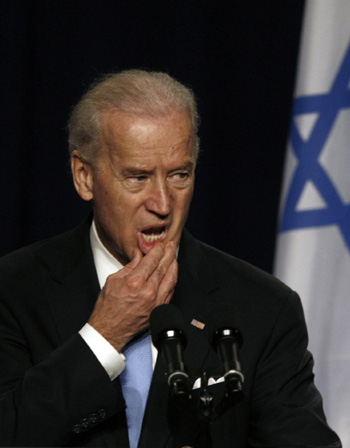
The January Mullen briefing was unprecedented. No previous CENTCOM commander had ever expressed himself on what is essentially a political issue; which is why the briefers were careful to tell Mullen that their conclusions followed from a December 2009 tour of the region where, on Petraeus’s instructions, they spoke to senior Arab leaders. “Everywhere they went, the message was pretty humbling,” a Pentagon officer familiar with the briefing says. “America was not only viewed as weak, but its military posture in the region was eroding.” But Petraeus wasn’t finished: two days after the Mullen briefing, Petraeus sent a paper to the White House requesting that the West Bank and Gaza (which, with Israel, is a part of the European Command – or EUCOM), be made a part of his area of operations. Petraeus’s reason was straightforward: with U.S. troops deployed in Iraq and Afghanistan, the U.S. military had to be perceived by Arab leaders as engaged in the region’s most troublesome conflict.

The Mullen briefing and Petraeus’s request hit the White House like a bombshell. While Petraeus’s request that CENTCOM be expanded to include the Palestinians was denied (“it was dead on arrival,” a Pentagon officer confirms), the Obama Administration decided it would redouble its efforts – pressing Israel once again on the settlements issue, sending Mitchell on a visit to a number of Arab capitals and dispatching Mullen for a carefully arranged meeting with Chief of the Israeli General Staff, Lt. General Gabi Ashkenazi. While the American press speculated that Mullen’s trip focused on Iran, the JCS Chairman actually carried a blunt, and tough, message on the Israeli-Palestinian conflict: that Israel had to see its conflict with the Palestinians “in a larger, regional, context” – as having a direct impact on America’s status in the region. Certainly, it was thought, Israel would get the message. [Read the rest of the report here.]

In December 2006, the Iraq Study Group Report was explicit in making this linkage: “The United States cannot achieve its goals in the Middle East unless it deals directly with the Arab-Israeli conflict and regional instability.”

What Mark Perry’s report indicates is that for the Obama administration a tipping point has been crossed in its perception of Israel’s effect on the conflicts that span the region.

Until now, the necessity for a resolution of the Arab-Israeli conflict has been framed in quasi-positive terms — such as that it would help defuse some of the hostility that the US now faces, or, that it would strengthen an alliance of nations attempting to curtail Iran’s nuclear program.

The shift, as expressed by Joe Biden last week and by the Petraeus briefing in January is that Israel is now being seen as a liability: the Jewish state is putting American lives at risk. “This is starting to get dangerous for us,” Biden reportedly told Netanyahu.

Such a shift marks a watershed in US-Israeli relations and so Perry’s report naturally raises questions. Indeed, the first line of defense from Israel and its supporters will be to claim that, on the contrary, recent events are nothing more than a bump in the road; that we can expect a quick resumption of business as usual between such close allies.

For this reason, I asked Mark — who I have had the privilege of working with in recent years — to provide some background to his report. This is what he said:

My piece on the briefing of Admiral Mullen by CENTCOM senior officers has occasioned a great deal of comment, as well as some skepticism: how accurate is the account? Was it told to me by direct participants in the briefing? Is there any basis for imagining that Petraeus has any kind of hidden agenda, whether that is a desire to expand CENTCOM – or even hostility towards Israel.

I won’t name my sources, even though it’s clear to people in the Pentagon – and certainly to General Petraeus – who they are. Was I told of the briefing by the briefers themselves? I will only say that there were four people in the briefing – the two briefers, Admiral Mullen, and Admiral Mullen’s primary adviser on the Israeli-Palestinian conflict. I know two of the people involved in the briefing. Whether or not they are my sources is something for the reader to determine. The account is not only accurate, it’s a precis of what actually happened. There is a lot more to it. The White House, State Department and Pentagon have not denied the account, and for good reason: it’s true.

Is there any basis for imagining that Petraeus has any kind of hidden agenda in ordering the briefing?

I have been reporting on the American military for thirty years. My work on the Joint Chiefs of Staff, Four Stars, is the authoritative account on the subject. I have deeply rooted contacts in the military that go back thirty years. I have never met a senior military officer whom I do not admire. There is no greater insult than to believe that General Petraeus or any other senior American military officer would use the lives of American soldiers as a lever to enhance their own political future. My sense is that General Petraeus neither likes nor dislikes Israel: but he loves his country and he wants to protect our soldiers. The current crisis in American relations with Israel is not a litmus test of General Petraeus’s loyalty to Israel, but of his, and our, concern for those Americans in uniform in the Middle East.

It is, perhaps, a sign of the depth of “the Biden crisis” that every controversy of this type seems to get translated into whether or not America and its leaders are committed to Israel’s security. This isn’t about Israel’s security, it’s about our security.

Facebooktwittermail

Obama gets kind of tough with Netanyahu

The Los Angeles Times says: “a dispute this week between the Obama administration and Israel has ballooned into the biggest U.S.-Israeli clash in 20 years.”

Tom Friedman says: “what the Israelis did played right into a question a lot of people are asking about the Obama team: how tough are these guys? The last thing the president needs, at a time when he is facing down Iran and China — not to mention Congress — is to look like America’s most dependent ally can push him around.”

But then Washington hit back — bam!

This is how Aluf Benn describes Obama’s get-tough approach:

Washington delivered its rebuke to Netanyahu through a number of channels. There was the extended censure by telephone from Secretary of State Hillary Clinton, a phone call from Biden, the summoning of Israel’s ambassador to Washington to the office of Deputy Secretary of State James Steinberg, the condemnation from the Quartet and, perhaps most important, a media briefing Clinton delivered during a CNN interview which escalated private rebukes into a full-blown public reprimand.

The reproofs were reminiscent of the “low chair diplomacy” the Turkish ambassador to Jerusalem was subjected to by the Israeli Foreign Ministry at the beginning of the year. The media was informed that the conversation between Clinton and Netanyahu lasted 43 minutes, “rather than 10 minutes as usual,” and that the prime minister barely uttered a word.

Obama himself reportedly worded the message to be delivered to Netanyahu during his weekly Thursday meeting with Clinton, lest the argument be made that it was merely the secretary of state scolding the Israeli leader, and not the U.S. president himself.

A State Department spokesman described the conversation using phrases which bring to mind a teacher castigating a student, not a working discussion with the leader of a friendly country and ally.

The substance was no less damning than the form – Clinton spoke of an “insult” to the United States and of “harming bilateral ties.” She could not understand, she said, how such a thing could have been done in light of America’s strong obligation to Israel’s security. U.S. media interpreted these remarks as suggesting that Washington’s military support for Israel is hardly unconditional.

Clinton dismissed Netanyahu’s explanation that the decision to approve the housing plan was made without his knowledge, reminding him that as prime minister he is responsible for his government’s actions.

The statements from the United States were publicized Friday evening – Shabbat – while Israel was officially unable to respond, therefore affording the White House a media exclusive. The instinctive reaction from Netanyahu and his associates was to accuse Washington of a diplomatic ambush, to simply rely on the support of his backers in the United States. Indeed, Abraham Foxman, national director of the Anti-Defamation League, was the first to charge the White House with “humiliating” the Israeli prime minister.

This week presents Netanyahu with a difficult decision. He may choose to visit Washington as planned to speak at the AIPAC conference, which would embarrass the preeminent pro-Israel lobby and put it on a collision course with the Obama administration. Senior U.S. officials will likely decline meetings with him, unless he agrees to at least some of Washington’s conditions. Canceling his flight, however, will be interpreted as acknowledgment of the crisis in U.S.-Israel ties.

High drama! But will it be of any lasting consequence? I really doubt it.

To put this in perspective we should not forget that the initiative the Obama administration is in a desperate effort to salvage — so-called proximity talks — is one that virtually no one had any confidence would accomplish anything in the first place. A successful resolution to the current dispute means getting this initiative back on a track that leads nowhere.

The Jerusalem District Planning and Building committee has canceled two meetings planned for this week. Big deal. It can reschedule them in a few weeks once America and the media are suitably distracted by current events. Indeed, the closer mid-term elections come, the greater this administration’s interests will be in restoring cordial relations with Israel.

Daniel Levy, a former adviser to then-Israeli prime minister Ehud Barak, says the administration is trying to “lay down a marker with [Netanyahu] that they will not allow him to make them look weak,” and no doubt that is true, but this is a marker on a movable line.

Nothing Netanyahu does or refrains from doing will reverse the perception of weakness that was Obama’s own doing when he caved on the issue of imposing a settlement freeze. To insist that this Israeli prime minister avoid doing anything to embarrass the US president merely underlines the extent to which this president is already highly susceptible to appearing weak.

As for whether the Israeli government has any interest in making meaningful gestures of reconciliation with the Palestinians, Ma’an reports on the latest indication: an order from Israeli authorities for the demolition of a mosque in Nablus, right in the heart of the West Bank.

Facebooktwittermail

Washington’s cult of narcissism and Iraq

Tom Engelhardt writes:

Hubris? We’re bigger than that!

We’ve now been at war with, or in, Iraq for almost 20 years, and intermittently at war in Afghanistan for 30 years. Think of it as nearly half a century of experience, all bad. And what is it that Washington seems to have concluded? In Afghanistan, where one disaster after another has occurred, that we Americans can finally do more of the same, somewhat differently calibrated, and so much better. In Iraq, where we had, it seemed, decided that enough was enough and we should simply depart, the calls from a familiar crew for us to stay are growing louder by the week.

The Iraqis, so the argument goes, need us. After all, who would leave them alone, trusting them not to do what they’ve done best in recent years: cut one another’s throats?

Modesty in Washington? Humility? The ability to draw new lessons from long-term experience? None of the above is evidently appropriate for “the indispensable nation,” as former Secretary of State Madeleine Albright once called the United States, and to whose leaders she attributed the ability to “see further into the future.” None of the above is part of the American arsenal, not when Washington’s weapon of choice, repeatedly consigned to the scrapheap of history and repeatedly rescued, remains a deep conviction that nothing is going to go anything but truly, deeply, madly badly without us, even if, as in Iraq, things have for years gone truly, deeply, madly badly with us.

An expanding crew of Washington-based opiners are now calling for the Obama administration to alter its plans, negotiated in the last months of the Bush administration, for the departure of all American troops from Iraq by the end of 2011. They seem to have taken Albright’s belief in American foresight — even prophesy — to heart and so are basing their arguments on their ability to divine the future.

Facebooktwittermail

Why did Joe Biden insult America’s friends?

In an interview on CNN, Hillary Clinton was refreshingly blunt in saying that Israel insulted the US:

But now that’s been clearly stated, why did Joe Biden have to cap the first insult by adding another when he said: “the United States has no better friend in the community of nations than Israel”?

That’s not true — and most Americans know it. Canada, Britain, Germany and Japan are all viewed more favorably by Americans than is Israel.

Is it because Israel is the most ill-mannered among America’s friends that it has to be flattered with this “best friend” status? Is it because Israel remains perpetually on the verge of throwing a tantrum that its wet nurse feels compelled to constantly sing sweet words to this troublesome infant?

At least there are a few Israelis who can see through this farce.

Akiva Eldar writes:

The apology offered by Prime Minister Benjamin Netanyahu and Interior Minister Eli Yishai recalls the joke about the servant who pinched the king’s bottom. En route to the gallows, the servant apologized: He thought it was the queen’s bottom.

The statement issued by Netanyahu’s bureau said that in light of the ongoing dispute between Israel and the United States over construction in East Jerusalem, the plans for new housing in the Ramat Shlomo neighborhood should not have been approved this particular week. It also said the premier had ordered Yishai to draft procedures that would prevent a recurrence. In other words, Yishai is welcome to submit more plans for Jewish construction in East Jerusalem next week, when U.S. Vice President Joe Biden will no longer be here.

Based on Biden’s reaction, it seems that he (and, presumably, his boss) has decided that it is better to leave with a few sour grapes than to quarrel with the vineyard guard. In his speech at Tel Aviv University, he said he appreciated Netanyahu’s pledge that there would be no recurrence. But what exactly does that mean? That next time he comes, the Planning and Building Committee will be asked to defer discussion of similar plans until the honored guest has left? With the media storm dying down, Netanyahu can breathe a sigh of relief.

In a sense, the uproar actually helped him: To wipe the spit off his face, Biden had to say it was only rain. Therefore, he lauded Netanyahu’s assertion that actual construction in Ramat Shlomo would begin only in another several years.

Thus Israel essentially received an American green light for approving even more building plans in East Jerusalem.

Biden might not know it, but the Palestinians certainly remember that this is exactly how East Jerusalem’s Har Homa neighborhood began: Then, too, Netanyahu persuaded the White House that construction would begin only in another several years.

When Biden arrived, the Arab League had just recommended that Palestinian Authority President Mahmoud Abbas accede to Washington’s proposal for indirect talks with Israel.

But instead of being able to leave with an announcement that the talks have officially begun, Biden is leaving with the news that the Arab League has suspended its recommendation.

Netanyahu can thus hope that the Ramat Shlomo imbroglio has deferred the moment of truth when he must reveal his interpretation of “two states for two peoples.” And just in case anyone failed to realize how impartial a mediator the U.S. is, Biden said in his Tel Aviv speech that the U.S. has “no better friend” than Israel.

For Netanyahu, the cherry on top was that the onus for advancing the negotiations has now been put on the Arab states – just two weeks before the Arab League summit in Tripoli, where the league’s 2002 peace initiative will again be up for discussion. For months, U.S. President Barack Obama has been trying to persuade Arab leaders not to disconnect this important initiative from life support. His argument is that nothing would make Iranian President Mahmoud Ahmadinejad happier than a final blow-up of the peace process and the outbreak of a third intifada. And his joy would be redoubled if the fire started in Jerusalem.

But while the U.S. may be papering over the rift for now, Western diplomats said the bill will come due once the talks with the PA begin (assuming they do). The U.S. has already said it will submit bridging proposals of its own during these talks, and its anger and frustration over the Ramat Shlomo incident are likely to make it far more sympathetic to the Palestinians’ positions, the diplomats said.

For instance, Netanyahu wants security issues to top the talks’ agenda, an Israeli source said. But the Palestinians want the first issue to be borders, including in Jerusalem.

And the European Union, which had planned to upgrade various agreements with Israel this week in honor of the resumed talks, has now postponed the upgrade until it becomes clear whether the talks will in fact take place.

Facebooktwittermail

Poll: Half of Israeli high schoolers oppose equal rights for Arabs

Haaretz reports:

Nearly half of Israel’s high school students do not believe that Israeli-Arabs are entitled to the same rights as Jews in Israel, according to the results of a new survey released yesterday [Thursday]. The same poll revealed that more than half the students would deny Arabs the right to be elected to the Knesset.

The survey, which was administered to teenagers at various Israeli high schools, also found that close to half of all respondents – 48 percent – said that they would refuse orders to evacuate outposts and settlements in the Palestinian territories.

Nearly one-third – 31 percent – said they would refuse military service beyond the Green Line.

The complete results of the poll will be presented today during an academic discussion hosted jointly by Tel Aviv University’s School of Education and the Citizens’ Empowerment Center in Israel. The symposium will focus on various aspects of civic education in the country.

“Jewish youth have not internalized basic democratic values,” said Prof. Daniel Bar-Tal, one of the conference organizers.

Facebooktwittermail

CIA drone attacks produce America’s own unlawful combatants

Gary Solis, an adjunct professor at Georgetown University Law Center, writes:

In our current armed conflicts, there are two U.S. drone offensives. One is conducted by our armed forces, the other by the CIA. Every day, CIA agents and CIA contractors arm and pilot armed unmanned drones over combat zones in Afghanistan and Pakistan, including Pakistani tribal areas, to search out and kill Taliban and al-Qaeda fighters. In terms of international armed conflict, those CIA agents are, unlike their military counterparts but like the fighters they target, unlawful combatants. No less than their insurgent targets, they are fighters without uniforms or insignia, directly participating in hostilities, employing armed force contrary to the laws and customs of war. Even if they are sitting in Langley, the CIA pilots are civilians violating the requirement of distinction, a core concept of armed conflict, as they directly participate in hostilities.

Facebooktwittermail

Afghan tribal rivalries bedevil a U.S. plan

The New York Times reports:

Six weeks ago, elders of the Shinwari tribe, which dominates a large area in southeastern Afghanistan, pledged that they would set aside internal differences to focus on fighting the Taliban.

This week, that commitment seemed less important as two Shinwari subtribes took up arms to fight each other over an ancient land dispute, leaving at least 13 people dead, according to local officials.

The fighting was a setback for American military officials, some of whom had hoped it would be possible to replicate the pledge elsewhere. It raised questions about how effectively the American military could use tribes as part of its counterinsurgency strategy, given the patchwork of rivalries that make up Afghanistan.

Government officials and elders from other tribes were trying to get the two sides to reconcile, but given the intensity of the fighting, some said they doubted that the effort would work. At the very least, the dispute is proving a distraction from the tribe’s commitment to fight the Taliban, not each other.

Meanwhile, the Los Angeles Times reports:

A growing number of Taliban militants in the Pakistani border region are refusing to collaborate with Al Qaeda fighters, declining to provide shelter or assist in attacks in Afghanistan even in return for payment, according to U.S. military and counter-terrorism officials.

The officials, citing evidence from interrogation of detainees, communications intercepts and public statements on extremist websites, say that threats to the militants’ long-term survival from Pakistani, Afghan and foreign military action are driving some Afghan Taliban away from Al Qaeda.

As a result, Al Qaeda fighters are in some cases being excluded from villages and other areas near the Afghanistan-Pakistan border where they once received sanctuary.

Facebooktwittermail

In early tally, tight Iraq race deepens splits

The New York Times reports:

Iraq’s major coalitions were locked in a surprisingly close race on Thursday, in initial results from elections that deepened divisions across a fractured landscape. Candidates were quick to charge fraud, heightening concerns whether Iraq’s fledgling institutions were strong enough to support a peaceful transfer of power.

The day was the most tumultuous since Sunday’s vote for Parliament, with Prime Minister Nuri Kamal al-Maliki’s office saying he underwent surgery, officials with his chief rival complaining that their ballots were dumped in the garbage, and a leading Shiite coalition claiming that it had challenged the popular mandate that Mr. Maliki needed to return to power.

The turmoil deepened both anticipation and uncertainty over an election to choose a government that will rule Iraq as the United States begins its military withdrawal in earnest next month. “It is a very close race,” said a Western official, who viewed the early results but spoke on condition of anonymity since Iraqi officials were designated to release them. “Whatever the end results, we know it will be a fierce struggle to form a government.”

The initial returns, according to officials who have seen tallies from across the country, suggested a very tight race among Mr. Maliki’s coalition; Ayad Allawi, a secular Shiite and the leader of the Iraqiya coalition; and a Shiite coalition known as the Iraqi National Alliance. The Kurds, though divided, appeared poised to finish strongly as well, they said, leaving Iraq’s political map far more ambiguous than just weeks ago.

Facebooktwittermail

Dubai tells spies to clear out

Newsweek reports:

Police in the Persian Gulf emirate of Dubai have advised all foreign spies to get out of town—and preferably out of the region—within a week. Although it is widely known in international spy circles, news of the expulsion threat has received little circulation beyond media in the Arab world. However, Gulf News, a newspaper based in Dubai, said the demand that foreign spies leave the area was confirmed to it by Lt. Gen. Dahi Khalfan Tamim, Dubai’s police chief and leader of the investigation into the Mahmoud al-Mabhouh murder.

“Those spies that are currently present in the Gulf must leave the region within one week. If not, then we will cross that bridge when we come to it,” Tamim reportedly said. When asked whether the spies he was talking about were holders of European passports, Tamim said “Europeans and others,” but offered no further details.

Gulf News says:

The ultimatum indicates that Dubai Police are aware of the identities of spies operating in the UAE and the Gulf region and appears to be a warning of exposure if they do not comply.

If Dubai is really serious about kicking out its resident spies, the consequences will be far reaching.

As Zvi Bar’el noted earlier this month:

Dubai has several masks. It helps Iran, but behind its back it provides the United States with an opportunity to gather intelligence about that country. The U.S. Consulate in Dubai also operates as a station for gathering information and enlisting agents. A few years ago the U.S. State Department wanted to close the consulate, but the CIA succeeded in convincing it to leave it open and even to boost the number of employees so that it could handle the hundreds and perhaps thousands of Iranians who come to request visas.

It’s not only the U.S. intelligence services that love Dubai: The tremendous scope of commerce and the large number of companies and foreign agencies there are an excellent cover and an appropriate disguise for any city of spies.

Dubai has now replaced 20th-century Istanbul, Nicosia, Casablanca and Berlin as a hotbed of spying activity. Russians exchange information with Pakistanis, Afghans and Chechens trade tactics, members of Hezbollah convert illegal money and diamonds in bank transactions “for widows and orphans,” and all while enjoying car races and performances by international artists.

Facebooktwittermail

Time for George Mitchell and the US to step aside

Among commentators unable to see beyond the bankrupt perspective that the United States has the indispensable role of mediating a Middle East peace agreement (if such an agreement is ever to be reached), much is being made about Joe Biden’s tough words “behind closed doors”. Laura Rozen quotes from a Yedioth Ahronoth report:

People who heard what Biden said were stunned. “This is starting to get dangerous for us,” Biden castigated his interlocutors. “What you’re doing here undermines the security of our troops who are fighting in Iraq, Afghanistan and Pakistan. That endangers us and it endangers regional peace.”

The vice president told his Israeli hosts that since many people in the Muslim world perceived a connection between Israel’s actions and US policy, any decision about construction that undermines Palestinian rights in East Jerusalem could have an impact on the personal safety of American troops fighting against Islamic terrorism.

Help us fight the war on terrorism, Biden admonishes his Israeli friends. But we are, they think but in this instance are too polite to say. That’s why we’re taking over East Jerusalem. We’re fortifying the front-line.

It seems to me that the crux of the issue is not the latest upset; it is that the so-called peace process has always rested on an unbalanced foundation. Which is to say, Israel will only accept the direct involvement of third parties that have a clear bias in their favor.

If President Obama wanted to do something truly radical, it might not have to take the form of applying pressure — pressure that would be fiercely and effectively resisted by the Israel lobby. On the contrary, it could be to acknowledge that American efforts have failed — not only his own but those of all his predecessors — and that there comes a point when failure has been so persistent and become so predictable, that it is time to step aside.

There is someone else waiting in the wings, eager to step in — a man who regards dialogue as the essence of politics and who can make a stronger claim to be even-handed than anyone in the United States or Europe: Brazil’s President Lula da Silva. He also happens to be the most popular political leader in the world.

Ahead of his visit to the Middle East next week, where his first stop will be in Israel, Lula was interviewed by Haaretz:

Lula was one of the first leaders to host President Mahmoud Ahmadinejad after Iran’s blood-stained election of June 2009. Brazil was also one of only five countries to abstain from an International Atomic Energy Agency vote last November on a condemnation of Iran.

He is set to visit the Islamic Republic in May, where his hosts will repay him in kind for the red carpet he laid out for them in Brasilia last November. When asked how he’ll be able to win over the Israelis, whose vantage point is related to the trauma of the Holocaust, Lula replies: “I spoke with the president of Iran and made it clear to him that he cannot go on saying that he wants Israel’s liquidation, just as it is untenable for him to deny the Holocaust, which is a legacy of all humanity. I added that the fact that he has differences with Israel does not allow him to deny or ignore history.”

In a way that will undoubtedly disturb those who will host him in Israel next week, Lula draws a direct association between the failure to advance Israeli-Palestinian peace and his planned visit to Tehran; between the need to ensure that Iran will not manufacture nuclear weapons and the need to resolve the Middle East conflict; and between the failed attempts at mediation led by international players, first and foremost the United States, and the need to bring in fresh new players – Brazilians, in all likelihood.

“I talked about Iran with many leaders, and particularly with those whose countries have a seat on the Security Council,” he explains. “The Americans, the French, the British, the Russians and the Chinese all want to advance the Middle East peace process. But I also feel that the parties to the conflict and the people involved in the process have long since grown tired of it. So, the time has come to bring into the arena players who will be able to put forward new ideas. Those players must have access to all levels of the conflict: in Israel, in Palestine, in Iran, in Syria, in Jordan and in many other countries that are associated with this conflict. This is the only way we will be able to advance Israeli-Palestinian peace, and at the same time be able to say clearly to Iran that we are against the manufacture of nuclear weapons.”

Lula does not overlook any of the elements in this comprehensive linkage when asked about the fact that Israeli patience regarding Iran seems to have worn thin. “The leaders I spoke to believe that we must act quickly, otherwise Israel will attack Iran. I do not want Israel to attack Iran, just as I do not want Iran to attack Israel. In an orderly world, people have to learn to talk to one another.” Here he seems to be alluding critically to the “proximity talks” about to get underway between Israel and the Palestinian Authority.

“The appropriate partners from each country have to be found, and more serious talks conducted,” he continues. “The importance of talks between third- and fourth-rank officials [does not hold] even 1 percent of the importance of tete-a-tete talks between leaders. Politics is mainly contact. People have to look at each other, sense each other. A leader has to look into the eyes of his interlocutor instead of communicating with him through lower-level individuals.”

The Brazilian president says he is disappointed that all that remains of the Oslo Accords is “Nobel Prizes and photographs of people hugging each other,” as well as the fact that the Annapolis conference of November 2007, in which Brazil participated, did not have any follow-up. “This gives me serious doubts: Who really wants peace in the Middle East? Who has an interest in achieving a solution and who would like the conflict to continue? The impression is that someone is constantly working here as though he has hidden enemies, people who simply do not want an agreement to be reached.”

Lula describes himself as a negotiator, not an ideologue, a person who manages to get along with both Hugo Chavez and George W. Bush, with Shimon Peres and Mahmoud Ahmadinejad. He says he has never read a book in his life, even though everyone admires his “supreme wisdom” and “creative mind.” As a chairman of the workers union during the years of military rule in Brazil, he encountered and resolved many difficult conflicts.

“I was born into the politics of dialogue, I became president of this country through dialogue and I have conducted my entire presidency by means of dialogue. I believe that through dialogue we will succeed in solving all the conflicts which today appear to be unsolvable,” he says.

He is well aware that he will be regarded as “naive” by his Israeli interlocutors. He is also familiar with the counter-rhetoric of Prime Minister Benjamin Netanyahu – who likens Ahmadinejad to Hitler, Iran to the Nazi regime and the world of 2010 to that of 1938. Lula’s assertive response is likely to surprise even those familiar with his arguments: “Anyone who compares Ahmadinejad and modern-day Iran to Hitler and the Nazis is having the same kind of radicalism of which Iran is being accused. Anyone who takes that line is not contributing in the least to the peace process which we want to create for the sake of the future. You cannot do politics with hate and resentment. Anyone who wants to do politics with hate and resentment should get out of politics. Nobody can rule a country through the liver. You have to rule a country with your head and your heart. Other than that, it’s best to stay somewhere else other than in politics

No doubt many veterans of the peace process would scoff at the notion that the Brazilian leader might succeed where those who have made this undertaking their professions have consistently failed. But if there is one place failure should succeed it is in the cultivation of humility.

As for the Israelis, there seems little prospect that they have the stomach for a genuinely even-handed approach and if they were to decline such an offer then that is undoubtedly their prerogative. They should be given these options: fair mediation or splendid isolation.

Claudio Lottenberg, the president of Sao Paulo’s Albert Einstein Hospital and a leader of Brazil’s Jewish community notes: “Lula is an important rising player in the international arena, and Israel should take account of this. It is important for Israel to have partners and allies besides the United States.”

But not only is Lula an important figure; Brazil itself clearly has much to teach a world which must become a multicultural success if it is to have any future at all.

Lula’s ambition to make a deep imprint in the Middle East goes beyond his country’s international status, to what he describes proudly as “a long Brazilian history of peace and a life of brotherhood in a region of diverse cultures. More than 120,000 Jews live here in full harmony with 10 million Arabs. It would seem that people can learn from us.” Brazil terms itself “the world’s largest Lebanese country” (some six million of Brazil’s Arabs are of Lebanese origin), “the second-largest African country in the world” (after Nigeria), and also the second-largest Italian and Japanese countries. It is a huge blend of peoples and cultures that do not know the meaning of friction.

You’d be hard-pressed to find someone in Rio de Janeiro who hasn’t heard of Saara Street, where Jews and Arabs sell clothing, toys and other items side by side. Whenever tension in the Middle East rises, local television crews show up to film the Brazilian version of coexistence. “All Brazilians are brothers,” they say – hence their ability, in their view, to bring brotherhood to all other nations.

Facebooktwittermail