Yearly Archives: 2010

America, the fragile empire

Niall Ferguson writes:

If empires are complex systems that sooner or later succumb to sudden and catastrophic malfunctions, what are the implications for the United States today? First, debating the stages of decline may be a waste of time — it is a precipitous and unexpected fall that should most concern policymakers and citizens. Second, most imperial falls are associated with fiscal crises. Alarm bells should therefore be ringing very loudly indeed as the United States contemplates a deficit for 2010 of more than $1.5 trillion — about 11% of GDP, the biggest since World War II.

These numbers are bad, but in the realm of political entities, the role of perception is just as crucial. In imperial crises, it is not the material underpinnings of power that really matter but expectations about future power. The fiscal numbers cited above cannot erode U.S. strength on their own, but they can work to weaken a long-assumed faith in the United States’ ability to weather any crisis.

One day, a seemingly random piece of bad news — perhaps a negative report by a rating agency — will make the headlines during an otherwise quiet news cycle. Suddenly, it will be not just a few policy wonks who worry about the sustainability of U.S. fiscal policy but the public at large, not to mention investors abroad. It is this shift that is crucial: A complex adaptive system is in big trouble when its component parts lose faith in its viability.

Facebooktwittermail

The war on terror is anti-American

Philip Giraldi writes:

The expression war on terror is meaningless. Terror is a tactic, it is not a foreign government or political movement. To use the expression a “terrorist group” is equally misleading as the groups which come in all shapes sizes and colors are essentially political and have frequently clearly defined political objectives even if they use terrorism to advance their agenda. In most cases, the groups we call terrorists seek to take over the government of the countries where they operate, replacing groups not dissimilar to themselves who are currently in charge.

Why is what we call something important, whether we use the expression “terrorist” or not? It is important because how you name and define something shapes how you think about it and how you respond to it. It frames the narrative. Instead of bumper sticker definitions, we should instead be asking whether international groups that use terror genuinely threaten either the United States or any vital national interest. If we were to undertake such an analysis, we would quickly learn that frequently the terrorist label is misleading.

The exploitation of fear of terrorism by those in government has led to wars that did not have to be fought. Fear has been the key to the door for expansion of government and government powers and the people in charge in Washington have seized the opportunity. It has also eroded the liberties that have defined us as a nation.

Facebooktwittermail

Greek mess, global mess

Immanuel Wallerstein writes:

Everyone is discussing what Fortune magazine is calling the “Greek maelstrom” and everyone is pointing the finger at someone else.

The Greek government is accused of cheating and allowing Greeks to live beyond their means. The European Union is accused of having created an impossible structure for the euro. Goldman Sachs is accused of having enabled the Greek government to falsify its accounts when it sought to join the euro monetary system. Chancellor Angela Merkel of Germany calls Goldman Sachs’ actions in 2002 “scandalous” and Christine Lagarde, France’s finance minister, calls for greater regulation of credit-default swaps.

Niall Ferguson says “a Greek crisis is coming to America” and calls this “a fiscal crisis of the Western world.” Paul Krugman says calls it a “Euromess” because Europe should not have adopted a single currency before it was ready for political union. But now the euro can’t be allowed to break up since it would trigger a worldwide financial collapse.

Facebooktwittermail

American hypocrisy on weapons in the Middle East

Haaretz reports:

The U.S. administration has asked Syrian President Bashar Assad to immediately stop transferring arms to Hezbollah. American officials made the request during a meeting Friday with the Syrian ambassador to Washington.

Al-Hayat reports Hillary Clinton sent a message to Lebanese Parliament Speaker Nabih Berri on the need to curtail arms smuggling to Hezbollah. “Not a problem” said Berri, but that the US must also stop arming Israel with weapons and equipment.

Facebooktwittermail

39 army raids, 28 arrests: Just another day in the West Bank

Amira Hass reports:

“The year 2009 was the quietest for Israelis from the security point of view and the most violent for the Palestinians from the point of view of attacks by settlers in the West Bank.” Just as he was saying this – as an example of one of the absurdities that characterize the political situation – Palestinian Agriculture Minister Ismail Daiq received a phone call from the Jenin district to inform him that five artesian wells in the village of Daan had been destroyed that morning. One person was shot and wounded in the abdomen when he tried to lift the pump to save it from damage. This was not an attack by settlers but a raid by the army.

And that wasn’t the only routine event on Wednesday, February 24. The negotiations affairs department of the Palestine Liberation Organization collects information daily from all the districts of the occupied territories (Gaza and the West Bank, as well as Jerusalem) and publishes it in a daily situation report by the Palestinian Monitoring Group. For the sake of convenience, the report categorizes the events and then provides details for each district.

That Wednesday, a total of 212 occupation-related incidents were recorded. Examples include: four physical assaults (which took place in the West Bank, and included civilians being beaten in Nablus and Jerusalem); one injury (a civilian hurt in a clash in Daan); eight military shooting attacks (two of which took place in Gaza, two were in the midst of raids, and one came from a military outpost; 39 army raids (one in Gaza); 28 arrests; and 12 detentions at checkpoints and in residential areas. The items on the checklist include home demolition (none that day), the leveling of agricultural land (one, in Gaza), and construction of the separation wall (at 22 locations).

Facebooktwittermail

FBI called in over Hamas murder

The National reports:

Dubai authorities have asked the FBI to investigate the links between suspects in the murder of the Hamas leader Mahmoud al Mabhouth and their American-issued payment cards, an FBI source confirmed yesterday.

The investigation will seek to discover the source of the funds used in the January 19 assassination at a Dubai hotel, particularly to establish if there is a link to Israel or its intelligence agency Mossad. Thirteen of the 27 suspects used prepaid MasterCards issued by MetaBank, a regional American bank, to purchase plane tickets and book hotel rooms, according to Dubai Police.

Facebooktwittermail

Hamas-Israel prisoner swap negotiations collapse

Der Spiegel reports:

Germany’s foreign intelligence agency has reached an impasse in its efforts to secure the release of Israeli soldier Gilad Shalit, who has been held captive in the Gaza Strip since 2006. The chief negotiator for the Palestinian militant group Hamas has told SPIEGEL that he is no longer willing to take part in talks.

Mahmoud Zahar, 64, is sitting in an armchair in the corner of a huge room on the ground floor of his house in the Tel al-Hawa neighborhood of Gaza City. On the other side of the room stands a massive desk, and beyond that a Toyota off-road vehicle. This space serves Zahar as a reception room, an office and a garage, all rolled into one. Zahar looks like a lonely man.

He feels betrayed by Israel’s Prime Minister Benjamin Netanyahu. In the spring of last year, Netanyahu asked Germany’s foreign intelligence agency, the Bundesnachrichtendienst (BND), to act as a go-between in the negotiations with the militant Islamist group Hamas over the possible release of the soldier Gilad Shalit, who was abducted and taken to the Gaza Strip in 2006. Zahar, who is a senior Hamas leader in the Gaza Strip, became the BND’s contact person on the Hamas side. Now he has had enough. “I am not ready to negotiate anymore,” Zahar told SPIEGEL.

Facebooktwittermail

Turkmenistan snubs former Mossad agent as Israel envoy

Haaretz reports:

For the past four months Turkmenistan has been stalling over the appointment of a former spy and close confidant of Foreign Minister Avigdor Lieberman as Israel’s first ambassador to the country, Haaretz has learned.

Israel in October nominated Reuven Dinel, a close associate of Lieberman and a former employee of the Mossad as its envoy to the Central Asian state.

But in a rare diplomatic snub, Turkmenistan has withheld approval the posting.

“They are hoping that we’ll take the hint and nominate someone else,” one senior diplomat told Haaretz.

Behind the rejection may lie an embarrassing episode that has dogged Dinel for more than a decade. In 1996 the Mossad man was expelled from Moscow after Russian security forces caught him accepting classified satellite photographs from senior army officers.

Facebooktwittermail

Vote seen as pivotal test for both Iraq and Maliki

The New York Times reports:

A few months ago, building on genuine if not universal popularity, Nuri Kamal al-Maliki appeared poised to win a second term as Iraq’s prime minister. Now, as Iraqis prepare to vote in parliamentary elections on March 7, his path to another four years in office has become increasingly uncertain, his campaign erratic and, to some, deeply troubling.

Far from consolidating power in the authoritarian manner that has plagued Iraq’s history, Mr. Maliki risks losing it through the ballot box. In a region where the traditional exit from power has been “the coup or the coffin,” as one Western diplomat here put it recently, the election has become a crucial test of Iraq’s post-invasion democracy, and of Mr. Maliki’s own fate.

How he wins — or perhaps more significantly, how he loses — will more than anything else determine the country’s course in the coming years as President Obama carries out his promise to withdraw all American troops.

Facebooktwittermail

At what point will the West dump Israel?

For those of us who view the Israeli-Palestinian conflict as being an issue of injustice, there’s plenty of reason to believe no resolution is in sight simply because justice is one of the weakest among the principles governing world affairs. To this extent, Israeli leaders can feel confident in their sense of impunity.

But there is another line Israel crosses at its peril: where its actions conflict with the commercial interests of its allies. Israel can be a moral liability but it cannot be a financial liability.

US taxpayers have every reason to feel that Israel, as the largest single recipient of US foreign aid, is already a massive financial liability. Even so, since most of those tax dollars get plowed straight back into the US defense industry, Washington is unlikely to become more attentive to the concerns of ordinary American citizens than it is to the interests of its corporate sponsors.

Nevertheless, there is now reason to think that with the murder of Mahmoud al Mabhouh in Dubai, Israel crossed a line that strains the limits of Western tolerance. Western governments would have paid scant attention to this event were it not for one egregious error by Mossad: its flagrant disregard for the integrity of foreign passports.

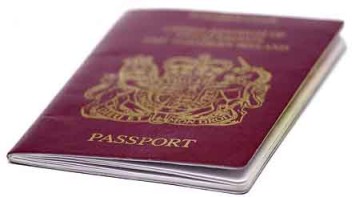
For many international travelers from Western countries, a passport might seem like nothing more than an obligatory document of no extraordinary value, yet in many ways these carefully bound and embossed permits are the lubricants of globalization. Swift passage through immigration control is one of the things that keeps the wheels of business turning smoothly.

But anyone traveling to the Middle East on an EU or Australian passport will now face a new level of scrutiny from immigration officers intent on blocking the passage of Israeli assassins.

Dubai’s police chief Lt Gen Dahi Khalfan Tamim announced on Monday that any travelers suspected of being Israeli, even if they hold passports from another country, will now be barred from entry into the UAE.

Asharq Al-Awsat reports that any foreign traveler visiting Lebanon who has a Jewish name will now be placed under surveillance.

Major General Wafiq Jizzini, director general of the Lebanese Public Security, said: “When someone comes to Lebanon on a foreign passport and the name of his family indicates that he is of Jewish origin, the border center sends the information to the central information office at the General Directorate of the Public Security. Afterward, the directorate observes this person who would have already registered his address in Lebanon. Both the visiting person and the one who receives him at the airport are observed.”

Israeli leaders such as Israel’s minister of industry, trade and labor, Binyamin Ben-Eliezer, who still regard the Dubai murder as a victory for Israel, have further reason to question that conclusion as fallout from the operation has now reached the United Nations General Assembly.

On Friday, the only countries willing to side with Israel in opposing a resolution that makes a renewed call for the investigation of war crimes committed during Israel’s war on Gaza, were the United States, Canada, Micronesia, Nauru, Panama, and Macedonia.

Australian government sources informed the Sydney Morning Herald that there was a direct connection between the UN vote and the Dubai affair:

Britain, France and Germany have all recently expressed anger at Israel after their passports were caught up in the Dubai plot.

One Department of Foreign Affairs source told the Herald there was no doubt the decision to abstain was intended as a sign to Israel not to take Australian support for granted.

“A number of things made it easier for us to switch our vote,” the source said.

“Firstly, the Americans helped the Palestinians to soften the wording of this resolution compared to the last one. Secondly, a number of other countries had indicated that they were toughening their own positions on Goldstone. But there is no question that the debacle surrounding our passports being used in Dubai helped to make up the government’s mind to abstain. The final decision was taken late on Friday, Australian time, just a few hours before the vote.

“Our pattern in the past has been to vote with the US when it comes to Israel, to show as much support for Israel as possible.

“We were also aware that the UK’s decision to vote in favour of the resolution was influenced by the fact that so many of their citizens had been caught up in the Dubai assassination.”

Israelis would do well to remember that even among their most effusive supporters, an allegiance to business invariably trumps all others.

Facebooktwittermail

Two Dubai murder suspects entered the US

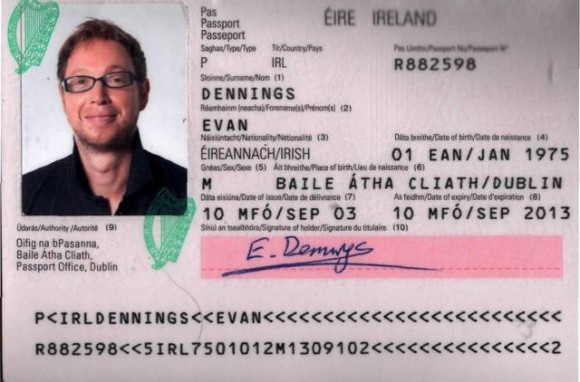
A murder suspect, traveling as an Irishman Evan Dennings, entered the US on January 21, a day after Mahmoud al Mabhouh’s body was discovered in Dubai.

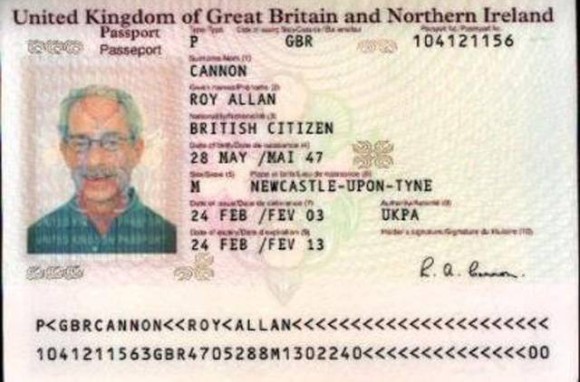
Roy Allan Cannon, entered the US on February 14.

The Wall Street Journal reports:

At least two of the 26 suspects sought by Dubai police for the alleged killing of a top Hamas leader appear to have entered the U.S. shortly after his death, according to people familiar with the situation.

Records shared between international investigators show that one of the suspects entered the U.S. on Feb. 14, carrying a British passport, according to a person familiar with the situation. The other suspect, carrying an Irish passport, entered the U.S. on Jan. 21, according to this person. Senior Hamas leader Mahmoud al-Mabhouh’s body was found in a Dubai hotel room on Jan. 20.

There aren’t records of either man leaving the U.S., though investigators can’t be sure the two are still in the country, according to this person. Since the two were traveling with what investigators believe to be fraudulently issued passports, they may have traveled back out of the U.S. with different, bogus travel documents.

The suspected U.S. travel broadens to American shores the international manhunt triggered by Dubai’s investigation into the death of Mr. Mabhouh. Dubai police have already identified two U.S. financial companies they believe issued and distributed several credit cards used by 14 of the suspects in the alleged killing.

Facebooktwittermail

Mossad returns to its ‘glory days’

The Times reports:

Would you be prepared to cross-dress? And kill a guest in an adjacent hotel room? If the answer to these questions is a resounding “yes”, and you can also act, enjoy luxury international travel with a twist and can carry off a convincing Irish or Australian accent, then the job could be yours.

The Israeli spy agency Mossad may be the target of international reproach since it allegedly killed the Hamas leader Mahmoud al-Mabhouh in a Dubai hotel this month, but at home emerging details of the operation have generated Mossad mania.

It has never been more popular in Israel, with stores selling out of Mossad memorabilia and its official website reporting a soaring number of visitors interested in applying to become agents. “Mossad has been restored to its glory days,” said Ilan Mizrahi, a former deputy director of the agency, which is located in the affluent beach town of Herzliya, north of Tel Aviv.

One of the signature elements of cult psychology is that the more a group is vilified, the more self-righteous it becomes. The outsiders’ opprobrium, far from provoking shame or doubt, has the opposite effect: it is treated as a vindication of the cult’s sense of superiority.

Facebooktwittermail

Is Israel really prepared to go it alone?

Reuters reports:

Israel’s perspective on Iran’s nuclear program differs from that of the United States, and the two may part ways on what action to take, Israeli Defense Minister Ehud Barak said on Friday.

Washington’s clout over its Middle East ally is under scrutiny after Israel’s veiled threats to attack Iran preemptively if international diplomacy fails to rein in Tehran’s uranium enrichment, a process with bomb-making potential.

The United States this week said it did not want to hurt the Iranian people with “crippling” sanctions against Iran’s energy sector, measures Israeli Prime Minister Benjamin Netanyahu has described as the only viable diplomatic solution.

“There is of course a certain difference in perspective and a difference in judgment and a difference in the internal clock, a difference in capabilities,” Barak told the Washington Institute for Near East Policy think-tank, when asked about Israeli-U.S. discussions about Iran.

“I don’t think that there is a need to coordinate in this regard. There should be understanding on the exchange of views, but we do not need to coordinate everything,” said Barak, who was in Washington for strategic talks.

Yet again, we are supposed to believe that Israel is prepared to go it alone and take on Iran.

Israel can destroy a nuclear reactor in Iraq; it can destroy one under construction in Syria; it wipe out a weapons convoy in Sudan; it can kill a Hezbollah commander with a bomb in Damascus; it can smother a Hamas commander with a pillow in Dubai; and it can flatten Southern Lebanon and Gaza.

Therefore, Israel’s ready to go to war with Iran… or, it loves to show off its power when it perceives the risk of doing so is minimal. If that was the case with Iran, we wouldn’t be weighing the chances of an Israeli attack — we’d be looking at the results of such an action.

Facebooktwittermail

Moussavi says Iran is ruled by a dictatorial ‘cult’

The New York Times reports:

One of Iran’s opposition leaders, Mir Hussein Moussavi, said Saturday that a dictatorial “cult” was ruling Iran — one of his most critical statements against the country’s rulers since disputed elections last summer.

“This is the rule of a cult that has hijacked the concept of Iranianism and nationalism,” Mr. Moussavi said in the interview posted on his Web site, Kalameh. “Our people cannot tolerate such behavior under the name of religion.”

The statements appear to be part of a renewed campaign by the opposition’s leadership to prove that they are still vital, despite a brutal crackdown by the government and their inability to bring masses of people to the streets in a recent planned protest.

Last week, another opposition leader, Mehdi Karroubi, called for a national referendum to gauge the popularity of the government. The supreme leader, Ayatollah Ali Khamenei, followed with a statement dismissing the possibility of any compromise with the opposition, saying those who refused to accept the results of the June 12 election had no right to participate in politics.

Facebooktwittermail

In Pakistan lack of opportunity fuels radicalism

The New York Times on how talent, stripped of opportunity, is feeding radicalism in Pakistan:

Umar Kundi was his parents’ pride, an ambitious young man from a small town who made it to medical school in the big city. It seemed like a story of working-class success, living proof in this unequal society that a telephone operator’s son could become a doctor.

But things went wrong along the way. On campus Mr. Kundi fell in with a hard-line Islamic group. His degree did not get him a job, and he drifted in the urban crush of young people looking for work. His early radicalization helped channel his ambitions in a grander, more sinister way.

Instead of healing the sick, Mr. Kundi went on to become one of Pakistan’s most accomplished militants. Working under a handler from Al Qaeda, he was part of a network that carried out some of the boldest attacks against the Pakistani state and its people last year, the police here say. Months of hunting him ended on Feb. 19, when he was killed in a shootout with the police at the age of 29.

Mr. Kundi and members of his circle — educated strivers who come from the lower middle class — are part of a new generation that has made militant networks in Pakistan more sophisticated and deadly. Al Qaeda has harnessed their aimless ambition and anger at Pakistan’s alliance with the United States, their generation’s most electrifying enemy.

Facebooktwittermail

Twenty-seven years of solitary confinement

In the United States it isn’t just suspected terrorists who are subject to cruel and unusual punishment. The case of Tommy Silverstein highlights the extremes that can be found inside the largest prison system in the world:

Tommy Silverstein has been held in solitary confinement for the past 27 years, longer than anyone else in the federal prison system, his lawyers say.

He is locked up at the high-security prison in Florence, Colorado, known as Supermax. The lights are always on. Guards who slip him food through a slot in his cell door usually ignore him. A few times a week, he is permitted to exercise in the recreation room — alone. Visits with his family and his lawyers are conducted through Plexiglas.

Silverstein’s isolation is the result of an unusual no-human-contact order issued by a judge in 1983, after he murdered a guard at the federal prison in Marion, Illinois. Marion was known at the time as the most rigorous confinement in the federal prison system.

Silverstein has referred to his solitary existence as “a slow, constant peeling of the skin.”

His attorneys, who are affiliated with the University of Denver, filed a lawsuit against the U.S. Bureau of Prisons in 2007, alleging that such prison conditions violate the cruel and unusual punishment clause of the Eighth Amendment. The lawsuit, filed in the federal district court of Colorado, is awaiting trial.

Facebooktwittermail

Can the US afford not to help in the Dubai murder investigation?

On Thursday, the US State Department spokesmen P J Crowley was called on to break the US silence regarding the murder of Mahmoud al-Mabhouh:

QUESTION: …has there been any comment on the apparent assassination in Dubai? Is that something the U.S. has weighed in on?

MR. CROWLEY: I don’t think we’ve weighed in on it. It is being investigated by Dubai authorities.

QUESTION: Are you concerned about what appears to have been the use of foreign passports, forged passports by foreign operatives?

MR. CROWLEY: Well, I think, as a – you probably – the best place to – well – I mean, we have taken steps in recent years to strengthen the security surrounding U.S. passports. Obviously, this has been an area where the United States has talked to other countries. We are very alert to attempts to use forged or stolen passports, and as a major effort to limit the travel of terrorists around the world. So it is something that we have spent a lot of time focused on.

As to – I mean, that obviously is an area that will be investigated and is being investigated by Dubai authorities.

QUESTION: Would you be – would you condemn the use by an intelligence agency of forging passports?

MR. CROWLEY: Well, there’s an assumption behind your question that I can’t address.

QUESTION: Have the Dubai authorities, or the European partners, allies, asked the United States for help in the investigation into —

MR. CROWLEY: Not to my knowledge.

QUESTION: And would you cooperate with Interpol on any of this?

MR. CROWLEY: Well, we – I mean, we have specific responsibilities to – law enforcement would be cooperative if there’s anything that we can do or if we come across any information that we think is useful to the investigation.

Maybe Dubai can set up an 800 number — a number US officials can call if they happen to stumble across any useful information. Crowley’s response did not suggest the US intends to stonewall the Dubai investigation, but the tone was one of calculated disinterest.

But wait. The Wall Street Journal now reports:

American and United Arab Emirates authorities are exchanging information on a handful of credit-card accounts, issued through two U.S. firms, that Dubai police say were used by suspects in the killing of a top Hamas official in Dubai, according to a person familiar with the situation.

For years, U.S. government officials have flown into the U.A.E. and other Persian Gulf states, asking for assistance in terror-financing probes. The investigation of Mahmoud al-Mabhouh’s death appears to be the highest-profile case in which the roles are reversed: The U.A.E. is turning to Washington in its efforts to track down suspected criminal financing through the U.S. banking system.

What the WSJ neglects to mention is that Dubai’s call for US assistance comes at particularly awkward moment.

As the US pushes for sanctions against Iran, the emirate of Dubai is in a pivotal position to tighten or ease the economic pressure — it functions as Iran’s most important commercial and financial connection with the rest of the world.

If Washington drags its feet in assisting Dubai now, why should the US expect help from Dubai on the larger issue of pressuring Iran — an issue that concerns Israel more than any other country?

At the same time, if the Associated Press is to be believed, Dubai is not getting much help from European governments in the investigation:

The spotlight is falling on those countries where police say the alleged assassins’ trails begin and end: Switzerland, Italy, France, Germany and the Netherlands.

Authorities there have either declined to say whether they are investigating, or told The Associated Press they have no reason to hunt down the 26 suspects implicated in the Jan. 19 killing of Mahmoud al-Mabhouh.

European countries’ reluctance to investigate may have something to do with the widely held belief that the killing of al-Mabhouh was carried out by a friendly country’s intelligence agency – Israel’s Mossad. The Jewish state has previously identified him as the point man for smuggling weapons to the Gaza Strip’s Hamas rulers.

Experts say arresting Israeli agents – or even digging up further evidence that Israel was involved – could be politically costly.

And what exactly would that political cost be? Israel might refuse to participate in the Eurovision Song Contest? Israel leaders might decline to visit European countries where they already face the risk of being arrested for war crimes?

Certainly, the arrest of Mossad agents by a European country might sour relations with the US, but what’s the US going to do? Kick NATO troops out of Afghanistan?

As far as I can see, we’re looking at a political balance sheet where all the loses are on Israel’s side.

But we scored a major victory against Hamas, Israelis say.

Let’s be honest. The future of the Palestinian national movement, of which Hamas is a part, did not depend on Mahmoud al-Mabhouh. The Islamist organization and his family no doubt mourn his loss, but he is replaceable.

Meanwhile, the Dubai police chief Dahi Khalfan Tamim made a move that will not sit well with dual national Israelis and non-Israeli Jews who conduct business in the region. He urged Arab countries to thoroughly check any Jew who carries a non-Israeli passport in order to “prevent Mossad’s infiltrations”.

You might call it profiling payback.

Facebooktwittermail

The attrition of bravery

In Shakespeare’s Henry V, as the Battle of Agincourt is about to commence, the king addresses his men — “We few, we happy few, we band of brothers” — heavily outnumbered by the French and facing the risk of imminent slaughter.

Henry — a king who fights with his men and doesn’t simply issue commands — declares:

… he which hath no stomach to this fight,
Let him depart; his passport shall be made,
And crowns for convoy put into his purse;
We would not die in that man’s company
That fears his fellowship to die with us.

To the extent that there is a noble dimension to warfare it is this: that those willing to kill are also willing to die. Those taking the lives of others do so knowing that just as easily they could lose their own.

The technological advance of war has broken this equation and broken it so thoroughly that not only do a new class of killers face no risk of being killed; they may not even lose any sleep.

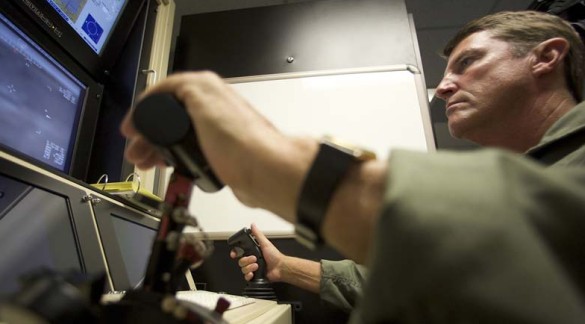
A drone pilot can fire on an insurgent dug into the Afghan hills and be home in time for a backyard barbecue. In just an hour or two, the pilot can go from a heated argument with a spouse to a tense radio conversation with an amped-up soldier pinned down by weapons fire.

“On the drive out here, you get yourself ready to enter the compartment of your life that is flying combat,” said retired Col. Chris Chambliss, who until last summer commanded drone operations at Creech Air Force Base, the command center for seven Air Force bases in the continental U.S. where crews fly drones over Iraq and Afghanistan. “And on the drive home, you get ready for that part of your life that’s going to be the soccer game.”

Drone crews don’t put their lives at risk. Instead, they juggle vast streams of video and data. With briefings both before and after their missions, their workdays typically stretch to 10 or 11 hours. Many of the pilots are experienced military fliers, but the camera operators tend to be much younger — often only 19 or 20, and new to the stresses of combat.

Mirroring the remote warfare of the drone operator is an unspoken compact between civilians and soldiers: The threshold at which this nation offers its tacit consent to war now corresponds not with the degree to which we embrace its gravity but the degree to which it can be ignored.

Ours have become wars of indifference whose advance is commensurate with the attrition of bravery.

Facebooktwittermail