The country of Ghanzia is embroiled in a civil war. As a soldier in America’s Army, your job is to do everything from protect U.S. military convoys against AK-47-wielding attackers to sneak up on a mountain observatory where arms dealers are hiding out. It is a tough and dangerous tour of duty that requires dedication, focus, and a bit of luck. Fortunately, if you get hit by a bullet and bleed to death, you can reboot your computer and sign on under a new name.
America’s Army is a video game — a “tactical multiplayer first-person shooter” in gaming lingo — that was originally developed by the U.S. military to aid in its recruiting and training, but is now available for anyone to play. Among the most downloaded Internet games of all time, it is perhaps the best known of a vast array of video game-based military training programs and combat simulations whose scope and importance are rapidly changing not just the video-game marketplace, but also the way the U.S. military finds and trains its future warriors and even how the American public interfaces with the wars carried out in its name. For all the attention to the strategic debates of the post-9/11 era, a different sort of transformation has taken place over the last decade — largely escaping public scrutiny, at modest cost relative to the enormous sums spent elsewhere in the Pentagon budget, and with little planning but enormous consequences.
At GlobalPost, Jean MacKenzie and Mohammad Ilyas Dayee write:
The dusty squares of Marjah are empty; there is no life, the soul of the place seems to have disappeared. Those residents who are left cower in their homes, afraid of bullets or mines if they venture out, even for food.
“It is a small picture of Doomsday,” said Alishah Mazlumyar, the head of Helmand’s Department of Information and Culture, and a member of the Marjah shura, or council. “Dozens of civilians have been killed. Their families cannot bury the bodies, and for days they have been lying in their houses, beginning to decompose. There is a smell of death here.”
Twelve days into Operation Moshtarak — pitting 15,000 U.S., British and Afghan troops against a few hundred Taliban — the message from the military and diplomatic communities is resolutely upbeat.
Western diplomats term the operation a success, and the media office of the International Security Assistance Force (ISAF) points to a bright future.
“Signs of steady progress in development and governance are being seen in central Helmand province. Bridges, roads and culverts are being repaired, bazaars are re-opening and attracting customers, and a variety of initiatives are being planned or implemented,” read the IJC press release of Feb. 22.
But those in Marjah are telling a very different story.
Pakistan has arrested nearly half of the Afghanistan Taliban’s leadership in recent days, Pakistani officials told the Monitor Wednesday, dealing what could be a crucial blow to the insurgent movement.
In total, seven of the insurgent group’s 15-member leadership council, thought to be based in Quetta, Pakistan, including the head of military operations, have been apprehended in the past week, according to Pakistani intelligence officials.
Western and Pakistani media had previously reported the arrest of three of the 15, but this is the first confirmation of the wider scale of the Pakistan crackdown on the Taliban leadership, something the US has sought.
“This really hurts the Taliban in the short run,” says Wahid Muzjda, a former Taliban official turned political analyst, based in Kabul. Whether it will have an effect in the long run will depend on what kind of new leaders take the reins, he says.
Inside a secret detention center in an industrial pocket of the Pakistani capital called I/9, teams of Pakistani and American spies have kept a watchful eye on a senior Taliban leader captured last month. With the other eye, they watch each other.
The C.I.A. and its Pakistani counterpart, the Directorate of Inter-Services Intelligence, have a long and often tormented relationship. And even now, they are moving warily toward conflicting goals, with each maneuvering to protect its influence after the shooting stops in Afghanistan.
Yet interviews in recent days show how they are working together on tactical operations, and how far the C.I.A. has extended its extraordinary secret war beyond the mountainous tribal belt and deep into Pakistan’s sprawling cities.
Beyond the capture of Mullah Abdul Ghani Baradar, C.I.A. operatives working with the ISI have carried out dozens of raids throughout Pakistan over the past year, working from bases in the cities of Quetta, Peshawar and elsewhere, according to Pakistani security officials.
A blizzard of bank notes is flying out of Afghanistan — often in full view of customs officers at the Kabul airport — as part of a cash exodus that is confounding U.S. officials and raising concerns about the money’s origin.
The cash, estimated to total well over $1 billion a year, flows mostly to the Persian Gulf emirate of Dubai, where many wealthy Afghans now park their families and funds, according to U.S. and Afghan officials. So long as departing cash is declared at the airport here, its transfer is legal.
But at a time when the United States and its allies are spending billions of dollars to prop up the fragile government of President Hamid Karzai, the volume of the outflow has stirred concerns that funds have been diverted from aid. The U.S. Drug Enforcement Administration, for its part, is trying to figure out whether some of the money comes from Afghanistan’s thriving opium trade. And officials in neighboring Pakistan think that at least some of the cash leaving Kabul has been smuggled overland from Pakistan.
Finally, in Mother Jones, Daniel Schulman reports:
Blackwater improperly obtained hundreds of weapons intended for use by Afghanistan’s already underequipped police force—and then falsely claimed to a Senate committee that the firearms had been returned when many remained unaccounted for.
According to a months-long investigation by the Senate Armed Services Committee that unearthed a range of misconduct by the company’s personnel, contractors working for a Blackwater subsidiary named Paravant operated recklessly and routinely violated military regulations. The inquiry also identified a series of major vetting lapses by the company, which employed at least one contractor it had previously fired for improper behavior in Iraq and others who abused alcohol and drugs, including steroids. The investigation paints a grim picture of the state of contracting oversight in Afghanistan, where, according to committee staffers, military officials missed multiple red flags calling Paravant’s conduct into question—and were even confused about who was ultimately responsible for overseeing the company’s work in the first place.
President Bashar al-Assad and Mahmoud Ahmadinejad, who was in Damascus today, threw down the gauntlet. Only the day before Hilary Clinton warned Syria “to begin to move away from the relationship with Iran,” and stop supporting Hizbullah, Hamas, and ex-Baathists in Iraq. For several years, Syria has been told to “flip” and break from Iran if it expects to be allowed out of diplomatic and economic isolation. Israel has made Syria’s break with Iran a condition for peace with Damascus.
Today, Assad came out forcefully and defiantly to end any talk of separation.
“We must have understood Clinton wrong because of a bad translation or our limited understanding, so we signed the agreement to cancel the visas,” Assad said. “I find it strange that they (Americans) talk about Middle East stability and peace and the other beautiful principles and call for two countries to move away from each other,” he added.
Ahmadinejad, for his part, held up his hand with his thumb and index finger only a centimeter apart to indicate how little separated the positions of both countries.
The presidents of Iran and Syria on Thursday ridiculed U.S. policy in the region and pledged to create a Middle East “without Zionists,” combining a slap at recent U.S. overtures and a threat to Israel with an endorsement of one of the region’s defining alliances.
Ah, more threats to Israel… except Ahmadinejad’s threat was more nuanced than the Post report implies and it was made conditional on the possibility that Israel might launch another war. The Iranian president said:
I call on the Zionists to return to their senses and to recognize the legitimate rights of the people of the region and to respect them and to understand that if they continue to go down the wrong path, which they have traveled in the past, there will be no place for them in our region.
In other words, if Zionists insist on disregarding the rights of Palestinians and on making war with their neighbors, they are not welcome in the Middle East. What a reckless and unreasonable statement!
Twenty-one years ago, in 1989, I wrote what many have called the first book for a general audience on global warming. One of the more interesting reviews came from the Wall Street Journal. It was a mixed and judicious appraisal. “The subject,” the reviewer said, “is important, the notion is arresting, and Mr. McKibben argues convincingly.” And that was not an outlier: around the same time, the first president Bush announced that he planned to “fight the greenhouse effect with the White House effect.”
I doubt that’s what the Journal will say about my next book when it comes out in a few weeks, and I know that no GOP presidential contender would now dream of acknowledging that human beings are warming the planet. Sarah Palin is currently calling climate science “snake oil” and last week, the Utah legislature, in a move straight out of the King Canute playbook, passed a resolution condemning “a well organized and ongoing effort to manipulate global temperature data in order to produce a global warming outcome” on a nearly party-line vote.
And here’s what’s odd. In 1989, I could fit just about every scientific study on climate change on top of my desk. The science was still thin. If my reporting made me think it was nonetheless convincing, many scientists were not yet prepared to agree.
Now, you could fill the Superdome with climate-change research data. (You might not want to, though, since Hurricane Katrina demonstrated just how easy it was to rip holes in its roof.) Every major scientific body in the world has produced reports confirming the peril. All 15 of the warmest years on record have come in the two decades that have passed since 1989. In the meantime, the Earth’s major natural systems have all shown undeniable signs of rapid flux: melting Arctic and glacial ice, rapidly acidifying seawater, and so on.
Somehow, though, the onslaught against the science of climate change has never been stronger, and its effects, at least in the U.S., never more obvious: fewer Americans believe humans are warming the planet. At least partly as a result, Congress feels little need to consider global-warming legislation, no less pass it; and as a result of that failure, progress towards any kind of international agreement on climate change has essentially ground to a halt.
Back in the fall of 2003, I was in London for an conference and I took a stroll around the neighborhood near my hotel. At one point I turned a corner and saw a massive, looming building, surrounded with various barriers and fences and looking for all the world like an updated version of a medieval castle. “What’s that?” I wondered, and wandered over to investigate. It was the U.S. Embassy, of course, and I was struck by how forbidding and unwelcoming it was. It seemed to me to be a vivid physical symbol of a powerful Empire striving to keep the outside world at bay.
I thought of that moment today when I read the Times story on the winning design for a new U.S. embassy in London. Lord knows I’m no architecture critic, and I think my wife was too harsh when she said the winning design looked “like a big ice-cube,” but the sketches in the Times don’t show a building that invites the world in, or that conveys a sense of openness and confidence. Despite elaborate efforts to conceal security measures with adroit landscaping, the overall image is one where security concerns predominate: a fancy building isolated from its surroundings and keeping the world at arm’s length.
What troubles me is what this tells us about America’s place in the contemporary world, and the tensions between its global ambitions and its willingness to accept the consequences of them. On the one hand, the United States defines its own interests in global terms: there are no regions and few policy issues where we don’t want to have a significant voice, and there are many places and issues where we insist on having the loudest one. But on the other hand, we don’t think we should get our hair mussed while we tell the world what to do. It’s tolerable for the United States to fire drones virtually anywhere (provided the states in question can’t retaliate, of course), and Americans don’t seem to have much of a problem with our running covert programs to destabilize other regimes that we’ve decided to dislike. We also aid, comfort and diplomatic support to assorted other states whose governments often act in deeply objectionable ways. But then we face the obvious problem that some people are going to object to these policies, hold us responsible, and try to do what they can to hit back.
Even among Israelis who welcomed news of the assassination of the Hamas commander Mahmoud al-Mabhouh, there must have been growing disquiet that the faces of so many Mossad operatives would have since become so widely known. So much exposure for a clandestine operation has to be bad, doesn’t it?
It now appears that Mossad has enrolled the services of Haaretz in order to do some damage control.
The passport photographs of the agents who assassinated Mahmoud al-Mabhouh in Dubai were doctored so the agents would not be identified, a Haaretz probe has discovered.
The discovery casts doubt on claims that the espionage agency that carried out last month’s hit on the senior Hamas operative committed grave errors.
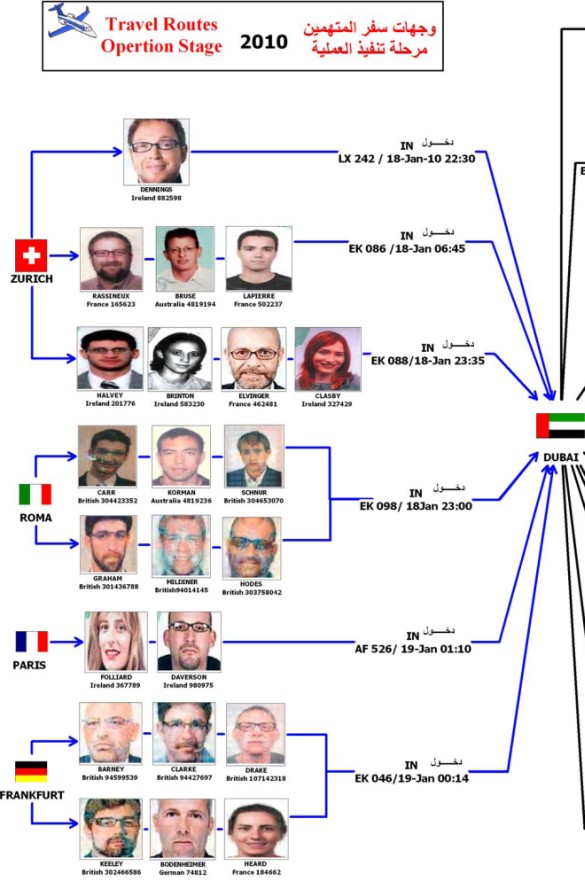
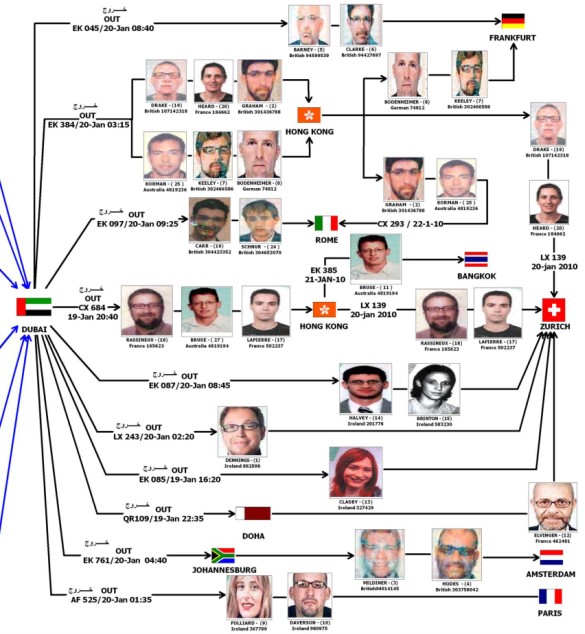
Various features of the people in the photographs, such as eye color or the line of a lip, were changed – slightly enough so as not arouse suspicion at passport control, but still enough that the real agent could not be recognized.
According to the Dubai police, only a few of the agents were caught on security cameras without their disguises. However, it had been assumed until now that publication of the photos of the 26 agents had blown their cover. Now it appears that the Dubai police still do not have viable information about their real appearance.
In an era where investigative journalism has largely become a thing of the past, it’s hard not to scoff when one reads that a newspaper has conducted a “probe”. Some intrepid reporters dug deep and pulled out the truth and now they can proudly display their discovery.
In this case, I would counter that there is more to be discovered by reasoning than revelation.
I’ll start with this — a wild piece of conjecture in which I have absolute confidence: the “espionage agency” that Haaretz stuck its probe into was Mossad — no other spy shop would dole out sensitive information to Israeli reporters.
Secondly, the idea that Haaretz actually discovered that there were discrepancies between the appearances of the Mossad agents and the images on their passports is absurd. (I don’t care how careful an analysis of the CCTV images might be it ain’t going to pick up differences in eye color and the like.) Such discrepancies may exist in reality, but there seem to be only two ways Haaretz could know about them. Either, in a friendly meeting with a Mossad officer the newspaper was shown two sets of photographs: one being the ones used in the passports and the other showing the undoctored appearances of the operatives — but I have my doubts that Mossad would be that candid. Much more likely was a friendly phone call from a trusted source inside the agency, saying: you know those photos of all our guys plastered over all the newspapers? We doctored them. Our guys are safe. No one will be able to recognize them. The intrepid Haaretz reporters would not have been so impertinent as to ask for some proof.
In sum, what we can reliably infer from this report is that Mossad is busy working the media. Its cover may or may not have been blown but at the very least it wants to reassure concerned Israelis that the much praised and feared agency remains rock solid.
Meanwhile, while one thrust of Mossad’s PR drive is pushing the message that its operatives identities are well protected, another thrust is actually promoting their images — as “young, pretty and dangerous“. The message: assassination is sexy and it doesn’t have to interfere with an Israeli woman’s plans to start a family. “Rumors that women are used by the Mossad mostly as [sexual] bait are greatly exaggerated,” Ynet reassures its readers.
Jonathan Cook, writing at Mondoweiss, provides some fascinating insights into the reasons for the entrenched bias in Western reporting on Israel-Palestine conflict. He explains why the case of Eitan (“Ethan”) Bronner — the New York Times Jerusalem bureau chief whose son’s enrollment in the Israeli army recently provoked a brief debate inside the newspaper about conflicts of interest — is far from unusual. Cook spoke to a Jerusalem-based bureau chief who anonymously shared these observations:
He calls Bronner’s situation “the rule, not the exception”, adding: “I can think of a dozen foreign bureau chiefs, responsible for covering both Israel and the Palestinians, who have served in the Israeli army, and another dozen who like Bronner have kids in the Israeli army.”
He added that it is very common to hear Western reporters boasting to one another about their “Zionist” credentials, their service in the Israeli army or the loyal service of their children. “Comments like that are very common at Foreign Press Association gatherings [in Israel] among the senior, agenda-setting, elite journalists.”
My informant is highly critical of what is going on among the Jerusalem press corps, even though he admits the same charges could be levelled against him. “I’m Jewish, married to an Israeli and like almost all Western journalists live in Jewish West Jerusalem. In my free time I hang out in cafes and bars with Jewish Israelis chatting in Hebrew. For the Jewish sabbath and Jewish holidays I often get together with a bunch of Western journalists. While it would be convenient to think otherwise, there is no question that this deep personal integration into Israeli society informs our overall understanding and coverage of the place in a way quite different from a journalist who lived in Ramallah or Gaza and whose personal life was more embedded in Palestinian society.”
And now he gets to the crunch: “The degree to which Bronner’s personal life, like that of most lead journalists here, is integrated into Israeli society, makes him an excellent candidate to cover Israeli political life, cultural shifts and intellectual life. The problem is that Bronner is also expected to be his paper’s lead voice on Palestinian political life, cultural shifts and intellectual life, all in a society he has almost no connection to, deep knowledge of or even the ability to directly communicate with … The presumption that this is possible is neither fair to Bronner nor to his readers, and it’s really a shame that Western media executives don’t see the value in an Arabic-speaking bureau chief living in Ramallah and setting the agenda for the news coming out of the Palestinian territories.”
All true. But I think there is a deeper lesson from the Bronner affair. Editors who prefer to appoint Jews and Israelis to cover the Israeli-Palestinian conflict are probably making a rational choice in news terms — even if they would never dare admit their reasoning. The media assign someone to the Jerusalem bureau because they want as much access as possible to the inner sanctums of power in a self-declared Jewish state. They believe – and they are right – that doors open if their reporter is a Jew, or better still an Israeli Jew, who has proved his or her commitment to Israel by marrying an Israeli, by serving in the army or having a child in the army, and by speaking fluent Hebrew, a language all but useless outside this small state.
Yes, Ethan Bronner is “the rule”, as my informant notes, because any other kind of journalist — the goyim, as many Israelis dismiss non-Jews — will only ever be able to scratch at the surface of Israel’s military-political-industrial edifice. The Bronners have access to power, they can talk to the officials who matter, because those same officials trust that high-powered Jewish and Israeli reporters belong in the Israeli consensus. They may be critical of the occupation, but they can be trusted to pull their punches. If they ever failed to do so, they would be ejected from the inner sanctum and a paper like the NYT would be forced to replace them with someone more cooperative.
As I noted below, the New York-based company Payoneer is linked to Israel in a number of ways, not least through it’s Israeli CEO, Yuval Tal, a former member of an elite combat unit of the Israel Defense Forces and former Vice President of Business Development for the Tel Aviv-based technology company, Radware. Tal describes how Payoneer operates in this video.
Mr Tal did not exactly conceal his prior affiliations when he appeared on Fox News during the 2006 Lebanon war. He opined then that “this is a war that Israel cannot afford to lose”.
If Tal or his Payoneer firm are in any way involved in the conspiracy to help a foreign intelligence service (like, say providing Mossad operatives with credit cards), he may soon find himself in his own battle with little prospects of winning – in a US courtroom.
The Federal Bureau of Investigation (FBI) is the lead agency with statutory authority and responsibilities for investigating foreign espionage activities on US soil. It’s a job they take seriously and with a proven record of not shying away from the numerous instances when America’s special ally played foul.
As an initial inquiry, I imagine case agents will subpoena all financial records associated with the fraudulently issued credit cards. This would include the original credit card applications, which requires such things as a delivery address (to mail the card to), social security numbers, dates of birth, and employment information.
If the applications were made on paper, then the documents may contain all manner of evidence, from handwriting samples to fingerprints. There will be a similar trail to pore over if the applications were made over the phone or electronically via computer.
I also smell money laundering, as the money was supposedly dumped into prepaid accounts to conceal its purpose and origination. So US investigators may even want to tap in on the US treasury department’s crack financial investigator, Financial Crimes Enforcement Network (FINCEN).
Beneath an article about Payoneer appearing at TechCrunch, a commenter suggests: “payoneer is definitely in the legal gray area when it comes to the patriot’s act, anti-money laundering, and a host of other laws around ‘know your customer'”
Tal answers:
Payoneer is meticulously compliant with all federal, state and MasterCard regulations, including AML, BSA, Patriot act, KYC etc. There is nothing grey about it. As a certified MasterCard Member Service Provider we undergo rigorous ongoing diligence related, among others, to our regulatory compliance level.
If Payoneer comes under investigation, the FBI and US government regulatory agencies will not simply take Tal at his word. They will want to know exactly how Payoneer cards could be used by individuals with false identification.
Although the Israeli government has yet to confirm its role in the murder of Mahmoud al Mabhouh, the Dubai police have provided further evidence through financial records that connect the crime to Israel.
Dubai police said Wednesday they had identified credit cards used by 14 of the suspects to book hotel rooms and pay for air travel. Police named the issuing bank as MetaBank, a unit of Meta Financial Group Inc., a financial company based in Storm Lake, Iowa.
The bank said it had no comment “because we are trying to confirm the accuracy of statements by the press.”
Dubai police identified cards issued by Britain’s Nationwide Building Society, IDT Finance of Gilbraltar, and Germany’s DZ Bank AG. A Nationwide spokesman told the Associated Press that bank officials were “investigating the reports and have no further comments.” The other European companies weren’t reachable late Wednesday.
Dubai also identified a company called Payoneer Inc., based in New York, though it wasn’t clear what precise role authorities believe that company played. In a chart released to reporters, authorities suggested the company distributed the cards on behalf of MetaBank.
According to its Web site, Payoneer offers online payment solutions, including arranging for employers to pay overseas workers through money transfers into prepaid MasterCard debit-card accounts. Payoneer is based in New York, but has offices in Tel Aviv.
The company’s chief executive, Yuval Tal, appeared as a commentator on the Lebanon war in 2006 on Fox News, identifying himself as a former Israeli special-forces soldier. Mr. Tal wasn’t available to comment.
Police revealed 15 more suspects in the Al Mabhouh murder case on Wednesday. The extensive investigation has led to a total of 26 suspects so far involved in the murder of the Hamas official Mahmoud Al Mabhouh at a Dubai hotel. In addition to the previously released list of 11 suspects, Dubai Police has now identified another six suspects, who include a woman who used British passports, a man and three women travelling on Irish passports, two men who used French passports, and three people with Australian passports. The Australians included a woman.
Newly-released video of some of the murder suspects:
With the travel movements and photographs of 26 suspected Mossad operatives now appearing in the international media, how long will it be before one of the murder suspects is arrested? Moreover, since Mossad’s assassination unit apparently included around just 50 agents, one would imagine that with half of them now in hiding (or getting reconstructive plastic surgery to change their appearances) the unit has, for the time being, rendered itself inoperative.
Israeli foreign minister Avigdor Lieberman yesterday flatly rebuffed David Miliband’s request for cooperation with an investigation into the use of forged British passports in the assassination of a Hamas leader.
The request for assistance came as the total number of fake British passports believed to have been used in last month’s assassination rose from six to eight. But private discussions on the sidelines of an EU meeting in Brussels – and an identical request from Irish foreign minister Micheál Martin – yielded no concessions on the Israeli side.
A statement from Mr Lieberman’s office reiterated that there was “no proof” of Israeli involvement in the affair. “If someone would present information beyond articles in the media, we would relate to it,” he is said to have told Mr Miliband. “But since there is no such information, there is no need to deal with the matter.”
A report in the Los Angeles Times, recounting an interview that an Israeli journalist, Ronen Bergman, gave on Israeli Army Radio on Monday, indicates that Mossad has been amazingly slow in covering its tracks:
A man walked in to the interior ministry in Cologne, Germany on June 16, 2009, and claimed that he was Michael Bodenheimer, an Israeli citizen, descended of a German family that had been persecuted by the Nazis.
He applied for German citizenship, saying he wished to leave Israel and emigrate to Germany. He presented documents, including his parents’ German marriage certificate, said he lived in the community of Liman and also gave an address in Herzliya.
The documents must have been convincingly authentic, and two days later, in a model of bureaucratic efficiency that seems atypical (even for Germany), the passport had been issued.
The photograph on the passport is the one now in the papers as one of the assassins, but it is most definitely not that of the Michael Bodenheimer who does live somewhere else in Israel.
The Israeli one is a yeshiva master, an ultraorthodox Jew living in Bnei Brak. His parents were, in fact, born in Frankfurt, Germany, but that’s where the similarity ends. He has Israeli citizenship and evidently American too, but not German.
The new Bodenheimer gave an address in Herzliya. Bergman said the German authorities didn’t check it out. But had they done so, they would have found that he had an apparent shell company in his name with offices in Herzliya.
“Michael Bodenheimer Ltd.” belonged to a group of offices opened by a different company called “Top Office” located on the same floor.
Top Office, says Bergman, is apparently a company that provides individuals and small businesses with an office and secretary at a respectable location.
Bergman said he paid the business address a visit on Friday night, together with the Der Spiegel correspondent in Israel, he told the radio.
He took a picture of the sign saying “Michael Bodenheimer Ltd,” and called the number for Top Office. An American-accented woman answered, sounded very surprised and hung up after saying she didn’t work on the Sabbath.
By Sunday morning, says Bergman, both companies were gone. The signs had been removed.
And the guard — the same one from Friday night — was awfully jittery and tried to shoo them away.
Finally, The Guardian reports on a British man whose identity was stolen by Mossad decades ago:
The infamous 1979 assassination of the Palestinian who masterminded the Munich massacre was carried out using a forged British passport belonging to a 27-year-old council worker living in a small flat in south London, the Guardian can reveal.
Peter Derbyshire, who at the time was running leisure centres for Lambeth council, found himself being questioned by special branch over the assassination of Ali Hassan Salameh, chief of operations for Black September, the terrorist organisation behind the hostage attack at the 1972 Olympics that resulted in the death of 11 Israeli athletes.
Derbyshire, who now runs a travel company in the French Pyrenees, told the Guardian: “I received a call at work from someone who said: ‘I’m from special branch. I’m inside your apartment. Can you come home?'”
He returned to find his flat in Balham, south London, had been turned upside down by two special branch officers. He was interrogated for hours by the police, who asked detailed questions about his history and political affiliations.
Eventually they told him his passport number had been used by a man named Peter Scriver in the murder of Salameh in Beirut.
The latest wave of detentions of nearly 50 retired and active duty military personnel as part of an investigation into the Sledgehammer coup plot, allegedly devised by the military to overthrow the government, has put those who strongly denied the authenticity of the plot when it was first made public in a difficult situation.
The Balyoz (Sledgehammer) Security Operation Plan, which was first revealed by the Taraf daily in January, included shady plans such as bombing the most-frequented mosques in İstanbul to trigger chaos in the country with the ultimate goal of a military takeover. While the plan led to nationwide outcry, with many calling on the authorities to punish those behind it, some had suspicions that the plan was “fabricated to defame the military.”
“Although all these claims were so serious that they were referred to judicial bodies, some circles tried to play down the plot or said it was revenge by the government. Instead of saying such plans should have no place in democracies, they denied them, defended them or downplayed them,” Mehmet Altan, a columnist for the Star daily, told Today’s Zaman.
Police said the operation on Monday was launched when the National Police Department’s criminal investigations unit examined and verified the authenticity of documents regarding the Sledgehammer and Cage plans. The original documents were handed to the Ergenekon prosecutors by Taraf, which exposed both plans.
For decades and decades, Turkey’s powerful generals, even if they often remained behind the scenes, ruled the country. And every Turk knew that. They also knew that if the elected politicians make the generals angry, the latter would come down and teach them a damn good lesson.
I got my own share of this national wisdom when I was 8 years old. That was the time when the military coup of 1980 was launched, and all active politicians, including my father, were arrested by the military. Almost all of them were tried for “high treason,” and similar nonsense, and the military prosecutors had asked for their execution.
As a kid, then, I really wasn’t getting what all this meant. I just knew that my father stopped coming home, and started to stay “at a hotel-like place” as my mom told me after his arrest. For weeks, I insisted to join her during her weekly visits to this “hotel.” And, one day, she took me with her.
The place was the military prison in Mamak, a destitute neighborhood in Ankara, and it really did not look like a hotel. It rather resembled, to be honest, Auschwitz. There was barbed wire everywhere, besides watchtowers with machine guns, and lots of soldiers with rifles. We waited behind a corridor of barbed wire, at 7 a.m. on a snowy day, and then my father, along with a dozen other men, showed up in the distance. Their heads were shaven, and they were made to walk in a straight line while singing some military march. Then they lined on the other side of the corridor. I just remember that my father looked warmly at my scared eyes and said, “Don’t worry, I will come home soon.”
He could come home only after spending 14 months in prison, a long-term arrest for no reasonable reason. Thousands of other politicians or activists were also jailed for months, and sometimes years, and often suffered terrible treatment. Unlike Auschwitz, to be fair, Mamak had no gas chambers. But, along with other military prisons in Istanbul and Diyarbakır, it had torture chambers. Some people died under the unbelievable agony they went through, which included notorious “techniques” that I don’t have the stomach to talk about.
The Turks who have gone through all this don’t know what to say when some presumptuous foreigners, such as Israeli president Shimon Peres, utter incredible words like this:
“Turkey is the only country in the world where a non-democratic institution, the Army, was in charge of preserving democracy. And they did it.”
The Army, of course, was not “preserving democracy.” It was rather preempting it. It was also preventing us from finding non-military solutions to our acute problems such as the Kurdish question or the stalemate in Cyprus. Besides the military coups and interventions — in 1960, 1971, 1980 and 1997 — it was perpetually limiting the scope of democratic politics with the “red lines” it drew on all these big issues.
In an interview with the Spanish newspaper El Pais, published on Monday, Turkey’s Prime Minister Recep Tayyip Erdogan said that the Davos incident in which he clashed with Israel’s President Shimon Peres a year ago soon after Israel’s war on Gaza, led to a new Turkish approach to foreign policy.
“That opened a new approach to foreign relations,” he said. “We have a philosophy of strength. It is a foreign policy with a backbone.”
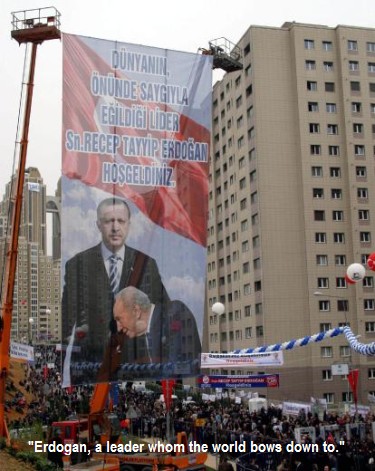
In a graphic response to the insult to Turkey’s ambassador to Israel shown by Israel’s Deputy Foreign Minister Danny Ayalon last month, a poster depicting Peres bowing before Erdogan was briefly unfurled in Istanbul this week.
A huge poster showing Israel’s president bowing to the Turkish prime minister was hung from an Istanbul crane Sunday in the latest round of sniping between the two nations.
The picture, unfurled from a crane in a city suburb, combined an image of Turkish Prime Minister Recep Tayyip Erdoğan standing upright with one of Shimon Peres leaning forward; making it look like the Israeli president was bowing.
Erdoğan was due to visit the area to inaugurate a new road network, and officials from his office had the poster removed before he arrived, the Akşam newspaper said on its Web site.
It was not clear who was behind the stunt, the newspaper said, though it appeared to be retaliation for the public dressing down given to the Turkish ambassador to Israel last month.
The most determined challenge to military political power in Turkey in decades is being reported in much of the Western media as a struggle between an Islamist government and the forces of secularism. Bulent Kenes, a columnist for Turkey’s Today’s Zaman, frames the issue much more starkly: this is a struggle between civilian and military power.
Turkey has kicked off a new week with another great shock. This time, the powerful sledgehammer of justice landed on the generals of the Sledgehammer (Balyoz) coup plan, a treacherous plot to devastate the whole country.
Accused of preparing thousands of pages of plans and preparations to blow up mosques, to trigger conflict between Turkey and Greece by arranging the crash-landing of Turkish warplanes in the Aegean Sea and give the army a central role in the country’s administration, to close Parliament, to ideologically profile hundreds of thousands of people just to arrest and collect them in stadiums during a future military coup, to introduce Soviet-style centralization to the country’s economic management, to shut the door to foreign investment, to arrest leading media professionals and to close down or take control of newspapers and TV channels, some former force commanders, retired generals and admirals were taken to custody one by one on Monday morning.
These detentions — including 17 retired generals, four active duty admirals and 28 military officers — carried out as part of the probe into Ergenekon, a shadowy network nested within the state aiming to lay the groundwork for an eventual military takeover, is not only regarded as the first of its kind in terms of its scope, but has also shown to the world that there will not be an “untouchable” judiciary class in this country. With that said, can we be justified in asserting that the abnormalities in civilian-military relations — a main source of almost all major problems in Turkey — have come to an abrupt end? Of course not.
Certainly, the fact that those who regard themselves as “untouchable,” superior to the rule of law and free from legal accountability, can now be touched will have important effects in the normalization of civilian-military relations and in the dispersal of the military tutelage that has been haunting us since the establishment of the republic. Still, I personally do not think that the exposure to daylight of military junta members who made plans to betray the nation, seeking to overthrow the democratically elected government, the sweeping detentions or the ongoing judicial processes will be sufficient to solve Turkey’s gravest problem, the “army issue,” and eliminate the army’s overwhelming pressure on politics, the judiciary, the legislature and civil life. This is because I am of the opinion that developments seen during the Ergenekon investigation process are not concerned with the essence of the matter but are related to the grave consequences of this problematic structure.
Turkey’s military said the detention of retired officers over an alleged coup plot was a “serious situation,” in the sharpest escalation of tensions with the government since a 2007 showdown that led to early elections.
The top commanders gathered at military headquarters in Ankara late yesterday to discuss the detention of more than 40 former officers, the armed forces said on its Web site. Police held the ex-officers, including previous heads of the air force and navy, in a series of raids on Feb. 22.
The arrests deepened strains between Prime Minister Recep Tayyip Erdogan and the military leadership. Erdogan, whose Justice and Development Party has its roots in political Islam, has curtailed the secularist generals’ influence over decision- making as Turkey chases membership in the European Union.
In another blow to the Taliban senior leadership, Pakistani authorities have captured Mullah Abdul Kabir, a member of the group’s inner circle and a leading military commander against American forces in eastern Afghanistan, according to a Pakistani intelligence official.
American officials in the region and in Washington said they had received some indications of Mullah Kabir’s detention but that they could not confirm it.
Mullah Kabir was detained several days ago in Nawshera, in Pakistan’s North-West Frontier Province, the Pakistani official said, speaking on condition of anonymity.
Mullah Kabir is a member of the Quetta Shura, the small group of leaders who direct the Taliban’s operations and who report to Mullah Muhammad Omar, the group’s founder. The group is named for the Pakistani city where many of the Taliban’s leaders are thought to be hiding.
Mullah Kabir is the second member of the Quetta Shura to be captured in Pakistan in recent weeks. Last month, American and Pakistani intelligence agents captured Abdul Ghani Baradar, the Taliban’s top military commander and the head of the Quetta Shura.
Shayana Kadidal, a senior managing attorney at the Center for Constitutional Rights, lays out the issues in fron of the Supreme Court today in a case that asks whether political speech – writing an op-ed for, or teaching nonviolent conflict resolution to a group on the government’s blacklists – can constitute a crime of terrorism carrying a fifteen year prison sentence.
The law at issue is the “material support” statute. Created in 1996 and modified several times by Congress (including in the Patriot Act) after parts of it were struck down by earlier rounds of this lawsuit, the statute allows the State Department to create a blacklist of “foreign terrorist organizations” – defined very broadly to include groups that engage in violence against property that hurts U.S. economic interests. Once a group is on the blacklist, virtually any form of association with the group becomes a crime.
Once obscure, the law is becoming more familiar as it is invoked in almost every terrorism prosecution brought since 9/11. People hear the term “material support” and, because the word “material” connotes “tangible,” assume it must mean things akin to weapons or money. But in fact the statute specifically says that various intangibles – “training,” “expert advice or assistance,” “personnel” or “services” – all are included within the ban.
Our plaintiffs are a variety of U.S.-based humanitarian activists. Humanitarian Law Project and its founder Ralph Fertig seek to work with members of one of the blacklisted groups, the Kurdistan Workers Party (PKK), teaching them how to monitor human rights abuses against the Kurds, bring human rights complaints to the UN, and encourage the PKK – which like many separatist groups has engaged in both peaceful advocacy and violence – to solve their disputes through nonviolent conflict resolution. The other plaintiffs are Tamil-American groups that sought to send humanitarian aid – money, relief supplies, and their own members (doctors, lawyers and engineers) – to do medical relief and help rebuild the parts of Sri Lanka devastated by the civil war between the government and a rebel group on the list, the Tamil Tigers (LTTE). Because the LTTE served as the functioning government in the area prior to 2009, any aid workers there would have to have dealt with the group in the course of carrying out their humanitarian missions. After the December 26, 2004 Indian Ocean Tsunami, those same LTTE controlled-parts of Sri Lanka already devastated by the civil war were further ravaged. Yet the prohibitions prevented Tamil-Americans from traveling there to help deal with one of the ten greatest natural disasters in recorded history.
Prime Minister Benjamin Netanyahu is busy day and night, preparing Israel for a fateful confrontation with Iran. But his real problem may occur elsewhere. The territories are heating up, with the Palestinians escalating their protests against the settlements and the separation fence. The settlers, meanwhile, can smell Netanyahu’s weakness and are undermining the authority of the state.
Two events in recent days indicate the threat of an outburst: the protest in Bil’in, which Palestinian Prime Minister Salam Fayyad participated in, where some of the 1,000 demonstrators tore apart a short portion of the fence; and the invasion of dozens of right-wing activists into the ancient synagogue of Na’aran, saying “we will return to Jericho and Nablus.” In both incidents, the violence was limited and no one was injured. But the struggle over the West Bank has transitioned to a new stage.
Fayyad, the former darling of official Israel, is proving to be Netanyahu’s most problematic rival. The one-time economist and technocrat has gradually become a politician – enjoying exposure, kissing children, stepping up to the head of the “White Intifada,” as dubbed by researchers Shaul Mishal and Doron Matza in their article in Haaretz this week. On Monday, the Palestinian government adopted a plan of action for “non-violent opposition” to the settlements and the fence.
Fayyad’s White Intifada is different from its predecessors. It has a clear political goal: Declaring a Palestinian state within the 1967 borders by the summer of 2011. By then, Fayyad will have completed the building of national institutions and will work on gaining international recognition through a diplomatic pincer movement on Netanyahu. He is receiving enthusiastic approval from the U.S. administration as a successful manager. Some 2,600 Palestinian policemen have already graduated from the training course run by U.S. General Keith Dayton in Jordan and are back in the territories, expecting to serve an independent state, not as subordinate agents of an Israeli occupation. The foreign ministers of France and Spain, in a joint article published yesterday in Le Monde, called to expedite the establishment of a Palestinian state and complete its recognition by October 2011.
The readiness of PA security forces to step outside the role of being occupation subcontractors is not evident to Jesse Rosenfeld:
Israeli invasions of PA territory have increased since the summer, hitting Ramallah regularly for the past few months to arrest popular struggle leaders and international solidarity activists, and raiding the offices of grassroots anti-occupation movements. While usually it is impossible to go more than two blocks in the West Bank Palestinian political centre without seeing armed PA forces, when the Israelis come into town, they are ordered back to their barracks and are nowhere to be seen. I witnessed this countless times while living in Ramallah.
Meanwhile, Israeli military assassination missions against resistance in Nablus resumed on 26 December, with three men linked to the Fatah movement being killed in cold blood while PA security forces connived with the Israeli military and were nowhere to be seen. Hamas spokesperson Sami Abu Zuhri was quoted by Maan news agency speculating that there was PA involvement in the assassination and warning that “resistance should be encouraged, not plotted against”.
French Foreign Minister Bernard Kouchner and his Spanish counterpart Miguel Moratinos are promoting an initiative by which the European Union would recognize a Palestinian state in 18 months, even before negotiations for a permanent settlement between Israel and the Palestinian Authority are concluded.
According to senior European diplomats and senior Israeli officials, Israel has relayed its opposition to the initiative – warning that it would undermine any chance of a successful peace process.
A senior European diplomat noted that Israel was informed about the initiative several weeks ago, a fact confirmed by a senior Israeli official. The Israeli official said the initiative is being spearheaded by Kouchner who recruited the support of the Spanish foreign minister, whose country also currently holds the rotating European Union presidency.
Israeli sources say the two foreign ministers are preparing an article they intend to publish together in some of the main European dailies. The main message of the article is that the European Union should recognize a Palestinian state before the completion of negotiations, under the assumption that such a declaration will be made by Palestinian Authority President Mahmoud Abbas.
Back in the days when hazy-eyed neoconservatives stood like prophets laying out their vision of a democratic wave of Biblical proportions sweeping across the Middle East, Israel was supposedly the actualization of what elsewhere might be possible.
The problem was that since it came into existence, all the evidence suggested that the Jewish state, far from serving as a liberating force in the region, had actually done the opposite. It became the prime legitimizer of autocracy and stagnation.
Benjamin E Schwartz, in an article in the latest edition of The American Interest magazine, describes how Israel, rather than striving for a sustainable peace with its neighbors, sees its ability to survive as dependent on its ability to be divisive.
For a state that believes its legitimacy will always be questioned, survival is a higher imperative than stability and the pacification of threats more valuable than peace.
The power of Schwartz’s essay derives as much as anything from the fact that he is clearly in sympathy with the Zionist enterprise. His is neither an apology nor a criticism; it is a clinical analysis.
He writes:
When American diplomats talk about the road to peace, few Israelis dare articulate one awkward truth. The truth is that Israelis have managed their conflict with the Arabs and the Palestinians for half a century not by working to unite them all, but either by deliberately and effectively dividing them, or by playing off existing divisions. By approaching matters in this way, Israelis have achieved de facto peace during various periods of their country’s history—and even two examples of de jure peace. It is because of divisions among Palestinians that Israelis survived and thrived strategically in 1947–48, and because of divisions among the Arab states that Israel won its 1948–49 war for independence. Divisions among the Arabs and divided competition for influence over the Palestinians allowed Israelis to build a strong state between 1949 and 1967 without having to contend with a serious threat of pan-Arab attack. It was because of divisions and the strength of Egypt amid those divisions that Anwar Sadat decided to make a separate peace in 1979. It was because of another set of divisions that King Hussein was able to do the same in 1994.
The results of Israeli statecraft did not produce an American-style comprehensive peace, and it did not produce peace with the Palestinians. It may not even have produced a lasting peace with Egypt and Jordan—time will tell. But it did produce peace in its most basic and tangible form: an absence of violence and the establishment of relative security. This is what peace means for the vast majority of Israelis, most of whom do not believe that their Arab neighbors will ever accept, let alone respect as legitimate, a Jewish state in geographical Palestine. And the way Israelis have achieved this peace is, in essence, through a policy of divide and survive.
Schwartz then lays out in some detail the mechanisms through which Israel has implemented its divisive strategy — a strategy in which the control of Palestinian land, or at least the ability to rapidly enter and dominate it, is seen as a military prerequisite for defending Israeli land.
He concludes:
As a tiny country, Israel can only defeat its more numerous adversaries by breaking them into manageable pieces, or by behaving so that already broken pieces stay that way. Indeed, its geopolitical predicament mirrors that of the original Hebrew polity. It was the unity of hostile empires—Assyrian, Babylonian, Greek and Roman—that doomed ancient Israelite kingdoms. When its neighbors were divided, the First and Second Jewish Commonwealths did rather well.
There are three lessons here for American diplomats. First, Israelis will be reluctant to promote Palestinian social and economic unity, even if it is an essential precondition for strengthening Mahmoud Abbas’s moderate Fatah Party. The barriers and checkpoints that choke off the West Bank’s economic life and undermine Abbas’s popularity simultaneously inhibit rival Hamas from organizing its operatives. The Israelis have removed a good many checkpoints in recent months, and the local economy has thrived as a result. So far there have been few negative security implications. But American officials should expect that Israel will restore a greater degree of control if violence increases, and that there are strict limits to how far it will go to loosen its grip on the West Bank even without evidence of security deterioration.
Second, while the peace that America seeks—two states cooperating to ensure their mutual security—is the ideal political solution, it is operationally irrelevant so long as it also appears to be an improbable outcome. Governance in the West Bank is increasingly devolving to the local level, which critically undermines the Palestinian national project. Yet Israelis will allow and even promote this arrangement so long as local rule ensures near-term stability. Indeed, it benefits Israel for local rulers to be strong enough to control their own people, but weak enough not to challenge the Jewish state. It makes even more sense to the extent that anything better is judged to be unattainable for the foreseeable future.
Third, the geography of the land between the Mediterranean and the Jordan River, combined with the nature of contemporary warfare, dictate that Israel requires the presence of a security force it can trust in Palestinian territory. This means that the occupation will continue until Israelis come to trust the Palestinians, or at least some of them. Ultimately, this trust is the only viable foundation for a two-state solution. In the absence of it, American diplomats can expect all ambitious “high politics” peace initiatives to remain ethereal abstractions, Israelis to continue managing the conflict as they have long done and Palestinians to grow ever more fragmented. This is a formula for a local political life that may be nasty and brutish, but not necessarily short.
Or, to put Israel’s dilemma in slightly different terms which lead to the same conclusion: how can the Zionist state dispossess, divide and dis-empower the Palestinian people and then win their respect? After all, trust and respect do go hand in hand.
Tom Engelhardt, noting that the US government is broke and that there is a bipartisan consensus that Washington is paralyzed, asks:
Why does the military of a country convinced it’s becoming ungovernable think itself so capable of making another ungovernable country governable? What’s the military’s skill set here? What lore, what body of political knowledge, are they drawing on? Who do they think they represent, the Philadelphia of 1776 or the Washington of 2010, and if the latter, why should Americans be considered the globe’s leading experts in good government anymore? And while we’re at it, fill me in on one other thing: Just what has convinced American officials in Afghanistan and the nation’s capital that they have the special ability to teach, prod, wheedle, bribe, or force Afghans to embark on good governance in their country if we can’t do it in Washington or Sacramento?
Nato forces in southern Afghanistan bombed a civilian convoy, killing 27 people including women and children and injuring many more, Afghan officials said.
The airstrike in a remote part of Oruzgan province yesterday capped a bloody week for Afghan civilians that has seen some 60 innocent people killed by Nato weapons.
Afghanistan’s cabinet called the attack “unjustifiable” and condemned the raid “in the strongest terms possible”.
The New York Times reports on the latest fracture in the NATO coalition:
A day after his government collapsed, Prime Minister Jan Peter Balkenende said Sunday that he expected Dutch troops to come home from Afghanistan before the end of the year.
A last-ditch effort by Mr. Balkenende to keep Dutch soldiers in the dangerous southern Afghan province of Oruzgan instead saw the Labor Party quit the government in the Netherlands early Saturday, immediately raising fears that the Western military coalition fighting the war was increasingly at risk.
Even as the allied offensive in the Taliban stronghold of Marja continued, it appeared almost certain that most of the 2,000 Dutch troops would be gone from Afghanistan by the end of the year. The question plaguing military planners was whether a Dutch departure would embolden the war’s critics in other allied countries, where debate over deployment is continuing, and hasten the withdrawal of their troops as well.
… Afghans involved in western-backed attempts to start talks with the Taliban to end the war were furious, warning that the arrest [of Mullah Abdul Ghani Baradar] might have ruined chances of negotiations.
“It’s a spectacular own goal [for the US],” said one official. “They want to wreck talks,” said a close aide to Afghanistan’s president, Hamid Karzai.
“Mullah Baradar was independently in contact with the Afghan government to find a way for reconciliation and the Pakistanis knew that from their secret agents.”
Pakistan will not turn over the Afghan Taliban’s No. 2 leader and two other high-value militants captured this month to the United States, but may deport them to Afghanistan, a senior minister said Friday.
Interior Minister Rahman Malik said Pakistani authorities were still questioning Mullah Abdul Ghani Baradar, the most senior Taliban figure arrested since the start of the Afghan war in 2001, and two other senior militants arrested with U.S. assistance in separate operations this month.
If it is determined that the militants have not committed any crimes in Pakistan, they will not remain in the country, he said.
“First we will see whether they have violated any law,” Malik told reporters in Islamabad. “If they have done it, then the law will take its own course against them.
“But at the most if they have not done anything, then they will go back to the country of origin, not to USA,” Malik said.
This website or its third-party tools use cookies, which are necessary to its functioning. By closing this banner, you agree to the use of cookies.






 I thought of that moment today when I read
 Mr Tal did not exactly conceal his prior affiliations when he appeared on Fox News during the 2006 Lebanon war. He opined then that “this is a war that Israel cannot afford to lose”.




 In an interview with the Spanish newspaper El Pais, published on Monday, Turkey’s Prime Minister Recep Tayyip Erdogan said that