Sayyed Hassan Nasrallah, the leader of Hezbollah, has said that protesters calling for the resignation of Hosni Mubarak, the Egyptian president, are changing the region with their battle for “Arab dignity”.
In his first comments since unrest began in Egypt almost two weeks ago, Nasrallah said on Monday that his Shia movement did not intend to intervene in the “internal business” of protesters, or to influence their decisions.
“Your movement will entirely change the face of our region for the interest of its own people,” Nasrallah said in a televised address to a Beirut conference held in support of the Egyptian protests.
“You are going through the battle of Arab dignity, restoring the dignity of Arab people.”
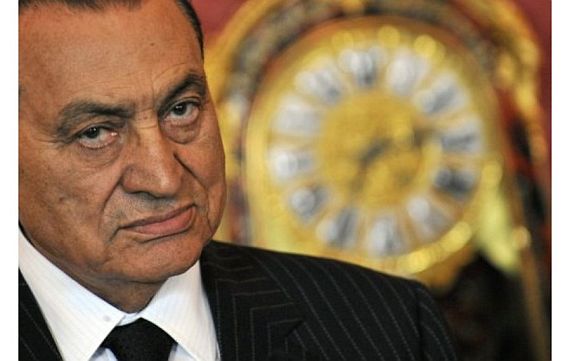
Will Hosni Mubarak travel to Germany as a patient as part of a graceful exit strategy for the Egyptian president? Plans for a possible hospital stay here appear to be more concrete than previously believed. SPIEGEL ONLINE has learned that a luxury clinic near Baden-Baden is being favored.
The United States government’s scenario for an end to the political chaos in Egypt appears to be this: President Hosni Mubarak travels to Germany for a “prolonged health check” that would offer the 82-year-old a dignified departure. Over the weekend, the New York Times reported that secret talks to that effect were being held between the US government and Egyptian military officials.
According to information obtained by SPIEGEL ONLINE, plans for a possible hospital stay in Germany are far more concrete than had been assumed so far. Talks are already being held with suitable hospitals, particularly with the Max-Grundig-Klinik Bühlerhöhe in the southwestern town of Bühl near Baden-Baden, SPIEGEL ONLINE has learned from sources close to the clinic. The hospital management declined to comment.
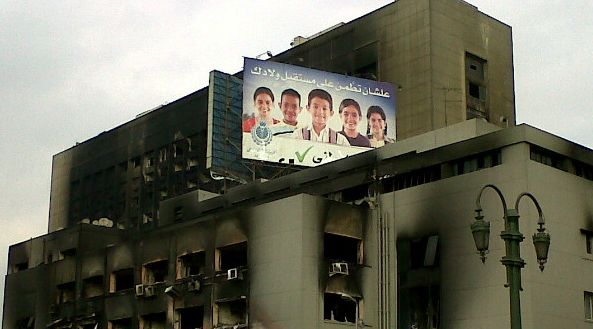
As Egypt’s government tries to minimize the importance of the protests, Girish Juneja, a producer for Britain’s Channel 4 News in Cairo, spotted a remarkable symbol of the ruling National Democratic Party’s determination to hang on to power on Monday. The burned-out ruins of the party’s headquarters in Cairo, which was torched during clashes 10 days ago, is now adorned with a sunny new political poster, calling on Egyptians to rally to the N.D.P. “to ensure the future of your children.”
Al Jazeera’s Ayman Mohyeldin describes his experience while held in detention yesterday by the Egyptian military:
The following video shows Egypt’s much-feared secret police in operation on January 26, the day after the first mass protests took place. At 1 minute 15 seconds into the report a gang of plain-clothes policemen can be seen advancing towards protesters. An individual, who would appear to have been a marked man, is dragged out of the crowd and bundled away.
Some observers believe this to have been Wael Ghonim, the Google executive and prominent Egyptian activist who was reported missing the next day and who has just been released.
Meanwhile, Al Jazeera has released footage showing unarmed protesters being shot, apparently by the Egyptian army and police.
As the saying goes, a man is known by the company he keeps. President Obama’s choice of Frank Wisner as his special envoy to Cairo shows that corruption has become so deeply institutionalized in Washington that it cannot be exposed — it is so commonplace, so much regarded as an inherent dimension of politics that politics and corruption are indivisible. The fact that bundles of unmarked bills in brown paper bags are rarely exchanged for political services is not evidence of a clean political system. On the contrary: it is evidence that corruption has been legalized.
Frank Wisner, President Barack Obama’s envoy to Cairo who infuriated the White House this weekend by urging Hosni Mubarak to remain President of Egypt, works for a New York and Washington law firm which works for the dictator’s own Egyptian government.
Mr Wisner’s astonishing remarks – “President Mubarak’s continued leadership is critical: it’s his opportunity to write his own legacy” – shocked the democratic opposition in Egypt and called into question Mr Obama’s judgement, as well as that of Secretary of State Hillary Clinton.
The US State Department and Mr Wisner himself have now both claimed that his remarks were made in a “personal capacity”. But there is nothing “personal” about Mr Wisner’s connections with the litigation firm Patton Boggs, which openly boasts that it advises “the Egyptian military, the Egyptian Economic Development Agency, and has handled arbitrations and litigation on the [Mubarak] government’s behalf in Europe and the US”. Oddly, not a single journalist raised this extraordinary connection with US government officials – nor the blatant conflict of interest it appears to represent.
Mr Wisner is a retired State Department 36-year career diplomat – he served as US ambassador to Egypt, Zambia, the Philippines and India under eight American presidents. In other words, he was not a political appointee. But it is inconceivable Hillary Clinton did not know of his employment by a company that works for the very dictator which Mr Wisner now defends in the face of a massive democratic opposition in Egypt.
So why on earth was he sent to talk to Mubarak, who is in effect a client of Mr Wisner’s current employers?
Patton Boggs states that its attorneys “represent some of the leading Egyptian commercial families and their companies” and “have been involved in oil and gas and telecommunications infrastructure projects on their behalf”. One of its partners served as chairman of the US-Egyptian Chamber of Commerce promoting foreign investment in the Egyptian economy. The company has also managed contractor disputes in military-sales agreements arising under the US Foreign Military Sales Act. Washington gives around $1.3bn (£800m) a year to the Egyptian military.
Mr Wisner joined Patton Boggs almost two years ago – more than enough time for both the White House and the State Department to learn of his company’s intimate connections with the Mubarak regime. The New York Times ran a glowing profile of Mr Wisner in its pages two weeks ago – but mysteriously did not mention his ties to Egypt.
Nicholas Noe, an American political researcher now based in Beirut, has spent weeks investigating Mr Wisner’s links to Patton Boggs. Mr Noe is also a former researcher for Hillary Clinton and questions the implications of his discoveries.
“The key problem with Wisner being sent to Cairo at the behest of Hillary,” he says, “is the conflict-of-interest aspect… More than this, the idea that the US is now subcontracting or ‘privatising’ crisis management is another problem. Do the US lack diplomats?
“Even in past examples where presidents have sent someone ‘respected’ or ‘close’ to a foreign leader in order to lubricate an exit,” Mr Noe adds, “the envoys in question were not actually paid by the leader they were supposed to squeeze out!”
While the rationalization provided by so-called political realism ascribes US support for Mubarak to the need for “stability” in an unstable region, he also belongs to the class of leaders America has always preferred to support: those unburdened by ideological affiliations whose insatiable greed makes them dependable US allies. In other words, the US government likes rulers who are so rotten they can be trusted — which is to say, trusted to serve US interests.
What does this tell us about American values and the American view of the world?
That every man can be bought — it’s just a matter of finding the right price.
It’s not a mentality one would hope to find in the cradle of modern democracy but hardly surprising to be seen prevailing in a nation built on slavery.
There is of course nothing uniquely American in this mentality — it’s the way imperial powers have always extended their reach, but as Barack Obama said on the day of his inauguration, “the world has changed and we must change with it.”
Indeed. But, if his response to the Egyptian revolution provides a reliable measure, we have yet more evidence this president lacks the will to become the agent of such change.
There is a lot more behind Hosni Mubarak digging in his heels and setting his thugs on the peaceful protests in Cairo’s Tahrir Square than pure politics. This is also about money. Mubarak and the clique surrounding him have long treated Egypt as their fiefdom and its resources as spoils to be divided among them.
Under sweeping privatisation policies, they appropriated profitable public enterprises and vast areas of state-owned lands. A small group of businessmen seized public assets and acquired monopoly positions in strategic commodity markets such as iron and steel, cement and wood. While crony capitalism flourished, local industries that were once the backbone of the economy were left to decline. At the same time, private sector industries making environmentally hazardous products like ceramics, marble and fertilisers have expanded without effective regulation at a great cost to the health of the population.
A tiny economic elite controlling consumption-geared production and imports has accumulated great wealth. This elite includes representatives of foreign companies with exclusive import rights in electronics, electric cables and automobiles. It also includes real estate developers who created a construction boom in gated communities and resorts for the super-rich. Much of this development is on public land acquired at very low prices, with no proper tendering or bidding.
Much has been made of the role of the internet and social media in the revolutions in Tunisia and Egpyt, but even more potent has been the human voice, unmediated, led in chants.
This video, posted on January 15, was taken at a protest by political opposition activists and citizens at the Press Syndicate in down town, Cairo. The most prominent chant was “revolution revolution until victory, revolution in Tunisia, and revolution in Egypt!”
Philip Rizk, describing the following video, writes: “Following Friday prayers on January 28 we joined protesters marching through the streets of Imbaba in Cairo, Egypt. The crowd of 100 that we joined kept increasing and continuously joined with other marches in the same quarter North West of downtown Cairo. By about 1pm the protesters numbered around 15,000 marching towards Galaa Square and attempting to get across the Nile to Tahrir Square, downtown Cairo.”
In a video posted on YouTube yesterday, protesters chanted: “Hosni has gone mad. Condoleeza, Condoleeza, find Mubarak a visa.”
“Oh Mubarak get lost. Let the nation see the light.”
Girl leading chants at Tahrir Square:
Boy leading chants:
“We’ll come tomorrow, and bring our friends! The day after that we’ll bring our neighbors.”
Egypt’s new vice president, Omar Suleiman, has long sought to demonize the opposition Muslim Brotherhood in his contacts with skeptical U.S. officials, leaked diplomatic cables show, raising questions whether he can act as an honest broker in the country’s political crisis.
U.S. Embassy messages from the anti-secrecy WikiLeaks cache of 250,000 State Department documents, which Reuters independently reviewed, also report that the former intelligence chief accused the Brotherhood of spawning armed extremists and warned in 2008 that if Iran ever backed the banned Islamist group, Tehran would become “our enemy.”
The disclosure came as Suleiman met on Sunday with opposition groups, including the officially banned Brotherhood, to explore ways to end Egypt’s worst political crisis decades.
Meanwhile, Channel 4 News reported on today’s protests in Tahrir Square:
In his novel The Autumn of the Patriarch, Gabriel Garcia Marquez outlines the behaviour of a dictator under threat and his psychology of total denial. In his glory days, the autocrat believes he is a national hero. Faced with rebellion, he blames “foreign hands” and “hidden agendas” for this inexplicable revolt against his benevolent but absolute rule. Those fomenting the insurrection are “used and manipulated by foreign powers who hate our country”. Then – and here I use a precis of Marquez by the great Egyptian author Alaa Al-Aswany – “the dictator tries to test the limits of the engine, by doing everything except what he should do. He becomes dangerous. After that, he agrees to do anything they want him to do. Then he goes away”.
Hosni Mubarak of Egypt appears to be on the cusp of stage four – the final departure. For 30 years he was the “national hero” – participant in the 1973 war, former head of the Egyptian air force, natural successor to Gamal Abdel Nasser as well as Anwar Sadat – and then, faced with his people’s increasing fury at his dictatorial rule, his police state and his torturers and the corruption of his regime, he blamed the dark shadow of the country’s fictional enemies (al-Qa’ida, the Muslim Brotherhood, al-Jazeera, CNN, America). We may just have passed the dangerous phase.
Twenty-two lawyers were arrested by Mubarak’s state security police on Thursday – for assisting yet more civil rights lawyers who were investigating the arrest and imprisonment of more than 600 Egyptian protesters. The vicious anti-riot cops who were mercifully driven off the streets of Cairo nine days ago and the drug-addled gangs paid by them are part of the wounded and dangerous dictator’s remaining weapons. These thugs – who work directly under ministry of interior orders – are the same men now shooting at night into Tahrir Square, killing three men and wounding another 40 early on Friday morning. Mubarak’s weepy interview with Christiane Amanpour last week – in which he claimed he didn’t want to be president but had to carry on for another seven months to save Egypt from “chaos” – was the first hint that stage four was on the way.
Political analysis prefers to suspend psychological analysis. The fact that we cannot know what’s going on inside Mubarak’s mind right now is turned into a reason for treating his thoughts and feelings as in some way peripheral to the unfolding events — yet of course they are central.
There is a pathological trend in most forms of acquisition of power — a tendency through which those who acquire power see inequity as the reflection of a natural order; an order that implies forms of consent where no such consent actually exists.
Mubarak has come to identify himself as the father of Egypt and to react to a people’s revolt by claiming that it is the result of foreign agitation. This is not simply a political ploy; it is an unwillingness to accept the legitimacy of a face of Egypt which invalidates Mubarak’s conception of himself and of the country he rules. To the extent that he has witnessed an uprising (and one must wonder exactly what picture he has had, since it seems unlikely he’s been watching Al Jazeera), he has struggled to see this as a reflection of the will of the Egyptian people.
For Mubarak to resign, rather than be forced out of power, would require a radical reshaping of his own identity — something that happens rarely if at all in an individual’s life, least of all at an age where the mind and heart have in so many ways become rigid.
Maybe my judgment is skewed because pro-Mubarak thugs tried to hunt down journalists, leading some of us to be stabbed, beaten and arrested — and forcing me to abandon hotel rooms and sneak with heart racing around mobs carrying clubs with nails embedded in them. The place I felt safest was Tahrir Square — “free Egypt,” in the protesters’ lexicon — where I could pull out a camera and notebook and ask anybody any question.
I constantly asked women and Coptic Christians whether a democratic Egypt might end up a more oppressive country. They invariably said no — and looked so reproachfully at me for doubting democracy that I sometimes retreated in embarrassment.
“If there is a democracy, we will not allow our rights to be taken away from us,” Sherine, a university professor, told me (I’m not using full names to protect the protesters). Like many, she said that Americans were too obsessed with the possibility of the fundamentalist Muslim Brotherhood gaining power in elections.
“We do not worry about the Muslim Brotherhood,” Sherine said. “They might win 25 percent of the votes, but if they do not perform then they will not get votes the next time.”
Sherine has a point. Partly because of Western anxieties, fundamentalist Muslims have rarely run anything — so instead they lead the way in denouncing the corruption, incompetence and brutality of pro-Western autocrats like Mr. Mubarak. The upshot is that they win respect from many ordinary citizens, but my hunch is that they would lose support if they actually tried to administer anything.
For example, in 1990s Yemen, an Islamic party named Islah became part of a coalition government after doing well in elections. As a result, Islah was put in charge of the Education Ministry. Secular Yemenis and outsiders were aghast that fundamentalists might brainwash children, but the Islamists mostly proved that they were incompetent at governing. In the next election, their support tumbled.
It’s true that one of the most common protester slogans described Mr. Mubarak as a stooge of America, and many Egyptians chafe at what they see as a supine foreign policy. I saw one caricature of Mr. Mubarak with a Star of David on his forehead and, separately, a sign declaring: “Tell him in Hebrew, and then he might get the message!” Yet most people sounded pragmatic, favoring continued peace with Israel while also more outspoken support for Palestinians, especially those suffering in Gaza.
I asked an old friend here in Cairo, a woman with Western tastes that include an occasional glass of whiskey, whether the Muslim Brotherhood might be bad for peace. She thought for a moment and said: “Yes, possibly. But, from my point of view, in America the Republican Party is bad for peace as well.”
Little does she seem to know: the Democratic Party is no better.
Let the Islamists share in governance — then they’ll lose their popularity.
It’s easy to see why this argument appeals to many an American liberal. Strangely, an equally persuasive argument — let them govern, they might govern well — has yet to gain any traction, at least in the US.
But look at Turkey. Are we supposed to believe that the success of the AKP has come in spite of them being Islamists, or, is it possible that lack of corruption presents such a stark contrast with politics-as-usual that the success of the Islamists has more to do with their integrity than anything else.
If the contest is not between Sharia and democracy, but between integrity and corruption, shouldn’t we be rooting for integrity, irrespective of the banner it might carry?
[T]he Brotherhood said earlier this week that it would recognize all of Egypt’s international treaties, a thinly veiled reference to the country’s longtime peace agreement with Israel.
To many observers, the reference signaled a willingness by the Brotherhood to negotiate with Western powers. Still, the Brotherhood eventually would like to put Egypt’s pact with Israel on the ballot in a national referendum, which would all but assure its rejection.
Israeli leaders have long professed the desire for peaceful relations with all their neighbors — as though the Egyptian people and the Jordanian people counted for nothing, Mubarak and King Abdullah being the sole peace contractors.
The fictitious peace that may soon be in jeopardy has merely been secured by American bribery, without the consent of the American taxpayer. Shouldn’t we be demanding a real peace and shouldn’t Israelis want such a peace — one that does not hinge on the “stability” of dictatorial rule?
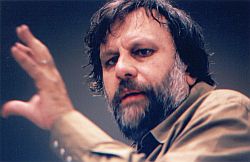
Many American academics and pundits from thinktankland should study the way Slavoj Žižek expresses himself. Passionate, emphatic, uninhibited, eccentric, and humorous — above all, a man who knows what it means to speak your mind. This is a display that shows that deep analysis does not need the protection of cover-your-ass-caveats or manicured sobriety. It can be an act of genuine self-expression.
The pre-condition though is that to speak your mind, you must know your mind and that is a dangerous enterprise.
In relation to Žižek’s central point — that the loss of the Left has come at a hefty price — it’s worth considering the pernicious influence of the sporting metaphor as it shapes American political thinking. Which is to say: the effect of the assumption that that which is defeated must by its nature be inferior; that those who lose are lesser. Guided by such thinking, we would have no reason to be concerned about the loss of species or the loss of cultures. As though the perfect condition would be one of victorious homogeneity.
And note: if democracy was by its nature something truly Western, would we now witness so much Western ambivalence about the birth of Egyptian democracy? On the contrary, the West’s ambivalence exposes the degree to which universal and socialist values have been marginalized in the West. As though we should have reason to doubt that human solidarity is a good thing.
Mubarak, when he stands down, is not likely to be missed by many people in Egypt, where he has pledged to spend his last days, but he will be missed in Washington and, above all, in Tel Aviv. Mubarak and Omar Suleiman, now the interim vice president, worked closely with Israel on everything from the Gaza blockade to intelligence-gathering; they allowed Israeli warships into the Suez Canal to prevent weapons smuggling into Gaza from Sudan, and did their best to stir up tensions between Fatah and Hamas. The Egyptian public is well aware of this intimate collaboration, and ashamed of it: democratisation could spell its end. A democratic government isn’t likely to abolish the peace treaty with Israel – even some of the leaders of the Muslim Brotherhood have said they would respect it. But Egyptian foreign policy would be set in Cairo rather than in Washington and Tel Aviv, and the cold peace would grow colder. A democratic government in Cairo would have to take public opinion into account, much as Erdogan’s government does in Turkey: another former US client state but one that, in marked contrast to Egypt, has escaped American tutelage, made the transition to democracy under an Islamist government, and pursued an independent foreign policy that is widely admired in the Muslim world. If Egypt became a democracy, it might work to achieve Palestinian unity, open up the crossing from Gaza and improve relations with Iran and Hizbullah: shifts which would be anathema to Israel.
Meanwhile, the New York Times reports on the Obama administration’s latest moves to back Mubarak II: Egypt’s torture chief, Omar Suleiman:
The United States and leading European nations on Saturday threw their weight behind a gradual transition in Egypt, backing attempts by the country’s vice president, Omar Suleiman, to negotiate with opposition groups without immediately removing President Hosni Mubarak from power.
The strong endorsement came as Mr. Suleiman, a longtime security official and confidante of Mr. Mubarak, told opposition leaders that he would not press his boss to resign before September and ruled out any delegation of Mr. Mubarak’s power, central demands of the opposition.
Mr. Mubarak’s ruling party then announced a shake-up that removed its old guard, including his son Gamal, while installing younger, more reform-minded figures as a modest gesture to protesters.
The moves amounted to a rebuff to protesters who have posed the most serious challenge to the nearly three-decade rule of Mr. Mubarak, a pillar of the American-backed order in the Middle East.
Hundreds of thousands of demonstrators have demanded faster and more sweeping changes to the military-dominated government that has relied on an ossified ruling party, police, and a powerful clique of businessmen at the center of power.
By emphasizing the need for a gradual transition, only days after emphasizing that change there must begin immediately, the Obama administration was viewed as shifting away from protesters in the streets and toward stronger backing for Mr. Mubarak’s hand-picked elite.
There is a vast repositioning taking place in elite Egyptian politics. Just an hour ago or so it was announced that Hosni and Gamal Mubarak had resigned from their positions in the NDP (chairman and deputy sec-gen / head of Policies Committee respectively), as had Safwat al-Sherif (formerly Secretary General). You can see the old structure in the chart I put up a few days ago. Moufid Shehab has also lost his position, as has Zakariya Azmi (crucially, Mubarak’s longstanding chief of staff). No doubt we’ll hear of more.
This is a game of musical chairs to install a new political elite, some of which will be those who survived the old one. The new secretary-general of the NDP is Hossam Badrawy, once a enthusiastic backer of Gamal and MP between 2000-2005. Badrawy one was of the liberal, reformist NDPers who wanted to bring change from the inside. He was one of the most reasonable figures in the party and did not simply ignore problems like human rights. However, we was also associated with efforts at educational reform that bore little fruit and an attempt at a reform to the health sector that seemed to benefit his main business, private healthcare.
In part of the ongoing coup carried out by Omar Suleiman and his army buddies (with Mubarak remaining as a fig leaf so it is not seen as such) they need a new political class. Badrawy has class, money and social clout.
Hossam Bahgat and Soha Abdelaty, the executive director and deputy director of the Egyptian Initiative for Personal Rights, write:
Egypt’s constitution stipulates that if the president resigns or his office becomes permanently “vacant,” he must be replaced by the speaker of parliament or, in the absence of parliament, the chief justice of the Supreme Constitutional Court. In the event of the president’s temporary inability to exercise his prerogatives, the vice president is to take over as the interim head of state. In both cases a new president must be elected within 60 days. Significantly, the constitution prohibits the interim president from introducing constitutional amendments, dissolving parliament or dismissing the cabinet.
If today Mubarak were no longer available to fulfill his role as president, the interim president would be one of two candidates. If he chooses to leave the country, say for “medical reasons,” the interim president would be Omar Suleiman, the former intelligence chief who was recently made vice president. Egyptians, particularly those of us calling for an end to Mubarak’s three-decade rule, see Suleiman as Mubarak II, especially after the lengthy interview he gave to state television Feb. 3 in which he accused the demonstrators in Tahrir Square of implementing foreign agendas. He did not even bother to veil his threats of retaliation against protesters.
On the other hand, if Mubarak is pushed to resign immediately we would have an even worse interim president: Fathi Surur, who has been speaker of the People’s Assembly since 1990. Surur has long employed his legal expertise to maintain and add to the arsenal of abusive laws that Mubarak’s regime has used against the Egyptian people. Since neither Suleiman nor Surur would be able to amend the constitution during the interim tenure, the next presidential election would be conducted under the notoriously restrictive election rules Mubarak introduced in 2007. That would effectively guarantee that no credible candidate would be able to run against the interim president.
So before Mubarak resigns he must sign a presidential decree delegating all of his authorities to his vice president until their current terms end in September. Mubarak issued similar decrees, transferring his powers to the prime minister, when he was hospitalized in 2004 and 2009. In addition, Mubarak must issue decrees lifting the “state of emergency” that has allowed him to suppress Egyptians’ civil liberties since 1981 and ordering the release or trial of those held in administrative detention without charge – estimated to be in the thousands.
Also before Mubarak resigns, an independent commission of respected judges, constitutional law experts, civil society representatives and all political movements should draft language to amend the constitution to ensure that presidential elections are open to all credible candidates; that Egyptians abroad are allowed – for the first time – to vote; that any elected president is allowed to serve only two terms; and that the elections are supervised by judicial and civil monitors. Most of this will be a matter of undoing the damage Mubarak inflicted with his constitutional changes in 2007.
To be honest, while the path they highlight is clear and worth considering, I believe extra-constitutional means deserve to be considered to: suspend the current constitution and have a transition council, for instance.
Another path that would remain within the constitution is to use Article 139 to appoint more vice-presidents, each empowered to deal with various aspects of the situation: one to take the lead on constitutional reform, one to investigate the events of the past week, one to restore and reform the Ministry of Interior, etc. It would be a defacto Council of Wise Men (and hopefully at least one woman!)
“Enough we say, the decision belongs to the people of the brotherly Egyptian and Tunisian nations… Turkey shares the grief of these nations as well as their hopes.” So-declared a self-confident Turkish Prime Minister Recep Tayyip Erdogan on Tuesday in his prime-time speech on recent events in the Middle East that received broad coverage regionally. While commentators point to the protests and revolutions in the Arab world as being the most recent example of the crumbling vestiges of the Cold War, the more significant long-term global trend is strangely familiar to the Turks. Protests in Tunisia have already overthrown the rule of a 23 year-old regime and inspired a similar uprising in the form of Egypt’s ongoing protest movement. Lebanon’s continuing instability and threats of Tunisian-inspired revolutions in Yemen and even Jordan further add to the significance of the moment we are witnessing in the Arab world.
The unprecedented levels and inter-linkages of the protests against the traditional authoritarian regimes represented most starkly by President Mubarak, has brought the Middle East back to a period more reminiscent of the breakup of the Ottoman Empire and the rise of Arab nationalism than anything seen in recent memory.
The declarations and prognostications of analysts across the Arab world in the wake of these events has focused on the grassroots movements and pent-up resentments that led to the protests along with debates about the level of US involvement from twitter feeds to President Obama’s statements. However the effect of this on the regional dynamics that has ushered in the remarkable arrival of a new player to the game of Middle Eastern great-power politics and the sidelining of traditional players is equally important to pay attention to.
It is commonplace for historians to compare revolutions to earthquakes, but the metaphor remains powerful. The Egyptian revolution is much like an earthquake: its epicenter may be Cairo, but its shockwaves have reached all the way to Washington. Since the first crowds began to appear in Tahrir Square, the Egyptian trembler has so shaken the U.S. that small but perceptible cracks have begun to appear in the foundations of America’s Middle East policies — and in the comity of opinion that has guided U.S. views of the region for 60 years. The changes were first evidenced last week, when policymakers, pundits and government officials made the rounds of the Sunday morning television news shows.
When Secretary of State Hillary Clinton appeared on CNN, interviewer Candy Crowley was blunt: which side is the U.S. on — “Mubarak or the people in the streets?” she asked. Clinton laughed slightly, then rejected the question: “Well, there’s another choice, it’s the Egyptian people,” she said. “We are on the side, as we have been for more than 30 years, of a democratic Egypt that provides both political and economic rights of its people, that respects the universal human rights of all Egyptians.” Of course, Crowley knew (as we all knew) that if Clinton had been asked the same question just the week before, her answer would have been entirely different: that our friendship with Egypt is based on its peace treaty with Israel, its opposition to Iran and its hostility to political Islam.
The difference between the two answers is less a reflection of America’s Orwellian relationship with the truth (“we are on the side, as we have been for more than 30 years, of a democratic Egypt”), than it is of the Obama administration’s realization that a new constellation of leaders will soon take office in Cairo — and we’re going to have to deal with them, like it or not. Washington’s pro-Israel lobby is scrambling to reverse this view, because talking to a new set of leaders means talking to the Muslim Brotherhood — which might be bad for Israel. This was made clear on the same day that Hillary Clinton appeared on CNN.
“Let’s make Mubarak hear our voices. We all, one hand, requested one thing, leave leave leave…Down Down Hosny Mubarak, Down Down Hosny Mubarak.. The people want to dismantle the regime….He is to go, we are not going… He is to go, we won’t leave…. We all, one hand, ask one thing, leave leave.”
Egypt has been the second-largest recipient of U.S. foreign aid for decades, after Israel (not counting the funds expended on the wars and occupations of Iraq and Afghanistan). Mubarak’s regime has received roughly $2 billion per year since coming to power, overwhelmingly for the military.
Where has the money gone? Mostly to U.S. corporations. I asked William Hartung of the New America Foundation to explain:
“It’s a form of corporate welfare for companies like Lockheed Martin and General Dynamics, because it goes to Egypt, then it comes back for F-16 aircraft, for M-1 tanks, for aircraft engines, for all kinds of missiles, for guns, for tear-gas canisters [from] a company called Combined Systems International, which actually has its name on the side of the canisters that have been found on the streets there.”
Hartung just published a book, “Prophets of War: Lockheed Martin and the Making of the Military-Industrial Complex.” He went on: “Lockheed Martin has been the leader in deals worth $3.8 billion over that period of the last 10 years; General Dynamics, $2.5 billion for tanks; Boeing, $1.7 billion for missiles, for helicopters; Raytheon for all manner of missiles for the armed forces. So, basically, this is a key element in propping up the regime, but a lot of the money is basically recycled. Taxpayers could just as easily be giving it directly to Lockheed Martin or General Dynamics.”
Likewise, Egypt’s Internet and cell phone “kill switch” was enabled only through collaboration with corporations. U.K.-based Vodafone, a global cellular-phone giant (which owns 45 percent of Verizon Wireless in the U.S.) attempted to justify its actions in a press release: “It has been clear to us that there were no legal or practical options open to Vodafone … but to comply with the demands of the authorities.”
Narus, a U.S. subsidiary of Boeing Corp., sold Egypt equipment to allow “deep packet inspection,” according to Tim Karr of the media policy group Free Press. Karr said the Narus technology “allows the Egyptian telecommunications companies … to look at texting via cell phones, and to identify the sort of dissident voices that are out there. … It also gives them the technology to geographically locate them and track them down.”
This website or its third-party tools use cookies, which are necessary to its functioning. By closing this banner, you agree to the use of cookies.








 Many American academics and pundits from thinktankland should study the way Slavoj Žižek expresses himself. Passionate, emphatic, uninhibited, eccentric, and humorous — above all, a man who knows what it means to speak your mind. This is a display that shows that deep analysis does not need the protection of cover-your-ass-caveats or manicured sobriety. It can be an act of genuine self-expression.